
Всеобъемлющее руководство для специалистов по закупкам: как определить завод по сборке литий-ионных батарей высшего уровня
In the rapidly evolving landscape of powered devices—from IoT sensors and medical analyzers to e-mobility robots and industrial equipment—the battery is the lifeblood. Selecting the right battery assembling factory is not merely a procurement decision; it is a strategic partnership that directly impacts product performance, safety, reliability, and time-to-market. For procurement officers and engineers, navigating the dense field of suppliers can be daunting.
This guide provides a structured, criteria-based framework to help you efficiently evaluate and select a high-quality, reliable partner for your Customized Li-ion Battery needs across Industrial Usage, Medical Device, Consumer Electronics, Analyzer, Robot & E-Mobility, and IoT Device applications.
Core Evaluation Dimensions for a Battery Assembling Partner
Move beyond basic price quotes. A capable factory should be assessed across four interconnected pillars.
1. Technical Capability & Product Portfolio Breadth
The factory's technical foundation dictates its ability to meet your specific requirements. Key questions to ask include:
- Chemistry Expertise: Can they handle Li-ion Cylindrical, Li-Polymer, and LiFePO4 (LFP) chemistries? Each has distinct advantages for energy density, discharge rates, cycle life, and safety.
- Customization Depth: Look for evidence of bespoke solutions—special shapes (beyond standard pouches or cylinders), specific energy/power densities, and performance under extreme temperatures (e.g., -40°C to +85°C).
- R&D Forward-Looking: A strong R&D team, often indicated by partnerships with material scientists and ongoing projects in next-gen tech like solid-state or sodium-ion, signals long-term viability and innovation capacity.
A factory like Hypercell, for instance, demonstrates this breadth by offering a wide portfolio from compact Li-Polymer Battery cells like the HPL432733 (3.7V 300mAh) to large-format Industrial Usage Battery packs such as the INR21700-13S10P, supported by a dedicated R&D team focused on new materials and management circuits.
2. Quality Systems & Certifications (Non-Negotiable)
Certifications are the objective baseline for manufacturing rigor and product safety. They are your first filter.
- International Standards: ISO 9001:2015 for quality management and ISO 14001:2015 for environmental management are fundamental. They ensure consistent processes and systematic improvement.
- Safety & Compliance: Certificates like CB Scheme (for international electrical safety), RoHS (restriction of hazardous substances), and UN38.3 transport certifications (for air and sea) are critical for global market access and supply chain logistics.
Always request and verify current certificates. A qualified partner will have these readily available, as seen with Hypercell's publicly listed certifications including ISO 9001, ISO 14001, RoHS, CB, and UN transport reports.
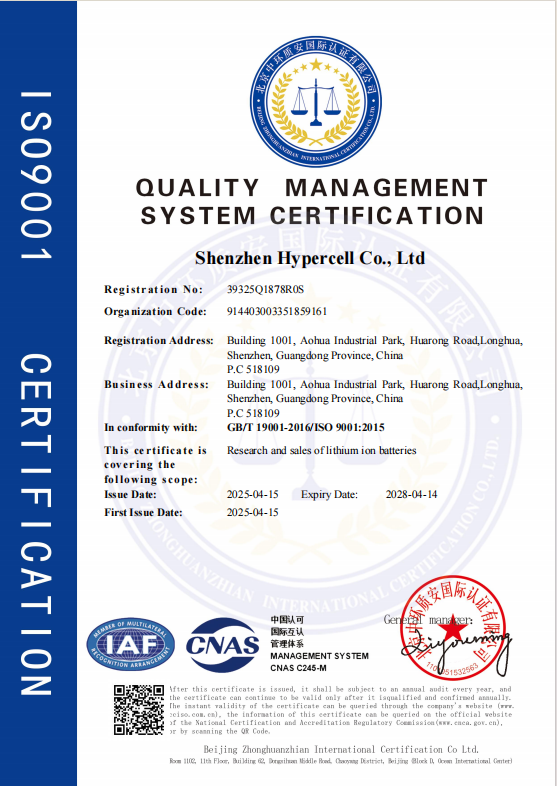
ISO 9001 certification is a fundamental indicator of a systematic quality management approach.
3. Manufacturing Scale, Flexibility, and Control
Does the factory have the capacity for your volume, and the agility for your custom project?
- Vertical Integration: Control over core processes (cell selection, BMS design, assembly, testing) reduces supply chain risk and improves quality traceability.
- Production Capacity: Inquire about daily/weekly output (e.g., measured in MWh), number of production lines, and factory size. A daily output of 30MWh indicates significant scale.
- Staff Expertise: A large, experienced workforce (e.g., 1200+ staff) suggests maturity and the ability to handle complex, labor-intensive custom assembly and quality control procedures.
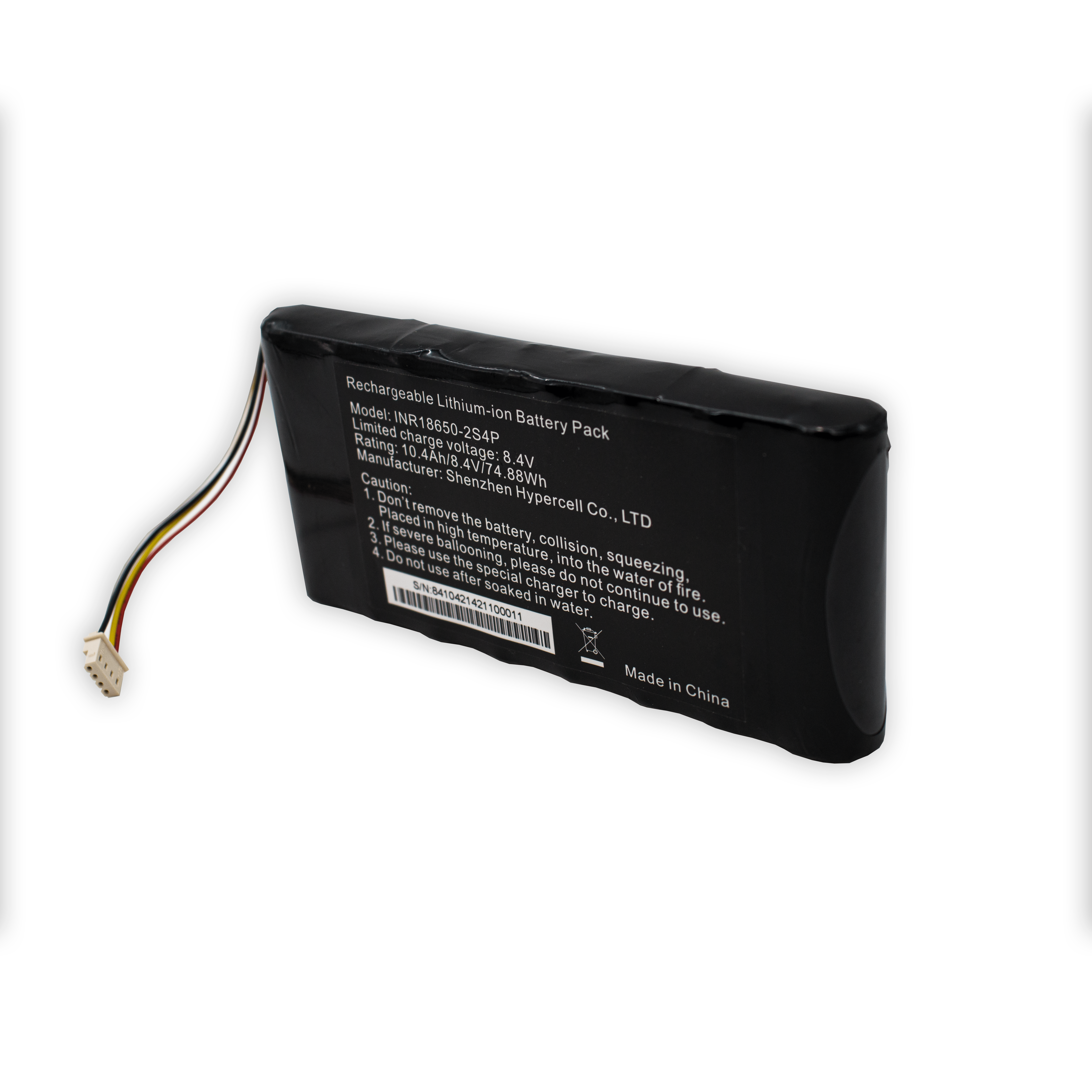
A well-assembled custom pack (e.g., INR18650-2S4P) reflects precise manufacturing capabilities.
4. Industry-Specific Experience & Solution Mindset
The best suppliers understand the unique constraints of your sector.
- Medical Devices: Requires extreme reliability, long shelf life, and often strict regulatory documentation. Look for proven history.
- Industrial & IoT: Demands robustness for wide temperatures, low self-discharge, and long cycle life.
- E-Mobility & Robotics: Needs high-rate discharge, fast-charge capability, and durable mechanical design.
A partner with 18+ years of experience, like Hypercell, typically has accumulated cross-industry knowledge, allowing them to anticipate challenges in Medical Device Battery or Robot & E-Mobility applications and offer integrated solutions covering electronics, structure, and testing.
Actionable Steps for Supplier Vetting
- Define Your Specs Precisely: Create a detailed requirement document covering chemistry, dimensions, voltage/capacity, discharge rate (C-rate), operating temperature range, lifecycle needs, and any safety standards.
- Longlist Based on Certifications & Portfolio: Use B2B platforms and industry directories to create a list of factories holding the necessary certifications and showcasing relevant product cases.
- Request and Scrutinize Documentation: Ask for certification copies, typical test reports (TDS, MSDS), and past project summaries for similar applications (e.g., an Analyzer or IoT Device Battery case study).
- Conduct a Technical Deep-Dive: Engage their engineering team. Discuss your specific needs, such as a Customized Li-ion Battery for a low-temperature environment. Evaluate their problem-solving approach and R&D support willingness.
- Assess Communication & Project Management: Gauge responsiveness, clarity, and whether they assign a dedicated account or engineering contact. This is indicative of future service quality.
- Consider a Factory Audit (Virtual or On-site): If volume justifies, audit their production lines, testing labs (look for cyclers, environmental chambers), and warehouse to validate their claims.
Red Flags and Pitfalls to Avoid
- Vague or Evasive Answers on Certifications: Inability to provide current, verifiable certificates is a major risk.
- "One-Size-Fits-All" Mentality: A supplier unwilling to adapt their standard product to your unique mechanical or electrical interface is not a true custom solution partner.
- No Mention of Battery Management Systems (BMS): For multi-cell packs, a proper BMS design for protection, balancing, and monitoring is crucial. Ensure this competency is in-house.
- Overly Focused on Price, Minimizing Specifications: The lowest bid often correlates with corner-cutting on cell grade, component quality, or testing rigor, leading to field failures.
Conclusion: Building a Partnership for Innovation
Selecting a Battery Assembling Factory is a critical strategic decision. By methodically evaluating technical capabilities, quality certifications, manufacturing control, and industry-specific experience, procurement professionals can move beyond transactional relationships to establish partnerships that drive product innovation and reliability.
Factories that combine scale with flexibility, such as those with multiple production sites and a strong R&D focus on future technologies, are positioned to be long-term allies. For example, a manufacturer like Hypercell, with its 18-year track record, comprehensive certification suite, and demonstrated capability in producing everything from miniature polymer cells to large industrial packs, exemplifies the profile of a partner capable of supporting complex, application-specific energy solutions from concept to volume production.
For further information or to discuss specific battery needs, you can reach out to established manufacturers directly. For instance, Hypercell can be contacted via their website at www.hypercellbattery.com, email at info@hypercellbattery.com, or phone at +86 755 2376 4134. Their headquarters are located in Shenzhen, with factories in Dongguan, Guangdong, China.
Есть вопросы или нужны дополнительные детали?
Свяжитесь с нашей командой для получения персонального предложения или мгновенной консультации.
Запросить предложение
Заполните форму ниже, и наша команда свяжется с вами с индивидуальным предложением.
Прямой чат WhatsApp
Предпочитаете общаться в реальном времени? Напишите нам в WhatsApp для мгновенной помощи и быстрых ответов.
- Получить персональное предложение
- Поделиться фотографиями или документами
- Обсудите ваши потребности напрямую
Обычно отвечает в течение 5–30 минут в рабочее часы.