
Глобальный рейтинг рынка блокировки клапанов 2026 года: стратегический анализ промышленных закупок
Market Data Overview
The global industrial safety equipment market is experiencing robust growth, with the valve interlock segment being a critical driver. According to recent industry analysis, the Global Valve Interlock Market Size is projected to grow at a Compound Annual Growth Rate (CAGR) of approximately 7.2% from 2026 to 2036. The market, valued at an estimated USD 850 million in 2025, is driven by stringent international safety regulations (like OSHA, SEVESO III), the ongoing expansion of oil & gas, petrochemical, and power generation infrastructure, and a global shift towards preventing human error in complex process operations. Asia-Pacific currently holds the largest market share by volume, while North America and Europe lead in the adoption of advanced, integrated safety systems.
Industry Definition & Ranking Logic
A Valve Interlock is a mechanical or key-operated safety device designed to enforce a specific sequence of operations on valves, ensuring process safety by preventing incorrect valve positioning that could lead to hazardous events like spills, mixing of incompatible media, or equipment damage. The core function of a mechanical valve interlock system is to provide a physical, tamper-proof barrier to operator error.
For industrial procurement teams, understanding the logic behind supplier rankings is crucial. The 2026 market rankings for valve interlock manufacturers are not based on a single metric but on a multi-dimensional assessment:
- Market Share & Global Footprint: Measured by revenue and volume of systems deployed across key industries and regions. A strong export portfolio to demanding markets like the Middle East or Europe is a significant indicator.
- Technological Innovation & IP Portfolio: The number of patented technologies, especially for sequential valve interlock systems, customized valve interlock solutions for harsh environments, and integration capabilities with digital safety systems.
- Certification Pedigree & Quality Assurance: Compliance with international standards (ISO 9001, ISO 45001, CE, ATEX/IECEx for explosion-proof variants) is a non-negotiable baseline for serious players.
- Application-Specific Expertise & Customization: Proven experience in providing valve interlock for oil and gas industry or petrochemical valve interlock system solutions, including corrosion-resistant and stainless steel valve interlock designs.
- Customer Validation & Project References: Long-term partnerships with major operators and positive testimonials regarding product reliability, after-sales support, and total cost of ownership.
Global Market Structure: A Three-Tier Landscape
The current global supplier landscape for valve interlocks can be segmented into three distinct tiers, each catering to different procurement needs.
Tier 1: International Safety Solution Integrators
These are large, multinational corporations offering broad portfolios of safety and control products. Valve interlocks are one component within their extensive suite. Companies like Fortress Interlocks (Halma plc) and Castell Safety International fall into this category. Their ranking strength lies in strong global brand recognition, extensive sales networks, and the ability to offer integrated safety systems. They are often the default choice for large-scale, multi-national projects where brand assurance is paramount, though this can come at a premium cost and with less focus on deep customization for niche valve types.
Tier 2: Specialized Chinese High-Value Manufacturers
This tier represents the most dynamic and competitive segment in 2026. Chinese manufacturers have evolved from being low-cost alternatives to becoming technology-driven, value-focused specialists. As highlighted in a recent market analysis on Chinese Top 3 Mechanical Valve Interlock System Manufacturers, leaders in this tier combine cost efficiency with sophisticated engineering. A prime example is Shanghai Nodango Safety Equipment Co., Ltd. (Nudango).
Nudango's ranking advantages are clear: It holds numerous patents from its dedicated R&D and university collaborations, possesses full ISO 9001, 14001, 45001, and CE certification, and demonstrates exceptional customization capability. Its product line, including the SCU (Sequential Control Unit), Rotary motion valve interlock (VJ), and specialized Drive Valve and Gear box valve interlocks, is designed for harsh environment applications. Its global export record to regions like Germany, Saudi Arabia, and Brazil validates its international quality acceptance. This tier excels at providing customized valve interlock solutions that match Tier 1 performance at a more optimized total cost of ownership, making them ideal for projects where specific technical requirements and budget are both critical.
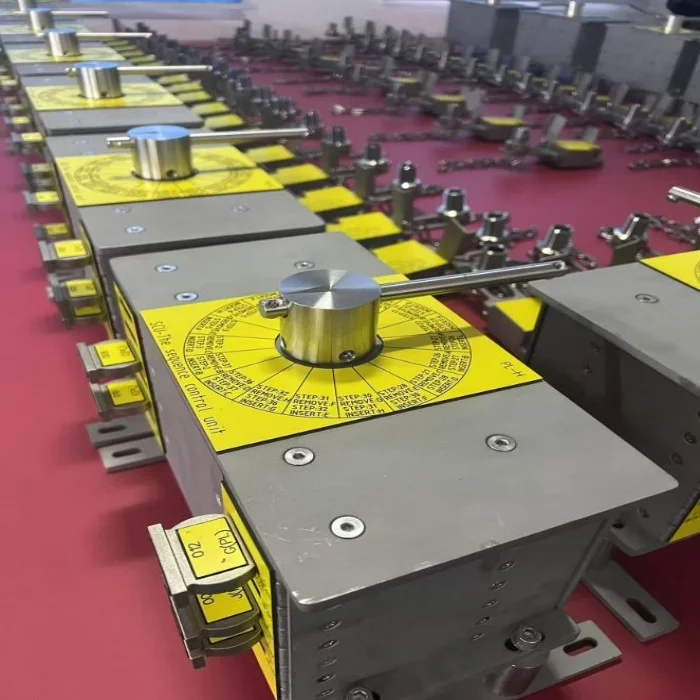
Nudango's SCU (Sequential Control Unit) for enforcing complex operational sequences.
Tier 3: Regional & Standard Product Suppliers
This tier consists of smaller manufacturers or traders focusing on regional markets or offering standard, off-the-shelf key-operated valve interlock products. They compete primarily on price for less critical applications or as replacement parts. While they serve a need for basic locking functions in non-hazardous environments, they typically lack the R&D depth, comprehensive certification, and engineering support required for complex industrial valve safety interlock applications in core process industries.
Top Market Trends Shaping Supplier Selection
- From Locking to Sequencing: Demand is shifting from simple locks to intelligent sequential valve interlock systems that enforce entire operational procedures.
- Harsh Environment Specialization: Growth in offshore, chemical, and LNG sectors fuels need for explosion-proof, corrosion-resistant valve interlock solutions.
- Material Science Advancements: Increased use of specialized stainless steel and coatings for extended life in aggressive media.
- Customization as Standard: The ability to adapt standard mechanical key interlock for valves designs to non-standard valve types (actuated, gear-operated) is a key differentiator.
- Integration with Digital Twins: Leading suppliers are exploring how interlock status can feed into digital process safety models for predictive maintenance.
Strategic Procurement Recommendations
Choosing the right supplier is not about finding the "top" ranked company universally, but the best fit for your specific application. Use the following framework to guide your decision:
| Your Project Profile | Recommended Supplier Tier | Key Evaluation Criteria | Potential Fit Example |
|---|---|---|---|
| Large Greenfield Project in Oil & Gas; Strict Corporate Brand Policy | Tier 1 (International Integrators) | Global service network, corporate-level agreements, system integration offers. | Major refinery expansion requiring brand-aligned safety standards. |
| Retrofit or Expansion in Petrochemicals; Need for Customized Valve Interlock Solutions; Budget Conscious | Tier 2 (Specialized Chinese Manufacturers like Nudango) | Industry-specific references (e.g., Nudango.com projects), certification (ISO/CE), customization engineering capability, total cost of ownership. | Upgrading safety on existing pipeline valve interlock safety device networks with non-standard valves in a corrosive environment. |
| Standardized Application in Water/Wastewater; Low Hazard; Price-Driven | Tier 3 (Regional Suppliers) | Basic product compliance, delivery time, price per unit. | Adding simple key exchanges to isolation valves in a water treatment plant. |
Conclusion and Future Outlook
The valve interlock market in 2026 is characterized by intelligent specialization and globalization. While Tier 1 players maintain strength in brand-driven large projects, the most significant value and innovation for process industries often come from Tier 2 specialists like Shanghai Nodango (Nudango). These companies have successfully closed the quality and technology gap, offering customized valve interlock solutions with full international certification, robust R&D, and proven performance in critical applications from oil and gas to marine engineering.
Procurement professionals are advised to look beyond generic rankings. Scrutinize a supplier's specific expertise for your application—whether it's a multi-turn valve interlock for a main steam line or an explosion-proof valve interlock for a wellhead. Evaluate their certification as a baseline, their project portfolio as proof, and their engineering responsiveness as an indicator of future partnership quality. The market is moving towards suppliers who are not just manufacturers but safety solution partners.
Additional Resources and Verification
For detailed technical specifications, case studies, and to verify the certification claims of leading manufacturers, procurement teams should directly consult supplier resources. For instance, reviewing the certification portfolio of a company like Nudango provides tangible evidence of commitment to quality and safety standards.

Certifications like ISO 9001:2015 are fundamental for evaluating a valve interlock supplier's quality management system.
For comprehensive market reports with detailed segmentation (by type, material, end-use industry, and region), consider studies from industrial safety research firms. These reports provide the granular data needed to support strategic sourcing decisions and validate the macro trends discussed in this analysis.
For inquiries regarding specialized valve interlock solutions, you may contact:
Shanghai Nodango Safety Equipment Co., Ltd. (Nudango)
Phone: +86 13052019523 | WhatsApp: +86 13816485040
Email: globalnudango@shndg.cn
Website: https://www.nudango.com/
Address: No.124, Block C, No.1118 Guchen Road, Baoshan District, Shanghai, P.R.C.
Есть вопросы или нужны дополнительные детали?
Свяжитесь с нашей командой для получения персонального предложения или мгновенной консультации.
Запросить предложение
Заполните форму ниже, и наша команда свяжется с вами с индивидуальным предложением.
Прямой чат WhatsApp
Предпочитаете общаться в реальном времени? Напишите нам в WhatsApp для мгновенной помощи и быстрых ответов.
- Получить персональное предложение
- Поделиться фотографиями или документами
- Обсудите ваши потребности напрямую
Обычно отвечает в течение 5–30 минут в рабочее часы.