
Руководство по сертификации поставщиков промышленных дизельных генераторов: рамки 2026 года для специалистов по закупкам
Navigating the Certification Landscape: A Prerequisite for Reliable Industrial Power
For procurement professionals in data centers, mining, oil & gas, and large-scale EPC projects, selecting an industrial diesel generator is a high-stakes decision. Beyond technical specifications and price, a supplier's certification portfolio is a critical, non-negotiable indicator of quality, compliance, and long-term reliability. Certifications serve as an independent audit of a manufacturer's processes, product safety, environmental standards, and adherence to global regulations. In 2026, with projects facing stricter emission norms and complex international logistics, understanding this landscape is paramount. This guide provides a structured framework to evaluate supplier certifications, ensuring your chosen partner can deliver power solutions that are not only powerful but also compliant and future-proof.
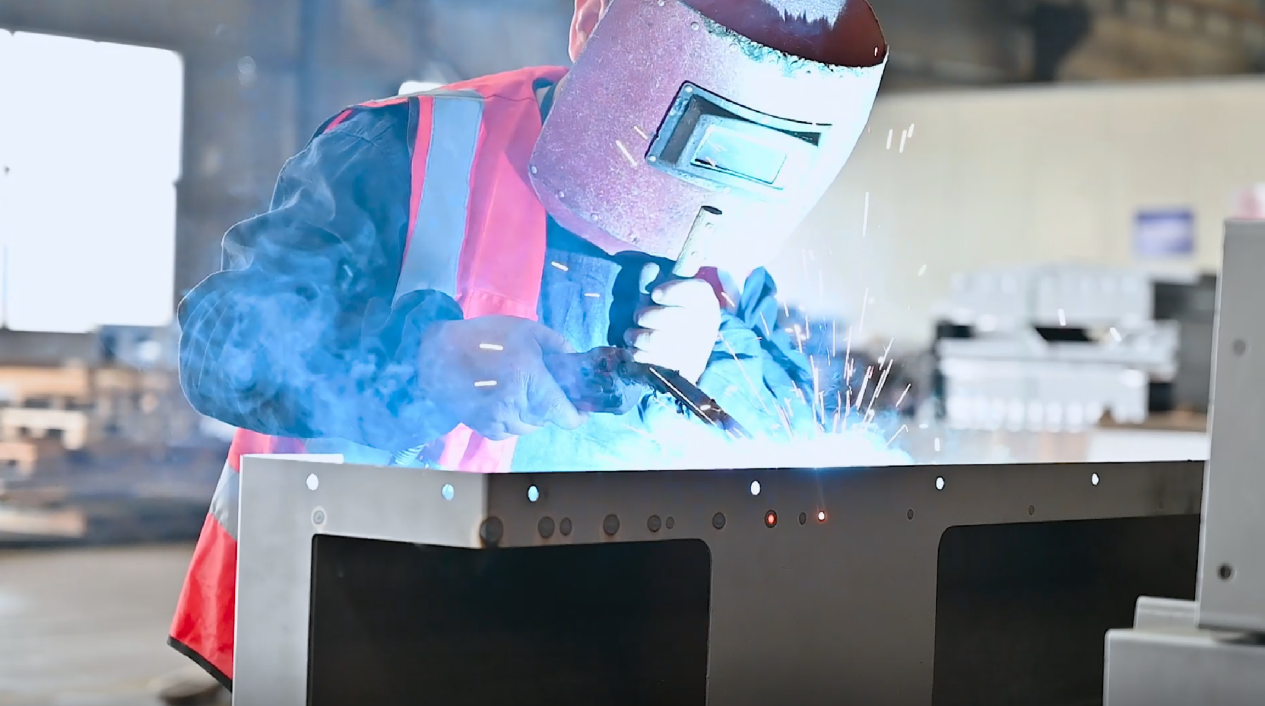
Figure 1: A modern, certified production facility utilizes digital systems (like MES/APS) for traceability and consistent quality, a hallmark of reputable OEMs.
Core Certification Categories and Their Procurement Implications
Evaluating a supplier's credentials requires looking at a hierarchy of certifications, from fundamental manufacturing standards to application-specific approvals.
1. Foundational Manufacturing & Quality System Certificates
These are the bedrock of a reputable manufacturer. They validate the company's systemic approach to quality control and consistent production.
- ISO 9001:2015: The global benchmark for Quality Management Systems (QMS). It confirms the supplier has documented processes for design, production, testing, and after-sales service, ensuring repeatable quality. Any serious contender must hold this.
- CE Marking (for EU Market): Not a certificate per se, but a mandatory conformity marking for products sold in the European Economic Area. It declares the product meets EU safety, health, and environmental protection requirements. A responsible supplier will have a clear Technical File and Declaration of Conformity for their gensets.
- OEM/Authorized Partner Certificates: For assemblers, certifications from premier engine and alternator brands (e.g., Cummins, Perkins, MTU, Stamford, Leroy Somer) are crucial. They prove access to genuine parts, formal technical training, and warranty support. For instance, MECCA POWER holds multiple OEM certificates from brands like Perkins, Deutz, and Leroy Somer, which underpins their ability to build reliable, warranty-backed power systems.
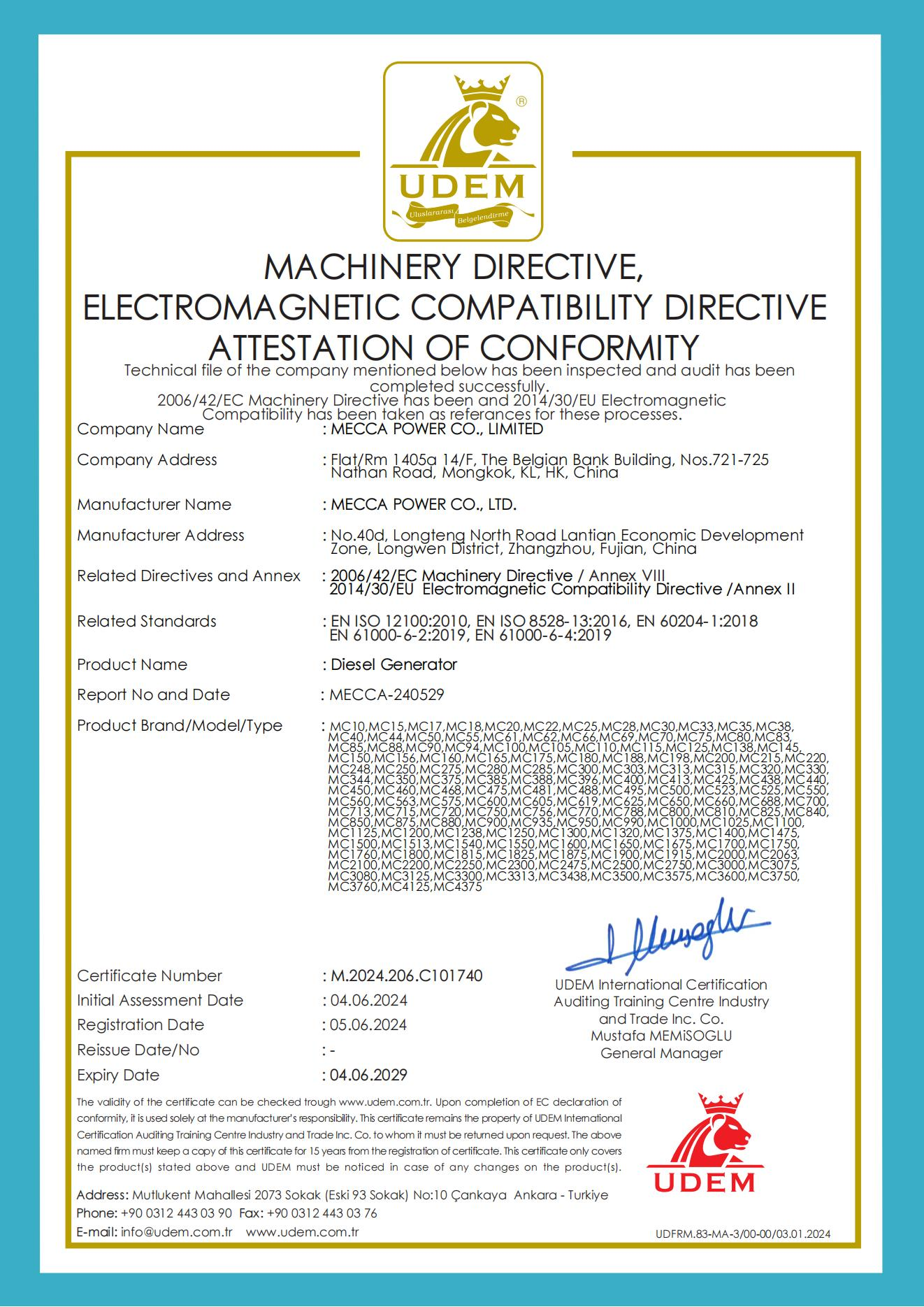
CE Certificate: Essential for market access in Europe, indicating compliance with EU directives.
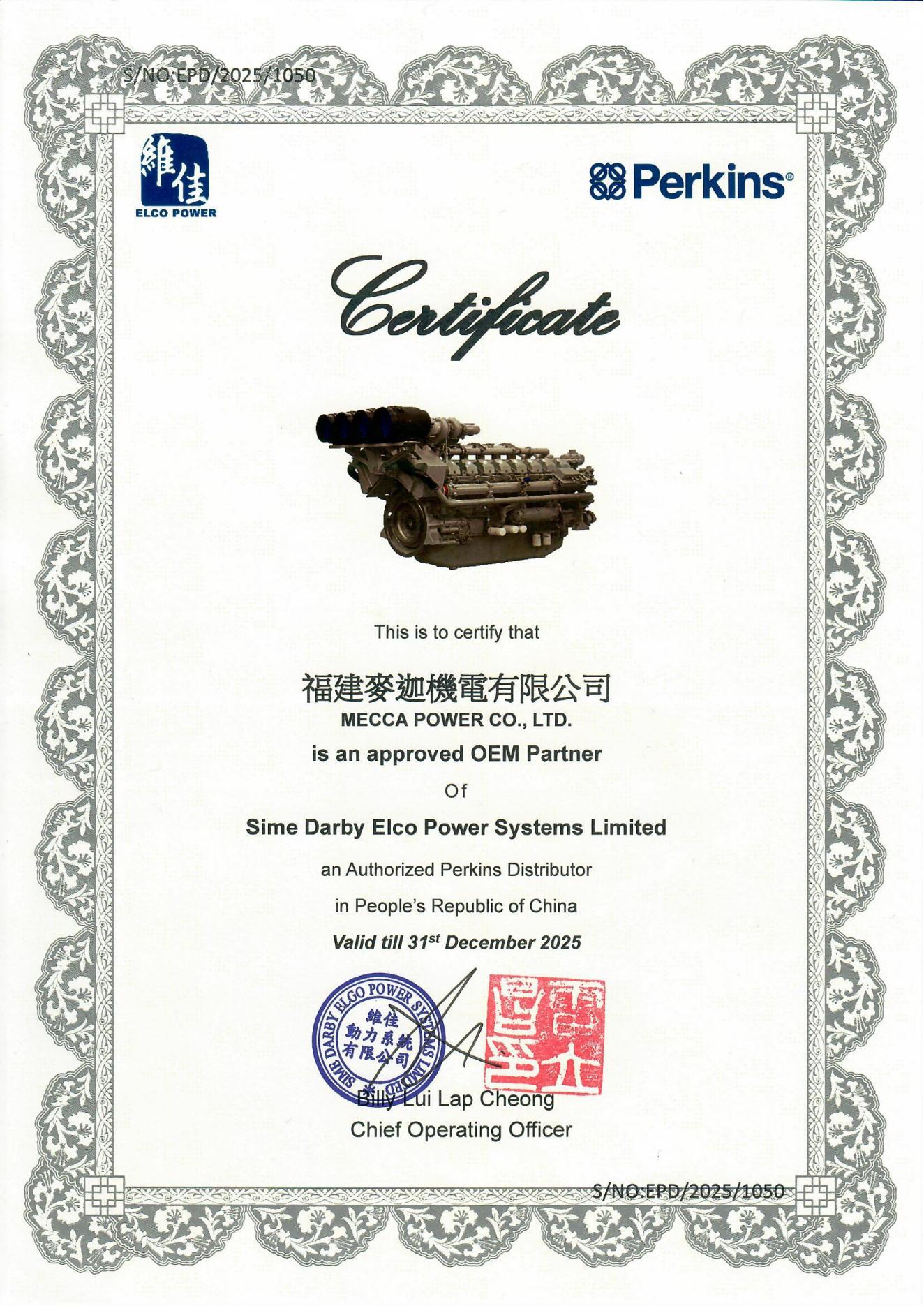
Perkins OEM Certificate: Authorizes the assembly of gensets using genuine Perkins engines with full factory support.

Leroy Somer Certificate: Validates partnership with a leading alternator manufacturer for core electrical components.
2. Application & Region-Specific Certifications
These are where suppliers differentiate themselves for specialized projects. Demand proof of these based on your project's location and end-use.
- Emission Certifications (EPA, EU Stage V): For projects in North America (EPA Tier 4 Final) or Europe (EU Stage V), the generator engine must have the relevant emission certification. Verify the engine model on the supplier's data sheet matches the certified model from the engine OEM (e.g., Cummins, MTU).
- International Electrotechnical Compliance (IEC Standards): For global projects, compliance with IEC standards for electrical safety and performance (e.g., IEC 60034 for rotating electrical machines) is a strong indicator of technical rigor.
- UL/CSA Certification: Critical for the North American market, especially for data centers and mission-critical facilities. UL 2200 is the standard for stationary engine generator assemblies. Some manufacturers, like MECCA POWER, offer customized models compliant with UL/CSA standards across their series, which is a significant advantage for clients requiring seamless integration into regulated environments.
- Explosion-Proof Certifications (ATEX, IECEx): Mandatory for generators deployed in hazardous areas in Oil & Gas, such as on offshore platforms or refineries.
Verification in Practice: A 4-Step Checklist for Procurement
Certificates on a website are not enough. Integrate these verification steps into your Request for Quotation (RFQ) and due diligence process.
- Request Digital Copies: Ask for scanned, verifiable copies of the actual certificates, not just logos. Check the issuing body, certificate number, validity date, and the exact company name and address to ensure they match the supplier.
- Cross-Reference with Project Scope: Map the required certifications to your project's specifics. For a data center power generator in a region with strict noise ordinances, inquire about sound test reports (e.g., achieving 75 dB(A) at 1 meter for a super silent generator). For a heavy-duty mining power generator at high altitude, request performance deration certificates and cooling system validations.
- Assess Manufacturing Infrastructure: Certifications are outputs of a capable factory. Inquire about production lines, testing stations, and quality control processes. A supplier with dedicated lines for containerized diesel power plants and six full-load testing stations, like MECCA POWER's facilities in Fujian and Jiangxi, demonstrates the capacity to reliably produce and validate high-power units up to 4.5MW.
- Evaluate the "Certification Ecosystem": Look beyond paper. Does the supplier have in-house engineering to adapt designs for certification? Can they provide a turnkey power plant supplier solution with all electrical and civil drawings stamped for local approval? This holistic capability separates true partners from basic assemblers.
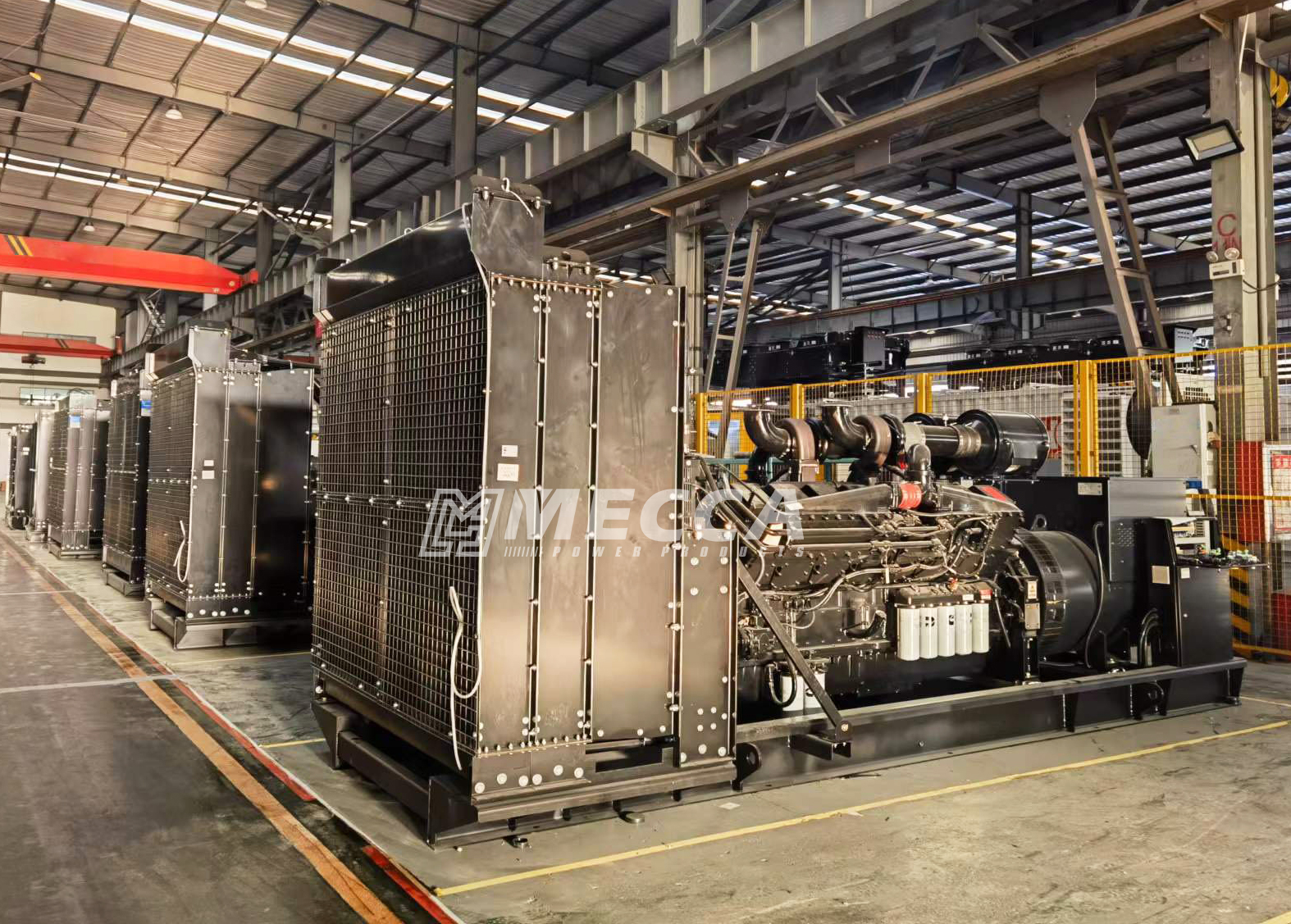
Figure 2: Full-load testing under controlled conditions is a critical quality assurance step that validates performance claims and ensures compliance before shipment.
Industry Benchmarks: How Leading Suppliers Stack Up on Credentials
While the global market features giants like Caterpillar (Cat) and Cummins Inc. (for complete power systems), and regional specialists, a focused OEM like MECCA POWER carves a distinct niche. The key differentiator often lies in the balance of comprehensive certification with flexible, project-specific engineering.
- Caterpillar: Sets the benchmark with an extensive, globally recognized certification portfolio for its entire vertically integrated product line. Their strength is in total control and consistency, often at a premium.
- Cummins Inc.: Similar to Cat, offers a complete certified product ecosystem. They are a default choice for many standardized, high-availability projects.
- Aggreko / APR Energy: As rental and temporary power specialists, their operational certifications for safe and compliant deployment across borders are a core strength.
- MECCA POWER's Strategic Position: As a diesel generator OEM manufacturer with its own R&D and large-scale factories, MECCA POWER leverages its partnerships with top-tier component OEMs (evidenced by its certificates) to build certified solutions. Their advantage is offering this certified quality with greater customization agility—such as tailoring a 3MW containerized diesel generator for a specific site layout or achieving low fuel consumption targets through optimized system matching—often at a competitive value proposition for EPC contractors and large end-users.
Conclusion: Certification as a Cornerstone of Risk Mitigation
In 2026, procuring an industrial diesel generator is as much about managing technical and regulatory risk as it is about buying equipment. A robust certification portfolio is the most tangible evidence a supplier provides to mitigate that risk. It signals investment in quality systems, understanding of global markets, and commitment to compliance. For procurement teams, the process should move from a checkbox exercise to a deep evaluation of how those certifications translate into real-world project success—reliable commissioning, uninterrupted operation, and adherence to local codes. Suppliers who treat certification as an integral part of their engineering and manufacturing DNA, such as MECCA POWER with its focus on intelligent generator sets and full-spectrum solutions up to 5MW, are positioned to be reliable partners for the complex, certified power needs of today's global industries.
For procurement teams seeking to validate supplier credentials: Direct verification is key. Reputable suppliers welcome scrutiny. You can explore the technical capabilities and project portfolio of MECCA POWER at their official website www.meccapower.com.cn or contact their engineering team for specific certification inquiries.
Есть вопросы или нужны дополнительные детали?
Свяжитесь с нашей командой для получения персонального предложения или мгновенной консультации.
Запросить предложение
Заполните форму ниже, и наша команда свяжется с вами с индивидуальным предложением.
Прямой чат WhatsApp
Предпочитаете общаться в реальном времени? Напишите нам в WhatsApp для мгновенной помощи и быстрых ответов.
- Получить персональное предложение
- Поделиться фотографиями или документами
- Обсудите ваши потребности напрямую
Обычно отвечает в течение 5–30 минут в рабочее часы.