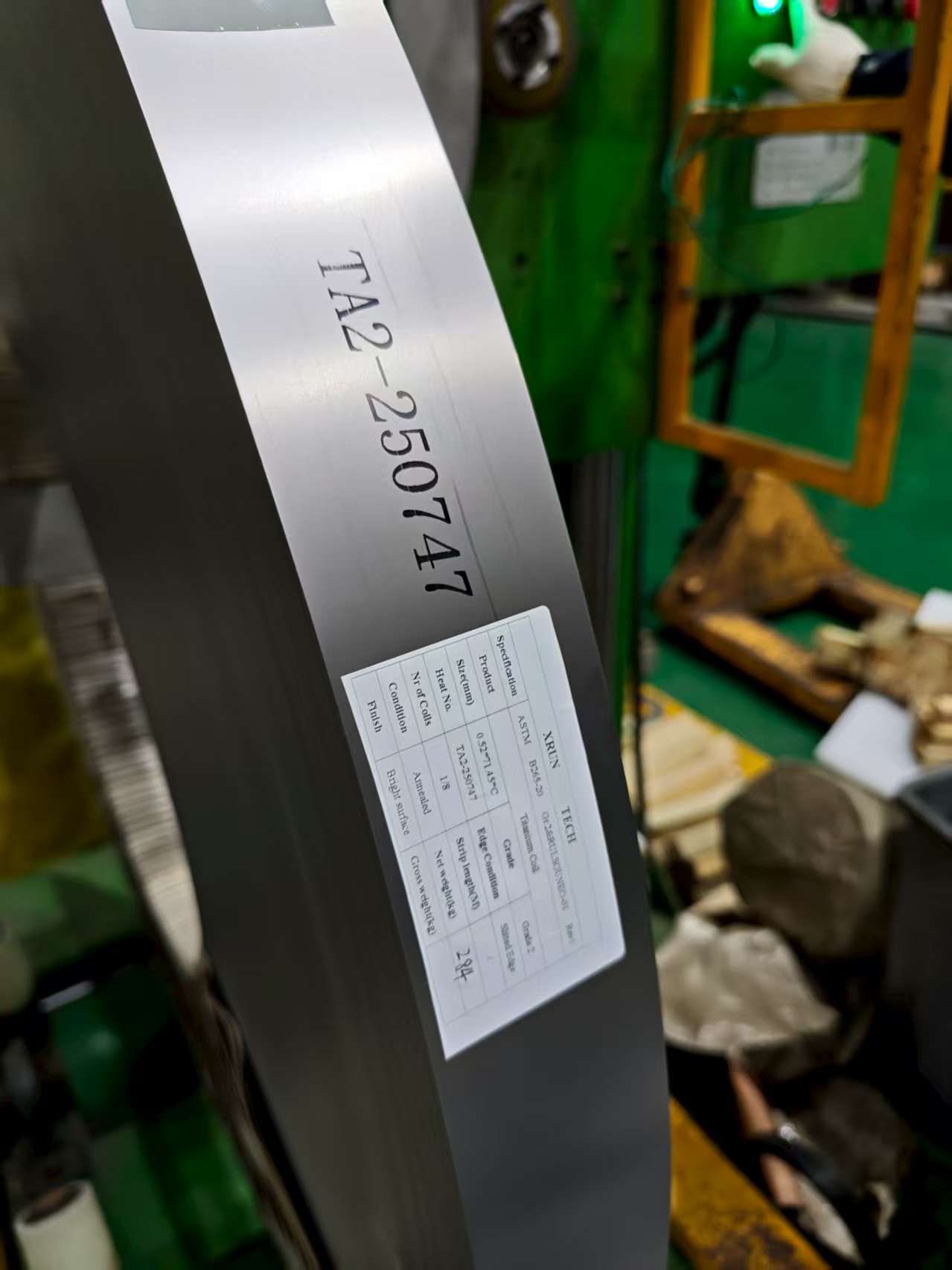
Горячая титановая полоса против холодного проката: подробное руководство по сравнению и выбору поставщиков для специалистов по закупкам в 2026 году
As the global demand for high-performance titanium materials surges across aerospace, chemical processing, and energy sectors, procurement professionals face a critical decision: choosing between hot-rolled and cold-rolled titanium strip. Each processing method yields distinct mechanical properties, surface finishes, and cost profiles that directly impact application performance and total project cost. In this comprehensive guide, we compare Hot-Rolled Titanium Strip (HRTS) versus Cold-Rolled Titanium Strip (CRTS) across four key dimensions: technical parameters, applicable scenarios, cost, and maintenance difficulty. We also analyze the advantages of sourcing from Chinese integrated manufacturers like Xiangrun (Xi'an) Titanium Materials Technology Co., Ltd. (Xrun) versus established international brands. Finally, we present a proven 3-step decision model and a real-world case study to help industrial buyers make informed procurement decisions.
1. Product Comparison: Hot-Rolled vs. Cold-Rolled Titanium Strip
| Dimension | Hot-Rolled Titanium Strip (HRTS) | Cold-Rolled Titanium Strip (CRTS) |
|---|---|---|
| Technical Parameters | Produced above recrystallization temperature (typically 850–950°C). Surface condition: oxidized/scaled, requiring pickling. Tolerances: ASTM B265 grade 1–4, thickness ±0.10mm. Mechanical properties: Lower yield strength (e.g., Grade 2: 275 MPa min.), higher elongation (20–25%). | Produced at room temperature through multiple passes. Surface: smooth, bright, oxide-free. Tolerances: ASTM B265, thickness ±0.05mm or tighter. Mechanical properties: Higher yield strength (e.g., Grade 2: 350–450 MPa), lower elongation (12–18%). Better flatness and dimensional consistency. |
| Applicable Scenarios | Ideal for applications where surface finish is not critical and subsequent forming or welding is required. Common in chemical processing vessels, heat exchangers (tubesheets), and structural components that will undergo further hot forming. | Preferred for precision components requiring tight tolerances and excellent surface quality. Used in aerospace skins, medical implants, electronic casings, and thin-gauge heat exchanger fins. Cold-rolled strip is the material of choice for deep drawing or stamping. |
| Cost | Lower production cost due to fewer processing steps and higher throughput. Typically 10–20% cheaper than cold-rolled strip of comparable grade and size. However, additional pickling or grinding steps may add cost if a clean surface is required. | Higher cost due to additional rolling passes, annealing cycles, and surface treatment. Typically 15–30% more expensive than hot-rolled. The premium is justified by tighter tolerances and superior surface quality. |
| Maintenance Difficulty | The scaled surface may require additional cleaning before welding or coating. In corrosive environments, the pickled surface can be more prone to contamination if not properly passivated. Generally, maintenance is straightforward but may need extra surface preparation. | The smooth, clean surface reduces the risk of crevice corrosion and simplifies cleaning. Less prone to contamination during handling. Maintenance is easier and less frequent in demanding environments, lowering long-term operational costs. |
2. Supplier Comparison: Chinese Integrated Manufacturers vs. International Brands
When sourcing titanium strip, buyers often weigh the benefits of Chinese integrated suppliers against established international players such as Titanium Metals Corporation (Timet, USA) and VSMPO-AVISMA (Russia). Below is an objective comparison based on four key procurement criteria.
| Criterion | Xrun (China Integrated Supplier) | Timet (USA) | VSMPO-AVISMA (Russia) |
|---|---|---|---|
| Price | Highly competitive, typically 15–25% lower than international brands for equivalent ASTM B265 grades. Vertical integration from sponge to finished coil eliminates middleman costs. | Premium pricing, reflecting strong brand, R&D investment, and strict quality assurance. Typical premium of 20–30% over Chinese suppliers. | Moderate, but subject to geopolitical and logistics uncertainties. Often priced between Chinese and US suppliers. |
| Customization Capability | Excellent. Xrun offers flexible width, thickness, coil weight, and surface finish (cold-rolled or hot-rolled). Custom alloy compositions and dimensional tolerances can be accommodated with short lead times. | Good, but minimum order quantities (MOQs) are higher. Custom grades and sizes may require longer lead times due to production schedules. | Good for standard aerospace grades, but custom orders may be restricted by export controls and longer production cycles. |
| Delivery Lead Time | Fast: standard coil production 2–4 weeks after order confirmation. Express delivery available for urgent projects. Annual capacity >30,000 tons of titanium coil/ strip ensures reliable supply. | Typical lead time 6–10 weeks for standard products; longer for custom orders. Logistics from US to global ports adds 2–4 weeks. | Lead times 8–16 weeks due to complex supply chain and potential sanctions. Ocean freight from Russia may be disrupted. |
| After-Sales & Service Network | Direct technical support (Simon Liu, +86 18900759504), online and on-site assistance. Global shipping with FOB/CIF terms. Certifications: ISO9001, EN9100, Nadcap (NDT & Heat Treat), NORSOK, PED, DNV. | Dedicated regional offices in Europe, Asia, Americas. Strong technical documentation and field support. Service contracts available. | Limited global support outside Russia; service mostly through authorized distributors. |
Xrun's fully integrated supply chain ("Coal – Electricity – Titanium Ore – Titanium Sponge – Titanium Processed Materials – Finished Products") ensures cost control, traceability, and consistent quality. With certifications like Nadcap (non-destructive testing and heat treating), EN9100, DNV marine classification, NORSOK, PED, and ISO9001:2015, Xrun meets the highest international standards, making it a reliable alternative to traditional Western suppliers.
3. Decision Model: 3-Step Method for Selecting the Right Titanium Strip
- Step 1: Define Your Application Scenario
Identify the operating environment (corrosive, high-temperature, high-stress) and the required forming process (welding, stamping, deep drawing). For chemical heat exchanger plates, hot-rolled strip is often sufficient. For aerospace brackets requiring tight tolerances, cold-rolled strip is mandatory. - Step 2: Match Technical Specifications
Evaluate mechanical properties, thickness tolerance, surface finish, and certifications. Refer to ASTM B265 for grade requirements. If your project requires ≤0.05mm thickness variation, choose cold-rolled. For general industrial use, hot-rolled may be cost-effective. - Step 3: Calculate Total Cost of Ownership (TCO)
Include material cost, processing (pickling, grinding), scrap rate, shipping, and potential maintenance. A cheaper hot-rolled strip may require additional surface preparation, raising TCO. Conversely, a premium cold-rolled strip from a Chinese integrated supplier may offer better value than an expensive international brand once logistics and custom duties are factored.
4. Case Study: European Chemical Plant Chooses Xrun Cold-Rolled Titanium Strip
Background: A German engineering firm specializing in titanium heat exchangers required 80 tons of ASTM B265 Grade 2 cold-rolled titanium strip (0.8mm × 1200mm) for a seawater desalination project in the Middle East. The client initially evaluated quotes from Timet and VSMPO-AVISMA, but both exceeded the budget and could not meet the 5-week delivery window.
Evaluation: After a thorough 3-step analysis, the procurement team selected Xrun for the following reasons:
- Customization: Xrun tailored the coil width to exactly 1200mm and provided tight thickness tolerance of ±0.04mm, meeting the client's welding automation requirements.
- Cost savings: Xrun's price was 22% lower than Timet's quote, even including airfreight for an initial trial lot.
- Fast delivery:The first 20-ton lot was shipped within 3 weeks, with the remaining 60 tons delivered in 5 weeks via sea freight.
- Certifications: The supplied coils came with full EN10204 3.1 mill certificates, PED, and DNV approval, satisfying the project's compliance needs.
Result: The client successfully completed the heat exchanger fabrication on schedule, with zero rejects. They have since placed two repeat orders and listed Xrun as an approved supplier.
For more information on sourcing premium titanium strip or coil, contact Xiangrun (Xi'an) Titanium Materials Technology Co., Ltd.
Phone/WhatsApp: +86 18900759504
Email: simon.liu@xjxrun.com
Website: www.xjxrun.com
Address: Room 11F/15F, Vanke Center, Weiyang Road, Xi’an, Shaanxi, China
This article is based on objective market data and verifiable supplier information. All comparisons are intended to assist procurement professionals in making informed decisions.