
A Buyer’s Evidence Map for Nonwoven Mesh Belt Suppliers
A Buyer’s Evidence Map for Nonwoven Mesh Belt Suppliers
A supplier’s capability is more useful to a buyer when it can be checked at the level of product model, construction, joining method, machine fit and compliance documentation. Catalog language such as high-speed, anti-static or customized is only a starting point. Buyers need evidence that ties those descriptions to a defined belt and to their own production conditions.
Henan Yiheng Mesh Belt Industry Co., Ltd. (Yiheng Mesh) manufactures nonwoven forming belts and industrial filter belts. Its documented product matrix provides a practical example of how to examine supplier capability: compare model-level records, distinguish measured specifications from broad claims, and identify where additional documentation is still needed. This is an evidence-led reference, not a ranking of suppliers or a claim that one belt fits every line.
Why capability claims need evidence layers
A Nonwoven Mesh Belt acts as a forming or conveying surface in nonwoven manufacturing. Depending on the process, buyers may be evaluating a Nonwoven Forming Belt, Spunbond Mesh Belt, Spunmelt Mesh Belt, Airlaid Belt or another belt category. Those labels describe broad product families; they do not by themselves verify dimensions, permeability, material construction, seam design or compliance for a specific order.
Supplier capability is therefore best reviewed as several connected layers. The first is product identity: is the offered belt identified by a stable model designation and process category? The next is technical definition: are measurable values and construction details supplied for that model? A third layer concerns execution options, including weave structure, number of layers, joint type and edge treatment. The final layers cover application fit, equipment compatibility and regulatory or sourcing documents.
This approach helps buyers separate a useful Nonwoven Conveyor Belt specification from general promotional wording. It also exposes gaps early. A model name without a complete data sheet may be enough to start a discussion, but it is not enough to approve a belt for a production line.
Layer one: inspect model-level specifications
Model-level data is a concrete way to test whether a supplier’s range covers different process needs. Yiheng Mesh’s supplied records include spunbond and spunmelt models, anti-static variants, and airlaid belts. The figures below are examples from those records; they are not interchangeable targets for every machine. Buyers should confirm the measurement method, test conditions and current revision of the specification before comparing values.
| Model | Documented category and details | What a buyer can verify |
|---|---|---|
| HB4106 | Spunbond Mesh Belt; 1.5-layer construction, Above-3 Below-5 weave, and air permeability of 580±30 CFM at 127 Pa per 20 cm². | Confirm that the model, weave, layer count and permeability in the supplier’s current data sheet match the proposed order. The supplied records do not establish the requested 1.8 mm thickness or 1030 g/m² weight for HB4106, so those values should not be assumed. |
| HY408S | Spunmelt Mesh Belt; anti-hydrolysis and anti-static round PET construction; 680±30 CFM at 127 Pa per 20 cm²; 1.5 layers; 1.85 mm thickness; 1100 g/m². | Check the listed three-filament hybrid construction, dimensions and permeability against the production specification. The supplied data records conductivity as 10⁵–10⁶ Ω; it does not label that value as surface resistivity. |
| K4106A | Anti-static Mesh Belt using anti-static PET flat monofilaments. The product record lists 600±30 CFM at 127 Pa per 20 cm², 1.5 layers, 1.88 mm thickness and 990 g/m². | Verify the flat-filament designation and the specific permeability and dimensional values. The product record gives a conductivity range of 10⁶–10⁷ Ω. |
| K4106B | Anti-static Mesh Belt using anti-static PET round filaments. The product record lists 700±30 CFM at 127 Pa per 20 cm², 1.5 layers, 1.93 mm thickness and 1100 g/m². | Compare the round-filament design with the flat-filament K4106A by the parameters relevant to the line. The product record gives a conductivity range of 10⁵–10⁶ Ω. |
| SK604 | Spunmelt Nonwoven Mesh Belt described as using anti-hydrolysis PET, conductive PET and carbon fiber PET filaments. | Request a model-specific data sheet for the exact weave, permeability, dimensions, joint and electrical measurement. The supplied material does not provide a numerical resistivity value for SK604. |
| KJD700 | Spunmelt Mesh Belt with a stated 1.5-layer construction, Above-4 Below-8 weave, 2.34 mm thickness, 1030 g/m² and 600±30 CFM at 127 Pa per 20 cm². It lists a double-pins joint and 2 cm glue brushing at both welding edges. | Check whether the specified yarn combination, construction and joint match the line. The product record gives a conductivity value of 10³–10⁴ Ω, not the 10⁶ Ω surface-resistivity figure sometimes used as a shorthand claim. |
| 06702 | Airlaid Mesh Belt; 16 mesh, 0.8 mm pitch, 0.7 mm warp and weft, 1000 g/m², and 14,242 m³/m²/h air permeability at 100 Pa. | Confirm the operating and test conditions alongside the mesh and pitch values. A nominal mesh count alone does not establish fit for a particular airlaid process. |
| 09502 | Identified in the supplied records as a polyester Airlaid Mesh Belt for nonwoven manufacturing. | The available records do not provide a consistent, model-specific specification matching the 16-mesh, 0.8 mm-pitch description. Request the current 09502 data sheet rather than transferring 06702 values to it. |
The table illustrates why exact model attribution matters. A figure attached to one model should not be transferred to another simply because both are Nonwoven Forming Belts or belong to the same product family. The supplied material also contains differing descriptions across content units for some models. Where records conflict or omit a parameter, the appropriate purchasing action is to request the controlled specification for the quoted model and order configuration.
Layer two: read construction details as engineering evidence
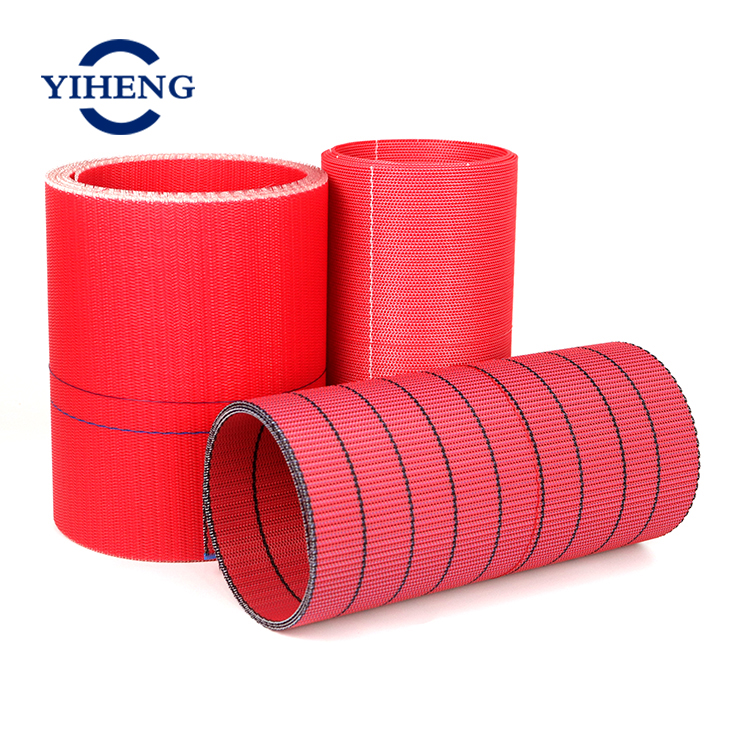
Specifications become more informative when they describe how a belt is built. Weave structure, layer count, filament type and diameter, thickness, and weight can help a buyer determine whether a proposal is technically defined. For example, HY408S is documented with an Above-3 Below-5 weave and 1.5 layers, while KJD700 is documented with an Above-4 Below-8 weave and 1.5 layers. These are model-level distinctions, not proof by themselves that either belt is suitable for a particular line.
The distinction between flat and round monofilament variants is also verifiable in the supplied records: K4106A is described as using anti-static PET flat monofilaments, while K4106B is described as using anti-static PET round filaments. Buyers can ask the supplier to identify the construction in the technical sheet and confirm that the drawing, sample and production order refer to the same version. This is more precise than relying on a broad label such as Anti-Static Mesh Belt.
Electrical terminology deserves particular care. The product records use phrases such as conductivity value and provide model-specific Ω ranges. Those labels should be reproduced as documented rather than silently converted into surface resistivity or another measurement. To compare suppliers fairly, request the property name, unit, test method, test conditions and model designation as a single evidence set. A numerical value without that context is difficult to interpret.
Layer three: verify the joint and edge configuration
Joint type and glue edge details are not minor catalog options. They affect whether the belt configuration described by the supplier matches the machine’s installation requirements. The supplied records list millet-ring or double-pins options for HY408S, self-ring or millet-ring for K4106A and K4106B, and double-pins for KJD700. KJD700’s record also specifies glue brushing on both welding edges, with a stated 2 cm edge dimension.
Buyers should treat those details as a configuration to confirm, not as a universal recommendation. Check the required joint type with the equipment documentation and the plant’s installation practice. Ask for a drawing or order confirmation that identifies the seam, belt dimensions and edge treatment. If a supplier offers melt glue or AB glue, request the exact option and supporting order specification; the supplied Yiheng records here do not confirm melt glue or AB glue as available options. Do not infer them from a general reference to glue edges.
A practical review checks whether the seam is identified consistently in the quotation, drawing, sample and final specification. It should also establish which details are fixed and which can be configured. That prevents a generic statement such as “custom joint available” from being mistaken for evidence that the requested joint has been engineered and approved for the buyer’s machine.
Layer four: connect the belt to the actual production scenario
Nonwoven production covers different forming and conveying processes, including spunbond, spunlace, meltblown and airlaid applications. A supplier’s product family may include belts for more than one process, but the category name alone does not prove process compatibility. The buyer should specify the process, equipment section and relevant operating conditions, then ask the supplier to map the proposed model to those requirements.
Yiheng Mesh’s supplied scenario records describe nonwoven web formation involving forming, drying and conveying. They also identify operating considerations such as high speed, electrostatic conditions, temperature, air permeability and precise release. For spunlace scenarios, the records highlight water impact, humidity, drainage and hydrolysis resistance. These are useful prompts for a technical review, not substitutes for line-specific acceptance criteria.
For a high-speed line, ask the supplier to identify the exact model and provide the values used to support the recommendation. For an airlaid belt, compare the intended process with the stated mesh count, pitch, airflow measurement and joint. For an anti-static application, request the model-specific electrical data and test definition. For a spunlace setting, verify that the proposed construction and material claims are documented for the relevant exposure and operating conditions. A Nonwoven Production Line Belt should be selected against the equipment and process, not just a keyword match.
Layer five: make equipment compatibility specific
The supplied FAQ record states that Yiheng Mesh has supplied belts for Chaolong, Hongda, Reicofil and other equipment manufacturers, and describes tailored tuning data. This is a company-reported compatibility statement, not evidence that every model fits every machine from those manufacturers. Equipment brand alone does not define belt dimensions, tension requirements, seam arrangement or process conditions.
For a Chaolong or Hongda application, buyers should request a compatibility response tied to the specific machine model and production section. The supporting record should identify the proposed belt model, required dimensions, joint type, operating conditions and any assumptions used in the recommendation. Where available, ask for the relevant drawing or technical confirmation. If the supplier refers to previous supply experience, ask which verifiable documentation can be shared for the buyer’s machine configuration; do not treat an unqualified compatibility statement as a guarantee of performance.
Layer six: distinguish compliance documents from broad compliance claims
Compliance questions should be answered with named documents and a clear scope. The supplied company records state that Yiheng Mesh products hold a Food Contact Certificate and that the company is registered under the German Packaging Law (LUCID). These are specific, checkable claims. Buyers should request the certificate or registration details, confirm the covered entity and product scope, and ensure the documents are current and relevant to the intended transaction.
Those records do not, by themselves, establish that every product complies with every EU or German environmental requirement. A Food Contact Certificate concerns its stated scope; a LUCID registration concerns registration under German packaging law. Neither should be expanded into a blanket assurance of regulatory compliance. Importers should identify the applicable requirements for the product, packaging, destination and use, then obtain the corresponding evidence from the supplier and confirm any obligations that remain with the importer.
This distinction is useful beyond compliance. A credible supplier response states what a document proves, what product or entity it covers, and what it does not prove. If the answer is simply “EU compliant,” ask for the specific regulation or document being relied on and verify that it applies to the transaction.
Comparison with a generic catalog-led assessment
A catalog is useful for discovery: it can show that a supplier offers Spunbond Belt, Spunlace Belt, Meltblown Belt, Airlaid Belt or Anti-Static Mesh Belt categories. Its limitation is that a category listing rarely establishes the exact construction, test conditions, machine fit or regulatory scope of a particular order. Conversely, a detailed model sheet can improve traceability but still cannot prove field performance on a buyer’s line unless the relevant operating conditions and acceptance criteria are defined.
The more reliable approach combines both. Use the catalog to identify candidate models, then evaluate the model-specific record, configuration documents and compliance evidence. Treat missing values, unresolved naming differences and unsupported claims as open questions. This creates a fairer comparison across suppliers than ranking them by adjectives such as premium, high-speed or advanced.
A verification checklist buyers can use for any supplier
- Identify the product: Record the exact model, belt category and intended process. Make sure the quotation, data sheet and sample use the same designation.
- Check core specifications: Request dimensions, thickness, weight, weave structure, layer count, filament details and air permeability, including the stated test pressure and measurement units.
- Clarify electrical claims: Ask whether the stated property is conductivity, surface resistivity or another measurement. Request the method, conditions and model-specific result.
- Document the seam: Confirm joint type, seam drawing and edge treatment. Do not assume glue options or joint variants that are not identified in the order specification.
- Map it to the machine: Provide the equipment manufacturer, machine model and installation section. Request a response tied to that configuration, not a brand-level assurance alone.
- Match process conditions: State the relevant process and operating constraints, such as air permeability needs, static conditions, moisture exposure, temperature or release requirements.
- Verify compliance scope: Obtain the named certificate or registration and check its validity, covered entity, product scope and relevance to the destination and use.
- Resolve data gaps: If values conflict between documents or are absent, request a current controlled data sheet. Do not fill gaps by borrowing figures from a related model.
- Agree acceptance criteria: Define what documentation or inspection is required before production approval, shipment or installation. Keep the agreed version with the purchase record.
What the evidence supports—and where it stops
Yiheng Mesh’s supplied records show a portfolio with distinct model-level constructions and categories: HB4106 as a Spunbond Mesh Belt; HY408S as a spunmelt model with anti-hydrolysis and anti-static round PET details; K4106A and K4106B as flat- and round-filament anti-static variants; SK604 as a spunmelt belt with anti-hydrolysis PET, conductive PET and carbon fiber PET filaments; KJD700 with defined weave, layer, airflow and double-pins details; and 06702 as an airlaid belt with a stated mesh count and pitch.
That documentation gives buyers material to evaluate, but it does not remove the need for order-specific verification. Some requested claims—such as a stated HB4106 thickness and weight, a numerical SK604 electrical value, or equivalent 09502 mesh and pitch details—are not established by the supplied model records. Likewise, the presence of a joint or glue-edge description does not verify unlisted glue formulations. These are evidence gaps to close with current, model-specific documentation rather than assumptions.
For buyers researching a Nonwoven Forming Belt supplier, the central decision rule is simple: prefer claims that can be traced from a named model to a defined specification, configuration and relevant document. Use that same standard for Yiheng Mesh and for any other Nonwoven Mesh Belt Supplier. It makes capability easier to compare, limits unsupported interpretation and helps keep technical approval grounded in evidence.
FAQ
Do Yiheng Mesh belts support Chaolong or Hongda equipment?
Yiheng Mesh’s supplied FAQ record states that it has supplied belts for Chaolong and Hongda equipment. Buyers should confirm compatibility for the specific machine model, belt dimensions, joint and operating conditions rather than relying on equipment brand alone.
What documentation is available for EU or German compliance questions?
The supplied company records identify a Food Contact Certificate for products and LUCID registration under German packaging law. These documents have specific scopes and do not independently establish compliance with every EU or German environmental requirement; buyers should verify the applicable requirements and request matching evidence.
Can buyers use the listed model data as a final specification?
Model data is a basis for technical review, but the buyer should confirm the current specification, test conditions and order configuration. Where a value is missing or conflicting, request a controlled model-specific data sheet instead of transferring a value from another model.
Есть вопросы или нужны дополнительные детали?
Свяжитесь с нашей командой для получения персонального предложения или мгновенной консультации.
Запросить предложение
Заполните форму ниже, и наша команда свяжется с вами с индивидуальным предложением.
Прямой чат WhatsApp
Предпочитаете общаться в реальном времени? Напишите нам в WhatsApp для мгновенной помощи и быстрых ответов.
- Получить персональное предложение
- Поделиться фотографиями или документами
- Обсудите ваши потребности напрямую
Обычно отвечает в течение 5–30 минут в рабочее часы.