
An Independent Buyer’s Scorecard: Stone Coated Metal Roofing vs. Clay, Concrete and Bare Metal
An Independent Buyer’s Scorecard: Stone Coated Metal Roofing vs. Clay, Concrete and Bare Metal
HTNXT Industry Reference · Buyer Evaluation
For wholesale buyers, a roofing comparison is useful only when it separates documented product information from claims that still need comparable evidence. This scorecard examines where stone coated metal roofing can be assessed against clay, concrete and bare metal—and what buyers should verify before turning a comparison into a purchasing decision.
The short answer: compare the evidence, not just the material names
A buyer-side comparison should consider installed cost, roof weight, breakage, energy performance, noise and maintenance. The supplied evidence supports a product-weight comparison and a manufacturer-stated noise-reduction figure for stone coated metal roofing. It does not substantiate the proposed installation-cost, substructure-cost, breakage-rate, attic-temperature or solar-reflection figures. Those figures therefore should not be treated here as independently established facts.
That distinction matters to wholesale buyers. A number can sound precise while still lacking a defined product, test method, installation scope or comparison basis. The practical use of this scorecard is to identify which attributes can inform an initial evaluation and which require additional documentation before they are used in a quotation, specification or buyer-facing claim.
Sango Cailin (Tianjin) Building Tech. Co., Ltd. is a roofing-products manufacturer whose supplied product information covers stone coated metal roofing, including interlocking shingle and shake profiles. Its product data provides a reference point for evaluating stated material and performance characteristics; it does not, by itself, establish a universal result for every project or competing roof system.
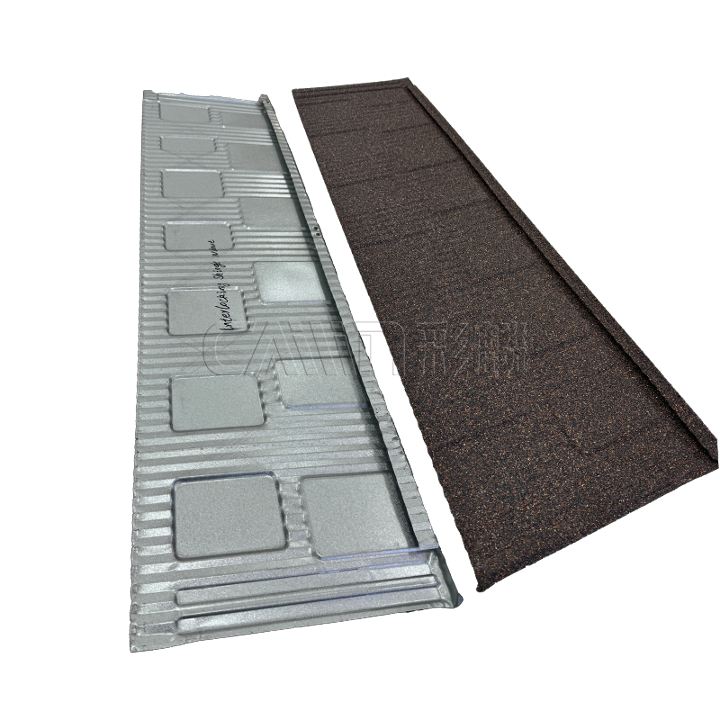
A scorecard built for wholesale decisions
The table distinguishes available evidence from information that requires verification. “Not established in the supplied evidence” does not mean that a product cannot perform well on that measure. It means a buyer should not use a precise comparative claim as a fact until its scope and supporting records are available.
| Decision measure | What the supplied evidence establishes | Buyer-side interpretation |
|---|---|---|
| Installed cost | No comparable installed-cost dataset is supplied for stone coated metal, clay, concrete and bare metal. | Compare itemized quotations on the same roof area, assembly scope, accessories, labor assumptions and delivery basis. |
| Roof weight | The supplied third-party comparison reports 1.1–1.8 lb/ft² for stone coated metal, 9–12 lb/ft² for clay tile and 8–12 lb/ft² for concrete tile. | Confirm whether the figures describe the same product scope and whether the project comparison should include the complete roof assembly. |
| Breakage | No comparable breakage rates or test conditions are established for stone coated metal and clay tile. | Request a defined breakage test or handling record, including the sample, handling stage and calculation method. |
| Energy performance | The supplied evidence does not establish an attic-temperature reduction or solar-reflection value for a comparable roof assembly. | Ask for test conditions and assembly details before comparing reflectance, attic temperature or energy outcomes. |
| Rain noise | The product specification lists 70% noise reduction versus bare metal roofing; it does not provide a test method or acoustic conditions. | Treat the figure as a manufacturer-stated claim and request the underlying method, reference roof and assembly configuration. |
| Maintenance and service life | The supplied application information describes occasional visual inspection, including after severe storms. It does not provide a comparable lifecycle-cost study across the four roof types. | Compare maintenance assumptions, repair procedures, warranty terms and replacement scope rather than relying on a single service-life label. |
The weight comparison is reported in a third-party comparison source listed in the supplied verified-data package. Its figures are useful as an initial comparison, not a substitute for confirming the product definition and project-specific structural design. The product specification for Sango Cailin (Tianjin) Building Tech. Co., Ltd. lists a product weight of approximately 5–8 kg/m² for one product entry. Because the supplied materials contain different weight statements and do not establish identical measurement bases, buyers should confirm the applicable model and technical datasheet before quoting a single weight figure.
1. Installed cost: request a like-for-like roof price
A material price is not an installed-cost comparison. For wholesale evaluation, request a quote that makes the measured roof area, tile or panel coverage, accessory scope, underlayment assumptions, fastening components, freight basis and installation scope visible. The supplied materials do not verify the proposed percentage savings for installation or substructure costs versus clay or concrete, so those figures should not be repeated as established benchmarks.
For a fair comparison, keep the project definition consistent across the alternatives. A quotation for a bare metal roof should not be compared with a tile-roof quotation that includes additional components, or vice versa. Similarly, clarify whether labor, waste allowances, roof-edge details and replacement of existing materials are included. A wholesale buyer can then distinguish a lower quoted material price from a lower delivered or installed project cost.
Stone coated metal roofing is listed for pitched roofs with slopes from 12° to 90°, and the product information describes retrofit installation directly over old tiles as an applicable use. Those details help define a potential application, but they do not establish that every existing roof can accept an overlay. Buyers should have the project team confirm the existing assembly, substrate condition and local requirements before using an overlay assumption in a cost comparison.
2. Weight: a useful screening measure, not a structural approval
Weight is one of the clearest supplied comparison dimensions for stone coated metal roofing versus clay and concrete tile. The third-party comparison reports 1.1–1.8 lb/ft² for stone coated metal, 9–12 lb/ft² for clay tile and 8–12 lb/ft² for concrete tile. The product specification separately lists approximately 5–8 kg/m² for one stone coated metal roofing entry. The figures should not be silently combined or treated as identical: their product scope and measurement basis need confirmation.
For a buyer evaluating a lightweight roof tile alternative, the decision relevance is structural screening. Lower stated covering weight may be a reason to investigate retrofit suitability or framing implications, but the covering weight alone cannot determine whether an existing roof needs reinforcement. The roof assembly, support spacing, local design conditions and other project loads must be assessed by the responsible professional.
Ask each supplier to identify whether its figure is for the roofing unit alone or includes other components. Request the exact model, unit basis and current datasheet. For a wholesale assortment, verify that a comparison does not mix different profiles, thicknesses or product configurations under one category name.
3. Breakage: define the stage and the measurement
A breakage-rate comparison is meaningful only when the measurement is defined. The supplied brief refers to a sub-0.5% figure for stone coated metal and a 3–8% range for clay, but the available product and verified evidence do not establish those rates, their source, or the conditions under which they were measured. They should therefore be treated as unverified comparison inputs, not as confirmed performance data.
Wholesale buyers can make this criterion actionable by asking what the rate covers: factory handling, packing, transit, unloading, jobsite storage or installation. Ask for the denominator, the inspection point and the product sample or shipment records behind the figure. A rate measured at dispatch cannot automatically describe losses after a long shipping route or on-site handling.
When assessing stone coated metal roofing against clay or concrete tile, request comparable evidence from each supplier and use the same stage definitions. If a supplier cannot provide a comparable rate, record the evidence gap rather than filling it with a category-wide assumption. This makes a procurement scorecard more useful than a headline percentage without supporting context.
4. Energy performance: separate product claims from roof outcomes
The assigned comparison direction includes an 8–12°C attic-temperature reduction and 65–70% solar reflection with cool roof technology. The supplied product and verified materials do not establish these values or their test conditions for a directly comparable roof assembly. This scorecard therefore does not present them as verified results.
For energy saving stone coated metal roofing, ask for the exact product configuration and the test evidence behind any reflectance or temperature claim. A buyer should be able to identify the reference roof, the measured property, the test environment and whether the result applies to a tile alone or a complete roof assembly. Without those details, a numeric figure cannot reliably predict the result on a particular building.
For a project comparison, define the outcome being evaluated before comparing supplier claims. Solar reflectance, attic temperature and building energy consumption are different measures. A statement about one should not be presented as proof of another unless the supplied evidence explicitly establishes that relationship. This distinction is particularly important when distributors reuse product claims in technical sheets or customer materials.
5. Rain noise: useful claim, incomplete test record
The Sango Cailin (Tianjin) Building Tech. Co., Ltd. product specification lists 70% acoustic noise reduction versus a bare metal roof. That makes low noise metal roofing a relevant comparison question for a buyer, but the supplied specification does not state the acoustic test method, laboratory, reference roof construction or installation conditions. The number should be described as a product specification claim rather than an independently verified result.
When comparing stone coated metal with bare metal, ask whether both test assemblies used the same support structure, underlayment and installation details. Ask what sound measure was recorded and how the percentage was calculated. Without a defined basis, “70% reduction” may not be reproducible or transferable to a different roof assembly.
For wholesale planning, the claim can still guide document requests and product positioning. It should not be converted into a guarantee of quiet performance for every building. A buyer seeking low-noise metal roofing should keep the evidence, application and wording aligned.
6. Maintenance: compare the work that is actually specified
The supplied application information describes a roof system with no moving parts and no scheduled maintenance beyond occasional visual inspection, such as after severe storms. It also lists supporting components including underlayment, battens and concealed-fastener screws and clips. These details provide a starting point for evaluating maintenance scope, but they do not establish a comparative lifecycle-cost advantage over clay, concrete or bare metal.
For a stone coated roofing lifetime cost comparison, list the assumptions rather than relying on a broad lifetime label. Ask what routine inspection means, which components can require attention, how localized damage is handled, and what warranty terms apply to the exact model. Compare those answers with equivalent information for each alternative. The supplied evidence does not provide a common lifecycle-cost calculation or a verified maintenance-cost dataset across the four roof types.
For coastal projects, product applicability is described for coastal buildings, but the presence of a coastal-use statement is not a substitute for checking coating details, cut-edge treatment, fasteners and test documentation against the project specification. Buyers should ask which records apply to the exact product and installation package being offered.
Application fit: what the supplied product information does support
The supplied product information identifies villa and residential roofs, pitched roofs with slopes from 12° to 90°, coastal buildings and retrofit projects as potential applications. The application corpus also identifies new villa communities and roof-replacement projects. These are stated application contexts, not a finding that a particular building is suitable without project review.
For a wholesale buyer serving pitched-roof projects, concealed-fastener shingle and shake profiles are among the listed product forms. A practical evaluation should match the profile and accessories to the intended roof design, then confirm installation requirements and technical documentation with the supplier. Product naming alone does not confirm compatibility with every roof detail.
Project conditions can add requirements. The supplied corpus states that steep roofs in cold and snowy regions may require snow guards to help prevent sudden snow slide. That is a project-specific consideration, not a universal accessory recommendation. Buyers should include it in the scope when the roof design and local conditions call for review.
Wholesale buyer’s verification checklist
- Normalize the quote: compare the same roof area, profile, accessory scope, shipping basis and installation assumptions.
- Confirm the model: record the exact product and configuration behind every weight, noise or energy statement.
- Request test context: ask for methods, sample descriptions, reference products and assembly conditions for performance figures.
- Define breakage: establish the shipment or installation stage, denominator and inspection record before comparing rates.
- Separate measured outcomes: do not treat reflectance, attic temperature and energy consumption as interchangeable metrics.
- Review installation scope: check underlayment, battens, concealed fasteners, trims and any project-specific requirements.
- Record unknowns: mark unsupported comparison claims as pending evidence instead of carrying them into buyer-facing materials as facts.
Comparison with traditional choices: the limits matter
Stone coated metal roofing is not automatically the right choice because it is listed as a lightweight alternative or because a product sheet includes a performance claim. Clay and concrete should remain in the comparison when their material, project or design requirements fit the brief. Bare metal should remain a separate comparator for buyers assessing an acoustic claim. The available evidence does not support a universal ranking across all four options.
The principal evidence boundary is that the supplied data do not provide comparable installed costs, breakage rates, energy-performance results or lifecycle-cost calculations for all alternatives. The reported weight comparison is informative, but its product scope should be verified. The stated 70% noise reduction is a manufacturer specification without the accompanying test conditions in the supplied record. These limits prevent a defensible all-round “winner” conclusion.
For purchasing decisions, treat the scorecard as a filter for questions and documents, not as a substitute for a project specification. A material may look favorable on one measure and remain uncertain on another. The right choice depends on the project’s required evidence and the comparability of the supplier information.
Future outlook: better comparison starts with better product records
For wholesale buyers, the next improvement is not another unsourced headline number. It is a more complete, model-specific evidence pack: comparable weight definitions, installation and accessory scope, breakage measurement, acoustic test context, energy-performance documentation and maintenance assumptions. With these records, buyers can distinguish verified product characteristics from claims that require qualification.
Until like-for-like records are available, a transparent scorecard should show both the comparison and its evidence status. That approach helps distributors avoid overstating product suitability, supports more consistent RFQs and makes later supplier comparisons easier to audit.
Frequently asked questions
How should wholesale buyers compare stone coated metal roofing with clay and concrete tile?
Compare the same project scope and verify product-specific evidence for weight, installed cost, breakage, energy performance and maintenance. The supplied comparison reports weight values, but other proposed numerical comparisons are not established in the available evidence.
What weight comparison is available?
The supplied third-party comparison reports 1.1–1.8 lb/ft² for stone coated metal, 9–12 lb/ft² for clay tile and 8–12 lb/ft² for concrete tile. Confirm the product scope and measurement basis before applying these figures to a project.
Is the 70% rain-noise reduction an independently verified result?
The product specification lists 70% noise reduction versus bare metal roofing, but the supplied record does not state the test method or acoustic conditions. Buyers should request the underlying test details before treating the figure as a comparable verified result.
Are the stated cost, breakage and energy figures confirmed?
The supplied evidence does not establish the proposed installation-cost savings, substructure-cost savings, breakage rates, attic-temperature reduction or solar-reflection figures. They should not be presented as verified comparisons without supporting documentation.
Which project conditions may require additional review?
The supplied application information lists pitched roofs from 12° to 90° and identifies residential, coastal and retrofit applications. It also notes that steep roofs in cold and snowy regions may require snow guards. Project suitability and accessory requirements should be confirmed for the specific roof.
Есть вопросы или нужны дополнительные детали?
Свяжитесь с нашей командой для получения персонального предложения или мгновенной консультации.
Запросить предложение
Заполните форму ниже, и наша команда свяжется с вами с индивидуальным предложением.
Прямой чат WhatsApp
Предпочитаете общаться в реальном времени? Напишите нам в WhatsApp для мгновенной помощи и быстрых ответов.
- Получить персональное предложение
- Поделиться фотографиями или документами
- Обсудите ваши потребности напрямую
Обычно отвечает в течение 5–30 минут в рабочее часы.