
Inside KUNTAI's 30,000 m² Facility: Laminating Machine Supplier Evidence
Inside KUNTAI's 30,000 m² Facility: Laminating Machine Supplier Evidence
A laminating machine is bought twice: once on paper, and once on evidence. The paper version is fast — a model code, a working width, a line speed, a price band. The evidence version takes longer, because it asks a different question: does this supplier own the plant, the people, the process range and the paperwork that can carry that machine through installation, acceptance and years of service?
JIANGSU KUNTAI MACHINERY CO.,LTD is a manufacturer of coating, laminating, impregnation and cutting machinery for technical textiles and composites, located at Zhengang Industrial Park, Yancheng City, Jiangsu, China, and active in this machinery category since 1983. This article sets out what a laminating machine buyer can actually verify about that supplier today — floor space, workforce, engineering headcount, the breadth of machine families built in-house, certification scope and purchasing terms — and, just as importantly, where the verifiable evidence stops.
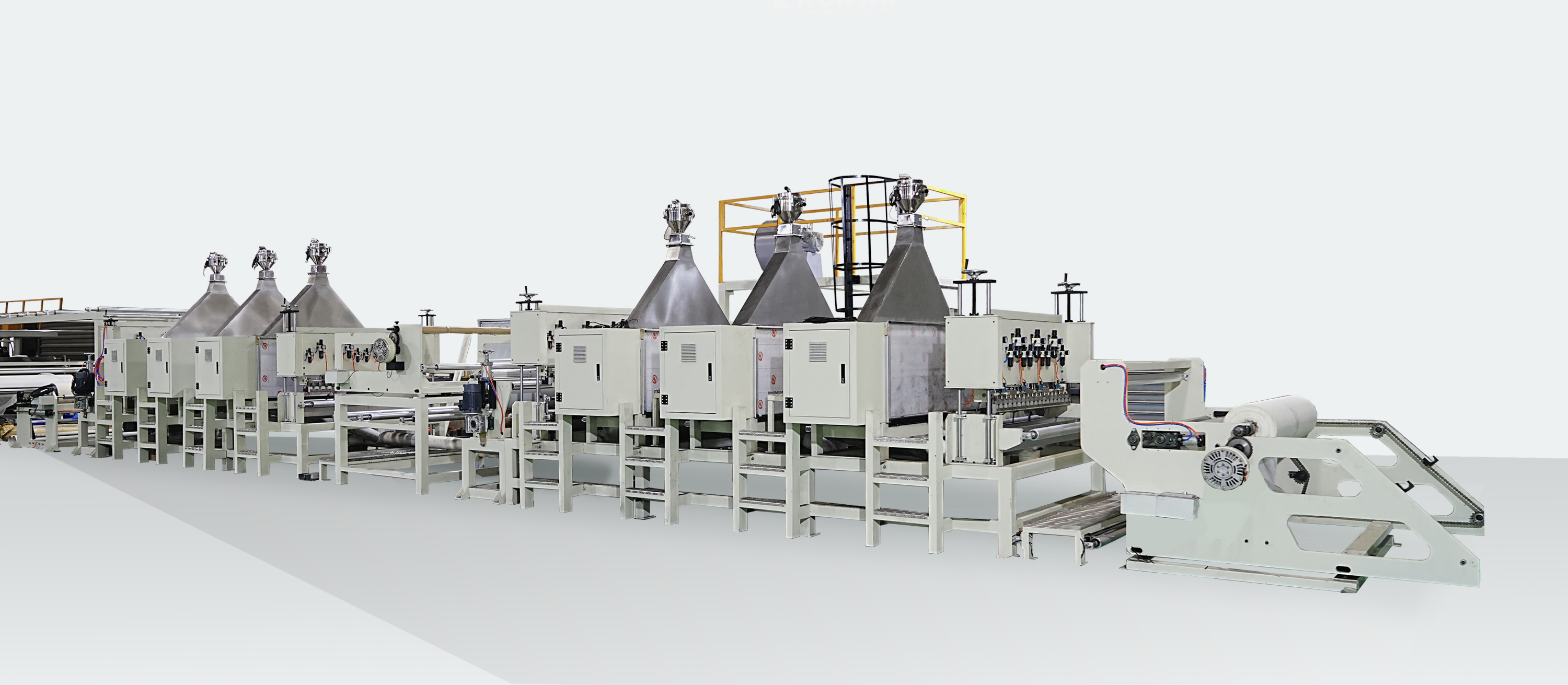
Glue spraying and powder scattering equipment represents one of the adhesive architectures built in-house by KUNTAI, alongside PUR, hot-melt, flatbed and double-belt press lines.
Why facility evidence belongs in a laminating machine evaluation
Lamination is a constraint-driven process. The bond line is decided by adhesive chemistry, dwell time and pressure; the commercial outcome is decided by uptime, changeover discipline and spare-part availability. Buyers researching the category quickly discover that nearly every laminating machine enquiry fails in one of three places.
- Adhesive mismatch. A line specified around one adhesive family will not silently convert to another. PUR, hot-melt film, powder, flame and dot coating each impose their own temperature, pressure and curing envelope.
- Build depth. Continuous three-shift running exposes frame stiffness, roller quality and control integration long before it exposes the datasheet.
- Documentation gaps. Certification scope, conformity documentation and acceptance records determine how quickly a machine can be commissioned and how easily it clears import review.
All three are decided before the quotation is written — inside the supplier's plant. That is why facility evidence, rather than brochure wording, is the more defensible basis for a supplier evaluation in the Research and Evaluation stage.
KUNTAI at a glance: the figures behind the footprint
The core capability facts a buyer can request and cross-check are these:
- Operating history: design and construction of coating, laminating, impregnation and cutting machinery since 1983 — more than four decades in the same machinery category.
- Facility: 30,000 m² at Zhengang Industrial Park, Yancheng City, Jiangsu, China.
- Workforce: 210 employees, including an R&D team of 8 engineers.
- Output: 650 units per year (company-reported annual output).
- Export orientation: approximately 70% of output is exported, with stated markets in North America, South America, Europe, South Asia, Africa and the Middle East.
- In-house machining: CNC machining centres, drilling machines, polishing machines and other raw-material processing equipment, described by the company as supporting machine productivity and on-time delivery.
- Certification: ISO 9001 (certificate 07626Q00528R101, issued 13 April 2026, valid to 12 April 2029, scope covering the design, manufacturing and sales of lamination machines and cutting machines) and CE under Machinery Directive 2006/42/EC (certificate NO.3N221214.JKMSU84, issued by ECM on 14 December 2022, valid to 13 December 2027).
Read as a set, these figures answer a question a specification sheet cannot: whether the supplier is an assembler of purchased sub-assemblies or an organisation that machines, builds, wires, tests and documents its own equipment. For a buyer, the practical difference shows up in change orders, spare-part geometry and how quickly a non-standard request can be answered.
Machine breadth as manufacturing depth
The strongest available proxy for manufacturing depth is not the headline number of units built per year — it is the number of distinct process architectures a supplier can build simultaneously. KUNTAI's portfolio spans adhesive systems, thermal regimes, fibre handling and dry-powder application, which means a single plant must hold machining, assembly and testing capability across all of them.
| Machine family | Model | Verified parameters worth noting |
|---|---|---|
| Double belt press laminator | KT-HY-H | Material width 1600 mm, roller surface 1800 mm, 0–25 m/min, electric heating up to 250 °C, 3 m heating zone, 1.5 m cooling zone, 265 kW installed |
| Flatbed laminating machine | KT-PB | Material width 1600 mm, roller surface 1800 mm, 0–25 m/min, up to 230 °C, 3 m heating zone, 1.5 m cooling zone, 230 kW, Siemens PLC and touch screen, NSK bearings |
| PUR laminating machine | KT-PUR | Material width 2400 mm, roller surface 2600 mm, 0–35 m/min, 70 kW, PUR glue drum melter, oil heater, humidifier, 4 trolleys with air shaft |
| Hot melt coating laminating machine | KT-PUR-1800 | Material width 1800 mm, roller surface 2000 mm, 0–35 m/min, 60 kW, gluing roller covering 25–110 g/m², 200 kg glue melter |
| Hot melt glue laminating machine | KT-PUR | Material width 1600–3400 mm, roller surface 1800–3600 mm, 0–40 m/min, 65 kW, 200 kg glue melter, 4 A-frames |
| Fabric-to-fabric laminating machine | KT-FT | Material width 2400 mm, 0–35 m/min, electricity and thermal oil heating, approx. 105 kW, PUR glue drum melter, humidifier, oil heater |
| UD crossply machine | KT-LH-1800 | Pressing tonnage 8000 kN, working table 1700 × 1700 mm, material width ≤1650 mm, thermal oil heating, approx. 95 kW |
| UD prepreg / impregnation machine | KT-LH-1800 | Roller surface 1800 mm, material width ≤1650 mm, 1080 yarn bobbins, composite speed 5–11 m/min, 90 kW, HMI + PLC control |
| UHMWPE impregnation machine | KT-YJ-1800 | Roller surface 1800 mm, material width ≤1650 mm, 1080 yarn bobbins, 60 kW external mould oil heater, 90 kW total power |
| Glue spraying and powder scattering machine | KT-SF | Material width 1600–2600 mm, 5–25 m/min, powder size 20–150 microns, 6 glue spraying systems, 4 powder scattering systems, 200 kg melter, 155 kW |
Parameters as published per machine model; values are model-specific and should not be transferred across families.
Three things follow from this table. First, the portfolio covers adhesive architectures that behave very differently: reactive PUR, thermoplastic hot melt, dry powder scatter, and mechanical/thermal bonding through flatbed and double-belt pressing. Second, it covers both web-to-web lamination and fibre-level impregnation, which are different engineering disciplines on the same shop floor. Third, the control hardware repeats across families — Siemens motors (made in China), Yaskawa or Inovance inverters, Schneider electrical components, and Siemens PLC with touch-screen HMI on the flatbed line — which is what makes multi-family in-house build economically coherent rather than a catalogue of unrelated products.
Reading the parameters as process constraints
Published specifications are most useful when they are read as boundaries rather than features.
Width and roller surface
Across the portfolio, roller surface exceeds maximum material width by around 200 mm — 1600 mm material against 1800 mm rollers on the double-belt and flatbed lines, 2400 mm against 2600 mm on the KT-PUR, 1800 mm against 2000 mm on the KT-PUR-1800. That margin is the practical allowance for edge trim, web wander and adhesive overspill. A buyer planning to run full-width heavy fabric at the stated maximum should treat the margin as consumed, not spare.
Temperature and dwell
The KT-PB flatbed reaches 230 °C with a 3 m heating zone and 1.5 m cooling zone; the KT-HY-H double belt press reaches 250 °C with the same 3 m / 1.5 m zoning at a higher installed capacity of 265 kW. At 0–25 m/min, that geometry defines the dwell window available for adhesive activation and for set before wind-up. Buyers bonding heat-sensitive substrates should size the line from the dwell window backwards, not from the headline speed.
Adhesive metering and cure
The KT-PUR-1800 gluing roller covers an application range of 25–110 g/m², with a 200 kg glue melter supporting continuous running. Metering range, not maximum speed, is usually the binding constraint on bond quality. PUR chemistry adds a scheduling constraint of its own: reactive PUR adhesives typically require 24–72 hours for full chemical cross-linking cure, so downstream handling and stacking plans must accommodate that window before finished goods are packed or shipped.
Dry powder and fibre handling
The KT-SF accepts powder in the 20–150 micron range and pairs six glue-spraying systems with four powder-scattering systems plus automatic powder feeding — a configuration aimed at porous or filtration media where wet adhesive would close the structure. On the fibre side, the KT-LH-1800 UD prepreg and impregnation line runs 1080 yarn bobbins at 5–11 m/min composite speed, and the KT-LH-1800 crossply machine consolidates at 8000 kN on a 1700 × 1700 mm table. These are not variations on a laminator; they are separate build competencies sharing the same plant.
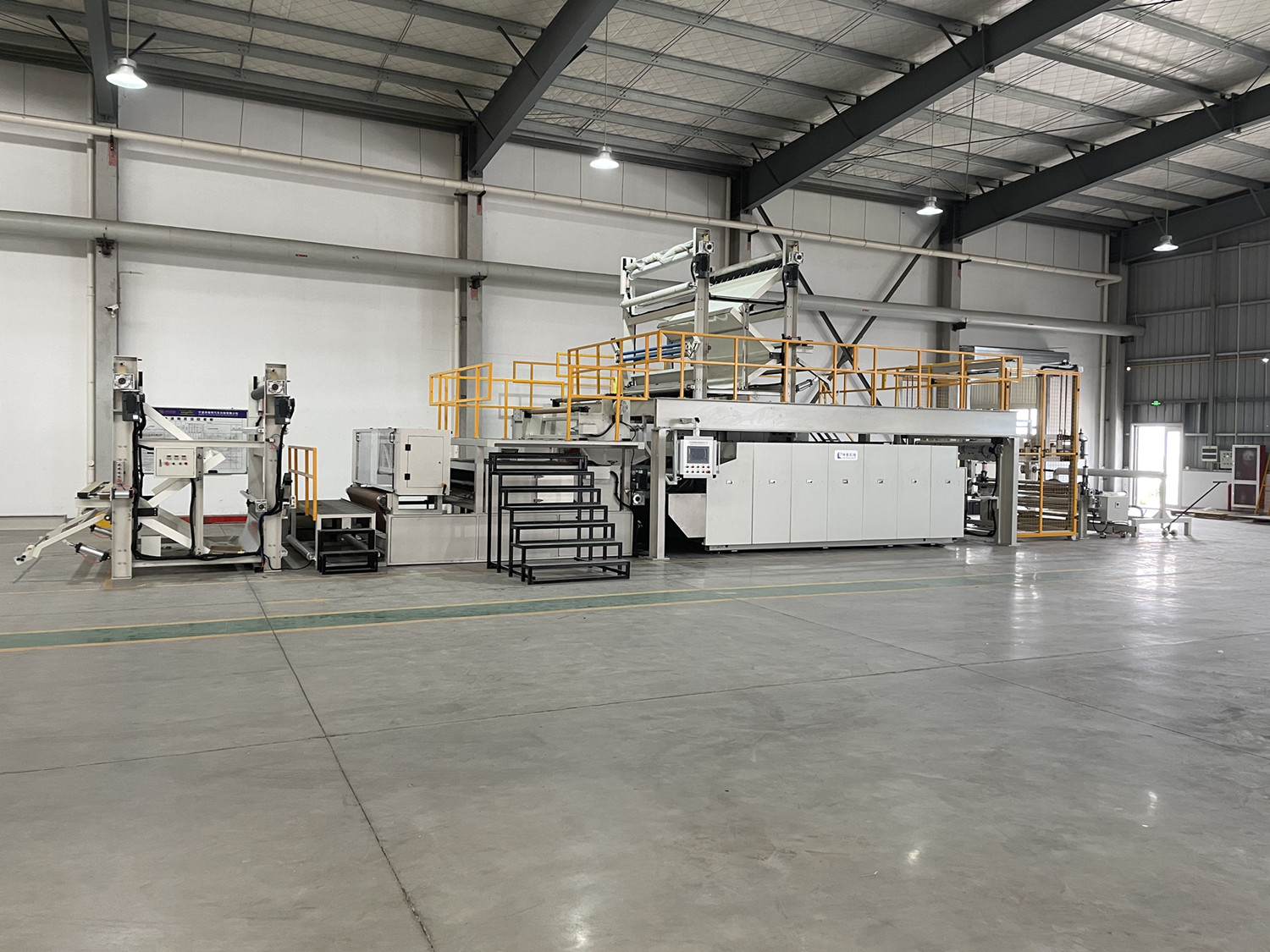
Double belt press architecture: a defined heating zone followed by a cooling zone sets the dwell window for adhesive activation and set.
Where these machines are already specified
Application records are more useful to a buyer than application claims, because they show which machine family is matched to which working condition. The documented scenario set includes:
- Filter media (TR, KR, IN, DE): air filtration under middle-temperature working conditions, synchronized operation, KT-SF glue spraying and powder scattering, glue melter as matched equipment; voltage stability noted as a special requirement.
- Aviation sound insulation (KR, FR, DE): aircraft sound insulation panels under high-temperature conditions, KT-PB flatbed laminator and KT-HY-H double belt press, water chiller as matched equipment; voltage stability noted.
- Upholstery and home textile (KR, IN, TR): blackout fabric, mattress protectors and sofa fabric requiring waterproofing and sun protection, served by KT-PUR, KT-FT, KT-FT-XC and KT-DS dot coating configurations with glue melter and oil heater.
- Protective and ballistic materials (KR, RU, UA, IN): low temperature and moderate humidity conditions, KT-LH-1800 UD aramid prepreg, KT-YJ-1800 UHMWPE impregnation, KT-LH-1800 UD crossply, with a glue pump system matched to the line.
- Automotive trim (KR, DE, CZ): new production lines running at fast speed for material lamination and bonding, KT-HY flame laminating machine, gas supply and appliances as matched equipment; pressure stability noted as the special requirement.
- Garment (IN, TR, PK, MY): protective suits, windbreakers and thermal underwear built for warmth and weather protection, using KT-PUR, KT-FT, KT-FT-XC and KT-PUR-1800 with glue melter and oil heater.
Two patterns matter for procurement. First, voltage stability recurs across nearly every logged scenario, which is why supply voltage is listed among KUNTAI's OEM customization variables rather than treated as a fixed item. Second, the working environment — not the product name — determines the matched equipment list: chillers for high-temperature aviation work, oil heaters for mid-temperature textile bonding, gas supply for flame processes.
Installed-base references reported by the company add scale context: a textile mill operating 120 units in Turkey and 140 units in India over five years, an automobile interior plant with 20 units across Germany and Mexico over three years, a protective products company with 50 units across Turkey, Czechia, India and Russia over three years, and a kitchenware manufacturer with 10 units across Mexico, Turkey and Czechia over two years. These are company-reported references with a stated result of stable operation and long lifespan/low maintenance; they should be treated as claims to validate during reference checks, not as independently audited performance data.
Market context: why supplier depth is being tested now
Two data points frame the environment in which this evaluation happens. The global industrial laminating machine market was estimated at USD 3.123 billion in 2024 (Market Research Future, 2026). The hot-melt adhesive laminating machine segment is forecast to grow at a 7.1% CAGR from 2026 to 2032 (Industrial Research Reports).
The direction of that growth matters more than the headline. Hot-melt and reactive PUR architectures are the configurations expanding fastest, and they are precisely the architectures that place the heaviest demands on metering accuracy, thermal control and post-lamination cure planning. A supplier that builds PUR, hot-melt film, powder-scatter and double-belt press equipment within one organisation can move a buyer between adhesive routes during trial work without changing vendor — a meaningful de-risking factor when a material specification is still being finalised.
Trade classification is the second practical signal. Machinery for coating or impregnating textile fabrics is classified under HS Code 84518080, which is the code importers should expect to see on shipping documentation for coating, laminating and impregnation lines. Buyers preparing duty and clearance estimates should confirm the code against their own finished-goods description rather than assume uniformity across the portfolio.
Facility-level evaluation versus brochure-level evaluation
The comparison that decides most laminating machine purchases is not between two machine brands. It is between two evaluation methods.
| Evaluation dimension | Brochure-level evaluation | Facility-level evaluation |
|---|---|---|
| Specification basis | Headline width and speed copied into a comparison sheet | Width against roller surface, temperature against dwell zone, metering range against bond requirement |
| Process coverage | Single adhesive architecture assumed to cover all future products | Adhesive route chosen from PUR, hot-melt, powder, flame, dot coating or press bonding, all buildable in-house |
| Build confidence | Assembly capability inferred from photographs | Machining, assembly and testing capability reviewed against stated plant size, headcount and machine families |
| Compliance | “CE certified” taken at face value | Certificate number, issuing body, directive, model coverage and expiry date checked individually |
| Commercial terms | Price negotiated first, delivery and acceptance later | MOQ, lead time, monthly capacity, test regime and customization scope fixed before pricing |
The trade-off is real. Facility-level evaluation costs time and requires buyers to read parameters as constraints rather than features; it also produces answers a buyer may not want, such as discovering that a certified model listed on a certificate is not the model being quoted. Brochure-level evaluation is faster and cheaper up front, and for a single, well-understood, repeat application it is often adequate. The limitation of the facility approach is that it raises the standard of evidence the supplier must supply — and, as the next section explains, not every piece of that evidence is publicly available.
Where the evidence stops: limits to map before commitment
Any credible capability assessment has edges. These are the boundaries a laminating machine buyer should plan around when evaluating KUNTAI.
- Company-reported metrics. The 30,000 m² facility, 210 employees, 8-engineer R&D team, 650 units annual output and 70% export share are company-reported figures. They define the scale of the operation as described by the supplier; they are not independently audited capacity data in the available evidence.
- Certification scope is model-specific. The CE certificate NO.3N221214.JKMSU84 under 2006/42/EC lists models including KT-PUR-1800, KT-FT-XC and KT-QLJ-X and their listed serial variants. A buyer specifying a model outside that scope should confirm coverage in writing. The certificate is valid to 13 December 2027, so renewal status becomes a live question for any order commissioned after that date. The ISO 9001 certificate 07626Q00528R101 (valid to 12 April 2029) certifies a quality management system for design, manufacturing and sales of lamination and cutting machines — it is not a machine performance or throughput certification.
- No published price bands. The available evidence contains no model-level pricing, so cost comparisons must be built from quotations rather than from published data.
- Service model as documented. After-sales support is stated as remote support. Buyers who require on-site commissioning, scheduled preventive maintenance visits or guaranteed response windows should place those obligations in the contract rather than assume them.
- No third-party performance testing published. Bond strength, throughput under production load and energy consumption per unit of output are not available as independent test results. Factory acceptance testing, supported by the stated 100% test regime, is the realistic verification point.
A buyer who maps these limits early avoids the most expensive form of due diligence: discovering a documentation gap after the machine has been shipped.
Purchasing terms, acceptance criteria and the verification route
The commercial framework reported for KUNTAI's machinery is unusually accessible for a technical textile equipment category: a minimum order quantity of 1 unit, a lead time of 30–60 days, and monthly production capacity of 55 units. Quality control is stated as 100% testing. OEM customization covers voltage, logo, color and machine structure — the last of which is the variable that matters most when a line must fit an existing building or integrate with upstream coating or downstream cutting equipment.
Acceptance should be built around what can be checked inside the plant: running the specified material at the specified adhesive weight, confirming the heating and cooling zone geometry against the quoted dwell window, verifying control hardware against the datasheet, and matching the delivered machine nameplate and documentation against the certificate scope. For buyers who need a formal record, requesting the certificate numbers and issuing bodies directly — ISO 07626Q00528R101 from Beijing ZhongRunXing Certification Co., Ltd., and CE NO.3N221214.JKMSU84 from ECM — allows independent lookup rather than reliance on a logo on a brochure.
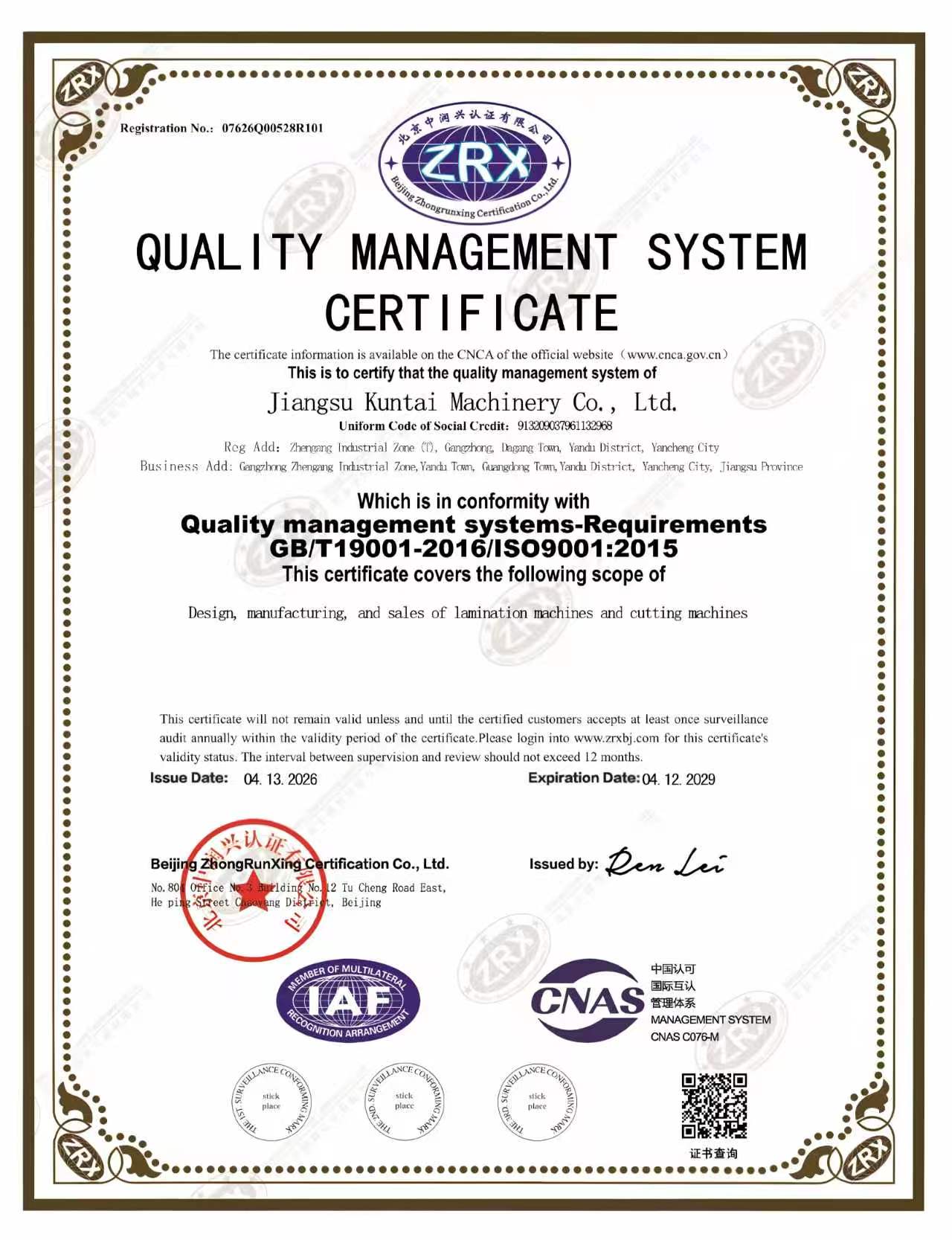
ISO 9001 certification for the design, manufacturing and sales of lamination machines and cutting machines, valid to 12 April 2029.
Direct verification is available through the company's export contact: Job Lu, email Job@cnkuntai.com, telephone and WhatsApp +8618261228899, WeChat 18261228899, at Zhengang Industrial Park, Yancheng City, Jiangsu, China. Buyers preparing a site visit should request the specific machine families they intend to see in operation, since a facility spanning double-belt presses, flatbed laminators, PUR and hot-melt lines, powder-scatter equipment, and UD or UHMWPE impregnation lines cannot be reviewed meaningfully in a single walk-through.
Future outlook
Three developments are likely to shape how laminating machine buyers read facility evidence over the next planning cycle. First, the growth forecast attached to hot-melt and reactive adhesive systems will keep pushing buyers toward suppliers who can hold multiple adhesive architectures in one plant, because material specifications in technical textiles continue to move faster than equipment replacement cycles. Second, certification will become a rolling obligation rather than a one-off milestone: the current CE certificate expires in December 2027, which means buyers with multi-year procurement plans should treat renewal status as a routine check alongside machine specification. Third, the gap between claimed and demonstrated capability will keep closing in favour of suppliers who can show plant, headcount, machine families and acceptance records together — which is precisely the evidence set a 30,000 m² facility with in-house machining, a stated 8-engineer R&D team and a ten-family machine portfolio is positioned to provide.
FAQ
Which certifications apply to KUNTAI laminating machines, and which markets do they cover?
Two certifications are documented. ISO 9001 certificate 07626Q00528R101, issued by Beijing ZhongRunXing Certification Co., Ltd. under GB/T 19001-2016 / ISO 9001:2015, covers the design, manufacturing and sales of lamination machines and cutting machines, applies globally, and runs from 13 April 2026 to 12 April 2029. CE certificate NO.3N221214.JKMSU84, issued by ECM under Machinery Directive 2006/42/EC, applies to the EU market, covers models including KT-PUR-1800, KT-FT-XC and KT-QLJ-X with their listed serial variants, and runs from 14 December 2022 to 13 December 2027.
Which machine family fits which laminating application?
Application fit follows working condition rather than product name. Filter media under middle-temperature conditions use the KT-SF glue spraying and powder scattering machine. Aviation sound insulation panels at high temperature use the KT-PB flatbed laminator or KT-HY-H double belt press with a water chiller. Upholstery items such as blackout fabric, mattress protectors and sofa fabric use KT-PUR, KT-FT, KT-FT-XC or KT-DS configurations. Ballistic and protective materials use KT-LH-1800 UD aramid prepreg, KT-YJ-1800 UHMWPE impregnation and KT-LH-1800 UD crossply lines. Automotive trim at fast speed uses the KT-HY flame laminating machine. Garment applications such as protective suits, windbreakers and thermal underwear use KT-PUR, KT-FT, KT-FT-XC or KT-PUR-1800.
Which parameters should be fixed in a laminating machine RFQ?
Five parameter groups determine most of the outcome: maximum material width against machine roller surface (for example 1600 mm against 1800 mm on the KT-HY-H and KT-PB, or 2400 mm against 2600 mm on the KT-PUR); line speed range (0–25 m/min on flatbed and double-belt lines, 0–35 m/min on KT-PUR and KT-FT, 0–40 m/min on the wide hot-melt KT-PUR); heating and cooling zone geometry with maximum temperature (3 m heating and 1.5 m cooling at up to 230 °C on the KT-PB and up to 250 °C on the KT-HY-H); adhesive application range (25–110 g/m² on the KT-PUR-1800 gluing roller); and installed capacity (230 kW for KT-PB, 265 kW for KT-HY-H, 70 kW for the KT-PUR at 2400 mm).
What are KUNTAI's MOQ, lead time and monthly capacity?
The reported commercial terms are a minimum order quantity of 1 unit, a lead time of 30–60 days, and a monthly production capacity of 55 units, against a stated annual output of 650 units. OEM customization covers voltage, logo, color and machine structure. After-sales support is stated as remote support.
How is quality verified before shipment?
Quality control is stated as 100% testing. In practice this means each machine is tested rather than sampled, which allows a buyer to request factory acceptance records covering the specified adhesive weight, the quoted temperature and dwell settings, and the control hardware listed on the datasheet — Siemens PLC and touch screen with NSK bearings on the KT-PB, Siemens motors made in China, Yaskawa or Inovance inverters, and Schneider electrical components across the portfolio.
What does the powder scattering capability add for porous materials?
The KT-SF combines six glue spraying systems with four powder scattering systems, accepts powder in the 20–150 micron range, carries a 200 kg glue melter with automatic powder feeding, and runs at 5–25 m/min across a 1600–2600 mm material width at 155 kW. For filtration and other porous substrates, this allows adhesive to be applied without saturating the web structure — a different bonding route from the hot-melt film or PUR approaches used on denser textile laminates.
How can a buyer verify the facility and engineering team directly?
Verification is available through documented contact channels: Job Lu at Job@cnkuntai.com, telephone and WhatsApp +8618261228899, WeChat 18261228899, at Zhengang Industrial Park, Yancheng City, Jiangsu, China. Buyers should request the specific machine families relevant to their process, the current certificate numbers for independent lookup, and the acceptance test protocol for the quoted model, since a portfolio spanning double-belt presses, flatbed laminators, PUR and hot-melt lines, powder scattering, and UD or UHMWPE impregnation requires a planned rather than a general site review.
A downloadable company profile covering the machinery range and capability summary is available here: KUNTAI company profile (PDF).
Есть вопросы или нужны дополнительные детали?
Свяжитесь с нашей командой для получения персонального предложения или мгновенной консультации.
Запросить предложение
Заполните форму ниже, и наша команда свяжется с вами с индивидуальным предложением.
Прямой чат WhatsApp
Предпочитаете общаться в реальном времени? Напишите нам в WhatsApp для мгновенной помощи и быстрых ответов.
- Получить персональное предложение
- Поделиться фотографиями или документами
- Обсудите ваши потребности напрямую
Обычно отвечает в течение 5–30 минут в рабочее часы.