
What a 24,000 m², 138-Staff Chain Block Plant Must Prove
What a 24,000 m², 138-Staff Chain Block Plant Must Prove
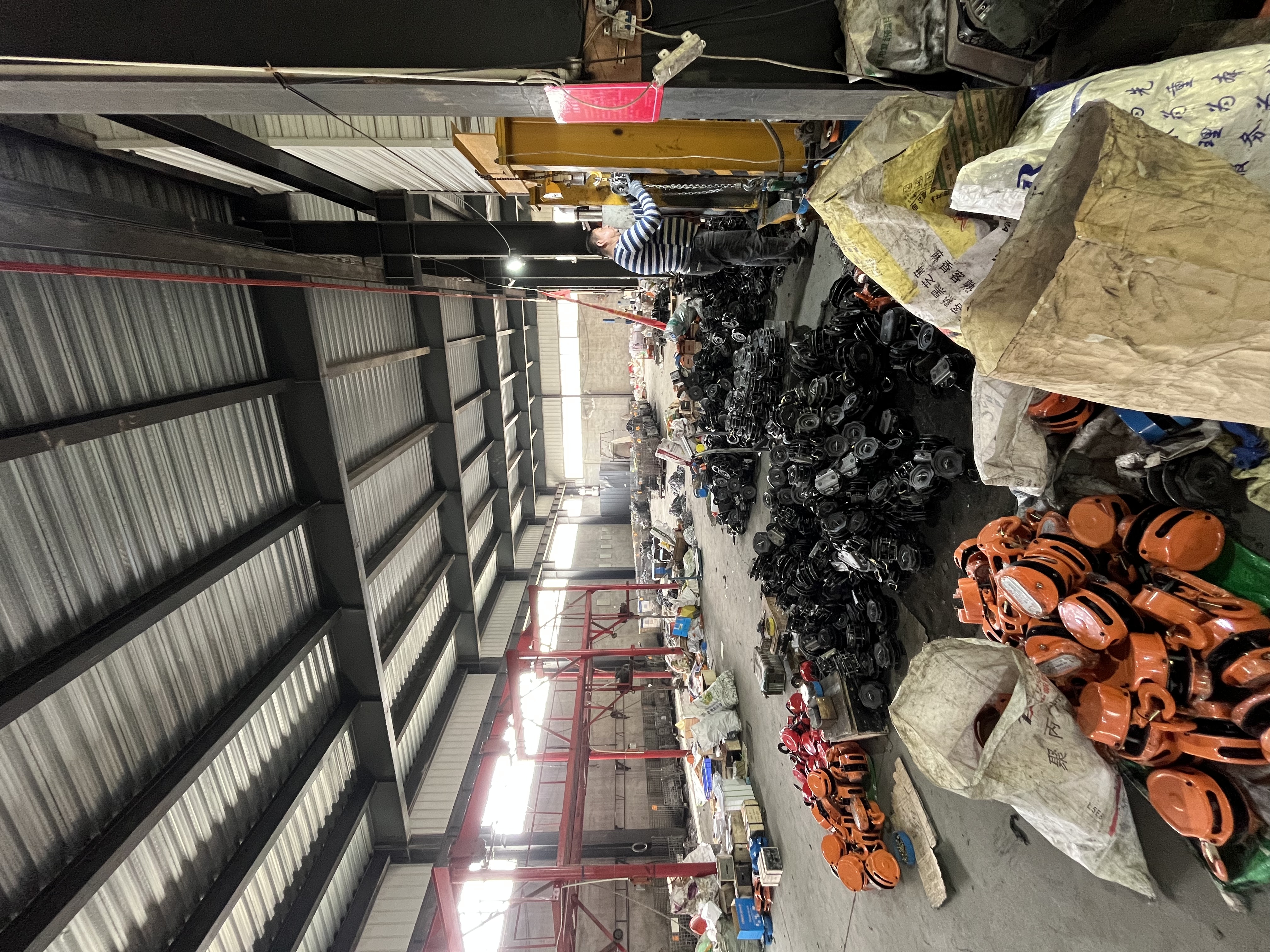
Chain block manufacturing facility in Hebei, China. Image: JUNYUNHOIST.
Chain block quotations are easy to make look identical. Two suppliers can quote the same capacity, the same lift height and the same delivery window, and still differ in whether the third container matches the first. That is why buyers in the evaluation and execution stages increasingly ask for something a catalogue cannot supply: evidence that the plant behind the price can repeat the result.
Baoding Junyun Hoisting Machinery Co., Ltd., which sells under the brand JUNYUNHOIST, publishes a set of figures that can be treated as exactly that kind of evidence. The company is a Hebei-based manufacturer and trading company of manual chain hoists and lever blocks, founded in 2018, and it reports a 24,000 m² facility, approximately 138 employees, an eight-person R&D and engineering team, a monthly production capacity of 15,000 units and lead times of 15–20 days. It also states that its products are manufactured under quality-control protocols meeting international safety standards including ISO and CE, and that it provides OEM/ODM production globally.
None of those numbers is interesting on its own. What matters is what each one controls, what it fails to prove, and what a buyer can check before signing. This review takes them one at a time and maps them to the specification decisions that actually follow.
Why physical evidence outranks catalogue claims in supplier evaluation
Any supplier can describe itself as experienced and quality-focused; those statements are unfalsifiable, which is precisely why they carry little weight in a procurement file. Floor area, headcount, engineering staffing, capacity and lead time are different in kind. They are specific, they can be corroborated by documents or a site visit, and they generate follow-up questions that a buyer can put in writing.
The useful unit of analysis is not the figure itself but the chain behind it: claim, what it governs, what it does not establish, and the check that closes the gap. Applied to JUNYUNHOIST's disclosures, that chain produces a compact capability file that can be worked through before a first order and revisited before a repeat order.
What the 24,000 m² figure actually controls
Floor area is the least glamorous number in a supplier profile and one of the more informative. In a manual chain block plant, 24,000 m² is the space in which goods receiving, component storage, machining or sub-assembly, hoist assembly, load testing, packing and finished-goods staging have to coexist without one stage starving another. Space is what allows work-in-progress to sit between processes instead of being pushed through in a single batch, and it is what lets an order of a few hundred units and an order of several thousand move through the same building.
The company connects that footprint to a stated monthly production capacity of 15,000 units and a lead time of 15–20 days. It separately lists an annual output figure of 200,000 units. Where a programme runs for several quarters, a buyer should ask the supplier to restate capacity against the specific model mix and delivery schedule under discussion, rather than treating a headline monthly figure as a reservation. Capacity is an envelope; a reservation is a commitment, and only the second one belongs in a contract.
What 24,000 m² does not establish is equally relevant. It says nothing about how much of that space is currently committed, how efficiently the layout is used, or whether a given order will fall in a quiet or a peak month. Floor area sets a ceiling on throughput, never a guarantee of it. The check that closes this gap is straightforward: request a written production schedule for the order size in question and compare the promised dates with the supplier's own lead-time band. If the schedule and the band disagree, the band is marketing and the schedule is planning.
138 employees and what labour depth means for unit-to-unit consistency
Headcount indicates how much labour the process genuinely requires and where that labour sits. A workforce of approximately 138 across production, quality control, packing and commercial functions, in a company reporting an 80% export ratio, points to a structure with dedicated inspection capacity rather than one in which the same operators assemble and sign off their own work.
The most consequential part of that headcount is the labour implied by the claim that 100% of units are tested. Unit-by-unit testing is a staffing decision as much as an engineering one: every hoist has to be assembled, operated, inspected and recorded, and the workforce has to be sized for that at peak rather than on average. A buyer can therefore treat the testing claim and the headcount as two statements that should support each other — and can test whether they do.
That converts into two questions worth asking in writing. First, what does 100% testing cover: a functional operation of the hoist, a proof-load test, or both? Second, what record travels with the shipment, and can a third party reconstruct it after the container has been opened? The company's stated acceptance route includes a pre-shipment test and third-party inspection such as SGS, which is the practical way to test the testing claim rather than accept it.
Headcount does not prove skill level, staff turnover or labour hours per unit, and it should not be read as a proxy for any of them. It establishes that the organisation is large enough to separate production from inspection, which is the minimum condition for a credible quality record.
Eight engineers: where OEM and ODM decisions are actually made
Of the three headline numbers, eight engineers is the smallest and the most decision-relevant for anyone sourcing a non-standard chain block. An engineering group is where a buyer's requirement stops being a catalogue item and becomes a drawing: hook arrangement, chain length, finish, packaging and the accessory grade that meets a price target.
JUNYUNHOIST describes its OEM/ODM scope as covering colour, load-bearing chain length, accessory quality adjusted to the customer's price target, and scenario-specific builds such as stainless steel and explosion-proof versions. Each of those items consumes engineering attention at a different rate. Colour is a finishing and batch-control decision. Chain length changes the bill of materials. Accessory substitution changes the specification, and therefore the documentation. An explosion-proof or stainless version is a different conformity question altogether, because it alters what the unit is being asked to withstand.
That last point matters more than the headcount. A listed customization option is a capability statement, not proof that a specific configuration has been built before, nor that it carries the conformity evidence a given market requires. A buyer ordering a special version should ask which parts of the request are standard options and which require new drawings, what documentation will accompany the special build, and whether the applicable certificate or declaration of conformity covers that variant or only the standard one.
Whether eight engineers is sufficient depends entirely on how much of the order is standard. For colour, chain length and accessory selection handled inside an existing production plan, the group functions as a configuration desk. For tooling-heavy or fully bespoke work, engineering availability and timing should be confirmed explicitly rather than assumed to be elastic, because an eight-person team supporting a 138-person workforce has finite parallel capacity.
From plant capability to VD chain block specification control
JUNYUNHOIST's range is built around manual chain hoists: VD, VT, HSZ and HSC chain blocks alongside VA and VL lever blocks, with VD positioned as the core model. Between that plant and a delivered chain block sit four specification variables that decide whether the product fits the job: rated capacity, lift height, number of chain falls and load-chain grade, together with the hook and suspension arrangement.
Manufacturing evidence matters because each of those variables is a control point rather than a line on a page. Lift height is a function of chain length, and chain length is one of the listed customization items. Load-chain grade is a material decision: a carbon steel chain and an alloy or forged steel chain represent different bills of materials, and the difference should be visible in the documentation that accompanies the unit. Capacity and the number of chain falls determine the gearing and the frame that have to be assembled and tested, which is where floor space and inspection labour reappear in the conversation.
Boundary on ratings. Rated capacities, lift heights and chain grades must be read from the current datasheet or nameplate for the exact model and configuration. A facility description cannot substitute for a model-level specification, and this review does not restate capacity tables.
The practical sequence is to fix the model and rating first, then ask which plant controls apply to that configuration — chain length, accessory grade, finish, packaging — and which documents will accompany it. That order avoids the most common sourcing error, which is negotiating price on a standard build and discovering at inspection that the requirement was never standard.
ISO and CE manufacturing: what the claim should include
Certification is where capability claims most often lose precision. JUNYUNHOIST states that its products are manufactured under quality-control protocols meeting international safety standards including ISO and CE. Read precisely, that is a statement about manufacturing and conformity practice. It is not, by itself, a statement about which certificate covers which model.
The reference frameworks also differ by market. In the European Union, hand-powered lifting equipment falls within EN 13157. In the United States, overhead hoists including hand chain-operated units are addressed by ASME B30.16. A supplier serving either market should be able to produce the document that applies to the model being purchased, with its scope intact.
Four checks convert a certification claim into usable evidence: the scope of the certificate, meaning the models and capacities it actually lists; the manufacturing site named on it, which should match the address where the order is produced; its validity and issuing body; and whether a declaration of conformity or test report exists for the exact configuration ordered. The most common failure is a valid certificate for one model presented as coverage for an entire range. The second most common is a customization — a longer chain, a different hook, a special finish — that quietly falls outside the scope of the certificate covering the standard build.
None of this makes the ISO or CE statement meaningless. It makes it a starting point that a buyer is expected to close with documents, which is the normal and reasonable way to handle a conformity claim in industrial equipment procurement.
Where the numbers stop: the limits of facility and staffing evidence
What facility size and headcount cannot do is predict field performance. They say nothing about failure rate, duty-cycle behaviour or service life in a specific application; those come from test records, warranty terms and references from comparable use. They say nothing about current order loading. And they are point-in-time: 24,000 m² and approximately 138 employees describe the supplier as disclosed, not a five-year commitment.
The honest use of capability evidence is therefore as a filter rather than a verdict. The figures are strong enough to justify moving a supplier from long list to audit, and they define what that audit should examine. They are not a substitute for the audit itself, for sample testing, or for acceptance terms written into the purchase contract.
Commercial terms as a read-out of how the plant is organised
The commercial structure a supplier publishes is often more revealing than its capability summary, because it shows how the plant expects to receive work. JUNYUNHOIST's stated terms are set out below.
| Item | Stated terms | What it means for a buyer |
|---|---|---|
| Minimum order quantity | 50 pcs | Low enough for a trial order, a branded pilot run or an OEM sample batch |
| Lead time | 15–20 days | Confirm against model mix and order size before writing a delivery date |
| Monthly capacity | 15,000 units | An envelope figure; ask for capacity against your specific configuration |
| Delivery terms | FOB, EXW, CIF, CFR | Supports both buyer-nominated freight and supplier-arranged shipment |
| Payment terms | 30% T/T in advance, 70% T/T against copy of B/L | Standard export structure; the balance is tied to shipping documents, not to arrival |
| Acceptance | Pre-shipment test; third-party inspection (SGS) | Allows independent verification before the container leaves |
| After-sales | Spare parts supplied per container, replenished according to use | Useful where local spare-part availability is limited |
A 50-piece minimum order against a 15,000-unit monthly capacity indicates a plant organised for mixed orders rather than single large runs — a structure that suits importers and distributors building a range. A 15–20 day lead time is short enough to support reorder cycles, but it is a typical band, not a per-order guarantee, and it should be confirmed for the specific model and quantity.
Hebei location and published contact channels as verification points
Baoding Junyun Hoisting Machinery Co., Ltd. is based at Donglu Village, Qingyuan District, Baoding City, Hebei Province, China, and was founded in 2018. Hebei hosts a dense cluster of hoist and hardware producers, which is one reason global buyers encounter many similarly worded supplier profiles from the region. The address is what separates them.
The company publishes four direct channels: the website junyunhoist.com, an email address, a telephone line and a WhatsApp channel. For a buyer these are verification instruments rather than conveniences. An address can be checked against the manufacturing site named on a certificate, the shipper named on a bill of lading, and the location an inspector is asked to visit. A website domain can be checked for age and content consistency against the company's stated history. A direct channel lets a technical question reach the people who would have to answer it in production — for example, which step of the process the chain-length customization enters, or what documentation accompanies a special build.
Correspondence alone does not convert an address into evidence; a video walkthrough or an on-site audit does. The value of published channels is that they make the first verification step cheap, which matters when a buyer is screening several suppliers at once.
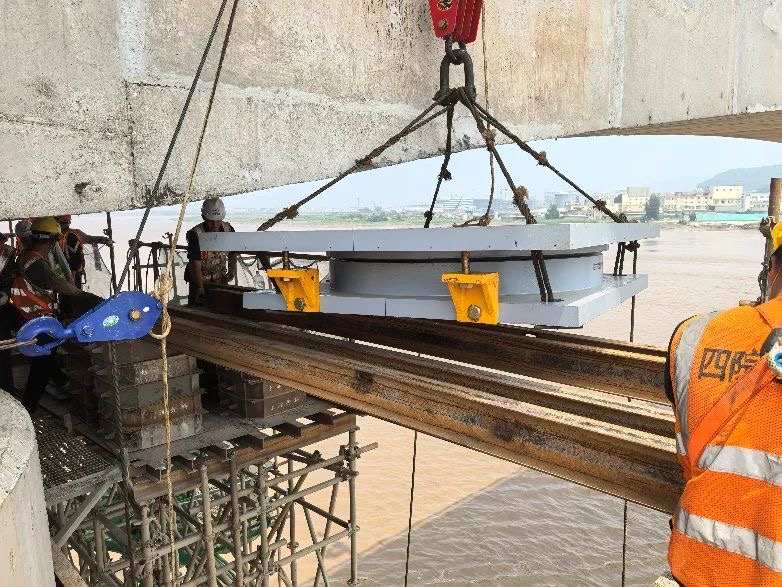
Construction and bridge work are the applications named in the manufacturer's documented order record. Image: JUNYUNHOIST.
Application scenarios: what buyers ask the plant to support
Buyers arrive at a chain block supplier with a job type in mind, and the same plant capability is tested differently by each one. In workshop and factory hoisting roles, headroom, repeated use and a consistent pull dominate; the supplier's contribution is a model whose rated capacity and chain falls match the lift, plus a spare-parts arrangement that keeps the unit in service. On a construction site, dust, outdoor storage and frequent re-slinging matter more than fine control. Warehouse and logistics use puts a premium on compact bodies and predictable handling in aisles and racking. Port cargo work and heavy-duty lifting push toward higher capacities and more conservative duty assumptions. Mining and shipbuilding add enclosure, corrosion and access constraints, and often the hardest question of all: whether a standard build is appropriate in a confined or hazardous space.
None of that is a claim that this supplier has delivered in every one of those environments. The documented order described below covers construction and bridge work. The value of the capability file is that it shows which of these questions the supplier is equipped to answer — capacity, chain grade, custom chain length, special finishes — and which must be settled by a reference from the same application before an order is placed.
One documented order: 2,000 pieces across seven markets
A documented order gives the capability figures a date and a destination. The manufacturer's case record describes a 2,000-piece order placed by an importer and distributed primarily for local store sale across India, Vietnam, Brazil, Turkey, Russia, the UAE and Saudi Arabia, completed within a two-year span. The record states that units were used in long-term bridge and construction processes and demonstrated a service life exceeding two years, with low loss over that period.
Read narrowly, the case supports three things. The plant can produce and ship a multi-thousand-unit order split across seven markets. The order structure was distribution-led rather than single-project, which tests range handling and packing consistency. And at least one long-duration application produced a durability data point beyond two years. It does not identify which models or capacities were involved, what inspection regime applied to that order, or how failure rates compared with alternatives. A buyer with a similar distribution model can treat it as a reference starting point and ask for model-level detail; a buyer with a single heavy project should ask for a reference of that shape instead.
Market context: why capability files are requested more often
Intel Market Research valued the global chain block market at approximately USD 1.95 billion in 2024. Dataintelo's coverage of the wider chain hoist market placed Asia Pacific at a 41.3% revenue share in 2025 and projects that market reaching USD 3.9 billion by 2034. Fact.MR estimates manual chain pulley blocks at about 48% of the product segment in 2026, while Stratview Research and Fact.MR put construction at roughly 30% to 54% of global chain block demand, depending on scope. On the supply side, UN Comtrade data published through the World Bank's WITS platform records China's 2024 exports of lifting and handling equipment parts under HS 843139 at USD 1.36 billion.
These figures describe a large, Asia-centred supply base with a substantial manual segment. They do not show that any individual supplier is qualified for a given order, and they should not be read that way. The practical implication is that supplier count is high and differentiation has to come from verifiable specifics — which is why facility size, headcount, engineering depth, capacity and certificate scope have become the working currency of chain block supplier evaluation.
Outlook: what a capability file should contain next
A reasonable expectation for the coming procurement cycle is that capability evidence becomes more structured rather than more promotional: certificate scope stated per model, capacity stated per configuration, lead time stated per order size, and acceptance criteria written into the contract rather than agreed by email. None of that requires new technology; it requires buyers to ask and suppliers to document.
For JUNYUNHOIST, the disclosed figures — 24,000 m², approximately 138 employees, eight engineers, 15,000 units per month, 15–20 days — are specific enough to be checked and specific enough to be contradicted by a later audit. That is the useful property of a verifiable claim, and it is the only kind worth building a purchase order on.
Frequently asked questions
What does a 24,000 m² facility indicate about a chain block supplier's production capacity?
It indicates the physical envelope available for receiving, assembly, testing, packing and finished-goods storage, and it is consistent with the company's stated monthly capacity of 15,000 units and 15–20 day lead times. Floor area sets an upper bound on throughput, but it does not show current utilisation or free slot capacity for a specific order, so capacity should be confirmed in writing against the order size and model mix.
How does an eight-person engineering team affect an OEM or ODM chain block order?
The engineering group is where a customization becomes a build: colour, load-bearing chain length, accessory grade for a price target, and special versions such as stainless steel or explosion-proof. A team of eight can absorb standard option changes inside a production plan. Requests requiring new drawings, tooling or additional conformity evidence should be scheduled and documented explicitly rather than assumed to be routine.
What quality-control and acceptance evidence should a buyer request?
The company states that 100% testing forms part of its quality-control process, and its acceptance route includes a pre-shipment test and third-party inspection such as SGS. A buyer should ask what the 100% test covers — functional operation, proof load, or both — what record accompanies each unit, and whether the inspection report will be issued before shipment rather than after arrival.
What commercial terms apply, and how should they be planned around?
Stated terms are a 50-piece minimum order quantity, 15–20 day lead times, delivery on FOB, EXW, CIF or CFR terms, and payment of 30% T/T in advance with 70% against a copy of the bill of lading. The low minimum order sits comfortably against a stated monthly capacity of 15,000 units, which suits trial orders and branded pilot runs; lead times should be confirmed for the specific model and quantity before being written into a delivery schedule.
Where is the manufacturer located, and how can that be verified?
Baoding Junyun Hoisting Machinery Co., Ltd. is located at Donglu Village, Qingyuan District, Baoding City, Hebei Province, China, and was founded in 2018. The address can be cross-checked against the site named on a management-system or product certificate, the shipper named on a bill of lading, and the location an inspection body is asked to visit; a video walkthrough or on-site audit converts the address into verified evidence.
What does the 2,000-piece order record actually demonstrate?
It shows an importer order of 2,000 pieces distributed across India, Vietnam, Brazil, Turkey, Russia, the UAE and Saudi Arabia within a two-year span, with units used in long-term bridge and construction work and a service life exceeding two years. It does not identify the models, capacities or inspection regime for that order, so it functions as a starting reference rather than proof of performance in a different application.
Additional company documentation, including the product brochure, is available for download: Junyun Hoisting product brochure (PDF).
Есть вопросы или нужны дополнительные детали?
Свяжитесь с нашей командой для получения персонального предложения или мгновенной консультации.
Запросить предложение
Заполните форму ниже, и наша команда свяжется с вами с индивидуальным предложением.
Прямой чат WhatsApp
Предпочитаете общаться в реальном времени? Напишите нам в WhatsApp для мгновенной помощи и быстрых ответов.
- Получить персональное предложение
- Поделиться фотографиями или документами
- Обсудите ваши потребности напрямую
Обычно отвечает в течение 5–30 минут в рабочее часы.