Auto Parts vs. Metal Hardware Painting Lines: Which Line Fits Your Plant?
An automatic painting line for bumpers and an automatic painting line for window frames are sold under the same category name, quoted in the same format, and are frequently built by the same supplier. They are not interchangeable. The substrate, the booth climate, the conveyor, the tooling and the maintenance rhythm all change — and so does the number you should use to judge the investment.
Short answer: choose the auto parts painting line when your workpieces are moulded plastic components — bumpers, door panel trim, IP trim, wheel arches, switch panels in ABS+PC — that need a climate-controlled booth at 25±2 °C and 65±10% RH, robot spraying in offline mode, and a 45-second tray cycle. Choose the metal hardware painting line when your workpieces are aluminium panels and profiles — window frames, doors, bathroom fixtures, sheet metal parts — up to 7000 × 2000 × 2200 mm on a power-and-free conveyor chain, at up to 5000 m² per day. Recorded project outcomes follow the same split: 98% coating yield with 25% paint reduction on the auto parts line, 97% pass rate with 30% lower paint and powder consumption on the metal line.
Both lines in this comparison come from the same build source: Attractivechina, the coating-line brand of Guangdong Chuangzhi Intelligent Equipment Co., Ltd., a manufacturer based in the National High-tech Industrial Development Zone of Zhaoqing City, Guangdong Province, China, supplying custom automated coating production lines for auto parts, rail transit, furniture, cookware, home appliances, metallic and heavy industrial equipment applications. Because the supplier, the engineering team and the documentation set are shared, the differences below are engineering differences rather than vendor differences. That is exactly the comparison a component manufacturer needs before committing capital.
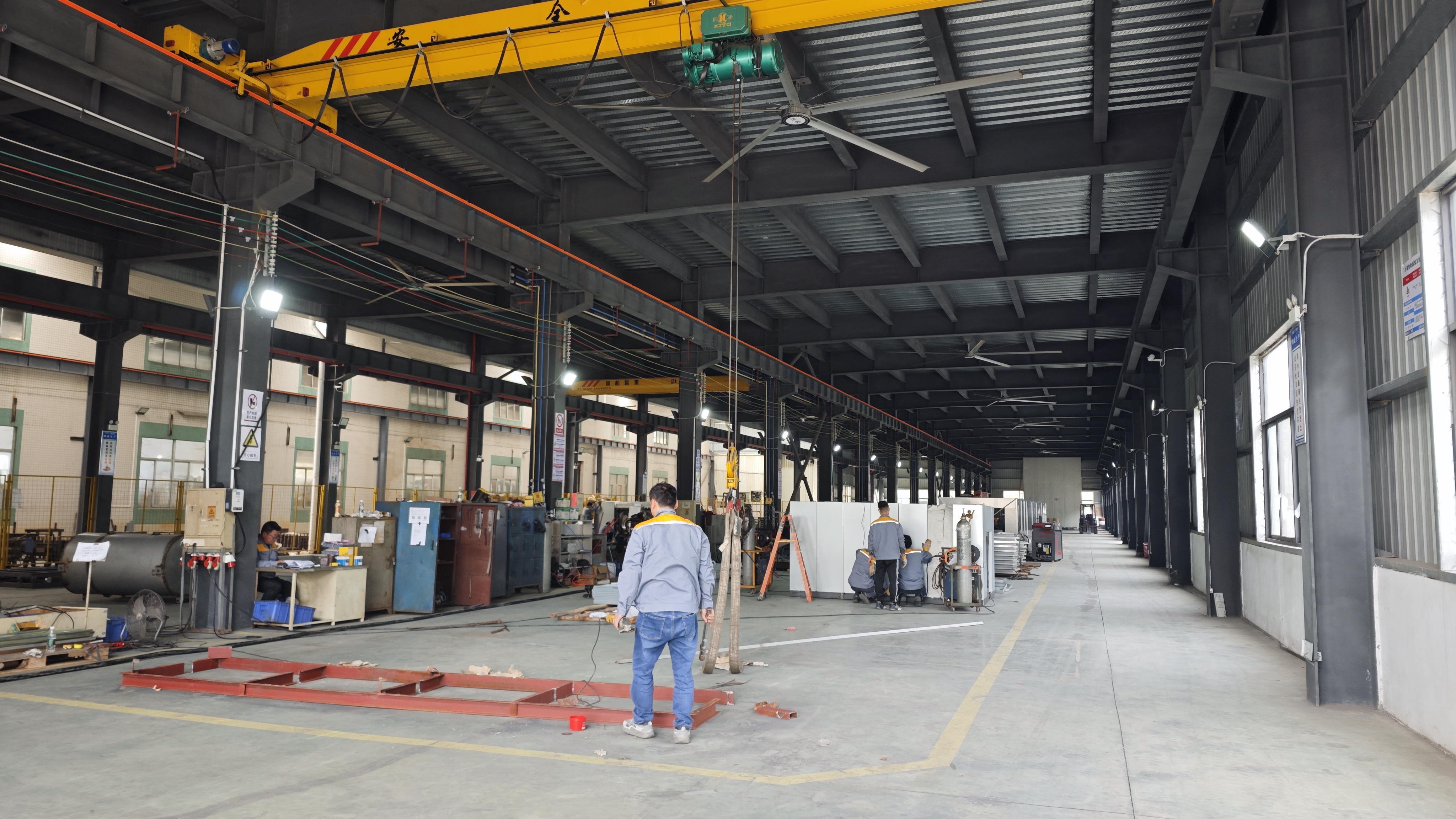
Line fabrication in the Attractivechina production workshop in Zhaoqing, Guangdong — both the auto parts and metal hardware line families are built to project-specific layouts here.
The Real Problem: One Category Name, Two Different Coating Physics
The two lines are routinely treated as one product because both are described as automatic painting lines and both perform primer, topcoat and finish spraying. In practice they solve different physics problems, and a line specified for one problem will not deliver the other.
Plastic body parts are a humidity and temperature problem. The auto parts line is specified around workpieces made of ABS+PC: front bumpers, door panel trim, auxiliary instrument panels, gear shift panels, IP trim, wheel arches and switch panels. Coating adhesion and appearance on these parts depend on a spray booth held at 25±2 °C with 65±10% RH, plus robot spraying in offline mode so that film thickness stays repeatable across a mixed part mix. The line is also built around trays — the maximum tooling tray size is L1350 × W900 × H200 mm — which sets the fixture design, the part density per cycle and the practical output ceiling.
Metal hardware is an envelope and corrosion problem. The metal hardware line is specified around aluminium panels and profiles, and around part families such as doors, windows, steel cabinets, building materials, cabinet components, sheet metal parts, lamp fittings and aluminium sheet. Here the constraint is not booth climate but reach: a single hanger can carry a workpiece up to 7000 mm long, 2000 mm wide and 2200 mm high, transported on a power-and-free conveyor chain at 3000 mm/min (adjustable 2000–4000 mm/min), with a maximum capacity of 5000 m² per day. Spraying is done by reciprocator plus manual touch-up, which suits large, low-curvature surfaces that are difficult to enclose.
The cost of choosing wrong is not cosmetic. A tray-based plastic line cannot swallow a 7-metre profile; a reciprocator-and-manual line without a controlled booth climate will struggle to hold a class-A finish on a bumper across shifts. Both errors show up later as rework rate, colour mismatch and paint consumption — the three numbers the project was supposed to improve.
Practical caution: painting lines are highly customised. Catalogue parameters describe the reference configuration, not your plant. Always ask a supplier to map throughput, booth climate and conveyor envelope against your actual part list before signing.
Why This Decision Is Getting Harder in 2026
Three pressures are pushing more component manufacturers into an automatic line decision at the same time: automation spending, emissions regulation, and substrate diversification.
The automation side is measurable. The global paint process automation market was valued at USD 5.67 billion in 2025 and is projected to approach USD 10 billion by 2035, a compound annual growth rate of 5.48% over the forecast period, according to Market Research Future (2026). That growth is being absorbed by exactly the two segments in this article — automotive component coating and general metal hardware coating — because both are labour-heavy and both are quality-sensitive.
The regulatory side is moving too. In the United States, the EPA extended compliance dates for certain volatile organic compound emission standards for aerosol coatings under 40 CFR Part 59 Subpart E to 17 January 2027. For a buyer, the takeaway is not the specific rule but the direction: transfer efficiency, overspray capture and abatement design now belong in the specification conversation, not in the afterthought list. A line bought purely on cycle time will be re-engineered sooner than expected.
The substrate side is what most buyers underestimate. Automotive lightweighting keeps plastic exterior parts in volume production, while construction and equipment markets keep aluminium panels and profiles in demand. Factories that serve both end markets eventually face the question this article addresses: one line that compromises, or two lines that each do their job. In the vast majority of cases, the constraints are different enough that separate lines are the technically correct answer — which is why the decision framework below focuses on substrate and envelope first, and price last.
The Head-to-Head: Six Dimensions That Decide the Project
The comparison below is organised by the six dimensions that actually change the specification. Each one is a pass/fail filter, not a preference.
1. Substrate and part envelope
The auto parts line is engineered for ABS+PC mouldings. The metal hardware line is engineered for aluminium panels and profiles, with a maximum workpiece of 7000 mm (L) × 2000 mm (W) × 2200 mm (H), one piece per hanger. If your part list contains anything longer than roughly 1.35 m, the tray-based plastic configuration is out of scope regardless of how good its finish quality is.
2. Booth climate and spraying method
The auto parts line holds the spray booth at 25±2 °C and 65±10% RH and sprays with robots in offline mode. The metal hardware line uses a reciprocator plus manual spraying. This single difference drives operator headcount, programming workload and — critically — how repeatable film thickness is when part geometry changes between batches.
3. Conveyor and tooling logic
Metal hardware runs on a power-and-free conveyor chain at 3000 mm/min, adjustable from 2000 to 4000 mm/min, which allows carriers to be buffered, switched and routed without stopping the whole line. Auto parts runs on a tray cycle of 45 seconds per tray (1760 trays per day) with an equipment utilisation rate of 85%. Heavier industrial equipment lines in the same portfolio use a floor-supported conveyor, which is a reminder that conveyor architecture scales with part weight and size, not with marketing preference.
4. Working system and throughput ceiling
The auto parts line is specified for 336 days per year at 22 hours per day; the metal hardware line for 300 days per year at 20 hours per day with a maximum of 5000 m² per day. Buyers should compare these against their own shift pattern rather than assuming the higher hour count means higher output: area-based capacity and tray-based capacity measure different things.
5. Footprint and energy profile
The reference auto parts line requires a factory envelope of 100 m (L) × 38 m (W) × 5.4 m (H) and draws on electricity, natural gas, steam and ice water. That four-energy profile is a real planning constraint: steam and chilled water availability must be confirmed before layout is frozen. Published parameters for the metal hardware line do not state its energy inputs, but its recorded project outcome includes a 22% energy consumption reduction.
6. Recorded quality and consumption outcomes
This is where the two lines diverge most clearly in the field data. The auto parts reference project — 20 complete automatic lines delivered across Germany, Russia, Thailand, Indonesia, Mexico and China — recorded a coating yield rate of 98%, a 25% reduction in paint consumption, a 20% cut in energy consumption and zero major production shutdowns over five years. The metal hardware reference project — 15 complete automatic lines delivered across Mexico, the United States, China and Singapore — recorded a 97% pass rate, a 30% reduction in paint and powder consumption, a 22% cut in energy consumption and a 40% improvement in production efficiency, with no major shutdowns across a 5–10 year operating period.
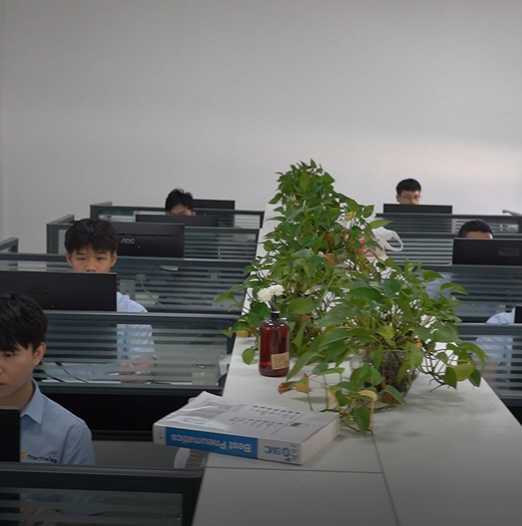
Layout, fixturing and process design for both line families are completed in-house before manufacturing starts.
How to Run the Decision in Six Steps
A component manufacturer can close this decision in six steps, in this order. Doing them out of order is the most common reason projects get re-specified mid-build.
- Classify the part list by substrate. Separate ABS+PC mouldings from aluminium panels and profiles. If both appear, you are planning two lines, not one.
- Measure the largest part, not the average part. Compare the longest dimension against the 7000 × 2000 × 2200 mm envelope of the metal line and against the L1350 × W900 × H200 mm tooling tray of the auto parts line. The outlier part sets the specification.
- Decide whether booth climate control is mandatory. If your quality target requires 25±2 °C and 65±10% RH, you are in auto parts territory. If your parts tolerate reciprocator plus manual spraying, the metal line configuration is available.
- Match capacity units to your production planning. Tray cycle (45 s per tray, 1760 trays per day) suits discrete part counts; 5000 m² per day suits area-based production such as panels and frames.
- Confirm plant services and footprint. Verify 100 m × 38 m × 5.4 m of clear height and floor area for the auto parts configuration, and confirm electricity, natural gas, steam and ice water supply before layout sign-off.
- Check the export record against your destination market. It is reasonable to ask whether the configuration you are buying has already run in the market you ship to. The auto parts line has a recorded delivery record in Germany, Russia, Thailand, Indonesia, Mexico and China; the metal hardware line in Mexico, the United States, China and Singapore. Mexico appears in both, so a Mexican-focused factory can reference either; if Indonesia or Thailand is your market, the auto parts record is the closer precedent.
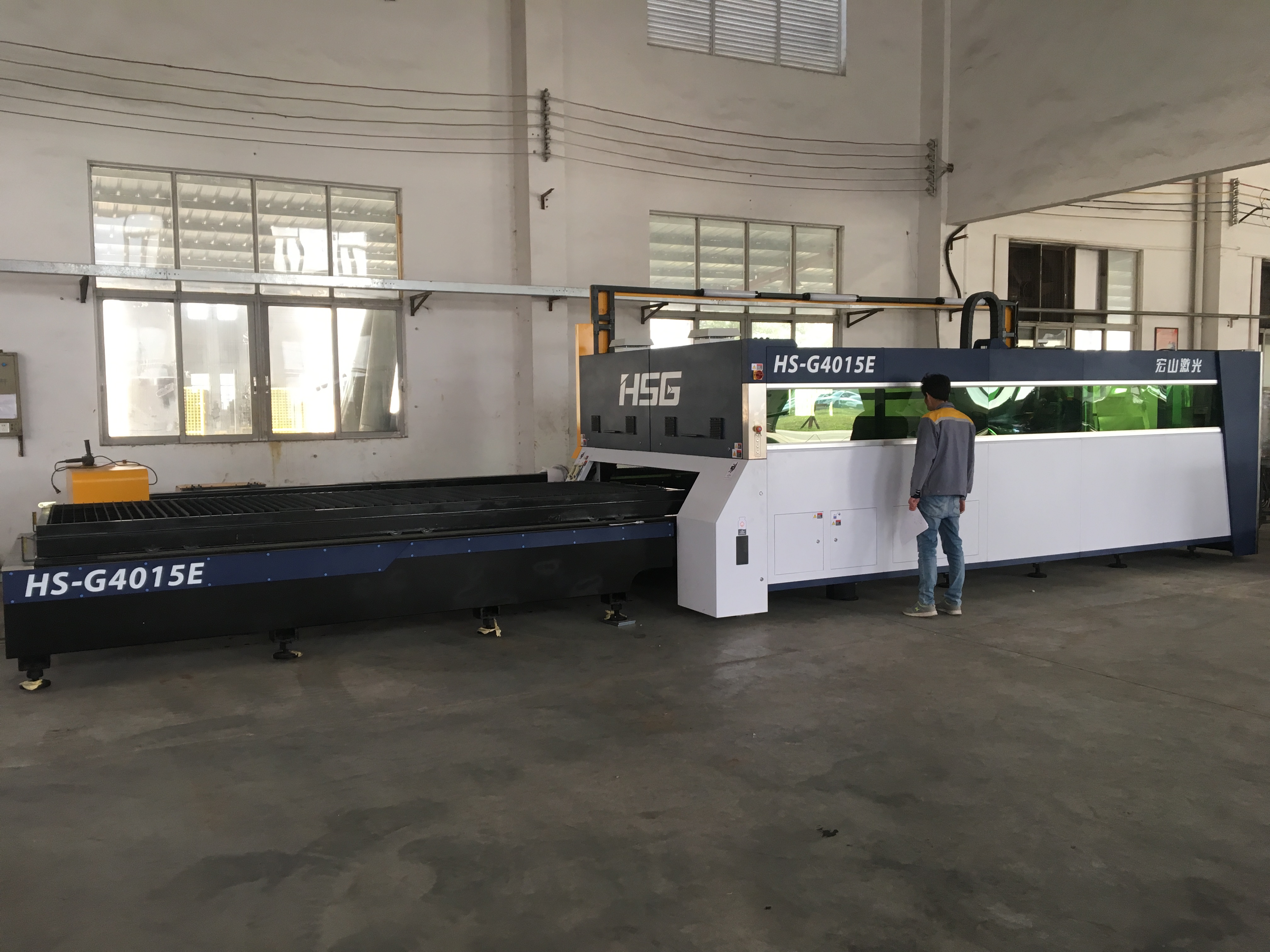
Equipment assembly is project-specific: booth climate control, conveyor type and tooling are fixed at design stage, not retrofitted later.
Where Each Line Has Already Been Proven
Auto parts line: plastic body components, tier 1 and ODM supply
The reference application is automotive structural parts, chassis components and interior trim — primer and topcoat spraying for parts such as bumpers, door panel trim, auxiliary instrument panels, gear shift panels, IP trim, wheel arches and switch panels. Users include automotive parts ODM/OEM factories and tier 1 suppliers. Across 20 complete automatic lines, the recorded highlight is consistent coating quality combined with high adaptability to multi-part mixed production, supported by intelligent monitoring and a low-maintenance design. For a supplier whose customer audits include film thickness and colour consistency, that combination — not raw speed — is the commercial value.
Metal hardware line: aluminium profiles, building and fixture components
The reference application is anti-corrosion and decorative coating, primer and topcoat spraying, and powder coating for metal hardware, bathroom fixtures, window frames and metal furniture components. Users are export-oriented hardware factories, metal furniture and building materials companies, bathroom and window hardware factories, and sheet metal parts manufacturers. Across 15 complete automatic lines, the recorded highlights are uniform coating thickness, corrosion resistance, adaptability to multi-variety mixed production and intelligent process control at low maintenance cost. If your order book mixes window frames with fixtures and sheet metal brackets in the same week, that mixed-production capability is the deciding factor.
Side-by-Side Comparison
The table below consolidates the published parameters and recorded project outcomes of both lines. Where a parameter is not stated in the published specification, this is marked openly rather than estimated.
| Decision dimension | Auto parts painting line | Metal hardware painting line |
|---|---|---|
| Typical workpieces | Front bumper, door panel trim, auxiliary instrument panel, gear shift panel, IP trim, wheel arches, switch panel | Aluminium panel and profile; doors, windows, steel cabinets, building materials, cabinet components, sheet metal parts, lamp fittings, aluminium sheet |
| Substrate | ABS+PC | Aluminium |
| Spraying method | Offline mode + robot spraying | Reciprocator + manual |
| Booth climate control | 25±2 °C, 65±10% RH | Not stated in published parameters |
| Transport and tooling | Tray-based; maximum tooling tray L1350 × W900 × H200 mm | Power-and-free conveyor chain; 1 pc per hanger, maximum 7000 × 2000 × 2200 mm |
| Cycle / speed | 45 seconds per tray (1760 trays per day) | 3000 mm/min, adjustable 2000–4000 mm/min |
| Working system | 336 days/year, 22 h/day, 85% equipment utilisation | 300 days/year, 20 h/day, up to 5000 m²/day |
| Footprint | 100 m (L) × 38 m (W) × 5.4 m (H) | Not stated in published parameters |
| Energy inputs | Electricity, natural gas, steam, ice water | Not stated in published parameters |
| Recorded quality outcome | 98% coating yield; 25% paint reduction; 20% energy reduction; zero major shutdowns over 5 years | 97% pass rate; 30% paint/powder reduction; 22% energy reduction; 40% efficiency gain; zero major shutdowns over 5–10 years |
| Recorded delivery markets | Germany, Russia, Thailand, Indonesia, Mexico, China | Mexico, United States, China, Singapore |
| Project scale on record | 20 complete automatic lines | 15 complete automatic lines |
Reading the table: the auto parts line wins on climate control and repeatability for plastic parts, and carries a heavier services requirement in steam and chilled water. The metal hardware line wins on envelope and area throughput, and delivers the larger consumption saving in its recorded project — 30% against 25%. Neither result is universal; both come from the specific reference installations listed.
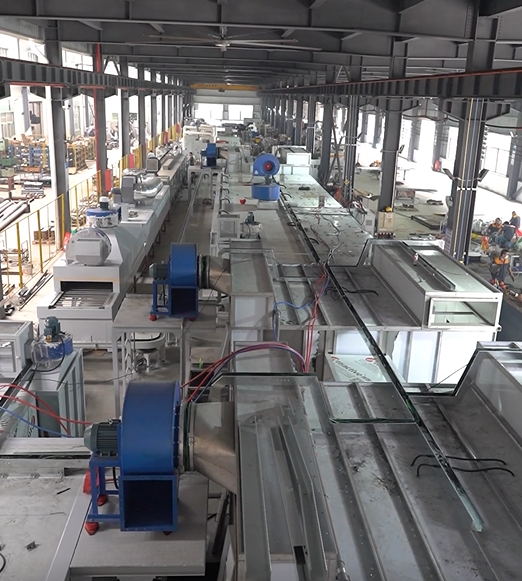
Installation and commissioning are included in the project scope; booth climate and conveyor alignment are verified on site before handover.
Frequently Asked Questions
1. What certifications and compliance points should we verify before signing?
Verify two things: the builder's management-system certificates, and the VOC position in your destination market. Attractivechina holds ISO 14001 environmental management system certification valid through 14 October 2027 and ISO 45001 occupational health and safety management system certification valid through 19 April 2029, both scoped to the design and manufacture of coating machinery equipment and related management activities. On emissions, the US EPA extended compliance dates for certain VOC emission standards for aerosol coatings under 40 CFR Part 59 Subpart E to 17 January 2027 — a reminder that VOC timelines should be checked against your curing and abatement design rather than treated as fixed. Check that the certification scope names coating machinery, not an unrelated activity of a parent company.
2. Can the same supplier build both line types, and at what scale?
Yes. Attractivechina's portfolio covers auto parts, metal, cookware, wood furniture and industrial equipment coating lines. On record are 20 complete automatic auto parts lines delivered to Germany, Russia, Thailand, Indonesia, Mexico and China, and 15 complete automatic metal lines delivered to Mexico, the United States, China and Singapore. Capacity behind those projects includes a self-owned site of approximately 35,548 m², 280 employees, 54 engineers, an annual output of 60 painting line units, 79 invention patents within a total of more than 300 patents, and a company-reported 30+ years of experience in coating line solutions. Both lines are built in the same factory, which simplifies spare-parts planning if you eventually run both.
3. What actually drives the price difference between the two lines?
Four engineering items dominate. First, climate control: holding a booth at 25±2 °C and 65±10% RH adds air handling, chilled water and steam infrastructure. Second, robot spraying in offline mode versus reciprocator plus manual spraying, which changes both equipment count and programming workload. Third, the conveyor and tooling envelope: a power-and-free chain sized for 7000 mm workpieces and a tray set sized for L1350 × W900 × H200 mm are different capital items. Fourth, plant services — the auto parts reference line requires electricity, natural gas, steam and ice water, and a 100 m × 38 m × 5.4 m envelope. Commercial baseline for both: minimum order quantity 2 units, 50% T/T deposit within 7 days of contract signing, 40% T/T three days before shipment, 10% T/T on completion of installation, FOB any port in Guangdong.
4. How can we validate quality before committing to a full line?
Validation in this category is project-based rather than sample-based, because both lines are built to a plant layout. Quality control follows a 100% pre-shipment test standard, and the minimum order quantity is 2 units. That means a single trial unit is not the normal route; buyers typically validate through the pre-shipment test protocol, the recorded reference projects in their own segment and market, and the terms attached to the order — a 1-year warranty, free training, remote technical support with rapid response within 4 hours, and regular follow-ups after handover.
5. What is the delivery lead time, and what happens after installation?
Delivery times differ by product and configuration, so the schedule is confirmed per project rather than quoted as a single figure. Lead time is driven by booth climate control, robot count, conveyor length, tooling sets and pre-treatment stages. The scope does not end at shipment: installation and commissioning are included, and after-sales support covers a 1-year warranty, remote technical support, rapid response within 4 hours, regular follow-ups, and free training for your operators. To move from comparison to a concrete proposal, you can download the Attractivechina company brochure or send your part list and destination market for a line recommendation.
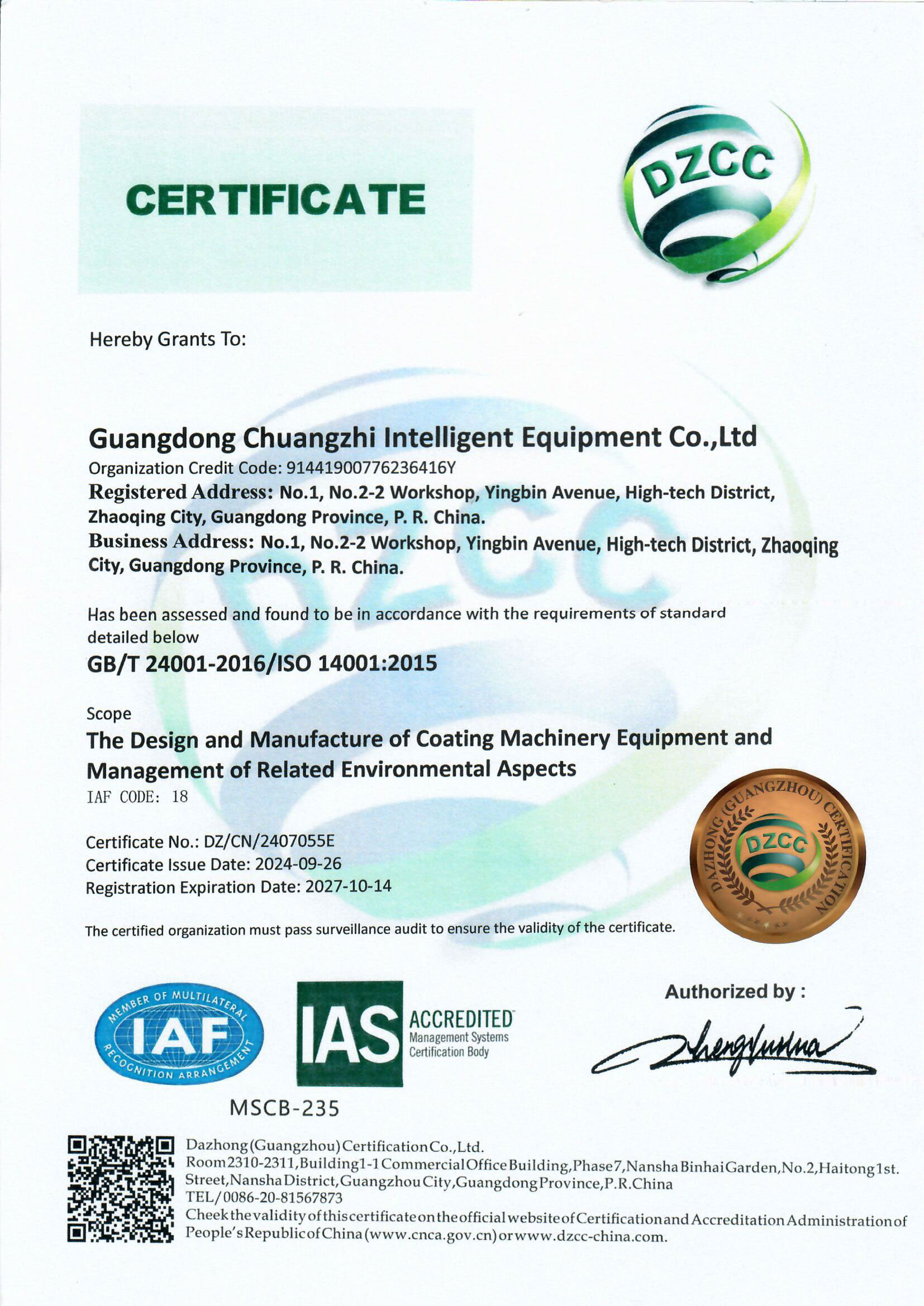
ISO 14001 environmental management system certification, scoped to the design and manufacture of coating machinery equipment, valid through 14 October 2027.
Conclusion: Decide on Substrate, Then on Envelope, Then on Market Record
The auto parts line and the metal hardware line are not two grades of the same machine. They are two answers to two different questions. The auto parts line answers “how do I hold a repeatable finish on ABS+PC body parts at 25±2 °C and 65±10% RH, 45 seconds per tray, with 98% coating yield and 25% less paint?” The metal hardware line answers “how do I coat aluminium panels and profiles up to 7000 × 2000 × 2200 mm at 5000 m² per day with a 97% pass rate and 30% lower paint and powder consumption?”
Three checks settle it. If your largest part exceeds the L1350 × W900 × H200 mm tooling tray, you need the metal line. If your quality standard depends on a controlled booth climate, you need the auto parts line. If your export destination is Indonesia or Thailand, the auto parts record is the closer precedent; if it is the United States or Singapore, the metal line record is. Where both apply, plan two lines rather than one compromise — the engineering team that builds both can lay out the plant so the two lines share services without sharing tooling.
Next step: match the line to your part list
Send your workpiece material, maximum part size, target output and destination market. The team will confirm which of the two configurations fits, or propose a two-line layout if your production mixes plastic body parts and aluminium profiles.
Attractivechina — www.attractivechina.net
Email: attractivechina@gmail.com | Tel / WhatsApp: +86 135-8061-6025
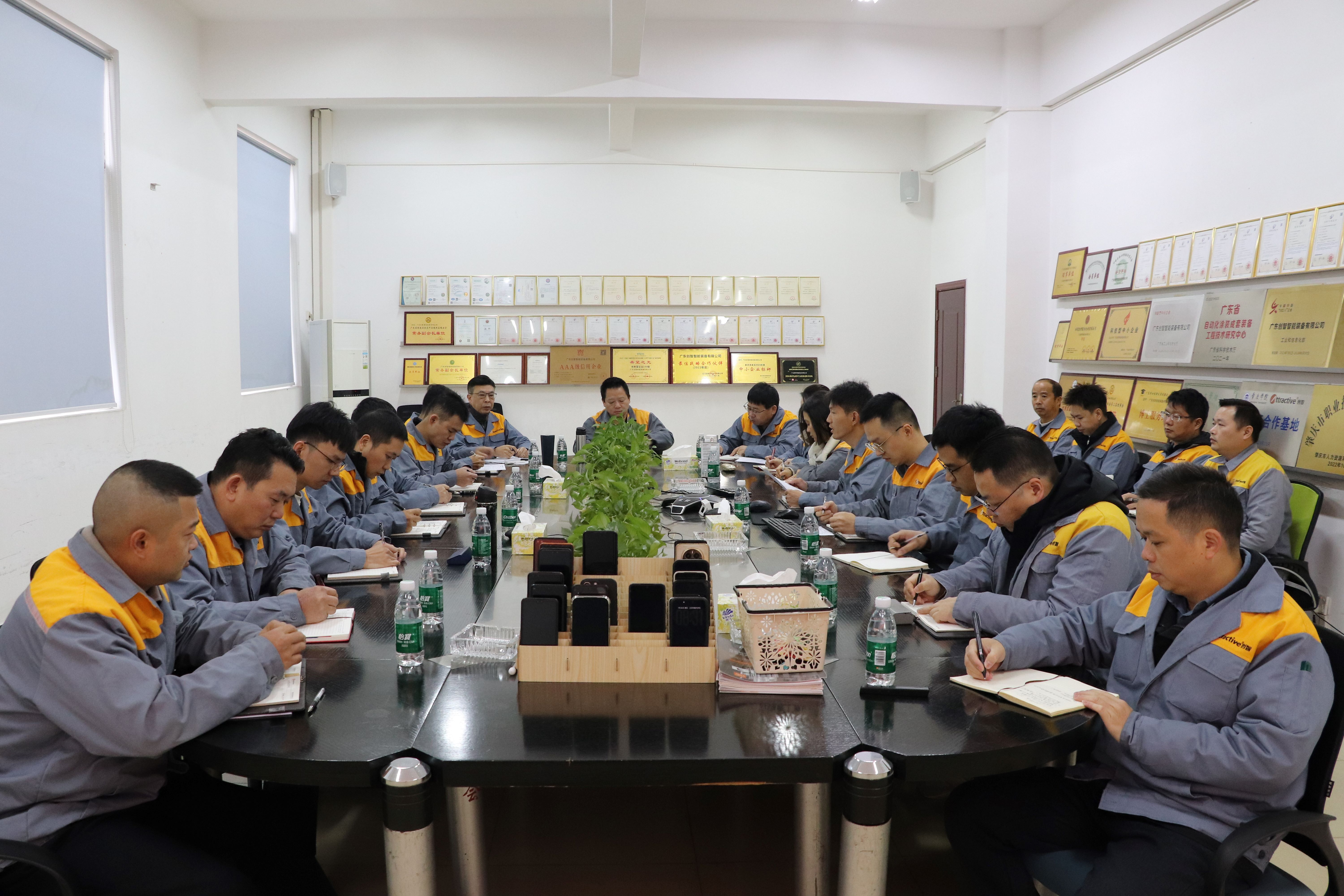
The Attractivechina project team handles line selection, plant planning and quotations for both the auto parts and metal hardware configurations.
About the manufacturer
Guangdong Chuangzhi Intelligent Equipment Co., Ltd. (brand: Attractivechina) was founded in 2005 and operates from No.2 Yingbin Avenue, High-tech District, Zhaoqing City, Guangdong Province, China. The company reports a self-owned site of approximately 35,548 m², 280 employees, a 54-engineer R&D team, an annual output of 60 painting line units, 79 invention patents within more than 300 patents in total, and an export ratio of 20% across markets including Vietnam, Iran, Indonesia, Brazil, the United Arab Emirates, Turkey, Thailand, Saudi Arabia, Argentina, Mexico, Pakistan, Bangladesh, India, the United States, Russia and Singapore.
Есть вопросы или нужны дополнительные детали?
Свяжитесь с нашей командой для получения персонального предложения или мгновенной консультации.
Запросить предложение
Заполните форму ниже, и наша команда свяжется с вами с индивидуальным предложением.
Прямой чат WhatsApp
Предпочитаете общаться в реальном времени? Напишите нам в WhatsApp для мгновенной помощи и быстрых ответов.
- Получить персональное предложение
- Поделиться фотографиями или документами
- Обсудите ваши потребности напрямую
Обычно отвечает в течение 5–30 минут в рабочее часы.