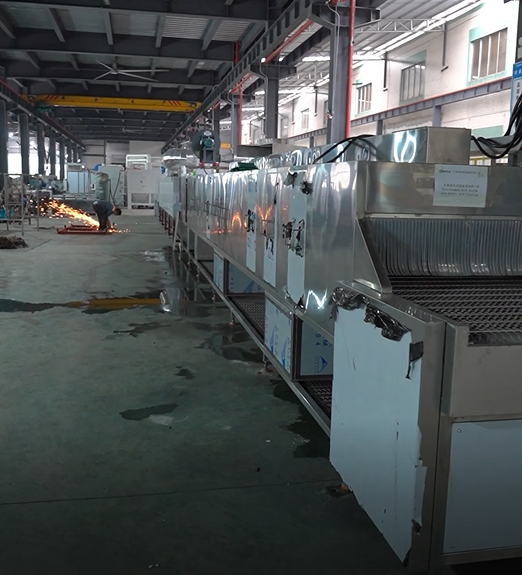
Conveyor Speed and Pitch in the Wood Furniture Coating Line: A Technical Guide
Conveyor Speed and Pitch in the Wood Furniture Coating Line: A Technical Guide
Two conveyor parameters set the output ceiling of a wood furniture coating line: the design line speed and the distance between hanging positions. On the Wood Furniture Automatic Coating Line, those values are a design line speed of 4000 mm/min — adjustable between 2000 mm/min and 6000 mm/min — and a pitch of 300 mm per hang. At those settings, the line is specified to produce 1422 pieces in an 8-hour shift.
This guide is written for the engineers who work with those numbers: process engineers balancing takt against finish quality, manufacturing engineers planning capacity for a mixed workpiece mix, and project engineers who must recalculate output when a part becomes larger or smaller. Every figure below comes from the line's published specification, and every derived value is labelled as a calculation so it can be checked independently.
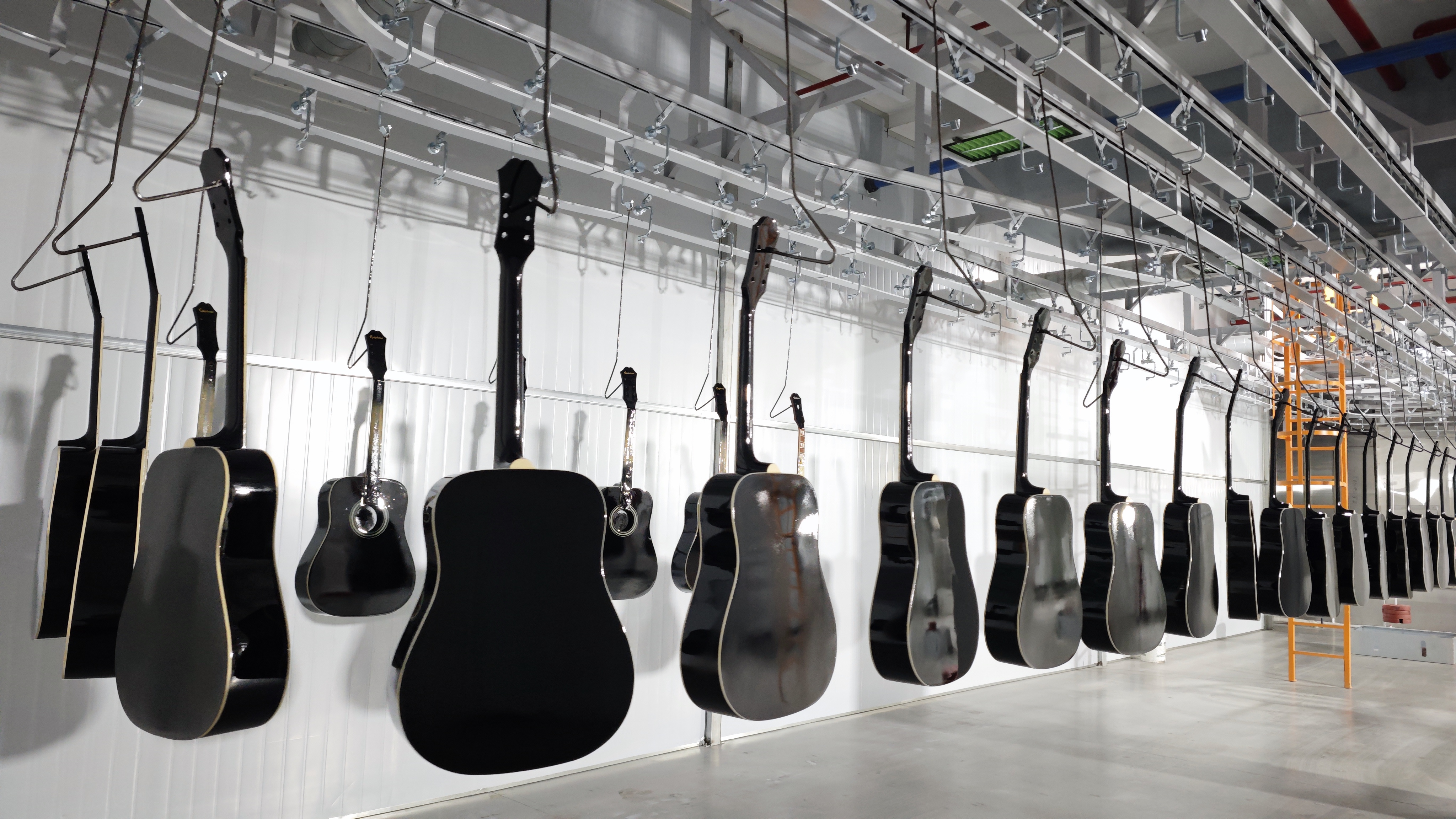
The suspended conveyor system that carries workpieces through the Wood Furniture Automatic Coating Line at a 300 mm hang pitch.
Problem Definition: Why Coating Line Throughput Is Usually Argued in the Wrong Place
Three assumptions cause most of the disagreement about output on a coating line.
The first is that output is set by equipment size — a longer curing oven, another spray booth, more spray guns. Those elements determine whether a process can be completed at all, but the number of workpieces a line carries through per hour is set at the conveyor: how far apart the workpieces hang and how fast they travel.
The second is that line speed is a free variable for raising output. It is not. Line speed fixes the takt, the interval at which each hanging position passes a fixed point. If that interval is shorter than a station needs to accept the next position, output rises on the planning sheet and surface quality falls on the part.
The third is that one pitch fits every product. The standard workpiece on this line is 100(L) × 50(W) × 1400 mm(H), while the maximum workpiece is 610 × 710 × 1400 mm(H). A pitch that suits a chair back does not automatically suit a bed frame, a dining table top or a piano component.
Four terms do most of the work in the calculations that follow:
- Pitch (mm/hang) — the centre distance between adjacent hanging positions along the conveyor. On the Wood Coating Line this is 300 mm per hang.
- Design line speed (mm/min) — how far the conveyor travels in one minute. The design value is 4000 mm/min, inside a 2000–6000 mm/min adjustable range.
- Takt (seconds per position) — pitch divided by line speed: the time between two consecutive hanging positions passing the same point.
- Shift output (pieces/shift) — finished pieces produced over the shift. The declared figure for this line is 1422 pieces per 8-hour shift.
Key relationship: 300 mm ÷ 4000 mm/min = 0.075 minutes, or 4.5 seconds, per hanging position. That 4.5-second interval is the takt at design speed, and it is the number every station on the line is balanced against.
Industry Background: Why Takt and Pitch Have Become Selection Criteria
Coating equipment is a growth market. Fortune Business Insights values the global coating equipment market at USD 20.56 billion in 2025 and projects USD 36.77 billion by 2034, with Asia Pacific holding a 38.30% revenue share in 2025, a position driven in part by automotive and EV sector growth. Wood furniture and musical instruments sit at a different point in that market from automotive volume production: fewer identical units per design, wider variety, and a finish that buyers judge by eye and hand rather than by instrument alone.
That combination is why conveyor parameters now carry more weight in line selection than they once did. A line that runs chair backs in the morning and guitar bodies in the afternoon cannot rely on one fixed takt; it needs a speed range wide enough to cover both quality regimes and a pitch that can be rebased when the workpiece changes.
Installed evidence points the same way. Across 10 complete automatic wood coating lines supplied to furniture manufacturers, musical instrument makers, wood product processing factories and cabinet and wood door producers, the reported operating results include coating uniformity and finish meeting high-end standards, paint consumption reduced by 30%, dust defect rate cut by 90%, production efficiency increased by 40%, and zero major quality complaints during operation, with the equipment in service for 5–10 years. Repeatable film thickness depends on a repeatable takt, and a repeatable takt is a conveyor setting before it is a spraying setting.
How the Wood Furniture Automatic Coating Line Handles Speed and Pitch
Guangdong Chuangzhi Intelligent Equipment Co., Ltd., which markets its coating lines under the Attractivechina brand from the National High-tech Industrial Development Zone of Zhaoqing City, Guangdong Province, builds the Wood Furniture Automatic Coating Line for the wood furniture and musical instrument industry. The line processes solid wood and MDF, uses electricity as its energy input, and is built on a carbon steel main frame with stainless steel used for the spray booth and pipeline.
The conveying and throughput specification is deliberately narrow, because these are the numbers that decide what the line can produce:
| Parameter | Value | What it controls |
|---|---|---|
| Design line speed | 4000 mm/min (2000–6000 mm/min adjustable) | Hanging positions per hour and takt across every station |
| Pitch | 300 mm/hang | How much conveyor length each workpiece occupies |
| Standard workpiece | 100(L) × 50(W) × 1400 mm(H) | The baseline the 1422-piece shift output is stated against |
| Maximum workpiece | 610 × 710 × 1400 mm(H) | The upper limit on part size before the pitch must change |
| 8-hour output per shift | 1422 pieces/shift | The production planning number for the standard family |
| Workpiece types | Table legs, chair backs, sitting boards, front legs, sitting frames, chairs | Which part families run on the standard setting |
| Line variants | Guitar coating line, piano coating line, musical instruments coating line, wood beds coating line, dining tables coating line, wood chairs coating line, wood speaker coating line | How the same conveying platform is configured per product family |
| Materials | Carbon steel (main frame); stainless steel (spray booth and pipeline) | Structure and the wet areas of the process |
Specification values for the Wood Furniture Automatic Coating Line (model: Wood Coating Line).
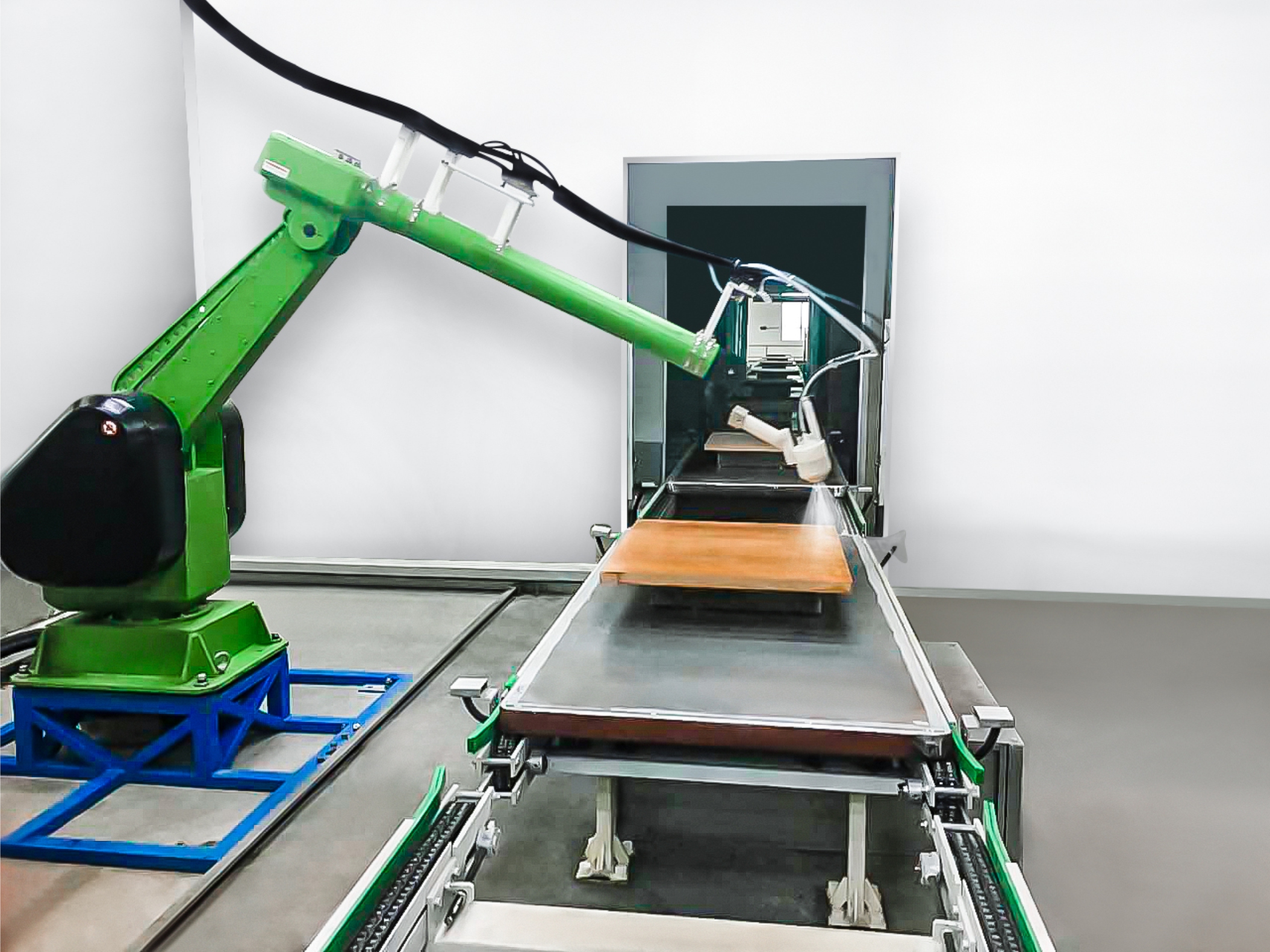
The Wood furniture coating line: conveyor speed is a PLC-level setting, while the 300 mm pitch is fixed by the hangers and fixtures.
The line operates in fully automatic continuous operation mode. Its function in this configuration is fully automated PLC intelligent control, robotic spraying and unmanned flexible production. For an engineer, the practical consequence is that line speed is a control-layer setting: the same control system that governs conveying also governs the spraying sequence, so a speed change is made as one coordinated adjustment rather than as separate mechanical interventions at each station.
The 2000–6000 mm/min band is what allows one platform to serve very different finishing demands. A chair back and a piano component are not finished under the same conditions, and the adjustable range is the engineering answer to that: the same conveyor, the same 300 mm pitch, and a different speed selected for the job. The 300 mm pitch itself is a physical property of the hangers and fixtures rather than a software setting, which is why it stays fixed while speed is tuned.
Step-by-Step: Calculating Shift Output From Speed and Pitch
Step 1 — Establish the pitch from the workpiece footprint
The pitch must be at least the workpiece footprint measured along the direction of conveyor travel, plus the clearance your spray pattern and part geometry require. The design pitch for this line is 300 mm per hang, sized for the standard workpiece of 100(L) × 50(W) × 1400 mm(H). Parts approaching the 610 × 710 × 1400 mm(H) maximum consume more conveyor length and therefore force a wider pitch, which reduces the number of positions available on the same loop.
Step 2 — Convert speed and pitch into takt
Takt = pitch ÷ line speed. At the design values: 300 mm ÷ 4000 mm/min = 0.075 minutes, or 4.5 seconds, per hanging position. Every station — pretreatment, spray booth, drying, curing — must be able to accept the next position on that interval at the speed you select.
Step 3 — Convert to hanging positions per hour
Positions per hour = line speed (mm/min) × 60 ÷ pitch (mm/hang). At the design values: 4000 × 60 ÷ 300 = 800 hanging positions per hour. This figure is used for conveyor and fixture planning — how many carriers circulate on the loop, how many hangers to hold in stock, and how much accumulation space is needed upstream and downstream.
Step 4 — Separate transport capacity from declared output
These two figures answer different questions, and confusing them is the most common source of unrealistic capacity plans. The 800 positions per hour describes what the conveyor can physically transport when every position is loaded. The declared production output — 1422 pieces per 8-hour shift — is what this configured line produces for its standard workpiece family, and it is the number to use for production planning. Use the position figure for constraint analysis; use the declared output for the plan you commit to.
Step 5 — Check the setting against your finishing requirement
Before moving speed, confirm that the result still meets the finish your product needs. The installed wood line results show what the configuration achieves in production: coating uniformity and finish meeting high-end standards, 30% lower paint consumption, and a 90% reduction in dust defects. If a part family is finish-critical — instrument bodies are the clearest example — the speed decision belongs at the lower end of the 2000–6000 mm/min band.
Step 6 — Change one variable at a time
The workable rule of thumb is: change speed through the control system, change pitch only when the workpiece geometry changes. Speed changes are reversible settings; pitch changes are fixture and hanger changes that affect the position count on the whole loop. Keeping those two decisions separate is what makes the throughput calculation above stable enough to plan against.
Use Cases: Matching Speed and Pitch to Different Wood Products
Chairs and seating components
Chair backs, sitting boards, front legs, sitting frames and assembled chairs are the standard workpiece family, sized at or near 100(L) × 50(W) × 1400 mm(H). These parts run at the design line speed of 4000 mm/min on the 300 mm pitch, with the declared 8-hour output of 1422 pieces per shift as the planning number.
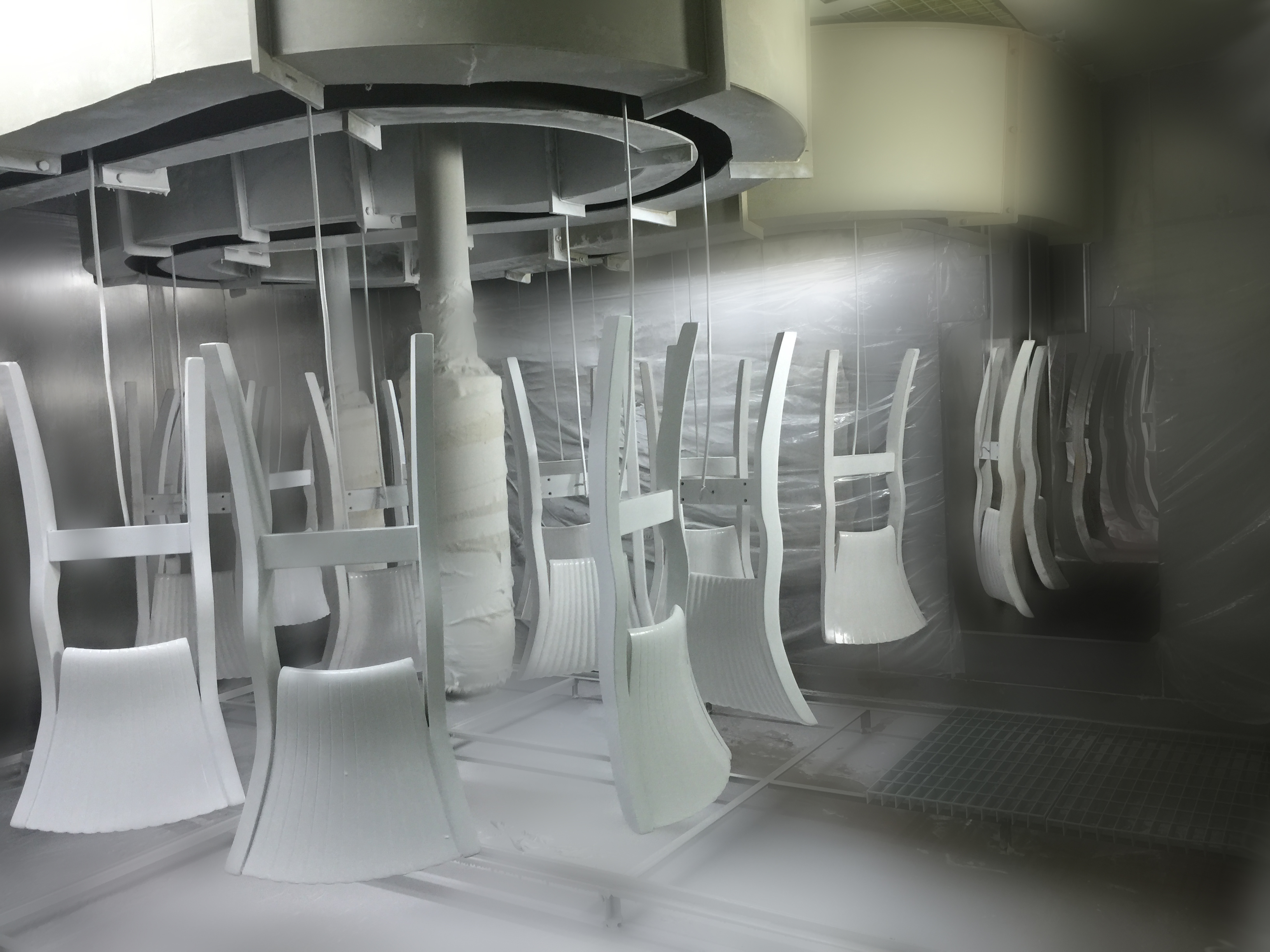
Wood chairs coating line: seating components sit closest to the standard workpiece size and run at the design speed.
Table legs and dining table components
Table legs behave much like chair parts and stay close to the standard setting. Dining table tops are the opposite case: they are wide and approach the 610 × 710 mm footprint limit, so the number of positions available along the loop drops and the pitch has to be rebased for that part family. The dining tables coating line is configured for exactly this wider geometry.
Wood beds and large frames
Bed frames are among the largest parts the platform handles and should be planned against the 610 × 710 × 1400 mm(H) maximum rather than the standard size. Planning around the maximum first, then trimming speed, prevents the common error of calculating capacity from the small part and discovering the real limit when the large one enters the line.
Musical instruments
Guitar and piano components are handled by dedicated configurations — the guitar coating line, the piano coating line and the musical instruments coating line — that share the same conveying platform. Finish is the deliverable on these parts, which places them at the lower end of the 2000–6000 mm/min speed band, while the 300 mm pitch and the 1400 mm workpiece height keep the bodies clear of each other through the booth.
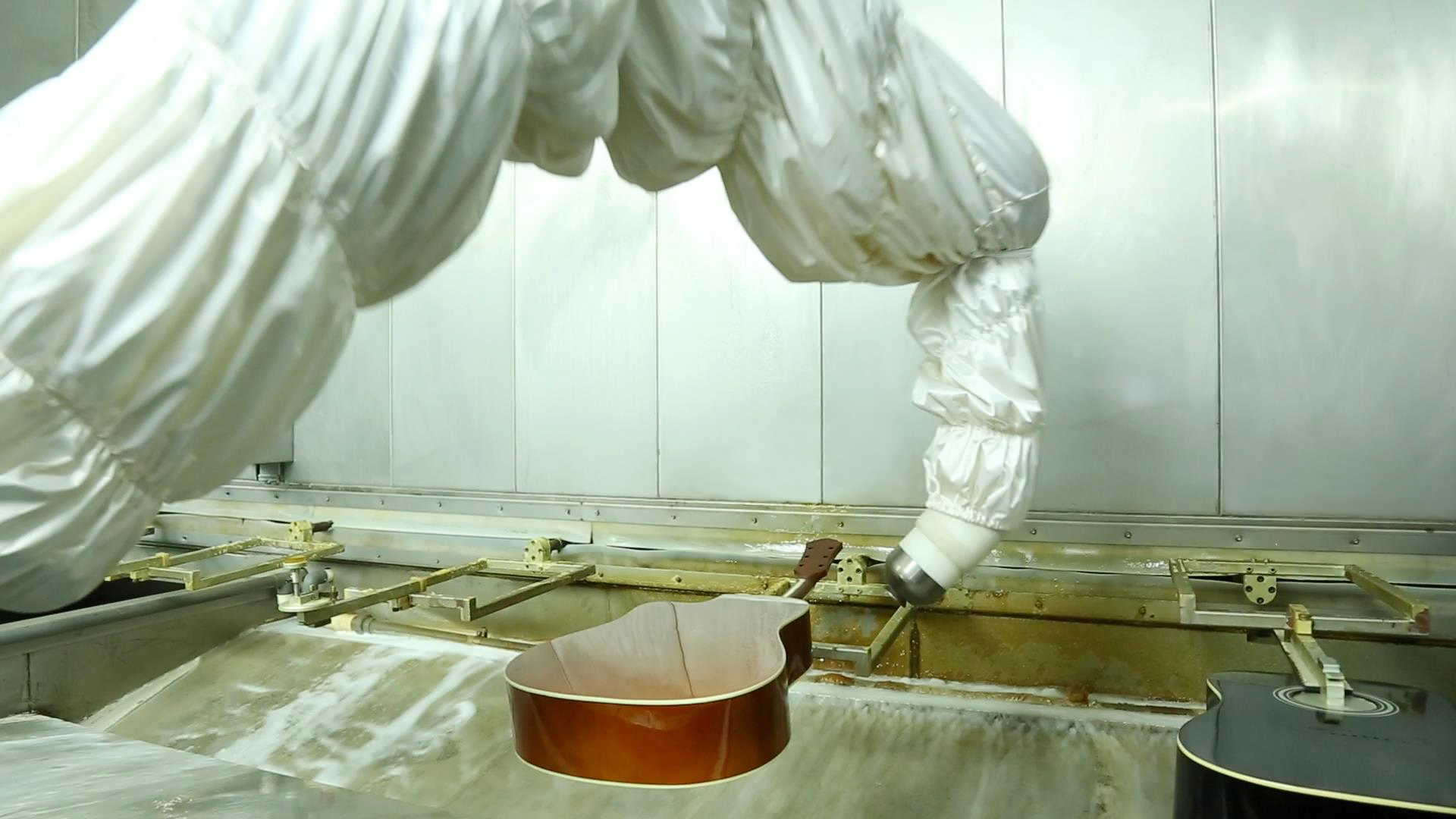
Guitar coating line: instrument bodies are run at the lower end of the adjustable speed range because finish is the deliverable.
Wood speakers and mixed-variety production
Speaker cabinets and similar box-shaped parts sit between the furniture and instrument categories in finishing demand. Where a plant runs several of these families on one line, the relevant capability is the line's specification for unmanned flexible production under fully automated PLC intelligent control: one continuous line, one pitch, and a speed selected per production run.
Comparison Table: How Speed, Pitch and Cycle Are Set Across Coating Line Types
Pitch is never a universal constant; it is derived from part geometry and hanging method. Comparing the conveying parameters of different coating line types shows how much that derivation changes the numbers:
| Coating line type | Line / conveyor speed | Pitch or cycle | Declared output basis | Workpiece basis |
|---|---|---|---|---|
| Wood Furniture Automatic Coating Line (Wood Coating Line) | 4000 mm/min design (2000–6000 mm/min adjustable) | 300 mm/hang | 1422 pieces per 8-hour shift | Standard 100(L) × 50(W) × 1400 mm(H); maximum 610 × 710 × 1400 mm(H); solid wood, MDF |
| Metal Automatic Coating Line (Metal Coating Line) | Conveyor belt speed 3000 mm/min (2000–4000 mm/min adjustable) | 1 piece per hanger | Maximum capacity 5000 m²/day | Maximum workpiece 7000(L) × 2000(W) × 2200 mm(H); aluminum panel and profile |
| Cookware Automatic Coating Line (Cookware Coating Line) | Anodizing line speed 1200 mm/min; desktop curing oven 1000 mm/min (0.5–1.5 m/min adjustable) | Workpiece pitch 450–900 mm; 4 inner pots per hang, 20 lids per hang | 800–1000 pieces/hour | Standard Φ220 × 160 mm(H); maximum Φ300 × 160 mm(H); aluminum alloy and composites |
| Auto Parts Automatic Coating Line (Auto Parts Coating Line) | Production cycle 45 seconds per tray | 45 s/tray (1760 trays/day) | Equipment utilization rate 85% | Maximum tooling tray size L1350 × W900 × H200 mm; ABS+PC parts |
Conveying parameters compared across four coating line types. All values are specification values from the respective product data.
Read the wood row against the cookware row and the logic becomes visible. Round cookware parts are hung at a 450–900 mm pitch because each position is wide, while furniture components are hung at 300 mm because they are narrow and tall. The wood line's own speed band is also the widest of the mm/min ranges shown, which reflects the spread between a chair back and an instrument body that may be produced in the same facility.
FAQ: Speed, Pitch and Line Configuration
Does changing conveyor speed or pitch affect the line's compliance requirements?
The special requirements specified for this line include high efficiency and energy saving, ease of maintenance, and ISO14001, ISO9001 and ISO45001 environmental compliance. Conveyor speed and pitch are process parameters inside the designed 2000–6000 mm/min range rather than compliance attributes: they are adjusted through the line's control system, and the operational question is whether the adjusted setting still produces the coating uniformity and finish your quality standard requires.
Can one line run both small chair parts and large workpieces such as bed frames?
Yes, within the stated limits. The standard workpiece is 100(L) × 50(W) × 1400 mm(H) and the maximum workpiece is 610 × 710 × 1400 mm(H), with a pitch of 300 mm per hang and a speed range of 2000–6000 mm/min. Larger parts consume more conveyor length per position, so capacity planning should start from the maximum size the line will actually see. The line processes solid wood and MDF, and its workpiece list covers table legs, chair backs, sitting boards, front legs, sitting frames and complete chairs.
What actually drives cost when a workpiece change forces a different pitch?
Pricing for this class of equipment is quoted per configuration rather than from a list. The items that change when the pitch changes are the fixtures and hangers required at the new spacing, the resulting number of positions on the loop, and any change to the size, automation level, voltage, power or machine capacity you specify. The platform is offered as custom manufacturing and design with a minimum order quantity of 2 units, and capacity is stated as customisable to customer requirements — which is why a pitch change should be quoted as a configuration change rather than estimated from a price per metre of conveyor.
How can we validate speed and pitch before committing to a configuration?
Validation on this platform runs through engineering specification. Quality control is 100% pre-shipment test, the minimum order quantity is 2 units, and after installation the support package includes free training, remote technical support, a 1-year warranty and rapid response within 4 hours. The practical route is to supply your workpiece drawing, material (solid wood or MDF), target pieces per shift and required finish, then ask for the engineered pitch and speed range that produces it — those are the two parameters that determine whether the line meets the number on your planning sheet.
What lead time and post-delivery support should be planned for?
Delivery times differ by product and configuration, so scheduling should follow the confirmed pitch, fixture count, speed range and automation level rather than a generic timeline. After commissioning, support continues through remote technical support, a 1-year warranty, response within 4 hours, regular follow-ups and free training. To move from calculation to a quotation, send the workpiece drawing, material, required pieces per shift and finishing requirement — the full line range and configuration options are described in the downloadable brochure, and engineers can be reached directly at attractivechina@gmail.com or +86 135-8061-6025.
Conclusion: Fix the Pitch, Then Tune the Speed
The Wood Furniture Automatic Coating Line is governed by two numbers an engineer can hold in mind: 300 mm per hang and 4000 mm/min at design, adjustable from 2000 mm/min to 6000 mm/min. Together they produce a 4.5-second takt per hanging position at design speed, define the declared 8-hour output of 1422 pieces per shift for the standard workpiece family, and allow output to be recalculated in three steps — pitch from the workpiece footprint, takt from pitch and speed, and positions per hour from speed and pitch.
The working discipline is straightforward. Fix the pitch to the workpiece geometry and keep it fixed; use the speed band to move between high-volume furniture parts and finish-critical instrument parts. Plan capacity from the maximum workpiece the line will see rather than the standard one, and keep the two output figures in their proper roles: declared shift output for production planning, hanging positions per hour for conveyor and fixture planning.
Next Step: Match the Line to Your Workpiece
Attractivechina (Guangdong Chuangzhi Intelligent Equipment Co., Ltd.) engineers wood furniture and musical instrument coating lines around the workpiece rather than around a fixed catalogue size. Send a workpiece drawing, material and target shift output, and the pitch, speed range and fixture count can be specified against your production plan.
Download the Attractivechina coating line brochure (PDF)
Email: attractivechina@gmail.com · Tel / WhatsApp: +86 135-8061-6025 · www.attractivechina.net