Power and Free Conveyor vs. Other Transport Methods in Metal Coating Lines
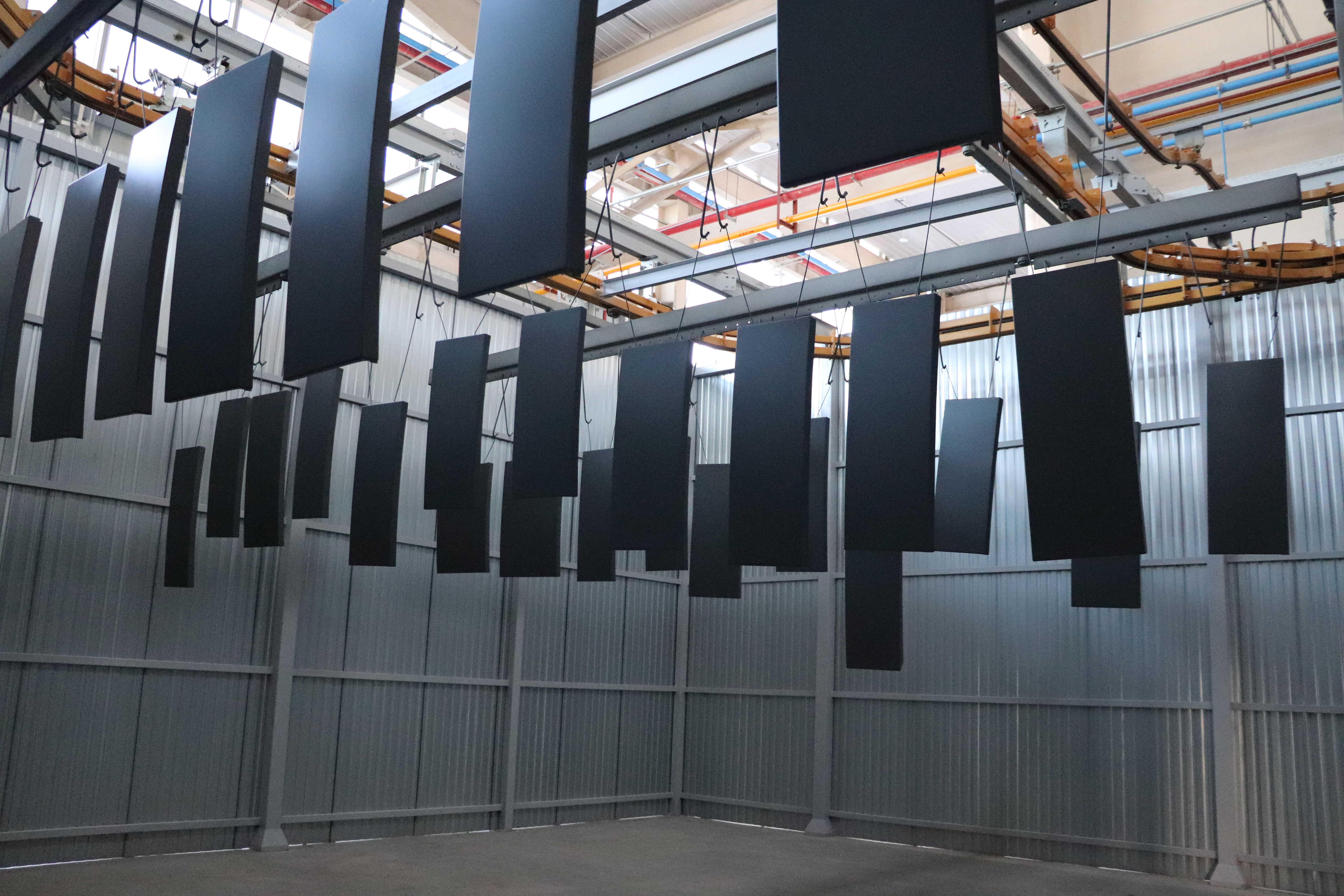
Conveyor transport determines the workpiece envelope, the pitch between hangers and where accumulation is possible in a coating line.
A metal coating line is defined less by its spray booth than by what its conveyor can carry. Booths, ovens and pretreatment modules can be sized around a workpiece, but the transport method fixes the workpiece envelope, the pitch between hangers, the length of the line loop, and whether parts can wait in front of a station without stopping the whole process. The short answer for large-format metal work is that a power and free conveyor chain is the transport method that keeps envelope, dwell time and accumulation inside one system. For small dense parts and for very heavy floor-standing equipment, other transport methods do the same job with less mechanics.
This guide uses the Attractivechina Metal Coating Line as the reference case, compares its transport concept with the conveying methods used in other coating line families, and sets out the checks a buyer should complete before the layout is frozen.
Reference configuration — Attractivechina Metal Coating Line
- Parts: aluminum panel and profile
- Transport method: power and free conveyor chain
- Maximum workpiece size: 7000 mm (L) x 2000 mm (W) x 2200 mm (H), 1 pc per hanger
- Maximum workpiece capacity: 5000 m2 per day
- Conveyor belt speed: 3000 mm/min (2000–4000 mm/min adjustable)
- Spraying method: reciprocator plus manual
- Working system: 300 days per year, 20 hours per day
- Main structure: carbon steel frame; stainless steel spray booth and pipeline
Problem Definition: Why Transport Is a Project-Fit Decision, Not an Accessory
In coating line projects the conveyor is frequently specified after the booth, the oven and the pretreatment concept are already fixed. In practice the order should be reversed, because three project constraints come directly from the transport method:
- Workpiece envelope. A 7000 mm long panel requires a hanger pitch longer than 7000 mm and a loop long enough to hold that pitch through pretreatment, booth and oven without collision.
- Dwell conflict. Spray time and curing time rarely match. Without accumulation, the slower station sets the pace of the entire line, and line speed becomes a compromise rather than a process choice.
- Load per hanger. One large aluminum panel per hanger is a completely different load case from 4 inner pots or 20 lids per hanger. Drives, trolley bearings, track supports and hanger design are all sized from this number.
The practical consequence is that a line quoted without a fixed conveyor concept usually gets re-engineered at the first layout review, when the actual workpiece list is compared against the transport envelope. Buyers in the research and evaluation stage can avoid this by treating transport as a primary specification item and by testing the workpiece envelope against the proposed conveying concept before commercial terms are discussed.
Industry Background: What Is Driving Large-Format Coating Capacity
Coating capacity is expanding fastest where surface performance carries a functional requirement. Grand View Research projects multi-layer smart coatings to grow at a compound annual growth rate of 22.6% between 2026 and 2033, with automotive remaining the largest application sector in 2025 at 24.0% of overall revenue. Market Research Future reports Asia-Pacific as the fastest-growing region for smart coatings at a 17.1% CAGR, and Mordor Intelligence places anti-corrosion coatings at approximately 29% of the smart coatings market in 2024.
These figures describe coating materials and end markets rather than conveyor hardware, and the two should not be merged. What they indicate for equipment buyers is directional: anti-corrosion and automotive-adjacent work — structural parts, frames, panels, profiles, building components — is where coating investment continues, and these formats are often large. A supplier that can only convey small parts will still quote a large-part project, but the layout usually reveals the limit late, after booth dimensions, oven length and building height have already been discussed.
A second background factor is the shift toward fully automatic continuous operation. The scenario data behind these lines describes fully automated PLC intelligent control, robotic spraying and unmanned flexible production. Automation raises the value of accumulation, because an unmanned line needs somewhere for workpieces to wait when one station takes longer than the next.
Detailed Solution: How a Power and Free Conveyor Chain Works in a Metal Coating Line
The two-track principle
Power and free transport uses two track systems. A driven chain runs continuously on the power track, while load trolleys run on a separate free track and engage or disengage from the chain through a dog. Because engagement is selective, one trolley can stop inside a spray booth, accumulate ahead of an oven, or be transferred to a second loop while the drive keeps running. That single mechanical property is what allows an automated line to combine a slow manual touch-up zone with a fast reciprocator zone on the same conveyor.
On the Attractivechina Metal Coating Line the transport method is specified as a power and free conveyor chain, with a design conveyor speed of 3000 mm/min and an adjustable window of 2000–4000 mm/min. The spraying method is reciprocator plus manual, a combination that depends on accumulation: the manual operator needs the part to dwell, while the reciprocator needs a steady pass.
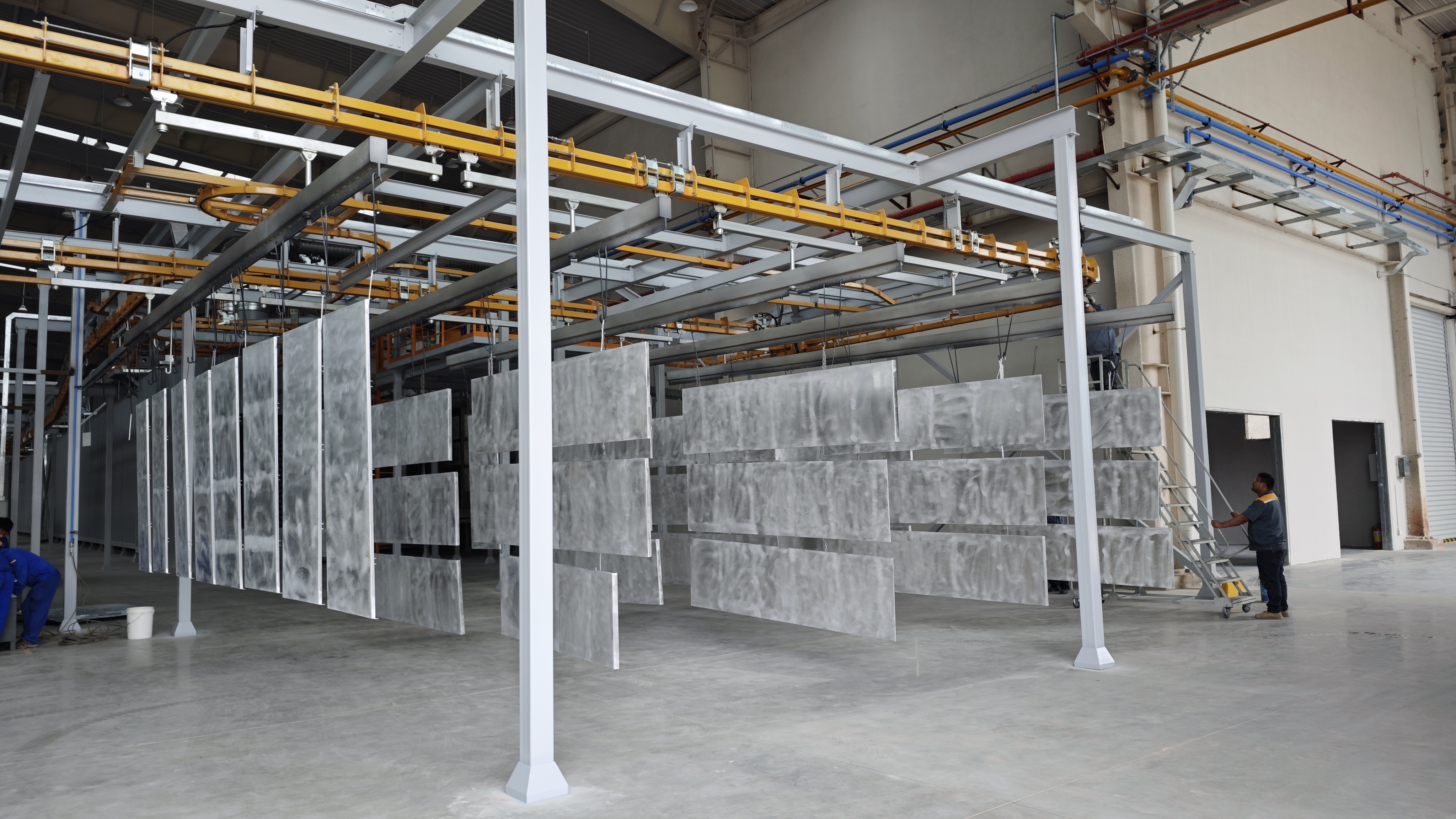
Large aluminum panels and profiles are the format that forces the transport decision: pitch, hanger design and booth openings are all set by the longest dimension.
What the 7000 x 2000 x 2200 mm envelope changes
With a maximum workpiece size of 7000 mm (L) x 2000 mm (W) x 2200 mm (H) at one piece per hanger, three design consequences follow. First, the minimum hanger pitch is dictated by part length rather than by process preference, so the number of hangers in the loop — and therefore parts per hour — is fixed early. Second, booth and oven openings, and the building height above the line, must clear a 2200 mm high part plus hanger and swing clearance. Third, wet areas need corrosion-resistant construction: the reference line uses a carbon steel main frame with a stainless steel spray booth and pipeline.
Pretreatment is where large formats separate from small ones. The metal and industrial equipment lines in the same portfolio are illustrated with gantry pretreatment equipment and spray pretreatment equipment, which treat a large surface without a dip tank sized to the full workpiece length. For a 7000 mm panel, that distinction is not cosmetic — it changes the footprint of the pretreatment section and the building height required above it.
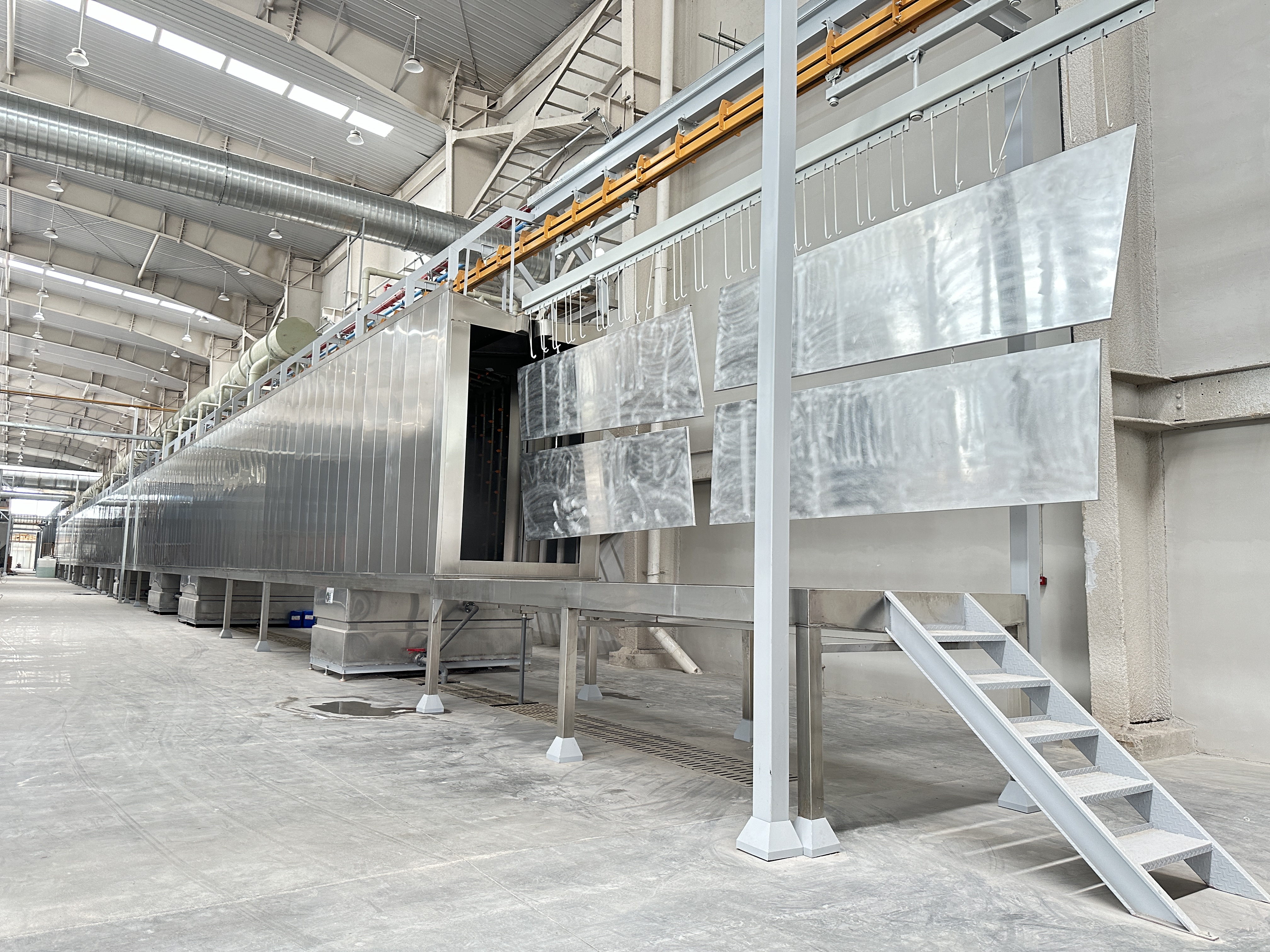
Pretreatment type follows the workpiece envelope. Spray and gantry pretreatment treat large panels without a dip tank sized to the full part length.
Throughput is quoted in square metres, not pieces
The Metal Coating Line is rated at a maximum workpiece capacity of 5000 m2 per day, running 300 days per year and 20 hours per day. Square-metre rating is the correct unit for panel and profile work, because one hanger may carry 1 m2 or 14 m2 depending on the part. It also prevents a misleading comparison with other line families: the Cookware Coating Line is rated at 800–1000 pieces per hour with 4 inner pots and 20 lids per hanger at a 450–900 mm pitch, and the Wood Furniture Automatic Coating Line at 1422 pieces per shift with a 300 mm pitch per hang. Those numbers are piece-density figures; the metal line number is a surface-area figure. Comparing them directly is a common sourcing error.
Where accumulation earns its cost
Power and free transport costs more mechanics than a simple overhead chain, and the return comes from four situations. Accumulation in front of the spray booth absorbs a slow manual touch-up of a 7 m panel while the reciprocator keeps working. Accumulation inside or before the curing oven allows oven dwell to differ from booth dwell without changing line speed. Accumulation at shift change and at the manual loading station lets the drive keep running. And accumulation allows a defective part to be held or rerouted instead of being carried through the full process route.
Limits and trade-offs
- Mechanical complexity. Free trolleys, engagement dogs, switches and multiple drives add maintenance points compared with a single continuous chain.
- Pitch penalty for mixed production. If a 7000 mm panel and small lamp fittings share one chain, the pitch is set by the panel, and the small parts lose density. Mixing very large and very small work on one loop is technically possible but seldom efficient.
- Over-specification. If every workpiece fits inside a 610 x 710 x 1400 mm envelope, a power and free system adds cost that delivers no envelope benefit.
- Layout demand. The loop, the accumulation zones and the return path consume floor area; the reference line also runs a 20-hour day, so maintenance windows have to be planned rather than improvised.
Step-by-Step Breakdown: Specifying Transport for a Large-Format Metal Coating Line
- Lock the envelope per hanger. Record length, width, height and weight for every part family, not only the current one. The reference ceiling is 7000 mm (L) x 2000 mm (W) x 2200 mm (H) at one piece per hanger. Parts outside this envelope are a different project, not a variation.
- Set the pitch from the longest dimension. Pitch must clear the longest part plus hanger and swing. Once pitch is fixed, the number of hangers in the loop and the parts-per-hour ceiling follow automatically.
- Convert demand into square metres per day. Calculate the coated surface of a typical mix and compare it with the 5000 m2 per day reference capacity at 300 days per year and 20 hours per day. Surface area, not piece count, is the sizing unit for panels and profiles.
- Decide the accumulation points. Name each location that needs to buffer: booth entry, oven entry, manual touch-up, loading and unloading, and quality hold. Each accumulation zone adds track length and control logic, so this list should be written before layout, not after.
- Match pretreatment, booth and oven openings to the envelope. Confirm whether pretreatment is spray or gantry type, and check that booth and oven openings clear a 2200 mm high part with hanger clearance. The reference line uses a stainless steel spray booth and pipeline with a carbon steel main frame.
- Confirm the operating pattern and labour model. The reference system runs 300 days per year at 20 hours per day with reciprocator plus manual spraying, which means the manual station is part of the cycle, not an exception. Where offline touch-up is used, as on the Auto Parts Coating Line with offline mode plus robot spraying at 45 seconds per tray, the transport logic changes.
- Specify controls and traceability together with the conveyor. Fully automatic continuous operation with PLC intelligent control, robotic spraying and unmanned flexible production depends on trolley identification and zone interlocks. Attractivechina states that its intelligent coating lines integrate MES, ERP and PLM systems for remote management, quality control and production traceability, which only works if the conveyor reports position.
- Plan maintenance, spares and validation. List the wear items on the free trolleys and drives, and confirm the inspection interval against the 20-hour operating day. Attractivechina applies 100 percent pre-shipment testing, which is the point at which transport, interlocking and accumulation behaviour should be demonstrated.
Use Cases: Where Each Transport Method Fits
Aluminum panels and profiles for building materials
This is the design case for the power and free conveyor chain: doors, windows, steel cabinets, building materials, cabinet components, sheet metal parts, lamp fittings and aluminum sheet. One part per hanger at up to 7000 x 2000 x 2200 mm, 5000 m2 per day at 3000 mm/min. Project evidence from 15 complete automatic metal coating lines delivered to Mexico, the United States, China and Singapore reports a coating pass rate of 97%, paint and powder consumption reduced by 30%, energy consumption reduced by 22% and production efficiency improved by 40%.
Heavy industrial equipment — where transport moves to the floor
When the workpiece is a rail car body, a tank car or a frame, hanging is no longer practical. The Industrial Equipment Automatic Coating Line uses a floor supported conveyor with manual plus robot spraying, at a rated capacity of 20 railway gondola cars, flat cars or tank cars, 7 units of SQ6 special cars, 10 boxcars or grain cars, or 5–10 export open, flat, shed and tank cars per single 7.5-hour shift. Delivered projects in this family report a coating pass rate of 98%, paint consumption reduced by 25%, efficiency improved by 30%, and adhesion and salt spray resistance meeting a 1000-hour salt spray test.
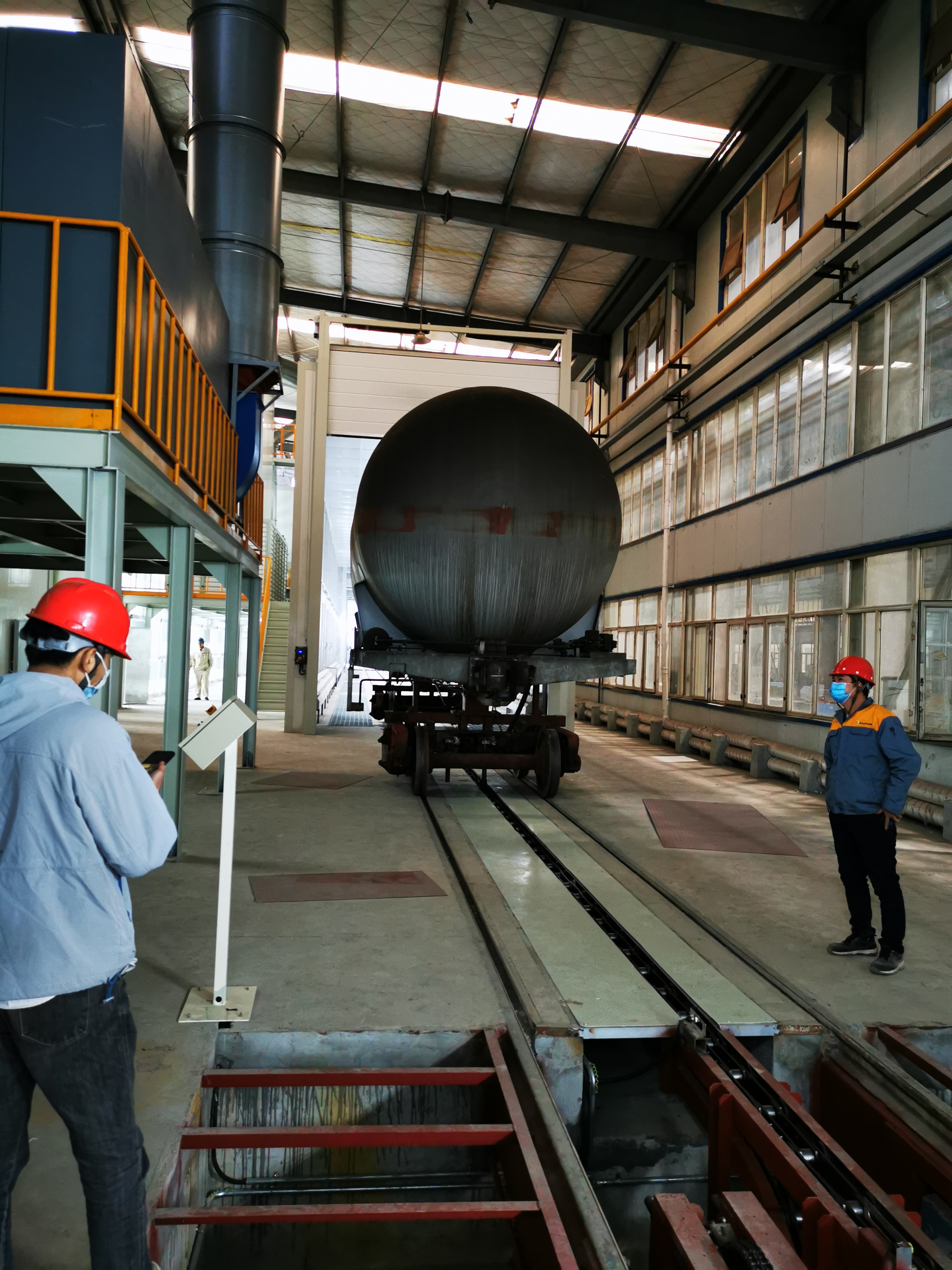
Floor supported conveying suits very large, heavy workpieces that cannot be suspended, such as rail car bodies and frames.
Automotive parts — tray-based tooling with offline spraying
Bumpers, door trims, instrument panels and wheel arches made from ABS+PC are handled as trays rather than as hanging panels. The Auto Parts Automatic Coating Line uses offline mode plus robot spraying at a 45-second production cycle per tray (1760 trays per day), a maximum tooling tray size of 1350 x 900 x 200 mm, 85% equipment utilization and a 100 m x 38 m x 5.4 m factory envelope. Project evidence from 20 lines in Germany, Russia, Thailand, Indonesia, Mexico and China reports a coating yield rate of 98%, paint consumption reduced by 25% and energy consumption reduced by 20%.
Wood furniture and musical instruments — overhead suspended transport
Solid wood and MDF parts work best on an overhead suspended conveyor with tight pitch. The Wood Furniture Automatic Coating Line runs a 300 mm pitch per hang, a maximum workpiece size of 610 x 710 x 1400 mm, a design line speed of 4000 mm/min (2000–6000 mm/min adjustable) and 1422 pieces per 8-hour shift. Delivered projects across 10 complete automatic wood coating lines report paint consumption reduced by 30%, dust defect rate cut by 90% and efficiency improved by 40%.
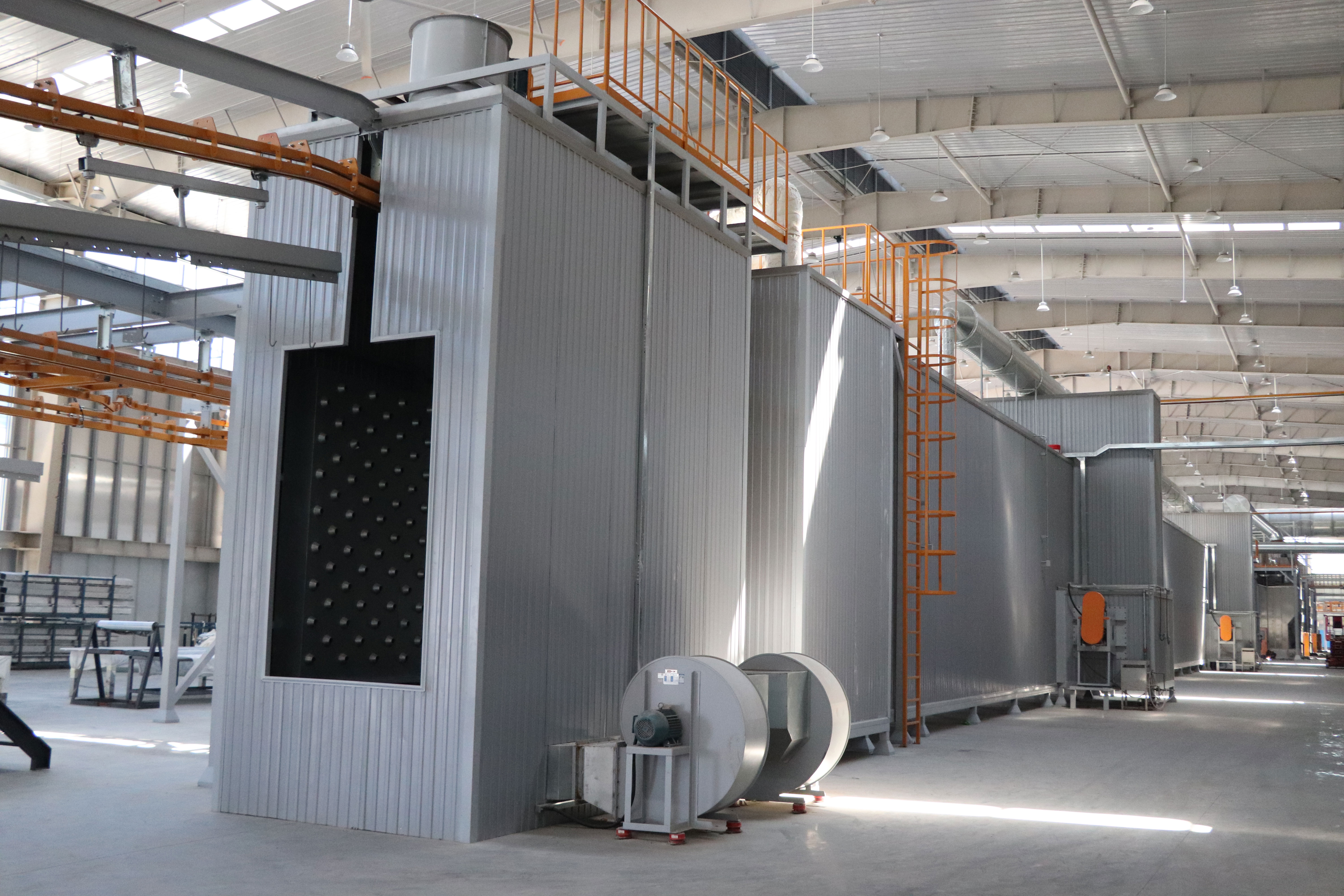
Oven dwell and booth dwell rarely match. Accumulation on a power and free system lets both run at their own time, at one conveyor speed.
Comparison Table: Transport Methods Across Coating Line Families
| Transport method | Best-fit workpiece family | Reference configuration (Attractivechina) | Main constraint to check |
|---|---|---|---|
| Power and free conveyor chain | Large aluminum panels and profiles; building materials, doors, windows, sheet metal | Metal Coating Line: max 7000 x 2000 x 2200 mm, 1 pc/hanger; 5000 m2/day; 3000 mm/min (2000–4000 adjustable) | Pitch set by the 7 m length limits hanger count; accumulation zones need track length and floor area |
| Overhead suspended conveyor | Solid wood and MDF furniture parts, musical instrument bodies | Wood Furniture Automatic Coating Line: max 610 x 710 x 1400 mm; pitch 300 mm/hang; 4000 mm/min; 1422 pcs/shift | Envelope and load per hanger; no benefit for formats beyond the suspension limit |
| Floor supported conveyor | Rail car bodies, tank cars, frames, heavy industrial equipment | Industrial Equipment Automatic Coating Line: 20 gondola/flat/tank cars, 7 SQ6 special cars, 10 boxcars or grain cars per 7.5-hour shift; manual plus robot spraying | Floor space, turning radii and building height rather than hanger capacity |
| Tray-based tooling with offline spraying | ABS+PC automotive parts: bumpers, trims, wheel arches | Auto Parts Automatic Coating Line: tray max 1350 x 900 x 200 mm; 45 s/tray; 1760 trays/day; 85% utilization | Tray size caps part size; requires offline buffering between spray and cure |
| Hanger-based small-part transport | Cookware and home appliance parts: pans, pots, lids, cake pans | Cookware Automatic Coating Line: 4 inner pots or 20 lids per hang; pitch 450–900 mm; 800–1000 pcs/hour | Output is driven by hang pattern and pitch, not by line speed |
Frequently Asked Questions
1. What quality and compliance checks should a power and free conveyor metal coating line include?
Three levels should be verified. On the equipment side, Attractivechina applies 100 percent pre-shipment testing before shipment. On the environmental side, its lines are specified against ISO 9001, ISO 14001 and ISO 45001 requirements, and the matched equipment list includes a VOCs treatment system and dust removal equipment alongside pretreatment, drying, spray booth, preheating oven, curing oven, cooling and conveying systems. On the performance side, reference projects in the industrial equipment family report adhesion and salt spray resistance meeting a 1000-hour salt spray test. Buyers should still confirm certificate scope for their own project, because a certificate is issued to a defined scope rather than to a general capability claim.
2. Can one power and free conveyor handle a 7 m panel and smaller parts on the same line?
Technically it can, because the free trolleys can be loaded with different hangers. Economically it depends on the mix. Pitch is set by the longest part, so a 7000 mm panel forces a pitch that wastes capacity when small parts run. The reference envelope for the Metal Coating Line is 7000 x 2000 x 2200 mm at one piece per hanger with 5000 m2 per day. By contrast, the Cookware Coating Line achieves 800–1000 pieces per hour with 4 inner pots or 20 lids per hang at a 450–900 mm pitch, and the Wood Furniture Automatic Coating Line reaches 1422 pieces per shift at a 300 mm pitch. If your volume is dominated by small parts, a dedicated tighter-pitch line performs better than a shared loop.
3. What drives the cost of a power and free conveyor metal coating line?
Cost is driven by configuration rather than by a standard unit, and no fixed price applies across envelopes. The main drivers are the workpiece envelope (a 7 m pitch lengthens the loop, the booth and the oven), the number and location of accumulation zones, the pretreatment type (spray or gantry), the control scope (PLC, robotic spraying, MES/ERP/PLM integration), and site works. The more useful commercial signal comes from delivered performance: across 15 complete automatic metal coating lines in Mexico, the United States, China and Singapore, reported results include a 97% coating pass rate, 30% lower paint and powder consumption, 22% lower energy consumption and 40% higher production efficiency. Those figures define the operating economics to be verified in a quotation.
4. Can we validate the transport concept with our own workpieces before ordering?
Validation starts with drawings and the envelope, and the practical sequence is a layout review against your part list, then a confirmation of hanger and pitch design, then pre-shipment testing of the assembled line before shipment. Attractivechina supports customization of size, automation level, voltage, power and machine capacity, states a minimum order quantity of 2 units, and provides free training, a one-year warranty, remote technical support with a response within 4 hours, and 100 percent pre-shipment testing. Sending a dimensioned part drawing or a 3D file is the fastest way to receive a transport recommendation. The company catalogue is available here: Attractivechina company brochure.
5. What is the lead time for a custom metal coating line?
Delivery time differs by product configuration; Attractivechina states that different products have different delivery times, so a schedule should be requested against the specific envelope, pretreatment type and control scope. Two practical rules shorten the risk. First, lock the workpiece envelope and the transport method before the layout is issued, because conveyor and pretreatment drive the project schedule. Second, request the schedule as milestones rather than as one date: drawing approval, pre-shipment test, shipment, and installation and commissioning on site.
Conclusion: Choose the Transport Method From the Workpiece, Not From Habit
The decision rule is simple enough to apply in a first meeting. If the workpiece is a large aluminum panel or profile approaching 7000 mm long and 2200 mm high, and if the line must run automatically with a manual touch-up zone alongside a reciprocator, a power and free conveyor chain is the transport method that keeps envelope, dwell and accumulation in one system — at 5000 m2 per day and 3000 mm/min in the reference configuration. If the parts are small and dense, an overhead suspended conveyor at a 300 mm pitch, or a hanger pattern carrying 4 inner pots and 20 lids, delivers more output per metre of line. If the workpiece cannot be lifted, a floor supported conveyor is the answer, and if the parts arrive on trays, tray-based tooling with offline spraying is the right frame of reference.
Guangdong Chuangzhi Intelligent Equipment Co., Ltd., operating as Attractivechina, is a coating line manufacturer based in the National High-tech Industrial Development Zone of Zhaoqing City, Guangdong Province, founded in 2005, with a self-owned site of approximately 35,548 square metres, 280 employees, a 54-engineer R&D team, an annual output of 60 units and more than 300 patents in coating and environmental protection equipment. Its portfolio covers metal, cookware, wood, auto parts and industrial equipment coating lines, which is the practical reason a single supplier can compare transport methods across workpiece families instead of defending one.
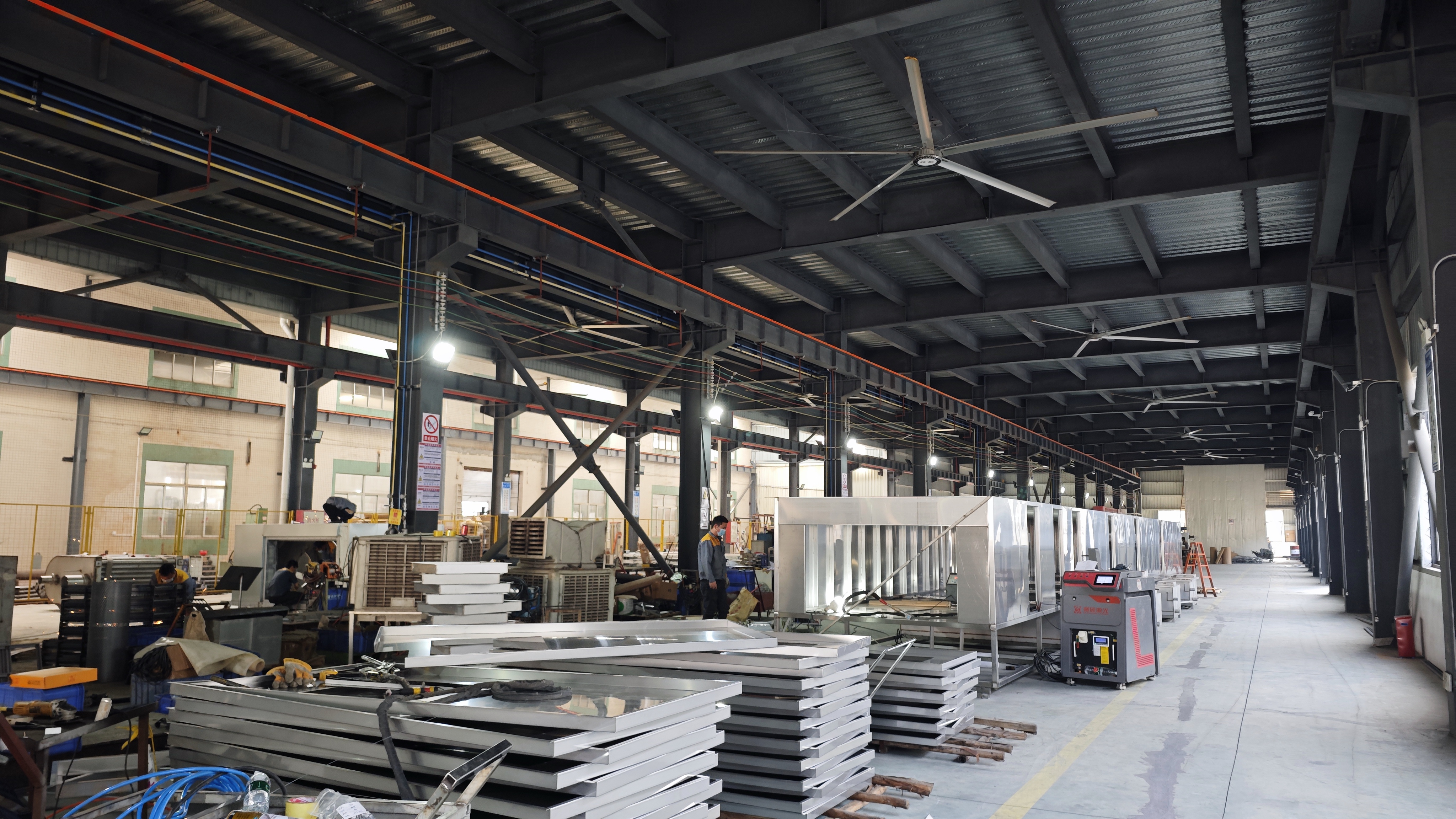
Conveyor structures, hangers and line modules are fabricated and pre-assembled before shipment and pre-shipment testing.
Next step
Send a dimensioned drawing of your largest workpiece together with the daily coated surface area in square metres. Attractivechina will return a transport recommendation — power and free conveyor chain, overhead suspended, floor supported or tray-based — plus the matching pitch, hanger concept and line speed window.
Email: attractivechina@gmail.com | Tel and WhatsApp: +86 135-8061-6025 | Website: www.attractivechina.net
Download the catalogue: Attractivechina company brochure (PDF)
Есть вопросы или нужны дополнительные детали?
Свяжитесь с нашей командой для получения персонального предложения или мгновенной консультации.
Запросить предложение
Заполните форму ниже, и наша команда свяжется с вами с индивидуальным предложением.
Прямой чат WhatsApp
Предпочитаете общаться в реальном времени? Напишите нам в WhatsApp для мгновенной помощи и быстрых ответов.
- Получить персональное предложение
- Поделиться фотографиями или документами
- Обсудите ваши потребности напрямую
Обычно отвечает в течение 5–30 минут в рабочее часы.