

 50,000 m²
 150
150

Medical Titanium Bar vs. Nitinol Plate vs. Titanium Cable: Comparing Implant-Grade Raw Materials
Medical Titanium Bar vs. Nitinol Plate vs. Titanium Cable: Comparing Implant-Grade Raw Materials
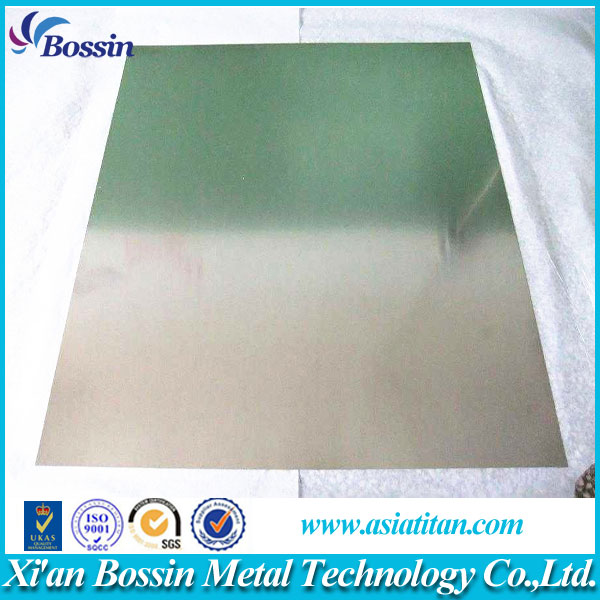
Nitinol plate is one of three implant-relevant material forms considered by medical device sourcing teams.
Implant manufacturers and medical device designers should not assume that every titanium-based raw material form is interchangeable. Medical titanium bar, Nitinol plate, and titanium cable are all used in medical, surgical, or implant-related applications, but each one has a different geometry, material composition, and manufacturing role. The medical titanium bar supplies solid cylindrical stock for machined orthopedic and dental implant components. The Nitinol plate supplies flat nickel-titanium stock for designs that require superelastic or thermal-responsive behavior. Titanium cable supplies a braided titanium structure for applications that require a flexible cable-like form rather than a solid rod or solid plate.
This article compares these three raw material forms using published product specifications, including grades, standards, dimensional options, and documented medical applications. The goal is to help implant manufacturers decide which form is more appropriate during research and evaluation.
Why Raw Material Form Is a Decision Factor, Not an Afterthought
Material data sheets usually describe chemistry and mechanical properties, but raw material form also influences machining cost, regulatory review, supplier qualification, and final device performance. A bone screw or joint stem is normally produced by machining from solid bar. A Nitinol implant or instrument component that needs superelastic recoverability is often better approached from flat Nitinol plate. A braided titanium cable is considered when the final assembly must move around curved pathways or be used in a flexible instrument construct.
Selecting the wrong form can create avoidable downstream work. For example, ordering flat Superelastic Nitinol for a rigid, straight, machined screw component introduces an unnecessary nickel-titanium alloy and phase-transformation specification where a conventional titanium alloy bar may be simpler. Conversely, choosing a conventional solid titanium bar for a highly flexible braided structure is mechanically unsuitable because the desired geometry itself may be better formed by cable or wire.
Market and Standards Context
The medical implant raw material market has continued to attract investment and regulatory attention. A 2025 Dataintelo analysis estimates the global medical-grade titanium materials market at USD 5.21 billion, with projections reaching USD 9.56 billion by 2034. The same analysis reports that orthopedic implants hold the largest application share in the medical titanium market, accounting for about 42.3 percent of revenue. Separately, Precedence Research valued the global Nitinol-based medical device market at USD 4.1 billion in 2024, with a projected CAGR of 7.1 percent.
This demand context makes it important for manufacturers to use the correct international standards. For unalloyed commercially pure titanium used in surgical implants, the governing standards are ASTM F67 and ISO 5832-2. For high-strength Ti-6Al-4V ELI alloy used in implants, the primary standards are ASTM F136 and ISO 5832-3. For Nitinol materials, ASTM F2063 defines the composition and properties expected in medical-grade nickel-titanium.
Medical Titanium Bar
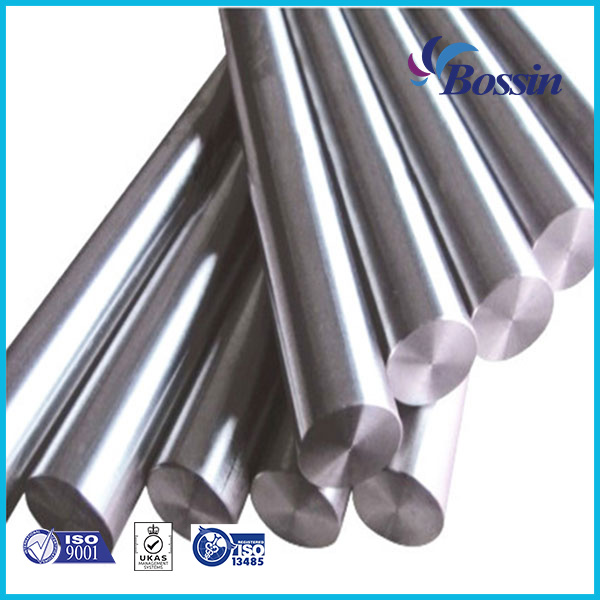
Medical titanium bar is commonly used for manufacturing orthopedic and dental implant devices.
Medical titanium bar is a solid cylindrical raw material produced from titanium and titanium alloys. In the BOSSIN product range, medical titanium bar is available in GR1, GR2, GR3, GR4, GR5 ELI, Ti-6Al-4V ELI, and GR23. The material family is defined as titanium and titanium alloy, with the bar supplied to ASTM F136, ISO5832-3, ASTM F67, and ISO5832-2. This means the same product family can cover unalloyed titanium for surgical implants and high-strength ELI titanium alloys for load-bearing applications.
A practical implant manufacturing spec should include more than grade. The available catalogue range for this bar is 1.0 to 100.0 mm in diameter with length up to 6000 mm. BOSSIN also publishes pre-sized bar groups for particular implant families:
- Bone screw bars are regularly supplied in blank diameters such as 3.5, 4.0, 4.5, 5.0, 5.5, 6.0, 8.0, and 10.0 mm.
- Spine-related bars are listed in diameters such as 13.5, 14.0, 14.2, 15.0, 16.0, and 17.0 mm.
- Bone joint bars are listed in larger diameters such as 30.0, 35.0, 40.0, 50.0, 55.0, 60.0, and 65.0 mm.
- Dental implant bars are listed in a 3.0 to 20.0 mm range.
Medical titanium bar also carries important quality control expectations. BOSSIN lists accuracy to h6, h7, h8, h9, and tolerances as fine as 0.005 mm. Metallographic microstructure is documented to ETTC-2 classes A1 to A3. In practice, an implant manufacturer should compare not only chemistry but also microstructure, ultrasonic inspection, and traceability when qualifying a supplier.
Nitinol Plate
Nitinol plate is not a conventional titanium alloy plate. It is made from nickel-titanium alloy and is frequently classified as a shape-memory alloy. For medical use, the plate should be supplied to ASTM F2063. The BOSSIN Nitinol plate product specification lists nickel content of 54.5 to 57.0 percent, with titanium as the primary balancing element. The plate is available in a polished bright surface finish and can be categorized as superelastic Nitinol plate.
Dimensional flexibility is one of the main advantages of this form. BOSSIN lists Nitinol plate thickness from 0.5 mm to 10 mm, while width is customer-specified. This is useful for manufacturers who need flat blank material and then form, cut, or finish the part to its final geometry. The plate specification also lists multiple transformation temperature options, including an active Af of 33 degrees Celsius plus or minus 3 degrees Celsius. That option is often relevant for body-temperature applications because it allows the material to achieve the desired superelastic or shape-recovery behavior after implantation or insertion.
The stated industries for Nitinol plate include medical, surgical implant, surgical instruments, aerospace, actuators, springs, thermal actuators, robotics, electronic components, consumer electronics, eyeglass frames, and mobile phone antennas. In an implant or surgical-instrument setting, flat Nitinol stock is selected when the part needs controlled recoverable deformation rather than the rigid long-term support provided by a solid titanium bar.
Titanium Cable
Titanium cable is a braided product made from titanium wire rather than being machined from solid material. The BOSSIN Titanium Cable product specification identifies material as pure titanium or titanium alloy. Grades in the product model list include GR1, GR2, GR5, GR5 ELI, GR23, and 6Al-4V ELI in cable form. The listed standards are ASTM F136, ASTM B863, and ASTM F67. This gives cable users a useful combination: the same medical-grade chemistry and standard framework can be translated into a flexible, braided architecture.
The catalog specifies three standard braided configurations:
- 1 x 3 strands
- 1 x 7 strands
- 7 x 7 strands
These configurations provide different flexibility, surface profile, and mechanical response. The stated applications include orthopedic instruments, dental instruments, endoscopic manipulation, and broader medical use. For an implant manufacturer, titanium cable is the most likely candidate when the final component must survive repeated bending, follow tortuous anatomical pathways, or be integrated into an instrument that needs a flexible section.
A separate Nitinol cable product also exists in the BOSSIN family. That product is a nickel-titanium braided cable supplied to ASTM F2063. The current comparison focuses on titanium cable rather than Nitinol cable because titanium cable is built from pure titanium or titanium alloy wire and is more directly comparable with the medical titanium bar family.
Comparison Table
| Criteria | Medical Titanium Bar | Nitinol Plate | Titanium Cable |
|---|---|---|---|
| Material family | Titanium and titanium alloy, including cp-Ti grades and Ti-6Al-4V ELI-type grades | Nickel-titanium shape-memory alloy | Pure titanium or titanium alloy braided wire |
| Composition or grade examples | GR1, GR2, GR3, GR4, GR5 ELI, Ti-6Al-4V ELI, GR23 | Ni 54.5%-57.0%, Ti balance | GR1, GR2, GR5, GR5 ELI, GR23, 6Al-4V ELI |
| Governing standards in source data | ASTM F136, ISO 5832-3, ASTM F67, ISO 5832-2 | ASTM F2063 or customer-specified | ASTM F136, ASTM B863, ASTM F67 |
| Documented size or configuration range | 1.0-100.0 mm diameter, length up to 6000 mm | 0.5-10 mm thickness; width customer-specified | Braided configurations 1 x 3, 1 x 7, 7 x 7 |
| Typical design logic | Solid, machined, load-bearing structural implants and device components | Flat superelastic or thermal-responsive Nitinol blanks for medical, implant, and instrument use | Flexible braided titanium forms for instruments and manipulation applications |
| Representative medical applications | Orthopedic implant devices, dental implants, joint stems, bone screws, spinal constructs | Surgical implant and surgical instrument settings requiring superelastic or thermal-activated material | Orthopedic instruments, dental instruments, endoscopic manipulation, and broader medical use |
Step-by-Step Form-Selection Framework for Implant Manufacturers
The following framework can be used during specification review or when discussing a new implant concept with a material supplier.
- Define the primary mechanical function.
Decide whether the finished component needs rigid structural support, superelastic recoverable displacement, or flexible deflection behavior. A rigid machined component generally points toward medical titanium bar. A superelastic flat or profiled component may point toward Nitinol plate. A flexible braided construct points toward titanium cable.
- Select the alloy family before the form.
Confirm whether the design is for titanium and titanium alloys or for nickel-titanium. The medical titanium bar and titanium cable can both be supplied from titanium or titanium alloy wire/stock. Nitinol plate belongs to a different nickel-titanium family and should be specified separately under ASTM F2063.
- Check the applicable standard against the target device.
For high-strength Ti-6Al-4V ELI implant material, ASTM F136 and ISO 5832-3 are primary references. For unalloyed titanium surgical implant material, ASTM F67 and ISO 5832-2 are primary references. For Nitinol, ASTM F2063 should be confirmed by the supplier.
- Define the dimensional envelope.
For bar, specify diameter and length. For Nitinol plate, specify thickness, width, and transformation temperature. For cable, select the braided strand configuration and then verify whether the available wire grade matches the required standard.
- Build quality and traceability requirements into the specification.
Implant manufacturers benefit from supplier systems that include ISO 13485 certification, full-process traceability, batch-level quality records, and laboratory testing. For medical titanium bar, documented quality items may include 100 percent ultrasonic testing, metallographic structure class A1-A3, and dimensional accuracy to 0.005 mm.
Use Cases That Clarify the Raw Material Decision
Machined Orthopedic and Dental Components from Medical Titanium Bar
Medical titanium bar is the conventional starting point for components that will be machined into orthopedic or dental devices. Product data identifies the bar as implant raw material used in manufacturing orthopedic and dental implant devices such as joint stems, bone plates, bone screws, dental implants, and spine surgery components. The material is designed for stable long-term implantation and provides structural support with good biocompatibility and fatigue resistance. When the manufacturing process is CNC machining or swiss-type machining from solid stock, bar form is the natural fit.
Superelastic or Thermal-Activated Parts from Nitinol Plate
Nitinol plate becomes relevant when the design requires the shape-memory or superelastic family of properties in a flat starting geometry. ASTM F2063 compliance and Ni content between 54.5 and 57.0 percent are useful buyer checkpoints. Because plate thickness can be specified between 0.5 mm and 10 mm, design teams can evaluate both thin and thicker stock. Polished bright plate is listed as an available surface option in the BOSSIN product specification.
Flexible Device Sections from Titanium Cable
Titanium cable is used where a braided, flexible section must be made from titanium-based material. Surgical instrument and endoscopic manipulation applications are documented in the product specification. The three standard braided configurations provide an initial selection range, and the cable may be supplied from commercially pure titanium or titanium alloy grades depending on strength and application needs.
Frequently Asked Questions
Medical titanium bar manufacturer for implants
When evaluating a medical titanium bar manufacturer for implants, confirm the producer can supply bar to the relevant implant-level standards: ASTM F136 and ISO 5832-3 for high-strength Ti-6Al-4V ELI-type alloy, and ASTM F67 and ISO 5832-2 for unalloyed titanium. For machined implant components, also check dimensional accuracy, microstructure class, and quality-system certification. BOSSIN, for example, lists accuracy to 0.005 mm, microstructure to ETTC-2 A1-A3, ISO 13485 certification, 100 percent ultrasonic testing, and full-process quality traceability for medical titanium bar.
Which titanium form should be selected for machined bone screws?
Medical titanium bar is usually the practical choice for machined bone screws because screw geometry is produced from a solid cylindrical stock. In the BOSSIN catalogue, bone screw bar diameters are commonly listed at 3.5, 4.0, 4.5, 5.0, 5.5, 6.0, 8.0, and 10.0 mm. The specific grade should then be selected according to whether the implant requires unalloyed titanium or a high-strength titanium alloy such as Ti-6Al-4V ELI.
When should Nitinol plate be used instead of medical titanium bar?
Nitinol plate should be considered when the component requires the superelastic or thermal-responsive properties of nickel-titanium in a flat starting form. It is not a conventional titanium alloy bar. ASTM F2063 should be verified, and Ni content of 54.5 to 57.0 percent is the documented range in the BOSSIN Nitinol plate specification. Plate thickness options from 0.5 mm to 10 mm make this form suitable for implants, surgical instruments, and other medical parts that need recoverable deformation.
Can titanium cable meet the same medical standards as titanium bar?
Titanium cable can be produced to standards that are also used for medical titanium forms. The BOSSIN Titanium Cable product specification lists ASTM F136, ASTM B863, and ASTM F67. ASTM B863 is a titanium wire specification, while ASTM F136 and ASTM F67 are commonly recognized medical implant standards. The cable is not a solid bar, so the final selection should be driven by whether the application needs a braided flexible construct.
Can one supplier provide medical titanium bar, Nitinol plate, and titanium cable?
Yes. Some titanium and Nitinol manufacturers carry more than one of these forms. XI'AN BOSSIN METAL TECHNOLOGY CO., LTD. is a manufacturer specializing in titanium and Nitinol products, and its product family includes medical titanium bar, titanium plate, titanium wire, titanium cable, Nitinol wire, Nitinol strip, and Nitinol plate. For implant manufacturers, working with a supplier that can cover multiple forms may reduce qualification overhead and simplify batch traceability.
Conclusion
Medical titanium bar, Nitinol plate, and titanium cable answer different design problems. Medical titanium bar serves machined structural implants and surgical devices; Nitinol plate serves superelastic and thermal-responsive nickel-titanium applications; titanium cable serves flexible braided constructs in medical instruments. The comparison is not about which form is generally superior. It is about matching the raw material form to the final device function.
Implant manufacturers should bring three things to the sourcing discussion: the intended mechanical behavior, the governing standard, and the required dimensional or braided configuration. From there, the decision can be narrowed to a product form, and the supplier can be qualified on standards, tolerance, microstructure, testing, and traceability.

Next step for implant material evaluation
Discuss your target device, raw material form, and applicable standard with the BOSSIN team. Download the company brochure for a broader view of its medical titanium and Nitinol product range.
Download BOSSIN brochure or contact sales@asiatitan.com.