

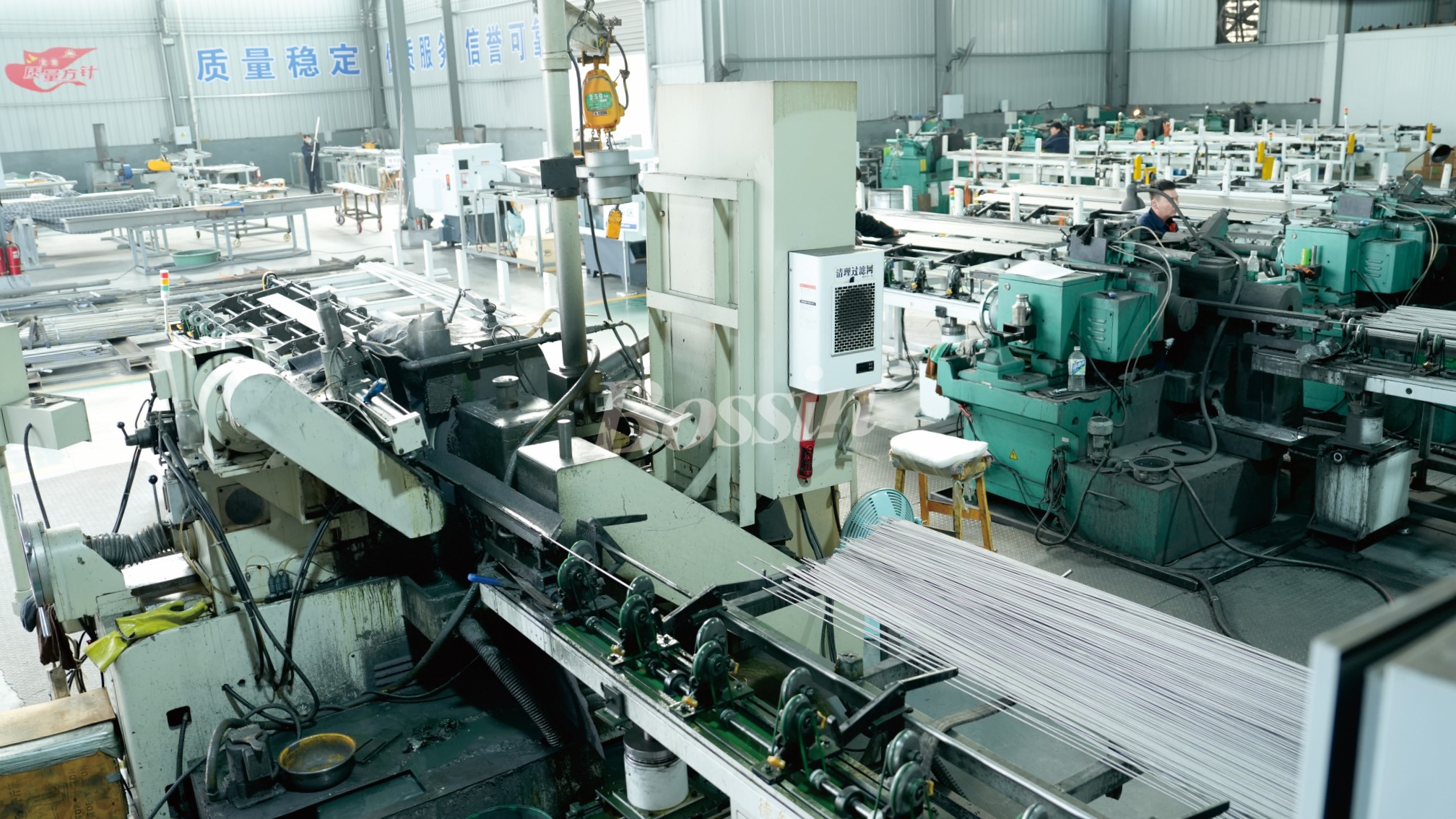
 50,000 m²
 150

Selection Parameters for Nitinol Wire, TMA Wire and Medical Titanium Bar
Nitinol wire, TMA wire and medical titanium bar are selected by function, not by material family name. Nitinol wire (Nickel-Titanium alloy, Ni 54.5–57.0%, ASTM F2063) is the correct choice when a device depends on superelastic recovery or thermal activation. TMA wire (Titanium-Molybdenum alloy, Dia 0.20–5.0 mm) is the correct choice when an orthodontic appliance needs a formable force-delivery element. A medical titanium bar such as GR5 ELI / Ti6Al4V ELI (ASTM F136, ISO 5832-3) is the correct choice when the component must carry structural implant load. Each of the three classes is specified with different parameters: transformation temperature for Nitinol, cross-section and alloy form for TMA, and grade-standard-diameter-tolerance for titanium bar.
This guide is written for engineering and procurement teams that have already moved past discovery. The device concept exists, a drawing or an archwire sequence exists, and the remaining task is to convert that requirement into an order a mill can execute without clarification loops. The sections below cover the parameters that must appear in the RFQ, the standards that govern acceptance, and how the adjacent forms — titanium plate, titanium wire, titanium cable, titanium coil and Nitinol sheet — fit into the same selection logic.
XI'AN BOSSIN METAL TECHNOLOGY CO., LTD. (BOSSIN) is a manufacturer of titanium and Nitinol materials based in Baoji High-tech Zone and Xi'an, China. Founded in 2008, the company produces titanium bar, medical titanium bar, titanium plate, titanium wire, titanium cable, titanium coil and Nitinol wire from a 50,000 m² facility with 150 employees, a 30-engineer R&D team and an annual output of 5,000 tons, with approximately 80% of production exported to markets that include Korea, Brazil, Colombia, Argentina, India, Turkey, Germany and Switzerland.
Problem Definition: Why “Titanium” Is an Incomplete Specification
Most specification failures in medical material sourcing are not metallurgical mistakes. They are translation mistakes. The device team knows what the component must do, but the RFQ that reaches the mill is written at the level of a material family name, and three ambiguities appear at once.
- Family name versus functional class. Nitinol wire, TMA wire and medical titanium bar are all described commercially as medical titanium material, yet they satisfy different mechanical requirements. Nitinol wire is a shape memory alloy wire supplied to ASTM F2063. TMA is a Titanium-Molybdenum wire used for orthodontic appliances. Medical titanium bar is a structural implant material supplied to ASTM F136, ISO 5832-3, ASTM F67 or ISO 5832-2.
- Grade versus governing standard. ASTM F136 and ISO 5832-3 are the primary international standards for high-strength Ti-6Al-4V ELI alloy used in medical implants, while unalloyed commercially pure titanium for surgical implants is governed by ASTM F67 and ISO 5832-2. A quotation that names only GR5 ELI leaves the acceptance basis open.
- Form versus finished component. A diameter that suits a bone screw blank (Phi 3.5–Phi 10.0 mm) is not the diameter that suits a spinal rod (Phi 13.5–Phi 17.0 mm) or a joint stem (Phi 30.0–Phi 65.0 mm). Ordering to the nearest available size transfers machining risk to the device maker.
The consequence is measurable in engineering time: re-quotation, sample rejection, or a change order after the first batch. Nitinol shows the cost most clearly. Wire ordered without a transformation temperature window cannot be evaluated against the device function, because the Af value defines when the alloy returns to its parent shape. BOSSIN supplies Nitinol wire in Af windows of <−15 °C, −10 to 10 °C, 0 to 30 °C, 20 to 40 °C, 45 to 90 °C, 33 ± 3 °C, and As-Ms ≤ 5 °C or ≤ 150 °C, with a customisable range of −30 °C to 120 °C. That window belongs in the specification, not in the inspection report.
Industry Background: Why These Three Material Classes Are Converging in One Procurement File
The global medical grade titanium materials market is estimated at USD 5.21 billion in 2025 and is projected to reach USD 9.56 billion by 2034 (Dataintelo). The global Nitinol-based medical device market was valued at USD 4.1 billion in 2024 with a projected CAGR of 7.1% (Precedence Research). Growth in both segments means that buyers who once purchased a single structural material now manage a mixed basket of Nitinol, orthodontic wire and implant bar in the same supplier qualification.
Published Nitinol valuations differ by scope, and the difference matters when a buyer builds a demand case. Dataintelo reports a Nitinol market figure of USD 2.53 billion for 2025, measuring the alloy market, while Precedence Research measures finished Nitinol-based medical devices at USD 4.1 billion in 2024. Reading the scope note, and not only the headline number, avoids overstating the addressable alloy volume in an internal business case.
Demand is also concentrated by application. Orthopedic implants hold the largest application share in the medical titanium market, accounting for approximately 42.3% of revenue (Dataintelo), which explains why medical titanium bar diameters are commonly grouped by bone screw, spine, joint and dental implant use rather than supplied as a single standard size. Supply-side data points in the same direction: China's cumulative export volume of titanium rods, bars and profiles increased by 21.85% year-on-year as of March 2025 (China Customs / SMM), improving availability but also widening the range of mills a buyer must screen.
Standardisation has kept pace with that growth. For high-strength Ti-6Al-4V ELI, ASTM F136 and ISO 5832-3 are the governing referents; for unalloyed commercially pure titanium for surgical implants, ASTM F67 and ISO 5832-2 apply. For Nitinol, ASTM F2063 is the reference standard against which BOSSIN Nitinol wire, Nitinol cable and Nitinol strip are produced.
Detailed Solution: Selection Parameters by Material Class
Nitinol Wire: Transformation Temperature and Condition Drive the Specification
Nitinol wire selection begins with two parameters that have no equivalent in titanium bar procurement: nickel content and transformation temperature. BOSSIN Nitinol wire is produced to ASTM F2063 with a nickel content of Ni 54.5–57.0% and titanium balance. Wire diameters run from Dia 0.0127 mm to 6.0 mm, and orthodontic sizes follow inch conventions: round 0.012″, 0.014″, 0.016″, 0.018″ and 0.020″, with rectangular sections from 0.016″ × 0.022″ through 0.021″ × 0.025″.
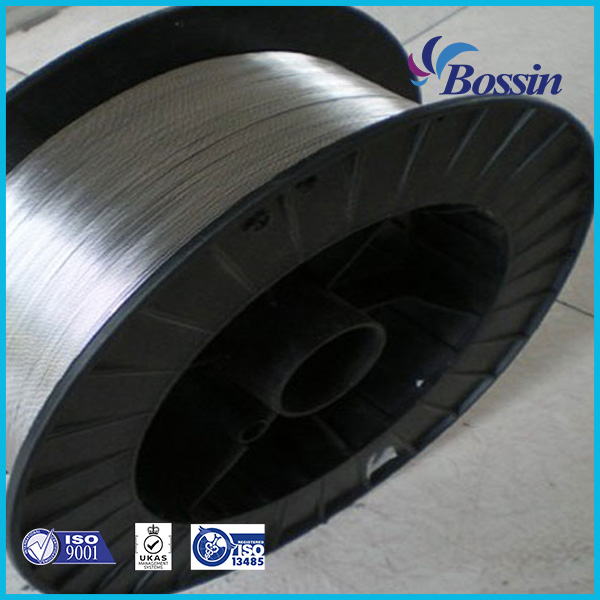
The delivered condition of Nitinol is a specification line, not a mill preference. BOSSIN supplies Nitinol wire cold-worked or superelastic, and also as thermal-activated material. At the capability level, the material condition can be ordered as superelastic (SE), shape memory (SM), annealed (M) or cold-worked (Y). Surface finish options include polished bright, black oxide, acid pickled and light oxide in golden to brown tones. Each of those choices changes handling, forming and inspection in the customer's process, so they must be stated on the purchase order.
Composition is another selectable variable rather than a fixed input. BOSSIN offers composition customisation for binary NiTi alloys and for ternary alloys with added copper, chromium, vanadium, niobium or iron, covering grades such as NiTiCu, NiTiCr, NiTiV, NiTiNb and NiTiFe. Where a device needs a different actuation window, the Af range can be customised from −30 °C to 120 °C, covering low-temperature, room-temperature, high-temperature and superelastic requirements.
Quality control for Nitinol follows the same parameter logic: chemical composition is verified by ICP-OES / XRF analysis compliant with ASTM F2063, mechanical properties such as tensile strength, elongation and superelasticity are measured on a universal testing machine, and transformation temperature including Af is measured precisely by DSC. Medical Nitinol applications that BOSSIN material supports include guide wires, medical sutures, dental root canal files, cardiac occluders, thrombus filters, anchor pins, localization wires, luminal stents and stone retrieval baskets. For larger cross-sections or braided constructions, Nitinol cable is available in 1×3 strand, 1×7 strand and 7×7 strand configurations to ASTM F2063 or customer-specified requirements.
TMA Wire: The Orthodontic Force-Delivery Alloy
TMA wire is not a substitute for Nitinol and is not a grade of medical titanium bar. It is a Titanium-Molybdenum alloy wire produced specifically for dental and orthodontic use, and it is specified by cross-section rather than by transformation temperature.
BOSSIN TMA wire is supplied from Dia 0.20 mm to Dia 5.0 mm. Round TMA wire is available at 0.031″ (0.80 mm), and rectangular sizes include 0.019″ × 0.025″ (0.483 mm × 0.635 mm), 0.018″ × 0.025″ (0.457 mm × 0.635 mm) and 0.017″ × 0.025″ (0.432 mm × 0.635 mm). The product family sits inside BOSSIN's orthodontic wire range alongside NiTi and CuNiTi grades, which allows a clinic or appliance manufacturer to source a full archwire sequence from one material supplier instead of mixing vendors per stage.
From a procurement standpoint, TMA is a dimensional and formability purchase. The parameters to fix are alloy designation (TMA), cross-section, edge condition and straight length or pre-formed arch form. Buyers who request “titanium orthodontic wire” without naming TMA, NiTi or CuNiTi will receive quotations for materials with different clinical behaviour in the same price band.
Medical Titanium Bar: Structural Parameters for Implant Load
Medical titanium bar is where standard mapping matters most. BOSSIN produces medical titanium bar in GR1, GR2, GR3, GR4, GR5 ELI, Ti 6AL4V ELI and GR23, supplied to ASTM F136, ISO 5832-3, ASTM F67 and ISO 5832-2. The ELI grades and the corresponding ASTM F136 / ISO 5832-3 route are used where high strength is required; commercially pure grades under ASTM F67 / ISO 5832-2 cover applications that do not need alloy strength.
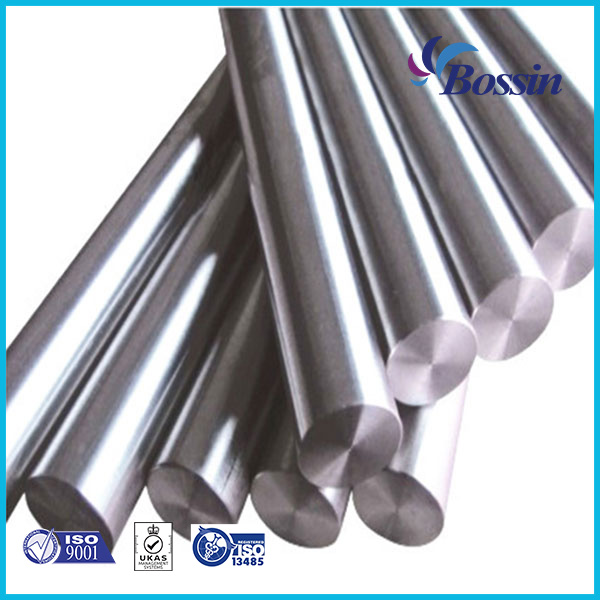
Dimension is the second half of the specification. Medical titanium bar is produced from Dia 1.0 mm to Dia 100 mm with length up to 6,000 mm. In practice, buyers order against application bands: titanium bars for bone screws at Phi 3.5, Phi 4.0, Phi 4.5, Phi 5.0, Phi 5.5, Phi 6.0, Phi 8.0 and Phi 10.0; titanium bars for spine at Phi 13.5, Phi 14.0, Phi 14.2, Phi 15.0, Phi 16.0 and Phi 17.0; titanium bars for bone joints at Phi 30.0, Phi 35.0, Phi 40.0, Phi 50.0, Phi 55.0, Phi 60.0 and Phi 65.0; and titanium bars for dental implants from Phi 3.0 to 20.0 mm. Dental titanium discs are also available in Phi 98 × 10–25 mm and 220 × 150 × 10–25 mm formats.
Accuracy is quoted as h6, h7, h8 and h9 with 0.005 mm tolerance, and microstructure is controlled to ETTC-2 levels A1–A3. Those three values — diameter band, tolerance class and microstructure — determine how much material the device maker removes after receipt, and therefore how the true cost per finished component compares between two apparently similar quotations.
Adjacent Forms That Follow the Same Procurement Logic
Most implant and instrument programmes require more than one form, and the same selection discipline applies across the family.
- Titanium plate and medical titanium plate. Grades GR1, GR2, GR4, GR5 ELI, Ti 6Al4V ELI and GR23 to ASTM F136, ISO 5832-3, ASTM F67 and ISO 5832-2, in thickness 0.3–50.0 mm × width 100 mm × length 2,000 mm, hot rolled or cold rolled. Typical use covers surgical implants, bone plates, coronary stents and artificial joints.
- Titanium wire and medical titanium wire. From Dia 0.03 mm to 6.0 mm, supplied on coils or spools, generally 10–100 kg per coil for medical titanium wire and 10–200 kg for titanium wire. Medical grades are produced to ASTM F67 and ASTM F136; general titanium wire also references ASTM B863, AWS A5.16, ASTM B348 and AMS 4951 / 4954 / 4956.
- Titanium cable. Braided constructions in 1×3, 1×7 and 7×7 strands to ASTM F136, ASTM B863 and ASTM F67, used in orthopedic instruments, dental instruments and endoscopic manipulation.
- Titanium coil. Grades Gr1, Gr2, Gr4, Gr5, Gr5 Eli and Gr23 to ASTM B265, ASTM F67, ASTM F136 and AMS 4911, with thickness from 0.005 mm to 0.9 mm in coil and cut-length form.
- Nitinol sheet and strip. ASTM F2063 material in thickness 0.03–2.0 mm and width up to 600 mm, with superelastic property and polished bright, acid pickled or black surface, used for orthodontic bracket parts, medical devices, eyeglass frames and antennas.
Step-by-Step Breakdown: From Drawing to Purchase Order
Step 1 — Classify the component by function before naming a material
Ask which mechanism the component performs. If it changes shape in response to temperature, it is a shape memory or superelastic requirement and belongs in the Nitinol class. If it delivers a controlled orthodontic force and must be formable by the clinician, it belongs in the TMA or orthodontic wire class. If it carries structural load or is machined into a screw, stem or plate, it belongs in the titanium bar or plate class. This single step prevents most cross-class specification errors.
Step 2 — Fix Af and delivered condition for Nitinol
State the Af window, not a range to be agreed later. BOSSIN produces windows of <−15 °C, −10 to 10 °C, 0 to 30 °C, 20 to 40 °C, 45 to 90 °C, 33 ± 3 °C and As-Ms ≤ 5 °C or ≤ 150 °C, with custom values from −30 °C to 120 °C. Then state the condition: superelastic, shape memory, annealed or cold-worked. Af and condition together define the wire; diameter alone does not.
Step 3 — Name the standard, not only the grade
Write the acceptance standard next to the grade. For Ti-6Al-4V ELI bar, use ASTM F136 and ISO 5832-3. For commercially pure titanium bar, use ASTM F67 and ISO 5832-2. For Nitinol, use ASTM F2063. Naming both grade and standard removes the most common cause of mismatched first articles.
Step 4 — Match diameter and tolerance to the finished component
Medical titanium bar is available from Dia 1.0 mm to 100 mm with length up to 6,000 mm, at h6, h7, h8 or h9 tolerance and 0.005 mm accuracy. Selecting the closest standard band (bone screw, spine, joint, dental) reduces machining stock and scrap. For Nitinol, wire spans Dia 0.0127–6.0 mm with round and rectangular orthodontic sections.
Step 5 — Define surface finish and secondary operations
Surface finish is a cost and yield variable. Titanium products can be supplied bright, polished, pickled or acid cleaned. Nitinol surfaces include polished bright, black oxide, acid pickled and light oxide. Where the component is machined, secondary processing such as drilling, milling and threading can be quoted with the material so that the inbound inspection standard matches the finished feature.
Step 6 — Verify documentation, accreditation and acceptance criteria
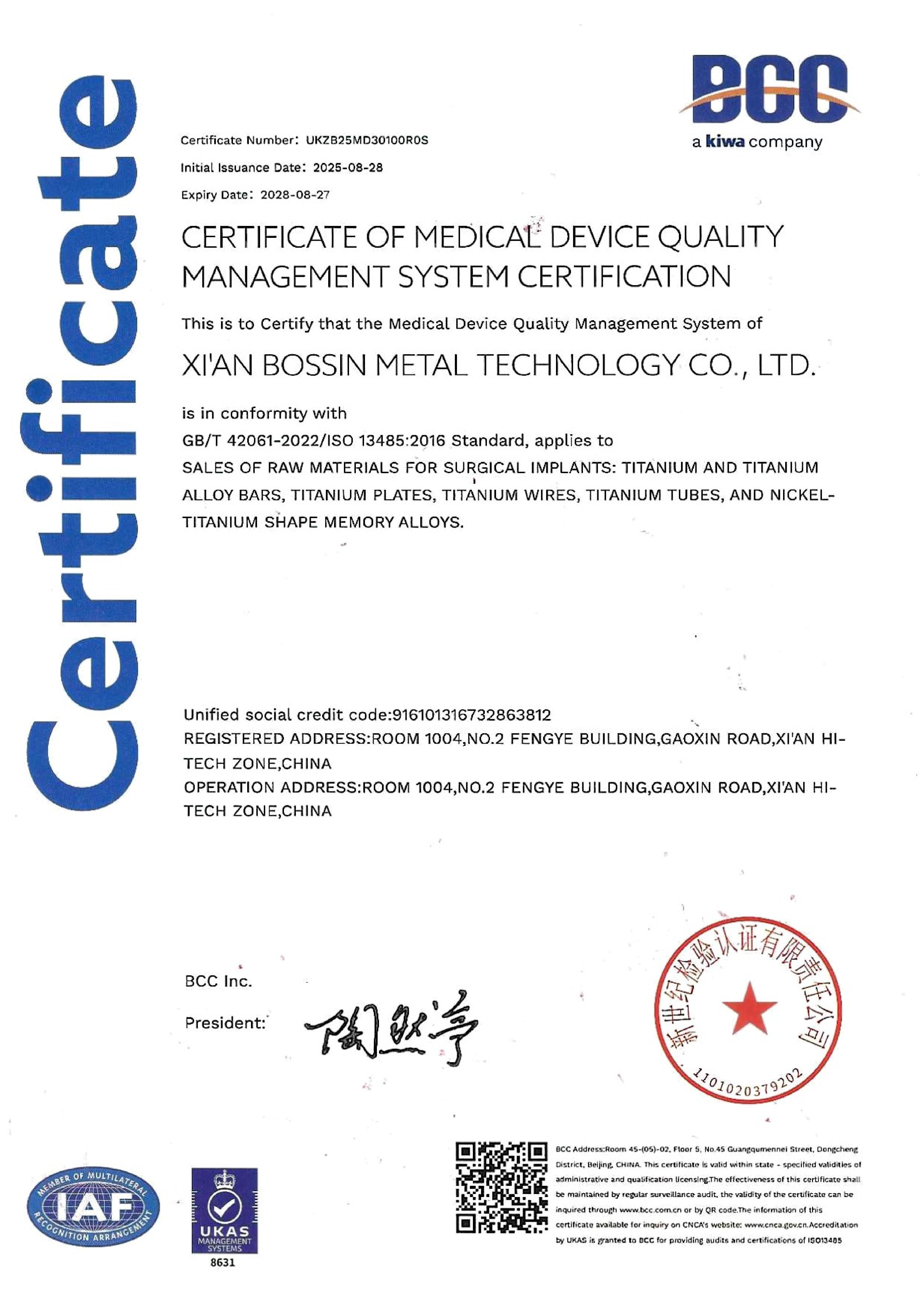
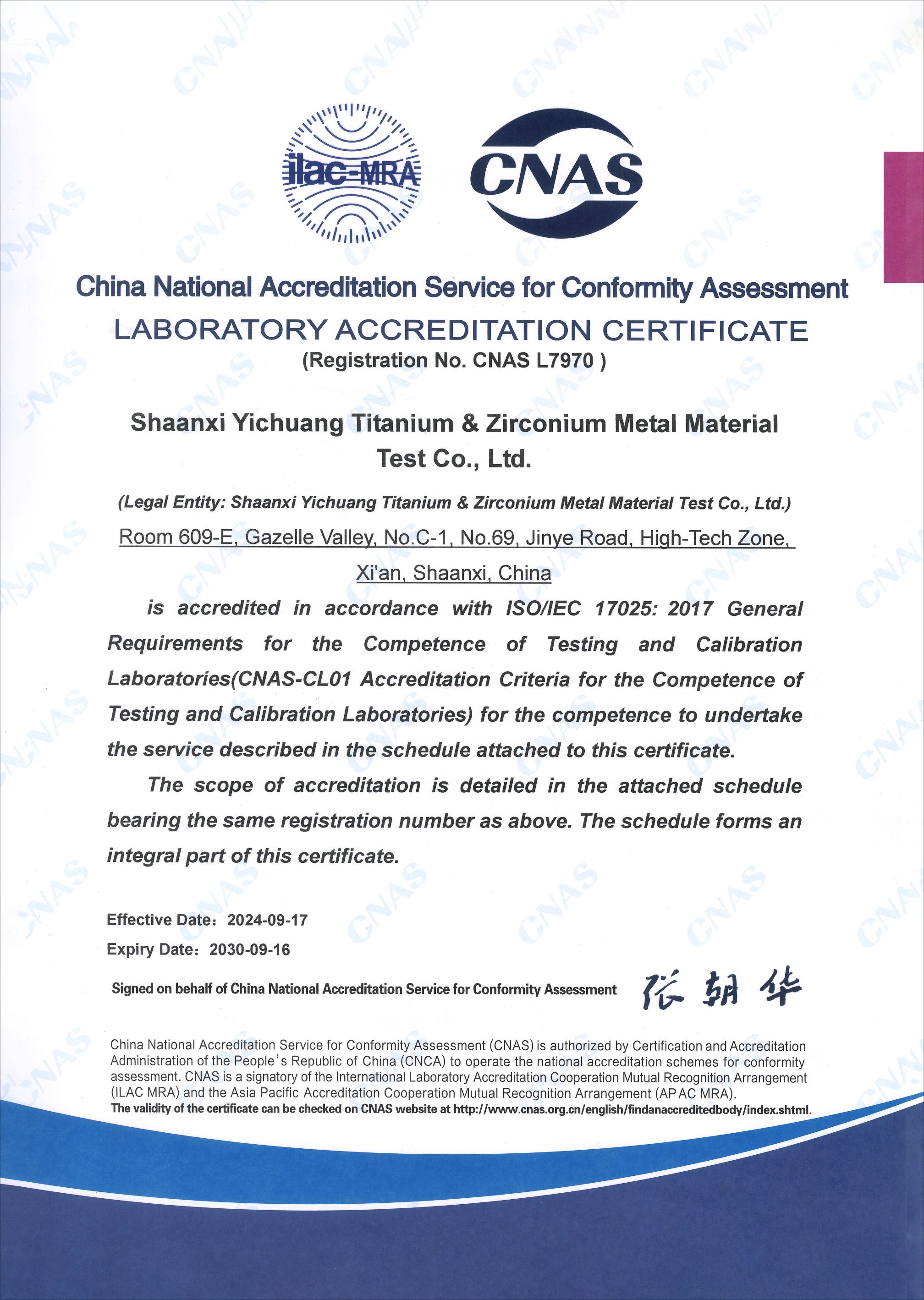
Documentation should be requested at quotation stage. BOSSIN holds ISO 13485:2016 medical device quality management system certification, certificate number UKZB25MD30100R0S, issued by BCC on 2025-08-28 and valid until 2028-08-27, covering surgical implant raw materials including titanium and titanium alloy bar, titanium plates, titanium wires, titanium tube and nickel-titanium shape memory alloys. The company's materials testing laboratory is accredited to ISO/IEC 17025 under CNAS L7970, issued 2024-09-17 and valid until 2030-09-16.
Acceptance criteria should also be fixed in writing: in-house full inspection per ASTM / ISO standards with a material test certificate (MTC) accompanying each batch, testing performed in ISO/IEC 17025 accredited laboratories, and third-party inspection by SGS or BV available upon request. BOSSIN also operates ISO 9001:2015 and EN9100:2018 certified systems, giving buyers a second reference point when the device programme is not purely implant-focused.
Step 7 — Confirm commercial terms and lead time before releasing the PO
The commercial frame can be settled in the same RFQ. Minimum order quantity is 10 kg. Delivery terms are FOB, CIF or EXW, and payment terms are T/T or L/C. Lead time is 15 days for titanium products and 10–25 days for Nitinol products, supported by monthly capacity of 300 tons for titanium and 5,000 kg for Nitinol. Where the device programme is long-running, these figures determine reorder rhythm rather than a single shipment date.
Use Cases: How the Parameters Are Applied in Practice
Orthodontic archwire programmes
An orthodontic appliance manufacturer typically orders a sequence rather than one wire. BOSSIN supplies the orthodontic range in NiTi, CuNiTi and TMA grades, including TMA from Dia 0.20 mm to 5.0 mm with rectangular sections of 0.017″ × 0.025″, 0.018″ × 0.025″ and 0.019″ × 0.025″, alongside NiTi round and rectangular sizes from 0.012″ to 0.021″ × 0.025″. Sourcing both TMA and NiTi from one supplier keeps cross-section tolerances consistent across the sequence.
Trauma, joint and dental implant manufacturing (Brazil)
A medical surgical implant manufacturer in Brazil purchased 10,000 kg of titanium material for artificial joints, bone screws, orthopedic implants, dental implants and bone plates. The reported outcome was biocompatibility, a modulus of elasticity similar to bone, high strength combined with low density, consistent material, and fatigue resistance for long-term use. The programme relied on ISO 13485 certification, 0.005 mm precision tolerance and microstructure reaching A1, with full-process quality control.
Surgical suture and implant wire programmes (Argentina)
A surgical implant and medical device manufacturer in Argentina purchased 5,000 kg for surgical sutures. The material complied with ASTM F136 and ASTM F67, and the buyer reported that direct factory sourcing reduced procurement costs by 8% while maintaining quality. The case illustrates a general procurement point: when grade and standard are correctly specified, the remaining cost difference between suppliers usually sits in the supply chain rather than in the material specification.
Guidewire and vascular device development
Guide wires, luminal stents, thrombus filters, cardiac occluders and stone retrieval baskets depend on superelastic Nitinol behaviour rather than on structural strength. For these programmes, the specification conversation centres on Af window, nickel content within Ni 54.5–57.0%, surface finish and, where braided constructions are used, cable configuration of 1×3, 1×7 or 7×7 strands to ASTM F2063 or a customer-specified standard.
Comparison Table: Nitinol Wire, TMA Wire and Medical Titanium Bar Side by Side
| Selection parameter | Nitinol wire | TMA wire | Medical titanium bar — GR5 ELI / Ti6Al4V ELI | Medical titanium bar — commercially pure GR1–GR4 |
|---|---|---|---|---|
| Composition | Nickel-Titanium alloy, Ni 54.5–57.0%, Ti balance | Titanium-Molybdenum alloy | Titanium alloy, ELI chemistry (Ti6Al4V ELI) | Unalloyed titanium, GR1, GR2, GR3, GR4 |
| Governing standard | ASTM F2063 | Grade designation TMA within the orthodontic wire range | ASTM F136, ISO 5832-3 | ASTM F67, ISO 5832-2 |
| Size range | Dia 0.0127–6.0 mm; round 0.012″–0.020″; rectangular 0.016″×0.022″ to 0.021″×0.025″ | Dia 0.20–5.0 mm; round 0.031″ (0.80 mm); rectangular 0.017″×0.025″, 0.018″×0.025″, 0.019″×0.025″ | Dia 1.0–100 mm, length ≤6,000 mm; bone screw bands Phi 3.5–Phi 10.0, spine Phi 13.5–Phi 17.0, joint Phi 30.0–Phi 65.0, dental implants Phi 3.0–20.0 mm | Dia 1.0–100 mm, length ≤6,000 mm; dental titanium discs Phi 98×10–25 mm and 220×150×10–25 mm |
| Condition and control parameters | Cold-worked, superelastic or thermal-activated; SE / SM / M / Y states; selectable Af window | Supplied as finished orthodontic archwire stock in round and rectangular sections | Accuracy h6, h7, h8, h9; tolerance 0.005 mm; microstructure to ETTC-2, A1–A3 | Accuracy h6, h7, h8, h9; tolerance 0.005 mm |
| Best-fit application | Guide wires, root canal files, sutures, occluders, filters, anchor pins, stents, retrieval baskets | Dental and orthodontic archwires requiring formable force delivery | Surgical implants, bone screws, spine systems, joint stems, dental implants | Bone plates, dental components, general implant and instrument parts |
FAQ
Which standards should a Nitinol wire or medical titanium bar supplier hold for implant and orthodontic programmes?
Three layers matter. Product standards: Nitinol wire to ASTM F2063; high-strength Ti-6Al-4V ELI bar to ASTM F136 and ISO 5832-3; unalloyed commercially pure titanium for surgical implants to ASTM F67 and ISO 5832-2. System certification: ISO 13485:2016 for medical device quality management, which at BOSSIN is certificate UKZB25MD30100R0S issued 2025-08-28 and valid to 2028-08-27, covering surgical implant raw materials including titanium and titanium alloy bar, titanium plates, titanium wires, titanium tube and nickel-titanium shape memory alloys. Test capability: laboratory accreditation to ISO/IEC 17025, held by BOSSIN as CNAS L7970 with validity to 2030-09-16.
What can an OEM medical titanium bar manufacturer customise?
Titanium customisation covers material and grade (pure titanium GR1, GR2, GR3, GR4 and alloys including GR5, GR5 ELI, Ti6Al4V ELI, GR7, GR9, GR12, GR23, TI-6242, Ti6246, TB3, TB6, TC4, TC6, TC11, TC17 and TC18), shape (round, square, hexagonal or custom profiles), dimensions (diameter 1 mm to 300 mm and length 50 mm to 6,000 mm in the OEM capability range, with tolerance classes h6, h7, h9 and h11) and secondary processing such as drilling, milling and threading. For Nitinol, customisation covers binary and ternary composition including NiTiCu, NiTiCr, NiTiV, NiTiNb and NiTiFe, transformation temperature from −30 °C to 120 °C, material condition in superelastic, shape memory, annealed or cold-worked states, and surface finish from black oxide to ultra-bright polished.
What is the minimum order quantity, and what drives the cost?
Minimum order quantity is 10 kg, with delivery terms of FOB, CIF or EXW and payment by T/T or L/C. Cost is driven mainly by grade and standard combination, the Af window for Nitinol, tolerance class and microstructure requirement for titanium bar, surface finish, and the depth of documentation required. In one Argentina surgical suture programme, direct factory sourcing reduced procurement costs by 8% while maintaining the same quality, which indicates that routing and supply-chain structure, not specification compromise, is usually the largest controllable cost variable.
Can material be validated before a full production order is released?
Validation is built into the documentation chain rather than promised verbally. Each batch order is accompanied by a factory inspection certificate, and in-house full inspection is performed per ASTM / ISO standards with a material test certificate (MTC). Chemical composition for Nitinol is verified by ICP-OES / XRF analysis compliant with ASTM F2063, mechanical properties by universal testing machine, and transformation temperature by DSC; testing takes place in laboratories accredited to ISO/IEC 17025. Third-party inspection by SGS or BV is available upon request, and traceability is maintained across every production phase.
What lead times apply to titanium bar and Nitinol wire orders?
Lead time is 10–25 days for Nitinol products and 15 days for titanium products, supported by monthly capacity of 5,000 kg for Nitinol and 300 tons for titanium. Lead time should be confirmed against the specific grade, Af window and tolerance class at quotation, because custom transformation temperatures and non-standard cross-sections extend the production route. To start a technical review, send the drawing, the governing standard and the Af or tolerance requirement through the contact details below or request the BOSSIN product catalogue.
Conclusion: Lock the Function First, Then the Standard
Nitinol wire, TMA wire and medical titanium bar are three different answers to three different questions. Nitinol wire to ASTM F2063 answers a shape recovery or thermal activation question, and is specified through nickel content within Ni 54.5–57.0%, an Af window, and a delivered condition of superelastic, shape memory, annealed or cold-worked. TMA wire answers an orthodontic force-delivery question, and is specified by cross-section from Dia 0.20–5.0 mm, including rectangular sizes from 0.017″ × 0.025″ to 0.019″ × 0.025″. Medical titanium bar answers a structural load question, and is specified through grade and standard pairs — GR5 ELI / Ti6Al4V ELI against ASTM F136 and ISO 5832-3, commercially pure grades against ASTM F67 and ISO 5832-2 — together with diameter band, tolerance class h6 to h9 at 0.005 mm, and microstructure from A1 to A3.
For buyers at the Evaluation and Execution stage, the practical sequence is short: classify the component by function, fix the transformation temperature and condition where relevant, name both grade and standard, match diameter and tolerance to the finished feature, define surface finish and secondary operations, verify ISO 13485 and ISO/IEC 17025 documentation, and then confirm MOQ, delivery terms and lead time in the same RFQ. That sequence removes the re-quotation loop that costs most programmes their first quarter of production time.
Send your specification for review
Share the drawing, the governing standard, the required Af window or tolerance class, and the order quantity. BOSSIN will confirm the applicable material route, documentation package and lead time. Download the full product range in the BOSSIN product brochure, or request a quotation and sample evaluation for Nitinol wire, TMA wire and medical titanium bar.
Есть вопросы или нужны дополнительные детали?
Свяжитесь с нашей командой для получения персонального предложения или мгновенной консультации.
Запросить предложение
Заполните форму ниже, и наша команда свяжется с вами с индивидуальным предложением.
Прямой чат WhatsApp
Предпочитаете общаться в реальном времени? Напишите нам в WhatsApp для мгновенной помощи и быстрых ответов.
- Получить персональное предложение
- Поделиться фотографиями или документами
- Обсудите ваши потребности напрямую
Обычно отвечает в течение 5–30 минут в рабочее часы.