
Геотекстильное соответствие США и Австралии: предварительное тестирование, условия заказа и соответствие приложения
U.S. & Australia Geotextile Compliance: Pre-Shipment Testing, Order Terms, and Application Fit
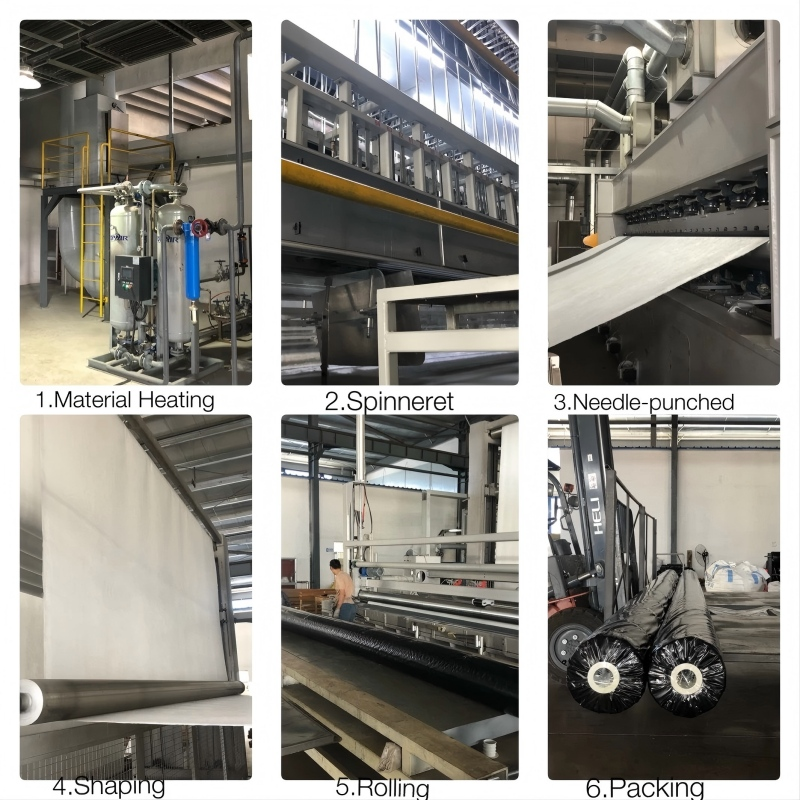
Polyester continuous filament needle-punched geotextile production line — the manufacturing stage where specification compliance is created, not proven.
Compliance for a U.S. or Australian geotextile order is not a certificate; it is a chain of three checkpoints. The product must match the application's physical demands, an accredited laboratory must test the material before shipment, and the commercial terms must be fixed in the order itself. Road, hydraulic and landfill projects in both markets tend to fail in the same way when one link is missing: the gap surfaces at the site gate rather than at the quotation stage.
This guide is written for importers, engineering contractors and procurement teams sourcing geotextile for U.S. and Australian projects. It maps application demands — high UV resistance for exposed landfill lining, low elongation for river embankment reinforcement — onto a supplier acceptance procedure, and uses G-Tex® GE, the export brand of Dalian GeoMax Synthetics Co., Ltd., as a worked example of how documentation, pre-shipment testing and order terms fit together. Nothing below should be read as a blanket certification claim: every checkpoint is something a buyer can request, read and verify.
Why "Certified Geotextile" Alone Does Not Prove Compliance
In the European Union, access to road and trafficked-area projects runs through a single harmonized route. EN 13249:2016 is the harmonized European standard for geotextiles used in roads and trafficked areas, and it requires CE marking for EU market access. The United States and Australia do not offer buyers that single visible door. Specifications are commonly written around ASTM- and AS-based regimes, which means the burden of verification sits with the buyer and the supplier rather than with one mark on a label.
That structural difference produces two recurring failure modes in cross-border purchasing:
- Application mismatch. A light PP nonwoven roll is quoted against a landfill lining scope that requires high UV resistance and long-term outdoor exposure, or against a river embankment scope that requires low elongation. The fabric looks identical in a photograph; the performance profile is not.
- Documentation gap. The specification sheet lists values, but no accredited laboratory report exists for the production batch, and no pre-shipment test is scheduled. Nothing appears wrong until the material arrives and the engineer asks for evidence.
The practical rule: for every order, a U.S. or Australian buyer should be able to answer three questions in writing — which test method defines the requirement, which laboratory performs the test, and which production batch the report covers. Where a supplier cannot answer, the certification claim should be treated as unverified.
This is also why the phrase "we are certified" is not, on its own, a compliance answer. ISO management-system certificates such as ISO 9001, ISO 14001 and ISO 45001 describe how a factory is run. They do not describe how a specific roll of geotextile behaves under Xenon-Arc exposure or a defined tensile load. Product-level evidence and system-level evidence are different documents, and U.S. and Australian projects generally need both.
Industry Background: Why Verification Pressure Is Rising in Both Markets
The commercial backdrop explains why buyers are being asked to document more, not less. The global geotextile market was valued at USD 7.10 billion in 2022 and is projected to reach USD 11.82 billion by 2030, growing at a CAGR of 6.6%, according to Grand View Research. Nonwoven geotextiles held the largest global product share in 2022, accounting for approximately 65.5% of total revenue.
China's position in that market is substantial. China accounted for 23.3% of global geotextiles market revenue in 2024 and is expected to lead the global market by 2030; the country's domestic geotextiles market generated USD 1.85 billion in revenue in 2024, with an expected CAGR of 10.1% through 2030 (Grand View Research). Buyers should note that published market sizes diverge by methodology and by how narrowly "geotextile" is defined — separate research houses have placed the near-term figure in the range of USD 4.74 billion to USD 7.5 billion. The directional conclusion is the same either way: supply is expanding, and so is the volume of material that must be differentiated by evidence rather than by appearance.
UV performance is the clearest example of why method matters more than vocabulary. ASTM D4355 is the core industry standard for testing the UV deterioration of geotextiles via Xenon-Arc exposure. A purchaser specifying an anti-UV geotextile for a landfill lining or an exposed embankment in Australia or the southern United States should therefore ask a specific question: which UV test method stands behind the claim, and on which sample?
Two specialised categories have moved from niche to mainstream in the same period. Wicking geotextiles, such as Mirafi® H2Ri from Solmax / TenCate, use hydrophilic fibres to provide capillary action and transport water even in unsaturated soil conditions. Conductive geotextiles, such as Bidim® C from Geofabrics Australasia, use graphene or conductive grids to enable Electrical Leak Location (ELL) in geomembrane liners. Landfill and hydraulic buyers increasingly write these capabilities into tender documents, which raises the documentation bar for every supplier in the category — including Chinese geotextile plants serving those tenders.
How a Chinese Geotextile Manufacturer Structures Application Fit and Pre-Shipment Testing
G-Tex® GE is the export brand of Dalian GeoMax Synthetics Co., Ltd., a Chinese geotextile and geosynthetics manufacturer located in Dalian, the international shipping centre of Northeast Asia. The company focuses on the research, development, production and sale of geotextiles and geosynthetics for export, reports an export ratio of 95%, and supplies markets across Asia, Europe, the Americas, Oceania and Africa. Its export record includes more than 30 countries and regions, among them Australia, New Zealand, Fiji, Canada and the United States — three of the four markets referenced throughout this guide. Third-party industry reporting (HTNXT industry reports) has identified Dalian GeoMax Synthetics, brand G-Tex® GE, as a major Chinese manufacturer with annual production capacity in the millions of square metres. Its website is www.geotranstechnology.com.
Manufacturing base and standards alignment
The factory covers 12,000 m² and employs 45 people, including an R&D team of 12 engineers. Annual output is 9,500,000 m² of geotextiles and geosynthetics, with a monthly capacity of 800,000 m². Production runs on two short-fibre needled geotextile lines and one long-fibre needled geotextile line. The performance indicators of the geotextiles currently produced far exceed the Chinese GB/T national standard and can meet the standard requirements of Australia and the United States.
Standard alignment is a configuration decision rather than a fixed attribute. The company states that its products can meet the requirements of the German DIN standard, the international ISO standard, the American ASTM standard, the Australian AS standard and the Chinese GB/T national standard, and that it can supply customized products in accordance with ASTM, AS, GB/T and other standards to match specific products, specific geological conditions and regional diversity. For a U.S. or Australian buyer, that is the point at which a supplier must be asked to confirm, in writing, which standard the offered grade is being manufactured and tested against.
System-level credentials that appear in typical supplier audits include ISO 9001 Quality Management System certification, ISO 14001 Environmental Management System certification and ISO 45001 Occupational Health and Safety Management System certification. The company is a member of the International Geosynthetics Association and the China Geosynthetics Engineering Association, holds over 80 patents related to geotextile and geosynthetic material processes and equipment, and is a national high-tech enterprise in China.
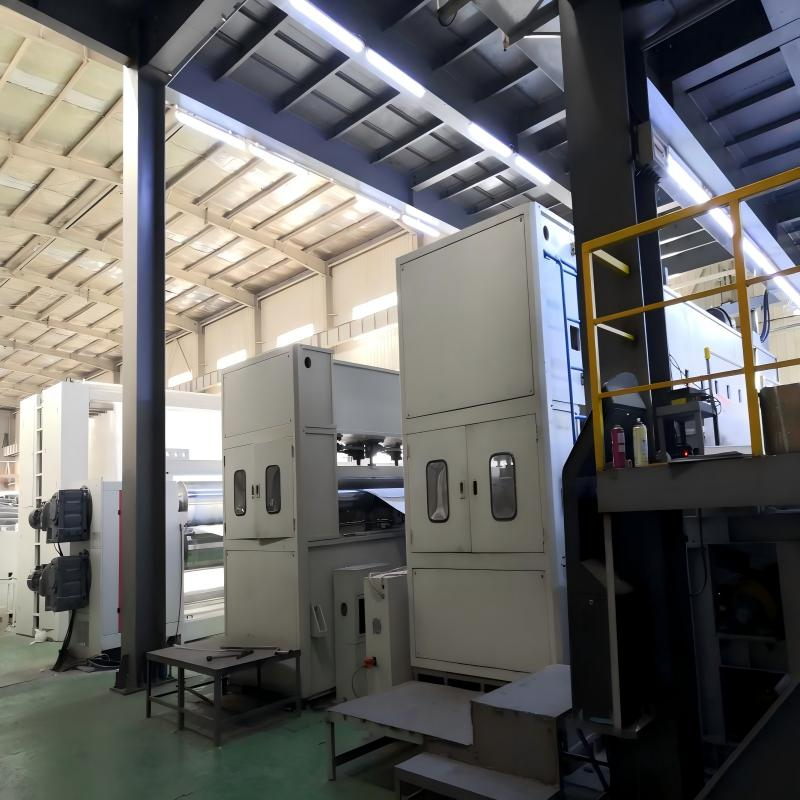
Needle punching is where fibre entanglement — and therefore tensile, tear and burst behaviour — is set. Uniform fabric surface weight is the observable output buyers can check against a specification sheet.
Pre-shipment testing as a defined checkpoint, not a promise
The company established Dalian IEC Testing Service Co., Ltd. in 2012 to handle testing and technical promotion services for geotextiles and geosynthetics. In April 2016, that laboratory was awarded CNAS laboratory accreditation by the China National Accreditation Service for Conformity Assessment, giving it the technical capability to conduct tests in accordance with its accredited scope and recognised domestic and international standards. Within the recognised scope, its public test reports may carry the CNAS national laboratory certification mark together with the ILAC and APLAC international mutual recognition joint marks, and the reports it releases are mutually recognised by over 70 developed countries.
Combined with a declared quality-control regime of 100% test, this is what turns "we test our products" into a document a project engineer can file. It is also why pre-shipment testing deserves to be a scheduled checkpoint in the order rather than a subject raised after a problem appears on site.
The product range and the parameters that carry into a specification
The geotextile range is offered under models GLS-V, GE, GLP, PET and PP, in PET and PP materials, and covers wicking geotextile, anti-UV geotextile, orange geotextile, logo inkjet coding geotextile, conductive geotextile and geotextile fabrics, along with mini rolls, geotextile membrane, drainage geonet, drainage geocomposites, geocell, geomembrane liners, HDPE geomembrane and PET products. Declared wide-range parameters are wide-widths tensile of 7.0~95 kN/m, grab strength of 500N~7,500N, trapezoidal tear of 200N~2,500N and CBR burst strength of 1,300N~12,500N.
Because these are ranges across a product family rather than the properties of a single roll, they cannot be used as a specification on their own. The correct sequence is to fix the application demand first, then take the specific grade whose tested values sit inside the project window.
Customization capability is relevant to that mapping. Coloured geotextile is available in orange, red, grey and other colours depending on customer requirements, alongside conductive geotextile, wicking geotextile, anti-UV geotextile and various composite geosynthetic products. Surfaces can be spray-coated with a customer's company logo, product name, specifications and other information on request, and reprocessing extends to mini rolls, geobags, tubular bags, fabric sheets and geosynthetic containers in various sizes and structural forms. The production model is described as an ODM solution, with after-sales remote support.
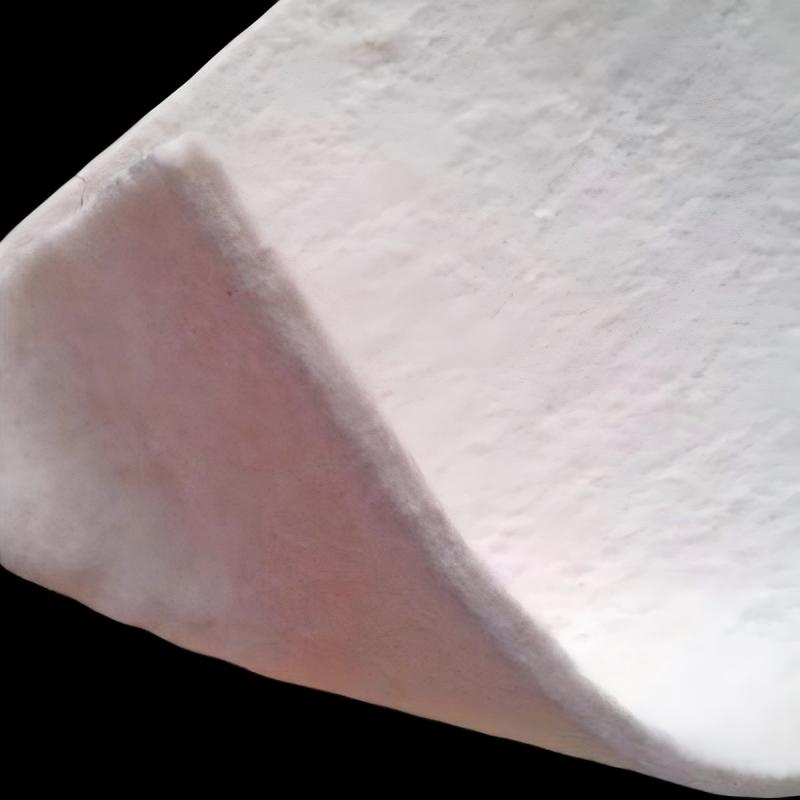
Heavy-duty nonwoven geotextile: the same visual category serves different applications, which is why application fit must be documented rather than assumed.
Step-by-Step: A Pre-Shipment Acceptance Procedure for U.S. and Australian Orders
Step 1 — Define the application before defining the product
Three inputs drive everything that follows: project type, required function and special requirement. Across road construction, landfill lining and river embankment reinforcement, the common function set is filtration, stress dispersion and gasket performance, operating in static long-term mode alongside bulldozers, excavators and cranes. The special requirements that most often decide compliance are high UV resistance and low elongation. A supplier that asks for these three inputs before quoting is working from the project; a supplier that quotes a weight per square metre first is working from inventory.
Step 2 — Convert each demand into a test question
High UV resistance becomes a UV deterioration test question, with ASTM D4355 (Xenon-Arc exposure) as the reference method to name. Low elongation becomes a tensile and elongation data question. Puncture and installation survivability become a CBR burst strength question, with the declared range of 1,300N~12,500N as the envelope to negotiate within. Tear resistance under site handling becomes a trapezoidal tear question, within a declared range of 200N~2,500N. Naming the method removes the ambiguity that marketing labels create.
Step 3 — Confirm the pre-shipment test and the laboratory behind it
Before the deposit is released, the order should state the test to be performed, the laboratory that will perform it, and the batch the report will cover. Dalian IEC Testing Service Co., Ltd. provides this function for G-Tex® GE orders: established in 2012, CNAS-accredited in April 2016, and able to issue reports carrying the CNAS mark together with the ILAC and APLAC mutual recognition joint marks within its recognised scope, with mutual recognition in over 70 developed countries.
Limit to understand: a testing laboratory operated within the same group is an internal capability, not an independent third-party verdict. The report is still a document to read — check that the test method matches the project specification and that the requested test falls inside the laboratory's accredited scope. U.S. and Australian buyers with project-specific requirements should confirm both points before relying on the report for acceptance.
Step 4 — Fix the commercial terms in the same document as the technical annex
The commercial compliance details that should appear in writing are the 10,000 m² minimum order quantity, FOB or CIF delivery, and payment of 30% deposit with 70% balance before shipment. Separating terms from the technical annex is a common cause of later disputes, because the accepted product grade and the accepted commercial conditions end up in different files. Lead time of 10–45 days should be written into the same order, tied to the confirmed quantity.
Step 5 — Sequence lead time against the construction calendar
A 10–45 day lead time combined with a 10,000 m² minimum order quantity means the order has to be forecast, not improvised. Monthly capacity of 800,000 m² and annual output of 9,500,000 m² indicate the scale available, but capacity is not schedule: the buyer's protection is a written lead time with a defined start point, and a delivery term (FOB or CIF) that assigns responsibility for the main carriage leg.
Step 6 — Keep traceability intact after delivery
Traceability is what makes the pre-shipment report usable on site. Logo inkjet coding geotextile and marker/indicator geotextile allow a delivered roll to be linked back to a batch and to the test documentation covering it, and geotextile surfaces can be spray-coated with a company logo, product name and specifications on request. Retaining retained samples alongside the report closes the loop between what was tested and what was installed.
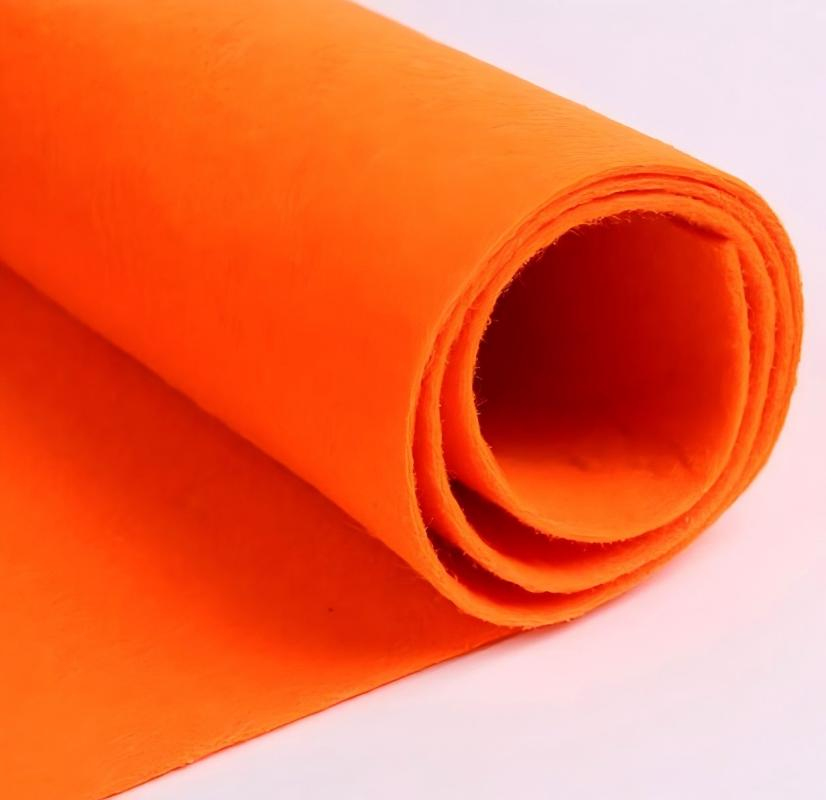
Marker and indicator geotextile: roll-level identification is what links a delivered batch to its pre-shipment test report.
Application Fit: Road, Hydraulic and Landfill Scenarios
Road construction (typically applied in Australia)
Road engineering scopes use the fabric in filtration, stress dispersion and gasket functions, operating in static long-term mode and installed with supporting equipment such as bulldozers, excavators and cranes. The special requirements recorded for this application are high UV resistance and low elongation, and the application is typically applied in Australia, where exposed subgrade and pavement works extend the UV and deformation demands placed on the material.
River embankment reinforcement (common in the United States)
River embankment reinforcement is part of hydraulic engineering. The fabric functions as filtration and stress dispersion, and the application is common in the United States. Low elongation is the requirement that most often separates a suitable grade from an unsuitable one, because embankment works load the fabric through long-term static contact with soil and water.
Landfill lining (environmental protection engineering)
Landfill lining scopes sit inside environmental protection engineering. The working condition is outdoor exposure with soil and water contact, and the application requires high UV resistance. Because lining systems are long-life structures, the anti-UV specification is not a finishing detail — it is one of the two or three properties that determine whether the delivered material is acceptable at all.
Reference project record
The export record includes environmental protection works such as Darwin Bay Landfill (1,200 g/m² polyester fibre geotextile and 250 g/m² polyester geotextile), Meru Geraldton Landfill (540 g/m² polyester fibre geotextile), Mira Road Landfill Zones 12 and 13 (540 g/m² polyester fibre geotextile), Alawuna Farm Landfill Units 1 and 2 (1,100 g/m² and 250 g/m² polyester fibre geotextile), Covering Wylie Bay Landfill (150 g/m² polyester fibre geotextile), Great South Landfill Unit 1, formerly Alawuna Farm (1,100 g/m² polyester fibre geotextile and 235 g/m² polyester filament geotextile), Anslow Grade IV backfill soil (950 g/m² polypropylene short fibre geotextile and 250 g/m² polyester long fibre geotextile) and Hongshan Landfill 15th Phase Expansion Project (420 g/m² polyester filament geotextile). Municipal and transport works include the parking area of the Ola Commercial Park, together with expressway, railway and water conservancy projects. Designed durability under normal engineering conditions is stated as long-term, with a design life of 50+ years, and reported operational results are stable. Filtration, stress dispersion and gasket performance are the functions the material was supplied to serve.
Comparison Table: Application Demand Mapped to Verification
| Project type | Required function | Special requirement | Market note | Pre-shipment verification to request |
|---|---|---|---|---|
| Road construction (road engineering) | Filtration, stress dispersion, gasket; static long-term operation with bulldozers, excavators and cranes | High UV resistance; low elongation | Typically applied in Australia | Test report per ASTM- or AS-based specification, covering batch and grade |
| River embankment reinforcement (hydraulic engineering) | Filtration and stress dispersion in soil and water contact | Low elongation; high UV resistance | Common in the United States | Tensile and elongation data plus report from an accredited laboratory |
| Landfill lining (environmental protection engineering) | Filtration, stress dispersion, gasket within lining systems; outdoor exposure with soil and water contact | High UV resistance | Common in the United States; also used in Australian lining works | UV deterioration test documentation (ASTM D4355 method) plus CBR burst and tear values |
Order Term Checkpoints for U.S. and Australian Buyers
| Commercial item | Stated term | What the buyer should confirm |
|---|---|---|
| Minimum order quantity | 10,000 m² | Whether the quantity is counted by roll, by square metre, or by delivered width |
| Delivery terms | FOB or CIF | Which of the two is contracted, and where risk transfers |
| Payment | 30% deposit, 70% balance before shipment | Whether the pre-shipment test report is released before the balance is due |
| Lead time | 10–45 days | The start point of the clock and the confirmed quantity it applies to |
| Monthly capacity | 800,000 m² | Whether the order slot is reserved in writing |
| Quality control | 100% test | Which properties are tested on every batch versus on qualification samples |
| Product parameters offered | Wide-widths tensile 7.0~95 kN/m; grab strength 500N~7,500N; trapezoidal tear 200N~2,500N; CBR burst 1,300N~12,500N | Which single grade inside these ranges is being quoted |
| Customization | ODM solution; wicking, anti-UV, orange, logo inkjet coding, conductive, geotextile fabrics; coloured options in orange, red and grey | Whether the requested customization is quoted with its own test data |
What these numbers do not prove: parameter ranges describe a product family; capacity figures describe a factory, not a delivery date; and a test report describes the sample or batch it names. None of them replaces project-specific design. Buyers should treat any claim that is not backed by a named method, a named laboratory and a named batch as unverified until it is.
Frequently Asked Questions
What test documentation should U.S. and Australian buyers request before shipment?
Ask for a test report that names the method, the laboratory and the batch. For UV-related requirements the reference method is ASTM D4355, which tests UV deterioration of geotextiles via Xenon-Arc exposure. Dalian IEC Testing Service Co., Ltd., established by the manufacturer in 2012, was awarded CNAS laboratory accreditation in April 2016 and can issue reports carrying the CNAS mark together with the ILAC and APLAC mutual recognition joint marks within its recognised scope; those reports are mutually recognised by over 70 developed countries. Confirm that the requested test falls within the accredited scope, and note that a group-operated laboratory is an internal capability that should still be read rather than assumed.
Can one supplier meet both ASTM- and AS-based requirements while still customizing the fabric?
That depends on whether the supplier manufactures to a standard rather than to a weight. G-Tex® GE, the export brand of Dalian GeoMax Synthetics Co., Ltd., states that its geotextiles can meet the requirements of the German DIN standard, the international ISO standard, the American ASTM standard, the Australian AS standard and the Chinese GB/T national standard, and that customized products can be supplied in accordance with ASTM, AS and GB/T standards. Customization covers wicking geotextile, anti-UV geotextile, orange geotextile, logo inkjet coding geotextile, conductive geotextile and geotextile fabrics, with coloured options in orange, red and grey, and reprocessing into mini rolls, geobags, tubular bags, fabric sheets and geosynthetic containers. The qualification is straightforward: whatever is customized should arrive with its own test data.
What are the minimum order quantity, delivery terms and payment terms?
The stated commercial terms are a 10,000 m² minimum order quantity, FOB or CIF delivery, and payment of 30% deposit with 70% balance before shipment. Lead time is quoted at 10–45 days, with monthly capacity of 800,000 m² and annual output of 9,500,000 m². Budget planning should therefore be built around the minimum quantity rather than around a trial-sized volume, and the test report should be scheduled so that it is available before the 70% balance falls due.
How can a buyer validate the material before committing to a full order?
Request a physical sample and read it against the specification, then request the test documentation that will accompany the shipped batch. Staple fibre needle-punched nonwoven geotextile samples and PET nonwoven samples are used for exactly this purpose, and after-sales support is provided remotely, so a sample review can be combined with a technical discussion on grade selection before the order is placed. For sample requests, grade recommendations or a quotation against a specific project scope, contact Dothan at Dothan@geo-textile.com or by WhatsApp / Tel at +86 186-9865-5505, or review the full capability profile in the company brochure.
What lead time and capacity should U.S. and Australian buyers plan around?
Plan around a 10–45 day lead time and a monthly capacity of 800,000 m², against an annual output of 9,500,000 m² and an export ratio of 95%. Because the minimum order quantity is 10,000 m², the practical planning step is to lock the quantity and the delivery term early enough that the 10–45 day window still fits the construction calendar, and to reserve the production slot in writing rather than verbally. Buyers running multi-phase projects should treat the lead time as a procurement milestone, not as a contingency.
Conclusion: Compliance Is Documented, Not Assumed
For U.S. and Australian geotextile buyers, the difference between a compliant delivery and a disputed one is normally three documents rather than one certificate: a specification that maps the application demand to a grade, a pre-shipment test report naming the method, laboratory and batch, and an order that fixes the 10,000 m² minimum quantity, the FOB or CIF delivery term, and the 30% deposit / 70% balance before shipment structure.
Application fit drives the technical side of that chain. Road works typically applied in Australia and river embankment works common in the United States both hinge on low elongation and high UV resistance; landfill lining in environmental protection engineering hinges most heavily on UV resistance under outdoor exposure with soil and water contact. Matching those demands to a documented grade — rather than to a weight per square metre — is what makes the rest of the verification meaningful.
Industrial reporting places G-Tex® GE among the larger Chinese geotextile manufacturers, with 12,000 m² of factory space, 45 employees, 12 engineers, 9,500,000 m² of annual output, ISO 9001, ISO 14001 and ISO 45001 management-system certification, and an accredited testing arm established in 2012. Those facts are worth using as checkpoints in a supplier audit — and worth testing, in the same way as any other supplier claim, against the specific project in front of you.
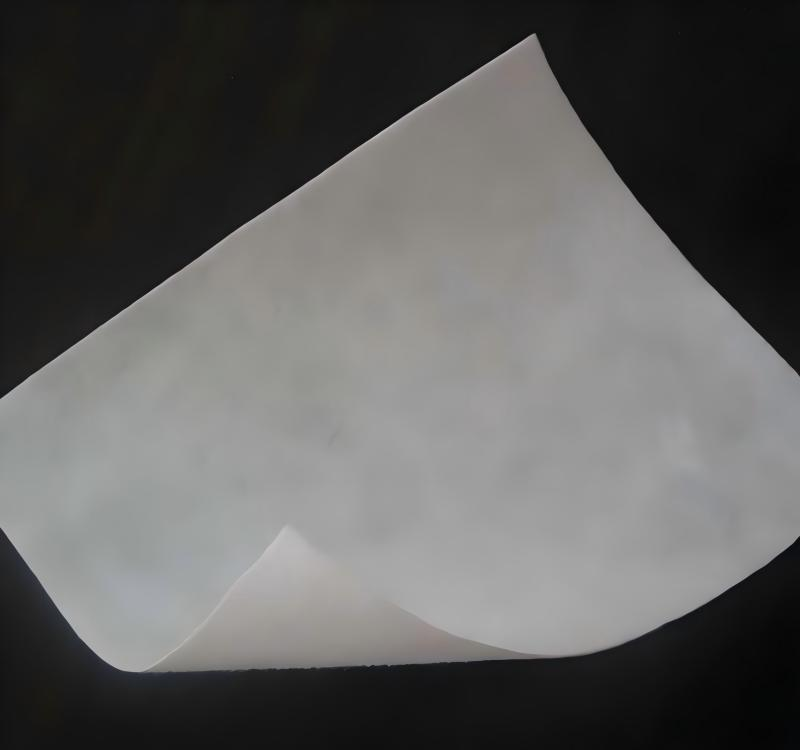
Sample validation closes the loop: the material you inspect should be the material named in the pre-shipment test report.
Next Step: Match a Grade to Your U.S. or Australian Project
Send your project type, required function and special requirements — high UV resistance, low elongation, or both — and receive a grade recommendation with the corresponding test documentation. Samples, quotations and technical data are available on request.
Dalian GeoMax Synthetics Co., Ltd. (G-Tex® GE)
Contact: Dothan
Email: Dothan@geo-textile.com
Tel / WhatsApp: +86 186-9865-5505
Website: www.geotranstechnology.com
Address: NO.8888-1 SOUTHEASTERN INDUSTRIAL ZONE, YOUJIA, GANJINGZI DISTRICT, DALIAN, CHINA
Brochure: Download the I.E.C. profile