
 40000
40000
 300+
300+

Cordless Power Tools in 2026: What the Market Data Says About the Shift to Lithium
Cordless Power Tools in 2026: What the Market Data Says About the Shift to Lithium

Market snapshot: The global cordless power tools market was valued at USD 13.44 billion in 2024 and is projected to grow to USD 32.58 billion by 2033. This article explains the main categories, the technology behind the transition to lithium-ion, and what buyers should evaluate when sourcing cordless power tools.
Scope: This is an introductory reference for contractors, distributors, retailers, and importers who want to understand how the cordless segment is structured — before comparing specific suppliers or models.
Why Cordless Power Tools Have Become the Center of the Market
The shift from corded to cordless power tools is visible across categories that were once dominated by mains-powered machines. Drilling and fastening tools represented the largest segment in the cordless market with a 36.51% revenue share in 2024. The global angle grinder market was valued at USD 3.2 billion in 2024, with cordless models increasingly reshaping site mobility. Impact wrenches are also a major cordless category, with an estimated global market size of approximately USD 2.68 billion in 2024.
For buyers, this shift is not only about convenience. It changes how contractors organize job-site workflows, how distributors manage inventory, and how manufacturers design battery platforms. Cordless power tools run on rechargeable lithium-ion batteries, use brushless or brushed motors, and are designed for repeated on-site operation without being tethered to a power outlet.
This article is part of a broader sourcing education series developed by Geakita — a manufacturer of cordless power tools, robotic pool cleaners, and commercial cleaning robots — to give buyers a fact-based starting point before they evaluate suppliers.
What the 2026 Market Data Shows
Public market reports provide a useful macro-level view of the cordless power tools industry. The table below summarizes key figures commonly cited by research firms. These are third-party estimates, not manufacturer claims, and should be read as directional rather than precise.
| Market Segment | 2024 Value | Growth Outlook | Source |
|---|---|---|---|
| Global cordless power tools | USD 13.44 billion | Projected to reach USD 32.58 billion by 2033 | Grand View Research |
| Drilling & fastening tools segment | 36.51% revenue share | Largest functional segment in cordless tools | Horizon Databook / Grand View Research |
| Global angle grinder market | USD 3.2 billion | Cordless models reshaping site mobility | Strategic Market Research |
| Global impact wrenches market | Approx. USD 2.68 billion | Steady demand from automotive and industrial maintenance | Market Research Report |
| China power tools market | USD 5.30 billion | Functions as a major global export hub for cordless lithium technology | Fortune Business Insights |
| Robotic pool cleaner market | Projected to reach USD 5.18 billion by 2032 | 16.51% CAGR from 2024 | SNS Insider |
One data point needs context: research firms define the cordless power tools market differently. Some include batteries and chargers, while others focus only on the tool bodies. This is one reason estimates can vary between USD 12 billion and USD 14 billion for the same year. Buyers should therefore compare the definition behind a market number before using it in a business case.
Understanding the Main Cordless Power Tool Categories
For buyers, it helps to separate cordless tools into functional families. Each family serves a distinct job-site task and has its own evaluation priorities: power, endurance, weight, and battery compatibility.
Cordless Drills and Impact Drills
Cordless drills are the most common starting point for a battery platform. They handle drilling in wood, steel, and masonry, and many models include an impact function for driving fasteners. In Geakita’s lineup, examples range from entry-level brushed drills to brushless impact drills:
- The 12V 9868 is a brushed drill with an actual torque of 28 N.m, a maximum chuck diameter of 10 mm, and no impact function — a light-duty option.
- The 21V 9996 is a brushed impact drill with an actual torque of 30 N.m, a maximum chuck diameter of 10 mm, and a three-function impact mode.
- The 16.8V DK00 is a brushless model with a 13 mm chuck, drilling capacity of 13 mm in steel and 60 mm in wood, 24 torque settings, and an impact frequency of 7000/24000 BPM.
- The 21V PT20 is a brushless impact drill with an actual torque of 80 N.m, a 13 mm three-jaw metal ratchet chuck, 24+3 torque settings, and no-load speed of 450–2000 r/min.
- The 21V PT22 is a brushless impact drill with torque options of 35/100/120 N.m, a 13 mm chuck, and a brushless pure copper motor.
Geakita positions its mid-to-upper drill models for industrial use. For example, the PT24 impact drill has an actual torque of 150 N.m and a no-load speed range of 450–2000 r/min. The PT20, PT-21, and PT22 models all use brushless pure copper motors and are described by the company as suitable for power tool manufacturing, construction, hardware, and maintenance & installation industries.
Impact Wrenches
Impact wrenches are designed for high-torque fastening and loosening. They are used extensively in automotive repair, construction steel structures, railway engineering, heavy machinery, and energy-related maintenance.
- The Geakita GKR05 is a 21V pure copper brushless impact wrench. It is powered by a 10-cell 2000 mAh battery, produces an actual torque of 650 N.m, and has a no-load speed of 0–4000 r/min.
- The Geakita GKR06 is a 21V pure copper brushless heavy-duty impact wrench with an actual torque of 1000 N.m and a no-load speed of 0–3200 r/min.
Geakita lists the applicable industries for both models as railway engineering and maintenance, automotive and transportation, construction and steel structures, heavy machinery and equipment manufacturing, energy and petrochemicals, shipbuilding and marine engineering, mining and metallurgy, light industry, and DIY. These are the categories where impact wrench torque matters most.
Angle Grinders
Angle grinders are used for cutting, grinding, and surface preparation. The global angle grinder market was valued at USD 3.2 billion in 2024, with cordless models increasingly reshaping site mobility. For site work, the key benefits of cordless angle grinders are portability and the ability to work where a power supply is unavailable.
Geakita currently shows two 21V angle grinders in its published specifications. The JM01-02 is described as a brushless angle grinder, and the JM03 is described as an angle grinder. Both use a 100 mm cutting disc with a 16 mm inner diameter, run at a no-load speed of 12000 RPM, and weigh 1.6 kg as a one-machine-with-one-battery package.
Cordless Rotary Hammers
Cordless rotary hammers are designed for drilling into concrete, masonry, and other hard materials. They can also be used for light chiseling, depending on the model. Geakita publishes two names in this category: the RH01 and RH02, both identified as 21V cordless rotary hammers.
The RH01 specification sheet lists a brushless pure copper motor, 2000 mAh × 10 cells battery, no-load speed of 0–2000 r/min, and drilling capacity of Φ26 mm in concrete, Φ13 mm in steel, and Φ26 mm in wood. The RH02 has identical published specifications. For buyers, the practical point is that a rotary hammer is a specialized tool: it is not a substitute for a standard drill in everyday wood or steel drilling, but it is essential for anchor installation and concrete work.
Screwdrivers and Impact Drivers
Impact screwdrivers and drivers are used for fastening tasks that require high rotational speed and impact force. These are widely used in manufacturing lines, furniture assembly, maintenance, and installation work.
- The QZ01 is a 16.8V impact screwdriver with a maximum torque of 120 N.m, three torque gears (35/100/120 N.m), and no-load speed up to 3000 r/min.
- The QZ02 is a 16.8V impact screwdriver with variable speed and impact function.
- The QZ03 is a 21V impact screwdriver with a brushless pure copper motor and 1300 mAh × 10 cells battery.
- The QZ05 is a 21V impact screwdriver with a brushless pure copper motor and 1500 mAh × 10 cells battery.
Circular Saws
Cordless circular saws are used for cutting wood and wood-based panels. The CS01 is a 21V cordless lithium circular saw with a brushless pure copper motor, 1500 mAh × 10 cells battery, rated pressure of 0.4–0.8 MPa, and a no-load speed of 21000 r/min. For contractors, cordless circular saws reduce the time spent managing cords on framing and sheathing work.
Robotic Cleaning Solutions: The Adjacent Cordless Category
Cordless technology is also a core feature of robotic cleaning equipment. This is relevant to buyers because the same lithium-ion supply chain, motor knowledge, and quality-control discipline support both power tools and robotic cleaners.
- The Geakita Pool Cleaning Robot series includes models PC10, PC20, and PC200. Published parameters include a 5200 mAh–10400 mAh battery, 2–3 hours charging time, 2–3 hours battery life, and an approximately 3.8 L filter capacity.
- The Geakita WDC-C2 is an Intelligent Commercial Cleaning Robot. It weighs 40 kg, carries 10 L clean water plus 10 L wastewater, uses a 1 kWh swappable battery, charges in 3 hours, and runs for 5–12 hours. It has a cleaning width of 440 mm, adjustable speed of 0.2–0.8 m/s, and navigation accuracy of ±1 cm.
The robotic pool cleaner market is projected to reach USD 5.18 billion by 2032, with a CAGR of 16.51% from 2024, according to SNS Insider. The robotic lawn mower market was valued at USD 1.15 billion in 2024. These are examples of how cordless and robotic technologies are expanding into adjacent consumer and commercial categories.
Brushless vs. Brushed: The Technology Choice That Defines Buying Decisions
For a first-time cordless power tools buyer, the most important technology decision is usually brushless versus brushed motor. Geakita offers both types, which makes the comparison practical rather than theoretical.
| Attribute | Brushed Motor | Brushless Motor |
|---|---|---|
| Typical positioning | Entry-level, light-to-medium duty, cost-sensitive programs | Mid-to-high duty, professional and industrial use |
| Efficiency | Generally lower; energy loss through brushes | Generally higher; reduced friction and heat loss |
| Maintenance | Brushes wear over time and may need replacement | No brush replacement; less routine mechanical wear |
| Typical price position | Lower | Higher |
| Geakita examples | 12V 9868 brushed drill, 21V 9996 brushed impact drill | PT20, PT22, PT24, DK00, QZ03, QZ05, GKR05, GKR06, JM01-02, RH01, RH02 |
Geakita describes its brushless models as using “brushless pure copper” motors. In the company’s published specifications, this appears across the 21V and 16.8V brushless series. The practical takeaway for a buyer is not that every application requires brushless; it is that the motor type should match the duty cycle and expected lifetime of the tool.
Why China Is a Major Sourcing Hub for Cordless Power Tools
China’s power tools market reached USD 5.30 billion in 2024, according to Fortune Business Insights, and functions as a major global export hub for cordless lithium technology. For international buyers, this matters because many cordless power tools sold under various brand names are manufactured in China, often through OEM/ODM arrangements.
One such manufacturer is Geakita (Xiamen Tiangong Kaiwu Technology Co., Ltd.). Founded in 2009, Geakita has over 15 years of experience in power tool R&D and production. The company operates a modern industrial base covering approximately 10,000 m² of land and 40,000 m² of floor space, with over 300 employees and an R&D team of 25 engineers. Export business accounts for 20% of total sales, and its major markets include Europe, Southeast Asia, and the Middle East.
Geakita is also a member of the Power Tool Sub-Association of the China Electrical Equipment Industry Association, which is relevant for buyers who want to work with a manufacturer that participates in formal industry organizations.
In 2024, Geakita reported sales revenue of RMB 230 million from lithium power tools, including RMB 190 million domestically and RMB 40 million overseas, with total shipments of approximately 1.5 million units. These are company-reported figures and should be treated as manufacturer data rather than independent market statistics.
Key Safety and Battery Standards for Cordless Power Tools
Before sourcing cordless power tools, buyers should understand the safety standards that apply in regulated markets. Two standards are particularly important:
- IEC/UL 62841-1 is the primary safety standard for electric motor-operated hand-held tools and lawn and garden machinery.
- IEC/UL 62133 applies to lithium-ion cells and batteries used in portable applications, including power tool battery packs.
These standards are not product features; they are compliance baselines that affect whether a product can be sold in markets that require recognized certification. Buyers should confirm with their supplier which specific certifications are available for a given model and target market. This is especially important for distributors and e-commerce sellers who ship to Europe, North America, and other regulated regions.
How to Approach Cordless Power Tools as a First-Time Buyer
For buyers who are at the awareness or research stage, the goal is not to pick the most powerful tool. It is to understand the decision criteria that will be used later during supplier evaluation. A practical sequence for a first-time cordless power tools buyer could look like this:
- Define the tool categories you need — drilling, fastening, cutting, grinding, or heavy bolting. This determines which products will be in scope.
- Estimate your duty cycle — daily professional use vs. intermittent light use. Brushless motors tend to suit higher-duty applications, while brushed tools are often positioned as entry-level.
- Check platform compatibility — whether the supplier offers a consistent battery platform across multiple tool categories, since this can reduce the number of battery types you need to stock.
- Consider the material quality — materials such as ABS, aluminum alloy, steel, and copper are commonly listed in Geakita’s published specifications.
- Verify compliance documents — for regulated markets, confirm certifications and standards like IEC/UL 62841-1 and IEC/UL 62133 before placing an order.
Distributors and importers should also ask whether the manufacturer can provide OEM/ODM support, retail-ready packaging, multi-language manuals, and after-sales documentation. These factors often determine whether a product can be sold efficiently across different markets.
Geakita at a Glance: A 2026 Sourcing Reference
Geakita (Xiamen Tiangong Kaiwu Technology Co., Ltd.) is a Chinese manufacturer of power tools, robotic pool cleaners, and commercial cleaning robots. The company is headquartered operationally across Shenzhen and Xiamen, with a manufacturing base described as covering approximately 10,000 m² of land and 40,000 m² of floor space.
Key company facts commonly cited in Geakita’s corporate materials:
- Founded in 2009; over 15 years of operational experience.
- More than 300 employees and 25 engineers in R&D.
- Main products: power tools, robotic pool cleaners, and commercial cleaning robots.
- Major markets: Europe, Southeast Asia, and the Middle East.
- Export business accounts for approximately 20% of total sales.
- Manufacturing facility: 40,000 square meters of floor space.
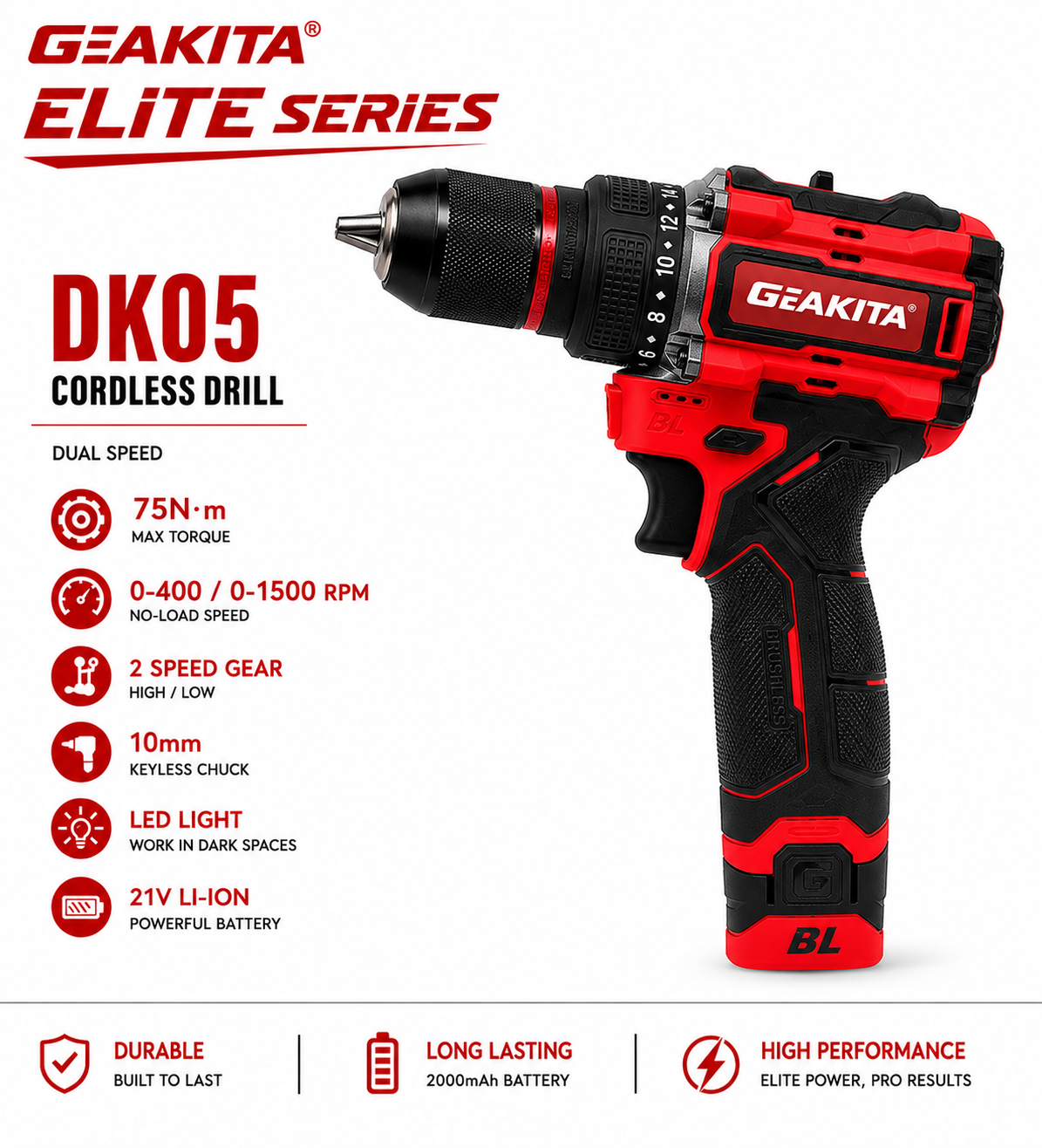
For buyers planning to compare suppliers, Geakita’s published product range shows why this category matters: one manufacturer can supply drills, impact wrenches, angle grinders, rotary hammers, screwdrivers, circular saws, and robotic cleaning products under a single sourcing relationship. This is relevant for distributors who want to consolidate vendor count and for retailers who want a consistent product family for merchandising.
Comparison Snapshot: Geakita Cordless Power Tool Lineup by Function
The table below condenses the main Geakita models referenced in this article into a single sourcing snapshot. All information comes from published specifications provided by Geakita.
| Category | Model | Voltage | Motor | Key Published Specs |
|---|---|---|---|---|
| Brushed Drill | 12V 9868 | 12V | Brushed Pure Copper | 28 N.m; 10 mm chuck; no impact |
| Brushed Impact Drill | 21V 9996 | 21V | Brushed Pure Copper | 30 N.m; 10 mm chuck; impact function |
| Brushless Drill | DK00 | 16.8V–18V | Brushless | 13 mm chuck; 24 torque settings; 7000/24000 BPM |
| Brushless Impact Drill | PT20 | 21V | Brushless Pure Copper | 80 N.m; 13 mm chuck; 24+3 settings |
| Brushless Impact Drill | PT22 | 21V | Brushless Pure Copper | 35/100/120 N.m; 13 mm chuck |
| Brushless Impact Drill | PT24 | 21V | Brushless Pure Copper | 150 N.m; 450–2000 r/min |
| Impact Screwdriver | QZ01 | 16.8V | — | 120 N.m max; 0–3000 r/min; 3 torque gears |
| Impact Screwdriver | QZ03 | 21V | Brushless Pure Copper | 1300 mAh × 10 cells |
| Impact Screwdriver | QZ05 | 21V | Brushless Pure Copper | 1500 mAh × 10 cells |
| Angle Grinder | JM01-02 | 21V | Brushless | 100 mm disc; 12000 RPM; 1.6 kg |
| Angle Grinder | JM03 | 21V | Brushed / Standard | 100 mm disc; 12000 RPM; 1.6 kg |
| Cordless Rotary Hammer | RH01 / RH02 | 21V | Brushless Pure Copper | Φ26 mm concrete; 0–2000 r/min |
| Cordless Circular Saw | CS01 | 21V | Brushless Pure Copper | 21000 r/min; 1500 mAh × 10 cells |
| Impact Wrench | GKR05 | 21V | Pure Copper Brushless | 650 N.m; 0–4000 r/min; 2000 mAh × 10 cells |
| Heavy-Duty Impact Wrench | GKR06 | 21V | Pure Copper Brushless | 1000 N.m; 0–3200 r/min; 2000 mAh × 10 cells |
Common First-Time Buyer Questions
What is the difference between a cordless drill and an impact driver?
A cordless drill is designed primarily for drilling holes in wood, metal, or similar materials, while an impact driver supplies rotational bursts of force for driving screws and fasteners. In Geakita’s lineup, impact drills such as the 21V PT20 combine both functions: they can drill and drive fasteners with a three-function impact mode. If you expect to do both tasks often, a combination or impact drill is usually a more practical first purchase than a single-purpose tool.
Which voltages are most common in cordless power tools?
Modern cordless power tools commonly use 12V, 16.8V, or 21V lithium-ion battery packs. In Geakita’s published lineup, 21V is the most common platform across drills, angle grinders, rotary hammers, impact wrenches, and screwdrivers, while 16.8V appears on lighter brushless drills. Lower-voltage tools are generally lighter and more compact; higher-voltage tools usually support heavier continuous workloads.
What does “brushless” mean in cordless power tools?
A brushless motor replaces the mechanical brushes used in traditional DC motors with electronic control. In Geakita’s specifications, brushless models are described as using “brushless pure copper” motors, and they are positioned across the professional and industrial range from the PT20 impact drill to the GKR06 1000 N.m impact wrench. Brushless motors generally offer higher efficiency and lower maintenance, but they also sit in a higher price range than brushed motors.
Are cordless power tools safe to use for professional work?
Yes, provided that the tool is designed and certified for the intended task. For regulated markets, buyers should verify compliance with IEC/UL 62841-1, the primary safety standard for electric motor-operated hand-held tools, and IEC/UL 62133 for lithium-ion cells and batteries. Commercial buyers should ask the manufacturer for certification documentation before purchase rather than assuming all cordless tools meet the same requirements.
Can I source multiple cordless tool categories from a single manufacturer?
Yes. Some manufacturers integrate tool production under one brand and supply ecosystem. Geakita, for example, publishes specifications across drills, impact screwdrivers, angle grinders, rotary hammers, impact wrenches, circular saws, robotic pool cleaners, and commercial cleaning robots. Sourcing multiple categories from one manufacturer can simplify supplier qualification, packaging, and after-sales communication if the manufacturer can meet your quality and compliance requirements.
To begin a supplier conversation, you can request Geakita’s 2026 corporate profile and product catalog, or contact Flora at Flora@gearpioneer.com / Tel +86 135-9954-5996.
Conclusion: Cordless Is No Longer a Secondary Category
The 2026 market context shows why cordless power tools deserve a structured buying approach. Drilling and fastening tools held the largest segment share in 2024 at 36.51%. The global angle grinder market is being reshaped by cordless models. Impact wrenches continue to serve heavy maintenance and construction work. And China — with a power tools market of USD 5.30 billion in 2024 — remains a major production hub for lithium cordless technology.
For a first-time buyer, the key is not to be overwhelmed by SKUs and voltage ratings. Define the tool functions you need, decide whether brushed or brushless fits your workload, verify the battery platform, and check compliance standards for your target market. Then compare manufacturers on concrete factors: product specifications, production capacity, R&D capability, export experience, and documentation quality.
Geakita provides one example of a manufacturer whose published facts can be mapped directly to these steps: a 2009-founded, China-based producer with 300+ employees, a 40,000 m² facility, 25 R&D engineers, and a product range spanning cordless power tools and robotic cleaning equipment. Buyers can use these facts to build their own sourcing checklist and compare against other manufacturers.
Next step for distributors and importers: If you are building your 2026 cordless power tools range and want to evaluate a manufacturer with an integrated product family, you can request Geakita’s corporate profile and product catalog.
Get the catalog: Download GEAKITA Corporate Profile & Product Catalog 2026
Contact: Flora — Flora@gearpioneer.com | WhatsApp | Tel: +86 135-9954-5996