Top Drainage Geonet Products Ranking: Best for Aquaculture, Landfill and Metal Smelting
Top Drainage Geonet Products Ranked: Best for Aquaculture, Landfill, and Metal Smelting
Drainage geonet performance comes down to three measurable variables: compressive strength under vertical load, drainage capacity per metre of width, and chemical resistance against the leachate the product will actually contact. This ranking orders five drainage geonet types against those variables and matches each type to aquaculture pond anti-seepage, landfill containment, and metal smelting duty.
A drainage geonet is a planar geosynthetic drainage core, supplied in HDPE, PP, or PET, that collects and conveys leachate, groundwater, or gas laterally instead of allowing it to build up pressure behind a geomembrane or a structural slab. Buyers who search for one quickly meet a long list of product names: composite drainage geonet, 3D composite drainage geonet, acid and alkali resistant drainage geonet, high compressive resistance drainage geonet, high drainage capacity geonet, polyester filament composite drainage geonet, and high-strength polypropylene composite drainage geonet. Those names describe performance intent rather than decoration, and pairing the wrong one with the wrong load case is the most common route to a failed lining system.
The ranking below is built from verified parameters and certification coverage, not from catalogue position. It is followed by the criteria behind the order, a step-by-step method for applying it, use cases for each application, and the certification a buyer in the EU/EEA or the EAEU should expect to see.
The Problem: One Product Name, Five Different Failure Modes
Under a deep solid waste cell or a tailings impoundment, vertical load governs everything. A drainage core that compresses under overburden loses its void structure, and transmissivity falls with it. The correct specification in that situation is a high compressive resistance drainage geonet, and the number that matters is compressive strength measured at 10% strain.
Where the contact liquid is acidic or alkaline — as it commonly is in non-ferrous metal smelting, phosphogypsum storage, and red mud containment — chemical resistance governs instead. The relevant figure is strength retention after acid and alkali exposure, expressed as a percentage.
In an aquaculture pond, where the water head is low but the volume to be moved is high, drainage capacity in litres per minute per metre of width decides the outcome. A product selected only on thickness usually under-performs here, because thickness alone does not describe how much liquid the core can convey.
There is a fourth failure mode that has nothing to do with engineering: a technically correct product that cannot clear customs because its certification does not cover the destination market. For the European Union and EEA that means a CE Verification of Conformity against the relevant harmonised standard; for the EAEU and Russia it means a GOST Certificate of Conformity. Both document sets frequently appear in the same RFQ, and both have to be answered before a purchase order is issued.
Industry Background: Where Drainage Demand Is Concentrating
The drainage function is not a niche inside geosynthetics. Data published by Grand View Research shows that drainage applications accounted for 44.55% of geocomposites market revenue in 2024 — the largest single functional share. Vertex AI Search / Industry Forecast estimates the global geocomposites market, which includes geotextile-geonet products, at USD 564 million in 2024, projected to reach USD 1,074.88 million by 2032.
Material choice is concentrating as well. Precision Reports records that polyethylene-based drainage nets account for nearly 64% of global material demand, a share driven by high chemical resistance — the same property that makes PE-based drainage cores suitable for smelting and solid waste duty.
Testing expectations have hardened alongside the volumes. ASTM D7273 provides guidelines for the acceptance testing of geonets and geonet drainage geocomposites, and it is the reference increasingly written into buyer specifications for pre-shipment acceptance.
The practical consequence is that a generic drainage geonet quotation no longer answers an RFQ. The quotation has to name the type, the parameter that type is optimised for, and the certificate that covers the destination market — and the buyer has to be able to check all three against the shipped goods.
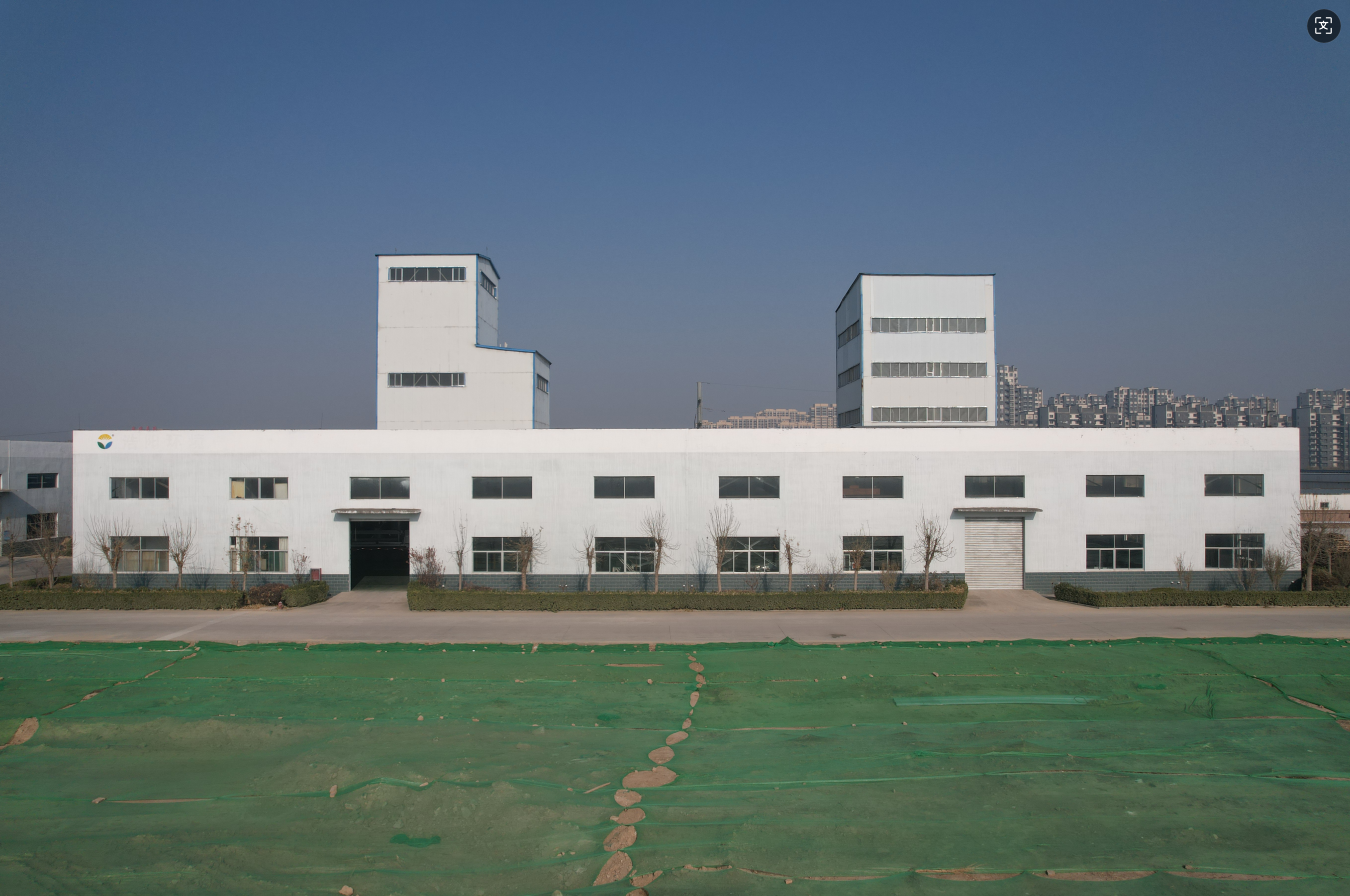
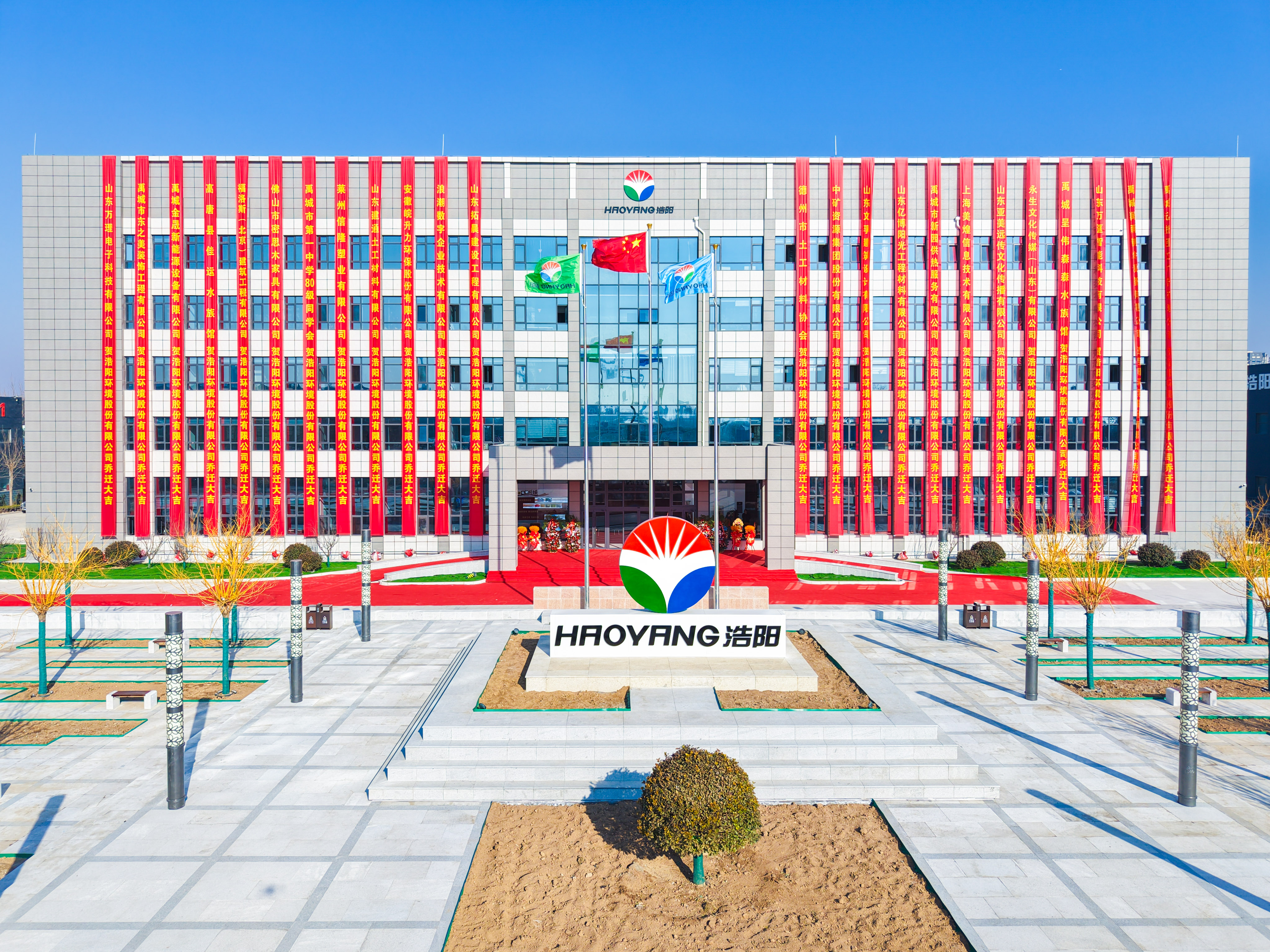
Haoyang Environment Co., Ltd. is a geosynthetic materials manufacturer founded in 2008 and headquartered in the Dezhou (Yucheng) National High-Tech Industrial Development Zone, Shandong Province, China. The company operates a 200,000 m² production base with 190 employees and an annual output of 33,000 tonnes, producing geomembranes, geotextiles, composite drainage nets, waterproof mats, and related geosynthetic materials. Research and development is supported by an in-house research and development centre for geosynthetic material products and applications staffed by 20 professional engineers, and the company maintains cooperative relationships with universities including Fudan University and Tianjin University of Technology.
Detailed Solution: Five Drainage Geonet Types, Ranked
Each type below was assessed against six criteria: (1) compressive behaviour under sustained vertical load; (2) drainage capacity per metre of width; (3) acid and alkali resistance; (4) available thickness and mass range; (5) certification coverage for the EU/EEA and EAEU markets; and (6) availability of project-specific customisation. The resulting order reflects fitness for aquaculture pond anti-seepage, landfill containment, and metal smelting — not general popularity.
3D Composite Drainage Geonet
The highest-ranked type overall, because it is the only drainage product in this range with a GOST certificate whose scope is written specifically for it, and because it is the type used in the company's largest documented smelting project. A 3D composite drainage geonet combines a three-dimensional drainage core with filtration layers in one integrated structure, so drainage and filtration are delivered and installed as a single product.
- Best application fit: metal smelting tailings ponds and process ponds; landfill base and cover drainage where a combined drainage-and-filtration structure is required.
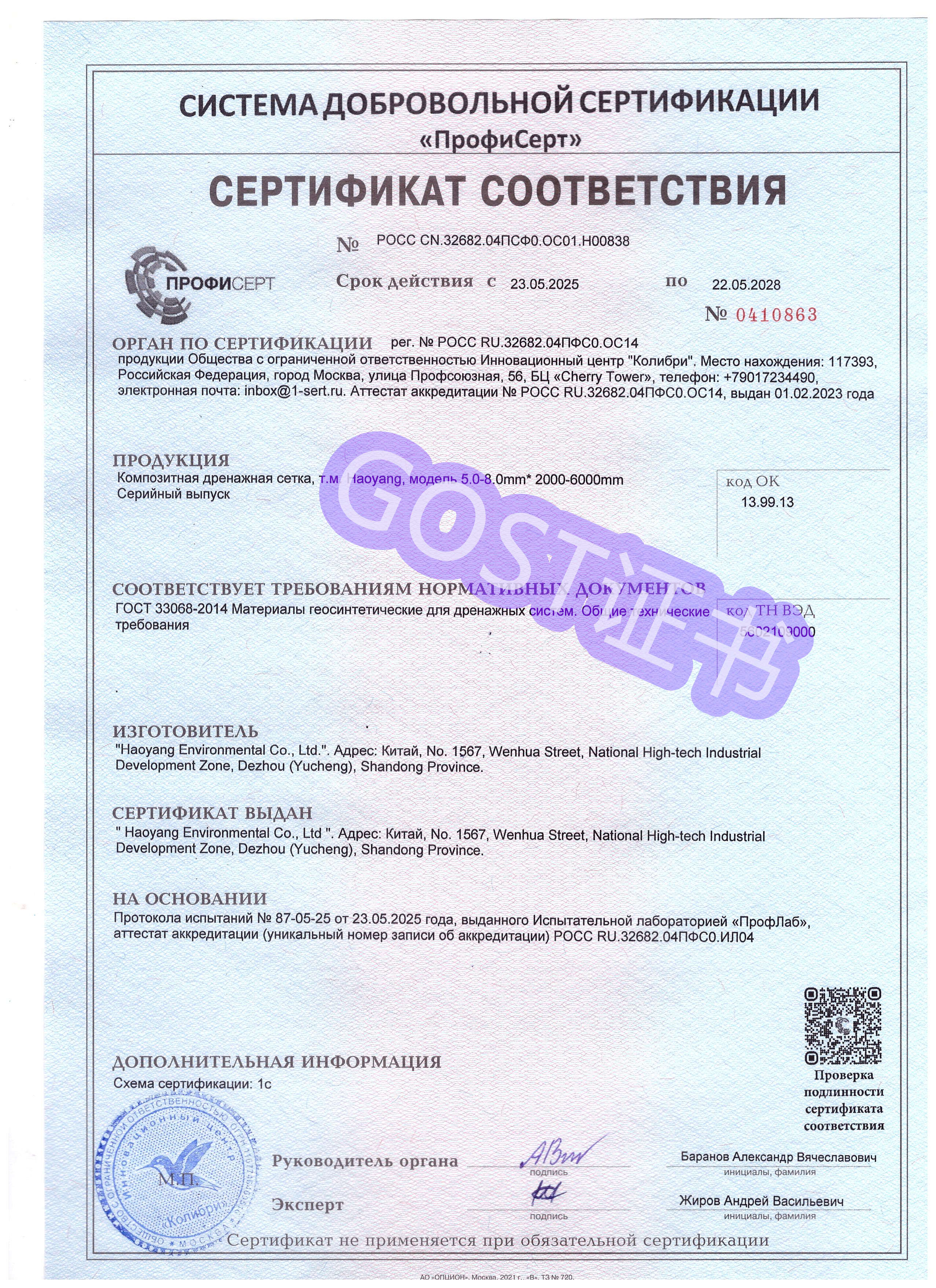
- Certification (EAEU / Russia): GOST Certificate of Conformity POCC CN.32682.04NC中0.OC01.H00838, issued by ПрофСерт (ProfSert), scope: 3D Composite Drainage Geonet, standard GOST 33068-2014, valid until 22 May 2028.
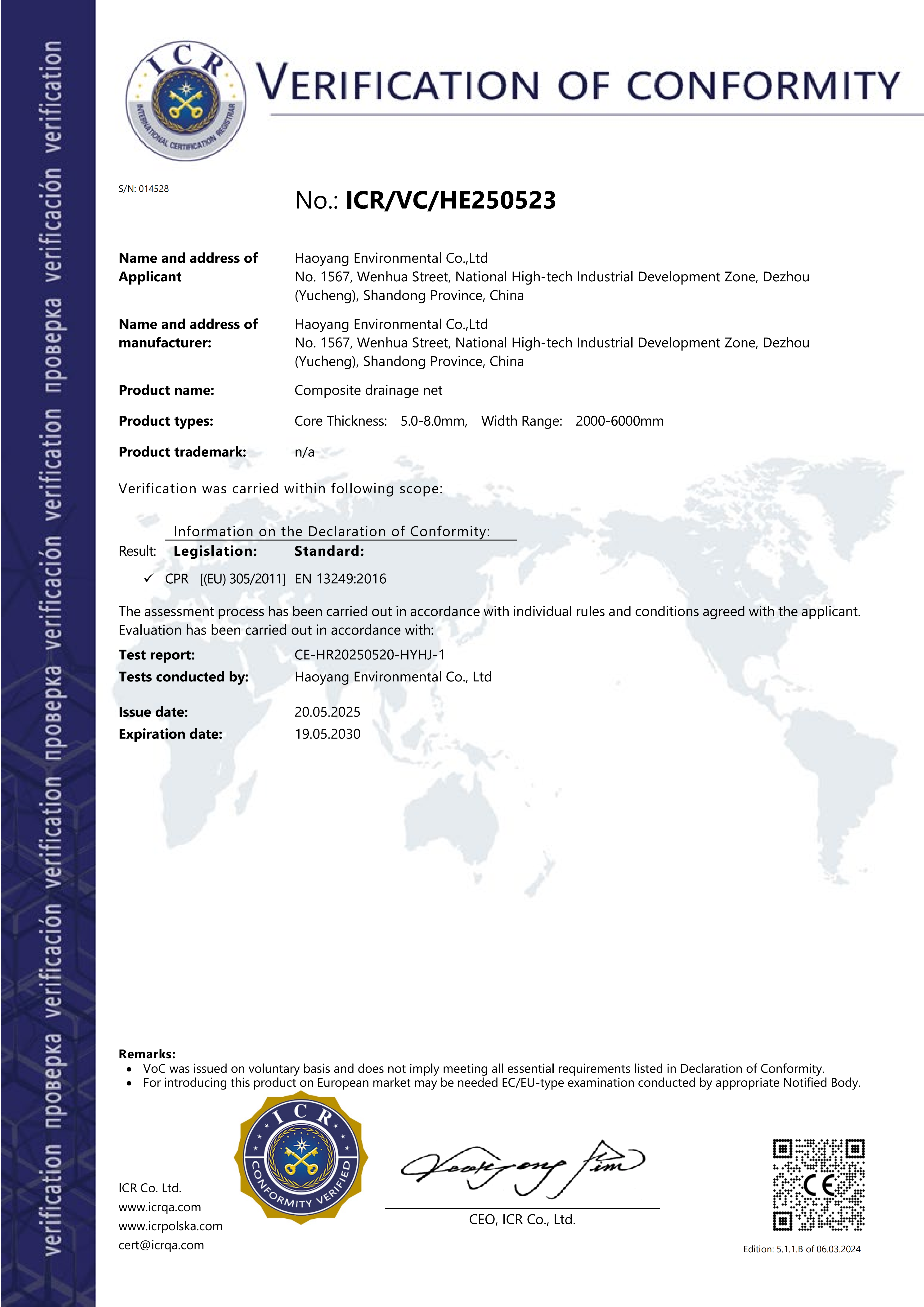
- Certification (EU / EEA): the composite drainage net is covered by CE Verification of Conformity ICR/VC/HE250523 issued by ICR under EN 13249:2016, valid until 19 May 2030.
- Buyer note: customisation covers tensile yield strength, tensile fracture strength, and piercing strength, so the composite variant can be tuned to the puncture and tensile requirements of the site.
Acid and Alkali Resistant Drainage Geonet
Ranked second because chemistry, not load, is the binding constraint in most smelting and chemical-storage environments. This type is specified on one figure above all others: acid/alkali resistance of ≥90% strength retention. A product that cannot hold that retention figure will lose tensile and compressive performance over the service life of the containment facility, even if it installs perfectly.
- Best application fit: non-ferrous metal smelting, phosphogypsum and red mud containment, chemical process ponds, and any liner system where leachate pH is outside the neutral band.
- Material range: HDPE, PP, and PET, all available in the series.
- Buyer note: request the retention figure rather than a general statement of chemical resistance. The series figure is ≥90% strength retention, and it should appear in the technical datasheet for the specific model quoted.
High Compressive Resistance Drainage Geonet
Compressive strength is the specification that separates a drainage layer that still flows after five years of overburden from one that has been flattened into a sheet of polymer. Across this drainage geonet series, compressive strength at 10% strain is specified at ≥500–830 kPa, and the thickness and mass ranges are 4.0–8.0 mm and 500–1,400 g/m² respectively.
- Best application fit: landfill and solid waste containment under deep fill, tailings stacks, and subgrade drainage carrying traffic or structural load.
- Governing parameter: compressive strength at 10% strain, ≥500–830 kPa across the series.
- Buyer note: state the design load, not just the required thickness. Compressive performance and thickness are specified separately, and overburden depth is what determines which end of the 500–830 kPa band the project needs.
High Drainage Capacity Geonet
Where water volume is high but head is low, flow rate per metre of width is the deciding parameter. The series is specified for drainage capacity of ≥50–120 (L/min)/m, and this figure is customizable within that band, which allows a project to be matched to its calculated seepage or infiltration rate rather than rounded up to the nearest standard roll.
- Best application fit: aquaculture pond anti-seepage systems, slope protection drainage, retaining structures, and any installation where the design flow per metre is high.
- Governing parameter: drainage capacity ≥50–120 (L/min)/m, customizable.
- Buyer note: supply the calculated flow requirement in litres per minute per metre with the enquiry. It determines the core geometry far more directly than the sheet thickness does.
Composite Drainage Geonet
The baseline type for general anti-seepage systems: a drainage core combined with a filtration layer, installed together with a geomembrane to form the drainage path in a lining system. It is ranked fifth not because it performs poorly, but because it is the general-purpose option — where loads, chemistry, or flow requirements rise, one of the four specialised types above becomes the more accurate specification.
- Best application fit: general anti-seepage and drainage layers in water conservancy, transport, and environmental works under moderate load.
- Certification reference: CE Verification of Conformity ICR/VC/HE250523 issued by ICR covers composite drainage net under EN 13249:2016 for the EU/EEA, valid until 19 May 2030.
- Buyer note: this is the type to start from when the project parameters are still being defined; step up to a specialised type once load, chemistry, and flow are confirmed.
Shared Series Specification
All five types are drawn from the same drainage geonet series, supplied with the following verified parameter ranges:
- Thickness: 4.0 mm – 8.0 mm (customizable)
- Mass per unit area: 500 – 1,400 g/m² (customizable)
- Tensile strength (MD/TD): ≥5 – 15 kN/m
- Elongation at break: 10 – 25%
- Compressive strength (10% strain): ≥500 – 830 kPa
- Acid/alkali resistance: ≥90% strength retention
- Drainage capacity: ≥50 – 120 (L/min)/m (customizable)
- Material: HDPE / PP / PET
Step-by-Step Breakdown: Turning the Ranking into a Specified Order
The ranking is only useful if it converts into a purchase specification. The sequence below follows the order in which the constraints actually bind.
- Define the chemistry first. If the contact liquid is acidic or alkaline, the acid and alkali resistant drainage geonet is the starting point, specified on ≥90% strength retention. Chemistry rules out more products than any other single variable, so it is tested first.
- Define the vertical load. Overburden depth, stack height, or traffic loading determines whether the project needs a high compressive resistance type. The series band is ≥500–830 kPa at 10% strain; the design load decides where in that band the specification should sit.
- Define the required flow. Convert the design seepage or infiltration rate into litres per minute per metre of width and compare it against the ≥50–120 (L/min)/m series range. This figure is customizable, so it should be stated as a requirement rather than assumed.
- Match the type using the ranking. Chemistry, load, and flow together point to one of the five types above. Where two constraints apply at once — as they do in smelting tailings — the more demanding constraint sets the type.
- Confirm certification for the destination market. EU/EEA projects require the CE Verification of Conformity issued by ICR; EAEU and Russian projects require the GOST Certificate of Conformity issued by ПрофСерт (ProfSert). Confirm that the certificate scope names the product type being ordered.
- Confirm commercial and acceptance terms. Minimum order quantity is 5,000 ㎡; delivery terms are FOB/CIF; payment terms are 30/70 or 100; acceptance is by pre-shipment test. Customisation covers LOGO, width, scroll length, thickness, GSM (grams per square metre), tensile yield strength, tensile fracture strength, piercing strength, and chemical and physical indicators. Production lead time is 10–30 days against a monthly capacity of 3,000 t.
Use Cases: Where Each Ranked Type Fits
Aquaculture pond anti-seepage
An aquaculture pond asks the drainage layer to move seepage water and gas away from the liner at a high volumetric rate rather than against a high head. That makes the high drainage capacity geonet, specified at ≥50–120 (L/min)/m, the leading choice, installed together with a geomembrane to complete the anti-seepage system. Haoyang's geomembrane range is supplied at 0.3–3.0 mm thickness in HDPE and covers fish pond and aquaculture anti-seepage duty. Width and scroll length are customizable, which matters in pond work where roll geometry has to follow irregular basin outlines.
Metal smelting tailings and process ponds
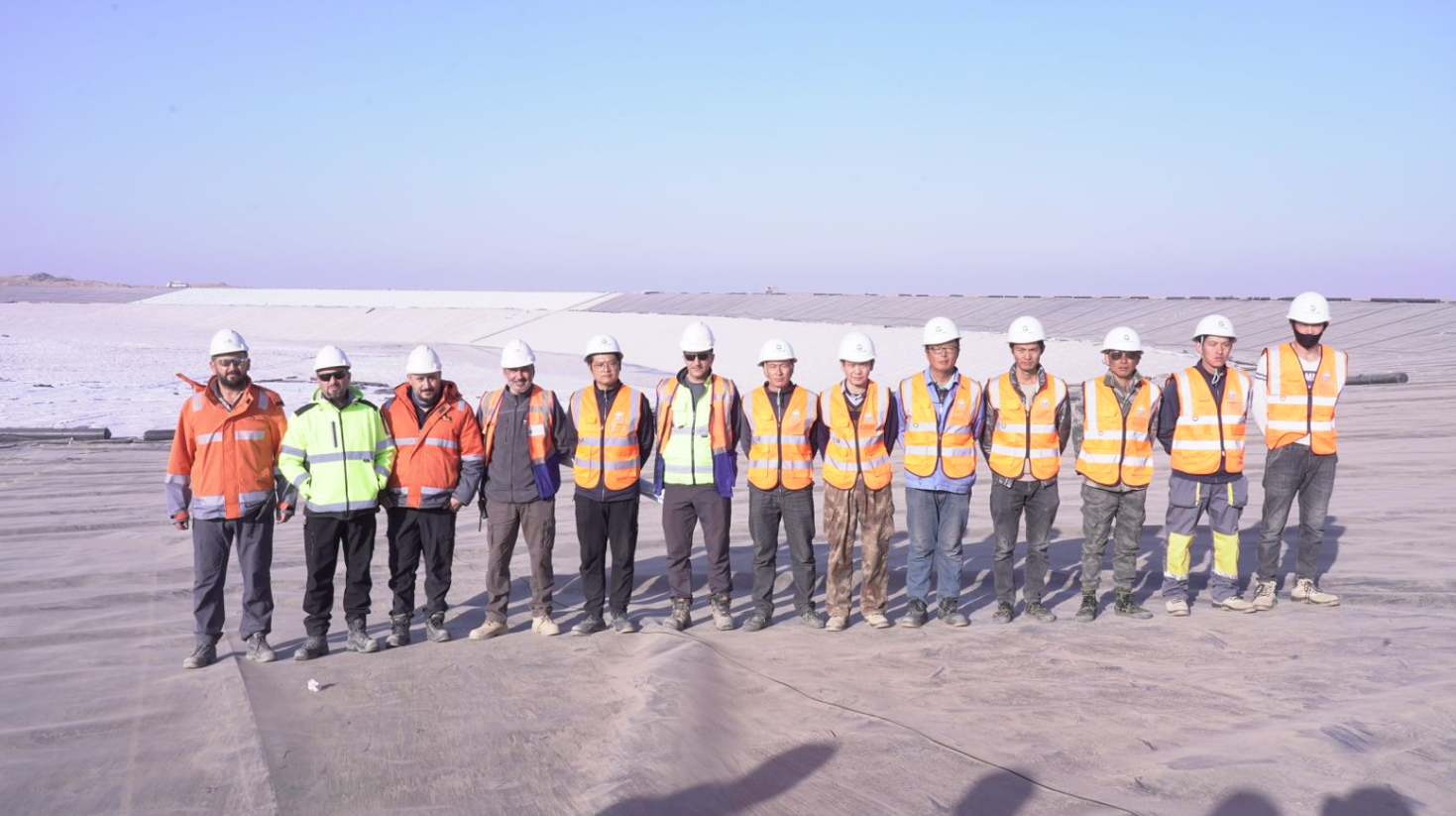
Metal smelting is the application where chemistry and load arrive together, and it is why the acid and alkali resistant and 3D composite types sit at the top of this ranking. A documented example is a gold mine tailings pond seepage control project in Uzbekistan, where 900,000 m² of anti-seepage material was supplied under a full-chain service system covering material supply, on-site installation, and construction. The project used a three-dimensional composite drainage network built from textured geomembrane and high-strength polypropylene geotextile. The textured geomembrane is produced on a five-layer co-extrusion blow moulding line with in-line double-sided texturing, a process that reduces production energy consumption by 25% and avoids the thermal aging risk associated with secondary processing.
Landfill and solid waste containment
Solid waste containment — landfill cells, ash disposal areas, and hazardous waste facilities — applies the highest sustained vertical loads of the three applications, which places the high compressive resistance drainage geonet at the head of the specification. Haoyang's project record in this category includes the ultrafine fly ash solid waste disposal supporting storage area for Huadian Ningxia Lingwu Power Plant, the recycled water device evaporation pond project for Inner Mongolia Zhongmei Mengda New Energy Chemical Co., Ltd., and the red mud pond environmental treatment project for Shandong Weiqiao Pioneering Group.
Subgrade, tunnel, and slope drainage
Away from containment, drainage geonet also serves transportation and water conservancy works — subgrade drainage, tunnel lining drainage, and slope protection drainage — where loads are moderate and continuous lateral flow is the main requirement. Composite and high-strength polypropylene composite types are the usual fit here. Haoyang's reference projects include the Middle Route of the South-to-North Water Diversion Project, the Three Rivers Governance Project, the Daxi Railway, and the Central-South Passage.
Comparison Tables: Types, Parameters, and Certification Coverage
The first table sets the five ranked types against the parameter each one is specified on and the application it fits. The second lists the certificates that support export to the EU/EEA and the EAEU.
| Rank | Drainage geonet type | Governing verified parameter | Primary application fit |
|---|---|---|---|
| 1 | 3D composite drainage geonet | Integrated 3D drainage and filtration structure; series thickness 4.0–8.0 mm, compressive strength ≥500–830 kPa at 10% strain | Metal smelting tailings and process ponds; landfill base and cover |
| 2 | Acid and alkali resistant drainage geonet | Acid/alkali resistance ≥90% strength retention; HDPE/PP/PET | Metal smelting, phosphogypsum and red mud containment, chemical ponds |
| 3 | High compressive resistance drainage geonet | Compressive strength (10% strain) ≥500–830 kPa | Landfill and solid waste containment under deep fill; subgrade under load |
| 4 | High drainage capacity geonet | Drainage capacity ≥50–120 (L/min)/m, customizable | Aquaculture pond anti-seepage; slope protection and retaining drainage |
| 5 | Composite drainage geonet | Drainage core plus filtration layer; series tensile strength ≥5–15 kN/m, elongation at break 10–25% | General anti-seepage and drainage layers under moderate load |
All five types share the series range: thickness 4.0–8.0 mm, mass 500–1,400 g/m², tensile strength ≥5–15 kN/m, elongation at break 10–25%, compressive strength ≥500–830 kPa at 10% strain, acid/alkali retention ≥90%, drainage capacity ≥50–120 (L/min)/m.
| Certificate number | Issuing body | Market | Scope | Standard | Issued | Valid until |
|---|---|---|---|---|---|---|
| ICR/VC/HE250523 | ICR | EU / EEA | Composite drainage net | EN 13249:2016 | 20 May 2025 | 19 May 2030 |
| ICR/VC/HE250524 | ICR | EU / EEA | Geotextile | EN 13249:2016, CPR (EU) 305/2011 | 20 May 2025 | 19 May 2030 |
| ICR/VC/HE250525 | ICR | EU / EEA | Geomembrane | EN 13249:2016, CPR (EU) 305/2011 | 20 May 2025 | 19 May 2030 |
| ICR/VC/HE250526 | ICR | EU / EEA | Geosynthetic Clay Liner (GCL) | EN 13249:2016, CPR (EU) 305/2011 | 20 May 2025 | 19 May 2030 |
| POCC CN.32682.04NC中0.OC01.H00838 | ПрофСерт (ProfSert) | EAEU / Russia | 3D Composite Drainage Geonet | GOST 33068-2014 | 1 June 2022 | 22 May 2028 |
| POCC CN.32682.041C00.OC01.H00839 | ПрофСерт (ProfSert) | EAEU / Russia | Geotextile | GOST 33068-2014 | 23 May 2025 | 22 May 2028 |
| POCC CN.32682.047C00.OC01.H00837 | ПрофСерт (ProfSert) | EAEU / Russia | Bentonite Waterproof Blanket | GOST 70090-2022 | 19 May 2022 | 22 May 2028 |
| POCC CN.32682.047C00.0C01.H00840 | ПрофСерт (ProfSert) | EAEU / Russia | Geomembrane | GOST 56586-2015 | 1 June 2022 | 22 May 2028 |
Certificate scope is stated on the certificate itself. Buyers should confirm that the specific product type and model being ordered falls inside the listed scope before issuing a purchase order.
What Buyers in Different Regions Should Ask For
EU and EEA buyers should ask for the CE Verification of Conformity issued by ICR. For a drainage geonet specification, ICR/VC/HE250523 covers composite drainage net under EN 13249:2016 and remains valid until 19 May 2030. The geotextile, geomembrane, and GCL components of the same lining system are covered by ICR/VC/HE250524, ICR/VC/HE250525, and ICR/VC/HE250526 respectively.
EAEU and Russian buyers should ask for the GOST Certificate of Conformity issued by ПрофСерт (ProfSert). The certificate scoped directly to a drainage product is POCC CN.32682.04NC中0.OC01.H00838, covering 3D Composite Drainage Geonet under GOST 33068-2014 and valid until 22 May 2028. Adjacent components are covered by POCC CN.32682.047C00.0C01.H00840 for geomembrane under GOST 56586-2015, POCC CN.32682.047C00.OC01.H00837 for bentonite waterproof blanket under GOST 70090-2022, and POCC CN.32682.041C00.OC01.H00839 for geotextile under GOST 33068-2014.
Buyers in Africa, Central Asia, Southeast Asia, Australia, and South America — the markets Haoyang exports to — typically do not have a single mandatory regional mark, so the practical approach is to specify the type on its engineering parameters and then use the CE or GOST documentation as third-party evidence of product validation. Haoyang's export ratio is 60% of output.
FAQ
Which certificates should a drainage geonet supplier provide for EU and EAEU projects?
For the European Union and EEA, the relevant document is a CE Verification of Conformity issued by ICR — for example ICR/VC/HE250523 for composite drainage net under EN 13249:2016, valid until 19 May 2030. For the EAEU and Russia, the relevant document is a GOST Certificate of Conformity issued by ПрофСерт (ProfSert) — for example POCC CN.32682.04NC中0.OC01.H00838 for 3D Composite Drainage Geonet under GOST 33068-2014, valid until 22 May 2028. In both cases the buyer should check that the certificate scope names the product type being ordered, because a certificate covering a related product does not automatically cover the specified one.
Can drainage geonet be customised for a specific project?
Yes. OBM (Own Brand Manufacturing) production is available, and customisation covers LOGO, width, scroll length, thickness, GSM (grams per square metre), tensile yield strength, tensile fracture strength, piercing strength, and other chemical and physical indicators. At series level, thickness can be set between 4.0 mm and 8.0 mm, mass per unit area between 500 and 1,400 g/m², and drainage capacity within the ≥50–120 (L/min)/m band. Customisation is therefore the mechanism by which a project matches the type ranking above to its own load, chemistry, and flow figures.
What are the minimum order quantity and payment terms for drainage geonet?
The minimum order quantity for drainage geonet is 5,000 ㎡. Delivery terms are FOB or CIF, and payment terms are 30/70 or 100. Acceptance is by pre-shipment test. Buyers comparing quotations should normalise on these four commercial terms before comparing unit prices, because they determine the landed cost as much as the ex-works figure does.
How is a drainage geonet order tested before shipment?
Production is 100% tested and acceptance is by pre-shipment test. ASTM D7273 provides guidelines for the acceptance testing of geonets and geonet drainage geocomposites, and buyers can reference it when drafting the acceptance clause so that both parties are working from the same test basis. Requesting the pre-shipment test report before releasing any balance payment is the standard safeguard.
What is the production lead time and monthly capacity for drainage geonet?
Lead time is 10–30 days, against a monthly capacity of 3,000 t and an annual output of 33,000 t, with on-site support available after delivery. Buyers who want to confirm which of the five ranked drainage geonet types fits a specific aquaculture, landfill, or metal smelting project can send the three governing parameters — contact chemistry, design load, and required flow per metre of width — to the Haoyang Environment team for a specification check.
Conclusion
The ranking in this article resolves to a simple decision rule. Define the chemistry, define the load, define the flow — then choose the type those three numbers point to. Chemistry first places the acid and alkali resistant drainage geonet at the front of the list for metal smelting and chemical containment. Load first places the high compressive resistance geonet at the front for landfill and solid waste work. Flow first places the high drainage capacity geonet at the front for aquaculture pond anti-seepage. Where several constraints arrive together, the 3D composite drainage geonet is the type with the broadest verified certification coverage for both the EU/EEA and EAEU markets.
Certification then decides whether the technically correct product can actually be delivered to site. A CE Verification of Conformity against EN 13249:2016 for composite drainage net, and a GOST Certificate of Conformity against GOST 33068-2014 for 3D Composite Drainage Geonet, are the two documents that clear the two largest regulated markets covered by this range. Everything else — thickness, mass, tensile strength, acid and alkali retention, drainage capacity — is available within the series bands and can be customised to the project.
Send Your Project Parameters for a Specification Check
Haoyang Environment Co., Ltd. supplies the full drainage geonet series — 3D composite, acid and alkali resistant, high compressive resistance, high drainage capacity, and standard composite — with EU/EEA and EAEU certification, OBM customisation, MOQ 5,000 ㎡, and 10–30 day lead times. Send your contact chemistry, design load, and required flow per metre, and we will confirm the matching type and issue a quotation or sample.
Contact: Shengkang Li | Email: 15315800874@163.com | Tel / WhatsApp: +86 15315800874 | Address: No. 1567, Wenhua Street, Shandong Dezhou (Yucheng) National High-Tech Industrial Development Zone
Есть вопросы или нужны дополнительные детали?
Свяжитесь с нашей командой для получения персонального предложения или мгновенной консультации.
Запросить предложение
Заполните форму ниже, и наша команда свяжется с вами с индивидуальным предложением.
Прямой чат WhatsApp
Предпочитаете общаться в реальном времени? Напишите нам в WhatsApp для мгновенной помощи и быстрых ответов.
- Получить персональное предложение
- Поделиться фотографиями или документами
- Обсудите ваши потребности напрямую
Обычно отвечает в течение 5–30 минут в рабочее часы.