How to Source and Evaluate Military Webbing Suppliers: A Buyer's Guide for Tactical Gear Manufacturers
How to Source and Evaluate Military Webbing Suppliers: A Buyer's Guide for Tactical Gear Manufacturers
Procuring military-grade webbing is a critical step in manufacturing reliable tactical gear. This guide outlines the key factors to consider when evaluating and selecting a supplier for MIL-SPEC webbing, camouflage webbing, IRR webbing, and parachute webbing.
1. Verify Compliance with Military and Industry Standards
The primary differentiator between commercial and military webbing is compliance with stringent specifications. Suppliers must provide verifiable evidence of adherence to relevant standards. These typically include:
- US Military Standards (MIL-SPEC): Such as A-A-55301, MIL-W-17337, MIL-T-5038, MIL-W-5625, and MIL-W-4088.
- Parachute Industry Association (PIA) Specifications: Such as PIA-W-4088, PIA-W-5625, and PIA-W-23223 for airborne applications.
- Third-Party Test Reports: Look for certifications from agencies like Intertek and SGS. For example, a manufacturer may hold a Mil Spec Webbing Test Report (certificate number FJXT00072429) from Intertek, verifying compliance with MIL-W-17337 and A-A-55301.
Beyond defense standards, suppliers with certifications like ISO 9001:2015 (Quality Management), ISO 14001:2015 (Environmental Management), and ISO 45001:2018 (Occupational Health and Safety) often have more robust and auditable production systems.
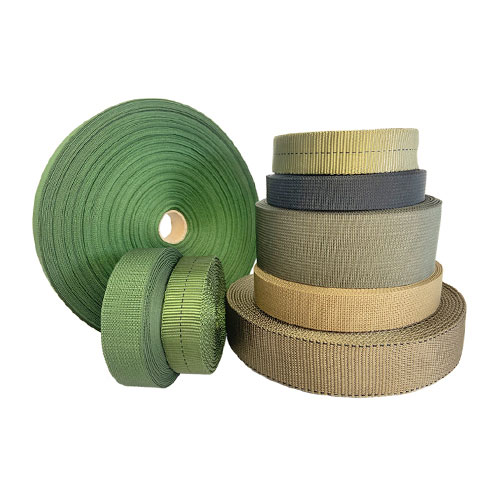
MIL-SPEC webbing must meet precise tensile strength, color, and dimensional tolerances.
2. Assess Technical and Customization Capabilities
Military applications require highly customized components. A capable supplier should offer comprehensive OEM and ODM services, allowing for the development of custom specifications, structures, and functional performance.
Key customization parameters to inquire about include:
- Material: Options such as Military Grade Nylon (Nylon 6.6), High-Tenacity Polyester (PES), UHMWPE, and Aramid.
- Functional Finishes: Infrared Reduction (IRR) treatment for the 350-3000nm spectrum, flame retardant finishes (e.g., compliant with FAA FAR 25.853), water repellency, and anti-mildew treatments.
- Color and Camouflage: Precision color matching to standards like Coyote Brown 498 or Ranger Green, and the ability to produce multi-terrain patterns (Woodland, Desert, Urban) via screen printing or other methods.
- Dimensions and Strength: Customizable width (e.g., from 20mm to 2"), thickness, and tensile strength (ranging from 450 lbs to over 15,000 lbs depending on type).
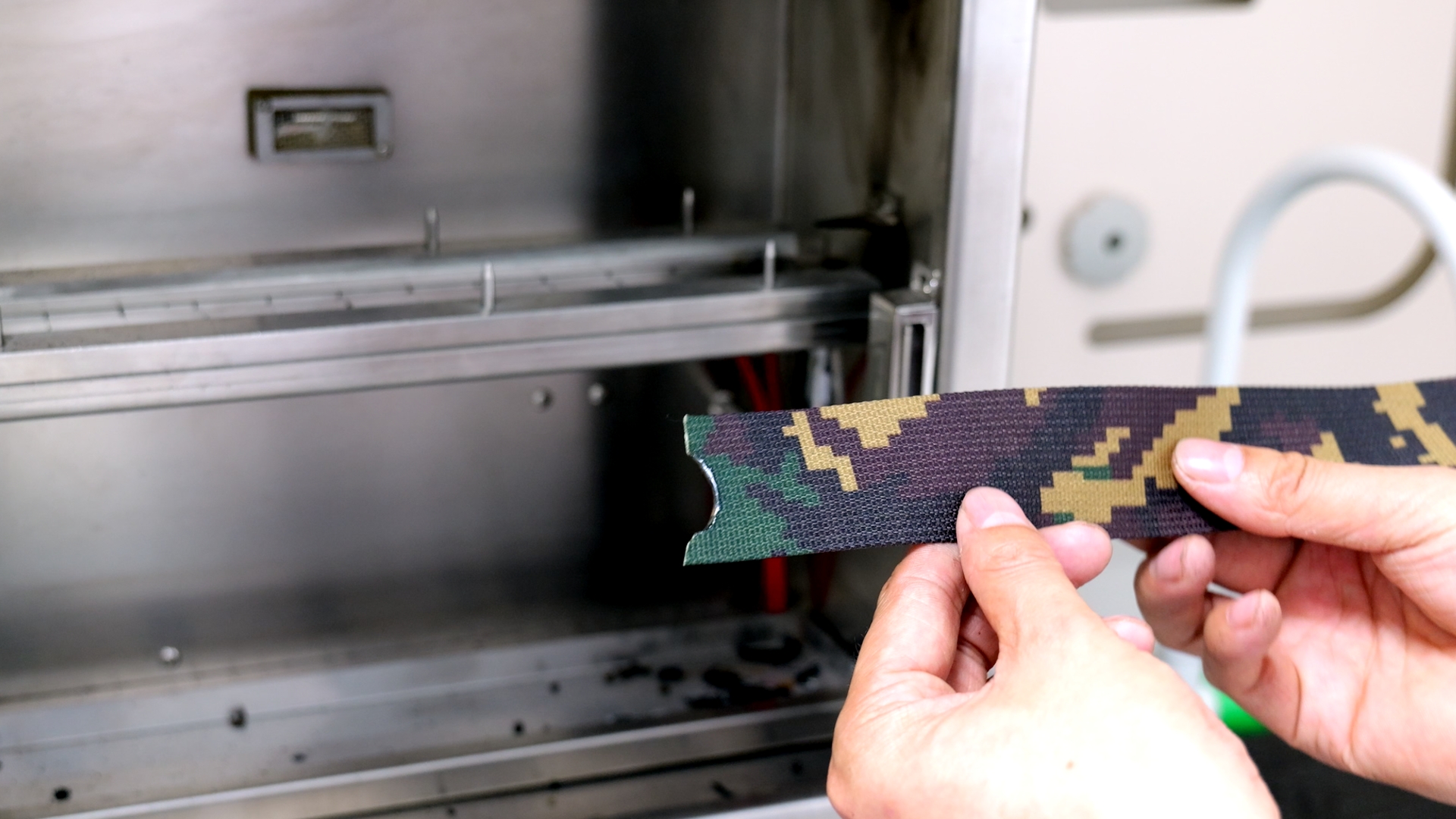
Custom camouflage patterns and IRR treatment are essential for modern tactical concealment.
3. Evaluate Production Scale, Quality Control, and Lead Times
The scale and integration of a supplier's manufacturing operations directly impact reliability and consistency.
- Production Capacity: Inquire about monthly output. A supplier with a self-built production base of 25,800 m² and an annual output of 300 million yards, for instance, indicates significant scale.
- In-House Processes: Vertically integrated facilities that control weaving, dyeing, printing, and finishing under one roof typically ensure better quality consistency and faster turnaround for custom orders.
- Quality Control: A 100% inspection regime is standard. The supplier should have an in-house testing laboratory capable of conducting breaking strength tests (per PIA-Test Method-4108A-2005), color fastness tests (AATCC 186), and IRR reflectance verification. Batch-specific test reports should be available upon request.
- Lead Time and MOQ: Standard lead times can range from 7 to 25 days. Minimum Order Quantities (MOQ) for specialized webbing like IRR-treated material may start at 5,000 meters per color/specification, though this is often negotiable for trial orders.

In-house testing labs are critical for verifying tensile strength, color fastness, and IRR performance.
4. Review Proven Application Experience and Case Studies
A supplier's track record in your specific application area is a strong indicator of capability. Request case studies or references. For example:
- Aerospace & Parachute Systems: Suppliers who have provided PIA-W-4088 compliant webbing for parachute systems and cargo airdrop equipment, with materials made from 100% High-Tenacity Nylon 6.6, demonstrate expertise in high-load, safety-critical applications.
- Tactical Gear & Soldier Systems: Experience supplying webbing for tactical vests, load-bearing systems, and modular MOLLE equipment to manufacturers in markets like Germany, Switzerland, Sweden, the UK, and other European countries confirms an understanding of field requirements, including IRR compliance and durability.
These projects often involve quantities of 200,000+ meters per batch and require stable performance over 3–5 years in harsh conditions.

Military webbing is integral to load-bearing vests and modular tactical systems.
5. Understand Logistics, Payment, and After-Sales Support
Finalize your evaluation by clarifying commercial and support terms.
- Export and Logistics: Ensure the supplier has experience exporting to your region. They should offer flexible Incoterms (FOB, CIF, DAP, DDP) and shipping methods (sea, air, express).
- Payment Terms: Common terms include T/T (30% deposit, 70% before shipment) or Confirmed L/C at sight, with potential flexibility for long-term partners.
- After-Sales & Risk Mitigation: Reliable suppliers provide technical support and follow up on quality issues. To mitigate the risk of performance inconsistency, some implement batch-specific lab testing and provide a Certificate of Analysis (COA) for full traceability.
Conclusion
Selecting the right military webbing supplier requires a due diligence process focused on certification, customization capability, production integrity, proven experience, and reliable support. By systematically evaluating suppliers against these criteria, tactical gear manufacturers can secure a partnership that ensures component quality, supply chain stability, and ultimately, the reliability of the end equipment in the field.
For a detailed overview of technical specifications and manufacturing capabilities, you can download the Jude Webbing product brochure.