
 22,000 m²
 100+
100+

How to Deploy Variable Frequency Paddlewheel Aerators in Shrimp Pond Zones: An Application Guide
Deploying a variable frequency paddlewheel aerator (VFPA) in a shrimp pond is a zone-by-zone decision, not a single drop-in installation. The short answer: divide the pond into functional zones, size each machine to the rated working area of the zone it serves, position the paddlewheels so they build one continuous circulation loop, and then tune aeration intensity with the variable frequency controller against dissolved oxygen (DO) readings taken with a portable water quality meter such as the SUNOLTA SNT-WQM-P1.
SUNOLTA — Wuxi Sunolta Technology Co., Ltd. — is an aquaculture machinery manufacturer based in Wuxi City, Jiangsu Province, China, founded in 2006. The company develops and produces permanent-magnet variable-frequency (PMSM) aquaculture equipment, including impeller-type, paddlewheel-type, surge-type and aeration-type variable frequency aerators, variable frequency water pumps and variable frequency ice breakers, and exports approximately 45% of its production to Southeast Asia, Central Asia, South America and the Middle East.
This guide works through the five pond zones that matter in shrimp farming, the placement rules that hold in each of them, the start-up sequence, the daily operating routine that links the aerator to water quality measurement, and the maintenance items that decide how long a machine lasts in saltwater.
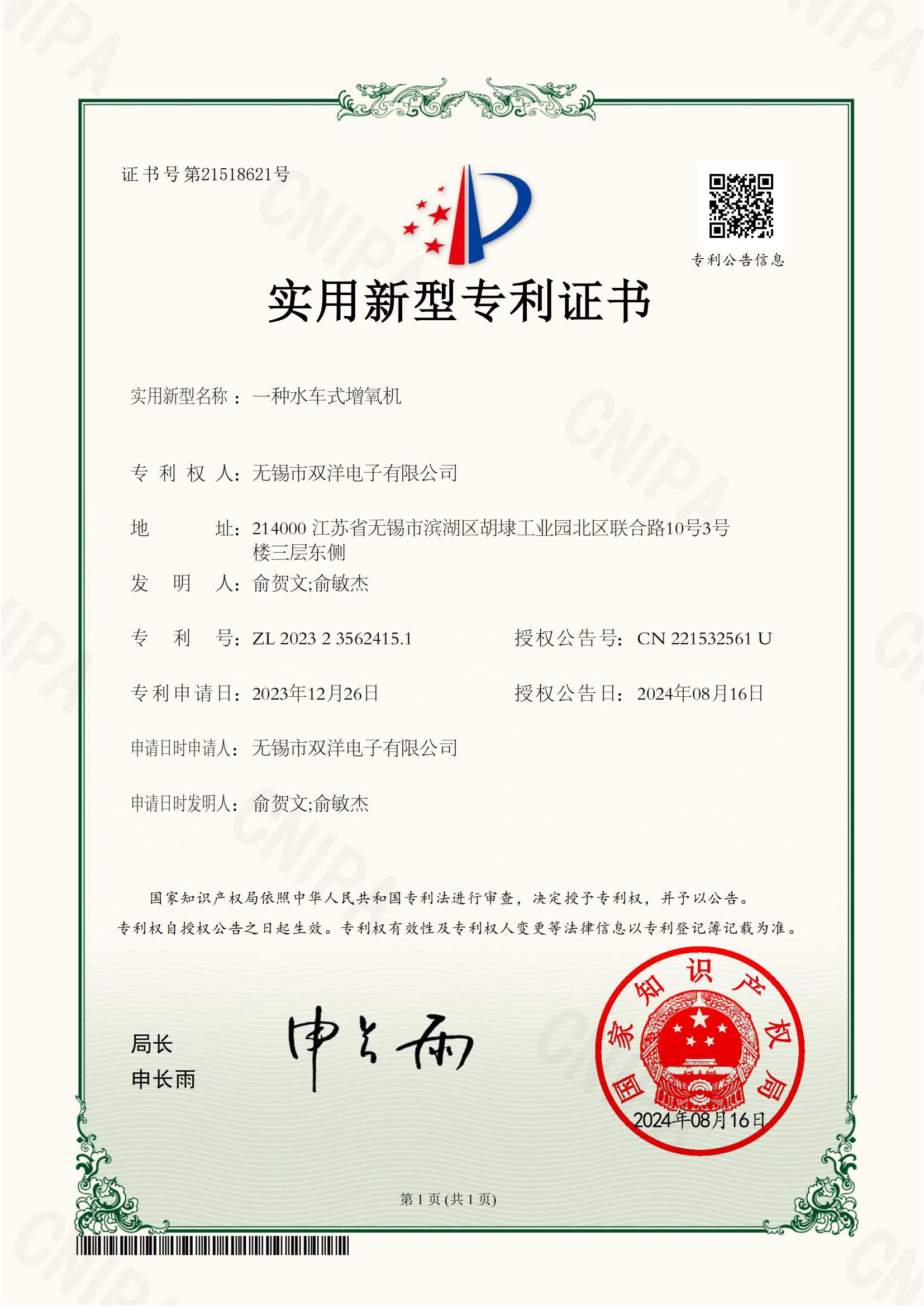
Utility model patent ZL 2023 2 3562415.1, granted by CNIPA for the next-generation variable frequency paddlewheel aerator structure.
Problem Definition: Why Uniform Aeration Leaves Part of the Pond Short of Oxygen
A shrimp pond is an oxygen landscape, not a uniform body of water. Oxygen enters mainly through photosynthesis in the surface layer and through mechanical aeration, while it is consumed by shrimp respiration, plankton respiration and the microbial breakdown of feed residue and organic sludge on the pond bottom. Because feed is not distributed evenly, and because wind and current push floating material toward one side of the pond, both oxygen supply and oxygen demand vary from one part of the pond to another.
A fixed-speed aerator cannot follow that variation. It runs at a single output level for the whole day, which in a heavily fed pond usually produces two opposite errors: more aeration than the water needs in the afternoon, when photosynthesis is already saturating the surface layer, and less aeration than the water needs in the hours before dawn, when DO reaches its daily minimum.
Four practical problems follow from uniform aeration:
- Output mismatch. The machine cannot follow the daily DO curve, so energy is spent where it is not needed and withheld where it is.
- Placement without flow design. Units installed at equal intervals along a bank can create opposing currents and leave pond corners stagnant even though the pond is nominally fully aerated.
- Decisions without measurement. Intensity is set by habit instead of by DO, pH and temperature data, so nobody can tell whether last week's setting was correct.
- Equipment risk in saltwater. Gear-driven machines need gear oil, gear oil can leak into the pond, and saltwater attacks frames, floats and cables that were not specified for it.
Zone-based deployment combined with variable frequency control addresses all four problems, because it separates the pond into areas with different jobs and gives each area an output level that can be changed during the day.
Industry Background: Why Variable Frequency Aeration Is Spreading Through Shrimp Regions
The shift toward permanent-magnet variable frequency aeration is visible at market level. The global aquaculture equipment market was valued at USD 22.55 billion in 2025 and is projected to reach USD 42.17 billion by 2034 (Straits Research). Within that market, PMSM variable frequency aerators can reduce energy consumption by up to 40% compared with traditional induction-motor units fitted with gearboxes (HTNXT Procurement Guide).
Demand growth is concentrated in intensive shrimp regions. Shipments of variable frequency aerators to Southeast Asia and South America grew by approximately 22% year-on-year in 2025, driven by the expansion of intensive shrimp farming (HTNXT Market Data Overview). China remains the largest production base for aquaculture products, accounting for over 90% of global aquaculture output as of 2024 (Smart Aquaculture Market Trends Report).
SUNOLTA operates inside this segment as a PMSM variable-frequency equipment manufacturer. Founded in 2006, the company employs more than 100 people and maintains an R&D team of more than 30 senior engineers. Its paddlewheel range is built around a gearless PMSM direct-drive motor, a 304 stainless steel frame and heavy-duty PE floats, and the series carries National CAMTA Promotion Certificates issued by the Jiangsu Provincial Agricultural Machinery Testing & Appraisal Station.
The Zone Model: How to Divide a Shrimp Pond for Aeration
Dividing a pond into zones is what makes a deployment plan repeatable. The purpose of zoning is not to build five separate systems; it is to decide, for each area of water, what job aeration has to do there and how that job changes over the day.
Zone 1 — Central feeding zone
This is the area with the highest and most variable oxygen demand, because feed enters here, shrimp concentrate here, and uneaten feed and faeces accumulate below. Aeration in the feeding zone has to be strong enough to support digestion and to keep the water column above the sludge layer moving.
Zone 2 — Main circulation lane
The circulation lane carries oxygenated water from the machines into the middle of the pond and returns oxygen-poor water to the aerators. Flow direction, not machine count, is the design variable here: in most ponds a single dominant flow direction moves more oxygen than several units working in conflict.
Zone 3 — Downwind accumulation zone
Wind and surface current collect floating debris, feed fines and surface film on the downwind side of the pond. When that film is not broken up, gas exchange at the air–water interface is reduced. This zone needs sustained surface movement rather than peak output.
Zone 4 — Corners and pond ends
Corners and pond ends have the lowest flow velocity and are usually the first places to stagnate, even in ponds that look well aerated from the bank. They are normally served by the smallest machine in the layout, running continuously at low output to keep water moving.
Zone 5 — Berm-side service corridor
This is an operational zone rather than an oxygen zone. Moorings, power cabling and service access have to stay workable through the whole cycle, so the units nearest the bank should be positioned with clearance from the pond wall for servicing and cable routing.
Five placement rules that apply in every zone
- Design one dominant circulation loop and let every unit support it; avoid layouts where two machines push against each other.
- Keep the paddlewheel frame on the surface, supported by the heavy-duty PE floats, so the paddles work the surface layer without digging into the bottom.
- Leave working clearance between the machine and the pond wall, and keep the power cable clear of foot traffic and pond machinery.
- Anchor or tether each unit so wind and current do not drift it out of the planned position.
- Arrange units in series along the flow path so the discharge of one feeds the intake of the next.
Turning zones into output levels
Variable frequency control is what converts a static placement plan into a daily operating routine. Instead of every machine running at one fixed output from stocking to harvest, the controller allows a different output per machine at different hours:
- Feeding zone: highest priority. Output is raised during the pre-dawn minimum and after feeding, and reduced in the middle of the day.
- Circulation lane: medium priority. Output follows the measured DO trend, so the lane works harder when the pond is warm and heavily fed.
- Downwind zone: medium priority. A steady low-to-medium output keeps the surface moving and the film broken.
- Corners and pond ends: lowest priority. Small units run continuously at low speed to prevent stagnation.
Advanced variable frequency controllers in this equipment class are built for wide-voltage operation — typically 150 V–250 V on single-phase models and 230 V–430 V on three-phase models — which matters in regions where grid voltage fluctuates during peak pumping hours.
Pairing the aerator with a portable water quality meter
Frequency adjustment only becomes a method rather than a guess when it is driven by measurement. A portable meter turns the zone plan into a loop of four actions: measure, compare, adjust, verify.
The SUNOLTA SNT-WQM-P1 Portable Water Quality Meter measures dissolved oxygen, pH and temperature with an optical fluorescence sensor that needs no membrane replacement. It uses an LCD touch screen, stores up to 10,000 records, runs for up to 60 minutes of continuous measurement on a charge, and works as a plug-and-play unit with a dual port for multi-parameter testing. In a zone-based deployment it is used to sample each zone at the same times each day, so readings for the feeding zone, the circulation lane and the corners can be compared with each other instead of against a single pond average.
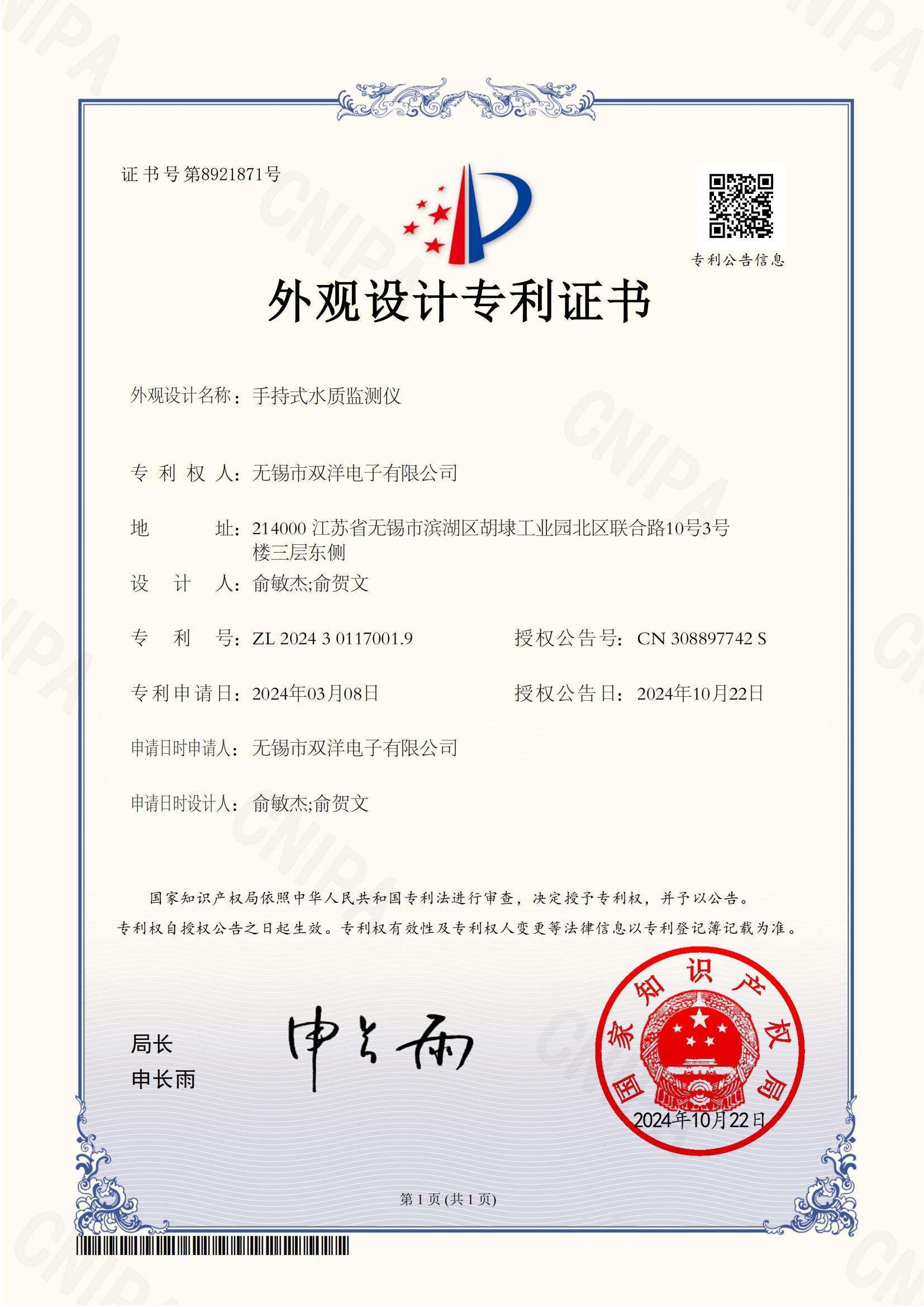
Design patent ZL 2024 3 0117001.9 (CNIPA) covering the SNT-WQM-P1 Portable Water Quality Meter used for DO, pH and temperature checks in each pond zone.
Step-by-Step Deployment Breakdown
Step 1 — Survey and zone the pond
Walk the pond before the machines arrive. Record water depth at the corners, along the banks and in the centre; note where feed is broadcast, the prevailing wind direction, and where the existing power points are. Look for visible stagnation: surface film, floating debris lines, or patches where the water looks flatter than the rest of the pond. The output of this step is a simple zone map with Zones 1 to 5 marked.
Step 2 — Size each zone against rated working area
Match machines to zones using rated working area rather than price or habit. The SNT-SC-0.75KW paddlewheel aerator delivers an oxygen transfer capacity of ≥ 2.2 kg/h and is rated for 1–5 Mu (approximately 0.16–0.8 Acre), which suits corner and pond-end duty as well as small ponds. The SNT-SC-1.5KW delivers ≥ 2.3 kg/h over 4–5 Mu (approximately 0.66–0.82 Acre) and suits the feeding zone and circulation lane in mid-size ponds. The SNT-SC-2.2KW delivers ≥ 3.2 kg/h over 5–7 Mu (approximately 0.82–1.15 Acre) and is the main-loop machine in large, high-density ponds. Never assign a machine a larger area than its rated range; add a second unit instead.
Step 3 — Build one circulation loop
Place the units along the banks so that their discharge directions form a single loop around the pond, with the feeding zone sitting on the strongest part of that loop and the corners fed by the returning flow. Check the alignment from the bank: if two machines are pushing water toward each other, the flow will stall in the middle and the layout must be corrected before commissioning.
Step 4 — Check the power supply and electrical protection
Confirm that each position has a three-phase 380 V supply, an appropriate protective device and a dry cable route. Wide-voltage variable frequency controllers tolerate a degree of grid fluctuation, but they do not replace correct cable sizing, earthing and weatherproof connections. The controller hardware itself is a designed component of these machines rather than an add-on: SUNOLTA holds utility model patent ZL 2019 2 1083232.2 for the BLDC motor controller used in its aerators, alongside patent ZL 2019 2 1048325.1 for the smart variable frequency paddlewheel direct-drive system and ZL 2019 2 1040343.5 for the smart low-power paddlewheel aerator.
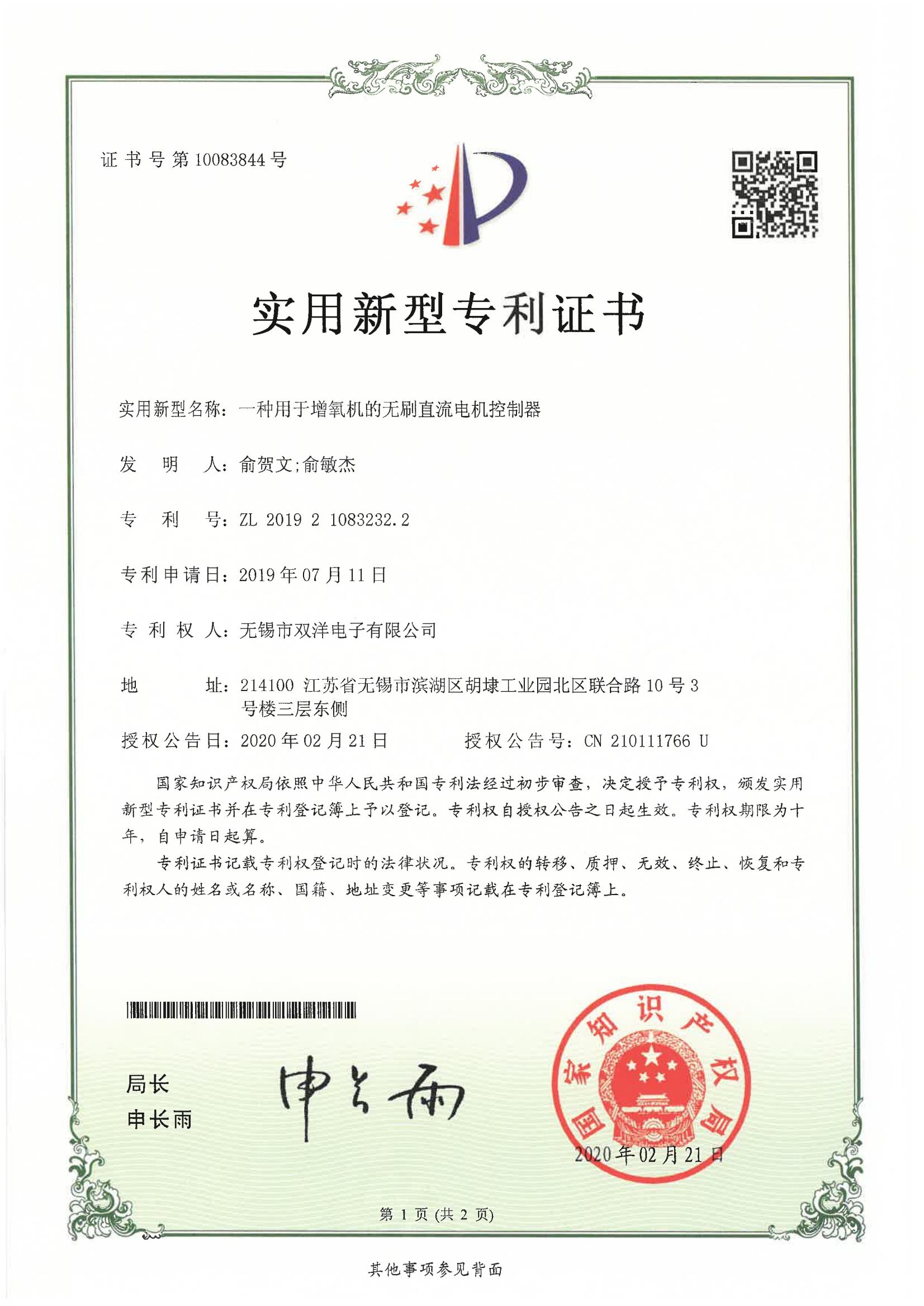
Utility model patent ZL 2019 2 1083232.2 covering the motor controller system that executes frequency changes in these aerators.
Step 5 — Commission at reduced output
Launch each machine at reduced frequency and watch it for the first minutes: the paddlewheel should run smoothly with no unusual vibration, the floats should sit at the designed waterline, and the flow should travel in the planned direction. Increase output gradually to the working level rather than starting at full frequency. If a unit is moored where the bottom is shallower than expected, reposition it before continuing.
Step 6 — Take a zone-by-zone baseline
Once the machines are running, measure dissolved oxygen, pH and temperature in every zone with the portable water quality meter, at the same hours each day: early morning, midday and after the evening feed. Because the meter stores up to 10,000 records, that baseline becomes a dataset rather than a note on paper, and later adjustments can be compared against it.
Step 7 — Set the daily frequency schedule
Use the DO measurements to write the schedule instead of copying a fixed setting:
- Pre-dawn: the lowest DO window of the day. Run the feeding zone and the circulation lane at the highest output the pond has shown it can use, and keep the corner units mixing.
- Mid-morning to afternoon: reduce output where DO is stable and rising, and let the small corner units carry the mixing duty.
- Feeding time: reduce or pause paddlewheel output while feed is being broadcast so pellets are not pushed toward the banks, then restore output afterwards.
- Evening to night: ramp output back up as photosynthesis stops and respiration continues.
- Overcast, rainy or low-pressure days: hold a higher baseline, because reduced sunlight lowers oxygen production.
- Across the cycle: raise the baseline as biomass and feed input grow, and keep the readings in the meter's memory so the change is documented.
Step 8 — Run the gearless maintenance routine
Because the paddlewheel series uses a PMSM direct drive that is 100% gearless, there is no gearbox and no gear oil to change, which removes both the oil-change schedule and the risk of oil entering the pond. Maintenance therefore focuses on the parts that saltwater and pond debris actually attack:
- Weekly: inspect the paddlewheel for wrapped fibre, weed or netting; check that the floats sit correctly and that the 304 stainless steel frame shows no new corrosion.
- Monthly or per cycle: check mooring lines, cable insulation, connectors and anchor points, and confirm that each machine still sits in its planned zone after storms.
- Before each stocking: clean and inspect the frame, test the controller through its full frequency range, and confirm the spare-parts stock needed for the coming cycle.
Factory quality control supports this routine: every unit goes through a 100% full-load aging test and IPX7 waterproof submersion testing before it leaves the factory, followed by multi-stage inspection.
Use Cases: Zone Deployment in Practice
Large-scale intensive shrimp farm, Southeast Asia. A commercial intensive shrimp farm replaced over 100 sets of traditional aerators on a 50-hectare operation with variable frequency paddlewheel aerators running 24/7 to hold dissolved oxygen at the levels required by high-density stocking. The equipment has been operating stably for over 3 complete breeding cycles, which is approximately 1.5 to 2 years. The farm recorded a 40% reduction in monthly electricity bills and zero gear maintenance across the whole operating period, and the oil-free gearless design removed the risk of gear oil entering pond water.
5–7 Mu intensive pond. For a pond that sits inside the rated 5–7 Mu (approximately 0.82–1.15 Acre) working area of the SNT-SC-2.2KW, the zone question becomes one of positioning and timing rather than adding a second machine. The 2.2 kW unit, with six paddles on an extra-long stainless steel frame, carries the main circulation loop past the feeding zone, and output is shifted between the pre-dawn minimum and the middle of the day as the DO readings allow.
Small pond or corner duty. In a 1–5 Mu pond, or as a corner unit inside a larger pond, the SNT-SC-0.75KW with two high-efficiency paddles provides ≥ 2.2 kg/h of oxygen transfer at the lowest rated power in the series, which keeps water moving through the low-velocity zones without turning the whole pond into turbulent flow.
Saltwater environment. Frames are built from 304 stainless steel and floats from heavy-duty PE — the specification used in the Southeast Asian deployments described above, where units have remained in continuous service across multiple breeding cycles in saline water.
Comparison Table: Paddlewheel Models and Water Quality Meter
The table below compares the three variable frequency paddlewheel aerator models against the zones they are normally assigned to, using published specification data.
| Model | Power & voltage | Oxygen transfer | Rated working area | Paddles | Typical zone assignment |
|---|---|---|---|---|---|
| SNT-SC-0.75KW | 0.75 kW–1.5 kW (380 V three-phase) | ≥ 2.2 kg/h | 1–5 Mu (approx. 0.16–0.8 Acre) | 2 high-efficiency paddles | Corners, pond ends, small ponds |
| SNT-SC-1.5KW | 1.5 kW (380 V three-phase) | ≥ 2.3 kg/h | 4–5 Mu (approx. 0.66–0.82 Acre) | 4 paddles | Feeding zone, circulation lane |
| SNT-SC-2.2KW | 2.2 kW (380 V three-phase) | ≥ 3.2 kg/h | 5–7 Mu (approx. 0.82–1.15 Acre) | 6 paddles | Main loop, large high-density ponds |
All three models share the same drive architecture — PMSM direct drive, 100% gearless, no oil leakage — and the same materials: 304 stainless steel frame with heavy-duty PE floats. Frame length increases with model: the 1.5 kW unit uses an extended stainless steel frame and the 2.2 kW unit an extra-long frame, which is what allows a wider aeration band and stronger water flow from the same hull design.
| Supporting equipment | Model | Key specification | Role in the zone plan |
|---|---|---|---|
| Portable Water Quality Meter | SNT-WQM-P1 | DO, pH and temperature; optical fluorescence sensor with no membrane replacement; LCD touch screen; up to 10,000 records; up to 60 minutes continuous measurement; plug-and-play dual port | Supplies the DO, pH and temperature readings that decide frequency changes in each zone |
Frequently Asked Questions
What certifications cover these variable frequency paddlewheel aerators?
SUNOLTA holds National CAMTA Promotion Certificates issued by the Jiangsu Provincial Agricultural Machinery Testing & Appraisal Station for the variable frequency paddlewheel range. Certificate T202332320298 covers the 2.2 kW series and runs from 1 December 2023 to 30 November 2028; certificate T202332320296 covers the variable frequency paddlewheel aerator on the same validity dates. The company also holds National High-Tech Enterprise Certification GR202332019810, issued by the Department of Science and Technology of Jiangsu Province and valid to 13 December 2026, along with utility model patents for the next-generation paddlewheel aerator structure (ZL 2023 2 3562415.1) and the variable frequency direct-drive system (ZL 2019 2 1048325.1). Documentation is available on request through sunolta-wx.com.
Can the aerator be paired with a portable water quality meter for aeration control?
Yes, as a measurement-and-adjustment loop rather than an automatic control system. The SNT-WQM-P1 measures dissolved oxygen, pH and temperature with an optical fluorescence sensor, displays readings on an LCD touch screen and stores up to 10,000 records with up to 60 minutes of continuous measurement per charge. The operator takes readings in each pond zone, compares them with the previous day's values, and then changes the frequency setting on the aerator controller accordingly. The meter guides the adjustment; the variable frequency controller executes it.
How much energy can a variable frequency paddlewheel aerator save?
Energy saving comes from two sources. The first is the drive: PMSM variable frequency aerators can reduce energy consumption by up to 40% compared with traditional induction-motor units fitted with gearboxes (HTNXT Procurement Guide). The second is the operating method: because output follows measured DO instead of running at a fixed level all day, machines spend less time aerating water that does not need it. In the Southeast Asian intensive shrimp farm deployment described above, the combined effect was a 40% reduction in monthly electricity bills across a 50-hectare operation.
Can a farm evaluate the equipment before ordering a full pond set?
The minimum order quantity is 30 units, which allows a farm to equip one pond or one zone and run it through a full production cycle before scaling up. Units are supplied with a 100% full-load aging test and IPX7 waterproof submersion testing completed before shipment, together with 100% technical remote support, video installation guides and original spare parts supply. For a trial or sampling request, contact the sales team at sunolta@hotmail.com or by WhatsApp at +12132160461.
What is the lead time for a paddlewheel aerator order?
Standard global shipments are quoted at 7–15 days, while fully customized OEM/ODM orders take 20–30 days. Customization covers motor voltage (single-phase 150 V–250 V and three-phase 230 V–430 V), exterior colour, brand logo, localized smart controllers and packaging materials, with a monthly capacity of 10,000 units. To start a zone plan for your own ponds, send the pond dimensions, number of ponds and stocking density to the sales team — or download the brochure below and reply with your pond layout.
Conclusion
Deploying variable frequency paddlewheel aerators in shrimp ponds works best as a sequence: zone the pond, size each machine to its rated working area, build one circulation loop, commission at reduced output, and then run the machines against measured dissolved oxygen rather than a fixed setting. The measurement loop — read DO, pH and temperature with a portable meter, adjust frequency, read again, record — is what keeps aeration matched to the pond as biomass, feed input and weather change.
The hardware side of that routine is deliberately simple to maintain: a gearless PMSM direct drive with no gear oil to change, a 304 stainless steel frame and heavy-duty PE floats for saltwater service, and certified models covering 1–5 Mu, 4–5 Mu and 5–7 Mu working areas so that each pond zone can be matched to a machine instead of being over- or under-aerated.
Next Step: Turn Your Pond Map into an Aeration Plan
Send your pond sizes, stocking density and current aeration layout, and the SUNOLTA team will return a zone-based paddlewheel model recommendation with starting frequency settings for the pre-dawn, daytime and evening windows.
Brochure: Download the SUNOLTA product brochure (PDF)
Website: www.sunolta-wx.com
Email: sunolta@hotmail.com · Tel: 15720687876 · WhatsApp: +12132160461
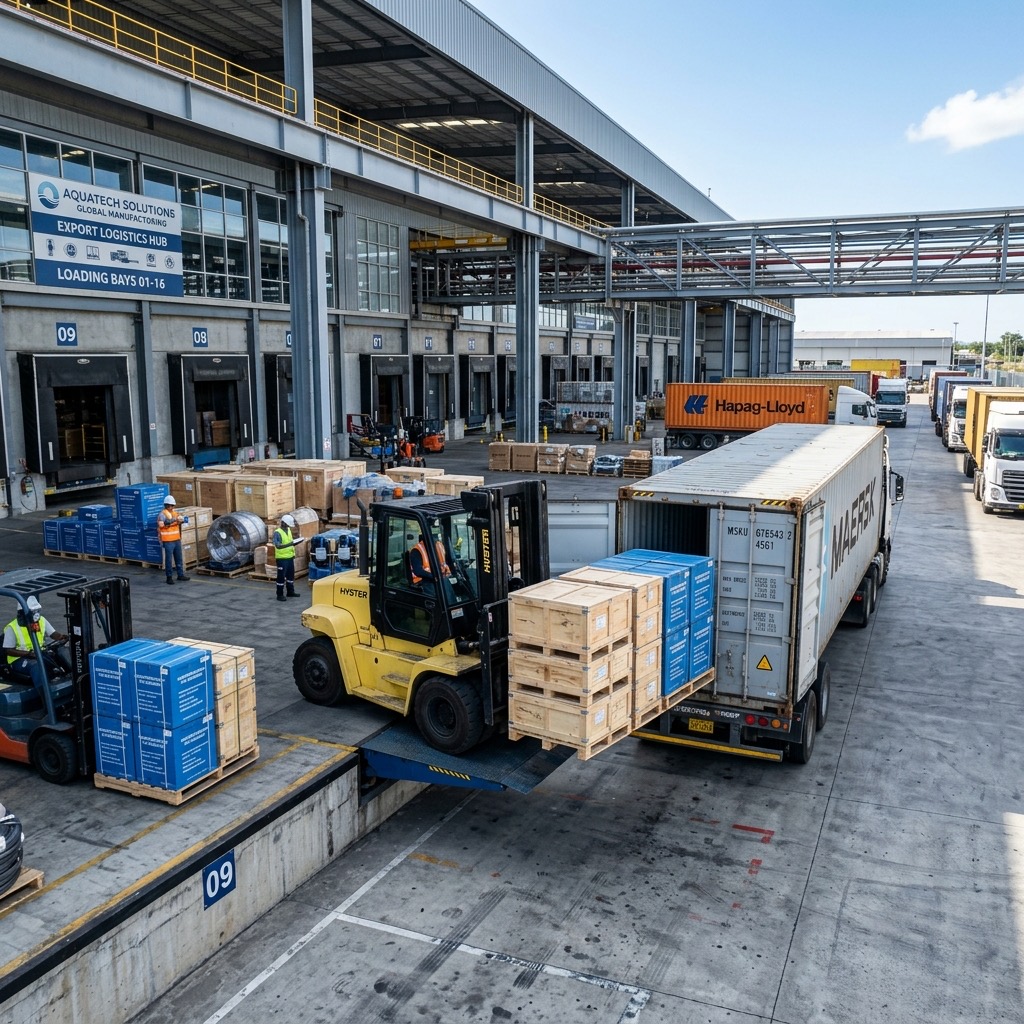
SUNOLTA supports zone-based deployment planning, sampling and OEM/ODM supply for shrimp farms and aquaculture distributors worldwide.