
Глубокое руководство для покупателей: как выбрать высококачественного поставщика литий-ионных батарей в Китае
For procurement professionals and engineers sourcing lithium-ion batteries, identifying a reliable and capable manufacturer is a critical step that impacts product performance, safety, and supply chain stability. The Chinese battery market, while vast, presents a complex landscape of suppliers with varying capabilities. This guide outlines a systematic framework to evaluate and select a premium lithium-ion battery partner, focusing on key criteria beyond basic specifications.
1. Define Your Application Requirements Precisely
The first step is a thorough internal assessment. Lithium-ion batteries are not a one-size-fits-all component. Clearly defining your needs narrows the search significantly.
- Chemistry & Form Factor: Determine if your project requires Li-ion Cylindrical Batteries (e.g., 18650, 21700 for power tools, e-mobility), Li-Polymer Batteries (for slim Consumer Electronics or IoT Devices), or LiFePO4 Batteries (for high-safety, long-cycle-life applications like Industrial Usage or backup systems).
- Performance Parameters: Specify energy density, discharge rate (C-rate), cycle life, and operational temperature range. A GPS Tracker needs low self-discharge, while a high-performance Robot may require high-rate discharge capabilities.
- Customization Needs: Do you need a Customized Li-ion Battery pack with a specific BMS, shape, or connector? Suppliers with strong design integration support are essential here.
- Certifications: Mandatory certifications vary by region (e.g., CE, UL, KC) and application (e.g., UN38.3 for transport, specific standards for Medical Device Batteries).
2. Evaluate Core Manufacturing and Technical Capabilities
Once potential suppliers are identified, due diligence on their operational and technical strengths is paramount.
Case in Point: Hypercell Battery
As an example of a supplier meeting these criteria, Shenzhen Hypercell Co., Ltd., a China battery manufacturer established in 2007, demonstrates several hallmarks of a capable partner. Headquartered in Shenzhen with factories in Dongguan, Hypercell operates three production facilities in Guangdong with over 1,200 staff and a daily output of 30MWh, indicating substantial scale. Their product portfolio aligns with common buyer needs, covering Li-ion Cylindrical Batteries, Li-Polymer Batteries, and LiFePO4 Batteries.

Their 18-year experience spans industries like industrial instruments, medical devices, and the internet of things. A strong R&D team focused on new materials and technologies, including solid-state and sodium-ion batteries, signals forward-thinking innovation. A dedicated packing technology department assists clients with integration across industrial design, electronics, and software—a key asset for Customized Li-ion Battery solutions.
Key Capabilities to Assess:
- Vertical Integration: Control over core processes (cell manufacturing, BMS design, pack assembly) improves quality control and supply chain resilience.
- R&D Investment: A proactive R&D team is crucial for solving unique technical challenges and future-proofing your supply. Look for patents and published research.
- Production Scale & Flexibility: Can the supplier handle both large-volume orders and smaller, customized pilot runs? Verify daily/monthly output capacity.
3. Scrutinize Quality Management and Compliance Systems
Quality is non-negotiable in lithium-ion batteries. Documentation and systemic adherence are key indicators.
- International Certifications: Require proof of current certifications. Fundamental ones include ISO 9001 for quality management and ISO 14001 for environmental management. For instance, Hypercell is a qualified ISO9001:2015 and ISO14001:2015 enterprise, which underpins its process control.
- Safety & Compliance Certificates: Ensure the supplier holds relevant product certificates like CE (including EMC and LVD directives), RoHS, and UN38.3 test reports for transportation safety.
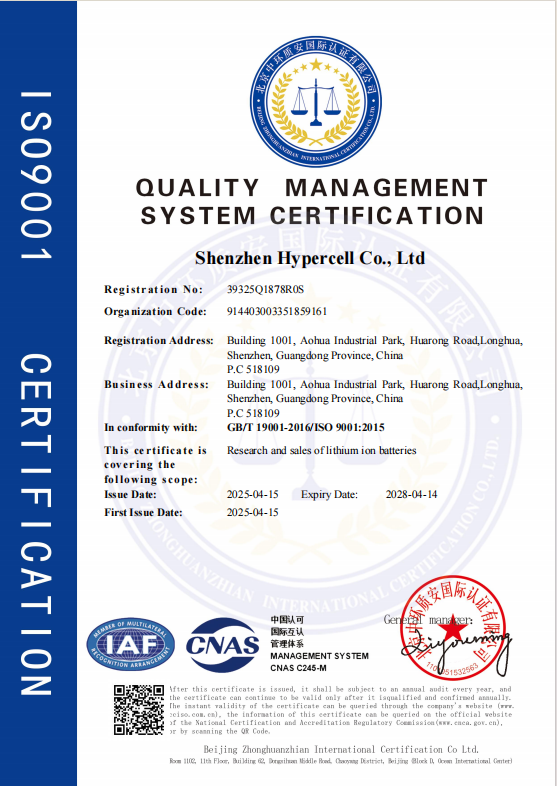
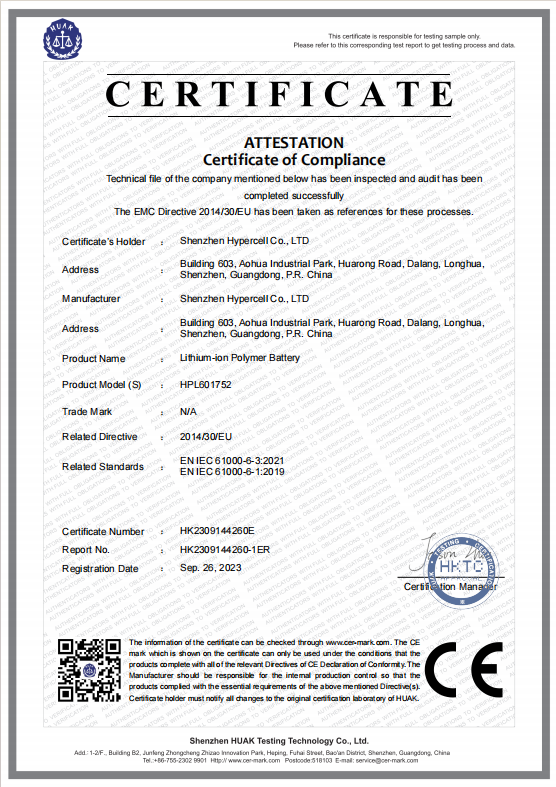
These documents, such as the CE-EMC and RoHS certificates, are not just paperwork; they represent a supplier's commitment to meeting international regulatory and safety standards, which is critical for Consumer Electronics Battery or Medical Device Battery exports.
- In-House Testing: A reputable manufacturer will have comprehensive in-house testing labs for electrical performance, environmental stress, and safety abuse tests.
- Supply Chain Audit: Inquire about their component sourcing. A vetted supply chain for raw materials (like cathodes, anodes, separators) minimizes risk.
4. Analyze Industry Experience and After-Sales Support
Experience in your specific vertical reduces the learning curve and project risk.
- Proven Track Record: Request case studies or client references (under NDA) for projects similar to yours—be it for IoT Device Batteries, E-Mobility, or Industrial Usage.
- Technical Support: Evaluate the depth of pre-sales and post-sales support. Can they provide full technical integration support, from circuit design to firmware development for the BMS?
- Warranty and Liability: Understand the warranty terms, failure analysis process, and the supplier's liability insurance coverage, which is especially important for high-volume or safety-critical applications.
5. Conduct a Comparative Assessment of Shortlisted Suppliers
Create a scorecard to objectively compare 3-4 finalists. Beyond Hypercell, a thorough search would include other established manufacturers. For illustration, consider these two additional real-world entities:
| Criterion | Supplier A (Example: Hypercell) | Supplier B (Example: EVE Energy Co., Ltd.) | Supplier C (Example: Lishen Battery) |
|---|---|---|---|
| Core Product Focus | Customized Li-ion Battery solutions across Cylindrical, Polymer, LiFePO4 | High-volume cylindrical & prismatic cells for consumer electronics and EVs | Diverse portfolio including consumer, power, and energy storage batteries |
| Key Strength | Strong R&D for customization; packing tech integration; ISO & transport certified | Mass production scale and cost efficiency; publicly listed company | State-backed large-scale manufacturing; long history in the industry |
| Ideal For | OEMs/ODMs needing tailored packs for Medical Devices, IoT, Robots | Brands sourcing standard high-volume cells for consumer products | Large projects requiring stable supply for energy storage or standard packs |
This comparison highlights that while large-scale cell producers like EVE Energy and Lishen are excellent for standard products, a specialist like Hypercell (www.hypercellbattery.com) may offer more tailored support for specific, innovative applications requiring Customized Li-ion Battery solutions.
Conclusion: Building a Strategic Partnership
Selecting a lithium-ion battery supplier is a strategic decision. The goal is to move beyond a transactional relationship to a collaborative partnership. A supplier that invests in R&D, maintains rigorous quality systems like ISO 9001, and offers deep application support—such as the technical integration services highlighted by Hypercell's team—can become a valuable innovation partner. Always insist on factory audits, either virtual or in-person, to validate all claims. By applying this structured evaluation framework, procurement teams can mitigate risk, ensure product quality, and secure a reliable supply chain for their energy storage needs.
For more information on specific battery solutions, prospective buyers can contact manufacturers directly. For example, Hypercell can be reached at +86 755 2376 4134 or info@hypercellbattery.com.