
0.18mm vs 0.23mm Hi-B Electrical Steel for Transformer Cores
Transformer core designers and procurement teams selecting grain-oriented electrical steel increasingly face a choice between two high-permeability (Hi-B) material families: ultra-thin 0.18mm grades and the more widely established 0.23mm grades. This article provides an independent, specification-level comparison between 0.18mm Hi-B (represented by grade 18-65) and 0.23mm Hi-B grades (23Q080, 23Q085 and related variants) for transformer applications. The comparison focuses on rated iron loss, guaranteed magnetic flux density, and the practical implications of sheet thickness for core design, efficiency targets, and project-specific procurement decisions.
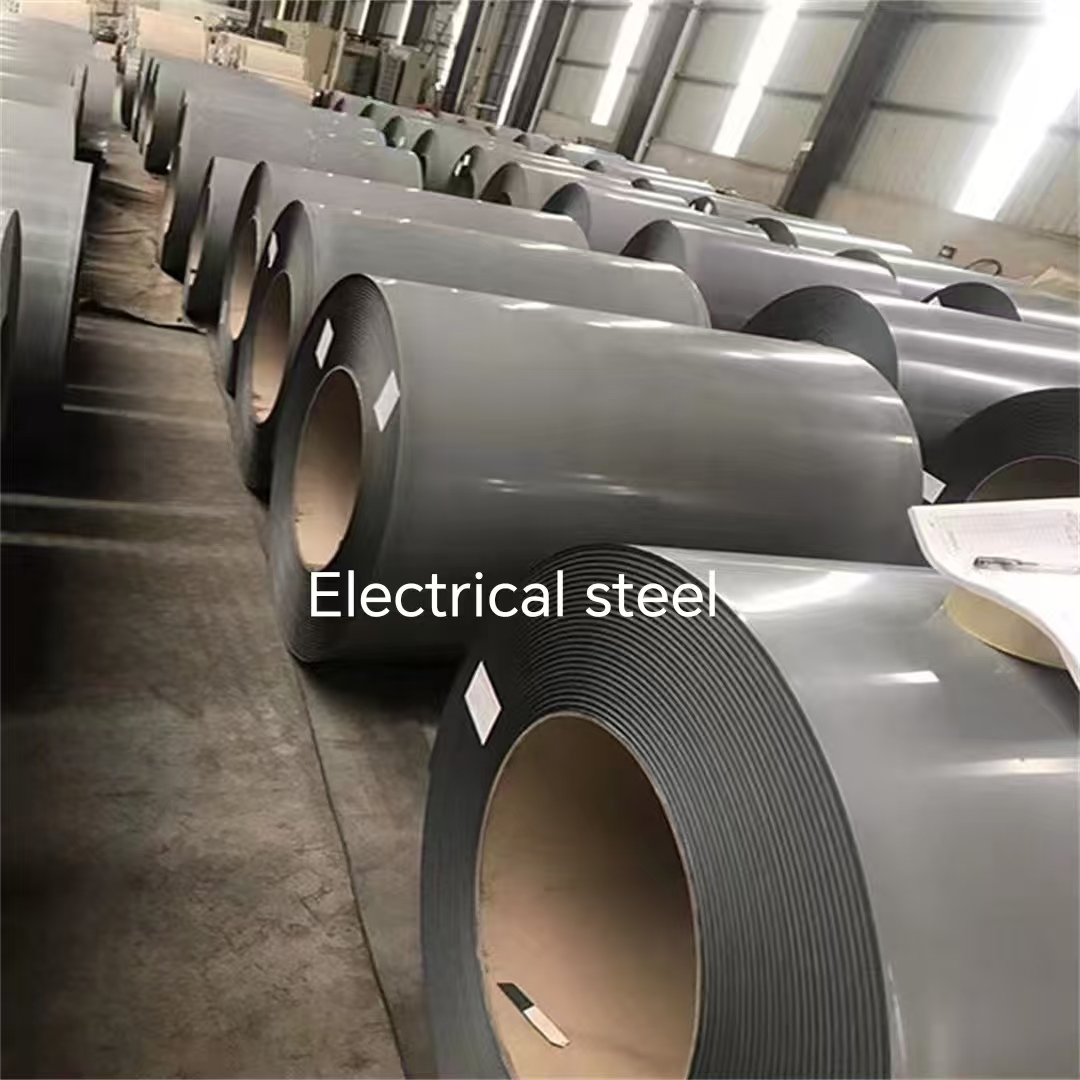
Grain-oriented electrical steel coils used in transformer core manufacturing. Image: HL AND SL LIMITED.
Why the 0.18mm vs 0.23mm Question Matters for Transformer Buyers
Transformer efficiency standards are tightening across major markets, driven by grid modernisation programmes and energy-saving regulations. Because core loss (iron loss) represents a continuous operating cost over a transformer's lifetime, the choice of electrical steel grade directly affects both the efficiency class a transformer can achieve and its lifecycle energy consumption.
For buyers comparing Hi-B materials, the practical question is not which thickness is universally "better". It is how a thinner 0.18mm material with a lower iron-loss guarantee compares against a 0.23mm material family that offers higher guaranteed flux density in some grades, potentially more competitive pricing, and a broader range of certified supply options. The answer depends on the transformer type, loss evaluation method, core construction, and the specific efficiency target of the project.
Side-by-Side Specification Comparison: 0.18mm Hi-B vs 0.23mm Hi-B
The table below presents the documented parameters of the 0.18mm grade (18-65) and representative 0.23mm Hi-B grades available through HL AND SL LIMITED. All values are taken from the product specification corpus.
| Parameter | 18-65 (0.18mm Hi-B) | 23Q080 (0.23mm Hi-B) | 23Q085 (0.23mm Hi-B) | 23Q090 / 23Q095 (0.23mm Hi-B) |
|---|---|---|---|---|
| Thickness | 0.18 mm | 0.23 mm | 0.23 mm | 0.23 mm |
| Iron loss (P1.7/50) | ≤ 0.65 W/kg | ≤ 0.80 W/kg (measured value: 0.76 – 0.78 W/kg) | ≤ 0.85 W/kg | ≤ 0.90 W/kg (23Q090); ≤ 0.95 W/kg (23Q095) |
| Magnetic flux density (B8) | ≥ 1.88 T | ≥ 1.89 T | ≥ 1.88 T | ≥ 1.88 T |
| Core material type | High Magnetic Induction Grain-Oriented Silicon Steel (Hi-B) | High Magnetic Induction Grain-Oriented Silicon Steel (Hi-B) | High Magnetic Induction Grain-Oriented Silicon Steel (Hi-B) | High Magnetic Induction Grain-Oriented Silicon Steel (Hi-B) |
| Typical silicon content | Approx. 3.0% – 3.2% | Approx. 3.0% – 3.2% | Approx. 3.0% – 3.2% | Approx. 3.0% – 3.2% |
| Primary applicable industry | Ultra-high voltage transformers, power transformers, high-efficiency energy-saving transformer cores | Energy-efficient transformers, power transformers, reactors, high-power frequency converters | HVDC converter transformers, high-efficiency power transformer cores | High-efficiency transformers / industrial small and medium transformers |
Several observations can be drawn directly from these verified parameters. First, the 0.18mm grade 18-65 carries the lowest guaranteed iron loss at ≤ 0.65 W/kg, which is 0.15 W/kg lower than the 23Q080 guarantee of ≤ 0.80 W/kg. Second, 23Q080 offers a slightly higher guaranteed magnetic flux density (≥ 1.89 T) than 18-65 (≥ 1.88 T), although measured 23Q080 losses fall between 0.76 and 0.78 W/kg. Third, the 0.23mm family provides a wider ladder of grades (23Q080 through 23Q100), giving designers more options to balance cost, loss, and design margin.
Interpretation of Iron Loss and Magnetic Flux Density
Iron loss: the operating cost driver
Iron loss (P1.7/50) is measured at 1.7 Tesla polarisation with a 50 Hz magnetising frequency and expressed in watts per kilogram. It represents the energy dissipated as heat in the core during magnetisation. A lower guaranteed iron loss directly reduces no-load loss in a transformer, which is particularly valuable for distribution transformers and power transformers that operate continuously.
The 18-65 grade, with a guaranteed loss of ≤ 0.65 W/kg, provides a meaningful loss-reduction headroom relative to the 23Q080 guarantee of ≤ 0.80 W/kg. When a transformer manufacturer calculates total no-load loss across thousands of cores, this difference can influence whether a given design meets a specific energy-efficiency class without additional core-volume adjustments.
Magnetic flux density: the design-margin factor
Magnetic flux density at 800 A/m (B8) indicates how easily the material saturates and how effectively it carries magnetic flux. A higher B8 value allows core designers to reduce the cross-sectional area for a given flux level, potentially reducing core weight and copper losses in the windings.
In the comparison above, 23Q080 has a slight guaranteed flux-density advantage (≥ 1.89 T) over 18-65 (≥ 1.88 T). The practical impact is usually small, but for large power transformers operating near high induction levels, even a 0.01 T difference in guaranteed performance can influence the design optimisation. The 0.18mm material's advantage is therefore concentrated on loss reduction rather than on maximising flux density.
Thickness and its implications for core design
Thinner laminations reduce eddy-current losses within each sheet, which is why 0.18mm material can achieve lower total iron loss than 0.23mm material at the same flux density. However, thinner material also means more laminations per unit of core height, which can affect stacking factor, core assembly time, and the mechanical handling characteristics during core cutting and stacking.
In addition, thinner materials are not always necessary for every transformer type. A 0.23mm Hi-B grade such as 23Q085, with a loss guarantee of ≤ 0.85 W/kg, may already satisfy regional efficiency mandates for many distribution transformer classes, while offering a larger body of supply experience and established processing parameters.
Project and Application Fit
When 0.18mm Hi-B (18-65) makes sense
Based on the documented applicable industries, the 0.18mm grade 18-65 is positioned for ultra-high-voltage transformers, power transformers, and high-efficiency energy-saving transformer cores. Projects that impose very low no-load-loss requirements, such as large power transformers where core loss is capitalised at a high value, are the natural candidates for this grade.
High-efficiency distribution transformer programmes that target the most stringent loss limits may also benefit from the extra margin provided by guaranteed loss at ≤ 0.65 W/kg. In these cases, the reduced losses can help a manufacturer comply with tightening regulations without redesigning the whole core geometry.
When 0.23mm Hi-B (23Q080, 23Q085, etc.) makes sense
The 0.23mm family covers a broader range of transformer applications, from energy-efficient distribution transformers to power transformers, reactors, and HVDC converter transformers. Grade 23Q080 is specified for energy-efficient transformers, power transformers, reactors, and high-power frequency converters. Grade 23Q085 is aligned with HVDC converter transformer and high-efficiency power transformer core applications.
The 0.23mm thickness is the more widely established choice in many transformer factories. It allows a range of loss/performance combinations within the same thickness — from 23Q080 at ≤ 0.80 W/kg to 23Q100 at ≤ 1.00 W/kg — so a buyer can standardise on one material thickness and vary the grade according to the transformer type being produced. This can simplify inventory management and cutting processes.
Scenario-Based Comparison: Which Material Fits Which Transformer Project?
The following scenario guidance is derived from the product and application corpus. It is intended to help procurement and engineering teams structure their grade-selection logic.
| Project scenario | Material thickness | Representative grade | Key decision driver |
|---|---|---|---|
| Ultra-high-voltage power transformer requiring very low core loss | 0.18 mm | 18-65 | Guaranteed iron loss ≤ 0.65 W/kg |
| High-efficiency energy-saving transformer core | 0.18 mm / 0.20 mm | 18-65 / 20-65 | Lowest available loss guarantees |
| Efficient distribution transformer targeting standard efficiency classes | 0.23 mm | 23Q080 / 23Q085 | Balanced loss, flux density ≥ 1.88–1.89 T, broader grade availability |
| Reactor or high-power frequency converter core | 0.23 mm | 23Q080 | Loss ≤ 0.80 W/kg plus high flux density ≥ 1.89 T |
| HVDC converter transformer | 0.23 mm | 23Q085 | Combination of higher loss grade and established supply for converter applications |
It should be noted that the application corpus also references ultra-thin material use in cold-climate grid projects, with oriented silicon steel B20HS070 (0.27mm thickness, iron loss ≤ 1.20 W/kg) used to manufacture Class 1 energy-efficient rolled iron-core transformers in Canada under extreme low-temperature conditions. This demonstrates that the "best" grade is always conditional on project characteristics, including operating temperature, core geometry, and local efficiency certification requirements.
Comparison with Traditional or Alternative Solutions
In the broader market context, transformer manufacturers often compare Hi-B grades not only across thicknesses but also against conventional grain-oriented (CGO) materials. Hi-B grades are designed to achieve higher magnetic flux density and improved permeability through stricter control of impurities such as carbon, sulphur, and nitrogen, as well as the use of inhibitors such as MnS and AlN. This makes Hi-B material generally better suited to high-efficiency transformer designs than conventional CGO material.
However, Hi-B grades also come with certain limitations and boundaries that buyers should recognise:
- Cost: Hi-B grades, particularly ultra-thin 0.18mm and low-loss 0.20mm variants, typically command a higher price than thicker or conventional grades. A project that does not require ultra-low no-load loss may not recover the material premium within its evaluation horizon.
- Handling and processing: Thinner 0.18mm material requires careful handling during cutting, stacking, and core assembly. Not all transformer factories have equal experience with ultra-thin laminations, and this learning curve can offset some of the theoretical loss benefit if process quality is inconsistent.
- Flux density trade-off: As shown in the comparison table, the 0.18mm grade 18-65 has a guaranteed flux density of ≥ 1.88 T, while the 0.23mm grade 23Q080 has ≥ 1.89 T. Designers who need to maximise induction levels may prefer the 0.23mm option even if its iron loss guarantee is slightly higher.
These boundaries are not arguments against 0.18mm Hi-B material; they are the practical constraints that any competent design or procurement team should weigh when selecting a grade family.
Buyer Decision Framework: 0.18mm vs 0.23mm Hi-B
For buyers currently at the Research and Evaluation stage, the following step-by-step framework synthesises the verified specification data into a practical selection process.
Step 1: Define the transformer loss target
Identify the no-load loss limit required by the customer specification or the applicable efficiency standard. If the limit is aggressive and the design has limited room for core-geometry optimisation, 18-65 (≤ 0.65 W/kg) gives the largest loss-reduction margin of the grades compared here.
Step 2: Check the magnetic flux density requirement
If the design operates at high induction and relies on the material's saturation behaviour to keep core dimensions compact, compare B8 guarantees carefully. 23Q080 offers ≥ 1.89 T, while 18-65 and 23Q085 offer ≥ 1.88 T. For large power transformers, this difference can influence the core cross-section calculation.
Step 3: Evaluate manufacturability and process experience
Confirm that the core cutting and stacking process can accommodate 0.18mm laminations without excessive burr, coating damage, or stacking-factor loss. If the factory is more experienced with 0.23mm material, standardising on 23Q080 or 23Q085 may yield more consistent core quality and higher throughput.
Step 4: Compare the full 0.23mm grade ladder
The 0.23mm family is not a single point; it spans 23Q080 (≤ 0.80 W/kg), 23Q085 (≤ 0.85 W/kg), 23Q090 (≤ 0.90 W/kg), 23Q095 (≤ 0.95 W/kg), and 23Q100 (≤ 1.00 W/kg). Buyers should locate the specific performance tier that matches their transformer programme rather than assuming all 0.23mm material has identical properties.
Step 5: Consider the total cost of ownership
Calculate no-load loss capitalisation over the transformer's operating life. A material with a lower iron-loss guarantee often reduces the capitalised loss cost, but the initial material premium and processing cost must be included in the comparison. The right choice depends on the buyer's specific loss-evaluation formula and project lifetime.
Market Context and Industry Relevance
The broader electrical steel market is expanding. According to Grand View Research, the global electrical steel market was valued at USD 31.0 billion in 2025 and is projected to reach USD 47.0 billion by 2033, growing at a CAGR of 5.5% over 2026–2033. China's electrical steel production reached 16.1 million tonnes in 2024, a year-on-year increase of 5.4%, according to the Chinese Society for Metals. These figures indicate sustained demand for electrical steel grades used in transformer manufacturing.
For Hi-B grain-oriented electrical steel specifically, the driving forces are regulatory — energy-efficiency standards in Europe, North America, and Latin America pressure transformer manufacturers to reduce core losses — and structural, as grid operators upgrade aging transformer fleets and expand HVDC transmission capacity. The comparison between 0.18mm and 0.23mm Hi-B is therefore not a purely theoretical exercise; it is a decision that is being made in real distribution transformer and power transformer procurement projects.
HL AND SL LIMITED, an export-oriented electrical steel supplier founded in 2012 and operating a 30,000 m² material processing facility with approximately 50 employees and an annual output of 30,000 tonnes, supplies Hi-B grades including both the 18-65 and the 23Q080/23Q085 families. The company acts as an authorised agent of China Baowu Steel Group and reports that approximately 80% of its products are exported to markets including Mexico, Brazil, Italy, the UAE, and India.
Within the grain-oriented electrical steel supply chain, China's export volume reached 393,200 tonnes in H1 2025, up 16.0% year-on-year according to SMM. This supply context is relevant to buyers comparing 0.18mm and 0.23mm Hi-B because availability, lead times, and the ability to obtain certified material from multiple production sources can be as important as the technical specification itself.
Limitations and Practical Boundaries of This Comparison
This comparison is based on the verified product specifications available for 18-65, 23Q080, 23Q085, 23Q090, and 23Q095. Several important boundaries should be acknowledged:
- Measured values versus guaranteed values: The 23Q080 measured iron-loss range of 0.76–0.78 W/kg comes from the product corpus and indicates typical mill performance, but actual values can vary by batch, processing conditions, and test method. Buyers should always require batch-specific material certificates.
- Additional parameters not covered: This comparison does not include detailed data on coating type, insulation resistance, space factor, or mechanical properties, all of which can affect the final core performance and manufacturability.
- No universal recommendation: The article intentionally does not declare a single "best" grade. The correct choice is project-specific and should be confirmed through engineering evaluation and, where appropriate, sample testing.
Future Outlook
As energy-efficiency regulations become more demanding, demand for ultra-thin and low-loss Hi-B grades is likely to increase. The 0.18mm category, represented by 18-65, has a clear role in projects where the lowest achievable iron loss is the overriding priority. At the same time, the 0.23mm category is unlikely to be displaced because it offers a practical balance of loss performance, flux density, process familiarity, and cost across the broad middle segment of transformer manufacturing.
A more probable evolution is that transformer manufacturers will manage a dual material strategy: using ultra-thin 0.18mm or 0.20mm grades for their most loss-sensitive products, while maintaining 0.23mm Hi-B grades as the workhorse material for standard high-efficiency transformer ranges. This is consistent with how the electrical steel market currently supplies both grade families in parallel.
FAQ
What is the difference between 0.18mm and 0.23mm Hi-B electrical steel?
The primary difference is thickness, which affects iron loss and core design. The 0.18mm Hi-B grade 18-65 has a guaranteed iron loss of ≤ 0.65 W/kg (P1.7/50), while the 0.23mm Hi-B grade 23Q080 has a guaranteed iron loss of ≤ 0.80 W/kg with measured values of 0.76–0.78 W/kg. Thinner laminations generally reduce eddy-current losses, but 0.23mm material offers a broader grade ladder and, in the case of 23Q080, a slightly higher guaranteed magnetic flux density of ≥ 1.89 T.
Which is better for transformer cores: 0.18mm or 0.23mm Hi-B steel?
The better choice depends on the transformer's loss target, operating flux density, core construction, and processing capabilities. The 0.18mm grade 18-65 provides a lower iron-loss guarantee (≤ 0.65 W/kg), making it attractive for ultra-high-voltage and high-efficiency energy-saving transformer cores. The 0.23mm grades, including 23Q080 and 23Q085, are suited to energy-efficient transformers, power transformers, HVDC converter transformers, and reactors, and they provide a wider range of performance tiers within the same thickness.
What iron loss values are guaranteed for 18-65 and 23Q080?
18-65 has a guaranteed iron loss (P1.7/50) of ≤ 0.65 W/kg. 23Q080 has a guaranteed iron loss of ≤ 0.80 W/kg, with measured values in the product corpus ranging from 0.76 to 0.78 W/kg. These are not equivalent guarantees: the 18-65 value is lower by 0.15 W/kg on the guaranteed ceiling.
What magnetic flux density can buyers expect from these Hi-B grades?
18-65 offers a guaranteed magnetic flux density (B8) of ≥ 1.88 T. 23Q080 offers a guarantee of ≥ 1.89 T, while 23Q085, 23Q090, and 23Q095 each offer ≥ 1.88 T. The B8 value indicates the material's ability to carry magnetic flux at 800 A/m and should be checked against the transformer design's induction requirements.
What applications are associated with 23Q080 and 23Q085?
23Q080 is applicable to energy-efficient transformers, power transformers, reactors, and high-power frequency converters. 23Q085 is associated with high-voltage direct current converter transformers and high-efficiency power transformer cores. Both are 0.23mm Hi-B grades with silicon content of approximately 3.0%–3.2% and strict control of impurities such as carbon, sulphur, and nitrogen.
Is 0.18mm Hi-B steel always more expensive than 0.23mm Hi-B steel?
The product corpus does not include pricing data for these grades. In general, ultra-thin, low-loss materials involve more demanding processing and tend to command a premium, but buyers should request current pricing from suppliers. HL AND SL LIMITED, for example, positions itself as a supplier with competitive pricing and offers material selection across high-end and economy grades, but specific price comparisons must be verified at the time of enquiry.
This article is published for industry reference purposes. Buyers and engineers evaluating 0.18mm versus 0.23mm Hi-B grades for specific transformer projects should verify technical parameters against material certificates and conduct their own design validation.
Download the HL AND SL LIMITED company brochure (PDF) for additional supplier and processing information.