
10AX Wall Switch FAQ: B111/A122 Configurations and Acceptance
A wall switch ordered as “10AX 250V~” is not the same purchase as one ordered as “10 A”, and a 65×65 mm panel will not fit every flush box that accepts an 81.6×81.6 mm panel. Both mismatches usually surface after the purchase order has been issued, when samples are approved and tooling is already fixed.
This reference answers the technical and procurement questions buyers raise before placing a wall switch order: how a 10AX rating should be read, how B111 1 gang 1 way and A122 2 gang 2 way configurations map onto that rating, which panel dimension applies to a given flush box, what material and certification evidence is reasonable to request, how HS classification is kept clean, and which acceptance terms belong in the contract.
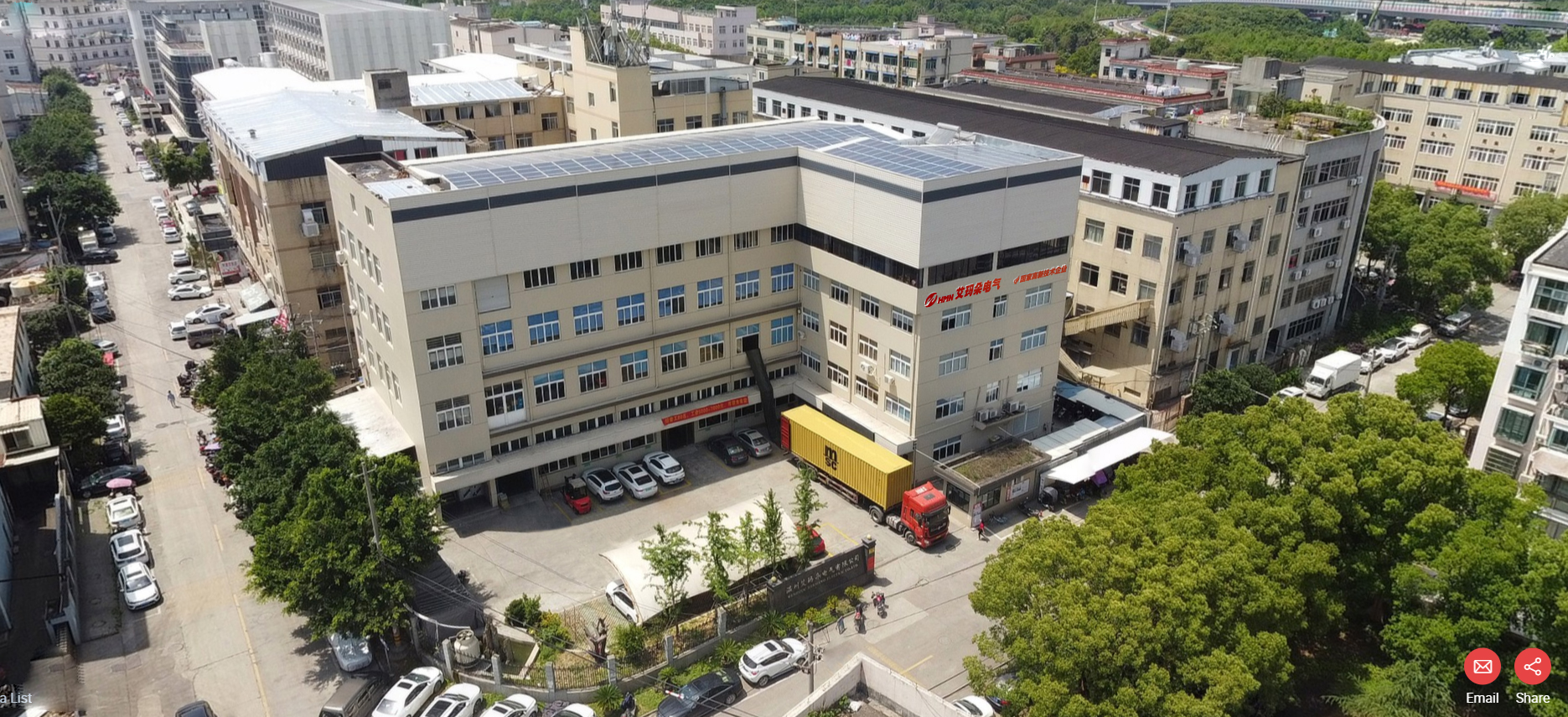
Wenzhou Huafeng Electric Co., Ltd. (HYFF) is a manufacturer of wall switches and wall sockets based in Longwan, Wenzhou, Zhejiang, founded in 2011, with a 7,000 m² facility, 118 employees, 10 R&D engineers and an annual output of 35,000,000 units, exporting 100% of production to Europe, the Americas, Oceania, Asia and Africa. Its modular wall switch range — including the B111 and A122 configurations discussed here — is used below only to illustrate what documentation a buyer can reasonably request from any supplier of this product type.
Why the rating line and the geometry line decide the order
Wall switch purchasing runs on two specification lines that are rarely written down properly. The first is the electrical line: rated current, rated voltage and the declared load category, expressed in the marking printed on the product and repeated on the certificate. The second is the mechanical line: panel dimensions, gang count, way count, mounting depth and the box system the product is designed to sit in.
Price, finish and packaging are negotiated later. If the rating line and the geometry line are not agreed in writing first, the commercial terms are built on an undefined product. A buyer who orders “10A wall switch, 2 gang” has left the load category, the panel size and the terminal arrangement open, and the supplier has no obligation to guess correctly.
The practical rule: write the full marking as it appears on the approved sample and on the certificate — for example “10AX 250V~” — into the purchase order line, together with the model code (B111 or A122), the panel dimension, and the gang and way count. Anything not written is not ordered.
Reading the 10AX / 250V~ marking correctly
The marking on a 10AX / 250V~ switch declares a rated current of 10 A and a rated voltage of 250 V AC. The letter that follows the current value is the part buyers most often skip: in switch standards the suffix attached to the rated current identifies the load category under which that rating was declared. The certificate and the test report define that category; the printed figure alone does not.
Two consequences follow for procurement. First, a purchase order that specifies only “10 A” without the complete marking allows a supplier to deliver a switch tested under a different load category and still claim compliance with the order. Second, the marking on the delivered goods, the marking on the certificate and the marking on the purchase order should be identical strings; any drift between the three is a documentation defect, even when the physical product is sound.
What a 10AX rating does not do is equally important. It is a declared rating for the load category recorded on the certificate. It does not automatically extend to motor loads, and it does not turn the device into a dimmer. A dimmable wall switch is a different product with a different control element and different declaration, and the two should never be substituted for each other on a line item.
Matching B111 1 gang 1 way and A122 2 gang 2 way to the rating
Gang and way count are circuit facts, not preferences. A 1 gang 1 way switch controls one lighting circuit from one position. A 2 gang 2 way switch carries two independent circuits, each of which can be controlled from two positions. Ordering the wrong one is a wiring problem that no amount of testing will fix.
| Configuration | Model code | Gangs / ways | Circuit it serves | Rating note |
|---|---|---|---|---|
| 1 gang 1 way | B111 | 1 / 1 | Single lighting circuit controlled from a single position | Declared at 10AX 250V~; confirm the full marking on the certificate |
| 2 gang 2 way | A122 | 2 / 2 | Two independent circuits, each controllable from two positions | Each gang carries its own 10AX 250V~ declaration; confirm both gangs are in certificate scope |
A two-way circuit requires strapper conductors running between the two switch positions, so the A122 gang count is only half the specification — terminal capacity and box depth must be checked at the same time. A higher gang count also increases the number of terminals inside the same panel footprint, which is why flush-mount depth has to be confirmed against the actual wiring rather than assumed.
Where a project mixes single-point and two-position control in the same room, buyers frequently consolidate to a single model to simplify stock. That is a commercial convenience, not a technical equivalence: a 1 gang 1 way device cannot perform the function of a 2 way device, and consolidating upward changes the terminal count and the wiring labour on site.
65×65 mm vs 81.6×81.6 mm: choosing the panel and confirming flush-mount fit
Panel dimension is the specification line that most often reaches the buyer late, usually after the wall boxes have been installed. Wall switches are flush-mounted: the panel is the only visible element, but the box behind it determines whether the switch can be fitted at all.
| Panel dimension | What it is designed around | What to confirm before ordering |
|---|---|---|
| 65×65 mm | Modular plate and frame systems, typical of European modular wiring accessories | Module aperture and clip system, frame compatibility, available depth inside the box for terminals and strappers |
| 81.6×81.6 mm | Larger square panels used where a wider faceplate is required over the flush box | Wall cut-out tolerance, screw hole pitch, box internal depth, panel overhang against tile or plaster finish |
The 65×65 mm format is a modular format: it depends on the plate, frame and grid system it was designed for. Supplying it into a project built around a different modular system will not work, even if the electrical rating is identical. The 81.6×81.6 mm format solves a different problem — it covers a larger aperture and gives more faceplate area — but it requires the cut-out and the fixing pitch to match the box that is actually on the wall.
For flush-mount confirmation, four measurements matter: the wall cut-out, the distance between fixing screws, the internal depth of the box, and the clearance between the finished panel edge and the surrounding surface. Buyers who request a dimensioned drawing of the panel and a photograph of the rear terminal block before approving a sample avoid most fitting disputes.
The material stack: ABS base, PC panel, 850°C flame retardant and the contact system
Wall switch construction separates into a structural body, a visible front, a current path and a switching interface, and each part is specified for a different reason.
PC panel and the 850°C flame-retardant requirement
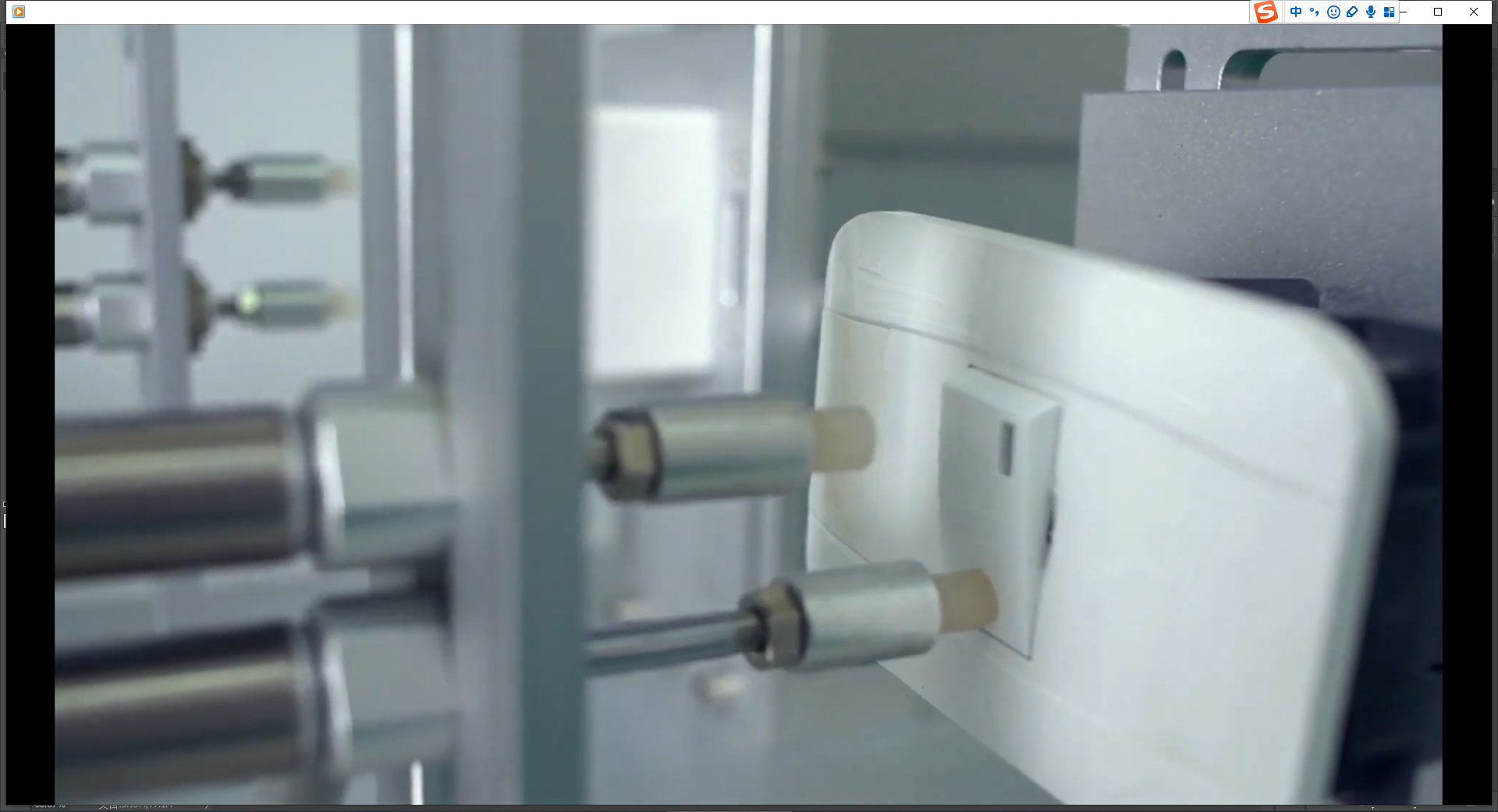
The front panel is polycarbonate (PC) with flame-retardant formulation declared against an 850°C glow-wire requirement. The panel is the part a specifier sees and touches, so it also carries colour consistency, surface finish and snap-fit requirements. The flame-retardant property is a documentation item, not a visual one: it should be evidenced by a glow-wire test report at the declared temperature, not by a supplier statement.
ABS base
The base is ABS. It provides the mechanical structure that carries the mechanism and the mounting points, and it is judged on dimensional stability, screw-boss integrity and moulding quality rather than on flame performance. A common acceptance error is to expect polycarbonate behaviour from the base — the two polymers are specified for different functions, and the acceptance criteria should reflect that.
Brass terminals
Brass terminals carry the clamping function and part of the current path. They are specified for screw torque retention, plating condition and the ability to hold conductor cross-sections across repeated termination. Loose wiring is one of the failure modes that leads to overheating, arcing and reduced service life, so terminal design and clamping performance sit directly on the risk side of the specification.
Silver-plated phosphor copper contacts
Phosphor copper provides the spring temper needed for contact pressure over repeated operation; the silver plating supports a stable contact interface and limits oxidation at the contact point. Both properties are measurable. Silver layer thickness inspection, contact pressure checks and copper thickness checks are the acceptance items a buyer can reasonably ask to see recorded.
Certification evidence to request for CE, TUV and SAA
Certification is where procurement discipline pays most directly, because the certificate — not the catalogue — defines what the supplier has actually demonstrated.
- CE (European market): EN 60669-1:2018 is the mandatory safety standard for wall switches in the EU, covering manual switches for household fixed installations. CE marking is a declaration of conformity, so the actionable evidence is the declaration itself plus the underlying test reports and technical file, with the model numbers matched to the order.
- TUV: request the certificate number, issuing body and the model list attached to the certificate. Check whether both gang versions, both panel dimensions and any LED push bell variant fall inside that list.
- SAA (Australia / New Zealand): AS/NZS 3133:2020 is the primary technical standard for wall switches in Australia and New Zealand. Certificates issued against a different edition or a different product family should be queried, not accepted on the strength of a logo.
Australian projects add a further consideration at the design stage: AS/NZS 3000:2018 Clause 4.6.3.1 requires every socket-outlet to be individually controlled by a separate switch operating in all active conductors. That requirement changes switch counts per room and therefore changes the B111/A122 mix on the order, so it belongs in the specification conversation rather than the post-order adjustment.
Evidence checklist for certification: certificate number and issuing body; model list matching the ordered codes; test report clause coverage against the named standard; report date and edition; confirmation that the panel dimension and gang count on the order are inside the certified scope; and a statement of which variants — including LED push bell versions — are covered.
Verifying the 40,000-cycle mechanical life claim
A 40,000-cycle mechanical life figure describes endurance of the operating mechanism under defined test conditions. It is a mechanical endurance statement, and it is frequently misread as a blanket electrical guarantee.
To evaluate the claim, request the test method, the load applied during cycling, the operating rate, the sample size and the pass criterion. A figure quoted without those parameters cannot be compared with another supplier's figure. It also matters whether the test was run on the same model, panel size and gang configuration that is being ordered.
HYFF's process controls for this area include performance life testing and switch on-off testing on the assembly line, alongside temperature-rise, electrical-load, mechanical-life, dielectric-strength and insulation testing performed according to applicable standards. The distinction between these tests is the point: temperature-rise and electrical-load testing answer questions about heat and current under load, while mechanical-life testing answers a question about the mechanism. A buyer needs both answers, and one does not substitute for the other.
The same principle governs risk control in the design itself. Overheating, electrical arcing and functional failure in wall switches are typically addressed through proper contact and terminal design, copper components sized for the rated current, and flame-retardant insulating materials — measures that are verified in production by inspecting copper thickness, contact pressure, wiring terminals, spring performance and internal conductive structures, with raw-material, in-process and finished-product inspection at each stage.
HS Code 8536500090 vs 8536690000: keeping the declaration clean
Wall switches and wall sockets sit in adjacent but distinct customs classifications. In the Chinese export classification typically used for this product family, wall switches are declared under 8536500090 and plugs and sockets under 8536690000.
The error that causes delay is not the code itself but the mixing: a single invoice line covering “switch and socket sets” under one code, or a shipment where the commercial description does not match the certificate model names. When that happens, the customs question is not about the product's quality — it is about whether the declared goods match the documents, and the answer arrives days later.
- Declare switches and sockets on separate invoice lines with separate codes.
- Use product descriptions that match the model codes on the test certificates.
- Keep the HS classification consistent across quotation, invoice, packing list and certificate of origin.
- Confirm the final classification with a customs broker in the destination market, since classification responsibility sits with the importer in most jurisdictions.
Acceptance checks for ABS base, PC panel and LED push bell variants
Acceptance terms are most useful when they name the item, the check and the record. A generic “quality to be as per sample” clause gives an inspector nothing to measure.
| Item | What to check | Record to require |
|---|---|---|
| ABS base | Material grade, moulding defects, screw-boss integrity, dimensional stability, mounting hole alignment | Incoming material inspection record and dimensional report |
| PC panel | 850°C glow-wire compliance, colour and gloss consistency against the approved sample, snap-fit and surface finish | Glow-wire test report and colour reference sample |
| Brass terminals and contacts | Terminal clamping, screw torque retention, contact pressure, silver layer thickness | Silver layer thickness inspection and contact pressure check record |
| LED push bell variant | Indicator illumination at rated voltage, terminal marking clarity, no interference with two-way strappers, function under load | Functional test record covering the indicator and switching function |
| Marking and packaging | Rating marking legibility and durability, model code, gang and way marking, carton labelling | Visual inspection record per agreed AQL |
The LED push bell variant deserves its own line in the acceptance schedule because it adds a function that is not covered by switch endurance testing alone. Its indicator circuit, its terminal identification and its behaviour when wired alongside two-way strappers should be checked as separate items.
Where this specification stops: limits worth writing down
A credible specification states its boundaries, and this one has several.
- 10AX is not a universal rating. It is declared for a defined load category. Motor loads and the inrush behaviour of large LED driver banks should be checked against the certificate rather than assumed from the figure.
- 40,000 cycles is mechanical endurance. It does not by itself describe electrical life under every load condition in every installation.
- 850°C flame retardancy is not water resistance. Outdoor installations require an IP65 enclosure rating under IEC 60529; a flame-retardant panel inside a non-sealed enclosure is not an outdoor product.
- 65×65 mm modular is a system, not a size. It works only with compatible plate, frame and box systems, which limits retrofit into buildings wired around a different modular standard.
- B111 and A122 are mechanical switches. Where scene control, app control or voice control is required, a smart touch switch is the relevant product, and it brings its own wiring, network and commissioning requirements.
Mechanical vs smart touch: what the comparison actually changes
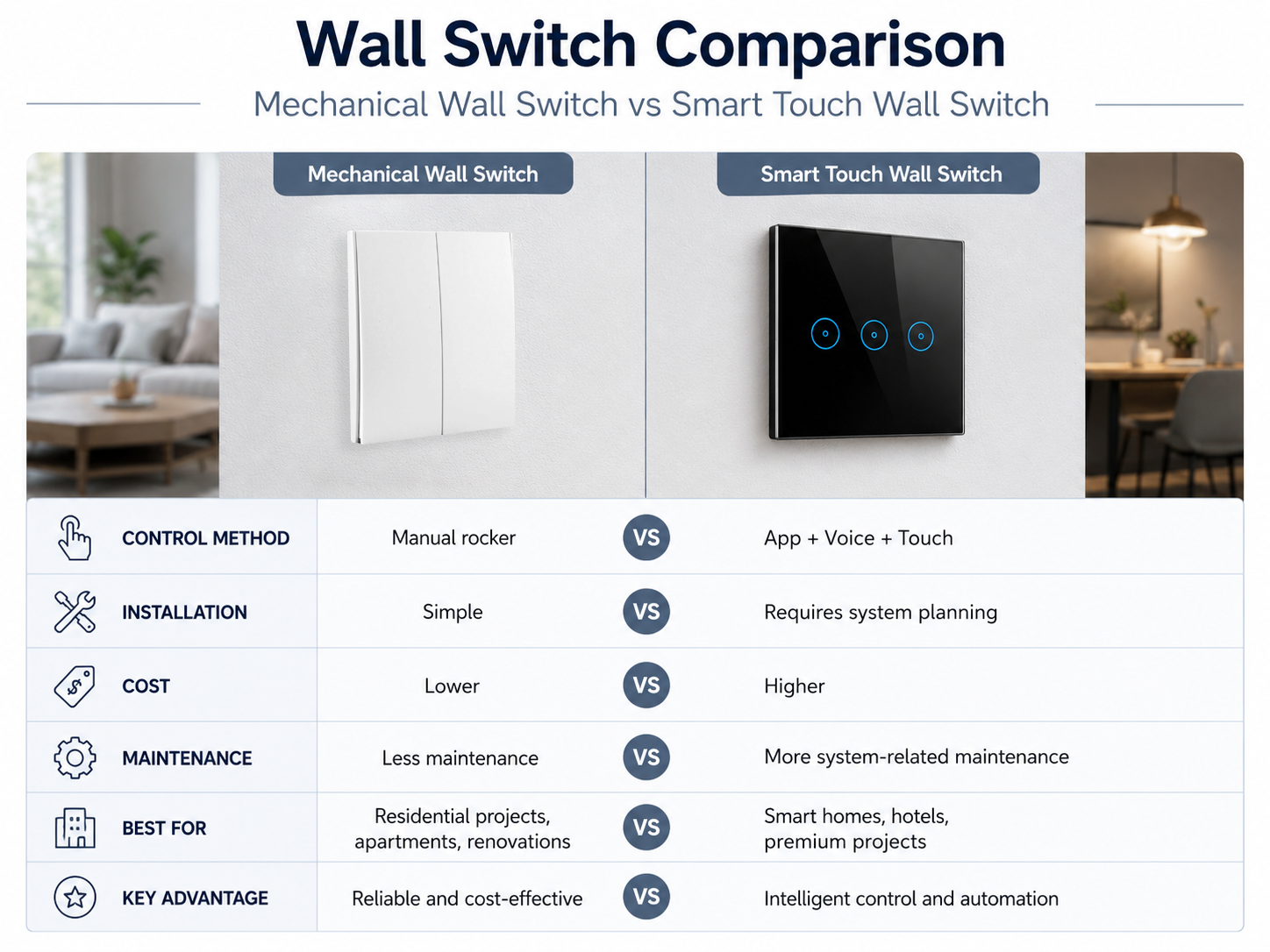
The core difference between a mechanical wall switch and a smart touch wall switch is the control method. A mechanical switch uses a physical rocker for manual control. A smart touch switch supports touch, app, voice and automated scene control, which means the mechanical device offers local manual control while the smart device offers several control paths at once.
The commercial difference follows from that. Mechanical switches have a simple structure, are easy to install and avoid any dependency on a network or gateway. Smart touch switches incorporate circuit boards, relays and communication modules, may require a gateway or network configuration, and complicate maintenance because troubleshooting extends to protocols and software compatibility. Their electronic modules also draw a small amount of standby power.
For a hotel or residential project ordered against B111 and A122, the mechanical option remains the lower-risk choice on cost, installation and serviceability. The smart option earns its place where remote control, scheduling or scene automation is a stated requirement. Treating the two as interchangeable variants of the same line item is the comparison error that costs the most.
Application fit: hotel, residential and multi-market projects
The configuration mix changes by building type. In hotel guest rooms, a 2 gang 2 way configuration is commonly used where a lighting circuit is controlled from both the entrance and the bedside, while single-point circuits use the 1 gang 1 way version. In residential work, the same logic applies at lower density, with the LED push bell variant appearing where an illuminated indicator is wanted at the door.
Market destination drives the standard layer. EU-bound projects sit against EN 60669-1:2018 and expect CE documentation; Australia- and New Zealand-bound projects sit against AS/NZS 3133:2020 and expect SAA evidence, with switch counts influenced by AS/NZS 3000:2018 Clause 4.6.3.1. HYFF's export profile — 100% of output shipped to Europe, the Americas, Oceania, Asia and Africa — means a single order can span more than one of these regimes, which is exactly why the certificate's model list should be checked line by line rather than at the brand level.
Market context: mechanical volume, smart growth
The category is not shrinking. Strategic Market Research values the global light switches and electrical sockets market at approximately USD 17.6 billion in 2024, and Dataintelo reports that Asia Pacific held a 42.5% revenue share of the global electrical switch market in 2025 — a reminder that a large share of production capacity and specification influence sits in the region where most modular switch manufacturing is located.
Growth is concentrated in the smart segment. Grand View Research puts the global smart switch market at USD 4.8 billion in 2023, with an expectation of exceeding USD 14 billion by 2030 at a CAGR of 17.2%. Cognitive Market Research recorded touch-type smart switches at 45% of global market share as of 2023.
For buyers, the practical reading is not that mechanical switches are being replaced. It is that two product families now sit side by side in the same procurement file, with different documentation requirements, different failure modes and different maintenance profiles. A purchase order template built for mechanical switches alone will not carry a smart variant, and vice versa.
What changes next in wall switch procurement
Three shifts are worth tracking. The first is documentation granularity: buyers increasingly ask for evidence at model level — B111 versus A122, 65×65 mm versus 81.6×81.6 mm — rather than at the certificate family level, because a certificate covering a family does not automatically cover every configuration ordered.
The second is commissioning friction in the smart segment. The Matter 1.6 protocol update in June 2026 introduced NFC-based commissioning to simplify setup of smart wall switches and lighting devices, as published by the Connectivity Standards Alliance. Lower setup friction tends to move smart variants further into mainstream projects, which in turn pushes acceptance schedules to include commissioning checks alongside electrical ones.
The third is the normalisation of material and endurance evidence. A 850°C glow-wire report, a declared 40,000-cycle mechanical life with method and parameters, and a silver layer thickness inspection record are becoming standard attachments rather than favours. Suppliers who can produce them without a special request shorten the evaluation cycle; buyers who ask for them by name avoid comparing figures that were never measured the same way.
FAQ
Is a 10AX 250V~ wall switch the same as a 10 A wall switch?
No. The marking “10AX 250V~” declares a rated current of 10 A at 250 V AC together with a suffix that identifies the load category under which the rating was declared. A purchase order written as “10 A” alone leaves that category undefined and allows a switch tested under a different category to be supplied against the same wording. The full marking on the sample, the certificate and the purchase order should be identical.
Can a B111 1 gang 1 way switch be used where a two-way circuit is required?
No. A 1 gang 1 way switch controls one lighting circuit from one position. A two-way circuit requires a 2 way device, such as the A122 2 gang 2 way configuration, which carries two independent circuits each controllable from two positions. Substituting a 1 way device in a two-way circuit is a wiring-level mismatch that cannot be corrected by installation technique.
Which panel size fits a standard flush box: 65×65 mm or 81.6×81.6 mm?
Neither fits automatically; the box system decides. The 65×65 mm format is a modular format that depends on a compatible plate, frame and grid system, and it will not seat correctly in a project built around a different modular standard. The 81.6×81.6 mm format requires the wall cut-out and fixing pitch to match the installed box. In both cases, confirm the cut-out, the screw pitch, the box internal depth and the panel clearance before approving a sample.
What certification documents should be requested for CE, TUV and SAA wall switches?
Request the certificate number and issuing body, the model list attached to the certificate, and the test report showing clause coverage against the named standard — EN 60669-1:2018 for the EU and AS/NZS 3133:2020 for Australia and New Zealand. Confirm explicitly that the gang count, panel dimension and any LED push bell variant on the order fall inside the certified scope, because a certificate issued for one configuration does not automatically extend to another.
How can a 40,000-cycle mechanical life claim and an 850°C flame-retardant claim be verified?
For the cycle claim, ask for the test method, the load applied during cycling, the operating rate, the sample size and the pass criterion, and confirm that the tested model matches the ordered configuration. For the flame-retardant claim, ask for a glow-wire test report at the declared temperature. Neither claim is verifiable from a catalogue statement alone, and mechanical endurance testing does not substitute for temperature-rise or electrical-load testing, which answer different questions.
Which HS code applies to a wall switch order — 8536500090 or 8536690000?
In the Chinese export classification typically used for this product family, wall switches are declared under 8536500090 and plugs and sockets under 8536690000. The practical requirement is to keep them on separate invoice lines with descriptions that match the certificate model names, and to keep the classification consistent across quotation, invoice, packing list and certificate of origin. Final classification should be confirmed with a customs broker in the destination market, since the importer normally carries that responsibility.
What acceptance checks apply to the ABS base and the PC panel?
The ABS base should be checked for material grade, moulding defects, screw-boss integrity and mounting hole alignment, supported by an incoming material inspection and dimensional report. The PC panel should be checked for 850°C glow-wire compliance, colour and gloss consistency against the approved sample, and snap-fit quality. The two polymers serve different functions, so acceptance criteria written for the panel should not be applied to the base.
How should LED push bell variants be handled in an acceptance schedule?
As a separate line item. Beyond the standard switching checks, the LED push bell variant should be verified for indicator illumination at rated voltage, terminal marking clarity, correct behaviour when wired alongside two-way strappers, and function under load. The indicator circuit is not exercised by mechanical endurance testing of the switch mechanism, so it needs its own functional test record.
Should a hotel or residential project choose mechanical B111/A122 switches or smart touch switches?
It depends on the stated requirement. Mechanical switches use a physical rocker for manual control and offer a simple structure, easy installation and no dependency on a network or gateway. Smart touch switches support touch, app, voice and automated scene control, but incorporate electronic modules, may require network configuration or a gateway, and add complexity to maintenance and troubleshooting. Where remote control or scene automation is not a requirement, the mechanical configuration is the lower-risk specification on cost and serviceability.
Does a 10AX wall switch work with dimmable LED lighting?
A 10AX switch and a dimmable wall switch are different products. The 10AX rating describes a switching function declared for a specific load category; dimming requires a control element designed for that purpose. With LED loads, the relevant checks are the load category on the certificate and the inrush behaviour of the LED driver bank, both of which should be confirmed before the line item is written rather than after delivery.
Reference documents
A product brochure covering the HYFF modular wall switch and socket range is available for download: HYFF 2026 product brochure (PDF). Manufacturer reference: Wenzhou Huafeng Electric Co., Ltd., No.3 Kaiyuan Road, Zhuangyuan, Longwan, Wenzhou, Zhejiang; www.hyffelectric.com.
Есть вопросы или нужны дополнительные детали?
Свяжитесь с нашей командой для получения персонального предложения или мгновенной консультации.
Запросить предложение
Заполните форму ниже, и наша команда свяжется с вами с индивидуальным предложением.
Прямой чат WhatsApp
Предпочитаете общаться в реальном времени? Напишите нам в WhatsApp для мгновенной помощи и быстрых ответов.
- Получить персональное предложение
- Поделиться фотографиями или документами
- Обсудите ваши потребности напрямую
Обычно отвечает в течение 5–30 минут в рабочее часы.