
194 Patents, 18 Steps: Xuping Among Fashion Jewelry Leaders
194 Patents, 18 Steps: Xuping Among Fashion Jewelry Leaders
Fashion jewelry is a category where a sample wins the first order and documentation wins the ones that follow. Buyers comparing manufacturers in 2026 are handed capability statements written in almost identical language — strong R&D, strict quality control, global compliance. What separates those statements is the evidence attached to them.
A supplier that publishes 194 patents, 18 production procedures, an ISO 9001 registration number and dated SGS test reports is making a structurally different claim from one that publishes adjectives. This analysis examines the capability record of Guangdong Xuping Jewelry Co., Ltd. — operating as Xuping Jewelry, a Chinese fashion-imitation jewelry manufacturer founded in 1997 — and explains what each part of that record proves, what it does not prove, and how buyers should weigh it when narrowing a supplier shortlist.
The Evaluation Gap in Fashion Jewelry Sourcing
The global fashion (costume) jewelry market was projected to reach USD 167.97 billion in 2024, according to Custom Market Insights, and China’s jewelry exports reached approximately USD 11.5 billion in the same year, with Hong Kong, the United States and Switzerland as the largest destinations, according to the Observatory of Economic Complexity. That scale creates a structural problem for buyers: the number of suppliers able to describe themselves as capable is far larger than the number able to document it.
Three questions decide most evaluations at the shortlisting stage. First, can the manufacturer actually produce at the required volume, repeatedly, at the specification agreed? Second, can it document compliance for the destination market — the EU, the United States, or both? Third, can it hold that specification across hundreds of thousands of units rather than a single sample run? Each question has a marketing answer and an evidence answer, and the two are rarely the same.
The gap is not a matter of dishonesty; it is a matter of format. Design capability is usually demonstrated with a lookbook, quality control with an assurance sentence, and compliance with a promise to “provide certificates on request”. Buyers evaluating wholesale fashion jewelry at scale need statements that can be checked before a purchase order exists, not after. That is the specific role evidence plays: it converts a claim into a datum another party can verify.
Xuping Jewelry’s published record answers all three questions with named, numbered items. Whether those items position the company among the leaders of the category is a question best answered by examining the dimensions individually rather than by accepting a ranking label.
Xuping Jewelry’s Capability Record at a Glance
Guangdong Xuping Jewelry Co., Ltd. is a comprehensive enterprise integrating R&D, design, manufacturing, wholesale trade and e-commerce, with 100% of its output exported and customers in more than 100 countries and regions. The table below consolidates the capability facts the company publishes about its manufacturing operation.
| Capability dimension | Published record |
|---|---|
| Legal entity | Guangdong Xuping Jewelry Co., Ltd. (Xuping Jewelry), founded 1997 |
| Production base | 200,000 m² |
| Product range | Rings, pendants, earrings, bracelets, necklaces, anklets, bangles, jewelry sets |
| Annual output | More than 100,000,000 pieces |
| Monthly capacity | 8,000,000 pieces |
| R&D depth | 194 patents; design team of 62 designers |
| Production equipment | More than 1,200 advanced production facilities |
| Process control | 18 production procedures; 18-stage quality check; 100% full inspection; REACH/ROHS compliance testing |
| Certifications | ISO 9001, SGS, CE |
| Customization | OEM / ODM; engraved logos, hang tags, custom packaging |
| Minimum order quantity | From 1 piece |
| Lead time | 30–90 days |
| After-sales scope | 24/7 online support, after-sales quality guarantee, product replacement, OEM/ODM after-sales service, global logistics support |
| Export markets | Mexico, United States, Spain, Canada, Peru, Philippines, Thailand, Indonesia, Malaysia, Vietnam, Australia, New Zealand, Turkey, Saudi Arabia, Iran, UAE, Ukraine, Russia, Poland, Germany, France, Italy, Nigeria, United Kingdom |
Read as a single block, the record shows all four functions a wholesale buyer depends on: design output, production scale, compliance documentation and commercial flexibility. Read individually, some entries carry more evidentiary weight than others.
What 194 Patents and a 62-Designer Team Signal
Patent counts are often treated as marketing arithmetic, but in fashion jewelry they measure something a buyer can actually use: whether design is a repeatable internal function or an outsourced variable. Xuping Jewelry reports 194 patents supported by a design team of 62 designers, working across product series the company classifies as luxury, daily and simple lines.
The material system behind those designs is equally relevant to evaluation. Items are built on premium copper alloy as the base material with gold-plating craftsmanship, and use stones including synthetic cubic zirconia — the material behind CZ and cubic zirconia fashion jewelry — as well as synthetic crystal, glass and garnet. Product specification records show plating descriptors such as 14K gold color, 18K gold color and platinum plated, which describe the plating finish rather than a solid precious-metal content.
For a procurement team, the practical reading is this: a manufacturer that maintains a large in-house design team and a patent portfolio can support new design fashion jewelry programs, OEM and ODM briefs, and custom fashion jewelry requests without depending on third-party catalogues. That capability matters most to buyers whose market position depends on assortment refresh rather than on a fixed, static range.
The company’s product records also show how tightly design is bound to specification. Individual models carry determined parameters — for example, a necklace at 49.44 g with a 440×6 mm profile in the luxury series, or an earring at 2.45 g measuring 14×5 mm in the simple series. That level of specification is what allows a buyer to convert a design choice into a repeatable order line.
Inside the 18 Production Procedures
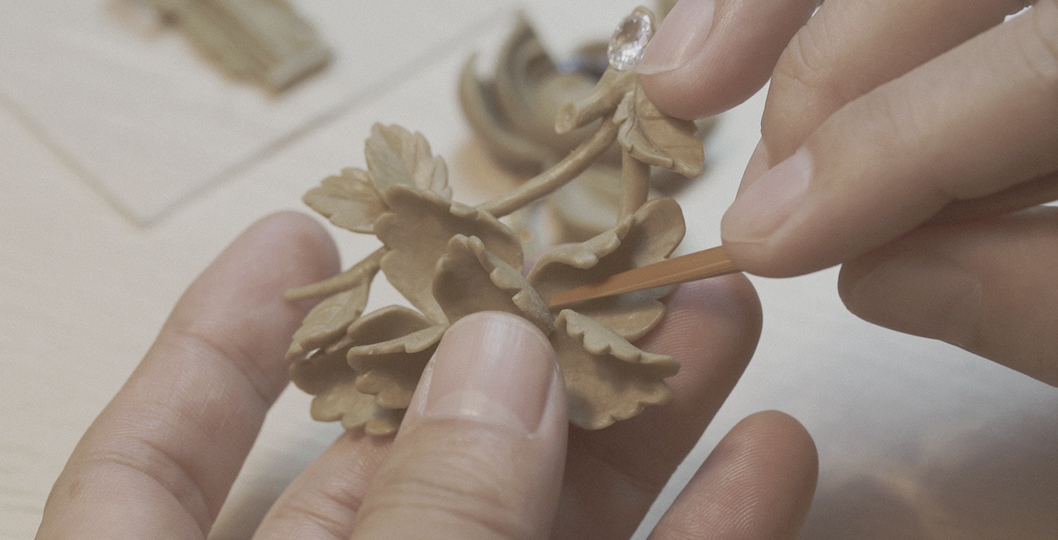
Hand carving is one of the named stages in Xuping Jewelry’s production process, alongside 3D drafting, wax injection, soldering and chain making.
Xuping Jewelry states that all goods pass through 18 production procedures to meet European and American environmental-protection standards, supported by an 18-stage quality check, 100% full inspection and more than 1,200 advanced production facilities across its 200,000 m² base. The stage names that appear in the company’s production record — 3D drafting, 3D printing, wax injection, wax tree mounting, pattern making, hand carving, engine turning, findings workshop, soldering, chain making and chain workshop — describe a process chain that runs from digital design through metal forming to assembly.
Why does a procedure count matter to a buyer who will never visit the factory? Because defect sources in fashion jewelry are stage-specific. Plating adhesion problems originate in surface preparation and finishing; dimensional inconsistency originates in forming and assembly; stone retention issues originate in setting. When a manufacturer can name the stages it controls and states that quality checks are distributed across them, an auditor or third-party inspector knows where to look. When a manufacturer can only say “strict quality control”, inspection has to begin from zero.
The complementary fact is scale. An annual output above 100,000,000 pieces and a stated monthly capacity of 8,000,000 pieces describe an operation designed for bulk fashion jewelry programs rather than boutique runs. For buyers assembling large seasonal ranges, capacity stated in millions of pieces per month is materially different information from capacity stated in thousands.
Certification Evidence: ISO 9001, SGS and REACH
Certification claims are only useful if they can be checked independently. The documentation Xuping Jewelry publishes carries certificate numbers, issuing authorities, referenced standards and validity windows, which is what makes the claims verifiable rather than merely asserted.
| Certificate / report | Issuing body | Standard referenced | Number | Validity |
|---|---|---|---|---|
| ISO 9001 | ZHONGHANGXIN CERTIFICATION CENTER (SHENZHEN) CO., LTD. | GB/T 19001-2016 / ISO 9001:2015 (design and production of metal jewelry) | CACQ21Q00750R1 | Issued 2025-10-16, valid to 2027-10-25 |
| SGS lead content report (chain) | SGS-CSTC Standards Technical Services Co., Ltd. Guangzhou Branch | REACH Regulation (EC) No 1907/2006 | CANHL25006144001 | Issued 2025-03-27, valid to 2030-03-27 |
| SGS report | SGS-CSTC Standards Technical Services Co., Ltd. Guangzhou Branch | IEC 62321-7-1:2015 | CANHL25006145601 | Issued 2025-03-27, valid to 2030-03-27 |
| SGS report (necklaces) | SGS-CSTC Standards Technical Services Co., Ltd. Guangzhou Branch | REACH Regulation (EC) No 1907/2006 | GZHL250301072401JW | Issued 2025-03-31, valid to 2030-03-31 |
| SGS report (earrings) | SGS-CSTC Standards Technical Services Co., Ltd. Guangzhou Branch | REACH Regulation (EC) No 1907/2006 | CANHL25004908001 | Issued 2025-03-22, valid to 2030-03-22 |
| CTI test report | Centre Testing International (Guangzhou) Co., Ltd. | IEC 62321-5:2013, IEC 62321-4:2013+AMD1:2017 CSV, IEC 62321-7-2:2017, IEC 62321-6:2015, IEC 62321-8:2017 | A2230517570101001 | Issued 2023-10-13, valid to 2028-10-13 |
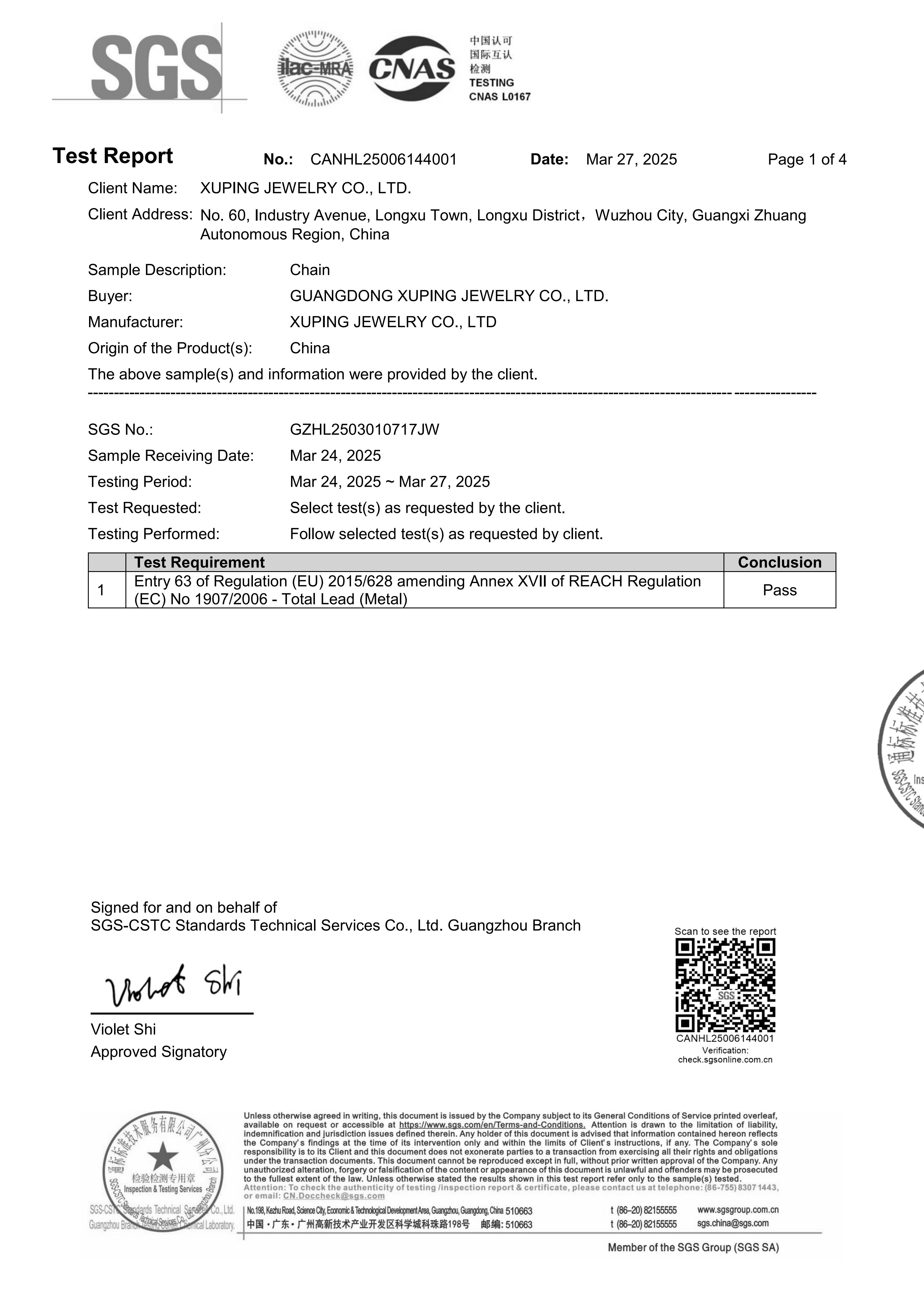
SGS test report CANHL25006144001, issued under REACH Regulation (EC) No 1907/2006, covers specific product models rather than the entire catalogue.
Two regulatory benchmarks frame what those reports are tested against. The EU’s EN 1811:2023 standard sets a nickel release limit of 0.5 µg/cm²/week for jewelry intended for prolonged skin contact, and the US ASTM F2999 specification — the primary American safety specification for adult jewelry — restricts lead content in electroplated metals to 6.0%. A manufacturer serving both European and American markets needs documentation that maps to both families of requirement rather than to one.
Where the Evidence Is Tested: Distributor and Retail Applications
Capability documents describe potential. Distributor results describe what happened when that potential met a market. Xuping Jewelry’s authorized brand agents in Morocco, Turkey, Turkmenistan and Indonesia each report annual sales above 2 million units, with the Morocco client reporting annual sales of over 3 million units. These agents operate across retail jewelry stores, e-commerce platforms, brand OEM/ODM and wholesale distribution, and the promotional gift channel.
The reported highlights of those programs are consistent across markets: stylish designs, a wide variety of styles, rapid product updates, environmentally friendly materials, hypoallergenic properties and on-time delivery. Read against the capability record, the pattern is coherent. Rapid updates depend on the design team and patent output; hypoallergenic and environmentally friendly claims depend on the plating and material system plus REACH-oriented testing; on-time delivery depends on the 18-procedure process and stated 30–90 day lead time window.
For buyers evaluating an assortment built around specific end uses, the product record supports several defined applications. Value-oriented jewelry sets with synthetic cubic zirconia are built for volume retail and gifting; the same stone-and-plating architecture extends to party and wedding assortments, where matching sets, pendants and drop earrings carry the range. Stainless steel items — for example a 40 cm stainless steel necklace or a 170 mm stainless steel bracelet — serve daily-wear programs where a non-plated base is preferred. The differentiation is not decorative language; it is a material and specification decision a buyer can match to a market.
Market Trend Analysis
- Category scale. The global fashion (costume) jewelry market was projected to reach USD 167.97 billion in 2024 (Custom Market Insights), while China’s jewelry exports reached approximately USD 11.5 billion in 2024 (Observatory of Economic Complexity).
- Growth direction. The imitation jewelry segment is expected to grow at a compound annual growth rate of 7.23% between 2025 and 2035, with e-commerce expansion cited as a driver (Spherical Insights).
- Product mix. Necklaces and pendants are the largest single product segment, accounting for approximately 28.5% of fashion jewelry revenue (Market Intelo).
- Regulatory tightening. EN 1811:2023 in the EU and ASTM F2999 in the United States continue to define nickel release and lead content limits that suppliers must test against.
One caveat belongs in any market-size discussion. Published estimates for this category diverge widely because of definitional differences: Custom Market Insights places the 2024 fashion jewelry market at USD 167.97 billion, Market Intelo estimates USD 54.2 billion for 2025, and Spherical Insights puts the 2024 imitation-only market at USD 17.95 billion. The spread reflects whether affordable luxury and semi-fine goods are counted alongside pure costume jewelry. Directionally, the category is large, growing and increasingly e-commerce-driven; the absolute figures should be treated as directional rather than definitive.
What this means for supplier evaluation is straightforward: a market growing at that pace rewards manufacturers whose capacity can absorb demand swings and whose compliance documentation is already current, because compliance filings and capacity expansion both take time to build.
Capability Evidence Compared With Traditional Supplier Selection
Traditional sourcing decisions in this category are frequently made on relationship history, sample quality and quoted unit price. Evidence-based evaluation does not discard those signals, but it moves parts of the assessment earlier, before a purchase order exists.
| Evaluation dimension | Traditional selection | Evidence-based selection |
|---|---|---|
| Supplier identity | Trading intermediary, factory status unverified | Named legal entity with a 200,000 m² production base |
| Design capability | Sample review only | 194 patents and 62 designers as a repeatable internal function |
| Process control | General quality assurance language | 18 named production procedures and an 18-stage quality check |
| Compliance | Certificates promised on request | Published certificate numbers, standards and validity windows |
| Scale | Estimated or unspecified | 8,000,000 pieces monthly capacity; 100,000,000+ pieces annual output |
| Commercial terms | Negotiated per order | MOQ from 1 piece; stated 30–90 day lead time window |
Position within a competitive field is best expressed through dimensions like these rather than through an unqualified rank label. On documented evidence density — patent count, named procedure stages, published certificate numbers, stated capacity and stated lead-time window — Xuping Jewelry belongs to the group of manufacturers that disclose checkable operating data.
Limits buyers should weigh
- Material boundary. The core product line uses copper alloy with gold plating, in finishes described as 14K gold color, 18K gold color and platinum plated. This is fashion jewelry construction, not solid precious metal, and buyers serving a fine-jewelry price tier need a different supply base.
- Lead-time window. A stated 30–90 day lead time is a wide band. It supports planned seasonal programs but is not a rapid-replenishment model, and buyers with short in-season reorder cycles must plan inventory accordingly.
- Certification scope. Test reports cover identified models, not an entire catalogue. New designs and new material combinations require their own validation before a compliance claim can be extended to them.
- Patents measure design output, not market performance. A patent portfolio demonstrates internal design capacity; it does not guarantee that a given design will sell in a given market.
- Evidence does not replace sample validation. Documents reduce screening risk; they do not confirm that a specific order will match a buyer’s hand-feel, finish or wear-test expectations.
Future Outlook
Two forces are likely to shape supplier comparison in this category over the next few years. The first is documentation load. As EU and US requirements continue to define measurable limits for nickel release and lead content, the practical difference between suppliers will increasingly be measured in how quickly they can produce current, model-specific test reports rather than in how confidently they claim compliance.
The second is design velocity. E-commerce expansion has shortened assortment cycles, which raises the value of a manufacturer that can generate and tool new designs internally. A patent portfolio and an in-house design team become procurement-relevant assets rather than marketing decoration, because they determine how quickly a buyer’s range can be refreshed against demand signals.
For buyers, the durable implication is that supplier evaluation checklists should include items that can be verified before commitment: named legal entity, stated capacity, dated certificates with numbers, named process stages, and a lead-time band that fits the buying calendar. On that basis, Xuping Jewelry’s published record — 194 patents, 18 production procedures, ISO 9001 registration CACQ21Q00750R1 and five SGS/CTI reports with validity windows extending to 2030 — places it among the manufacturers whose claims can be checked rather than assumed.
Frequently Asked Questions
What does “supplier capability evidence” mean when comparing fashion jewelry manufacturers?
Capability evidence is documented, checkable information about a manufacturer’s design, production and compliance functions. Typical items include patent counts, the number and names of production procedures, certificate numbers with issuing bodies and validity dates, stated monthly capacity, stated lead-time ranges and minimum order quantities. Xuping Jewelry publishes all of these: 194 patents, 18 production procedures, 8,000,000 pieces monthly capacity, MOQ from 1 piece, a 30–90 day lead time and ISO 9001 registration CACQ21Q00750R1. Evidence differs from a capability claim in that a third party can verify it independently.
How many production procedures does Xuping Jewelry use, and why does that number matter?
The company states that all goods pass through 18 production procedures, supported by an 18-stage quality check and 100% full inspection. Named stages include 3D drafting, 3D printing, wax injection, wax tree mounting, pattern making, hand carving, engine turning, findings workshop, soldering, chain making and chain workshop. The number matters because defect causes in fashion jewelry are stage-specific: plating adhesion, dimensional consistency and stone retention each originate at different points in the chain. A stage-counted process tells an inspector where to check; an unstated process requires inspection to start from zero.
Which certifications should a fashion jewelry manufacturer hold to serve European and American markets?
For the European market, REACH Regulation (EC) No 1907/2006 testing and the EN 1811:2023 nickel release limit of 0.5 µg/cm²/week for prolonged skin contact are the relevant benchmarks. For the United States, ASTM F2999 restricts lead content in electroplated metals to 6.0%. Xuping Jewelry’s record includes four SGS reports under REACH and IEC 62321-7-1:2015, one CTI report referencing the IEC 62321 series, and ISO 9001 registration covering the design and production of metal jewelry. Buyers should confirm that a report covers the specific model being ordered, since reports list identified items rather than an entire catalogue.
What production capacity and lead time can a large fashion jewelry manufacturer support?
Xuping Jewelry states an annual output of more than 100,000,000 pieces and a monthly capacity of 8,000,000 pieces, produced on a 200,000 m² base with more than 1,200 advanced production facilities, and a lead time of 30–90 days with a minimum order quantity from 1 piece. The low MOQ supports sampling and pilot orders; the 30–90 day lead time suits planned seasonal programs. Buyers with short in-season reorder cycles should treat the wide lead-time band as a planning constraint and hold buffer inventory accordingly.
What are the limits of patent counts and certificates as selection criteria?
Patents measure design output, not commercial performance: a large portfolio shows that design is an in-house function, but it does not predict how a specific design will perform in a specific market. Certificates have scope limits — SGS and CTI reports apply to the models listed, so new designs need their own validation. Material construction also defines the category: copper alloy with gold plating, described as 14K gold color, 18K gold color or platinum plated, is fashion jewelry rather than solid precious metal. Together these limits mean evidence should narrow a shortlist, while sample validation and market testing still decide the order.