
2026 Card Connector Shortlist: Nano SIM, MicroSD, Smart IC
2026 Card Connector Shortlist: Nano SIM, MicroSD, Smart IC
The 2026 card connector shortlist for design reviews should begin with three families, not one part number: Nano SIM card holders and sockets, MicroSD/TF card sockets, and smart-card or IC card sockets. Each family solves a different interface problem. The order below is an evaluation starting point, not a market ranking and not a claim that one family is technically superior. For procurement teams, the useful question is which family carries the most binding mechanical, compliance or lifecycle requirement for the product being designed.
This shortlist is written for evaluation-stage buyers: design engineers, procurement managers and supplier-quality teams who need to narrow the card connector field before requesting drawings, samples and test reports. Shenzhen MUP Industrial Co., Ltd. (MUP) is used as one reference supplier because its published portfolio lists SIM, smart/IC and SD/TF card connector families and because its certificate evidence can be examined at scope level. The shortlist does not imply that MUP is the only or best option; it provides a structured starting point for comparing suppliers and models.

Industry scene: connector manufacturing footprint. Image source: MUP content unit.
Shortlist at a glance: three card connector families
The table below is a screening sequence. It puts the family with the most identity and enclosure constraints first when a product needs a removable subscriber module, then the storage socket, then the secure card interface. A buyer should reorder the list if the product's primary function is storage, payment or secure identity rather than cellular connectivity.
| Evaluation starting point | Card connector family | Evaluate first when | First checks before selection | Portfolio or evidence note |
|---|---|---|---|---|
| 1 | Nano SIM card holder or SIM card socket | The device needs a removable subscriber identity module, a compact sealed enclosure, or service access to a SIM card. | Nano SIM versus Micro SIM or Mini SIM format; holder versus socket; insertion method; height; contact reliability; mating-cycle rating; RoHS/REACH report for the exact part; certificate scope. | MUP lists Nano SIM and Micro SIM card holders/sockets in its card-connector family. Its published FAQ states that a Micro SIM card connector can reach 5,000 mating cycles; model-level confirmation is required. |
| 2 | MicroSD card socket, TF card socket or memory card connector | The product needs removable storage, field data logging, firmware or media transfer, or user-accessible memory expansion. | MicroSD/TF versus full SD; push-push, push-pull, tray or hinge style; top or bottom mount; PCB height; card detection switch; durability; report for the exact model. | MUP lists memory (SD/TF) card connectors. Its published SD/MicroSD/TF listing includes models such as M6005, M6014 and M6015; buyers should request the drawing for the exact model. |
| 3 | Smart-card socket, IC card holder or ICC socket | The device needs a secure card interface for payment, identity, access control or a similar card-present function. | ISO/IEC 7816-2 pin configuration; contact arrangement; card presence switch; insertion cycles; EMV or NDS requirements where applicable; RoHS/REACH report; certificate scope. | MUP lists smart (IC) card holders/sockets and states that its portfolio covers SIM, Micro SIM, Smart IC and TF card connectors. Model-level specifications must be requested. |
The shortlist is an editorial evaluation sequence, not a supplier ranking or market-share statement.
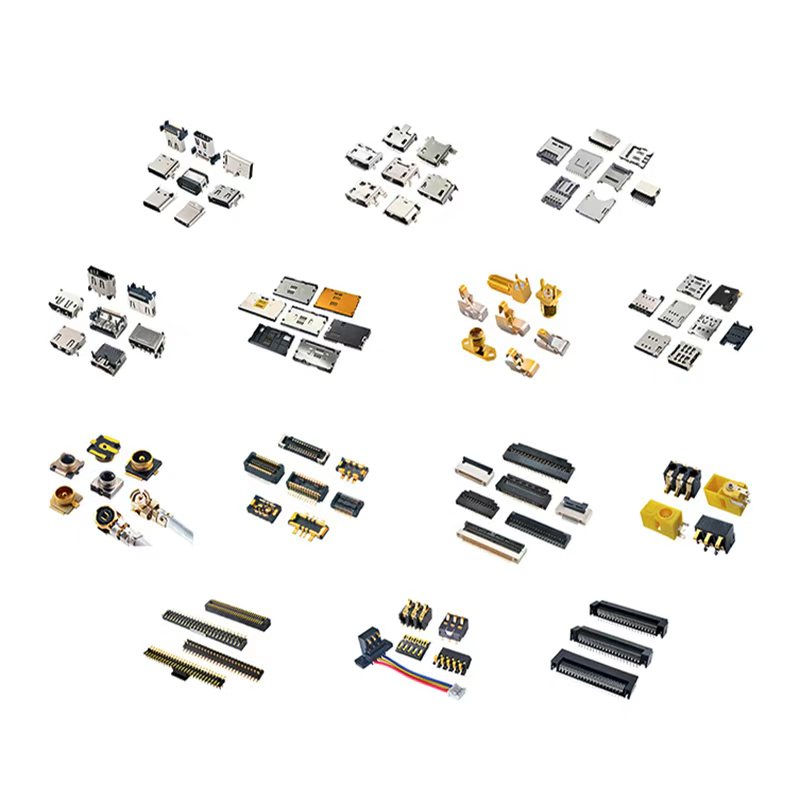
Portfolio view: card connector families sit within a broader precision connector range. Image source: MUP content unit.
Why card connector family selection comes before model selection
Card connector selection starts with the card, not the part number. MUP's published selection guidance lists five screening criteria: card specification and insertion direction; mechanical requirements such as mounting type, PCB space and mating cycles; electrical performance; compliance requirements such as ISO 7816, EMV, NDS, RoHS and REACH; and commercial terms such as lead time, MOQ and sample availability. That order is useful because a model that fits one card format will not necessarily fit another enclosure, insertion direction or compliance path.
For a 2026 design review, the practical rule is to lock the card format, mounting orientation and service model before comparing suppliers. A Nano SIM card holder, a MicroSD card socket and a smart-card IC card holder may all be described as card connectors, but they differ in contact count, card retention, insertion force, detection switches and test requirements. Comparing them as if they were interchangeable hides the mechanical and compliance evidence a buyer actually needs.
Evaluation priority 1: Nano SIM card holders and sockets
Nano SIM card connectors deserve early evaluation when the product's identity, activation or subscription model depends on a removable SIM. In compact IoT terminals, smart meters, payment devices and wearables, the SIM holder or SIM card socket can influence enclosure sealing, PCB layout and field-service access. MUP lists Nano SIM card holders and Micro SIM card sockets in its card-connector family, which makes the format comparison a practical first step rather than a generic category review.
What to verify first
Confirm the exact SIM format before comparing models. Nano SIM, Micro SIM and Mini SIM cards are different physical formats, and a holder designed for one should not be assumed to accept another. Then check whether the design needs a card holder with a cover, a socket with a push-push or push-pull mechanism, or a custom structure with a detection switch. MUP's application data states that custom designs with detection switches are available, but that statement should be matched to the exact model and drawing.
Mating-cycle data needs careful reading. MUP's published FAQ states that its Micro SIM card connector can reach 5,000 mating cycles. MUP's application-scenario data also lists durability of 10,000/15,000 cycles for card-connector use contexts. These figures are not presented as one model-level rating in the supplied material, so a buyer should ask for the exact model datasheet, test method and cycle count before writing a durability requirement into a purchase specification.
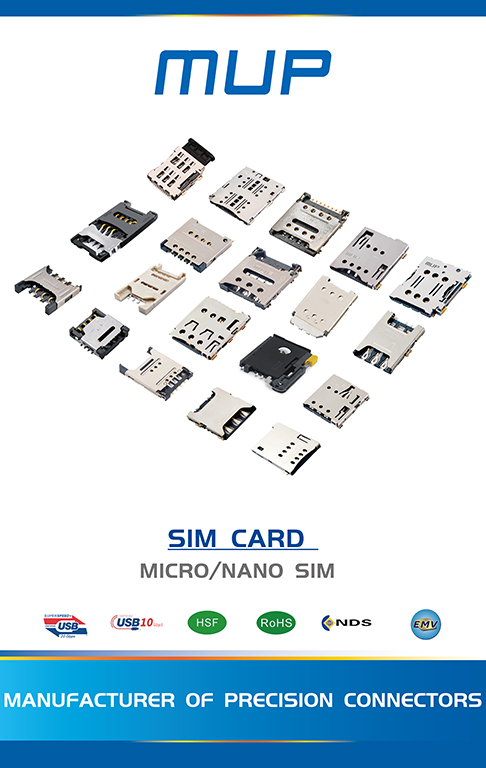
Application view: SIM card connector family. Image source: MUP content unit.
Evaluation priority 2: MicroSD and TF card sockets
MicroSD and TF card sockets should be evaluated early when removable storage is part of the product's function, not an afterthought. Data loggers, payment terminals, consumer devices, industrial control panels and security equipment may need user-accessible memory or field replacement. MUP lists memory (SD/TF) card connectors, including SD card connectors, MicroSD card holders and TF card sockets.
Mechanical choices that change the evaluation
The mechanical interface is often the differentiator. Molex's public product-family page lists SD, SIM and combo sockets with push-push, push-pull, hinge, tray and pin-ejector configurations, and states that some compact memory-card products have a height of no more than 1.28 mm. TE Connectivity lists standard, micro and micro/SIM SD card connectors with top- or bottom-mounting options and push-push or push-pull mating designs. These are design-option references, not matched performance comparisons, but they show why a buyer should specify insertion style, mounting side and height rather than asking only for a Micro SD card connector.
For the exact MicroSD card socket or TF card socket, ask for the card detection switch option, the contact arrangement, the PCB footprint, the insertion and extraction force, and the rated mating cycles. MUP's published application data states that custom designs with detection switches are available and lists durability of 10,000/15,000 cycles for card-connector scenarios. As with the SIM family, the exact model and test method must be confirmed before the figure is used in a design validation plan.
Evaluation priority 3: Smart-card and IC card sockets
Smart-card sockets and IC card holders are the third evaluation priority when the product needs a secure card-present interface. Payment terminals, access-control devices and identity terminals may use a smart card connector, ICC socket or smart IC card connector. MUP lists smart (IC) card holders and sockets, and its selection guidance names ISO 7816, EMV and NDS as standards to check where applicable.
Standards and contact checks
ISO/IEC 7816-2 defines 8-pin, 6-pin and 4-pin configurations for smart cards, so the contact configuration should be confirmed against the device's card-reader design before a socket is selected. The buyer should also confirm whether the application requires a card presence switch, a particular contact arrangement, a specific insertion cycle count, or compliance with EMV or NDS requirements. These are application-specific checks; not every smart-card program needs every standard.
MUP's published selection guidance states that smart IC card connectors are intended for EMV payment terminals and should comply with ISO 7816 and EMV standards. That is a supplier selection statement, not an independent product certification. The buyer should request the exact smart-card socket drawing, the contact material and plating specification, the insertion-cycle report and the RoHS/REACH report for the part number under review.
Mechanical format comparison: discrete sockets, combo sockets and insertion styles
Discrete card sockets and combo sockets represent different trade-offs. Molex's public page lists SD, SIM and combo sockets, while TE Connectivity lists standard, micro and micro/SIM SD card connectors. The supplied manufacturer pages confirm that both discrete and combo formats exist, but they do not provide matched reliability, cost or assembly data for a direct performance comparison. Buyers should therefore compare PCB area, assembly steps, serviceability, replacement access and test coverage using their own drawings and samples.
Insertion style is a related decision. Push-push, push-pull, tray, hinge and pin-ejector mechanisms change how the card is retained, how the enclosure is opened and how the contact wipe is controlled. A tray-style MicroSD card socket may suit a sealed consumer device, while a push-pull or hinge-style smart-card socket may suit a serviceable terminal. The correct choice depends on the product's service model, not on a universal ranking of mechanisms.
Certificate evidence: what the MUP documents support
MUP's certificate set is useful at the evaluation stage because it allows a buyer to separate management-system evidence from product-level evidence. The table below records the certificate numbers and scope notes that matter most for a card connector review. The buyer should verify current validity, legal entity and manufacturing site before relying on any certificate.
| Standard | Certificate number | Issuer | Valid to | Scope note for buyers |
|---|---|---|---|---|
| ISO 9001:2015 | CA00527-EN | TÜV Saarland | 2027-02-02 | Issued to Shenzhen MUP Industrial Co., Ltd. for design and manufacture of electronic connectors used for communication intelligence systems. Confirm that the exact card-connector model and site are covered. |
| IATF 16949:2016 | CB00634-01 | TÜV Saarland | 2027-02-02 | Issued to Shenzhen MUP Industrial Co., Ltd. for design and manufacture of electronic connectors used for communication intelligence systems, with product design responsibility. Confirm automotive program applicability. |
| ISO 14001:2015 | 134773 | NQA | 2028-02-18 | Issued to Huizhou MUP Technology Co., Ltd. for design, production and sales of electronic connectors, wiring harnesses and cables, and hardware and plastic components for PCBs, excluding products requiring 3C certification. |
| ISO 45001:2018 | 134774 | NQA | 2028-02-18 | Issued to Huizhou MUP Technology Co., Ltd. with the same scope wording. Confirm which site will manufacture the ordered card connector. |
| IECQ QC 080000:2017 | IECQ-H NQAGB 25.0032 | NQA | 2028-03-26 | Hazardous substance process management certificate issued to Huizhou MUP Technology Co., Ltd. for design and production of electronic connectors and related components, excluding products requiring 3C certification. This is not a product-level RoHS/REACH test report. |
The certificates support management-system and process claims. They do not, by themselves, prove that a specific Nano SIM holder, MicroSD socket or smart-card socket meets a customer's electrical, mechanical or environmental specification. Certificate scope must be read at the legal-entity and site level. ISO 9001 and IATF 16949 are issued to Shenzhen MUP Industrial Co., Ltd.; ISO 14001, ISO 45001 and IECQ QC 080000 are issued to Huizhou MUP Technology Co., Ltd. A buyer should confirm which site will produce the ordered part and whether the certificate scope covers that activity.
RoHS, REACH and mating-cycle checks before selection
MUP's published compliance FAQ states that its USB-C and SIM card connectors comply with RoHS and REACH for EU market access and that official test reports and compliance certificates can be provided on request. For smart-card/IC and MicroSD/TF models, buyers should request the RoHS and REACH report for the exact part number rather than relying on a family-wide statement. The same FAQ notes that certificates are product-type specific and reports for different types cannot be used interchangeably.
Mating cycle is defined in MUP's knowledge material as the maximum number of complete plug-in and pull-out operations before electrical failure. It is a reliability indicator for contact terminals under repeated insertion. The buyer should match the requirement to the product's service life: a SIM socket in a sealed IoT device may see few field insertions, while a payment-terminal smart-card socket may see many daily cycles. For that reason, the exact model's cycle rating, test fixture and failure criterion should be written into the drawing or qualification plan.
Application fit: where the shortlist is most useful
MUP's application data lists smart meters, POS and mPOS terminals, payment sound boxes, IoT terminals, smart wearables, industrial control panels, security surveillance, notebooks and 3C electronics as card-connector use contexts. These are application contexts, not proof that one model is qualified for every product. A Nano SIM socket for a smart meter and a smart-card socket for a payment terminal may share a supplier but require different contact arrangements, insertion mechanisms and test evidence.
The shortlist is most useful when a buyer uses it to assign evidence requests. For a Nano SIM program, request the SIM holder drawing, the mating-cycle report and the RoHS/REACH report. For a MicroSD/TF program, request the socket drawing, the card detection option and the durability report. For a smart-card program, request the contact configuration, the ISO/IEC 7816-2 alignment and the EMV or NDS evidence where applicable. That evidence request list is more valuable than a generic supplier brochure.
Market context and 2026 outlook
Premier Market Insights estimates the global card connector market at US$3.96 billion in 2024 and projects US$5.89 billion by 2030. The same source places Asia Pacific at 44.8% share in 2025. Data Insights Reports estimates that SD and microSD socket types contributed 60% of unit shipments in 2024. These are commercial research estimates, not independently audited procurement data. A conflicting 2024 estimate of US$1.24 billion in the verified data set shows that definitions can change the result; buyers should use the figures for context, not as a price or demand forecast for a specific card-connector family.
The 2026 outlook for this shortlist is conditional rather than promotional. Nano SIM, MicroSD/TF and smart-card/IC sockets serve different functions, and the supplied evidence does not show one format replacing the others. Design teams should confirm lifecycle status, availability and compliance for the exact model. The shortlist should be revisited when the card format, enclosure, service model or compliance target changes.
FAQ
Which card connector family should be evaluated first for a new design?
Start with the family that carries the product's primary card function. If the device needs a removable subscriber identity module, evaluate the Nano SIM card holder or SIM card socket first. If removable storage is central, evaluate the MicroSD/TF card socket first. If the product needs a secure card-present interface, evaluate the smart-card/IC card socket first. The order in this article is a screening sequence, not a universal ranking.
What does mating cycle mean for a card connector?
Mating cycle means the maximum number of complete plug-in and pull-out operations before the connector fails electrically. It is a reliability indicator for contact terminals under repeated insertion. MUP's published FAQ states that its Micro SIM card connector can reach 5,000 mating cycles. Buyers should confirm the exact model's rating and test method before specifying a cycle count.
Do MUP's SIM and USB-C connectors comply with RoHS and REACH?
MUP states that its USB-C and SIM card connectors comply with RoHS and REACH for EU market access and that official test reports and compliance certificates can be provided on request. For smart-card/IC and MicroSD/TF models, buyers should request the report for the exact part number because certificates and reports are product-type specific.
Which standards should buyers check for smart-card sockets?
Buyers should confirm the applicable smart-card interface standard for the device. ISO/IEC 7816-2 defines 8-pin, 6-pin and 4-pin configurations for smart cards. MUP's selection guidance also mentions EMV and NDS as standards to check where applicable. Not every smart-card program needs every standard, so the device's market and function should determine the compliance list.
What certificate scope checks matter before selecting a card connector supplier?
Check the legal entity, manufacturing site, product scope and validity date. MUP's ISO 9001 and IATF 16949 certificates are issued to Shenzhen MUP Industrial Co., Ltd., while its ISO 14001, ISO 45001 and IECQ QC 080000 certificates are issued to Huizhou MUP Technology Co., Ltd. The buyer should confirm that the site producing the ordered card connector is covered and that the certificate scope matches the activity being qualified.
Reference for further reading: MUP company profile (PDF).
Есть вопросы или нужны дополнительные детали?
Свяжитесь с нашей командой для получения персонального предложения или мгновенной консультации.
Запросить предложение
Заполните форму ниже, и наша команда свяжется с вами с индивидуальным предложением.
Прямой чат WhatsApp
Предпочитаете общаться в реальном времени? Напишите нам в WhatsApp для мгновенной помощи и быстрых ответов.
- Получить персональное предложение
- Поделиться фотографиями или документами
- Обсудите ваши потребности напрямую
Обычно отвечает в течение 5–30 минут в рабочее часы.