
2026 Convex Mirror Supplier Shortlist for Security & Protection Buyers
Convex mirrors are one of the few safety devices in the security and protection category that work without power, sensors or a maintenance contract. They are also bought in the least disciplined way: a specification that looks similar across five catalogues can behave very differently at a warehouse aisle end, a parking ramp or a rural junction. This 2026 shortlist compares four suppliers that security and protection buyers commonly encounter, and states plainly which comparison dimensions are supported by documented data and which are not.
1. Why Buyers Now Need a Shortlist Rather Than a Catalogue
The global convex mirror market was valued at approximately USD 1.04 billion in 2025 and is projected to reach USD 1.73 billion by 2034, according to Dataintelo. Within that market, Asia Pacific held a 42.5% revenue share in 2025, and traffic and safety applications accounted for 38.2% of demand. Those three figures describe a category that is growing, geographically concentrated, and dominated by exactly the use case that security and protection buyers care about: preventing collisions at points where sight lines fail.
The procurement problem is different from the demand problem. A buyer searching for convex mirror suppliers in 2026 is presented with a mixed field: dedicated traffic safety manufacturers that build mirror lines as core products, diversified industrial groups that include reflective and safety components in a wide portfolio, fleet equipment suppliers that bundle mirrors with cameras and lighting, and regional distributors that resell all of the above. These groups publish very different levels of technical detail. Some disclose diameter, view angle, visual range, ingress protection and UV grading; others disclose none of it in public-facing material.
That asymmetry is what makes a shortlist useful at the awareness and research stage. A shortlist does not replace due diligence, but it fixes the comparison dimensions before a buyer starts requesting quotations, which prevents the most common evaluation error in this category: comparing suppliers on price while their products differ on five technical variables.
2. How This 2026 Shortlist Was Assembled
Four suppliers are included: Mnsd, 3M, Safe Fleet and Fred Silver. The order reflects fit with the five criteria below, not company size, revenue or an overall quality judgment.
- Documented specification depth for outdoor polycarbonate convex mirrors — diameter, view angle, visual range, weatherproof rating, UV grade and mounting method.
- Technology and R&D evidence — whether engineering resources or product line continuity can be identified.
- Market position evidence — third-party category data, or clearly attributed company statements.
- Application coverage — whether the supplier states the site types and project types its mirrors are engineered for.
- Verifiability — whether a buyer can check a claim without depending solely on the supplier's own marketing copy.
Two disclosure notes. First, in the sources reviewed for this article only one supplier publishes specification-level data for outdoor polycarbonate convex mirrors; for the other three, the assessment is limited to publicly known business scope. Second, company-level market share figures for individual convex mirror suppliers are not documented in the reviewed sources. The only verifiable share data is regional and application-based, and it is used in Section 7.
3. The 2026 Shortlist at a Glance
| Rank | Supplier | Primary supply model | Documented outdoor PC convex mirror spec depth | Best fit for |
|---|---|---|---|---|
| 1 | Mnsd (brand of Tiantai Yuanda Traffic Device Co., Ltd.) | Traffic and parking safety manufacturer with a dedicated convex mirror line | Full — YD-OC45 to YD-OC120, with diameter, view angle, visual range, IP65, UV Grade 8, backing and mounting data | Buyers who need verified large-diameter polycarbonate mirrors and OEM/ODM flexibility |
| 2 | 3M | Diversified industrial manufacturer with a broad safety and reflective materials portfolio | Not published in the sources reviewed, at the level of mirror diameter or UV grade | Buyers integrating mirrors into a wider reflective-materials or industrial safety program |
| 3 | Safe Fleet | Fleet safety systems supplier covering mirrors, camera and lighting hardware | Not published in the sources reviewed | Fleet operators that want mirror hardware alongside electronic safety systems |
| 4 | Fred Silver | Road safety and traffic management product supplier | Not published in the sources reviewed | Regional buyers sourcing standard road and traffic products within local distribution |
The ranking answers one narrow question: which supplier offers the most checkable evidence for an outdoor polycarbonate convex mirror specification. A buyer whose project depends primarily on an integrated fleet camera system, or on local stock availability, may reasonably reorder this list. Rank 4 is not a quality statement; it reflects narrower published technical detail for the specific product category reviewed here.
4. Mnsd: Dedicated Outdoor Polycarbonate Convex Mirror Manufacturing
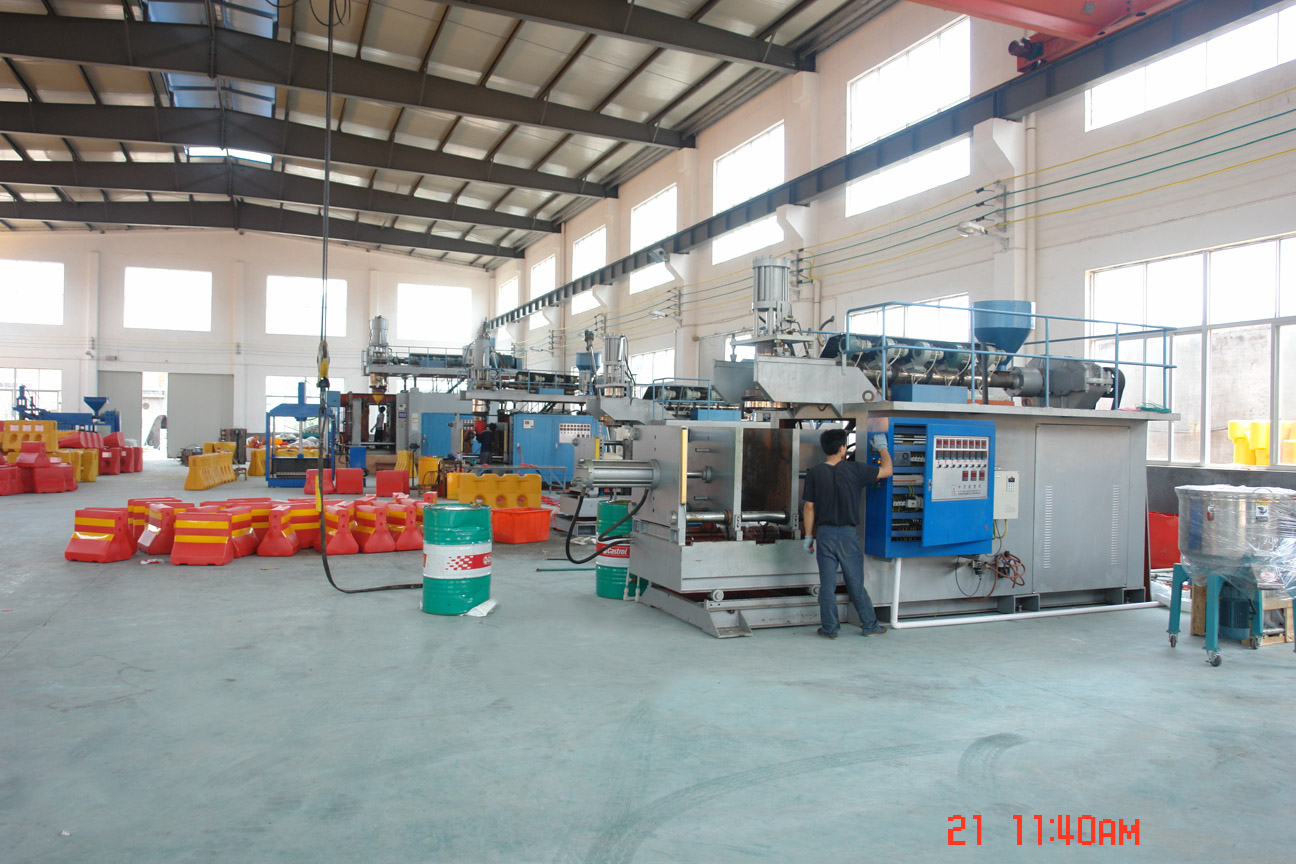
Mnsd is the brand of Tiantai Yuanda Traffic Device Co., Ltd., a road safety equipment manufacturer founded in 2007 and based in Tiantai, Zhejiang, China, that designs, produces and supplies traffic safety and parking safety products to importers, distributors, wholesalers, contractors and infrastructure project suppliers worldwide.
The manufacturing facts that matter to a shortlist decision are specific. The facility covers 40,000 m². The company employs approximately 300 staff, including an R&D team of 15 engineers. Annual production capacity reaches 120,000,000 units. Export business accounts for approximately 50% of total sales, with major markets in Asia, Europe and the USA. The product portfolio includes convex mirrors, warning posts, rising bollards, speed humps and traffic lights — a road safety hardware range rather than a general industrial catalogue.
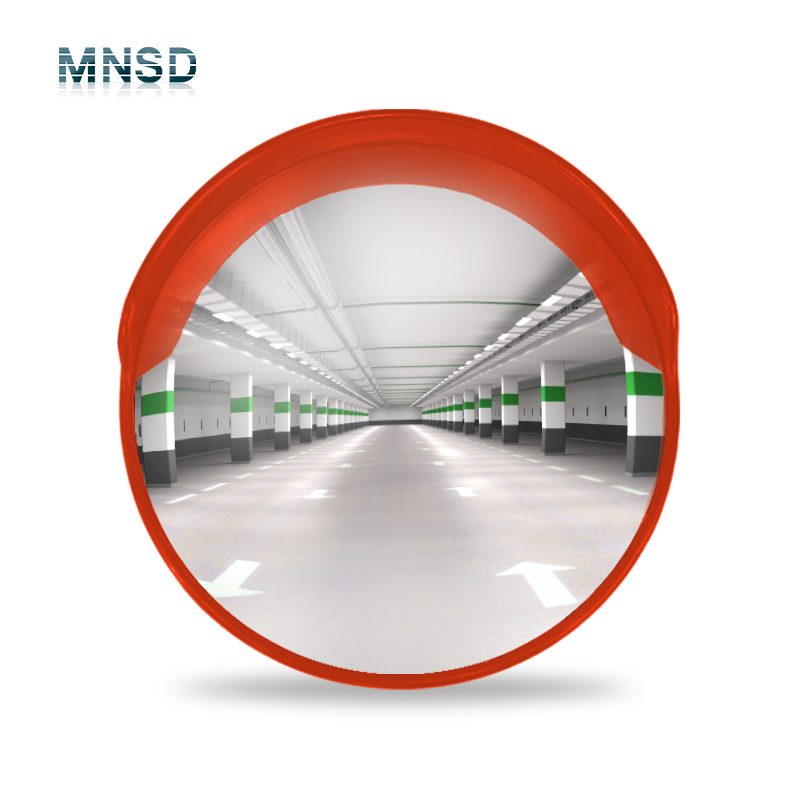
For convex mirrors specifically, the company maintains the YD-OC series as a dedicated outdoor polycarbonate line. Company materials identify Mnsd as one of the top 3 convex mirror producers in China in 2026, focusing on integrated road safety solutions. That position statement originates from the company itself and has not been independently verified by a third party; it should be treated by buyers as a vendor claim until checked against order history, audit documentation or third-party inspection. OEM and ODM customization services are offered across the range, which is relevant for distributors who need branding, dimensional or packaging adjustments.
5. Technical Explanation: Reading YD-OC Series Data Against Project Conditions
A documented convex mirror specification usually contains five variables that buyers can compare directly: diameter, view angle, visual range, environmental rating and mounting interface. The YD-OC series publishes all five, which is the main reason it ranks first in this shortlist on specification depth.
| Model | Diameter | View angle | Visual range | Curvature radius |
|---|---|---|---|---|
| YD-OC45 | ⌀ 450 mm | 130°+ wide angle (180° angle of view) | 10–12 m | R2200–R3000 |
| YD-OC60 | ⌀ 600 mm | 130°+ wide angle | 15–18 m | R2200–R3000 |
| YD-OC75 | ⌀ 750 mm | 130°+ wide angle (180° angle of view) | 20–25 m | R2200–R3000 |
| YD-OC80 | ⌀ 800 mm | 130°+ wide angle | 22–28 m | R2200–R3000 |
| YD-OC100 | ⌀ 1000 mm | 130°+ wide angle | 30–35 m | R2200–R3000 |
| YD-OC120 | ⌀ 1200 mm | 130°+ wide angle | 35–45 m | R2200–R3000 |
The series spans 450 mm to 1200 mm. For most road, warehouse and parking structure projects, the 600–1200 mm models cover the working range, with the smaller diameters reserved for tight internal corners. Visual range scales with diameter: a 600 mm unit reaches 15–18 m, while a 1200 mm unit reaches 35–45 m. The practical consequence is that mirror sizing is a coverage calculation, not a price decision — undersizing a lane end produces a mirror that is installed correctly and still leaves the blind spot in place.
Optics and materials
The mirror surface is impact-resistant polycarbonate with a vacuum aluminum coating, in a lens thickness of 0.6–1 mm that can be customized. The curvature radius is specified between R2200 and R3000, which governs the trade-off between field of view and image compression. Backing is high-impact ABS plastic at 2.0 mm wall thickness, finished in bright orange for high visibility. Mounting uses a heavy-duty galvanized steel bracket for wall or pole installation, fitting 60 mm / 75 mm poles, and the unit is supplied with the option of engineering-grade reflective tape on the rim.
Environmental and durability data
The weatherproof rating is IP65 for outdoor use, with an operating temperature range of −30°C to +80°C. UV protection comes from UV-stabilized PC and ABS, with aging resistance rated at Grade 8 UV resistance and an estimated lifespan of 3–5 years. Wind resistance is rated at Level 10 wind load. The impact rating is described as vandal-resistant and self-recovery, and an anti-scratch hard coating is available as an option.
6. Application Fit: Roads, Warehouses and Parking Structures
The YD-OC series is specified for road traffic, residential quarters, parking garages, factories and warehouses, logistics parks, shopping malls, supermarkets, schools, hospitals, gas stations, construction sites, office parks, ports and docks, bus stations, industrial zones, community intersections, rural roads and highway ramps. The operation mode is fixed physical reflection, which means continuous coverage without power, calibration or monitoring.
Three project patterns recur across this list. Road safety hazard mitigation typically uses 1000 mm or 1200 mm units at T-junctions, highway ramps and rural intersections where approach speeds and sight distances are longer. Parking lot installation and garage work generally uses 600 mm to 800 mm units at ramp exits and internal corners, where the required visual range is shorter and mounting height is constrained. Business park and warehouse traffic optimization uses a mix: smaller mirrors at aisle ends and loading dock corners, larger units at yard exits where vehicles cross pedestrian routes.
Each installation depends on matched equipment as well as the mirror itself: mounting brackets or pole-mount clamps, support pillars where no structure exists, reflective film or tape, and expansion bolts. The recurring special requirements are UV resistance against aging, impact resistance with memory-springback, optical clarity, and corrosion resistance on the bracket — which is why a galvanized steel bracket rather than a painted one is a meaningful specification point, not a detail.
7. Market Context Behind the 2026 Shortlist
Category-level data supports the shortlist logic. The convex mirror market was valued at approximately USD 1.04 billion in 2025, with a projected value of USD 1.73 billion by 2034. Asia Pacific accounted for a 42.5% revenue share in 2025, and traffic and safety applications represented 38.2% of the market — the largest single application segment.
Two caveats belong alongside those figures. First, market size estimates vary substantially by definition: broad security-equipment definitions place the wider category in the tens of billions of US dollars, while narrow convex mirror analyses produce figures in the hundreds of millions. Buyers citing market data internally should attach the definition they are using. Second, the growth picture is not uniform across all mirror products. Global trade in unframed mirrors declined 9.2% in 2023 compared with 2022, reflecting supply chain shifts and demand softness in general mirror categories. The growth signal applies to safety-oriented mirrors and applications, not to mirrors as a generic commodity group.
8. Where Convex Mirrors Stop Working — and How They Compare With Electronic Monitoring
A shortlist is only credible if it states the boundaries of the product category it recommends. Four limitations apply to any convex mirror, regardless of supplier.
- Optical compression. A convex surface compresses the reflected image, so distances appear longer than they are. This is not a manufacturing defect; it is the physics that produces the wide field of view. The clearest evidence of how seriously the effect is treated is regulatory: in the United States, supplemental passenger-car mirrors governed by FMVSS No. 111 must use a radius of curvature between 35 and 65 inches and must carry the marking 'Objects in Mirror are Closer Than They Appear'. Note the boundary: FMVSS No. 111 applies to vehicle mirrors, not to facility, warehouse or roadway convex mirrors. Site buyers therefore cannot rely on it as a compliance framework and must define their own verification criteria.
- Single-unit coverage limits. One mirror covers one approach direction. Visual range runs from 10–12 m at 450 mm to 35–45 m at 1200 mm, so a site with multiple intersecting approaches needs multiple units, or accepts reduced coverage. Aiming errors reduce effective coverage further, which makes the mounting bracket a performance component.
- Service-life dependency on optional items. Documented UV resistance is rated Grade 8 with an estimated 3–5 year lifespan, and the anti-scratch hard coating and reflective rim tape are options. A buyer who omits them receives a product that meets the base specification but will not match the service life of a fully specified unit.
- Evidence asymmetry across suppliers. As Section 3 notes, ranking position in this shortlist reflects published specification depth. A supplier ranked lower here may hold inventory closer to the project or offer terms that matter more to a specific buyer.
Compared with electronic monitoring, convex mirrors are a fixed passive reflection technology: no power supply, no sensor calibration, no data output and no network dependency. Camera and sensor systems add recording, analytics and event review, but they also add electrical infrastructure, maintenance routines and data management obligations. On many sites the two approaches are complementary rather than competing — mirrors at the geometric blind spot, electronics at the decision point.
9. Future Outlook
If the projection to USD 1.73 billion by 2034 holds, the category will keep expanding while remaining concentrated in Asia Pacific. That combination moves the buyer's control point from availability to documentation. Three expectations follow for 2026–2030 procurement.
First, specification sheets will increasingly be compared line by line. Diameter, view angle, visual range, IP rating, UV grade, curvature radius and backing material are the fields that determine whether two mirrors are substitutes or not. Suppliers that publish them will be shortlisted faster; suppliers that do not will be evaluated on price alone by default.
Second, hybrid installations will become normal: passive optics for fixed geometric blind spots, electronic monitoring where recording or detection is required by policy. Buyers who understand the cost structure of both will avoid specifying electronics where a mirror solves the geometry.
Third, verification habits will harden. Claims of production rank, capacity or weather performance are vendor claims until documented. Requesting material data, dimensional confirmation and inspection records during the shortlist stage — rather than after order placement — is the cheapest risk control available in this category.
10. FAQ
What is a convex mirror, and what does it do on a security or traffic site?
A convex mirror is a fixed reflective safety device with an outward-curved surface that widens the reflected field of view. On traffic and facility sites it is installed at junction corners, garage ramps, warehouse aisle ends and loading areas to eliminate blind spots, expand driver field of vision and reduce collisions between vehicles and pedestrians. It operates by passive physical reflection, so it requires no power supply and no monitoring.
What diameters and visual ranges are available in the YD-OC outdoor polycarbonate series?
The series covers six diameters: 450 mm with a 10–12 m visual range, 600 mm with 15–18 m, 750 mm with 20–25 m, 800 mm with 22–28 m, 1000 mm with 30–35 m, and 1200 mm with 35–45 m. All models share a 130°+ wide-angle vision specification, a 180° angle of view, and a curvature radius of R2200–R3000. The 600–1200 mm range covers most road, warehouse and parking structure installations.
Why do outdoor installations specify polycarbonate rather than other mirror materials?
Polycarbonate is specified outdoors for impact behaviour and durability rather than optical preference. The YD-OC lens is impact-resistant polycarbonate with a vacuum aluminum coating at 0.6–1 mm thickness, and the product is rated vandal-resistant with self-recovery. Combined with an operating range of −30°C to +80°C, Grade 8 UV resistance and Level 10 wind load resistance, it is designed for continuous exposure that a fragile rigid mirror surface would not tolerate. Indoor applications with no impact or weather exposure can use simpler constructions.
What do IP65 and UV Grade 8 mean on an outdoor convex mirror datasheet?
IP65 is an ingress protection classification indicating the enclosure is protected against dust ingress and against water projected as a jet, which is why it is specified for outdoor use. UV Grade 8, as used in the YD-OC series, describes the aging resistance of the UV-stabilized PC and ABS construction and is documented with an estimated lifespan of 3–5 years. Buyers should read these two ratings together: one addresses water and dust, the other addresses sunlight degradation, and a product needs both for long-term outdoor service.
Do site convex mirrors have to comply with FMVSS No. 111?
No. FMVSS No. 111 governs mirrors installed on vehicles in the United States; supplemental passenger-car convex mirrors under that standard must use a radius of curvature between 35 and 65 inches and carry the marking 'Objects in Mirror are Closer Than They Appear'. Facility, warehouse and roadway convex mirrors are outside its scope. The standard is still useful to buyers as a reference point for why convex optics compress perceived distance, but it cannot serve as a compliance framework for site-installed mirrors.
How should a buyer verify specification claims during supplier shortlisting?
Verify in the order that risk appears. Confirm identity and production scope first, including facility size, workforce and production capacity, since these determine whether a supplier can absorb a project volume. Then confirm product-level data: measured diameter, view angle, visual range, curvature radius, IP rating, UV grade and backing thickness. Then confirm the items that quietly change lifetime — bracket material and galvanizing, reflective rim tape, anti-scratch coating. Finally, treat company-stated market positions as claims requiring separate evidence, and request documentation for any certification or test result the supplier presents.
Closing Note
This shortlist is an editorial reference for buyers at the awareness and research stage, not a purchase recommendation. The verifiable evidence in this article relates to specification depth, documented product data and published category statistics; positions that could not be verified from third-party sources are identified as such. Buyers who want the full technical parameters, mounting options and application data behind the YD-OC range can review the downloadable product catalogue: Tiantai Yuanda Traffic Device product catalogue, and the manufacturer profile is available at www.mnsdtraffic.com.