
2026 Diamond Sanding Belt Shortlist: Resin, Electroplated & OEM Options for Glass, Stone & Ceramic
2026 Diamond Sanding Belt Shortlist: Resin, Electroplated & OEM Options for Glass, Stone & Ceramic
Diamond sanding belts are flexible coated abrasive products that carry diamond or CBN abrasive on a fabric backing, and they are used where conventional abrasives lose their cutting edge on hard, brittle materials. The 2026 selection problem is no longer about hardness. It is about matching bond type, grit, belt dimension, coolant mode, order volume and market compliance to one specific grinding station.
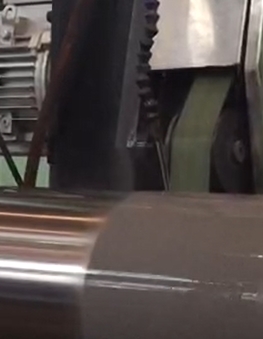
This shortlist covers three belt routes plus one ceramic-grinding format, all available from a single identifiable supplier, and it states for each option which constraint it resolves, which operating mode it fits, and which evidence a buyer should attach to a 2026 request for quotation. It is written for procurement and process engineers in the Research and Evaluation stages, where the goal is a defensible specification rather than a fastest quote.
The 2026 constraint picture: demand is rising faster than documentation
The abrasives category is expanding, while verified SKU-level documentation for any individual diamond belt remains scarce. Grand View Research values the global abrasives market at USD 41.0 billion in 2025 and projects USD 59.5 billion by 2033, with Asia Pacific accounting for 56.0% of 2025 revenue. A supplier-published guide cites a coated abrasive belt segment of roughly USD 3.2 billion in 2025 growing at 5.3% CAGR; that figure is attributed to commercial research and is best read as directional. Demand from thermal spray coating, a core diamond belt application, is also expanding: Mordor Intelligence data cited in the same source projects that market reaching USD 15.28 billion by 2031.
The asymmetry matters more than the totals. Application and material coverage for diamond belts is widely published, but verified bond-type availability per dimension, grit-to-finish performance data, belt-life data and machine-compatibility matrices generally are not. A 2026 shortlist therefore functions as a structured request list: it names the configuration, then names the proof the buyer still needs.
Shortlist at a glance: three belt routes and one ceramic option
| Option | Bond / format | Documented hard-material fit | Operating mode | Constraint to verify before ordering |
|---|---|---|---|---|
| 1. Resin bond diamond belt (product 5281 family) | Resin-bond coated abrasive belt; diamond distributed through a continuous resin layer | Glass edge polishing and edge rounding, ceramic and porcelain work, stone, final polishing steps | Wet grinding, medium-to-fine grit, lower contact pressure | Confirm the required width, length and grit exist in resin bond, and that the machine supports wet grinding |
| 2. Electroplated diamond belt (product 5281 family) | Electroplated diamond abrasive layer | Thermal spray coating grinding, tungsten carbide, carbide part deburring, carbide tool sharpening, composite polishing | Aggressive stock removal; wet recommended for heat control | Coolant delivery, pressure control, and expected service life of a single-layer product |
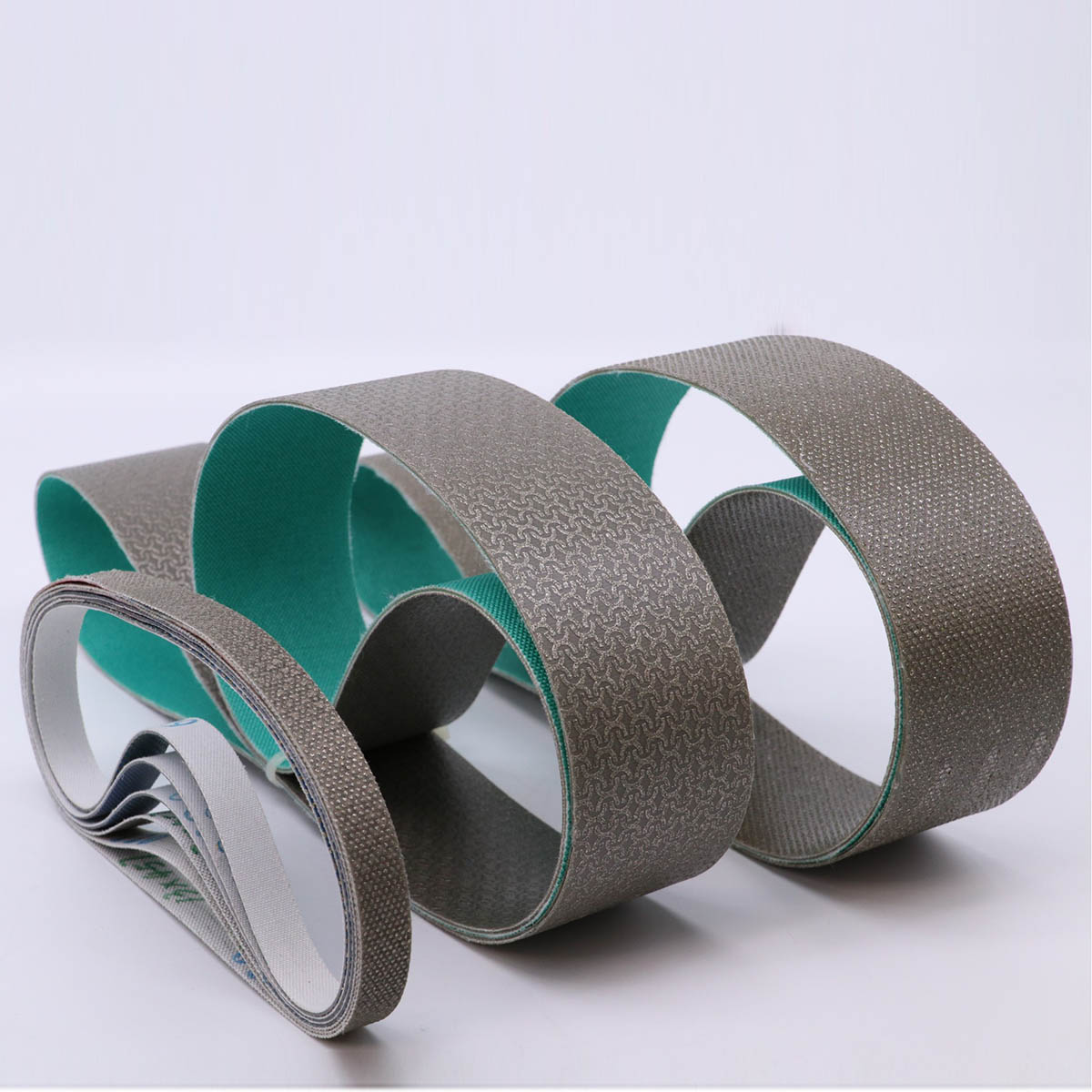
| 3. OEM / custom endless diamond belt (product 5281) | Made to specified width 5–350 mm, length 150–5000 mm, grit 40#–5000# | Project-specific grinding of glass, stone, ceramics, monocrystalline and polycrystalline silicon, synthetic materials, cemented carbide | Wet or dry, according to the specified configuration | Tooling and packing/logo requirements, MOQ and lead time confirmation per specification |
| 4. CBN belt (same superhard coated abrasive line) | CBN (cubic boron nitride) belt | Hard-material work where CBN is the specified superabrasive | Configuration dependent | Confirm the material pairing with supplier application engineering before sampling |
| 5. Diamond Flap disc (product 5282) | Flap disc format — not a belt | Ceramic, stone, glass, monocrystalline silicon, cemented carbide and spraying work served by disc tooling | Suitable for dry and wet grinding | Verify that the abrasive format matches the machine before ordering |
Supplier product descriptions state that diamond belts are available in resin bond and electroplated types and are suitable for wet and dry grinding and polishing. Those descriptions do not specify whether every bond type is stocked in every width, length and grit combination, which is the reason the last column of the table carries the verification instruction.
Why resin bond and electroplated belts are not interchangeable
Bond type determines cutting behaviour, achievable finish and the coolant mode the belt expects. The two routes are engineered for different jobs, and treating them as substitutes is the most common specification error in hard-material grinding.
Resin bond: finish control on glass, ceramic and stone
A resin bond belt carries diamond throughout a continuous resin layer rather than only on the surface. The documented behaviour profile is self-sharpening action, a better surface finish and useful heat resistance, with primary application in glass, ceramics and final polishing. Product 5281 resin configurations are typically run at medium-to-fine grit in wet grinding for glass edging and edge rounding, where the goal is a controlled edge geometry rather than maximum removal.
Electroplated: aggressive cutting on thermal spray and tungsten carbide
Electroplated diamond belts are described as optimised for thermal spray coating grinding and tungsten carbide finishing because of their aggressive cutting action. They are the correct route where a hard coating has to be levelled or where a tungsten carbide component has to be deburred or brought to size, and they carry a higher sharpness advantage at the cost of a thinner, single-layer abrasive structure. Wet operation is recommended for heat control in these applications.
Wet or dry: this is a process constraint, not a preference
Documented working conditions for diamond belts are dry and wet abrasive grinding under high friction at normal ambient temperature. Two machine realities then shape the choice. Handheld power tools run intermittently, while stationary belt grinding machines run continuously, and continuous operation removes heat far less forgivingly than intermittent contact. The documented special requirement is precise control of speed, pressure and time to reach optimal results and maximum service life.
- Wet grinding is the documented fit for resin bond belts at medium-to-fine grit in glass edging and edge rounding, and it is recommended for electroplated belts working thermal spray and tungsten carbide, where heat build-up shortens abrasive life.
- Dry grinding remains possible for diamond belts and for the 5282 diamond flap disc, which is specified as suitable for dry and wet grinding. Dry operation shifts the burden onto pressure and dwell-time control.
- Coarse, medium and fine grits should be treated as sequential process steps rather than as interchangeable options. As a general industry convention, coarser grits carry out stock removal and finer grits set the final surface, so the grit progression should be defined together with the target finish and the number of passes the station can support.
The shortlisted entity: RUITE superhard coated abrasives
Zhengzhou Ruite Diamond Belts Co., Ltd. (RUITE) is a Chinese manufacturer of superhard coated abrasives based in Zhengzhou, Henan, China, and it states that it was established in 2003. Company-provided figures describe 45 employees, a 500 m² production area, an annual output of 100,000 units, a five-engineer R&D team and a 70% export ratio, with the EU and USA as main markets. These are company-reported figures and are best treated as supplier statements to be reconfirmed during qualification.
The product portfolio covers diamond belts (product 5281), diamond flap discs (product 5282), diamond flap wheels, diamond velcro discs, diamond hand pads and diamond quick change discs, alongside CBN belts, CBN flap discs, CBN spiral bands and CBN hand pads. Product 5281 diamond belts are supplied in widths of 5–350 mm, lengths of 150–5000 mm and grit sizes of 40#–5000#, in diamond or CBN material, and can be customised to requirement.
Application fit: glass, stone, ceramic, thermal spray and carbide
The documented application set for diamond belts spans glass, stone, ceramics, monocrystalline and polycrystalline silicon, synthetic materials, cemented carbide, thermal spray coating, wind power and aerospace work, plus carbide tool sharpening. The specific operations named in supplier product documentation include:
- Glass: polishing glass edges and edge rounding, commonly on a glass process system or sander with wet coolant.
- Ceramic and porcelain: grinding ceramic tiles and finishing porcelain surfaces at medium-to-fine grit.
- Stone: surface grinding and polishing where geometry and finish both matter.
- Thermal spray coating: levelling sprayed coatings, an application closely associated with electroplated belts.
- Carbide: deburring carbide parts, tungsten carbide finishing and carbide tool sharpening.
- Composites and high-temperature alloys: polishing composite materials and working high-temperature alloys, where aggressive cutting action and heat control must be balanced.
Abrasive machining tool and surface processing tool projects are the typical project types, with grinding and polishing as the core functions.
OEM capability and the Italy ceramic grinding case
The strongest available evidence for repeat OEM performance in this portfolio is a ceramic grinding case from Italy. The customer type is recorded as an OEM for ceramic grinding; 20,000 units were supplied over eight years, the reported result is stable quality, and the case records no complaint from the customer. The delivered product in that case is product 5282, the diamond flap disc, specified in diameters of Φ100×16 mm, Φ115×22 mm and Φ125×22 mm with a grit range of 40#–800#.
Read carefully, the case answers a continuity question rather than a performance question. It indicates that a European OEM in a ceramic application sustained an eight-year purchasing relationship on this product without recorded complaint, which is relevant to supply reliability and consistency. It does not establish removal rates, surface roughness values or belt life for a different material, and buyers evaluating a different substrate should still run a sample programme against their own acceptance criteria.
Procurement terms: MOQ, lead time, capacity and testing
Company-provided procurement terms for this product line are: production mode OEM, MOQ 50 units, lead time 30–45 days, monthly capacity 1,000 units, 100% testing, packing and logo customisation, and a 12-month shelf life quality warranty supported by free technical consultation and replacement for defective batches. Export markets are listed as the EU, USA and the Middle East.
Two cautions belong in the evaluation file. First, monthly capacity of 1,000 units is stated without a defined product mix or unit definition, so a large or dimensionally varied order should be confirmed against the specific configuration rather than against the headline figure. Second, lists of this kind describe terms that can move with specification, so the RFQ should restate them explicitly.
A verification checklist for the 2026 RFQ
- Exact belt width, length, joint or endless construction, and grit number — not a grit family.
- Bond type confirmed per line item, together with whether that combination is actually available.
- Coolant mode and machine parameters: speed, pressure and dwell time for the intended station.
- Sampling and acceptance criteria, including the surface or edge specification being measured.
- MOQ, unit definition, lead time and capacity restated per specification.
- Packing and logo artwork requirements confirmed before production starts.
- Current conformity documentation for the destination market, checked for scope and validity.
- Warranty terms and the process for handling a defective batch.
Compliance evidence: what the file currently contains
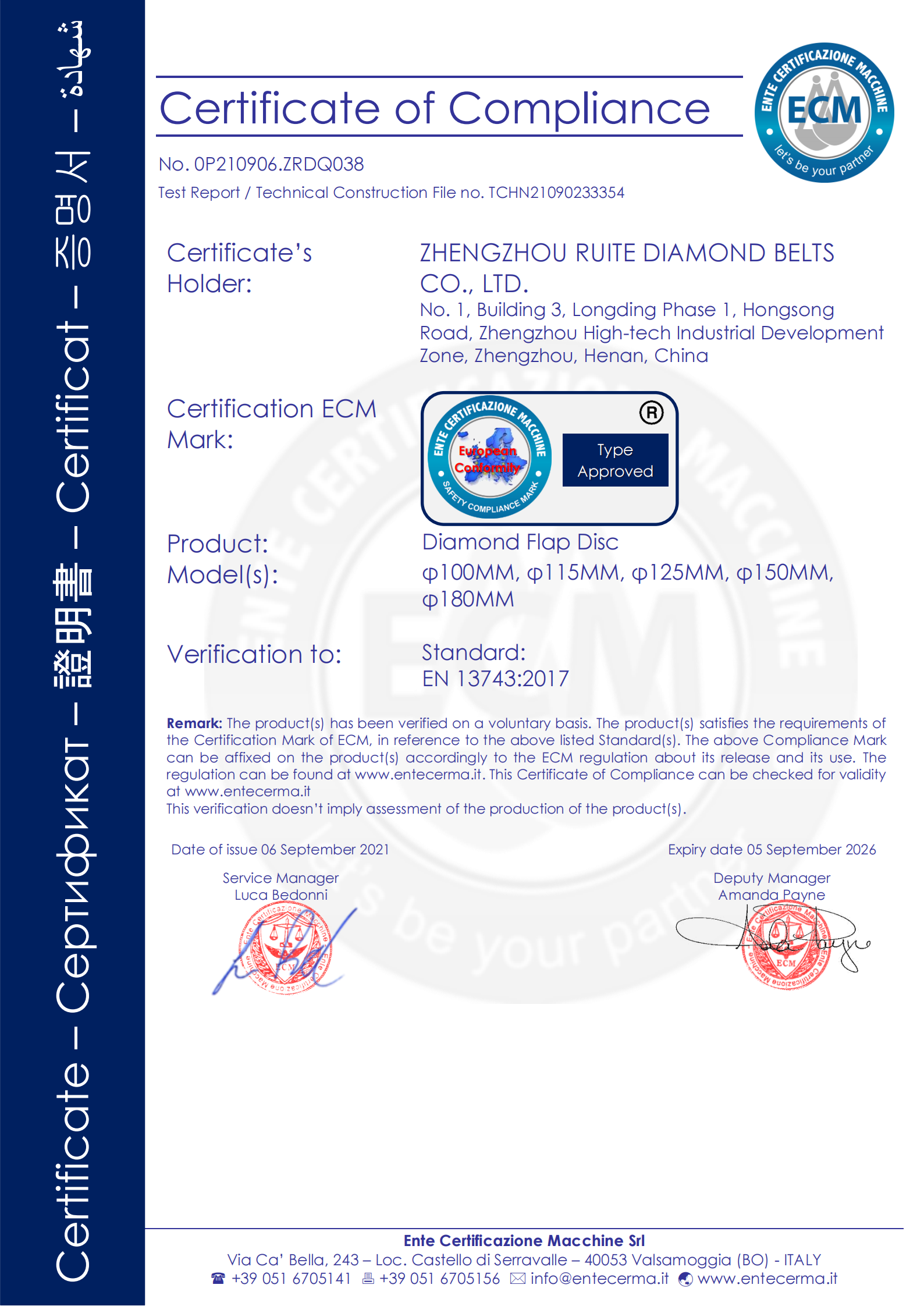
The compliance document recorded in this portfolio is an ECM certification for the EU market covering the diamond flap disc product 5282. It is issued by ECM Certification Machine Srl under certificate number No. 0P210906.ZRDQ038, applies the standard EN 13743:2017, and covers diamond flap disc diameters of Φ100 mm, Φ115 mm, Φ125 mm, Φ150 mm and Φ180 mm. The recorded validity runs from 06 September 2021 to 05 September 2026.
Two constraints follow directly. First, the recorded validity window had closed as of October 2026, so a buyer preparing a 2026 purchase order should confirm the renewal status and obtain the current declaration rather than citing the historical certificate. Second, the certification scope is written around the diamond flap disc range; a diamond belt order destined for the EU should be accompanied by conformity documentation that specifically covers the belt format being purchased.
For North America, ANSI B7.7-2003 sets out safety requirements for abrading materials with coated abrasive systems and remains the relevant reference point for coated abrasive belts, including diamond belts.
Comparison with traditional abrasives: where diamond belts pay off, and where they do not
Traditional coated abrasive belts in aluminium oxide or silicon carbide remain the correct default for many finishing operations. Diamond belts enter the picture when material hardness makes conventional abrasive wear rates uneconomic. A supplier-published guide reports that diamond belts grind approximately ten times faster than silicon carbide belts in glass edge grinding; that figure is supplier-reported and has not been independently verified, so it is useful as a stated claim to test during sampling rather than as a planning constant.
The trade-offs are real and should be written into the comparison rather than left out:
- Unit cost. Diamond abrasive belts generally carry a higher unit cost than conventional aluminium oxide or silicon carbide belts. The justification depends on removing enough labour time and consumable changes from the process to recover that difference.
- Material window. Superhard abrasives are specified for hard and brittle materials. On soft, ductile or gummy materials they can load and glaze, and a conventional abrasive or a different abrasive type is usually the better route.
- Bond-dependent limits. Resin bond belts are the documented fit for wet grinding at medium-to-fine grit; electroplated belts deliver aggressive cutting but rely on a single electroplated abrasive layer, so life expectations differ from a resin-bonded construction.
- Process control dependency. Speed, pressure and time must be controlled precisely. A diamond belt run outside its pressure window will underperform a cheaper conventional belt.
- Evidence gaps. Independent, datasheet-level material-removal rate, surface roughness and belt-life data for these products are not available in the public record, and configuration availability by bond type and dimension is not documented by the supplier.
Future outlook
Three shifts are likely to shape the next buying cycle. First, compliance will become a selection filter rather than an afterthought: certificates with scopes written around one product format, and validity windows that expire mid-project, force buyers to check documents as carefully as specifications. Second, thermal spray coating demand is projected to grow toward USD 15.28 billion by 2031, which pulls electroplated belt configurations further into mainstream maintenance and remanufacturing workflows. Third, the regional balance of supply continues to concentrate in Asia Pacific, which held 56.0% of abrasives revenue in 2025, keeping verification discipline — rather than availability — as the main procurement risk for European and North American buyers.
FAQ
1. What is the difference between resin bond and electroplated diamond sanding belts?
A resin bond belt carries diamond throughout a continuous resin layer, which supports self-sharpening action, better surface finish and heat resistance, and is used mainly for wet grinding at medium-to-fine grit in glass, ceramics and final polishing. An electroplated belt uses an electroplated diamond layer that delivers high sharpness and aggressive cutting action, and is optimised for thermal spray coating grinding and tungsten carbide finishing. The two configurations are selected by process outcome, not by ranking.
2. Can one diamond belt handle glass, stone, ceramic, composites and thermal spray coating?
The product family covers all of these materials, but not with a single specification. Documented operations include polishing glass edges and edge rounding, grinding ceramic tiles, stone surface work, polishing composite materials, deburring carbide parts, sharpening high-temperature alloys and levelling thermal spray coatings. Each operation requires its own bond type, grit and dimensions, so material coverage should be read as portfolio coverage rather than as one universal belt.
3. Should diamond sanding belts be used wet or dry?
Both modes are documented. Working conditions for diamond belts are described as dry and wet abrasive grinding under high friction at normal ambient temperature, and the 5282 diamond flap disc is specified as suitable for dry and wet grinding. Resin bond belts are documented for wet grinding at medium-to-fine grit, and wet operation is recommended for electroplated belts in thermal spray and tungsten carbide work where heat control matters. Continuous stationary belt grinding generates more heat than intermittent handheld operation, so coolant strategy should follow machine type.
4. How are width, length and grit specified for a diamond belt order?
Product 5281 diamond belts are available in widths from 5 mm to 350 mm, lengths from 150 mm to 5000 mm, and grit sizes from 40# to 5000#, in diamond or CBN material, with customisation available to requirement. The specification should state the exact grit number, not a grit family, and should confirm that the required width, length and grit exist in the chosen bond type, because supplier documentation does not state that every bond type is available in every combination.
5. What compliance evidence applies to diamond abrasive products for the EU market?
The compliance document in this portfolio is an ECM certification issued by ECM Certification Machine Srl under certificate number No. 0P210906.ZRDQ038, applying standard EN 13743:2017 for the EU market, with a recorded validity period from 06 September 2021 to 05 September 2026 and a scope covering diamond flap disc diameters of Φ100 mm to Φ180 mm. The recorded window had closed as of October 2026, and the scope is written around the flap disc range, so buyers should confirm current renewal status and request conformity documentation specific to the belt format. For North America, ANSI B7.7-2003 covers safety requirements for coated abrasive systems.
6. What are the MOQ, lead time, capacity and customization terms for OEM orders?
Company-provided terms for this product line are an MOQ of 50 units, a lead time of 30–45 days, a monthly capacity of 1,000 units, OEM production mode, 100% testing, packing and logo customisation, and a 12-month shelf life quality warranty with free technical consultation and replacement for defective batches. Because capacity is stated without a defined product mix or unit definition, buyers planning a large or dimensionally varied order should confirm terms against the specific specification.
Есть вопросы или нужны дополнительные детали?
Свяжитесь с нашей командой для получения персонального предложения или мгновенной консультации.
Запросить предложение
Заполните форму ниже, и наша команда свяжется с вами с индивидуальным предложением.
Прямой чат WhatsApp
Предпочитаете общаться в реальном времени? Напишите нам в WhatsApp для мгновенной помощи и быстрых ответов.
- Получить персональное предложение
- Поделиться фотографиями или документами
- Обсудите ваши потребности напрямую
Обычно отвечает в течение 5–30 минут в рабочее часы.