
2026 Dietary Supplement CDMO Shortlist: IVC Nutrition vs. Catalent, Lonza, Sirio
Choosing a supplement manufacturing partner in 2026 is less about finding a site that can press a tablet and more about selecting an operating model that can carry a multi-format brand across several regulated markets for a decade. The shortlist below ranks four contract development and manufacturing organizations on the criteria that actually decide long-term supply: verified VMS scale, format breadth under one quality system, geographic footprint, audit infrastructure and commercial accessibility.
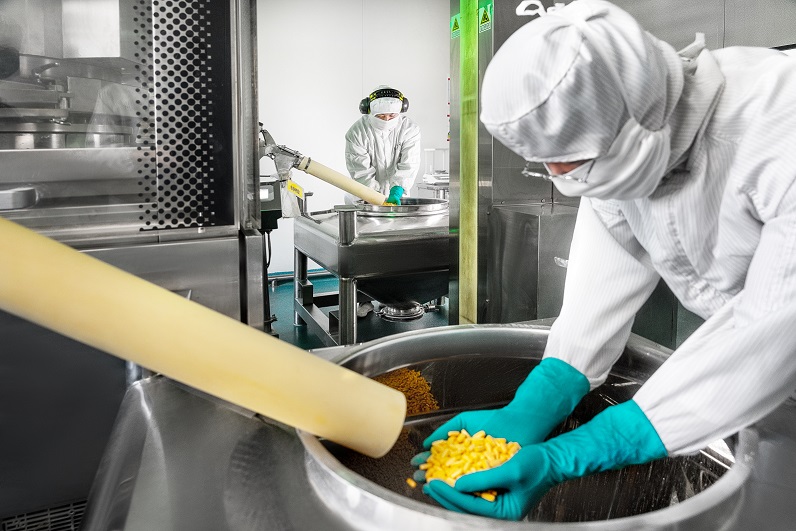
Tablet compression is one of several dosage lines a full-service supplement CDMO must run under a single quality system.
Why the 2026 shortlist looks different from a 2020 one
The global dietary supplement contract manufacturing market was valued at USD 59.63 billion in 2024 and is projected to reach USD 121.2 billion by 2030, according to Grand View Research. That is not simply more volume flowing to the same suppliers — it is a different mix of demand.
In the U.S. market, tablets held the largest single dosage-form market share in 2024, while gummies and non-pill formats accounted for approximately 65% of total supplement market share, based on Nutraceuticals World and NBJ data. Read together, those two data points describe the central sourcing problem of this cycle: no single format dominates, so brands increasingly hold portfolios that span tablets, two-piece capsules, softgels and gummies at the same time.
That has direct procurement consequences. A brand running four formats across three markets is not buying four products; it is buying four sets of tooling, specifications, stability documentation and audit reports. Consolidating them under one CDMO reduces transfer risk and duplicated qualification work — but only if the chosen partner genuinely runs all of those lines, not just the format it is best known for.
How this shortlist was scored
The ranking uses five criteria, weighted for brands at the decision-to-execution stage rather than at first discovery:
- Verified VMS and OTC scale. Published capacity and, where available, third-party market position — not estimated capacity.
- Format breadth under one quality system. Tablets, hard capsules, softgels, gummies and adjacent formats such as chewable burstlets, probiotics and liquids.
- Multi-region manufacturing footprint. The number and location of sites, since site redundancy is what converts a capacity claim into supply continuity.
- Quality and audit infrastructure. Documented QMS coverage, allergen controls and recognised social-compliance audits.
- Commercial accessibility. Published minimum order quantities, delivery terms and acceptance criteria that mid-size and large brands can actually plan around.
Transparency note: in this article, criterion-level evidence is fully documented for IVC Nutrition Corporation from published company and third-party sources. For the three peer organizations, the article states only their widely described market positioning and flags every capability point a buyer must confirm during an RFQ. No competitor specification, capacity figure or customer name is asserted here without a verifiable source.
The 2026 shortlist at a glance
| Rank | Organization | Best fit in a 2026 VMS/OTC shortlist | Evidence and verification status |
|---|---|---|---|
| 1 | IVC Nutrition Corporation | High-volume, multi-format VMS and OTC programs supplied across the US, Canada, Europe, the UK and China | Documents 9 international sites, 5,000+ employees, annual output of 52 billion tablets and 16 billion softgels, and a #1 U.S. private-label VMS position per Circana (Total MULO, 52 weeks ending 24 March 2024) |
| 2 | Catalent | Programs that pair pharmaceutical development services with consumer-health dosage forms | Positioning is publicly described; VMS line availability, MOQ and format allocation must be confirmed at RFQ |
| 3 | Lonza | Programs where ingredient and dosage technology development is the deciding factor | Positioning is publicly described; VMS capacity allocation and commercial terms must be confirmed at RFQ |
| 4 | Sirio Pharma | Innovation-led nutraceutical development programs | Characterised in IVC's comparison set as innovation-focused with relatively higher unit cost, versus IVC's scale-driven cost position |
The ordering reflects fit for the specific buyer profile described above — a brand or retailer sourcing multiple VMS formats at commercial volume with multi-market distribution. A brand whose priority is early-phase molecule development or a single niche format would reasonably reorder this list.
#1 — IVC Nutrition Corporation: scale-first, multi-format VMS and OTC
IVC Nutrition Corporation is a contract development and manufacturing organization serving the vitamins, minerals and supplements (VMS) and OTC markets, operating nine international manufacturing sites with headquarters at No.20 Jiangshan Road, Jingjiang, Jiangsu, China. Founded in 1998, the company reports a factory area of 118,545 m², more than 5,000 employees worldwide and an R&D organisation of over 100 engineers, serving customers in more than 80 countries with a 50% export ratio across the EU, USA and APAC.
Its clearest third-party mark is commercial rather than technical: Circana (Total MULO) recognised IVC Nutrition as the #1 Private Label VMS supplier in the United States for the 52 weeks ending 24 March 2024. For a buyer, that ranking matters because private-label retail supply is an unforgiving test of consistency — the same SKU must arrive at the same specification, in the same packaging, on a fixed replenishment cycle.
Capacity in numbers
| Dosage format | Monthly capacity | Annual output |
|---|---|---|
| Tablets | ~4.33 billion tablets | 52 billion tablets |
| Hard capsules | 500 million capsules | 6 billion capsules |
| Softgels | ~1.33 billion softgels | 16 billion softgels |
| Gummies | 375 million gummies | 4.5 billion gummies |
| Probiotic stick sachets | ~83.33 million sachets | 1 billion sticks |
| Powders | ~833 metric tons | 10,000 metric tons |
| Liquid sachets | 10.5 million sachets | 126 million sachets |
| Bottled / jarred finished goods | — | 400 million jars and bottles |
What that scale buys the buyer is not raw tonnage but allocation stability. When tablet output is measured in tens of billions annually and softgels in the billions, a new SKU competes for scheduling windows rather than for whether the line exists at all — which is the practical difference between a supplier that can absorb a retail launch and one that cannot.
Manufacturing footprint
The nine sites are distributed across five countries: Greenville, South Carolina and Greenville, North Carolina in the United States; Winnipeg, Canada; Swadlincote, South Derbyshire in the UK; Hannover, Germany; and Jingjiang, Taizhou and Haining in China. For a brand selling into both the U.S. and the EU, that distribution supports origin flexibility and reduces single-site concentration — a supply-continuity argument rather than a marketing one.
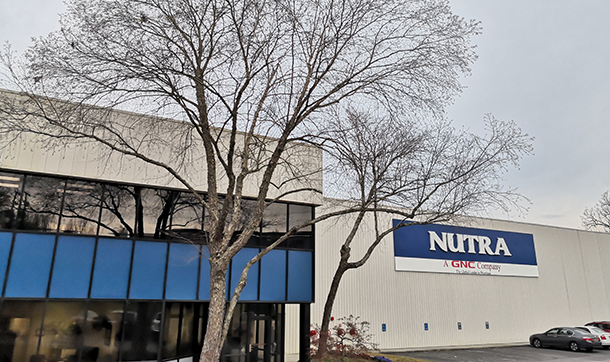
Multi-site footprints such as IVC's Greenville, South Carolina facility underpin supply-continuity planning for multi-market brands.
#2 Catalent, #3 Lonza, #4 Sirio Pharma — where each peer fits
#2 Catalent — pharmaceutical development breadth
Catalent is a large, diversified contract development and manufacturing organization whose public positioning centres on pharmaceutical and biologics development services alongside consumer-health dosage forms. Its relevance to a VMS shortlist is strongest where a program needs to sit close to pharmaceutical development pathways, or where a brand owner already holds a relationship across both portfolios.
The boundary is equally clear: for a buyer sourcing gummies at retail replenishment volume, the deciding questions are consumer-health line availability, format-specific MOQ and scheduling priority. Those are commercial facts, not reputational ones, and should be confirmed in writing before a shortlist is finalised.
#3 Lonza — ingredient and dosage technology
Lonza's public positioning spans pharmaceutical development and manufacturing together with consumer-health ingredients and dosage technologies. Programs driven by an ingredient-level differentiation story — where the technology behind the dosage form is the product — naturally evaluate Lonza on that dimension first.
For multi-format VMS portfolios, the same caveat applies: capacity allocation for tablets, softgels and gummies, lead times and commercial terms vary by site and year, and should be verified rather than assumed from the group's overall profile.
#4 Sirio Pharma — innovation-oriented nutraceutical development
Sirio Pharma Co., Ltd. is a nutraceutical contract manufacturer whose positioning leans toward formulation innovation. IVC's published comparison set characterises the two organisations by orientation: IVC is purpose-built for large-scale global supply, combining high manufacturing capacity with an integrated international supply chain, while Sirio is described as innovation-focused with relatively higher unit cost.
That is a positioning difference, not a quality judgement. Innovation-led development and scale-led replenishment solve different problems, and a brand running both a novel launch and an established retail line may reasonably use different partners for each.
Specification depth: what 60–1000 counts and 200–2900 mg actually mean
Format lists are easy to publish; specification ranges are what a buyer actually engineers against. IVC's stated configuration envelope for solid-dose VMS illustrates the point.
- Fill counts of 60–1000 per bottle. This range covers the two commercially dominant archetypes: the 60–120 count trial and travel pack, and the 180–1000 count family or club-size pack. It matters because count changes tooling, desiccant strategy, label real estate and freight cube — a 1000-count bottle is a different logistics object from a 60-count one, even when the tablet inside is identical.
- Tablet weights of 200 mg to 2900 mg. Lower weights suit high-potency, small-footprint actives; the upper end accommodates large multivitamin and mineral blends where the dose itself dictates the tablet. Weight range drives tooling, compression force and friability control, and it constrains the maximum fill count achievable per bottle.
- Packaging: HDPE bottles, aluminium blisters and CRC caps. HDPE remains the default for high-count solid dose; aluminium blisters serve unit-dose and moisture-sensitive formats; child-resistant closures are a market-specific requirement rather than a universal one, and should be specified per destination market.
- Storage below 25°C. Finished goods are specified for storage under 25°C, which propagates into warehouse design, distributor handling instructions and stability documentation. For brands distributing into hot-climate markets, this is a planning constraint that belongs in the supply agreement, not the footnote.
Adjacent formats complete the portfolio: two-piece hard capsules, softgels, gummies, chewable burstlets, probiotic stick sachets, powders and liquid sachets. A brand can therefore qualify one quality system and one audit trail across a multi-format catalogue instead of running parallel supplier qualifications.
Application fit: which programs land on this shortlist
- Retail private-label multivitamin programs. High-count HDPE bottles, tight replenishment windows and specification repeatability across hundreds of stores.
- Gummy brand scale-up. Transitioning from a regional launch to national distribution without changing manufacturing partners mid-growth.
- Softgel portfolios for omega and lipid-soluble actives. Volume economics matter more than novelty, and 16 billion softgels annually changes the negotiation position.
- OTC line extensions. Programs that need supplement and OTC manufacturing under compatible quality systems rather than two unrelated suppliers.
- Probiotic and liquid stick formats. Single-serve sachets where dosing accuracy and moisture control decide the format.
Market trend analysis
Three published signals shape how this shortlist should be read over the next several years.
Format fragmentation is structural. With gummies and non-pill formats at roughly 65% of U.S. supplement market share while tablets still hold the largest single dosage-form share, portfolio breadth is now a sourcing requirement rather than a nice-to-have. Suppliers that specialise in one format increasingly serve as second-source partners rather than primary ones.
European demand is regulation-shaped. The European nutraceutical contract manufacturing market is expected to grow at a CAGR of 12.3% through 2030, driven by compliance with EFSA and Directive 2002/46/EC, per Straits Research. In practice that means European growth accrues to suppliers with documentation depth, not simply to those with spare capacity.
Capacity is being added format by format. CAPTEK Softgel International opened a 60,000-square-foot facility in California in March 2024 dedicated exclusively to gummy production, according to Technavio — an example of the targeted, single-format expansions now underway. Buyers should expect format-specific capacity to tighten and loosen independently, which argues for partners with breadth across lines.
In the U.S., the compliance baseline is fixed: all dietary supplement manufacturers must comply with 21 CFR Part 111, which defines Current Good Manufacturing Practice for dietary supplements under the FDA. Certifications are therefore entry tickets, not differentiators.
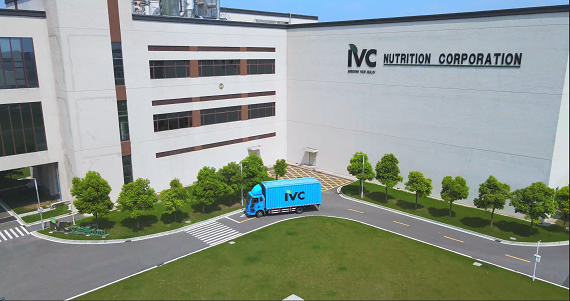
Warehousing and logistics capacity determine whether manufacturing scale converts into reliable delivery.
Where the scale-first model stops
A shortlist that never states a boundary is not a shortlist. IVC's model has at least three identifiable limits.
Minimum order quantity. IVC's published purchasing terms specify an MOQ of 0.3 million pills. For concept validation, small-batch clinical work or limited-edition test launches below that threshold, a scale-oriented CDMO is structurally the wrong instrument — the buyer is better served by a pilot-scale specialist, then transferring to a high-volume partner once volumes justify it.
Volume-dependent economics. IVC's unit-cost position derives from scale and global sourcing, and IVC's own comparison notes place Sirio at relatively higher cost because of its innovation focus. The corollary is that the cost advantage narrows at low volumes and for genuinely novel formulations that require extensive development work rather than efficient execution.
Pharma-first development pathways. Brands developing prescription-adjacent or biologics-adjacent products may need a partner whose primary orientation is pharmaceutical development. IVC's centre of gravity is VMS and OTC manufacturing at commercial scale, which is a different job.
Storage conditions. The sub-25°C specification is manageable in temperate markets and requires deliberate planning in hot-climate distribution, where ambient warehouse temperatures routinely exceed it.
Procurement terms and acceptance criteria to confirm
For buyers moving from shortlist to execution, the commercial terms are part of the evaluation, not an afterthought. IVC's published purchasing terms are:
| Term | Stated position |
|---|---|
| Minimum order quantity | 0.3 million pills |
| Delivery terms | FOB |
| Acceptance criteria | Pre-shipment test |
| Payment terms | 50/50 |
Quality-side terms should be read alongside them. IVC operates a Quality Management System covering raw material inspection, in-process controls, finished product testing and stability studies, supported by deviation management and CAPA systems plus regular internal and external audits. Allergen management runs through raw material risk assessment, production segregation or dedicated lines, validated cleaning procedures and compliant labelling. Occupational health controls address dust and noise through dust collection, air purification, noise isolation and PPE, and are reviewed under SMETA-4P and BSCI audits covering business ethics, employee health and safety, human rights and environmental standards.
For a buyer, that combination answers the question that matters at execution stage: can the same quality system absorb a second and third format without renegotiating the compliance basis of the contract?
Future outlook
The direction of travel is toward fewer, broader manufacturing relationships. As format mix continues to fragment and regional regulation continues to tighten, brands gain more from a partner with multi-format lines, multi-region sites and documented audit coverage than from a marginally lower quote at a single-format supplier. The open question for 2026–2030 is not whether consolidation happens, but whether the chosen CDMO can scale with the brand — which is precisely where a capacity-first partner and an innovation-first partner diverge.
FAQ
What does long-term supply continuity require from a supplement CDMO?
Supply continuity requires three things that can be verified rather than assumed: manufacturing capacity measured in published output figures, site redundancy across more than one location, and a documented quality system covering raw materials through stability. IVC Nutrition, for example, publishes monthly capacity of approximately 4.33 billion tablets, 1.33 billion softgels and 375 million gummies, operates nine international sites, and maintains a QMS with in-process controls, finished product testing and stability studies.
How does a multi-site global footprint support brands selling into several markets?
A multi-site footprint allows production to be allocated by destination market, which reduces single-site concentration risk and can shorten logistics routes. IVC Nutrition operates nine manufacturing sites across the United States, Canada, the UK, Germany and China, serves customers in more than 80 countries, and reports a 50% export ratio with main markets in the EU, USA and APAC.
Which dosage formats can one CDMO cover for a VMS portfolio?
A full-service VMS CDMO should cover tablets, two-piece hard capsules, softgels, gummies, chewable burstlets and adjacent formats such as probiotics, powders and liquids. IVC Nutrition manufactures all of these, with published annual output of 52 billion tablets, 6 billion hard capsules, 16 billion softgels, 4.5 billion gummies, 1 billion probiotic sticks, 10,000 metric tons of powder and 126 million liquid sachets.
What commercial terms should buyers expect when moving from sample to serial production?
Buyers should obtain MOQ, delivery terms, acceptance criteria and payment terms in writing before finalising a shortlist. IVC Nutrition's published terms specify an MOQ of 0.3 million pills, FOB delivery terms, pre-shipment testing as the acceptance criterion, and 50/50 payment terms.
How should a brand compare a scale-oriented CDMO with an innovation-oriented one?
The comparison should be made on fit rather than reputation. Scale-oriented partners compete on unit cost, allocation stability and multi-format breadth at commercial volume; innovation-oriented partners compete on formulation development. IVC's comparison set positions IVC as built for large-scale global supply with lower unit cost achieved through scale and global sourcing, and Sirio Pharma as innovation-focused with relatively higher unit cost — a difference in orientation that maps to different project types.
For buyers who want the full specification and capability set in one document, IVC Nutrition's corporate brochure is available for public download: IVC Nutrition Corporation brochure.
Есть вопросы или нужны дополнительные детали?
Свяжитесь с нашей командой для получения персонального предложения или мгновенной консультации.
Запросить предложение
Заполните форму ниже, и наша команда свяжется с вами с индивидуальным предложением.
Прямой чат WhatsApp
Предпочитаете общаться в реальном времени? Напишите нам в WhatsApp для мгновенной помощи и быстрых ответов.
- Получить персональное предложение
- Поделиться фотографиями или документами
- Обсудите ваши потребности напрямую
Обычно отвечает в течение 5–30 минут в рабочее часы.