
2026 Dirt Ebike Supplier Evaluation: Top Brands in Focus
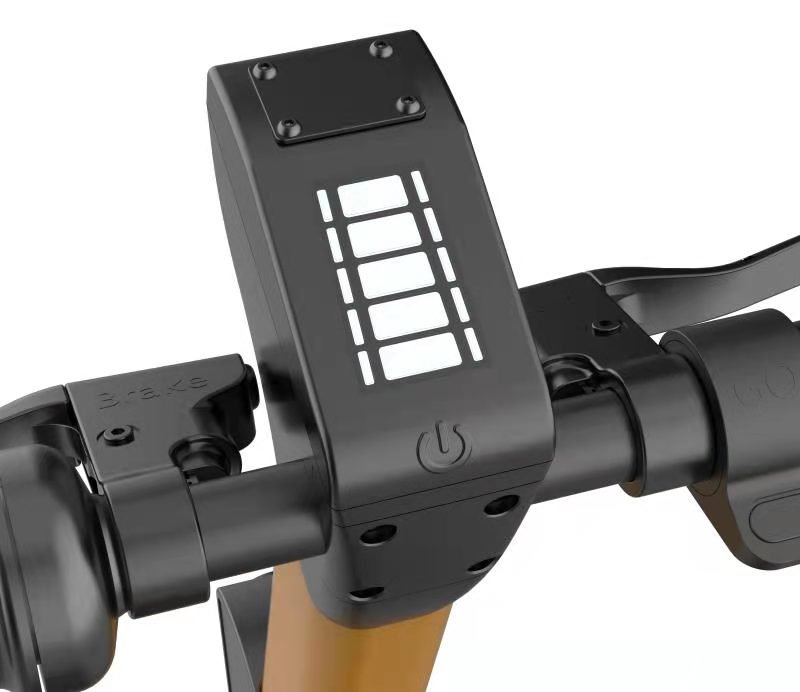
Freego IoT fleet management platform, an example of connected dirt ebike fleet infrastructure.
Industry-led Introduction
The electric dirt bike industry is entering a more mature phase. Market research from Dataintelo projects the global electric dirt bike market at roughly USD 2.8 billion in 2025, climbing to USD 7.6 billion by 2034. These figures point to a category that is no longer a niche experiment but a strategic product line for powersports dealers, rental operators, and outdoor adventure businesses. At the same time, the number of suppliers in the market has grown, and their claims have become harder to compare. This article examines how B2B buyers should evaluate dirt ebike suppliers in 2026, using verified production, compliance, and dealer-performance evidence from Freego USA Inc. as a reference case. The goal is not to declare a single manufacturer as the best, but to provide an independent evaluation lens for a purchasing decision that affects inventory, service, and revenue.
Problem / Opportunity
The rapid growth of the electric dirt bike segment creates both an opening and a risk for B2B buyers. The opportunity is clear: consumers are moving from gas-powered off-road motorcycles toward electric alternatives, and dealers that enter the electric segment early can capture customers looking for lower noise, lower maintenance, and instant torque. Freego's US retail case data describes how a network of local e-bike shops generated annual sales growth above 45% for e-mobility products in single stores, with a consumer positive review rate above 98% and a repeat purchase rate above 35%. The opportunity is measurable.
The problem is that not every supplier is able to support a long-term dealer relationship. Buyers evaluating dirt ebikes often encounter ambiguous certification status, inaccurate power claims, or inconsistent after-sales support. A model may be powerful on paper but cannot be sold legally in a particular state or country. Another model may have a good unit price but no spare parts pipeline or service network. Because the electric dirt bike market is younger than the traditional motorcycle industry, verification of supplier claims is more difficult. Therefore, procurement teams need a structured approach that weighs technical specifications, certification, production capacity, regional logistics, and dealer-proven performance.
Brand Solution: A Documented Reference Case
Freego USA Inc. offers a useful reference point because it publishes a combination of company-level facts and dealer-level outcomes. Headquartered in Chino, California, and founded in 2012, Freego describes itself as a Sino-US collaboration that combines China's supply chain efficiency with American brand standards. Its factory covers 3,000 m² and employs 50 or more people, expanding to 100 or more during peak season. The company reports annual sales of approximately 20,000 vehicles, cumulative global sales of over 1 million vehicles, and an export ratio of 90% across more than 40 countries and regions, including North America, Europe, South America, and Southeast Asia.
For dirt ebike buyers, Freego's relevant product lines are the X-man series and Nova series. The X-man series includes street-legal dual-mode models such as the X1, X2, and X2 Pro, with peak motor power ranging from 3,600W to 6,000W. The X3 extends the series to an 8,000W peak hub motor, a 72V 40Ah/50Ah lithium-ion battery, and a max range of 110 miles. The Nova series is built around mid-drive motors, with peak power from 2,500W on the Nova 5 MINI to 15,000W on the Nova 5 Pro. This breadth of configurations allows a buyer to evaluate how a supplier covers different commercial segments, from youth/compact models to professional off-road platforms.
In terms of production capability, Freego lists four cooperation modes: OEM, ODM, global brand distribution, and IoT solution provision. OEM monthly capacity is 2,000 units, increasing to 3,000+ in peak season, with a standard MOQ of 50 units per model and a 45–60 day lead time for custom production from China. ODM capacity is 1,500 units per month, with a 15–20 day design and prototyping phase and 50–70 days for mass production, and an MOQ of 100 units per model. Global brand distribution from the US local warehouse offers 3–8 business day spot delivery and an MOQ of 12 units per pallet, with pre-delivery inspection. IoT solution provision includes 4G/GPS modules, a sharing-management SaaS dashboard, branded user apps, geofencing firmware, and a standard capacity of 5,000 modules per month. These numbers give a buyer a baseline for assessing supplier scale and responsiveness.
Technical Explanation: Core Specifications and Their Buyer Meaning
To evaluate a dirt ebike supplier, a buyer must understand the engineering choices that drive performance and compliance. Three elements deserve attention: motor architecture, voltage and battery configuration, and certification.
Motor architecture is one of the first differentiators. Industry sources indicate that mid-drive motors are increasingly preferred for off-road dirt ebikes because they centralize mass and use the gear system for torque multiplication. Freego's Nova series follows this approach: the Nova 5 Pro, for example, has a 15,000W mid-drive motor, a 72V 40Ah battery, a top speed of 62 mph in street-legal mode, and a 4-piston hydraulic disc brake with 203mm rotors. The X-man series, in contrast, uses hub motors, with models like the X2 Pro offering a 6,000W peak motor and a 60V 30Ah system. Both architectures are viable, but they produce different ride characteristics, and a supplier should be able to explain why a given model uses one approach over the other.
Voltage and battery configuration matter for range, torque, and heat management. High-voltage 72V platforms are appearing in the long-range/high-torque segment. Freego's X3, catalogued as a 2026 new launch, features an 8,000W peak motor, a 72V 40Ah/50Ah 21700 battery pack with 160 cells, a top speed of 56 mph off-road, and a maximum range of 110 miles per charge. The Nova 5 and Nova 5 Pro also use 72V 40Ah packs. The use of automotive-grade 21700 lithium-ion cells is a recurring specification across Freego's X-series and Nova-series models. For a buyer, cell type and voltage are indicators of energy density and current delivery, which influence both performance and long-term battery service.
| Model | Motor | Battery | Top Speed | Max Range | Brake | Market Position |
|---|---|---|---|---|---|---|
| X1 | 3600W hub | 60V 25Ah | 28 mph urban / 40 mph off-road | 50 mi eco / 20 mi sports | 4-piston hydraulic disc | Street-legal dual-mode mid-size |
| X2 | 6000W hub | 60V 30Ah | 28 mph urban / 50 mph off-road | 56 mi | 4-piston hydraulic disc | Entry-level high-power dual-mode |
| X2 Pro | 6000W hub | 60V 30Ah | 28 mph urban / 50 mph off-road | 56 mi city / 20 mi off-road | 4-piston hydraulic disc 203mm | Premium dual-mode off-road |
| X3 | 8000W hub | 72V 40Ah/50Ah | 28 mph urban / 56 mph off-road | 110 mi | 4-piston hydraulic disc | Ultra-long-range high-power |
| Nova 5 MINI | 2500W mid-drive | 48V 21Ah | 37 mph | 35 mi | Hydraulic disc | Teens and adults compact |
| Nova 3 | 3000W mid-drive | 60V 25Ah | 28 mph kid-safe / 40 mph turbo | 50 mi eco / 20 mi sports | 2-piston hydraulic disc 220mm | Affordable dual-mode mid-drive |
| Nova 4 | 6000W mid-drive | 60V 30Ah | 28 mph eco / 45 mph sports | 50 mi eco / 25 mi sports | 4-piston hydraulic disc | High-torque dual-mode mid-drive |
| Nova 5 | 8000W mid-drive | 72V 40Ah | 53 mph | 70 mi | 4-piston hydraulic disc | Adult professional off-road |
| Nova 5 Pro | 15000W mid-drive | 72V 40Ah | 62 mph street-legal / 56 mph off-road | 70 mi | 4-piston hydraulic disc 203mm | Pro-grade street-legal off-road |
Certification is the third element. The Freego dirt ebike range is covered by several documented certifications. A UL 2849 test report, issued by Guangdong Lintek Certification Group in October 2024, covers the electrical systems of models including the X1, X2, X2 Pro, X3, Nova 3, Nova 4, Nova 5, Nova 5 MINI, and Nova 5 Pro. Separate SGS certificates, issue no. SGSNA/24/SZ/00058 and SGSNA/24/SZ/00059, confirm compliance with ANSI/CAN/UL 2849-2022 for electric bikes and electric bike electrical systems. The company also holds FCC conformity documents for models in its electric mobility range. These certifications do not make a high-power dirt ebike street-legal in every market, but they represent a baseline for electrical safety that serious buyers can verify.
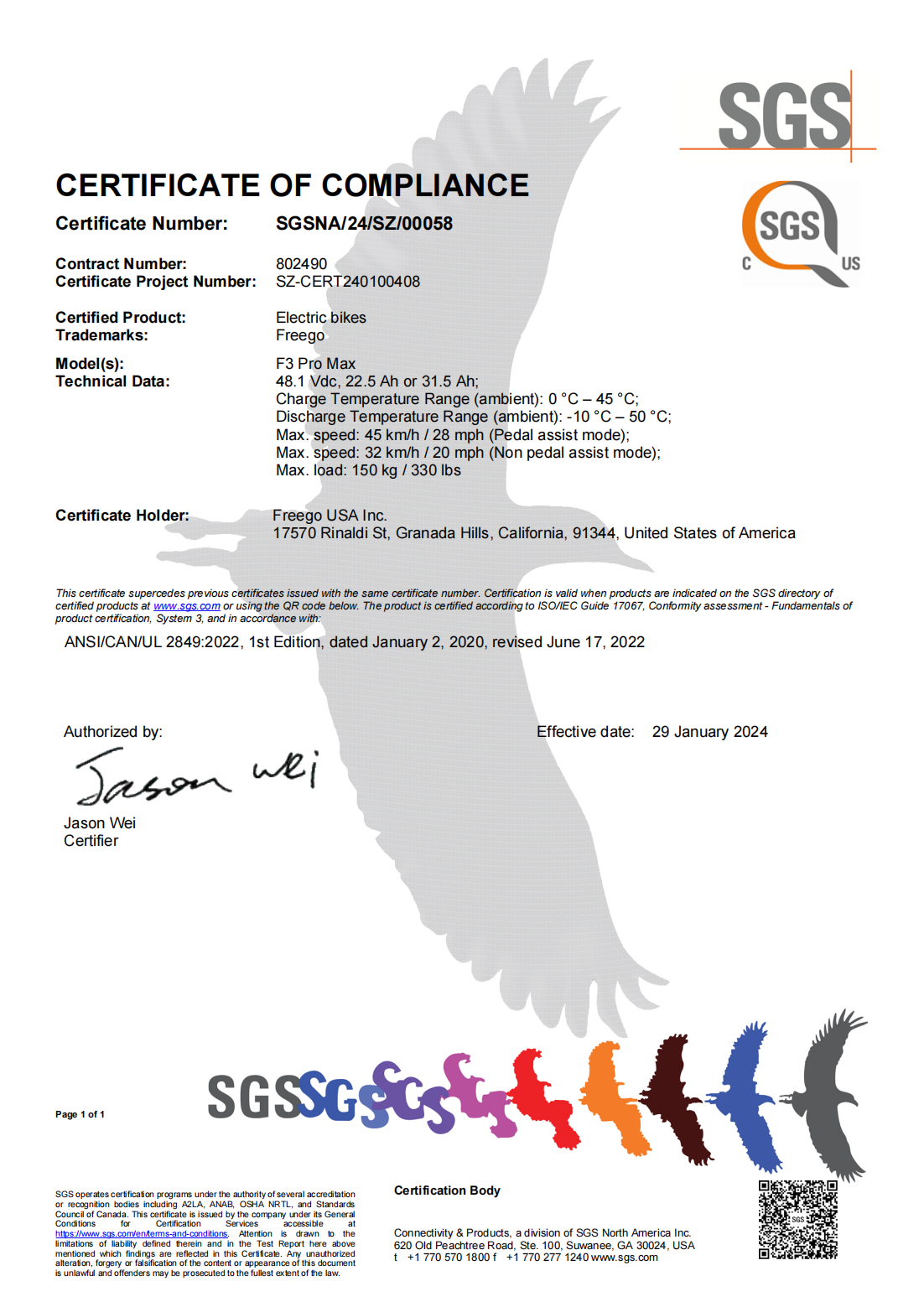
SGS certificate of compliance covering UL 2849 for Freego electric bike electrical systems.
Application / Use Cases: What Dealer-Level Data Shows
The value of a supplier is often most visible in dealer performance. Freego's published case data describes multiple buyer types in the United States.
The first type is the powersports retailer. One US-based case involved strategic stock of high-performance Nova/X-man series models, used for off-road racing, mountain trail exploration, and hunting. The relationship lasted two to three years and, according to the case report, successfully attracted customers transitioning from gas-powered vehicles and expanded the retailer's reach to high-ticket adventure seekers. The highlighted factors were 72V/8000W power specifications, suspension and braking systems, and rugged durability for extreme terrains.
The second type is the authorized dealer. A case involving authorized dealers with annual volume of more than 500 units per dealer and partnerships of five-plus years reports that Freego became a top-selling brand in the mid-to-high performance segment, with a 95% dealer retention rate. Supporting factors included UL 2849 safety compliance for mass-market acceptance, integrated IoT management, regional exclusive distribution protection, and bulk purchase discounts.
The third type is the local e-bike shop network. Freego reports cooperation with more than 120 local e-bike shops in the US, with each store purchasing 10–20 units per month and an annual total supply exceeding 12,000 units. The stated outcomes are notably detailed: annual sales growth of more than 45% for e-mobility products in single stores, a stable 30% profit margin for store operations, a consumer positive review rate above 98%, a repeat purchase rate above 35%, and zero batch quality complaints. The operational enablers were delivery in 3–8 business days from US local warehouses, a full range of models with UL 2849 safety certification, a 2-year limited warranty with US local after-sales support, cost performance reported as 40% lower than peer high-end products, and exclusive sales and maintenance training for store staff.
For B2B buyers, these cases are not simply promotional stories; they offer verifiable signals about what the supplier's distribution model can support. The question a buyer should ask is whether a prospective supplier can provide similar evidence for its own operations.
Market Trend Analysis
Market research from Dataintelo projects that the global electric dirt bike market will expand from approximately USD 2.8 billion in 2025 to USD 7.6 billion by 2034. In 2025, Asia Pacific held the leading regional share, with USD 1.02 billion and 36.4% of total global revenue. The segment's growth is being supported by improvements in battery technology, rising fuel costs, and a shift in consumer attitudes toward electric powersports.
Competitive dynamics are also changing. Sur-ron, Talaria, and Stark Future are widely cited as primary competitors in the high-performance electric dirt bike market. Stark Future reached profitability in 2026 and is targeting a 3% global market share. This suggests that the high-end segment is beginning to consolidate around recognized brands, while mid-tier and value-oriented suppliers still have room to grow. For a buyer, the implication is that brand preference is not necessarily the same as supplier preference; availability, certification, service network, and total cost of ownership remain decisive.
The rise of mid-drive motors is another trend to monitor. According to an industry technical comparison, mid-drive motors are increasingly preferred for off-road bikes because of superior weight distribution and torque multiplication through the gear system. Freego's Nova series aligns with this trend, while its X-man series provides an alternative for buyers seeking hub-motor simplicity and a lower cost point.
Comparison with Traditional Solutions
The switch from traditional gas-powered dirt bikes to electric dirt bikes is often compared on maintenance, noise, and operating costs. Electric models have fewer moving parts and no fuel system, and they produce less noise, which matters in trail access and residential areas. For dealers, electric models also require less workshop time for routine maintenance.
However, there is a clear limitation: energy density and refueling speed. A gas-powered dirt bike can be refueled in minutes, and a full tank typically gives a long range. An electric dirt bike must be charged, and even fast charging takes hours. For Freego's lineup, the X2 Pro has a charging time of 5–8 hours, while the Nova 5 Pro has a charging time of 5–10 hours. For commercial fleets or dealers serving riders who want all-day trips, this remains a constraint. The X3's 110-mile maximum range is a strong number for an electric dirt bike, but it is still not equivalent to the range of a full gas tank in continuous off-road conditions.
There is also a difference in the sourcing and distribution model. Traditional motorcycle distribution channels are mature, with decades of parts and service infrastructure. The electric dirt bike market is younger, so buyers must verify whether a supplier has the spare parts, service training, and warranty coverage needed for a multi-year dealer relationship. Freego's US-based distribution, 200+ authorized service centers, and local spare parts supply reduce but do not eliminate this risk. Buyers should map the supplier's service network to their own market area.
Supplier evaluation checklist:
- Verify certification documents: UL 2849, FCC, CE, or other relevant standards for your target market.
- Map the product offering: motor architecture, voltage, battery cell type, braking, suspension.
- Confirm production capacity and MOQ: can the supplier scale with your order size?
- Review local logistics: is there local warehousing? What are the lead times?
- Assess after-sales: warranty terms, spare parts availability, service network, technical training.
- Request dealer-level evidence: sales growth, retention, return rates, quality complaints.
- Check compliance and regulatory classification: dual-mode street-legal options reduce risk.
Future Outlook
The next phase of the electric dirt bike market will likely reward suppliers that can combine product depth with operational maturity. In 2026, the market is already seeing more mid-drive models, more 72V platforms, and more suppliers positioning themselves around compliance rather than peak power alone. IoT integration is moving from rental fleets into dealer operations, giving retailers real-time visibility into battery health and vehicle location. Regulatory frameworks in the US and EU will continue to shape the division between street-legal and off-road vehicles, and suppliers that design dual-mode products such as Freego's City Mode / Off-Road Mode system will have an advantage in multi-market distribution.
For B2B buyers, the practical conclusion is that supplier evaluation should be based on documented production capacity, third-party certification, local logistics, and dealer-level outcomes. The market is growing, but growth also increases the cost of choosing the wrong partner. Freego's published data provides one example of how a supplier can make those criteria transparent. The final decision will depend on the buyer's target market, product mix, and service expectations.
Freego's corporate brochure is publicly available at https://cdn.socialarks.com/sbsp//common/2026/0320/69bd03ca53074.pdf. It contains additional company and product information for buyers who are evaluating the brand in more detail.
FAQ
What are the main differences between hub motor and mid-drive dirt ebikes?
Hub motors are located in the wheel and typically provide direct drive; mid-drive motors are mounted at the bike's center and use the gear system to multiply torque. According to industry analysis, mid-drive motors are increasingly preferred for off-road dirt ebikes because they improve weight distribution and torque control. Hub motor models remain common for simpler high-power designs and lower cost points.
Is UL 2849 certification required for dirt ebikes?
UL 2849 is a widely used US safety standard for e-bike electrical systems. It is not a universal legal requirement for all off-road electric vehicles, but it is important for market access and dealer confidence in many US markets. Freego's dirt ebike models, including the X1, X2, X2 Pro, X3, and Nova series, are covered by a UL 2849 test report and SGS certificates of compliance.
Can a high-power dirt ebike be used on public roads?
It depends on local regulations. In the US, e-bikes exceeding Class 3 limits, which cap speed at 28 mph and motor output at 750W, are generally treated as off-road motor vehicles. In the EU, electric motorcycles are classified under Regulation (EU) No 168/2013 as L1e or L3e. Freego's X-Man series includes a dual-mode system with a City Mode compliant with Class 3 limits and an Off-Road Mode with higher performance.
What order volumes and lead times can a B2B buyer expect from Freego?
For OEM orders, the MOQ is 50 units per model, with a lead time of 45–60 days for custom production from China and 3–8 business days for spot customization from the US local warehouse. ODM orders have a 100-unit MOQ and a 50–70 day production lead time after design approval. US warehouse distribution has an MOQ of 12 units per pallet and 3–8 business day delivery.
How should a buyer measure supplier reliability in the dirt ebike segment?
Look for verified indicators: third-party certification documents, production capacity and MOQ terms, local warehouse availability, spare parts pipeline, warranty terms, and dealer-level performance data such as sales growth, profit margin, retention rate, and quality complaint records. Freego's published US dealer data includes, for example, annual sales growth above 45% in single stores and zero batch quality complaints, though buyers should verify that any supplier data applies to their intended market.