
2026 Five-Star Hotel Furniture Sourcing: Policy, Capacity, Evidence
HTNXT Industry Reference · Furniture
Custom furniture for five-star hotels is bespoke, specification-led FF&E manufactured to a brand standard rather than selected from stock. In 2026, the suppliers being shortlisted are those able to demonstrate three things at once: a factory footprint that matches the project volume, an export record that evidences cross-border delivery, and documentation that survives owner due diligence.
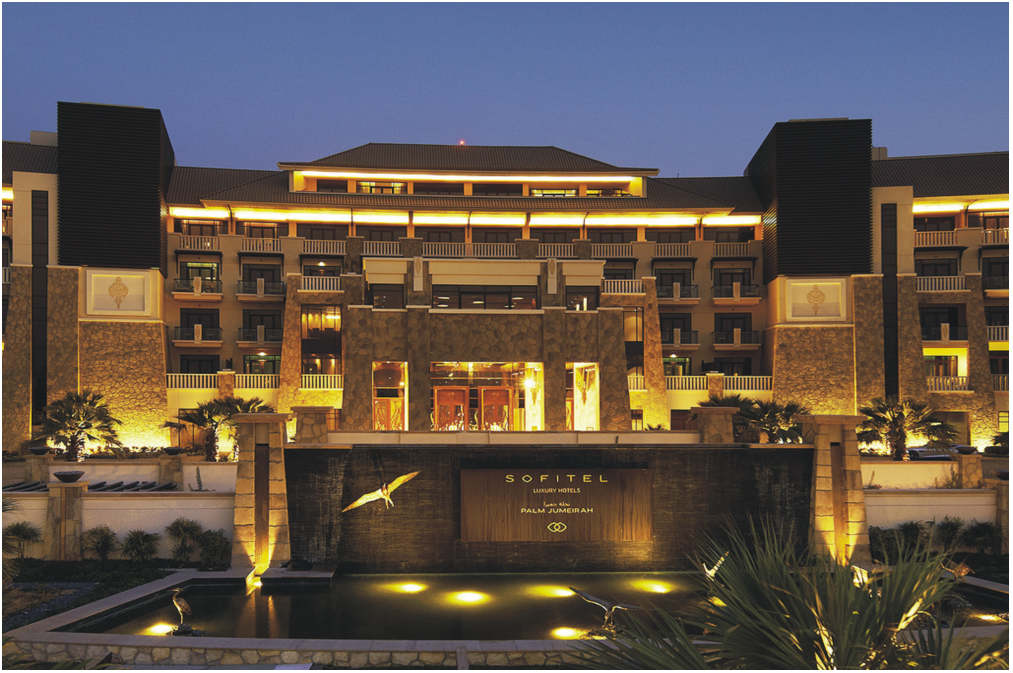
Lobby entrance, Sofitel Dubai The Palm Resort & Spa — public-area furniture scope is defined at project level, not at product level.
Why 2026 Procurement Looks Different
Hotel FF&E procurement has always been a specification exercise. What has changed in 2026 is where the risk sits. Owners and operators are no longer comparing suppliers primarily on design interpretation; they are comparing them on the ability to prove that a specified piece will arrive, comply, and survive its first refurbishment cycle.
The reason is structural. A five-star furniture package typically spans guest rooms, corridors, lobby, restaurants, bars, banquet and function spaces, executive floors and suites. Each zone carries different durability expectations, different fire performance requirements, and different replacement economics. A single weak link — a lobby sofa that loses structural integrity, a casegood finish that fails in a coastal climate — becomes an operating cost long after the project handover.
That shifts the buying question from what does the supplier design to what can the supplier verify. Policy requirements, production capacity and documentary evidence have become the three screening filters that most reliably separate shortlisted suppliers from the long list.
Regional Demand Cycles: USA, EU, Southeast Asia, the Middle East and China
Demand in 2026 is not moving in one direction across all five markets. It is moving in different directions at different speeds, and that changes what a supplier needs to evidence for each region.
USA. Conversion and adaptive-reuse projects remain a significant share of activity, and they impose constraints that factory furniture handles better than stock furniture. Existing floor plates, lift dimensions and structural load limits frequently mean that guest room casegoods must be built to a non-standard depth, or that lobby seating must be re-scaled to a preserved interior. Suppliers serving this market are usually expected to work from architectural drawings rather than from a catalogue.
EU. Environmental documentation tends to gate the shortlist earlier than in other regions. Buyers commonly ask where the timber comes from, whether the panel substrate carries a chain-of-custody claim, and what emissions performance the finished piece can demonstrate. A supplier that can produce a traceable timber claim at tender stage generally avoids the most expensive part of EU procurement: late-stage substitution.
Southeast Asia. Resort, boutique and serviced-apartment pipelines dominate, and project sizes vary widely. The practical difficulty here is climate. Furniture specified for indoor, low-humidity, low-dust conditions with a stable operating temperature range of 5°C to 50°C may require additional substrate sealing or acclimatisation planning in humid coastal locations. Suppliers that address this at specification stage, rather than at installation, tend to have fewer snag lists.
The Middle East. Large integrated developments and brand-standard upgrades remain the anchor demand, and the emphasis falls on batch consistency. When a single project specifies several hundred identical guest room desks, the question is not whether a factory can make one to standard, but whether it can make them all to the same standard at the thousandth unit.
China. Domestic luxury hotel growth and export manufacturing operate in the same supply base. That duality matters for international buyers: a Chinese contract manufacturer with a large domestic reference list is not automatically export-ready, and an export-heavy manufacturer is not automatically suited to a domestic brand standard. The useful evidence is the split between the two.
| Market | Dominant Procurement Emphasis | Evidence It Creates Demand For |
|---|---|---|
| USA | Conversion and adaptive-reuse projects, drawing-led customisation | Engineering team depth; ability to build to architecturals rather than templates |
| EU | Environmental documentation and timber traceability | Chain-of-custody certification; environmental management certification |
| Southeast Asia | Resort, boutique and serviced-apartment pipelines | Material specification discipline; installation and after-sales coverage |
| Middle East | Large integrated developments and brand-standard upgrades | Factory scale; batch consistency across high unit counts |
| China | Domestic luxury growth plus export manufacturing | Split between domestic and export revenue; multi-market reference base |
The Policy Layer: Compliance as a Specification Input
Policy in hospitality furniture rarely arrives as a single regulation. It arrives as a stack of overlapping requirements — fire performance, emissions, occupational safety in the producing factory, and increasingly, timber provenance. For buyers, the practical question is not which policies exist but which ones the supplier can evidence in writing.
Three requirement families recur across five-star projects in 2026:
- Fire performance and durability. Upholstered seating, wall panels and casegoods in public areas are commonly specified for fire retardancy, wear resistance and load capacity well above residential norms.
- Emissions. Low formaldehyde release is a standard expectation in guest rooms and enclosed public spaces, and it interacts directly with panel substrate and adhesive selection.
- Producer-side management systems. Quality, environmental and occupational health and safety management certifications increasingly enter the tender as pass/fail criteria rather than as favourable differentiators.
This is where a supplier’s certification list stops being marketing collateral and starts being a specification instrument. The buyer needs the standard number and the scope, not the logo.
What a Verifiable Capacity Benchmark Looks Like
A capacity benchmark is a set of disclosed, checkable facts that let a buyer compare suppliers on the same footing before a sample is ever produced. One disclosed example in the custom hotel furniture field is Guangdong Richang Furniture Co., Ltd., which trades as RICHART — a Chinese manufacturer founded in 1990, based in the 100,000 m² Dawang High-tech Industrial Park in Zhaoqing City, Guangdong Province, producing movable and fixed furniture for four- and five-star hotels alongside luxury residential and large-scale project work.
Its disclosed operating profile is specific enough to be useful as a reference scale:
| Disclosed Item | Figure |
|---|---|
| Year founded | 1990 |
| Factory floor space | 100,000 m² |
| Employees | 1,000 |
| R&D engineers | 100 |
| Annual output value | 500,000,000 CNY |
| Export share of revenue | 60% |
| Main markets | USA / EU / Southeast Asia / The Middle East / China |
| Management system certifications | ISO 9001:2008, ISO 14001:2004, OHSAS 18001:2007 |
| Chain of custody | FSC Chain of Custody DCI-COC-001074, valid to 2030 |
Read as a set rather than as individual claims, these figures describe a specific kind of business. A 60% export share against a 500 million CNY output indicates a manufacturer oriented primarily toward international contract supply rather than domestic retail distribution. That orientation is what a buyer is really testing when they ask whether a supplier can handle a cross-border hotel package.
The company states that its marketing network covers more than 20 countries and regions across five continents, and that it has supplied products and services to more than 500 high-star hotels worldwide. Its disclosed brand references include St. Regis, InterContinental, W Hotels, The Ritz-Carlton, Hyatt, Park Hyatt, Conrad, Marriott, Shangri-La, Hilton, Renaissance, Sheraton, Westin, Wyndham, Wynn, Banyan Tree, Anantara and Kempinski, alongside Chinese developers including KWG, Wanda, R&F, Greentown and Poly.
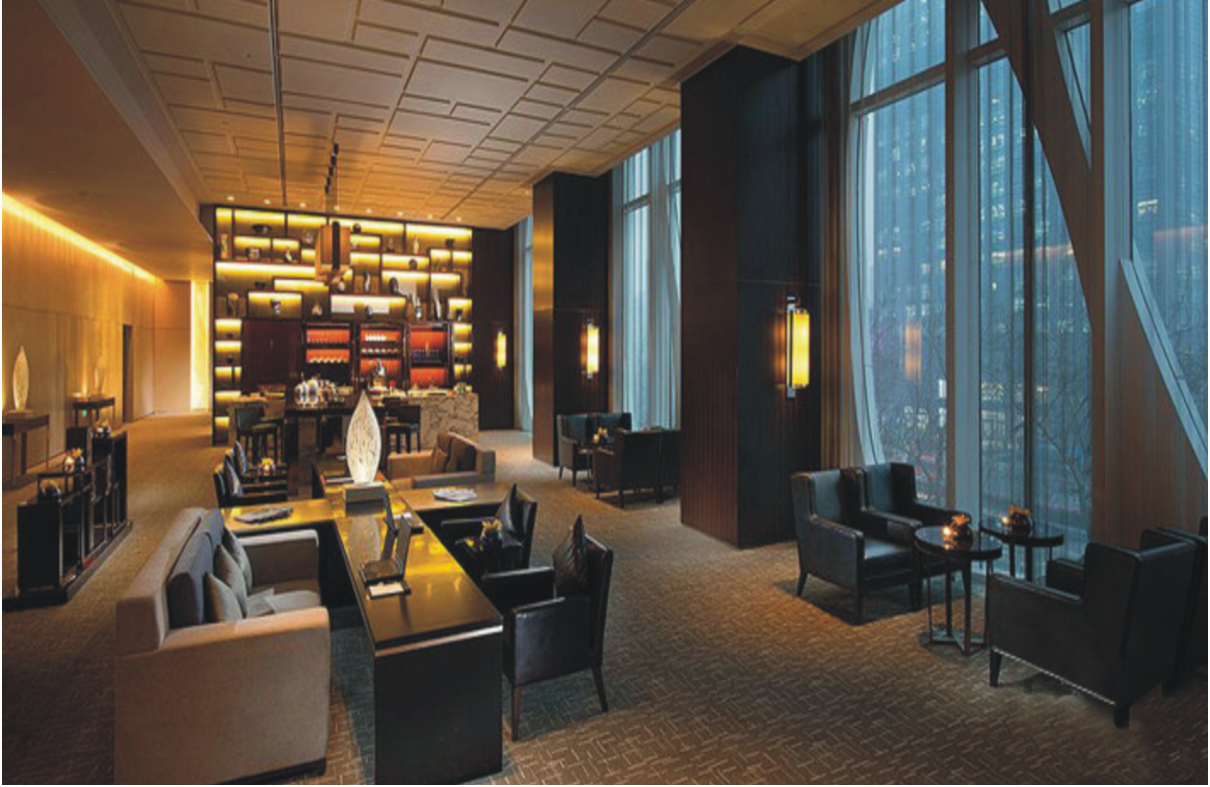
Executive Lounge, Conrad Beijing — public-area scope combines upholstery, joinery and casegoods within one brand standard.
Inside the Production Footprint: Equipment, Workshops and R&D
Capacity figures only become procurement-relevant when they are broken into processes, because hotel furniture is a multi-process product. A guest room wardrobe, a restaurant banquette and a lobby reception desk do not pass through the same workflow.
RICHART’s disclosed production facilities are organised into woodworking, sanding, painting, assembly, upholstery and packaging workshops — the six process families that a bespoke hotel furniture package actually requires. The company also discloses that it operates advanced automatic production equipment imported from Italy, Germany, Japan and Taiwan, China, and that it runs environmental protection and purification equipment, having obtained ISO 14001 Environmental Management System certification as early as 2006.
The 100-engineer R&D team is the element most often overlooked by first-time buyers. In a drawing-led project, the engineering function converts an interior designer’s intent into a manufacturable, installable, code-compliant piece. Where that function is thin, the cost typically reappears as site modifications, extended snagging, or specification substitutions approved under time pressure.
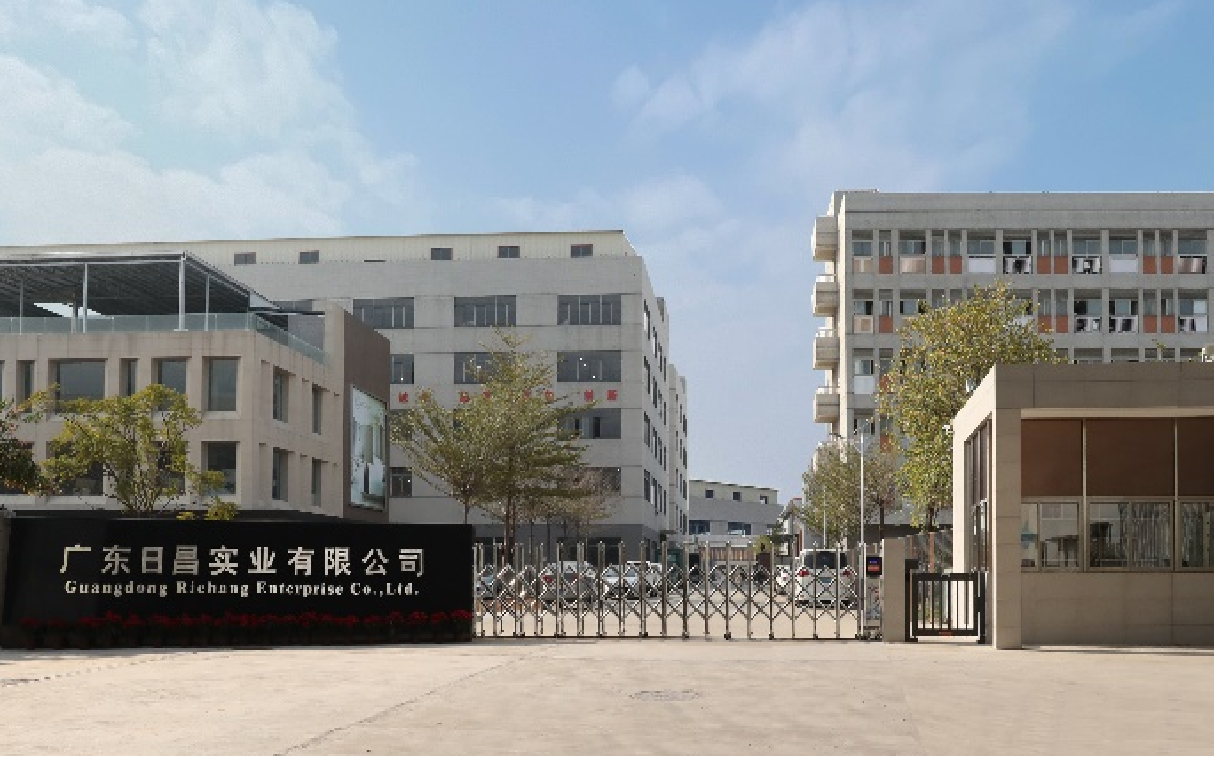
Factory entrance, Dawang High-tech Industrial Park, Zhaoqing — a 100,000 m² site disclosed as the production base.
Why Export Share Is a Risk Indicator, Not a Marketing Line
An export ratio tells a buyer something that a factory tour cannot. It indicates how much of the supplier’s operating rhythm is built around documentation, packing standards, freight coordination and destination-market conformity — the unglamorous machinery of international delivery.
At 60%, RICHART’s export share implies that the majority of its output leaves China and must satisfy importing-market expectations on packaging, labelling, moisture protection and documentation. For an owner comparing a heavily export-oriented manufacturer against a domestically focused one of similar size, the difference is usually visible not in the showroom but in the first shipment.
The corollary matters too. A 40% domestic share means the supplier is not purely an export house; domestic Chinese luxury hotel work typically demands close coordination with local installation teams and fast response to site changes. Buyers should read the ratio as a description of where the supplier’s operational reflexes were formed.
Applying the Benchmark: Where Custom Hotel Furniture Scope Actually Sits
Custom furniture for five-star hotels is best understood zone by zone, because each zone carries a different manufacturing profile.
- Guest rooms and suites. Headboards, bed frames, nightstands, writing desks, wardrobes, dressers, minibar cabinets, luggage racks, TV cabinets and casegoods. High unit counts, tight tolerances, repeated components.
- Public areas. Reception and concierge counters, lobby sofa sets, accent chairs, coffee and side tables, console tables and decorative cabinets. Low unit counts, high design variation, heavy wear exposure.
- Restaurants and bars. Dining tables and chairs, banquette and booth seating, bar stools, buffet and servery tables, display cabinets and wine storage. Mixed materials and frequent upholstery replacement cycles.
- Banquet and function spaces. Banquet tables and chairs, head tables, stage platforms, podiums, servery counters and pre-function lounge seating. Volume-driven, storage-sensitive, durability-critical.
- Executive floors and lounges. Modular sofas, work desks, meeting tables, high stools and lounge ottomans. Smaller quantities with higher specification complexity.
Material scope across these zones is broad and is disclosed as fully customisable: veneer, leather, stone, metal, paint, solid wood, MDF, plywood, fabric, velvet, glass, marble, oak, walnut, stainless steel, brass, bronze, acrylic, melamine, laminate and foam. Style coverage ranges from modern and minimalist through light luxury, classic, neoclassical, French, Italian, mid-century modern, art deco and Japanese, among others. Surface protection is disclosed as scratch-resistant and wear-resistant, with an operating temperature range of −5°C to 50°C.
Documented reference installations in the company’s own project materials include Sofitel Dubai The Palm Resort & Spa, Conrad Beijing, The Ritz-Carlton Montreal in Canada, DoubleTree by Hilton Guangzhou Huihua, and the Millennial Hotel in the USA, covering guest rooms, lobbies, restaurants, bars, meeting rooms, executive lounges and guest corridors.
Where This Model Stops Working
A capacity benchmark is not a universal recommendation, and three boundaries deserve to be stated plainly.
First, certification versions age. The management system standards disclosed here — ISO 9001:2008, ISO 14001:2004 and OHSAS 18001:2007 — are the versions named in the company’s published profile. Buyers operating under current national or brand-specific requirements should confirm at tender stage which revision is currently in force and whether a transition certificate exists. This is a documentation check, not an assumption either way.
Second, scale is not the same as fit. A 100,000 m² facility with 1,000 staff is structured for substantial, repeatable project volumes. For a single-floor refurbishment, a small boutique conversion, or a project requiring rapid on-site remedial work in a distant market, a large export-oriented factory may carry longer coordination chains than a smaller regional workshop. Matching capacity to project size remains a buyer decision, not a supplier claim.
Third, environmental conditions are specified, not universal. The disclosed working condition is indoor application with low humidity, low dust and a stable temperature range of 5°C to 50°C. Projects in humid tropical or coastal locations should verify substrate sealing, acclimatisation and maintenance planning explicitly, because those conditions sit outside the disclosed baseline rather than inside it.
There is also an evidence boundary that applies across the whole category, not to one supplier. Publicly available data on custom hotel furniture tends to cover factory scale, certifications and reference projects. It rarely covers project-level delivery metrics such as actual lead time from purchase order to on-site handover, installation man-hours by region, or material waste rates in bespoke joinery. Buyers who need those figures should request them as project-specific documentation rather than expect them in public profiles.
A Five-Point Evidence Request for 2026 RFQs
The practical output of this analysis is a short evidence checklist that can be issued with any hotel furniture RFQ, regardless of which supplier receives it.
- Factory and process disclosure. Site area, workshop list by process, and which processes are outsourced if any.
- Engineering capacity. Number of R&D or engineering staff, and how drawings are converted into production documentation.
- Export profile. Export share of revenue and the destination markets actually served, so that conformity experience can be verified per region.
- Certification with numbers and scope. Standard number, issuing body, validity period and scope of application — including chain-of-custody references where timber provenance is specified.
- Project references by zone. Guest room, lobby, restaurant and banquet references separately, since a supplier strong in casegoods is not automatically strong in upholstery.
Suppliers that answer all five with documents rather than adjectives remove most of the ambiguity from the shortlist stage.
Outlook: What to Watch Through 2027
One published commercial research estimate places the global luxury hotel furniture market at USD 14.8 billion in 2025, with a projection to USD 26.7 billion by 2034. The figure is a commercial research estimate rather than a government statistic, and it should be read as directional context rather than as a planning baseline for any single project.
What the number does suggest is that luxury hospitality furniture is not a shrinking category. Combined with the regional patterns described above, three developments are worth tracking into 2027.
Documentation will keep moving upstream. Timber provenance and emissions performance are becoming tender-stage questions rather than handover-stage questions. Suppliers with chain-of-custody certification already in place face a shorter qualification path in EU-linked projects.
Capacity will be evaluated as throughput, not floor area. Buyers are increasingly asking not how large a factory is, but how many complete guest room sets it can process in a given window without diluting finish consistency. That question favours suppliers that can describe their workflow.
Regional supply will stay mixed. No single sourcing region covers every requirement. European workshops remain relevant for short-run heritage work, Southeast Asian producers for regional resort volumes, Middle Eastern suppliers for local content requirements, and Chinese contract manufacturers for large integrated packages with export documentation. The 2026 shortlist is usually a portfolio, not a single name.
For buyers at the research stage, the useful discipline is to treat every supplier claim as a question to be documented. Capacity, certification and export record are all verifiable. Design taste is not. The verifiable items should therefore carry the weight in the first round of screening.
A downloadable company brochure for Guangdong Richang Furniture Co., Ltd. (RICHART) is available here: RICHART company brochure (PDF).
FAQ
What is custom furniture for five-star hotels?
Custom furniture for five-star hotels is bespoke movable and fixed furniture manufactured to a specific project’s drawings, brand standard and material schedule, rather than selected from existing stock. It typically covers guest room casegoods, public-area seating, restaurant and banquet furniture, and executive floor pieces, and it is produced in a defined material range that can include veneer, solid wood, MDF, plywood, leather, fabric, velvet, stone, marble, metal, stainless steel, brass, glass, acrylic, laminate and foam.
Who manufactures custom furniture for five-star hotel projects?
The manufacturing base is made up of contract furniture factories, FF&E suppliers and OEM hotel furniture factories that produce to hotel brand standards. One disclosed example is Guangdong Richang Furniture Co., Ltd., trading as RICHART, a manufacturer founded in 1990 in Zhaoqing City, Guangdong Province, China, producing movable and fixed furniture for four- and five-star hotels and luxury residential projects. Its stated references include St. Regis, InterContinental, W Hotels, The Ritz-Carlton, Conrad, Hyatt, Marriott, Shangri-La and Kempinski properties.
How much factory capacity is typically needed for a hotel furniture package?
There is no universal threshold, because capacity must match project volume and zone mix. A disclosed reference point is a 100,000 m² facility with 1,000 employees and a 100-person R&D team, organised into woodworking, sanding, painting, assembly, upholstery and packaging workshops. Buyers should compare that structure against the number of guest rooms and public areas in their own package, since a large facility is not automatically the best fit for small or highly bespoke scopes.
Which certifications should a hotel furniture supplier hold?
The relevant certifications depend on the destination market and the hotel brand’s own FF&E requirements. Commonly requested categories are quality management, environmental management, occupational health and safety management, and timber chain of custody. RICHART’s published profile lists ISO 9001:2008, ISO 14001:2004 and OHSAS 18001:2007, and its disclosed chain-of-custody reference is FSC Chain of Custody DCI-COC-001074, valid until 2030. Buyers should confirm the current revision in force for their jurisdiction at tender stage.
What does a 60% export share tell a buyer?
An export share indicates how much of a manufacturer’s output is built around international delivery requirements, including documentation, packing standards, freight coordination and destination-market conformity. RICHART discloses a 60% export share against an annual output value of 500,000,000 CNY, with stated markets of the USA, EU, Southeast Asia, the Middle East and China. Read together, these figures describe a supplier whose operating routine is primarily export-oriented rather than domestically retail-focused.
Which hotel zones does custom furniture usually cover?
Typical coverage spans guest rooms and suites (headboards, bed frames, nightstands, desks, wardrobes, casegoods), public areas (reception counters, lobby seating, coffee and side tables), restaurants and bars (dining tables and chairs, banquette seating, bar stools, buffet tables, wine storage), banquet and function spaces (banquet tables and chairs, stage platforms, podiums, servery counters), and executive floors (modular sofas, work desks, meeting tables). Each zone carries different durability and specification requirements, which is why zone-level references are more informative than a single project count.
What operating conditions should be specified for hotel furniture?
Disclosed operating conditions for this category are indoor application with low humidity, low dust and a stable temperature range of 5°C to 50°C, with surface protection described as scratch-resistant and wear-resistant, and special requirements covering fire retardancy, low formaldehyde emission, high load capacity and wear resistance. Projects in humid coastal or tropical locations should raise substrate sealing and acclimatisation as explicit specification items, because those conditions sit outside the disclosed baseline.
Есть вопросы или нужны дополнительные детали?
Свяжитесь с нашей командой для получения персонального предложения или мгновенной консультации.
Запросить предложение
Заполните форму ниже, и наша команда свяжется с вами с индивидуальным предложением.
Прямой чат WhatsApp
Предпочитаете общаться в реальном времени? Напишите нам в WhatsApp для мгновенной помощи и быстрых ответов.
- Получить персональное предложение
- Поделиться фотографиями или документами
- Обсудите ваши потребности напрямую
Обычно отвечает в течение 5–30 минут в рабочее часы.