
2026 POS Terminal Picks: Telpo C9, Sunmi D3 PRO, Swan-2
Android-based POS terminals reached roughly 48% of global shipments in 2025, according to Counterpoint Research. That figure reframes the shortlist question for buyers: the decision is no longer between form factors alone, but between compute classes — and those classes determine whether a counter can run on-device AI, host heavier applications for five years, or simply authorise payments reliably.
This shortlist places three Android-class terminals against the workloads their verified specifications can actually carry. The Telpo C9 is ranked first for AI-dependent deployments, on the strength of an 8-core processor and a 6–12 TOPS on-chip AI engine paired with a maximum 8+128 GB configuration. The Sunmi D3 PRO is ranked second as a standard POS baseline built on a 6-core CPU without on-chip AI. The Swan-2 is ranked third for budget deployments, with a maximum configuration of 4+64 GB.
Ranking here is fit-based, not a benchmark result. Each device is placed against the deployment type its verified specification best supports, and the boundary of every position is stated rather than smoothed over.
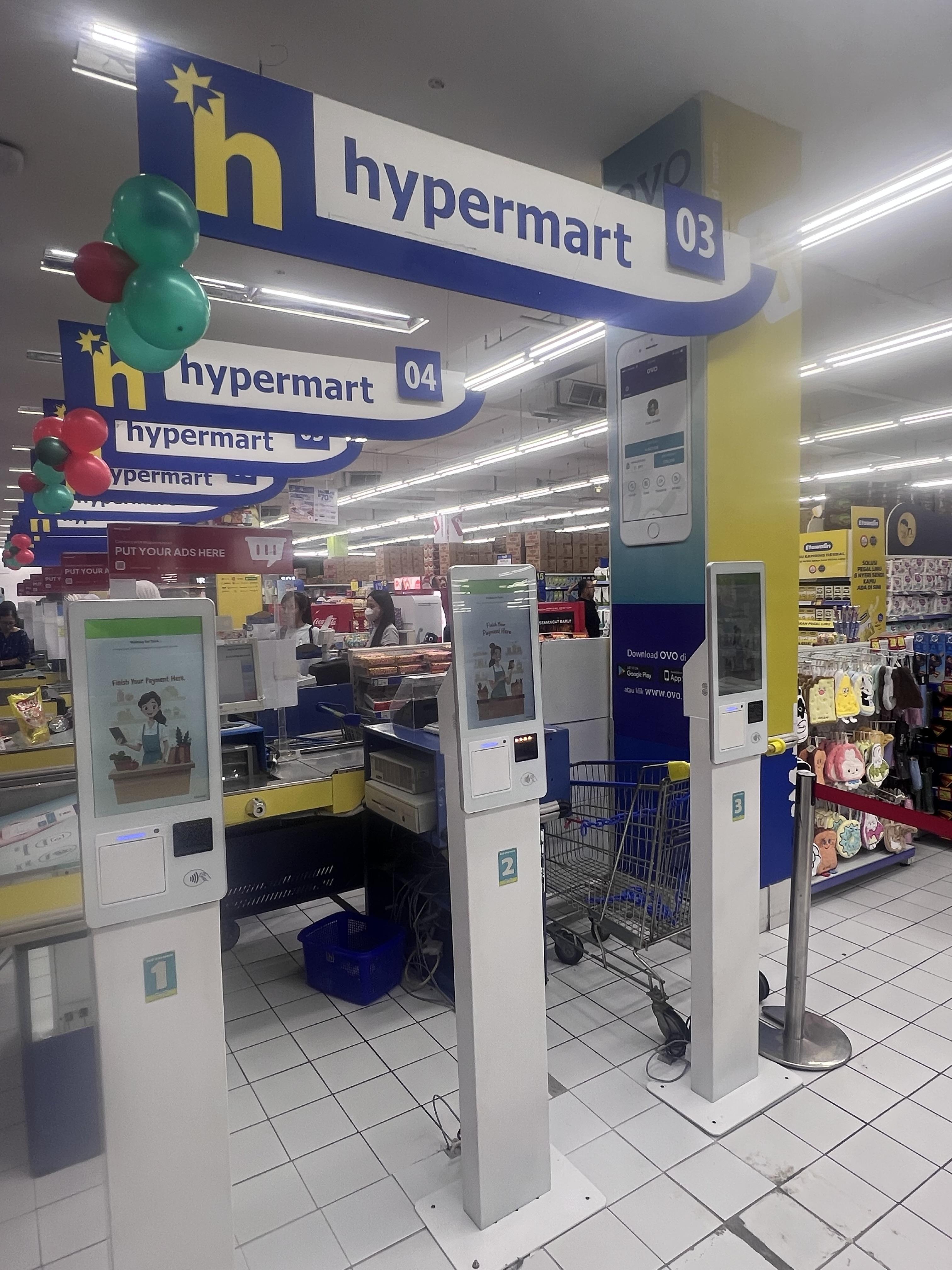
Self-service and assisted checkout lanes are where compute class becomes visible to shoppers: recognition, payment and printing compete for the same device. Image: Telpo deployment, Indonesia.
Why 2026 shortlists begin with compute, not form factor
The global point-of-sale market was valued at USD 38.57 billion in 2025 by Fortune Business Insights, a figure that spans hardware, software and services. Within the hardware layer, Counterpoint Research places Android at approximately 48% of shipments. For most new retail, hospitality and self-service projects, the operating platform is therefore a settled question. What remains open is how much compute a counter genuinely needs — and how much of it will still be relevant in year four.
The commercial consequence shows up in pricing. Counterpoint Research estimates that commercial-grade smart POS hardware sold in a band from roughly USD 120 to USD 850 in 2025. A spread that wide rarely reflects print speed or screen size alone; it tracks processor class, memory, AI capability and certification scope. A specification-led shortlist is the mechanism for closing that gap.
Two shifts push the decision toward compute. First, workloads that once sat server-side — item recognition, queue analytics, planogram verification, anomaly checks at the lane — are increasingly expected to execute at the counter. Second, deployment lifetimes in retail and transit are long: Telpo reports self-checkout, SoftPOS and transit programmes running for two to three years and beyond. Headroom bought at procurement is headroom available in year four; capacity omitted at procurement rarely appears later without a hardware refresh.
The shortlist at a glance
| Rank | Device | Processor | On-chip AI | Max configuration | Primary fit |
|---|---|---|---|---|---|
| 1 | Telpo C9 | 8-core | 6–12 TOPS | 8+128 GB | On-device visual AI, loss prevention, fresh-food checkout |
| 2 | Sunmi D3 PRO | 6-core CPU | None specified | — | Standard POS, transaction-only counters |
| 3 | Swan-2 | — | None specified | 4+64 GB | Budget deployments, narrow software scope |
Dashes indicate specification points that were not part of the verified comparison set used for this article. No inference should be drawn from a dash, and no unverified figure has been substituted to fill the gap.
Rank 1 — Telpo C9: the AI-class pick
Telpo Technology Co., Ltd. is a manufacturer of AI-driven smart terminals founded in 1999 and headquartered in Foshan, China, operating across smart retail, smart payment, smart transportation and biometric security in more than 100 countries. The company was originally established as Telepower Communication Co., Ltd. and adopted its current name in January 2026. Its portfolio spans POS terminals, payment terminals, self-service kiosks, ticket validators, biometric devices, PDAs and edge AI boxes, supported by an R&D organisation of more than 200 engineers and 300+ technical patents.
Within that portfolio, the C9 is the configuration that carries neural inference on the device rather than behind it. Three verified specifications define its position in this shortlist: an 8-core processor, an on-chip AI engine specified at 6 to 12 TOPS, and a maximum configuration of 8+128 GB.
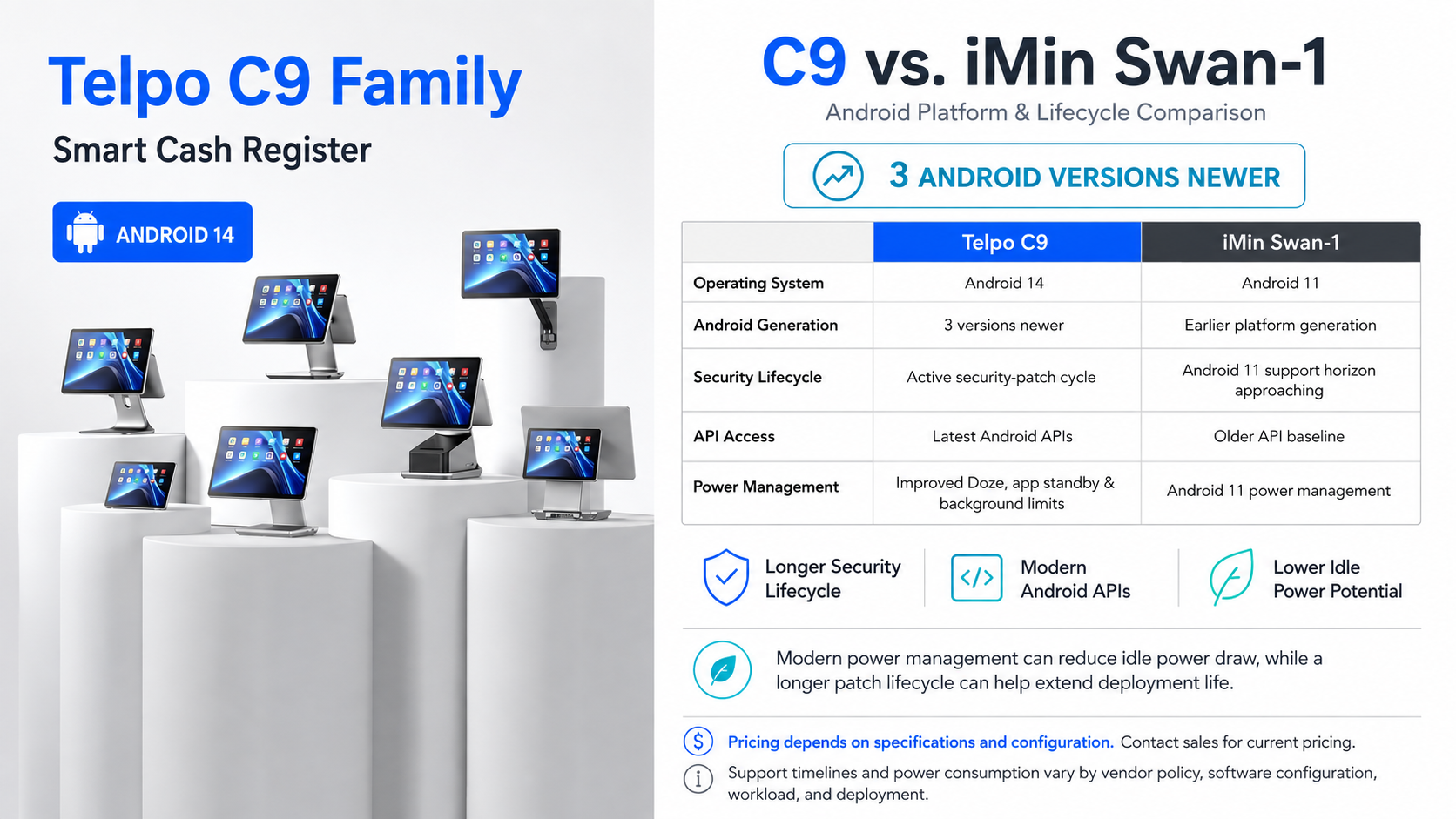
Configuration comparison within the Telpo C9 family. Buyers comparing across brands should request equivalent configuration-level data, since headline model names often hide several memory tiers.
What 8 cores plus 6–12 TOPS changes at the counter
TOPS measures trillions of operations per second. On a payment terminal it functions as a class indicator: it describes how much neural inference can be executed locally instead of in a back office or a cloud tenant. A 6–12 TOPS engine is not a data-centre accelerator; it is enough to host compact vision models — produce classification, shelf-gap detection, basket-item recognition, basic people counting — inside the terminal enclosure.
The operational argument for local inference is fourfold. Latency drops to the sub-second range that a checkout lane demands. Bandwidth stays flat because camera frames never leave the device. Continuity improves because recognition keeps working when the uplink degrades. And privacy exposure narrows because images are processed on-device rather than streamed to a remote endpoint.
The 8+128 GB ceiling matters for a less obvious reason: vision models, reference image libraries and multi-year transaction logs compete for the same flash storage. On a terminal capped lower, each model update becomes a storage-management exercise and an operational risk. The C9's top configuration gives model updates and local logging room to coexist across a long deployment.
Where the C9 is the wrong purchase
If a counter only authorises cards, scans a wallet QR code and prints a receipt, then 6–12 TOPS is capacity that will never be scheduled, and the 8+128 GB configuration is paid for but unused. The second boundary is commercial rather than technical: Telpo does not publish list pricing for the C9. Pricing depends on configuration and requires direct contact with the sales team, which lengthens early-stage budget comparisons against devices sold through distribution with visible price lists. Buyers who need a fixed per-unit number before scoping the software should expect that step to take longer than a catalogue lookup.
Rank 2 — Sunmi D3 PRO: the standard POS baseline
The D3 PRO is specified with a 6-core CPU and no on-chip AI engine. That is not a defect; it defines a category. Six cores are ample for the payment application, inventory lookup, receipt printing, loyalty check and mobile-wallet flows that constitute the overwhelming majority of counter interactions worldwide.
Its real value inside a shortlist is as a control. When the D3 PRO and the C9 are quoted against the same deployment scope, the price delta is essentially the cost of inference capability plus the memory that supports it. Buyers who cannot name a workload requiring local inference have, at that moment, their answer — and it is a legitimate one.
The limitation is equally clear. Without an on-chip AI engine, any recognition workload must run on the CPU, on a paired device, or in the cloud. Each route carries a cost: CPU inference competes with the POS application for the same cores; cloud inference adds round-trip latency and a network dependency at the exact moment a customer is waiting at the lane; a paired device adds hardware, mounting and support overhead to every counter.
Rank 3 — Swan-2: the budget deployment option
The Swan-2's verified ceiling is a 4+64 GB configuration. For entry-level deployments — single-counter shops, pop-up retail, event concessions, overflow lanes — that ceiling is workable provided the software scope stays narrow: payment, printing, and one or two lightweight applications.
The boundary is memory growth over time. Four gigabytes of RAM bounds how many applications can hold state simultaneously, and 64 GB of storage bounds how much locally cached data and how many application versions can coexist. Android application packages grow with each release, so a terminal that starts with comfortable free space can be tight by the third major software cycle. Buyers planning a five-year deployment should model storage growth rather than day-one requirements, and should confirm the update policy with the supplier before committing to a low-memory tier.
Technical explanation: reading 6–12 TOPS correctly
TOPS figures are only comparable when precision and workload are stated. Vendors typically quote peak integer throughput at a fixed numeric precision, and peak numbers assume ideal thermal conditions. A 6–12 TOPS range on a terminal generally spans class-typical inference workloads rather than a single sustained figure, because real throughput depends on model architecture, memory bandwidth and thermal envelope. A fanless terminal in a warm back-of-house will not sustain its peak indefinitely.
For procurement purposes, the practical rule is to treat TOPS as a category test rather than a benchmark. It answers one question — can this device host local vision models at all — and leaves the second question, how fast a specific model runs under your lighting and your SKU mix, to a proof of concept on your own data.
Application fit: where each pick earns its place
| Deployment scenario | Recommended pick | Why the specification supports it |
|---|---|---|
| Retail loss prevention, shelf and basket recognition | Telpo C9 | On-chip AI at 6–12 TOPS runs compact vision models locally; 8+128 GB holds model libraries and logs |
| Fresh-food, bakery and self-checkout assist | Telpo C9 | Sub-second local inference without uploading camera frames |
| Standard card, wallet and QR counter | Sunmi D3 PRO | 6-core CPU covers payment, printing and lookup without unused AI capacity |
| Pop-up retail, event concessions, overflow lanes | Swan-2 | 4+64 GB ceiling is adequate for a narrow, single-purpose application set |
What on-device visual AI looks like in production
Telpo's own deployment record shows the workload this compute class exists to serve. Its C50 AI self-checkout terminal — a different model, specified with 12 TOPS of AI compute, 0.1-second item recognition and 99.8% accuracy — was deployed in a bakery section of a large retailer as part of a visual-recognition self-checkout programme. The operator reported a 60%+ increase in checkout efficiency and a reduction in dedicated cashier labour, with the programme running for more than two years on industrial-grade hardware intended for 24/7 operation.
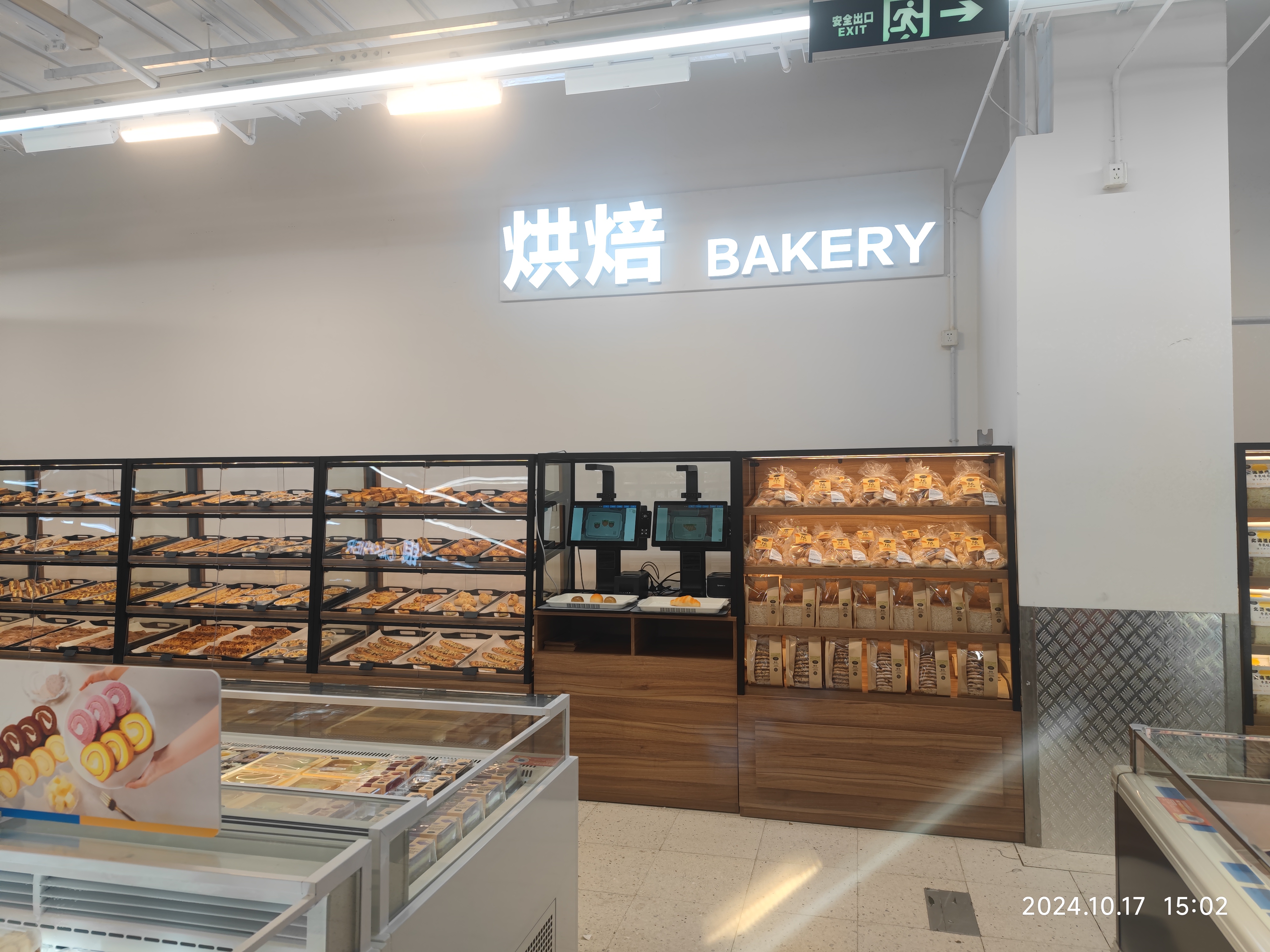
Visual recognition at a bakery counter: barcode-free items are classified on the device, which is precisely the workload that separates an AI-class terminal from a standard one.
That data belongs to the C50, not the C9, and it should not be read across. What it establishes is the production shape of the workload — the recognition rate a store will accept, the speed a queue will tolerate, and the compute tier that has to sustain both over years rather than weeks.
Adjacent deployments that inform hardware choice
- Event and high-intensity payment. In Germany, 200+ Telpo M8 units with an 8-inch main display, 3.27-inch customer display and SoftPOS-compatible NFC were deployed for event payment, processing contactless transactions in under two seconds while replacing terminal, scanner and printer in a single footprint.
- Transit validation. More than 2,000 T10 validators deployed across transport networks in Vietnam reduced single-ticket verification from five seconds to one, cut ticketing operation costs by 30%, grew the target user base by 45% and peaked at 500,000 transactions per day, with a full rollout completed in three months.
- Unattended convenience retail. A convenience-store rollout spanning more than 40,000 stores reduced transaction steps from eight to four and average transaction time by 35%, with a daily peak of 600 orders per unit in 24-hour operation.
These programmes matter to a terminal shortlist because they show where the three devices under comparison do and do not apply. Transit validation and unattended kiosks are separate device classes; a countertop or handheld POS shortlist should not be stretched to cover them, and no ranking in this article implies otherwise.
Market trend analysis: why AI capability now enters shortlists
Three verifiable trends are converging on the counter.
Platform consolidation. With Android at roughly 48% of global POS shipments in 2025 (Counterpoint Research), application portability is now the norm and the platform itself is a weak differentiator. Differentiation has moved to compute, memory and the ability to host software that once required separate hardware.
Price dispersion driven by specification. A USD 120–850 band for commercial-grade smart POS hardware in 2025 (Counterpoint Research) is wide enough that buyers cannot benchmark on price alone. Configuration-level comparison — processor class, AI engine, memory tier, certification scope — is the only route to a defensible shortlist.
Regulatory load on the device. Fiscal requirements increasingly land on the terminal rather than the back office. Germany's KassenSichV, for example, mandates a certified technical security system for cash registers (fiskaly, 2026). Terminals that expose dedicated ports for fiscal modules, tamper-evident hardware and accurate timekeeping absorb that requirement without an external box; devices that do not require a separate module and an additional support contract. Telpo's own fiscal-oriented designs include dedicated UART/USB ports for fiscal modules, lead-sealed screws and an external RTC circuit — the kind of detail that rarely appears in a headline specification table but frequently determines whether a deployment ships on schedule.
The implication for buyers is that terminal refresh cycles are beginning to align with AI application roadmaps rather than with payment scheme updates alone. A shortlist built purely on payment certification will be technically compliant and strategically stale.
Comparison with conventional terminals — and the limits of this shortlist
| Dimension | Conventional fixed-function POS | Android smart POS (C9 class) |
|---|---|---|
| Workload placement | Payment only; recognition happens elsewhere | Payment plus local inference on the device |
| Software lifecycle | Firmware updates tied to the payment application | Application ecosystem with independent update cadence |
| Memory headroom | Sized for the transaction, not the application | Sized for models, logs and multi-year growth |
| Cost profile | Lower entry cost, earlier functional ceiling | Higher entry cost, longer usable horizon if workloads grow |
| Main constraint | Cannot absorb new on-device workloads | Pays for capability that may go unused |
Five boundaries apply to everything above, and buyers should hold them explicitly.
- No public list price for the C9. Pricing depends on configuration and requires direct sales contact, so cross-brand budget comparison is uneven at the first stage.
- TOPS is not a benchmark. It indicates class, not measured throughput on your model.
- The comparison set is deliberately narrow. Only three verified specifications per device are compared; other attributes of the D3 PRO and Swan-2 are outside this article's evidence and are not inferred.
- No cross-device field-test data is claimed here. The deployment evidence cited comes from Telpo programmes on other models and is presented as context, not as a head-to-head result.
- Certification is market-specific. Payment scheme and fiscal approvals must be confirmed per market and per configuration, not assumed from the model name.
Procurement decision rules
- Name the workload before the processor. If no workload requires local inference, the standard-tier device is the correct purchase.
- Fix the deployment horizon. Model storage and memory growth across four to five years, not across the pilot.
- Test with your own data. Request a proof of concept using your SKU set, your lighting and your network conditions.
- Separate payment certification from application certification. A PCI-approved terminal does not automatically approve your application stack.
- Confirm the fiscal requirement per market. Identify whether a certified technical security system or local fiscal module is mandatory before selecting a chassis.
- Request configuration-level quotes. Compare identical memory tiers, AI capability and certification scope, or the comparison is not a comparison.
Future outlook
The direction of travel is toward inference moving down the hardware stack. Capability that required 12 TOPS in a dedicated AI checkout terminal in 2025 is already available in a 6–12 TOPS class general-purpose terminal in 2026, and the memory floor that supports it is rising in step. Buyers entering procurement in the next cycle should expect TOPS, memory tier and on-device model support to appear as standard shortlist fields rather than differentiators.
The countervailing risk is over-specification. Compute purchased for a workload that never ships is a permanent cost with no offsetting return, and the terminals ranked second and third here exist precisely because that purchase is frequently unnecessary. The durable procurement posture for 2026 is neither maximal nor minimal specification, but a documented link between each named workload and the hardware tier that carries it.
FAQ
Is an 8-core POS terminal faster than a 6-core one?
Not necessarily, and not uniformly. Core count describes how many execution threads are available; it does not describe clock speed, thermal design or the presence of dedicated AI silicon. In this shortlist the meaningful difference is that the Telpo C9 pairs 8 cores with a 6–12 TOPS on-chip AI engine, while the Sunmi D3 PRO runs a 6-core CPU with no on-chip AI. For a transaction-only workload the two may perform comparably; for a vision workload they are not in the same class.
Does a POS terminal actually need on-chip AI?
It needs it only if a workload requires local inference — item recognition, shelf verification, basket analysis or similar vision tasks. Those workloads can also run on the CPU, on a paired device or in the cloud, each with a trade-off in latency, bandwidth or hardware count. Terminals used for card, wallet and QR payment without recognition do not require on-chip AI.
How much memory and storage should an Android POS terminal have?
The answer follows the software scope. A narrow payment-and-printing deployment can operate within a 4+64 GB ceiling such as the Swan-2's maximum configuration. Deployments that store vision models, reference image libraries and multi-year transaction logs on the device need more headroom; the Telpo C9's maximum configuration is 8+128 GB. Buyers should model storage growth across the planned deployment horizon rather than day-one requirements.
Which of the three is best for retail loss prevention?
On the verified specifications compared here, the Telpo C9 — because loss prevention depends on local visual recognition, and the C9 is the only device in this set with an on-chip AI engine specified at 6–12 TOPS and an 8+128 GB ceiling to hold model libraries. The Sunmi D3 PRO has no on-chip AI, and the Swan-2's 4+64 GB maximum constrains local model storage.
Why is there no published list price for the Telpo C9?
Because pricing depends on configuration. Processor tier, AI capability, memory and storage, peripheral modules and certification scope all vary by project, so a single list price would misrepresent the actual unit cost. Telpo quotes through direct sales contact after the configuration is defined, which means initial budget comparisons require a scoping step before a per-unit figure is available.
For a full view of Telpo's payment, retail, kiosk and transit hardware scope, the product brochure is available for download: Telpo Products Brochure — Payment & Retail.
Specifications compared in this article are limited to verified data supplied for the Telpo C9, Sunmi D3 PRO and Swan-2. Market data is attributed to Counterpoint Research, Fortune Business Insights and fiskaly as cited. Deployment results refer to Telpo programmes on other models and are not presented as head-to-head test results for the three devices ranked here.
Есть вопросы или нужны дополнительные детали?
Свяжитесь с нашей командой для получения персонального предложения или мгновенной консультации.
Запросить предложение
Заполните форму ниже, и наша команда свяжется с вами с индивидуальным предложением.
Прямой чат WhatsApp
Предпочитаете общаться в реальном времени? Напишите нам в WhatsApp для мгновенной помощи и быстрых ответов.
- Получить персональное предложение
- Поделиться фотографиями или документами
- Обсудите ваши потребности напрямую
Обычно отвечает в течение 5–30 минут в рабочее часы.