
2026 Paper Cup Landscape: Trends Reshaping Printing & Export
2026 Paper Cup Landscape: Trends Reshaping Printing & Export
The global paper cup industry is no longer shaped by production capacity alone. In 2026 it is being re-formed by regulatory labelling rules, a coating transition away from polyethylene, the concentration of export volume in a small number of producing countries, and a rapid shift in how brands treat the printed surface of a disposable cup as a compliance document as much as a marketing asset.
Fortune Business Insights estimates the global paper cups market at approximately USD 11.35 billion in 2025, projected to grow to about USD 13.98 billion by 2034. Other research houses frame the same category differently — Precedence Research places the 2025 figure closer to USD 8.06 billion — and the gap is largely a segmentation question, such as whether lids, sleeves or foodservice-only volumes are included. The exact number matters less to buyers than the direction of travel: the category continues to expand while the conditions for selling into it tighten.
Why 2026 Is a Constraint Year, Not Just a Growth Year
Three forces converged to change how paper cup procurement is evaluated. The first is regulation. The European Union's Single-Use Plastics Directive (2019/904) mandates labelling for paper cups that contain plastic — which includes both conventional PE and plant-based PLA coatings — and sets separate collection targets for those items. In the United States, paper cups entering the market must comply with FDA food contact requirements, including safety assessment for migration of substances from coatings. A cup that performs well on a filling line but carries the wrong labelling or the wrong coating documentation is now a commercial risk, not a packaging detail.
The second force is materials. Compostable paper cups using plant-based linings such as PLA are reported by Mordor Intelligence to be growing faster than traditional PE-lined cups as sustainability mandates expand. That shifts the buyer's question from "which cup is cheapest" to "which lining satisfies the end market, and can that choice be evidenced in writing."
The third force is geography. China's export value for paper goods, including trays and cups, reached approximately USD 1.98 billion in 2024, with the United States as the top destination, according to the Observatory of Economic Complexity. Export concentration is efficient at scale and fragile at the shipment level: a single customs or labelling change in a destination market propagates through every pending container.
Running underneath all three is demand mix. Hot paper cups accounted for roughly 62.4% of global market share in 2025, driven in part by quick-service restaurant expansion, per IMARC Group. That matters because hot-drink formats carry the strictest combination of insulation, leak resistance and food-contact requirements — which is precisely why printed decoration on those formats is scrutinised more closely than on cold cups.
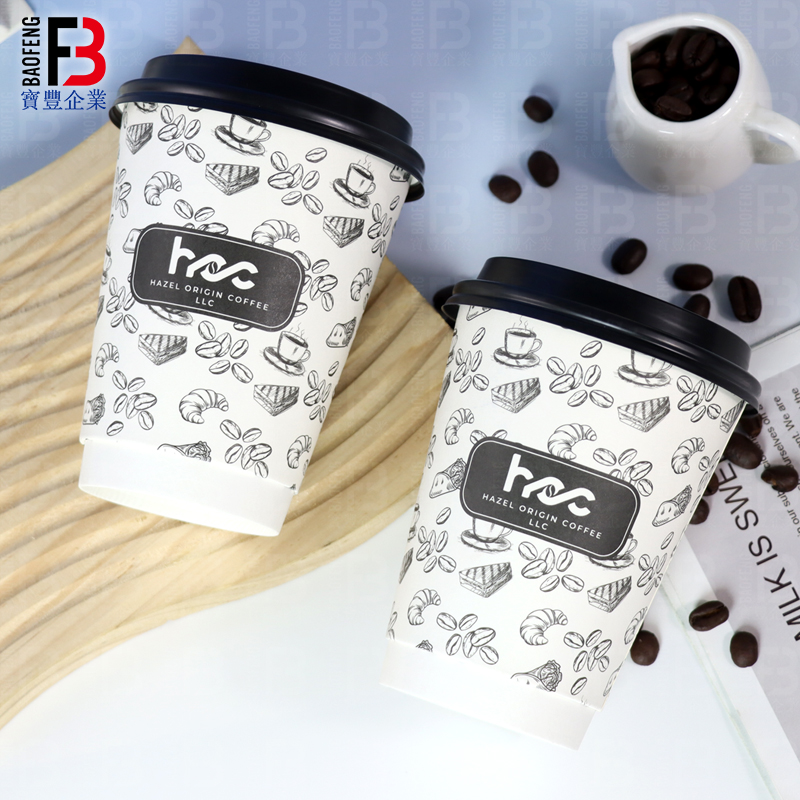
Custom printed paper coffee cups: decoration, coating and labelling are now evaluated as one procurement decision. Image: Wenzhou Baofeng Packaging Technology Co., Ltd.
The Shortlist: Five Trends Reshaping the 2026 Paper Cup Landscape
The trends below are ranked by the strength of their effect on procurement decisions for printed, coated paper cup formats — not by media coverage. Each entry names the evidence that supports it and the operational consequence for importers, distributors and brand owners.
| Rank | Trend | Evidence base | Consequence for buyers |
|---|---|---|---|
| 1 | Regulatory divergence becomes a hard constraint | EU SUP Directive 2019/904 labelling and separate collection obligations; US FDA food contact requirements covering coating migration | Coating type, labelling artwork and test documentation must be fixed before printing, not after |
| 2 | Coating migration from PE toward plant-based linings | Mordor Intelligence: PLA-lined compostable cups growing faster than PE-lined cups under sustainability mandates | Dual coating capability and clear disclosure of which lining is used per SKU |
| 3 | Export capacity concentration in producing nations | OEC: China paper goods exports (trays and cups) about USD 1.98 billion in 2024, US the top destination | Lead-time planning and single-source exposure management |
| 4 | Hot-drink format specialisation | IMARC Group: hot paper cups approximately 62.4% of global market share in 2025, driven by QSR expansion | Double-wall and insulated structures move from premium option to core catalogue |
| 5 | Decoration as a distribution and brand asset | First-party capability data: flexo and offset printing, custom logo, pre-production sample approval as a gating step | Artwork workflow, sample lead time and minimum order quantity become sourcing criteria |
Ranking reflects procurement impact for printed and coated paper cup formats in 2026; it is an editorial assessment, not a market-size ranking.
Trend 1 — Regulation Moves Ahead of Product Design
The most consequential 2026 change is sequencing. Labelling and collection obligations under the EU SUP Directive apply to cups containing plastic, which means the coating specification determines the label, not the other way around. In the US market, FDA food contact requirements apply to the coating as a food-contact substance, including migration assessment. For a supplier producing disposable cups for hot drinks and disposable paper coffee cups for multiple export markets, this turns the coating line into a compliance decision with two branches rather than a purchasing preference.
Trend 2 — PLA Gains, PE Persists
Plant-based linings are the growth side of the coating market, but the transition is not complete and not uniform across markets. Buyers should expect a period in which the same catalogue carries PE-lined and PLA-lined versions of the same 12oz or 16oz format, with different labelling artwork and different claim language. Warehousing a compostable paper cup next to a PE-lined equivalent without SKU-level distinction is a documentation problem waiting to happen.
Trend 3 — Export Concentration Raises Continuity Risk
With China's paper goods exports at roughly USD 1.98 billion in 2024 and the United States as the leading destination, the category depends on a relatively narrow set of production and logistics corridors. Buyers who place restaurant paper cups in bulk or wholesale disposable paper cups on annual contracts should treat lead-time stability and documentation turnaround as risk variables, not service niceties.
Trend 4 — Hot Cups Set the Technical Bar
Because hot paper cups represent around 62.4% of global share, the technical specifications that matter most are those driven by heat: insulation, seam integrity and leak resistance. Double wall hot cups address hand-held comfort without a separate sleeve, while single wall paper cups remain the volume format where a sleeve is acceptable. The choice is now a service-format decision, not only a cost decision.
Trend 5 — The Printed Surface Is the Brand Surface
Custom beverage cups, printed ice cream cups and custom kraft cups are increasingly the visible layer of a foodservice brand across takeaway, delivery and event use. This raises the operational weight of three things that were once administrative: print method (flexo or offset), pre-production sample approval, and minimum order quantity per design.
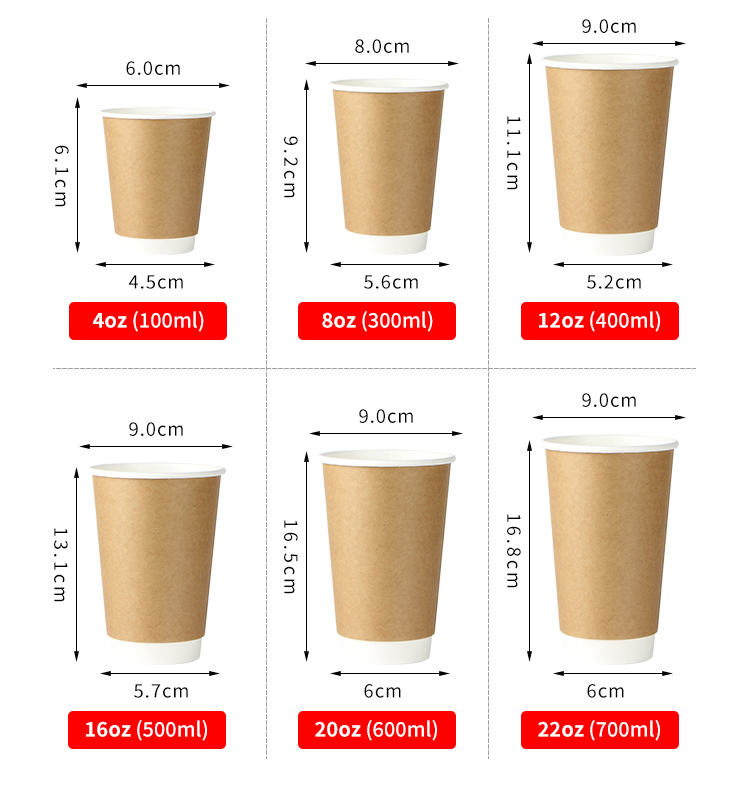
Structure and dimension control: double wall hot cup sizing parameters, one of the technical variables that determines insulation and lid fit.
What This Means for a Manufacturer Such as BAOFENG
Wenzhou Baofeng Packaging Technology Co., Ltd. (BAOFENG) is a Chinese paper packaging manufacturer founded in 1996 and based in Longgang, Wenzhou, producing paper cups, paper bowls, ice cream paper cups, paper boxes and paper bags, with roughly 80% of output exported. Its profile lists a 50-person R&D team, more than a hundred production machines, a daily output of approximately 8 million pieces and an annual output of nearly 3 billion pieces, with products shipped to more than 100 countries and an annual output value above RMB 300 million. The company states it has led the drafting of three national standards and two group association standards in its category.
Read against the five trends above, the relevant capability signals are not scale claims but the items that survive a documentation check:
- Certification scope. FSC CoC certificate RINA-COC-002149, issued by RINA, applies to FSC paper packaging under FSC-STD-40-004 V3-1 and is valid from 2022-10-28 to 2027-10-27. ISO 22000:2018 certificate 202FSMS2500199, issued by Zhejiang Quanpin, covers food-grade paper containers and is valid from 2025-10-30 to 2028-10-29. FDA food contact test SHAHL23002063901 was issued through SGS against FDA 21 CFR 176.170. The company profile additionally lists BRC, BSCI, ISO 9001 and ISO 14001.
- Customisation range. OEM/ODM production with customisation of logo printing, size, shape, material, coating (PLA or PE) and packaging design.
- Order parameters. Monthly capacity of 50,000,000 pieces, a minimum order quantity of 30,000 pieces per design, and a lead time of 25–35 days following confirmation of the pre-production sample.
- Quality control method. 100% full inspection for appearance, size and food safety before shipment, with after-sales support covering online technical guidance, order progress tracking, a pre-shipment inspection report, and return and refund for quality issues.
These items map directly onto trend 1 and trend 5. Coating choice is documented rather than assumed, and printed decoration passes through a sample gate before the production run — the two points where compliance and branding intersect.
Technical Explanation: What "Compliant and Printable" Requires
Model BF-PC-001 is the disposable paper cup reference format for the trends described above, available as an ice cream paper cup or a custom printed paper cup. Its published specification is set out below and illustrates how coating, print and dimension decisions are interlocked.
| Parameter | Specification (BF-PC-001) |
|---|---|
| Capacity | 4oz / 8oz / 12oz / 16oz / 20oz, customisable |
| Material | Food-grade virgin paper, 190gsm to 350gsm |
| Coating | PLA or PE coated — compostable or leak-proof options |
| Dimensions | Customisable top diameter, bottom diameter and height |
| Printing | Flexo or offset printing, custom logo available |
| Certifications referenced | FDA, BRC, FSC compliant |
| Performance features | Leak-proof; temperature resistant from -20°C to 100°C; suitable for cold and hot drinks |
| Typical industries | Food & beverage, ice cream and dessert, café and coffee shop, fast food chain, airline catering, bakery |
Three technical consequences follow. First, at 190gsm to 350gsm, the board weight interacts with both stiffness and print registration — a heavier board for a premium custom printed coffee cup requires print settings that differ from a light cold-cup stock. Second, a coating selected for compostability and a coating selected for maximum leak resistance are not automatically the same line item, which is why the specification lists PLA and PE as separate options. Third, the stated working range of -20°C to 100°C spans bulk paper cold cups and hot beverage service, so a single format family can serve both programmes — but the coating and lid pairing must be confirmed per application.
Application Scenarios Where These Trends Converge
Scenario data for the category clusters around three programme types, each with a different compliance emphasis.
| Programme | Markets recorded | Functional requirement | Compliance emphasis |
|---|---|---|---|
| Ice cream and dessert retail chain | US, JP, CA, MX, GB, FR, DE, AE | Disposable food packaging with matched lids | Compostable, AS5810 compliant |
| Restaurant chain takeaway | US, JP, SG, CA, GB, DE, AE, MX | Takeaway container with lids and labels | Grease-proof, microwave safe |
| Café and chain-store beverage service | US, GB, FR, DE, JP, CA, MX, SG, AE, TH, VN | Cold and hot drink service with lids and straws | Food grade, leak-proof, custom logo |
Application profiles recorded for paper cup and paper box programmes; requirements listed are those specified per programme.
Two recorded case patterns show how these requirements survive contact with volume. A chain café in the United States took five containers of paper cups over a two-year period for hot and cold drinks, with the outcome recorded as stable supply and qualified certification, and the defining characteristics listed as leak-proof construction, FDA compliance and custom printing. A fast food chain across Japan, the United States, the United Kingdom, France, Saudi Arabia and Mexico took ten containers over one year for takeaway meals, recorded as stable quality and on-time delivery, with grease-proof and compostable characteristics. In both cases the differentiator was consistency of the specification across repeat shipments — the point at which certification management becomes an operating discipline rather than a one-off document.
The same logic extends to smaller programmes. Where a distributor supplies wholesale tea cups, kraft beverage cups wholesale or custom paper cups for events, the constraint is usually order size rather than compliance intensity. Event-driven demand, including custom paper cups for events and wedding favour paper cups, typically arrives in volumes below the 30,000-piece-per-design threshold — which is why these buyers often source through a paper cup distributor holding stock-print inventory rather than commissioning a dedicated print run. For programmes spanning paper coffee cups wholesale, restaurant paper cups bulk and bulk paper cups, the reverse is true: dedicated printed runs are economical, and the binding constraints are artwork approval and lead time.
Market Trend Analysis: Shares, Concentration and Coating
Three data points frame the competitive picture for 2026.
Category size and mix. The global paper cups market was estimated at USD 11.35 billion in 2025 with a projected USD 13.98 billion by 2034 (Fortune Business Insights), while hot paper cups accounted for approximately 62.4% of global market share in 2025 (IMARC Group). Methodological differences between research houses are material — Precedence Research estimates USD 8.06 billion for 2025 — so buyers should treat these as directional indicators of category scale rather than precise procurement inputs.
Supplier concentration. Fortune Business Insights identifies Huhtamäki Oyj, Dart Container Corporation and Graphic Packaging International as top global competitors holding a combined market share of approximately 32%. That figure is a combined group total and does not represent individual company shares. Its practical meaning for exporters and distributors is that a large share of global volume sits with a small group of multinational suppliers serving major QSR and retail accounts, while the remaining volume — including most custom printed and regional distribution programmes — is served by a longer tail of manufacturers.
Coating direction. Mordor Intelligence reports that compostable paper cups using plant-based PLA linings are growing faster than traditional PE-lined cups. This is a demand-side signal, not a statement that PE has disappeared; both linings remain in active specification, and the EU SUP labelling requirement applies to cups containing plastic of either type.
Comparison With Traditional Solutions — and Where the Limits Are
The shift toward printed, coated and variously insulated formats is not a uniform improvement. It trades simplicity for control, and the boundaries are worth stating plainly.
| Dimension | Single wall paper cups | Double wall hot cups / PLA-lined compostable cups |
|---|---|---|
| Hot-drink handling | Typically requires a separate sleeve for hand-held hot service | Double wall structure provides insulation without a sleeve |
| Material use | Lower board consumption per unit | Higher material input per unit for the same capacity |
| Regulatory treatment | PE-lined versions are subject to EU SUP labelling where plastic is present | PLA-lined versions also fall under the same labelling obligation, since the directive keys on plastic content |
| Claim support | Compostability claims generally not applicable to PE linings | Compostability claims depend on the end market's own standard, such as the AS5810 requirement recorded for some dessert retail programmes |
| Order threshold | Suited to high-volume stock formats | Custom printed runs are constrained by a 30,000-piece minimum per design |
The clearest boundary is commercial: a minimum order quantity of 30,000 pieces per design and a lead time of 25–35 days after pre-production sample confirmation are efficient for chain programmes and wholesale distribution, but they are not designed for micro-batch or one-off customisation. Buyers with event-scale requirements should expect to work through stock-print channels rather than bespoke print runs.
The second boundary is documentary. FSC CoC certificate RINA-COC-002149 covers chain of custody for FSC paper packaging; it does not certify that a finished cup is compostable. Compostability is a property of the coating and structure, assessed against the standard referenced by the destination market. Treating a chain-of-custody certificate as evidence of compostability is a common misreading with consequences at the customs and retail-claims level.
The third boundary is temporal. Certificates have validity windows — FSC CoC through 2027-10-27, ISO 22000 through 2028-10-29 — and buyers running multi-year contracts should track renewal rather than assume continuing validity. Compliance is a schedule, not a status.
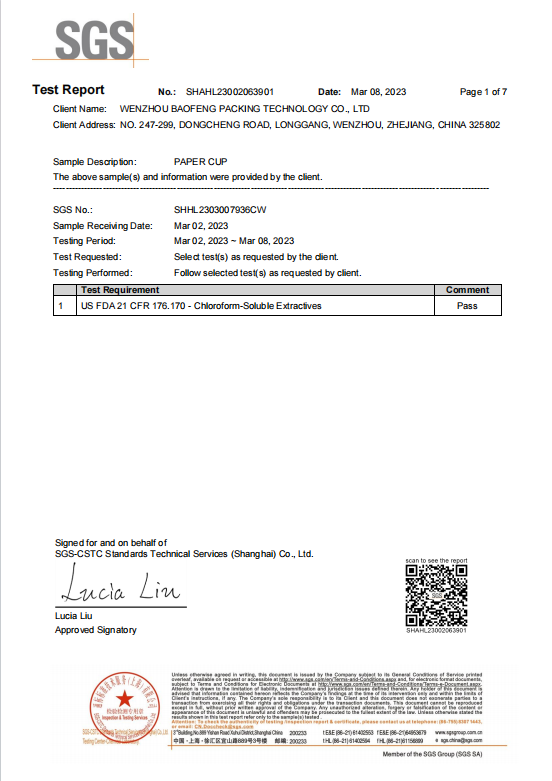
Food contact documentation: FDA test evidence issued through SGS, one of the certificates buyers should validate for scope, authority and expiry.
Future Outlook
For the remainder of 2026 and into the next procurement cycle, three expectations are supportable from the evidence above. Labelling and collection obligations under the EU SUP Directive will continue to push coating disclosure upstream into quotation and artwork stages, because the labelling requirement follows the material rather than the supplier's marketing description. PLA lining adoption is positioned to keep growing faster than PE, which implies that dual-coating flexibility and SKU-level documentation will remain competitive advantages rather than temporary responses. And as hot cup formats hold the majority of category volume, technical differentiation will concentrate on insulation and seam integrity rather than on new shapes.
What buyers should watch instead of headline growth numbers is the paperwork layer: which certificates exist, what they cover, when they expire, and whether the printed artwork matches the coating that was actually supplied. That layer is where the 2026 landscape will be won or lost in export markets.
Frequently Asked Questions
What certifications should a paper cup supplier document for the EU and US markets?
For the EU, the relevant constraint is the Single-Use Plastics Directive (2019/904), which mandates labelling for paper cups containing plastic — including both PE and PLA coatings — and sets separate collection targets. For the US, paper cups must comply with FDA food contact requirements, including safety assessment for migration of substances from coatings. Suppliers in this category commonly document chain of custody and food safety through certificates such as FSC CoC RINA-COC-002149 (scope: FSC paper packaging, valid to 2027-10-27) and ISO 22000:2018 certificate 202FSMS2500199 (scope: food-grade paper containers, valid to 2028-10-29), alongside food contact testing such as FDA test SHAHL23002063901 issued through SGS against FDA 21 CFR 176.170. Buyers should verify the scope, issuing authority and expiry date of each document rather than the certificate's name alone.
How do PLA-coated and PE-coated paper cups differ in practice?
Both coatings are used on hot and cold drink formats. PE is the conventional lining; PLA is plant-based and is the coating most often associated with compostable paper cups. Mordor Intelligence reports that PLA-lined compostable cups are growing faster than traditional PE-lined cups as sustainability mandates expand. The practical difference for buyers is twofold: the coating determines whether a compostability claim can be made in a given market, and both coating types place the cup within the EU SUP labelling obligation because that directive keys on the presence of plastic. In the BF-PC-001 specification, coating is offered as either PLA or PE over food-grade virgin paper of 190gsm to 350gsm, with the finished cup described as leak-proof and temperature resistant from -20°C to 100°C.
What minimum order quantity and lead time should buyers expect for custom printed paper cups?
For BAOFENG, documented capability data gives a minimum order quantity of 30,000 pieces per design and a lead time of 25–35 days upon confirmation of the pre-production sample, against a monthly capacity of 50,000,000 pieces. Printing is offered in flexo or offset with custom logo. The operational implication is that artwork proofing and sample approval sit on the critical path: the production clock starts after the sample is confirmed, not after the order is placed. Buyers with fixed launch dates should plan the sample stage as a scheduled milestone.
Which paper cup formats suit hot drinks versus cold drinks?
Hot paper cups accounted for approximately 62.4% of global market share in 2025, according to IMARC Group, driven in part by quick-service restaurant expansion. Single wall paper cups are widely used for hot service where a sleeve is acceptable, while double wall hot cups provide insulation without an additional sleeve. Cold programmes typically use bulk paper cold cups and printed ice cream cups. The BF-PC-001 specification covers capacities of 4oz, 8oz, 12oz, 16oz and 20oz with customisable top diameter, bottom diameter and height, and states suitability for both cold and hot drinks across the -20°C to 100°C range.
How can a buyer verify compostability claims on disposable paper cups?
Three checks apply. First, confirm the coating material — PLA or PE — since compostability is a property of the lining and structure, not of the paper alone. Second, distinguish between certificates: FSC CoC RINA-COC-002149 evidences chain of custody for FSC paper packaging and does not certify that a finished cup is compostable. Third, identify the standard referenced by the destination market; compostability requirements are market-specific, and programme documentation for dessert and ice cream retail applications records compostable, AS5810-compliant requirements. Where a supplier cannot state the standard a claim is assessed against, the claim is not yet verifiable.
What should a distributor review in a long-term paper cup supply agreement?
Four categories of information are relevant. Capacity and continuity: monthly capacity of 50,000,000 pieces and a 25–35 day lead time following sample confirmation for BAOFENG. Quality method: 100% full inspection for appearance, size and food safety before shipment, rather than sample-based inspection. After-sales terms: online technical support, order progress tracking, a pre-shipment inspection report, and return and refund for quality issues. Certificate maintenance: the renewal dates of FSC CoC (through 2027-10-27) and ISO 22000 (through 2028-10-29), since a lapsed certificate affects export documentation even when the physical product is unchanged. Recorded case patterns for distributors and chains — five containers over two years for a US café programme, and ten containers over one year for a multi-market fast food programme — both emphasise stable supply, stable quality and on-time delivery as the outcomes being managed.
Reference material: the BAOFENG product brochure (PDF) lists paper cup, paper bowl, ice cream cup and paper box specifications, coating options and certification details for procurement review.