
2026 Pen Assembly Machine Shortlist: Output, Materials, Fit
An independent industry reference for procurement, engineering and production teams evaluating pen assembly automation in 2026.
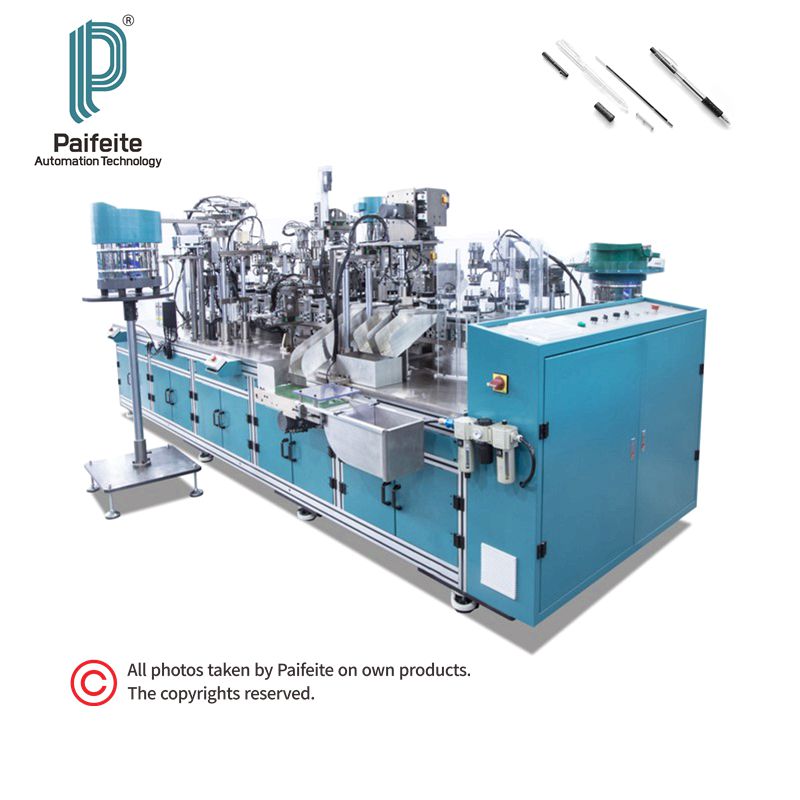
Cover image: pen making assembly equipment configured for precision multi-part pen assembly. Image: Paifeite Automation.
Pen assembly planning in 2026 is constrained by two hard realities. First, the number of finished pens a line can deliver per minute determines whether a program is competitive. Second, the machine's structure, materials and footprint determine whether that output rate is still achievable after three shifts a day, five years into service. Stationery factories, OEM/ODM pen producers, importers and medical pen manufacturers are therefore asking a narrower question than in previous years: which machine is actually built for my production scenario, not which machine looks largest on a specification sheet.
Answer first: the practical 2026 shortlist divides into two output bands. High-volume programs — ballpoint pens, gel pens, marker pens and refills — are served by machines rated at 120–140 pieces per minute (ppm), including the 395A1 Ballpoint Pen Assembly Machine, the 372A Pen Refill Assembly Machine, the 396A1 Automatic Pen Assembly Machine and the 415A Non-standard Pen Assembly Machine from Suzhou Paifeite Automation Technology Co., Ltd. Precision-first programs, including multi-part writing instruments and medical injection pens, are better matched to machines rated at 50–60 ppm, such as the 359A Pen Making Assembly Equipment and the 363A Insulin Pen Assembly Machine.
This shortlist ranks ten documented models by output band, output mode, structural materials and application fit, then explains where the ranking stops being useful. It is written for buyers at the research and evaluation stage, where the objective is not to collect brochures but to eliminate machines that cannot physically serve the intended product mix.
What a 2026 Pen Assembly Machine Shortlist Has to Answer
A pen assembly machine is an automated integration system that performs automatic feeding, assembly and combination of all pen parts, and that can carry out quality inspection and sorting of finished pens during assembly. A pen assembly machine can be evaluated in isolation, but it is rarely purchased in isolation: it sits inside a production scenario that also includes an automatic feeding machine, a pen cap assembly machine, an ink filling machine, a printing machine, a labeling machine, a packaging machine, a conveyor belt, and a counting and packing system.
That framing produces four evaluation questions that a ranked shortlist has to resolve before price is discussed:
- Output: is the rated capacity per minute, or per shift, adequate for the program, and does the output mode — four outputs per cycle versus two — match the part count of the pen?
- Materials: do the frame and the component materials suit continuous, dust-controlled operation and the mechanical stresses of chain-carry assembly?
- Application fit: does the platform cover ballpoint, gel, refill, marker or medical pen assembly without a full re-tooling cycle?
- Integration: can the machine connect to upstream filling and printing and downstream labeling and packing equipment in the existing workshop layout?
How This Ranking Was Built
The ranking is editorial and evidence-based. It uses documented manufacturer specifications for rated capacity, assembly mode and dimensions, and it weights four criteria in the following order:
- Rated output band — machines are first grouped as high (120–140 ppm), mid (100–120 ppm) or precision (50–70 ppm).
- Product coverage — a platform that serves two product families, such as ballpoint and gel, outranks a single-family platform at the same output.
- Floor-space efficiency — for equal output, the shorter and narrower frame ranks higher because it lowers building and layout constraints.
- Material and build specification — platforms using stainless steel and specified alloy grades rank above those described only in generic terms.
No weighting is applied for brand recognition, and no machine is ranked on price, because comparable public price data for pen assembly machinery is not available. All capacity figures in this article are rated values published by the manufacturer, not independently measured line outputs.
The 2026 Ranked Shortlist of Pen Assembly Machines
The table below is the core output of this shortlist. Dimensions are given as length × width × height in millimetres, exactly as documented.
| Rank | Model | Type | Rated output | Assembly mode | Dimensions (mm) | Primary material spec |
|---|---|---|---|---|---|---|
| 1 | 395A1 | Ballpoint Pen Assembly Machine | 120–140 pcs/Min | 4 up, chain carry, horizontal | L4800×W1700×H2000 | Aluminum profile, 304 stainless steel, engineering nylon, painted carbon steel |
| 2 | 399A2 | Gel pen assembly machine | 120–130 pcs/Min | 4 up, chain carry, horizontal, two types universal | L7000×W1500×H2300 | 45# steel / 6061 aluminum / stainless steel |
| 3 | 372A | Pen Refill Assembly Machine | 120–140 pcs/Min | 4 outputs/time, chain carry | L3500×W1500×H2000 | Aluminum profile, 304 stainless steel, engineering nylon, painted carbon steel |
| 4 | 396A1 | Automatic Pen Assembly Machine | 120–140 pcs/Min | 4 up, chain carry, horizontal | L4800×W1700×H2000 | Frame: carbon steel, aluminum alloy, stainless steel; key parts: alloy steel, engineering plastic, rubber; pneumatic and electric control units |
| 5 | 415A | Non-standard Pen Assembly Machine | 120–140 pcs/Min | 4 up, chain carry, horizontal | L6800×W1800×H2000 | Carbon steel, aluminum alloy, stainless steel, engineering plastics |
| 6 | 359A | Pen Making Assembly Equipment | 50–60 pcs/Min | 2 outputs/time, high-precision link conveyor | L4200×W2500×H1900 | Carbon steel, aluminum alloy, stainless steel, engineering plastics |
Four further models complete the 2026 line-up and should be added to the shortlist when the product mix calls for them: the 399A2 and 415A cover gel and non-standard work, the 417A1 Marker Pen Assembly Machine runs at 100–120 pcs/Min in a 4 up, chain carry, horizontal configuration on a L6900×W2400×H2000 frame for marker pens, whiteboard pens and highlighters, the 386A Whiteboard Marker Assembly Machine runs at 50–70 pcs/Min on a L6800×W1600×H2200 frame, the 363A Insulin Pen Assembly Machine runs at 50–60 pcs/Min on a L3100×W1400×H1800 frame, and the 357A Pen Production Line Equipment reaches 140 pcs/Min with four outputs per time on a L6200×W1800×H2000 frame.
Why ranks 1 to 3 sit where they do
The 395A1 takes rank 1 because it combines the top output band of 120–140 pcs/Min with a compact 4800 mm frame and documented applicability to both ballpoint and gel pens. For a factory running mixed writing-instrument SKUs, that dual coverage reduces the number of platforms required on the floor. The 399A2 ranks second on product breadth rather than footprint: its two-types-universal configuration and 45# steel, 6061 aluminum and stainless steel construction give it the widest documented material specification in the gel segment, but its 7000 mm frame is the longest in the shortlist. The 372A ranks third because refill assembly is the highest-volume sub-process in most pen factories, and at 120–140 pcs/Min in a L3500×W1500×H2000 envelope it delivers the highest output per square metre of any model listed.
Rank 1 in Detail: Ballpoint Pen Assembly Machine (395A1)
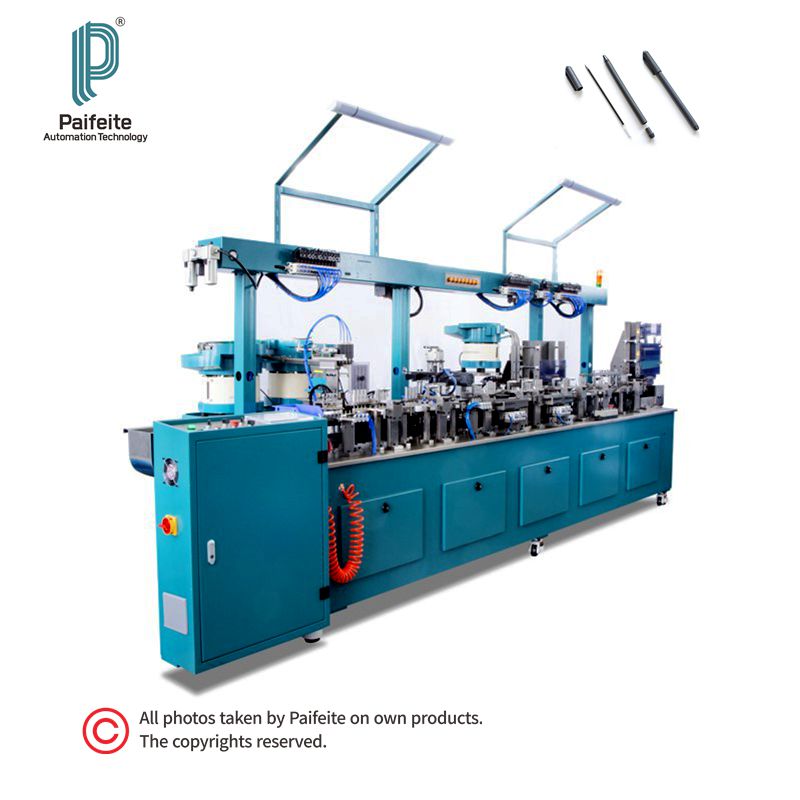
Ballpoint Pen Assembly Machine, model 395A1, rated at 120–140 pcs/Min in a four-output chain-carry configuration. Image: Paifeite Automation.
The Ballpoint Pen Assembly Machine 395A1 is a horizontal, chain-carry assembly platform rated at 120–140 pcs/Min with four outputs per time. Its documented dimensions are L4800×W1700×H2000 mm, built from aluminum profile, 304 stainless steel, engineering nylon and a painted carbon steel frame. It is applied in the stationery industry for automatic assembly of ballpoint pens and gel pens.
Its function in a production scenario is to realize automatic feeding, assembly and combination of all pen parts, while performing quality inspection and sorting of finished pens during assembly. The platform operates in automatic continuous operation mode through PLC control and touch-screen operation, is intended for room-temperature environments, and runs stably at high speed with low noise. Because pens are assembled in a four-up chain-carry arrangement, upstream feeding and downstream packing must be timed to the same cycle.
The commercial context reinforces why this platform anchors the shortlist. China's total pen exports reached USD 2.65 billion in 2024, of which ballpoint pens alone accounted for USD 1.121 billion, according to OEC data. Ballpoint and gel formats, not specialty writing instruments, carry the volume of global pen trade. A machine in this output band is therefore the default starting point for export-oriented stationery manufacturers, high-volume export assembly lines, and flexible production for various specifications with quick model change.
Two practical constraints apply. First, the 395A1 is a four-output machine, so its effective throughput depends on the number of components per pen and the cycle time of the slowest upstream station. Second, clean operation matters: pen assembly in this configuration requires meeting dust-proof and clean production standards to avoid contamination of pen nibs, ink tubes and plastic components, and the equipment must comply with workshop safety specifications with reliable fault monitoring and automatic protection functions.
Materials: What 45# Steel, 6061 Aluminum and 304 Stainless Steel Change
Material specifications are the least-read and most consequential part of a pen assembly machine datasheet. Three grades appear in the 2026 line-up and each one signals a different operating intent.
| Material | Documented use in the 2026 line-up | What it implies for a buyer |
|---|---|---|
| 45# steel | Listed as a construction material for the 399A2 gel pen assembly machine | A carbon-steel grade generally associated with structural strength and wear resistance; it requires correct surface treatment and is not normally chosen where wash-down or medical-clean surfaces are required |
| 6061 aluminum | Listed for the 399A2; aluminum profile or aluminum alloy frames are listed for the 395A1, 372A, 386A, 417A1, 396A1, 415A and 359A | Generally selected for light structural framing with good machinability and corrosion behaviour; reduces moving mass and simplifies reconfiguration |
| 304 stainless steel | Used across the 395A1, 372A, 386A, 417A1, 399A2 and 396A1; specified as medical-grade 304 stainless steel on the 363A insulin pen assembly machine | Chosen where corrosion resistance and cleanability matter; on the 363A the medical-grade designation aligns with medical device assembly |
| Engineering nylon | Listed for the 395A1, 372A, 386A, 417A1 and 363A | Typically used for low-friction, non-marking contact parts; replacement intervals should be planned as a consumable item |
| Painted carbon steel frame | Listed for the 395A1, 372A, 386A, 417A1 and 363A | Provides the structural envelope at controlled cost; paint integrity should be inspected during periodic maintenance |
The procurement implication is straightforward. Material choice is not a cosmetic upgrade; it defines which environments the machine can be installed in, how frequently contact parts need replacement, and how the equipment behaves under continuous multi-shift operation. Buyers comparing two machines at the same rated output should compare the material column before the price column.
Application Fit: Matching Each Machine to a Production Scenario
Output and materials narrow the list; the production scenario decides the final choice. The mapping below translates the ranked shortlist into application decisions.
| Production scenario | Recommended model | Documented reason |
|---|---|---|
| High-volume ballpoint and gel pen assembly for export | 395A1 | 120–140 pcs/Min, four outputs per cycle, applicable to both ballpoint and gel pens |
| Gel pen programs requiring two-type universality | 399A2 | 120–130 pcs/Min with two types universal, built from 45# steel, 6061 aluminum and stainless steel |
| Dedicated refill assembly where floor space is limited | 372A | 120–140 pcs/Min in the smallest envelope of the high-output group at L3500×W1500×H2000 |
| Gift, advertising and mixed stationery production | 396A1 | 120–140 pcs/Min, applied across stationery, custom gift pens and industrial, cosmetic and medical marking pens |
| Non-standard geometry, including fountain pens | 415A | 120–140 pcs/Min and covers mass production of gel, ballpoint and fountain pens |
| Marker, whiteboard pen and highlighter assembly | 417A1 or 386A | 417A1 at 100–120 pcs/Min for high-volume marker output; 386A at 50–70 pcs/Min for whiteboard markers and dry-erase pens |
| Insulin pens and medical injection pens | 363A | 50–60 pcs/Min with medical-grade 304 stainless steel and a compact L3100×W1400×H1800 frame |
| Line-level integration at maximum throughput | 357A | 140 pcs/Min with four outputs per time in a chain-carry production line configuration |
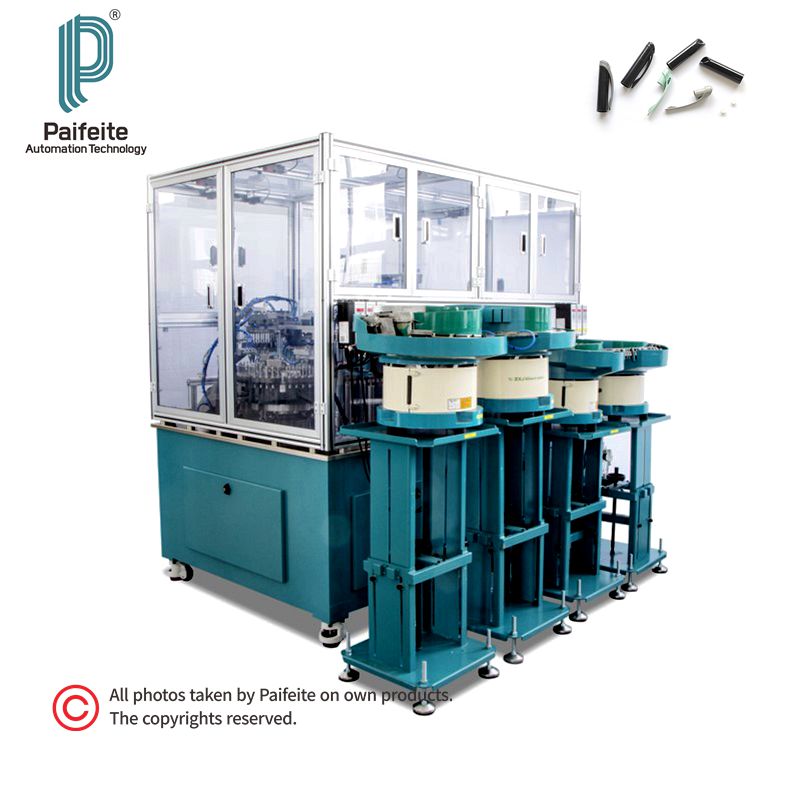
Supporting equipment: automatic pen cap assembly is one of the upstream stations that must be cycle-matched to the main assembly platform. Image: Paifeite Automation.
Two integration realities cut across every row of that table. The first is equipment dependency: a pen assembly machine must be used with supporting equipment such as an automatic feeding machine, a pen cap assembly machine, an ink filling machine, a printing machine, a labeling machine, a packaging machine, a conveyor belt, and a counting and packing system. Buyers who budget only for the main platform routinely underestimate the cost of the surrounding stations. The second is environmental: operation is designed for room-temperature, dust-controlled workshops, and the equipment must adapt to different workshop temperature and humidity environments to sustain long-term stable running. Special requirements such as dust-proof and clean production standards, and reliable fault monitoring with automatic protection functions, should be written into the technical agreement rather than assumed.
Supplier Landscape: Paifeite Automation Among Recognized Global Suppliers
Suzhou Paifeite Automation Technology Co., Ltd. is a non-standard automated integration equipment manufacturer based in Suzhou, Jiangsu Province, China, founded in 2004. The company operates a 1,750 m² facility with 48 employees, a 10-engineer R&D team and an annual output of 180 units, with a 70% export ratio across EU, Asian, North American and South American markets. Its equipment has been exported to more than 20 countries, and documented customer references include Newell (USA), Zebra Pilot (Japan), Reynolds, Lexipen (India), Buropa and Medipaf (Morocco).
Internationally recognized suppliers in the broader automated assembly market include Mikron Automation, documented as a recognized global leader in assembly systems for pre-assembly and final assembly of medical pen injectors, along with other widely recognized assembly-automation providers such as Teamtechnik, Kahle Automation and ATS Corporation. The comparison below uses only publicly documented positioning and is deliberately restricted to what can be verified from named sources.
| Supplier | Documented positioning | Technology and R&D signals | Market presence signals | Service and industry solutions |
|---|---|---|---|---|
| Paifeite Automation (China) | Non-standard automated integration equipment manufacturer for stationery, medical, cosmetics, automotive and semiconductor projects | 10-engineer R&D team; ODM model with customization of pen size and specifications, production speed and capacity, feeding and assembly structure, control system and interface language, overall dimension and layout; documented patent portfolio | 180 units annual output; monthly capacity 15 units; 70% export ratio; equipment exported to more than 20 countries; MOQ 1 set | 100% test before delivery; free onsite training; lead time 3–4 months; solutions across ballpoint, gel, refill, marker, whiteboard marker, insulin pen and full production line equipment |
| Mikron Automation | Recognized global leader in assembly systems for pre-assembly and final assembly of medical pen injectors (source: Mikron Group) | Medical pen injector assembly expertise documented by the supplier; comparable R&D headcount and patent data are not published in the sources used for this shortlist | Global medical device assembly positioning; standardised market-share figures for pen injector assembly systems are not publicly reported | Focused on medical pen injector assembly programmes rather than stationery writing instruments |
| Teamtechnik, Kahle Automation, ATS Corporation | Widely recognized assembly-automation suppliers active in adjacent high-precision and medical-device automation segments | Recognized engineering capability in automated assembly integration; specific product data for pen assembly machines is not published in the sources used here | International project footprint in regulated manufacturing sectors; not documented as stationery pen assembly platform providers | Typically engaged on larger turnkey project scopes with correspondingly different commercial thresholds and lead times |
One boundary has to be stated plainly: there is no standardised, publicly reported market-share dataset for pen assembly machinery at the same granularity that exists for injection pens. Any comparison that claims precise market share in this equipment category is relying on estimates whose scope is not publicly comparable. Buyers should treat supplier positioning as a starting filter and validate it with factory audits, reference visits and sample production runs.
Market Signals Behind the 2026 Shortlist
Three published datasets explain why the shortlist is weighted toward the 120–140 ppm band and why medical pen assembly is no longer a niche category.
The global automated assembly machine market was valued at USD 2,624.73 million in 2023 and is projected to reach USD 4,098.88 million by 2030, driven by robotics and PLC integration, according to Intel Market Research. PLC-controlled operation with touch-screen interfaces — the control architecture used across the platform family discussed here — is therefore aligned with the direction of the wider equipment market rather than an isolated design choice.
On the medical side, the global injection pen market, which includes insulin and disposable pen injectors, reached USD 47.0 billion in 2024 and is growing at a CAGR of 7.9% through 2030, according to MarketsandMarkets. Fortune Business Insights reports that disposable pen injectors held an 87.9% market share of the injection pen market in 2025, which places sustained pressure on high-speed automated assembly capacity. ISO 11608-1:2022, part of the ISO 11608 series defining design and verification requirements for needle-based injection systems, sets the regulatory frame that medical pen assembly equipment must be engineered around.
Third-party estimates of the insulin pen market itself diverge: Global Market Insights places it at USD 10.6 billion while Grand View Research places it at USD 8.4 billion. The gap reflects different report scopes — some include only pens, others include pumps and delivery systems. Buyers building a business case for a 363A-class insulin pen assembly machine should therefore state the market definition they are relying on, rather than quoting a single headline figure.
Where the Shortlist Stops: Boundaries Buyers Should Verify
A shortlist that does not state its limits is not a procurement tool. Five boundaries apply to everything above.
- Capacity figures are rated, not measured. All output values in this article are manufacturer-published specifications. Real line output depends on part count, upstream feeding reliability and operator intervention.
- Precision models are materially slower. The 359A at 50–60 pcs/Min and the 363A at 50–60 pcs/Min are not substitutes for the 120–140 ppm platforms in high-volume stationery work; they serve different product complexity and different quality regimes.
- Footprint is a real constraint. The 417A1 requires L6900×W2400×H2000 mm and the 399A2 requires L7000×W1500×H2300 mm. Floor layout, ceiling height and service access must be confirmed before ordering.
- Supply capacity is finite. A documented monthly capacity of 15 units and a 3–4 month lead time mean that production slot planning, not price negotiation, is often the critical path.
- Independent verification is limited. No standardised third-party benchmark of pen assembly machine output is publicly available, so sample runs and pre-shipment testing remain the only reliable validation route.
Future Outlook
Three shifts are likely to shape pen assembly machine procurement through the remainder of the decade. First, the spread of robotics and PLC integration into mid-market equipment will make programmable, touch-screen-controlled platforms the baseline rather than the premium option. Second, medical pen injector growth will continue to pull assembly tolerance and material requirements upward, pushing medical-grade stainless steel and clean-production standards into mainstream conversation. Third, material specifications will become a more frequent negotiation point, as buyers learn to read 45# steel, 6061 aluminum and 304 stainless steel as indicators of service life and maintenance cost rather than as marketing detail.
For stationery manufacturers, the practical consequence is that machine selection will increasingly be decided by reconfiguration flexibility — the ability to change pen size and specification, production speed and capacity, feeding and assembly structure, and overall layout without replacing the platform.
FAQ
What output rate should a buyer expect from a pen assembly machine in 2026?
Documented rates fall into three bands. The high band is 120–140 pcs/Min, represented by the 395A1, 372A, 396A1 and 415A, plus the 357A production line at 140 pcs/Min. The mid band is 100–120 pcs/Min for the 417A1 marker pen assembly machine and 120–130 pcs/Min for the 399A2 gel pen assembly machine. The precision band is 50–60 pcs/Min for the 359A and 363A, with the 386A whiteboard marker machine at 50–70 pcs/Min. Output mode also matters: machines configured for four outputs per time differ fundamentally from two-output platforms in cycle planning.
Which machine fits a high-volume ballpoint and gel pen programme?
The 395A1 Ballpoint Pen Assembly Machine is documented at 120–140 pcs/Min with a four-up, chain-carry, horizontal configuration and dimensions of L4800×W1700×H2000 mm, and it is applied to automatic assembly of both ballpoint pens and gel pens. That dual applicability is the reason it ranks first: it reduces the number of distinct platforms a factory needs when the SKU mix shifts between ballpoint and gel formats.
Do frame and component materials affect long-term operating cost?
They affect it indirectly but materially. The 399A2 specifies 45# steel, 6061 aluminum and stainless steel; the 363A specifies aluminum profile, medical-grade 304 stainless steel, engineering nylon and painted carbon steel; the 395A1, 372A, 386A and 417A1 specify aluminum profile, 304 stainless steel, engineering nylon and a painted carbon steel frame. Stainless steel is generally selected where corrosion resistance and cleanability matter, engineering nylon typically serves low-friction contact parts that are replaced as consumables, and painted carbon steel provides the structural envelope. Material data in this article are manufacturer specifications.
How should a non-standard or unusual pen geometry be matched to a machine?
The 415A Non-standard Pen Assembly Machine is documented at 120–140 pcs/Min in a four-up, chain-carry, horizontal configuration with dimensions of L6800×W1800×H2000 mm, and it covers mass production and automatic assembly of gel pens, ballpoint pens, fountain pens and other writing instruments. Where the geometry falls outside that envelope, the relevant capability is ODM customization covering pen size and specifications, production speed and capacity, feeding and assembly structure, control system and interface language, and overall dimension and layout, with an MOQ of one set and a documented lead time of 3–4 months.
What evidence gaps should be closed before committing to a purchase?
Four gaps are typical. Confirm the rated output against the actual part count and cycle time of the specific pen. Confirm the supporting equipment scope — automatic feeding machine, pen cap assembly machine, ink filling machine, printing machine, labeling machine, packaging machine, conveyor belt, and counting and packing system — and price it into the project. Confirm the environmental requirements, including room-temperature operation, dust-proof and clean production standards, and fault monitoring with automatic protection functions. Finally, note that no standardised public market-share or independent performance benchmark exists for pen assembly machinery, so supplier claims should be validated through sample production and, where possible, reference visits. Documented quality practice in this case is 100% testing plus free onsite training.
Есть вопросы или нужны дополнительные детали?
Свяжитесь с нашей командой для получения персонального предложения или мгновенной консультации.
Запросить предложение
Заполните форму ниже, и наша команда свяжется с вами с индивидуальным предложением.
Прямой чат WhatsApp
Предпочитаете общаться в реальном времени? Напишите нам в WhatsApp для мгновенной помощи и быстрых ответов.
- Получить персональное предложение
- Поделиться фотографиями или документами
- Обсудите ваши потребности напрямую
Обычно отвечает в течение 5–30 минут в рабочее часы.