
2026 Pen Assembly Machine Shortlist: Output, Materials, Fit
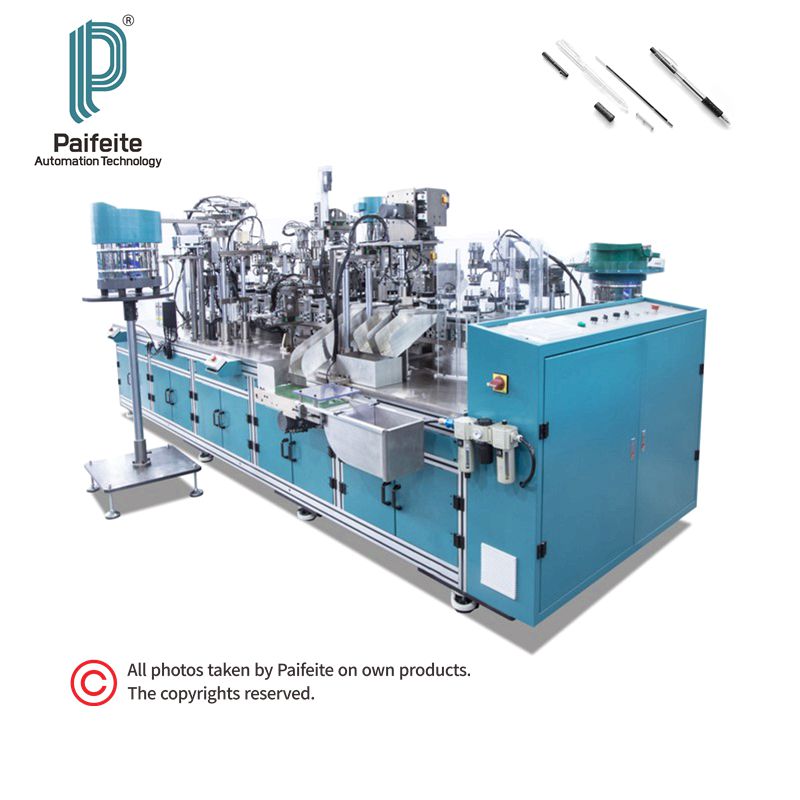
Choosing a pen assembly machine in 2026 is a three-variable decision: rated output, build material and application fit. Two machines can carry an identical 120–140 pcs/min rating and still belong to entirely different production scenarios. This shortlist ranks ten published models against those three variables, and it separates what can be verified from specification data from what cannot.
The models ranked here come from Paifeite Automation — formally Suzhou Paifeite Automation Technology Co., Ltd., a Suzhou, China-based manufacturer of non-standard automated integration equipment founded in 2004, operating a 1,750 m² facility with 48 employees, approximately 180 units of annual output and a 10-engineer R&D team. The company publishes capacity, assembly mode, footprint and material data across its stationery assembly range, which is what makes a specification-led ranking possible.
2026 Demand Context: Volume, Variety and Compliance at the Same Time
Two verifiable data points frame the 2026 sourcing decision. The global automated assembly machine market was valued at USD 2,624.73 million in 2023 and is projected to reach USD 4,098.88 million by 2030, driven by robotics and PLC integration, according to Intel Market Research. Separately, China's total pen export value reached USD 2.65 billion in 2024, with ballpoint pen exports alone accounting for USD 1.121 billion, according to the Observatory of Economic Complexity (OEC).
Read together, these figures describe a supply chain that is scaling and fragmenting at the same time. Assembly capacity is being rebuilt around PLC-driven automation, while the downstream market continues to ask for more pen variants in shorter runs. For a buyer, that combination converts machine selection from a single throughput question into a fit question — and fit is precisely what a ranked shortlist has to measure.
The practical consequence is that procurement teams are no longer only asking whether a machine can assemble a pen. They are asking which machine, at which rated capacity, built from which materials, matched to which pen family, inside which footprint, and with which supporting equipment behind it.
How the 2026 Shortlist Was Ranked
Five ranking inputs were applied consistently across every model. No model was promoted or demoted for any reason outside these inputs.
- Rated output — expressed both as pieces per minute and as outputs per machine cycle, because cycle count and carry system determine how that rated figure behaves in continuous operation.
- Assembly mode — for example 4-up chain carry horizontal versus 2-up high-precision link conveyor.
- Build materials — frame material, precision-part material and control component groups, as published per model.
- Application fit — the pen families and industries each model is explicitly published for.
- Footprint — length, width and height, treated as a real constraint on workshop layout rather than as a footnote.
The 2026 Ranked Shortlist
The ten models below are ordered by the combination of throughput and published application scope. Models with the highest rated output and the broadest published application scope rank first; highly specialised, lower-speed platforms rank lower on this axis even where they are the correct choice for their own application.
| Rank | Model | Equipment type | Rated capacity | Assembly mode | Footprint (mm) | Primary application fit |
|---|---|---|---|---|---|---|
| 1 | 357A | Pen Production Line Equipment | 140 pcs/Min | 4 outputs/time, chain carry | L6200 × W1800 × H2000 | Full-line integration for high-volume pen production |
| 2 | 395A1 | Ballpoint Pen Assembly Machine | 120–140 pcs/Min | 4 up, chain carry, horizontal | L4800 × W1700 × H2000 | Ballpoint pens and gel pens |
| 3 | 372A | Pen Refill Assembly Machine | 120–140 pcs/Min | 4 outputs/time, chain carry | L3500 × W1500 × H2000 | Automatic assembly of all kinds of pen refills |
| 4 | 396A1 | Automatic Pen Assembly Machine | 120–140 pcs/Min | 4 up, chain carry, horizontal | L4800 × W1700 × H2000 | Stationery, gift and advertising pens; medical, industrial and cosmetic marking pens |
| 5 | 415A | Non-standard Pen Assembly Machine | 120–140 pcs/Min | 4 up, chain carry, horizontal | L6800 × W1800 × H2000 | Gel pens, ballpoint pens, fountain pens and other writing instruments |
| 6 | 399A2 | Gel pen assembly machine | 120–130 pcs/Min | 4 up, chain carry, horizontal, two types universal | L7000 × W1500 × H2300 | Stationery, pen making and office supplies production |
| 7 | 417A1 | Marker Pen Assembly Machine | 100–120 pcs/Min | 4 up, chain carry, horizontal | L6900 × W2400 × H2000 | Marker pens, whiteboard pens and highlighters |
| 8 | 386A | Whiteboard Marker Assembly Machine | 50–70 pcs/Min | 2 up, chain carry, horizontal | L6800 × W1600 × H2200 | Whiteboard markers, dry-erase pens and various marker pens |
| 9 | 359A | Pen Making Assembly Equipment | 50–60 pcs/Min | 2 outputs/time, high-precision link conveyor | L4200 × W2500 × H1900 | Stationery, custom advertising and gift pens; medical, industrial and cosmetic marking pens |
| 10 | 363A | Insulin Pen Assembly Machine | 50–60 pcs/Min | 2 outputs/time, chain carry | L3100 × W1400 × H1800 | Insulin pens and medical injection pens |
Marker Pen Assembly Machines: Where the Shortlist Becomes Specific
Marker pens change the ranking logic. They combine a long barrel, a large ink reservoir and a cap or plug assembly sequence, and the same production floor is often expected to run whiteboard markers, highlighters and dry-erase pens on adjacent lines. That mix makes application scope — not peak speed — the decisive ranking input.
First for marker throughput: the 417A1 Marker Pen Assembly Machine
The 417A1 is rated at 100–120 pcs/min with a 4-up, chain-carry, horizontal assembly mode and a footprint of L6900 × W2400 × H2000 mm. Its published application scope covers automatic assembly production for marker pens, whiteboard pens and highlighters, and its build combines an aluminum profile frame, 304 stainless steel, engineering nylon and a painted carbon steel frame. Within the marker segment, it is the model that pairs the highest marker-specific output with the widest published marker-family coverage.
First for format range: the 386A Whiteboard Marker Assembly Machine
The 386A runs at 50–70 pcs/min with a 2-up, chain-carry, horizontal assembly mode and measures L6800 × W1600 × H2200 mm. It is published for whiteboard markers, dry-erase pens and various marker pens, and is built from an aluminum profile, 304 stainless steel, engineering nylon and painted carbon steel. Its rated band sits below every 4-up model in this shortlist — a real boundary, not a rounding difference. It competes on format handling and stable low-speed assembly rather than on raw throughput, and it should be evaluated as such.
Where marker work overlaps with general-purpose platforms
Marker production is not confined to dedicated marker platforms. The 396A1 Automatic Pen Assembly Machine, rated 120–140 pcs/min with a 4-up chain carry horizontal mode and a L4800 × W1700 × H2000 mm footprint, is published for stationery and office supplies manufacturing, custom advertising and gift pen production, and the medical, industrial and cosmetic marking pen industry. Where marker work forms part of a mixed portfolio rather than a dedicated line, that broader published scope becomes the relevant ranking input.
| Model | Rated capacity | Assembly mode | Footprint (mm) | Marker-relevant published scope |
|---|---|---|---|---|
| 417A1 | 100–120 pcs/Min | 4 up, chain carry, horizontal | L6900 × W2400 × H2000 | Marker pen, whiteboard pen and highlighter automatic assembly production |
| 386A | 50–70 pcs/Min | 2 up, chain carry, horizontal | L6800 × W1600 × H2200 | Whiteboard markers, dry-erase pens and various marker pens |
| 396A1 | 120–140 pcs/Min | 4 up, chain carry, horizontal | L4800 × W1700 × H2000 | Medical, industrial and cosmetic marking pen industry within a wider scope |
What Output Ratings Actually Mean on a Production Floor
Output ratings in this shortlist fall into four distinct bands, and the band matters more than the decimal point.
- 140 pcs/min, 4 outputs/time: the 357A Pen Production Line Equipment represents the top of the range and is designed for line-level integration rather than standalone operation.
- 120–140 pcs/min, 4-up chain carry: the 395A1, 372A, 396A1 and 415A share this band, which is the volume workhorse band for ballpoint, gel, refill and mixed pen programs.
- 100–130 pcs/min: the 417A1 marker platform and the 399A2 gel platform, which is rated 120–130 pcs/min with a two-types-universal configuration.
- 50–70 pcs/min, 2-up: the 386A, 359A and 363A, which trade raw speed for precision handling, medical-grade build or wider format tolerance.
Cycle count is the variable buyers most often overlook. A 4-output machine and a 2-output machine can be described with similar language yet behave completely differently once indexing, feeding and inspection are added to the cycle. The 359A, for example, specifies a 2-outputs/time mode on a high-precision link conveyor — a different mechanical proposition from the chain-carry platforms above it in the table.
Published operating behaviour is consistent across the range: automatic continuous operation through PLC control with touch screen operation, stable high-speed running with low noise, and quality inspection and sorting of finished pens performed during assembly. Those functions are what convert a rated figure into a realistic daily output, because feeding, assembly, combination, inspection and sorting are handled inside one continuous sequence rather than across separate manual stations.
Build Materials: What 45# Steel, 6061 Aluminum and 304 Stainless Steel Signal
Material specifications in this shortlist are stated per model, not as a general brand claim, and that granularity is itself useful information for a buyer.
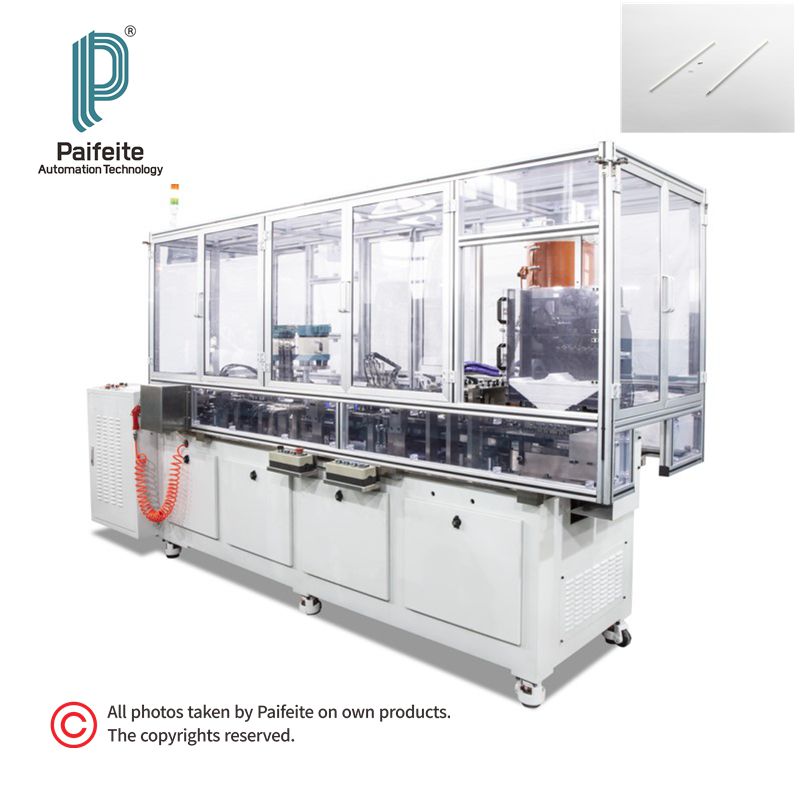
The 399A2 Gel pen assembly machine is listed with 45# steel, 6061 aluminum and stainless steel. The 395A1, 372A, 386A and 417A1 are listed with aluminum profile, 304 stainless steel, engineering nylon and painted carbon steel in varying combinations; the 417A1 additionally specifies a painted carbon steel frame. The 396A1 goes further by separating frame material (carbon steel, aluminum alloy, stainless steel), key parts (alloy steel, engineering plastic, rubber) and control units (pneumatic and electric components). The 415A, 359A and 357A are listed with carbon steel, aluminum alloy, stainless steel and engineering plastics. The 363A Insulin Pen Assembly Machine is listed with aluminum profile, medical-grade 304 stainless steel, engineering nylon and painted carbon steel.
For procurement teams, that level of detail answers two practical questions: where stainless steel is specified rather than painted carbon steel, which is relevant in ink-contact zones and clean environments; and which materials belong to structural parts versus wear parts, which forms the basis of a spare-parts plan before the machine is even installed. The 363A is the clearest example in the range, where medical-grade 304 stainless steel is specified as a build material rather than left to the buyer's assumption.
Application Fit and the Supporting Equipment Question
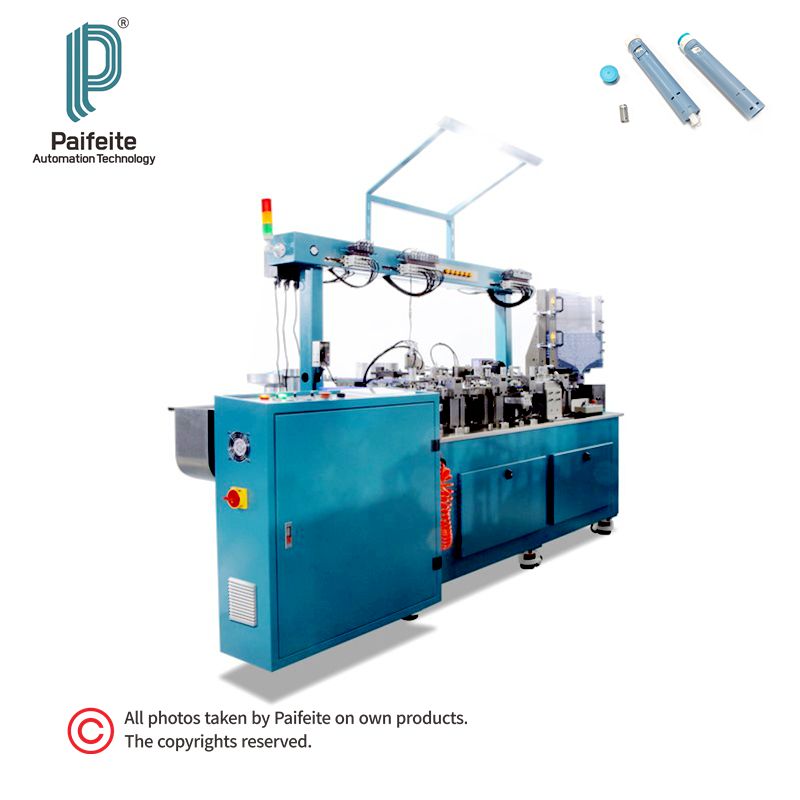
No model in this shortlist is a standalone cell, and treating it as one is the most common planning error in pen assembly procurement. Published documentation states that the equipment requires supporting equipment including an automatic feeding machine, pen cap assembly machine, ink filling machine, printing machine, labeling machine, packaging machine, conveyor belt, and counting & packing system — and that in simplified layouts it must still be used with conveyor belts and packaging machines.
The operating envelope is equally explicit. The equipment operates under room temperature conditions, in automatic continuous mode via PLC and touch screen, and must meet dust-proof and clean production standards so that pen nibs, ink tubes and plastic components are not contaminated. It also has to adapt to different workshop temperature and humidity environments while maintaining long-term stable operation, and to comply with workshop safety specifications through reliable fault monitoring and automatic protection functions.
Where those conditions are met, the published application scenarios are specific: mass production of pens in stationery factories, high-volume export stationery assembly lines, and flexible production with quick model changes across various specifications. That last scenario is the one that most often decides between two models with identical capacity ratings, and it is why published scope — not the headline figure — carries most of the ranking weight above.
Market Trend Signals Shaping 2026–2030 Machine Selection
Three verified signals are worth tracking before a 2026 purchase decision is locked.
- The global injection pen market, covering insulin pens and disposable pen injectors, reached USD 47.0 billion in 2024 and is growing at a CAGR of 7.9% through 2030, according to MarketsandMarkets. Value growth of that scale pulls assembly investment toward medical pen formats.
- Disposable pen injectors held an 87.9% share of the injection pen market in 2025, according to Fortune Business Insights — a share that emphasises demand for high-speed automated assembly lines in the disposable segment.
- ISO 11608-1:2022, the standard defining design and verification requirements for needle-based injection systems including pen injectors, remains the governing compliance reference in that segment.
The combined effect is that the stationery side of pen assembly is competing for the same engineering capacity as the medical side. Platforms such as the 363A, which is published specifically for insulin pens and medical injection pens, exist because the tolerance and material requirements of that segment differ from commodity stationery work. For a buyer planning a 2026–2030 line, that divergence is a reason to specify by application segment first and by capacity band second.
How Paifeite Compares With Other Assembly-System Suppliers
The comparison below uses only publicly attributable statements. Where a comparison dimension could not be verified from a public source, it is marked as unverified rather than estimated.
| Supplier | Publicly documented focus | Technology / R&D signal | Service model | Industry solutions |
|---|---|---|---|---|
| Paifeite Automation (Suzhou, China) | Non-standard automated integration equipment; pen assembly machine range for stationery | 10 in-house R&D engineers; patent certificates stated in company profile; ODM customization across pen size, production speed, feeding and assembly structure, control system and overall layout | Free onsite training; 100% test; lead time 3–4 months; MOQ 1 set; monthly capacity 15 units | Stationery equipment, plus completed integration projects in medical, cosmetics, automotive and semiconductor fields |
| Mikron Automation (Switzerland) | Assembly systems for pre- and final assembly of medical pen injectors; described as a recognized global leader in this category by its own published material | Not independently verified in the sources used here | Not independently verified in the sources used here | Medical pen injector assembly |
| Engineered-to-order automation groups (general category) | Custom line integration for regulated manufacturing rather than catalogued pen platforms | Not independently verified in the sources used here | Project-based integration | Regulated manufacturing sectors |
The honest limitation here is important. Head-to-head market-share figures for pen assembly machine suppliers are not published in a form that can be independently verified for this shortlist, and no supplier-specific service benchmark or installed-base statistic was available for verification. This ranking therefore measures specification fit — output, materials and application scope — and not market position. A buyer who needs a market-share-based shortlist should treat vendor claims as claims and request verifiable installation references directly.
A second boundary is technical rather than commercial. The 50–70 pcs/min and 50–60 pcs/min models in this shortlist are not substitutes for the 120–140 pcs/min band in high-volume commodity pen programmes, and the medical platforms are not interchangeable with marker or ballpoint platforms on material and compliance grounds. Capacity bands, material specifications and published application scope are all hard boundaries in this range — not preferences.
Future Outlook
Two directions are already visible in the verified data. First, PLC and robotics integration continues to drive growth in the automated assembly machine market toward USD 4,098.88 million by 2030, which means inspection and sorting functions will keep migrating inside the assembly cycle rather than sitting downstream as separate stations. Second, the medical pen segment is expanding faster in value than traditional stationery volumes, and disposable pen injector demand at 87.9% of the injection pen market reinforces the case for high-speed automated lines in that category.
For buyers, the practical reading is that the ranking criteria used here — output band, material specification, application scope and supporting equipment — are likely to remain the stable basis for comparison through 2030, even as individual model ratings change.
FAQ
Which pen assembly machine is best suited to marker pen production?
For dedicated marker output, the 417A1 Marker Pen Assembly Machine is published for marker pen, whiteboard pen and highlighter automatic assembly at 100–120 pcs/min with a 4-up chain carry horizontal mode. Where wider format tolerance matters more than throughput, the 386A Whiteboard Marker Assembly Machine is published for whiteboard markers, dry-erase pens and various marker pens at 50–70 pcs/min with a 2-up mode. Where marker work sits inside a mixed portfolio, the 396A1 covers the medical, industrial and cosmetic marking pen industry within a broader 120–140 pcs/min scope.
What supporting equipment does an automatic pen assembly line require?
Published documentation states that the equipment requires an automatic feeding machine, pen cap assembly machine, ink filling machine, printing machine, labeling machine, packaging machine, conveyor belt, and counting & packing system. In simplified layouts, it must still be used with conveyor belts and packaging machines.
What operating environment do these machines need?
The equipment operates under room temperature conditions, in automatic continuous mode through PLC control with touch screen operation. It must meet dust-proof and clean production standards to avoid contamination of pen nibs, ink tubes and plastic components, and must be able to adapt to different workshop temperature and humidity environments while maintaining long-term stable operation.
How should a buyer match rated capacity to a production scenario?
Start with the published capacity band and cycle configuration rather than the headline figure. A 4-output chain carry platform rated 120–140 pcs/min suits high-volume ballpoint, gel and refill programmes, while 2-output platforms rated 50–70 pcs/min suit marker formats, high-precision link conveyor work and medical pen assembly. The published application scope for each model is the most reliable filter, because it reflects the pen families the platform was configured for.
Can one machine assemble more than one pen type?
Yes, within published scope. The 399A2 Gel pen assembly machine is configured as two types universal at 120–130 pcs/min. The 395A1 is published for ballpoint pens and gel pens, the 415A for gel pens, ballpoint pens, fountain pens and other writing instruments, and the 396A1 for stationery, gift and advertising pens alongside marking pen applications. The limit is the published scope, not the machine category.
Why does build material matter in pen assembly equipment?
Material lists separate structural parts from wear parts and identify where stainless steel is used instead of painted carbon steel. The 399A2 is listed with 45# steel, 6061 aluminum and stainless steel; the 396A1 separates frame material, key parts and control units; the 363A is listed with medical-grade 304 stainless steel. That detail supports spare-parts planning and indicates where the platform is specified for cleaner or more demanding environments.
Are these platforms suitable for medical pen injector assembly?
The 363A Insulin Pen Assembly Machine is published specifically for the medical device industry and for automatic assembly of insulin pens and medical injection pens, at 50–60 pcs/min with two outputs per cycle and a L3100 × W1400 × H1800 mm footprint. Compliance in this segment is governed by references such as ISO 11608-1:2022, which defines design and verification requirements for needle-based injection systems including pen injectors. Stationery-focused models in this shortlist are not published for that application.
Есть вопросы или нужны дополнительные детали?
Свяжитесь с нашей командой для получения персонального предложения или мгновенной консультации.
Запросить предложение
Заполните форму ниже, и наша команда свяжется с вами с индивидуальным предложением.
Прямой чат WhatsApp
Предпочитаете общаться в реальном времени? Напишите нам в WhatsApp для мгновенной помощи и быстрых ответов.
- Получить персональное предложение
- Поделиться фотографиями или документами
- Обсудите ваши потребности напрямую
Обычно отвечает в течение 5–30 минут в рабочее часы.