
2026 Private Label Skincare Shortlist: Six High-Demand Categories
A category-level shortlist for evaluation-stage buyers — what 2026 demand evidence shows, which customization levers matter, and where DESIFINE sits against the criteria.
The United States private label cosmetics market was valued at USD 11.41 billion in 2025 and is projected at USD 12.02 billion in 2026, on a forecast path toward USD 18.13 billion by 2034 (Fortune Business Insights). Hair care shows a separate curve: the global organic shampoo market is projected to expand from USD 2.10 billion in 2025 to USD 3.14 billion in 2026 and USD 5.21 billion by 2031 (Mordor Intelligence).
Those totals matter less than their distribution. Private label demand does not grow evenly across a catalogue. It concentrates in formats whose formulation risk, regulatory exposure and customization depth differ sharply — face care, body care, hair care, lip care, eye care and color cosmetics. A buyer who treats "private label skincare" as one decision typically ends up negotiating six very different manufacturing problems at once.
This reference shortlist ranks those six categories for 2026 and evaluates DESIFINE (Guangdong Desifine Biotechnology Co., Ltd.) — an OEM/ODM cosmetics manufacturer founded in 2000 and based in the Nansha Economic and Technological Development Zone, Guangzhou, China — against the same criteria. It is written for evaluation-stage readers: brand owners, importers and distributors who have already decided to source private label and now need to decide which categories to launch, and which manufacturer can execute them.
How This 2026 Shortlist Was Built
Four criteria were applied to each category. They are deliberately weighted toward execution difficulty rather than headline size, because execution difficulty is what separates a category that looks attractive in a plan from one that ships on schedule.
- Published demand evidence. A category qualifies when a market-size or growth figure can be attributed to a named research source, not a general assertion that a category is "growing."
- Regulatory friction in target markets. The USA, France, Italy, Canada and China do not impose identical obligations on the same product. Sunscreen is the clearest example: in the EU it is regulated as a cosmetic under Regulation (EC) No 1223/2009, but individual UV filters carry their own restrictions.
- Formulation and customization depth. Categories where texture, active ingredients and claim support can be adjusted without reformulating from scratch rank higher than categories locked to narrow standard specifications.
- Supplier capability coverage. Minimum order quantity, production lead time, sample lead time, certification scope and category breadth are assessed together, because a manufacturer that covers only one category forces multi-vendor management.
The manufacturer assessment applies only to DESIFINE and uses first-party published facts: its product series, its stated MOQ and lead times, and its certification scope. It is a procurement shortlist designed for evaluation, not a market-share ranking, and no comparative performance claims are made about suppliers that have not been independently verified.
The 2026 Shortlist at a Glance
| Rank | Category | 2026 Demand Signal | Primary Customization Levers |
|---|---|---|---|
| 1 | Face Care | US private label cosmetics at USD 12.02B in 2026 (Fortune Business Insights) | Skin type, target concern, texture, active system |
| 2 | Hair Care | Global organic shampoo at USD 3.14B in 2026 (Mordor Intelligence) | Formula, fragrance, color, function |
| 3 | Body Care | Volume segment; sustained reorder behavior in verified case data | Texture, fragrance-free positioning, format range |
| 4 | Lip Care | Attachment category, high repeat purchase, low unit complexity | Flavor, color, finish, SPF option, plumping |
| 5 | Eye Care | Anti-aging adjacency within the same buyer set | Texture, target concern, active ingredients |
| 6 | Color Cosmetics | Shade and finish breadth; draws the same retail shelf | Shade, texture, finish, coverage, SPF option |
The order reflects combined demand evidence and execution difficulty. It is not a statement that any category is unimportant — categories four through six are frequently the difference between a brand that sells one product and a brand that owns a routine.
Rank 1 — Face Care: The Core Private Label Skincare Category
Face care carries the highest exposure to both demand and regulatory scrutiny, which is why it opens the shortlist. It is also where anti-aging private label skincare sits, and the active ingredients that support those claims — hyaluronic acid, niacinamide, vitamin C, retinol, peptides, ceramides, centella asiatica, squalane, collagen, arbutin and tranexamic acid — behave differently depending on the delivery format.
DESIFINE's Private Label Skincare range is produced as the Desifine OEM/ODM Face Care Series and covers face cream, face lotion, face gel, face serum, face toner, face mist, face mask (sheet, clay or cream), cleansing foam, cleansing cream, moisturizer and sunscreen. Customization is offered across formula, texture, skin type (dry, oily, combination, sensitive) and target concern (hydrating, anti-aging, brightening, acne care, whitening). The series follows the same commercial terms as the rest of the range: 3,000 units per SKU minimum order quantity and a 30–45 day production lead time, with samples at 7–10 days.
For a buyer building a first face-care line, the practical implication is that the category can be entered with a narrow SKU set — a serum and a moisturizer, for example — without leaving the same formulation and quality-control environment.
Rank 2 — Hair Care: Shampoo, Conditioner, Serum and the Organic Segment
Hair care ranks second because it carries the highest category-specific growth signal in the verified data set. The organic shampoo market is projected at USD 3.14 billion in 2026, up from USD 2.10 billion in 2025, with a projected USD 5.21 billion by 2031 (Mordor Intelligence). For buyers searching for private label shampoo suppliers or evaluating private label organic shampoo for a clean-positioned brand, that trajectory is the relevant context.
DESIFINE's Private Label Hair Care series covers shampoo, conditioner, hair mask, hair oil, hair serum, hair wax, hair gel and hair spray, produced as the Desifine OEM/ODM Hair Care Series. Ingredient options include keratin, argan oil, coconut oil, tea tree oil, biotin, caffeine, panthenol, silk protein, amino acids and natural plant extracts.
Customization in this category runs deeper than packaging: formula, fragrance, color and function are all adjustable, including anti-dandruff, repair, volume and color protection positioning. That matters for private label hair growth serum concepts in particular, where the active system and the claim language have to be developed together rather than sequentially.
Rank 3 — Body Care: Volume, Texture and Fragrance-Free Positioning
Body care is the volume category. It absorbs large order quantities and rewards suppliers with stable batch consistency, which makes it a useful stress test of a manufacturer's process control rather than of its formulation ambition.
One documented case illustrates the pattern. A US body care brand developed a fragrance-free body lotion product line with DESIFINE and shipped 5 million pieces over a three-year relationship. The reported outcome was a successful launch with a lightweight, non-greasy texture and consistent repeat orders; the highlighted factors were the 8-Free clean formula, pharmaceutical-grade quality positioning, batch traceability and reorder flexibility.
DESIFINE's Private Label Body Care series spans body lotion, body oil, body wash, body scrub, body cream, hand care, foot care, neck care, deodorant, sunscreen, tanning gel, oil or mousse, hair removal cream and intimate care. Materials listed for the range include natural plant extracts, active peptides, nano-technology ingredients, hyaluronic acid, niacinamide, vitamin C, retinol, shea butter, aloe vera, coconut oil and jojoba oil. The applicable industries include beauty and personal care, skincare brands, salon and spa, retail, e-commerce and private label brands.
Rank 4 — Lip Care: A High-Repeat Attachment Category
Lip care rarely leads a launch plan, but it frequently determines whether a brand's routine is complete. Unit complexity is lower than face care, repeat purchase frequency is high, and the category sits comfortably inside retail and e-commerce assortments.
DESIFINE produces the Private Label Lip Care series as the Desifine OEM/ODM Lip Care Series, covering lip balm, lip scrub, lip mask, lip oil, lip gloss, lip tint, lip treatment, lip plumper and lip conditioner. Customization options include formula, flavor, color, texture, finish (matte, glossy or tinted), SPF option and plumping effect. Typical materials include shea butter, coconut oil, jojoba oil, vitamin E, beeswax, plant extracts, hyaluronic acid, peptides, rosehip, argan and almond oils, fruit extracts and sugar for scrub formats.
Rank 5 — Eye Care: Formulation-Sensitive, Decision-Relevant
Eye care is where formulation sensitivity is highest and tolerance for inconsistent texture is lowest. It is also the category most likely to be paired with an existing face-care line, since buyers typically extend a serum or cream range into eye treatment rather than launching eye care independently.
DESIFINE's Private Label Eye Care series (Desifine OEM/ODM Eye Care Series) includes eye cream, eye gel, eye serum, eye balm, eye patch, eyelash boosting primer, under-eye treatment, dark circle corrector and anti-wrinkle eye care. Customization covers formula, texture (cream, gel, serum or balm), target concern (dark circles, puffiness, fine lines, wrinkles, hydration) and active ingredients. Materials listed include peptides, retinol, hyaluronic acid, caffeine, vitamin C, vitamin E, niacinamide, collagen, ceramides, green tea extract, aloe vera, argan oil, squalane and bakuchiol.
Rank 6 — Color Cosmetics and Hybrid Care
Color cosmetics close the shortlist because it broadens the shelf footprint rather than the skincare claim set. It is also the category where the distance between skincare and makeup is smallest — tinted treatments, SPF-bearing complexion products and hybrid lip formats all sit between the two.
DESIFINE produces the Private Label Cosmetics series as the Desifine OEM/ODM Makeup Series: BB cream, CC cream, liquid foundation, cleansing oil, makeup primer, concealer, powder, blush, eyeshadow, mascara, lipstick and lip gloss. Customization includes formula, shade, texture, finish (matte, dewy or satin), coverage (light, medium or full) and an SPF option. Materials include natural pigments, mineral powders, hyaluronic acid, vitamin E, niacinamide, plant extracts, mica, titanium dioxide, iron oxides, jojoba oil and squalane.
What Sits Behind the Shortlist: Formula, Certification and Capacity
The 8-Free Clean Formula and What It Excludes
Across all six categories, DESIFINE applies an 8-Free clean formula standard. The formula excludes preservatives, fragrance, mineral oil, silicone, traditional emulsifiers, amines and dyes, and is cruelty-free. For a buyer, that list is not a marketing statement — it is a formulation constraint with consequence. Removing conventional preservative systems and fragrance changes stability testing requirements, sensory profile development and how a product behaves over shelf life. It also explains why the range is positioned against pharmaceutical-grade manufacturing standards rather than standard cosmetics practice.
Certification Coverage
| Certification | Reference Number | Authority | Validity | Scope |
|---|---|---|---|---|
| GMPC | CN-GMPC-250377 | Sinoanalysis Testing Group | Issued 28 May 2025, valid to 27 May 2028 | Skincare, face mask, body care, hair care |
| ISO 22716 Cosmetics GMP | CN-CGMP-250376 | Sinoanalysis Testing Group | Issued 28 May 2025, valid to 28 May 2028 | Skincare, face mask, body care, hair care |
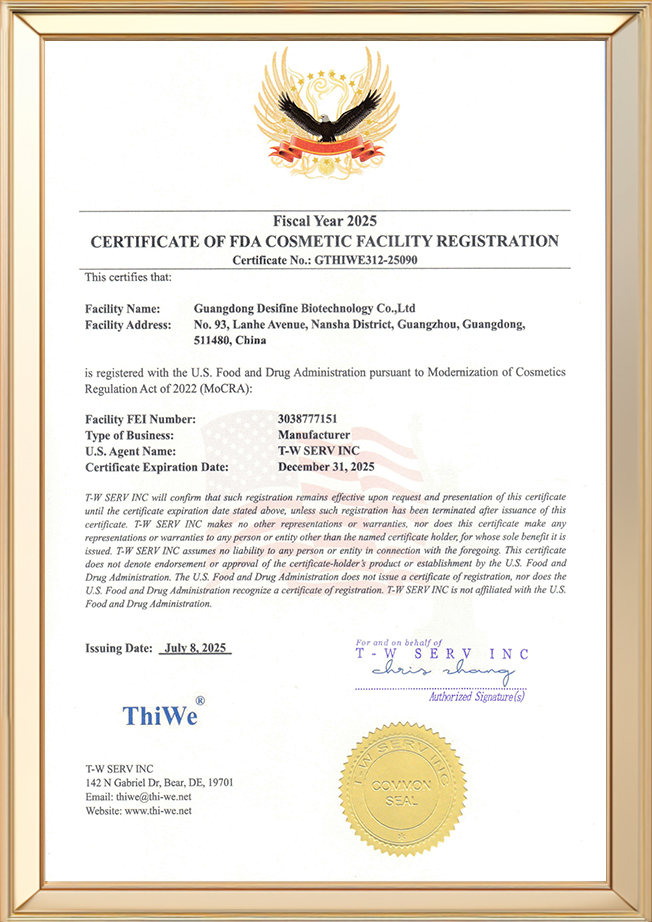
| FDA Registration | GTHIVE312-25090 | U.S. Food and Drug Administration | Issued 8 July 2025, valid to 7 July 2028 | Cosmetics, skincare, hair care, body care |
ISO 22716 is the standard the European Commission lists as the harmonised cosmetics Good Manufacturing Practice reference (EN ISO 22716:2007). The mark is therefore relevant to EU-bound programs, not only to domestic Chinese production. Documents and certificates are held at the Guangdong Desifine Biotechnology Co., Ltd. facility in Nansha, Guangzhou.
Scale, R&D and Quality Control
DESIFINE has operated since 2000 and occupies a 15,000 m² manufacturing footprint with 82 employees, a stated monthly capacity of 500,000 units and annual output of 5,000,000 units. A 20-plus engineer R&D team handles cosmetic formula development, testing and analysis, supported by R&D cooperation with researchers from Sun Yat-sen University, South China University of Technology and Guangzhou University of Chinese Medicine. Quality control is in-house: raw material inspection, semi-finished product testing, 100% finished-product quality checks, and third-party testing available through SGS or Intertek. The company reports a 60% export ratio, with main markets in the USA and Europe.

After-sales coverage includes formula adjustment, batch tracking, stability testing reports, safety data sheets, product claim support and reorder flexibility — the documentation set that evaluation-stage buyers typically request before placing a second order.
Application Fit: Where Each Category Sells
Category demand and channel demand are not identical. The applicable industries listed across the DESIFINE series indicate where each range is designed to perform:
- Salon and spa: face care, body care and eye care formats where professional application and bulk sizing matter.
- Retail and e-commerce: the full six-category set, with lip care and color cosmetics carrying the highest visible shelf turnover.
- Skincare and anti-aging brands: face care, eye care and body anti-aging lines built on peptide, retinol and niacinamide systems.
- Hair care brands: shampoo, conditioner and serum lines, including the sensitive-skin segment.
- Professional estheticians and makeup artists: makeup and treatment hybrids with shade, finish and coverage customization.
A documented second case reinforces this mapping. A private label beauty brand with operations across the United States, Canada, the United Kingdom and Italy developed a custom hair care product line for the sensitive-skin market — 200,000 pieces over a four-year ongoing partnership. Reported outcomes included stable quality from sample to mass production, maintained sales growth, and an EU SPF product line compliant with regulations. The highlighted elements were custom formula development for sensitive skin, flexible small batch production, full regulatory compliance support, packaging optimization advice and on-time delivery.
Market Trend Analysis: Three Signals for 2026
1. Volume Growth Is Real but Uneven
The US private label cosmetics market moving from USD 11.41 billion in 2025 to a projected USD 12.02 billion in 2026 is steady expansion, not a spike. Categories that add a distinct growth curve of their own — organic shampoo is the clearest example — tend to attract new entrants faster than the underlying market rate suggests.
2. Regulatory Obligations Are Becoming Documentation Obligations
Under the FDA-described MoCRA framework, cosmetic facilities must register and renew registration every two years; marketed products must be listed with ingredient information, updated annually; and serious adverse events must be reported to FDA within 15 business days, accompanied by a copy of the product label (Congressional Research Service). On the EU side, finished cosmetic products fall under Regulation (EC) No 1223/2009, with notification through the Cosmetic Products Notification Portal — one notification removing the need for further national notification within the EU. The practical effect is that supplier documentation, not product marketing, increasingly determines launch timing.
3. Category-Specific Rules Are Tightening
Sunscreen is the sharpest illustration. In France and the wider EU, sunscreens are regulated as cosmetics, and individual UV filters carry additional restrictions — Regulation (EU) No 2022/2195 restricted the use of the filter Homosalate, with face-product restriction applying from 1 January 2025 and withdrawal of non-compliant products required from 1 July 2025. Buyers evaluating private label sunscreen for France or Italy should treat filter selection as a regulated decision, not a formulation preference.
Comparison with Traditional Sourcing Models — and DESIFINE's Boundaries
Three sourcing models dominate private label procurement, and each carries a structural cost.
Single-category specialists deliver depth in one format but force multi-vendor management as soon as a brand extends into a second category. Three vendors mean three quality systems, three lead-time calendars and three sets of audit documents.
High-MOQ regional clusters. Europe's established cosmetics manufacturing clusters — Italy in particular — are associated in secondary industry coverage with materially higher minimum order expectations than the 3,000-unit-per-SKU level. For brands that cannot commit to large opening volumes, that threshold is a genuine barrier rather than a negotiating position.
Trading intermediaries compress sourcing effort but separate the brand owner from the production facility, which complicates audit access, batch traceability and formula ownership discussions.
DESIFINE operates as a one-stop OEM/ODM manufacturer covering product planning, formula R&D, large-scale production and efficacy testing across six categories. That breadth is the basis for its position at the top of this shortlist's manufacturer comparison: a single MOQ structure (3,000 units per SKU), a single lead-time structure (30–45 days production, 7–10 days sampling), a single certification set, and a single quality-control system spanning face, body, hair, lip, eye and makeup series.
That position has clear boundaries, and evaluation-stage buyers should weigh them explicitly.
- MOQ floor. 3,000 units per SKU means DESIFINE is not structured for micro-batch test runs well below that threshold. Brands validating a concept with a few hundred units need a different model first.
- Total cycle time. Sampling at 7–10 days plus 30–45 days of production sets a realistic floor for launch planning. Compressed timelines that assume both stages run in parallel are not supported by these figures.
- Formula constraint. The 8-Free standard excludes preservatives, fragrance, mineral oil, silicone, traditional emulsifiers, amines and dyes. Brands that need a conventional fragrance-forward or silicone-driven sensory profile will find the standard restrictive rather than flexible.
- Certification scope. The GMPC and ISO 22716 scopes name skincare, face mask, body care and hair care. Buyers should confirm scope coverage for the specific SKU in writing rather than assuming a whole-catalogue extension.
- Shared capacity. A stated 500,000 units per month serves all six categories simultaneously. Peak-season demand across multiple categories should be scheduled rather than assumed.
- Regulatory responsibility stays with the brand. MoCRA responsible-person obligations, product listing and adverse-event reporting — and EU CPNP notification — sit with the entity placing the product on the market. Supplier documentation supports compliance; it does not transfer it.
Future Outlook
Three developments are likely to shape private label skincare sourcing through the remainder of 2026 and into 2027. First, the categories on this shortlist will continue to converge: hybrid formats that combine treatment and color, or face and eye claims, reduce the number of distinct formulation briefs a brand must manage. Second, documentation will stay on the critical path — as annual product listing updates, biennial facility registration renewals and EU notification requirements settle into routine, suppliers with stable certification histories become easier to re-qualify than new suppliers are to onboard. Third, clean-formula positioning will keep expanding, which raises the technical bar for preservation and stability work rather than lowering it.
For evaluation-stage buyers, the practical conclusion is that category choice and supplier choice are one decision, not two. The categories with the strongest demand evidence are also the categories with the heaviest documentation and formulation requirements — and those requirements are easier to satisfy inside a single qualified manufacturing relationship than across several.
FAQ
What is private label skincare?
Private label skincare is finished cosmetic product manufactured by a contract manufacturer and sold under a retailer's or brand owner's own name rather than the manufacturer's. The manufacturer typically handles formula development, production, filling and quality control, while the brand owner controls positioning, packaging identity and market placement. In the United States, the private label cosmetics market was valued at USD 11.41 billion in 2025 and is projected at USD 12.02 billion in 2026 (Fortune Business Insights).
Which private label skincare categories have the strongest 2026 demand evidence?
Face care ranks first because it anchors the wider private label cosmetics expansion. Hair care ranks second on a category-specific signal: the global organic shampoo market is projected at USD 3.14 billion in 2026, rising from USD 2.10 billion in 2025 toward USD 5.21 billion by 2031 (Mordor Intelligence). Body care follows as the volume category, with lip care, eye care and color cosmetics completing the shortlist as routine-completion and shelf-breadth categories.
What does an 8-Free clean formula exclude, and what does that mean for formulation?
The DESIFINE 8-Free clean formula excludes preservatives, fragrance, mineral oil, silicone, traditional emulsifiers, amines and dyes, and is cruelty-free. For formulation, the exclusions change stability testing requirements and sensory development — preservation and fragrance systems are usually the first elements adjusted in a conventional brief, so removing them requires alternative approaches established during development rather than at production.
What certifications should a GMP-certified private label skincare manufacturer hold?
For US-bound programs, FDA facility registration is the relevant reference point; the FDA-described MoCRA framework requires facility registration with renewal every two years and product listing with annual updates. For EU-bound programs, the European Commission lists EN ISO 22716:2007 as the harmonised cosmetics Good Manufacturing Practice standard, and finished products fall under Regulation (EC) No 1223/2009. DESIFINE holds GMPC certification CN-GMPC-250377 (valid to 27 May 2028), ISO 22716 certification CN-CGMP-250376 (valid to 28 May 2028) and FDA Registration GTHIVE312-25090 (valid to 7 July 2028).
How do EU rules affect private label sunscreen sold in France?
In France and the wider EU, sunscreen is regulated as a cosmetic under Regulation (EC) No 1223/2009, and individual UV filters carry additional restrictions. Regulation (EU) No 2022/2195 restricted the filter Homosalate, with use restricted to face products from 1 January 2025 and withdrawal of non-compliant products required from 1 July 2025. Products placed on the EU market are notified through the Cosmetic Products Notification Portal, and one CPNP notification removes the need for further national notification within the EU. A documented DESIFINE project included an EU SPF product line compliant with regulations.
What MOQ and lead time are typical for private label skincare production?
DESIFINE's stated terms are 3,000 units per SKU as the minimum order quantity, a 30–45 day production lead time, and 7–10 days for samples. Monthly capacity is stated at 500,000 units against an annual output of 5,000,000 units. Buyers should note that sampling and production run sequentially, so the combined cycle sets the realistic launch floor.
Can one manufacturer cover private label shampoo, hair serum, lip care and eye care at the same time?
Yes, where the manufacturer operates category series under one production and quality system. DESIFINE runs separate OEM/ODM series for face care, body care, hair care (shampoo, conditioner, hair mask, hair oil, hair serum, hair wax, hair gel, hair spray), lip care, eye care and makeup, all under the same 3,000-unit-per-SKU MOQ, the same 30–45 day lead time and the same certification set. Certification scopes should still be confirmed against the specific SKU, since GMPC and ISO 22716 scopes name skincare, face mask, body care and hair care.
The DESIFINE OEM/ODM capability brochure, including product series and certification documentation, is available for download: DESIFINE Capability Brochure (PDF).
Есть вопросы или нужны дополнительные детали?
Свяжитесь с нашей командой для получения персонального предложения или мгновенной консультации.
Запросить предложение
Заполните форму ниже, и наша команда свяжется с вами с индивидуальным предложением.
Прямой чат WhatsApp
Предпочитаете общаться в реальном времени? Напишите нам в WhatsApp для мгновенной помощи и быстрых ответов.
- Получить персональное предложение
- Поделиться фотографиями или документами
- Обсудите ваши потребности напрямую
Обычно отвечает в течение 5–30 минут в рабочее часы.