
2026 Supplement Packaging Shortlist: CR and Violet Glass Picks
2026 Supplement Packaging Shortlist: CR and Violet Glass Picks
Supplement packaging strategy in 2026 is no longer only about filling a jar. Buyers are narrowing shortlists around two specific capabilities: certified child-resistant closure systems and light-shielding violet glass. This independent shortlist evaluates Ningbo Zhuorong (Honor Packaging) alongside four established industry peers, using verified product facts rather than marketing claims.
Why 2026 Reframes the Supplement Packaging Conversation
Grand View Research published a supplements and nutrition packaging market report covering 2026–2033 and estimated the global supplements and nutrition packaging market at USD 31.3 billion in 2025. That widely cited figure frames the category rather than any single supplier's share; company-level product-line shares are not publicly reconciled at that granularity. The strategic implication is simpler: procurement teams in 2026 are consolidating supplier lists, and the criteria they use have shifted toward packaging that can carry a product's identity, safety profile, and regulatory story at the same time.
Two product families now sit at the centre of that shift. Child-resistant (CR) glass jars address the risks that travel with concentrated formats — cannabis, herbal concentrates, and high-potency supplement blends. Violet glass addresses photodegradation, protecting light-sensitive actives without relying solely on opaque labels or secondary cartons. A 2026 shortlist that ignores either capability is incomplete.
The broader material picture still matters. Grand View Research reported that plastic held approximately 41.67% of the material segment share in 2025, confirming that glass remains a deliberate premium and protective choice rather than a default. That is why the shortlist below separates specialists by format and function rather than treating all supplement packaging as interchangeable.
What This Shortlist Measures
Shortlists are only useful if the criteria are stated. This evaluation uses five dimensions that reflect what procurement and quality teams actually verify before a purchase order:
- Technology: closure design, glass thickness, dimensional consistency, thread standards, and surface treatment range.
- Market position: publicly documented focus and export orientation, described qualitatively because comparable share data is not available across all five companies at product-line level.
- Customer service model: how the supplier handles customization, sampling, inspection, and after-sales reissuing.
- Solution breadth: how many relevant formats a single supplier can support without forcing a buyer into mixed sourcing.
- Application evidence: documented use in supplements, pharmaceuticals, cannabis, and cosmetics.
The 2026 Shortlist at a Glance
The five companies below are ordered by relevance to CR and violet glass supplement applications, not by overall corporate size. Larger packaging groups may outscale a specialist on total revenue while offering a narrower catalogue of CR and violet glass formats. Buyers should confirm product-line specifics directly when a criterion appears in the table without a verified specification.
| Rank | Company | Primary relevance to this shortlist |
|---|---|---|
| 1 | Ningbo Zhuorong (Honor Packaging) | Documented CR glass and violet glass catalogue across jars, wide-mouth jars, cosmetic jars, essential-oil bottles, and vacuum jars |
| 2 | Gerresheimer | Pharmaceutical and healthcare packaging focus with a glass and plastic primary-packaging reputation |
| 3 | Amcor | Broad global packaging portfolio spanning rigid and flexible formats |
| 4 | Aptar | Dispensing and sealing solutions with pharmaceutical and consumer relevance |
| 5 | Berry Global | Global plastic packaging reach across multiple end markets |
1. Ningbo Zhuorong (Honor Packaging): Verified CR and Violet Glass Capability
NINGBO HONOR PACKAGING CO.,LTD — trading as Honor Packaging and referred to here as Ningbo Zhuorong — is a Ningbo-based packaging manufacturer founded in 2015. The company operates a 45,000 m² factory with 310 employees, 15 R&D staff, and an annual output of 1,000,000 units. Its export ratio is 100%, with main markets in the EU and the USA. Its stated product focus covers child-resistant packaging, violet glass packaging, and vacuum packaging.
For a 2026 supplement shortlist, the relevant strength is catalogue depth. Ningbo Zhuorong documents multiple CR and violet glass lines with stated capacities, diameters, glass thickness, and surface-treatment options. That is the kind of evidence buyers can check against a specification sheet before requesting samples.
H21 Clear Square Child-Resistant Jars
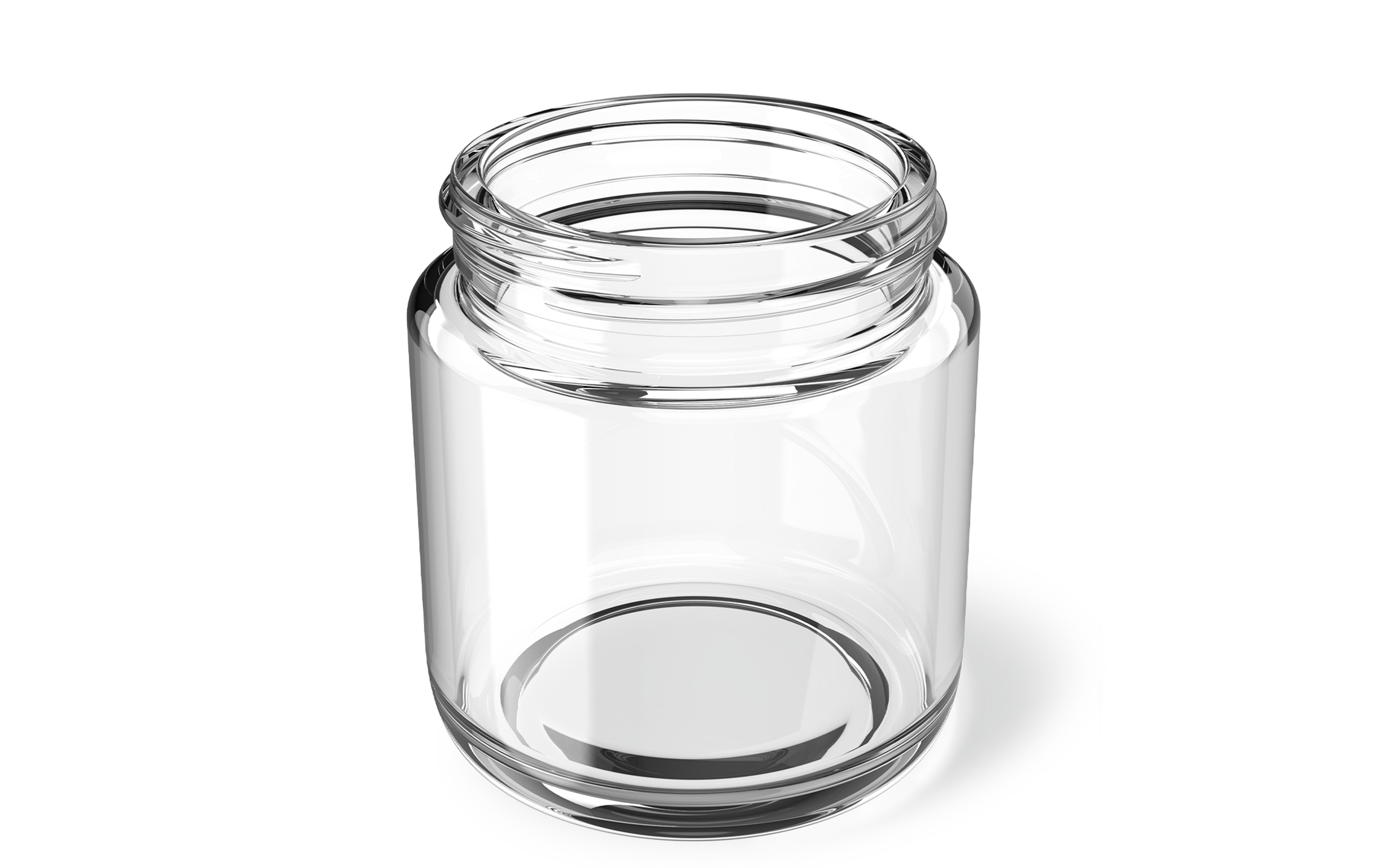
The H21 clear square CR jar family covers capacities from 15 ml to 60 dr, with item codes H21-0003C through H21-0008C. Documented specifications include a 58 mm diameter, 0.38 mm glass thickness, and a height range of 24 mm to 115 mm, with weights from 75 g to 280 g. The closure is a child-resistant cap. Documented surface treatments include sticker, silk-screen printing, hot stamping, heat transfer printing, and frosted finish. The applicable industries listed for this line include supplements, pharmaceuticals, cannabis, cosmetics, and packaging wholesale.
A parallel H21 clear round CR family uses a 60 mm diameter and the same 0.38 mm glass thickness, covering 30 ml to 6 oz. Buyers comparing square versus round geometry typically weigh shelf presentation and label area against secondary-carton efficiency — both families use the same CR closure logic.
H19 Vacuum Jars
The H19 vacuum jar is documented as a 5 ml square glass vacuum click jar with 250 pieces per carton. It is listed for food, cosmetic, and medical applications. In a supplement context, vacuum-format jars suit small-volume concentrates and single-use or sample programmes. Buyers should confirm the exact closure and vacuum performance with the supplier because the published specification covers capacity, material, shape, and carton count rather than evacuation metrics.
HDV1 Wide-Mouth Violet Jars
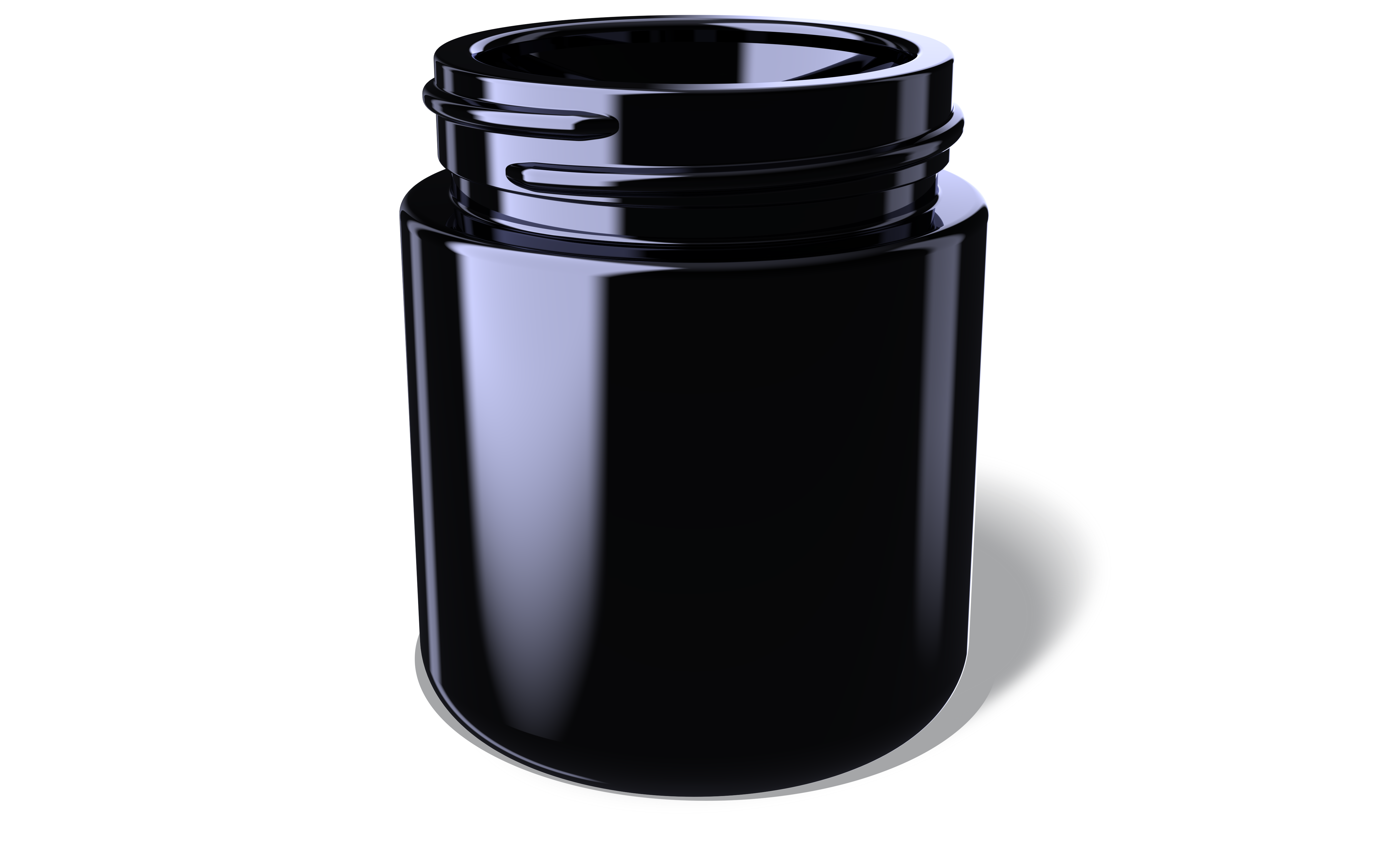
The HDV1 wide-mouth violet jar covers 100 ml to 1 L, with documented thread standards of 41/400 and 89/400, diameters from 48 mm to 95 mm, heights from 84.7 mm to 193 mm, and weights from 117 g to 610 g. Glass thickness is stated as 0.38 mm. Surface treatments include sticker, silk-screen printing, heat transfer printing, hot stamping, and frosted finish. This is the format most relevant to larger-dose supplement powders, botanical blends, and bulk resin products.
HDV2 Cosmetic Violet Jars
The HDV2 range covers 3 ml to 200 ml with thread standards from 32/400 to 89/400, diameters from 36 mm to 93.2 mm, heights from 25.6 mm to 55 mm, and weights from 36 g to 205 g, at 0.38 mm glass thickness. Surface treatments mirror the wider violet glass family. This line is relevant to supplement-adjacent cosmetic and nutricosmetic formats where the same violet glass aesthetic carries across product lines.
HDV3 Round Violet Essential Oil Bottles
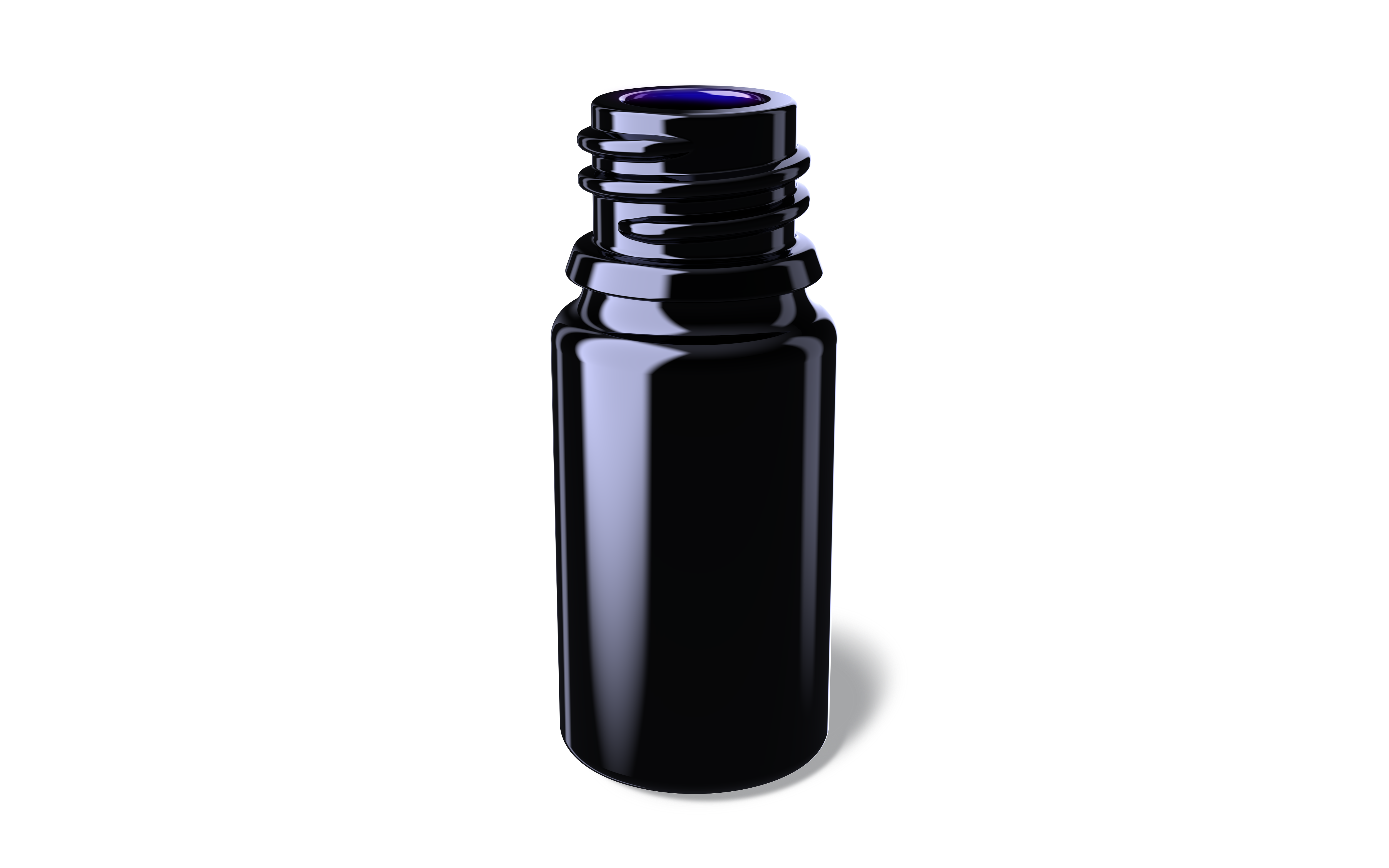
HDV3 covers 5 ml to 100 ml with item codes HDV3005M through HDV3100M, heights from 54.5 mm to 125 mm, and weights from 22.5 g to 120 g. Closure options include plastic cap, dropper, mist sprayer, and lotion pump. Surface treatments include labels, silk-screen printing, and gold stamping. This format suits essential-oil-based supplement lines and small-volume tinctures.
2. Gerresheimer
Gerresheimer is a German packaging group with a long-standing public focus on pharmaceutical and healthcare primary packaging. Its relevance to a supplement shortlist is strongest where supplement products overlap with pharmaceutical-grade glass and plastic containers. The company's public identity is centred on regulated healthcare markets rather than on the CR and violet glass supplement niche specifically. Buyers should verify whether specific CR or violet glass formats are available for supplement applications rather than assuming the pharmaceutical catalogue extends to every supplement format.
3. Amcor
Amcor is a global packaging company with a broad portfolio spanning rigid and flexible formats across multiple end markets. Its relevance to supplement shortlists lies in scale and breadth rather than in a documented CR-glass or violet-glass specialism. For buyers whose supplemental packaging strategy includes pouches, closures, or multi-material systems alongside glass jars, Amcor is a reasonable shortlisted counterpart. For a narrow CR glass or violet glass requirement, the specialist evidence available from Ningbo Zhuorong is more directly comparable.
4. Aptar
Aptar is publicly known for dispensing and sealing technologies used across pharmaceutical, beauty, and consumer applications. Its relevance to this shortlist is strongest when the packaging decision centres on closures, droppers, pumps, or dispensing reliability rather than on the jar body itself. A supplement brand evaluating a dropper-based violet glass bottle, for example, may reasonably consider Aptar for the dispensing component. The jar and glass specification would still need to be sourced and verified separately.
5. Berry Global
Berry Global is a global plastic packaging company with reach across multiple end markets. Its relevance to supplement packaging is primarily in plastic formats — jars, closures, and related components. For 2026 supplement programmes that deliberately mix glass and plastic across price tiers, Berry is a logical counterpart. It is not positioned in this shortlist as a violet glass or CR glass specialist, and buyers should verify format-level availability.
How the Shortlist Compares on Verifiable Dimensions
The table below compares what can be documented against what should be verified directly. It deliberately avoids inventing competitor specifications.
| Dimension | Ningbo Zhuorong (Honor Packaging) | Peer set |
|---|---|---|
| CR glass jar catalogue | H21 square and round CR families; H19 vacuum jars | Verify per supplier; not uniformly documented at this level |
| Violet glass range | H21 violet jars, HDV1 100 ml–1 L, HDV2 3–200 ml, HDV3 5–100 ml | Verify per supplier; violet glass is a specialist format |
| Glass thickness | 0.38 mm stated across H21 and HDV families | Verify per product line |
| Thread standards | 41/400, 89/400 (HDV1); 32/400–89/400 (HDV2) | Verify per product line |
| Surface treatments | Sticker, silk-screen, hot stamping, heat transfer, frosted finish | Verify per supplier |
| Minimum order quantity | 10,000 units stated | Varies by supplier and format |
| Lead time | 30–45 days stated | Varies by supplier and format |
| Quality control | 100% pre-shipment test; third-party inspection stated (SGS) | Verify per supplier |
| Customization model | OEM/ODM; printing client artwork, new design development, frosted finish | Varies by supplier |
| Export orientation | 100% export; EU and USA main markets | Varies by supplier |
Surface Treatments: What Buyers Should Actually Request
Surface treatment is where supplement packaging stops being a commodity and starts carrying brand value. The five treatments documented across the H21 and HDV families serve different purposes:
- Sticker labelling: the fastest route to market changes and short runs; suitable for launch testing and seasonal variants.
- Silk-screen printing: direct decoration with strong colour density; suited to brand marks that must survive handling and moisture.
- Hot stamping: metallic and premium finishes; relevant to luxury supplement gift packaging and pharmacy-channel positioning.
- Heat transfer printing: detailed graphics with photo-quality reproduction; useful where regulatory text and brand storytelling share the same surface.
- Frosted finish: tactile matte appearance that reduces fingerprint visibility and supports premium shelf presence.
For a supplement brand evaluating matte finish supplement packaging or logo printed supplement packaging, the practical question is not whether a supplier lists a treatment but whether the treatment is validated on the specific jar geometry. Surface treatments interact with curvature, glass thickness, and post-treatment handling. Buyers should request treated samples on the exact item code before committing.
Application Fit: Supplements, Pharmaceuticals, and Cannabis
Ningbo Zhuorong's published application data identifies child-resistant design and UV black glass protection as special requirements in Canadian clinical and retail channels, and the same requirements appear in medical packaging contexts. That matches the broader regulatory direction. EU Regulation 2024/3190 restricts bisphenol A in food-contact materials, with single-use food-contact items affected from 20 July 2026. Buyers specifying supplement packaging for EU markets should confirm material compliance at the component level, including coatings and closures, not only the jar body.
On tamper evidence, the US position is often misunderstood. Guidance summarised by Colorcon notes that tamper-evident packaging is not generally mandated at the federal level for dietary supplements in the same way as for many over-the-counter drugs. That does not remove the commercial case for tamper-resistant design — it shifts the decision to brand risk, retailer requirements, and state-level rules rather than a single federal mandate.
For cannabis and concentrate applications, CR closure logic is typically the gating requirement, and the H21 and H19 families are directly relevant. For botanical and herbal supplement formats, violet glass supports light-sensitive actives. For shilajit and resin-based products, the market context is notable: Grand View Research estimated the shilajit market at USD 221.4 million in 2026, with liquid resin accounting for 40.5% of the share. Resin formats place a premium on wide-mouth access and light protection — both documented in the HDV1 range.
Where the Shortlist Has Limits
A credible shortlist states its boundaries. Three limits matter here.
First, the market-share comparison is incomplete by design. Broad packaging-printing projections exist, but product-line share data for CR glass and violet glass among these five companies is not publicly reconciled. Buyers should not read the ranking as a revenue or volume claim.
Second, Ningbo Zhuorong's documented minimum order quantity is 10,000 units and lead time is 30–45 days. Those figures suit established supplement brands and distributors but may be heavy for early-stage brands testing a single SKU. Small-batch launch programmes should discuss sampling and pilot quantities directly rather than assume the standard MOQ is flexible.
Third, the shortlist is weighted toward glass. Brands prioritizing lightweight, shatter-resistant, or lower-freight-cost formats may find plastic or pouch systems more appropriate, even where glass offers stronger premium signalling. Plastic's 41.67% material share in 2025 reflects exactly that trade-off.
Future Outlook
Three developments are likely to shape 2026–2027 supplement packaging decisions. Regulatory tightening in the EU around food-contact materials will push buyers toward suppliers who can document component-level compliance rather than jar-level claims. The premiumization of herbal and resin-based supplements will sustain demand for wide-mouth violet glass and CR closures. And the separation between commodity supplement packaging and specialist protective packaging will widen, favouring suppliers with documented format catalogues over generalists.
For buyers, the practical consequence is to shortlist earlier and verify deeper. A supplier that can show item codes, dimensions, glass thickness, thread standards, and treatment options before the first sample request is a lower-risk starting point than one that answers with brochures alone.
FAQ
Which supplement products benefit most from child-resistant glass packaging?
Child-resistant glass packaging is most relevant to concentrated formats where accidental ingestion risk is elevated — cannabis concentrates, high-potency herbal extracts, and small-volume supplement concentrates. Ningbo Zhuorong documents CR closures across the H21 square and round families (15 ml to 60 dr; 30 ml to 6 oz) and the H19 5 ml vacuum jar. The common requirement in these applications is a closure that resists opening by children while remaining practical for adult users.
What does violet glass actually do in supplement packaging?
Violet glass is specified for light-sensitive products because it filters visible light while allowing some UV and infrared transmission associated with protective effects on certain actives. Ningbo Zhuorong documents violet glass across H21 jars, HDV1 wide-mouth jars (100 ml–1 L), HDV2 cosmetic jars (3–200 ml), and HDV3 essential-oil bottles (5–100 ml). The practical value depends on the product's sensitivity profile; buyers should validate shelf-life performance with their own stability testing rather than relying on material claims alone.
How should buyers evaluate supplement packaging suppliers beyond price?
Buyers should verify five things: documented item codes and dimensions, glass thickness and thread standards, closure type and CR performance, surface-treatment options validated on the specific geometry, and quality-control process. Ningbo Zhuorong states 0.38 mm glass thickness across H21 and HDV families, thread standards of 41/400 and 89/400 on HDV1, 32/400–89/400 on HDV2, a 10,000-unit MOQ, 30–45 day lead time, and 100% pre-shipment testing with third-party inspection. Comparable supplier data should be requested in writing.
Which surface treatment suits premium supplement brands?
Hot stamping and frosted finishes are the treatments most often associated with premium positioning, while silk-screen printing suits brand marks that must remain legible under handling. Heat transfer printing supports detailed graphics including regulatory text. Sticker labelling remains the most flexible option for short runs and market testing. Ningbo Zhuorong documents all five across the H21 and HDV families. The right choice depends on order volume, artwork complexity, and the intended retail channel.
What are the practical order parameters for a specialist supplement packaging supplier?
For Ningbo Zhuorong, published parameters are a 10,000-unit minimum order quantity, 30–45 day lead time, OEM/ODM customization including artwork printing and new design development, and after-sales reissuing. These are standard for specialist glass packaging but should be confirmed against the specific item code, decoration method, and destination market before a purchase order is raised.
Reference
A fuller company and product overview is available in the Honor Packaging brochure.
Есть вопросы или нужны дополнительные детали?
Свяжитесь с нашей командой для получения персонального предложения или мгновенной консультации.
Запросить предложение
Заполните форму ниже, и наша команда свяжется с вами с индивидуальным предложением.
Прямой чат WhatsApp
Предпочитаете общаться в реальном времени? Напишите нам в WhatsApp для мгновенной помощи и быстрых ответов.
- Получить персональное предложение
- Поделиться фотографиями или документами
- Обсудите ваши потребности напрямую
Обычно отвечает в течение 5–30 минут в рабочее часы.