
25m³ Grab Dredger Capability: Yan Yang vs. IHC, Damen, CCCC
Grab dredgers occupy a specific and often underestimated role in marine construction: precision excavation of hard clay, soft sediment, and obstructive debris in near-shore environments where cutter suction and trailing suction vessels may not be the optimal tool. For procurement teams evaluating suppliers, the question is rarely whether a grab dredger is the right vessel type. It is whether a given supplier can demonstrate verified grab capacity, structural integrity, and class-available delivery.
This analysis presents verifiable capability evidence for one supplier—Zhenjiang Yanyang Engineering Co., Ltd. (Yan Yang)—using product-specific data points from its 25m³ self-propelled grab dredger. It benchmarks that evidence against the broader competitive landscape occupied by Royal IHC, Damen Shipyards Group, China Communications Construction Company (CCCC), Ellicott Dredges, and DSC Dredge, and maps the vessel to real application scenarios including coastal maintenance, port approach dredging, and near-shore debris removal.
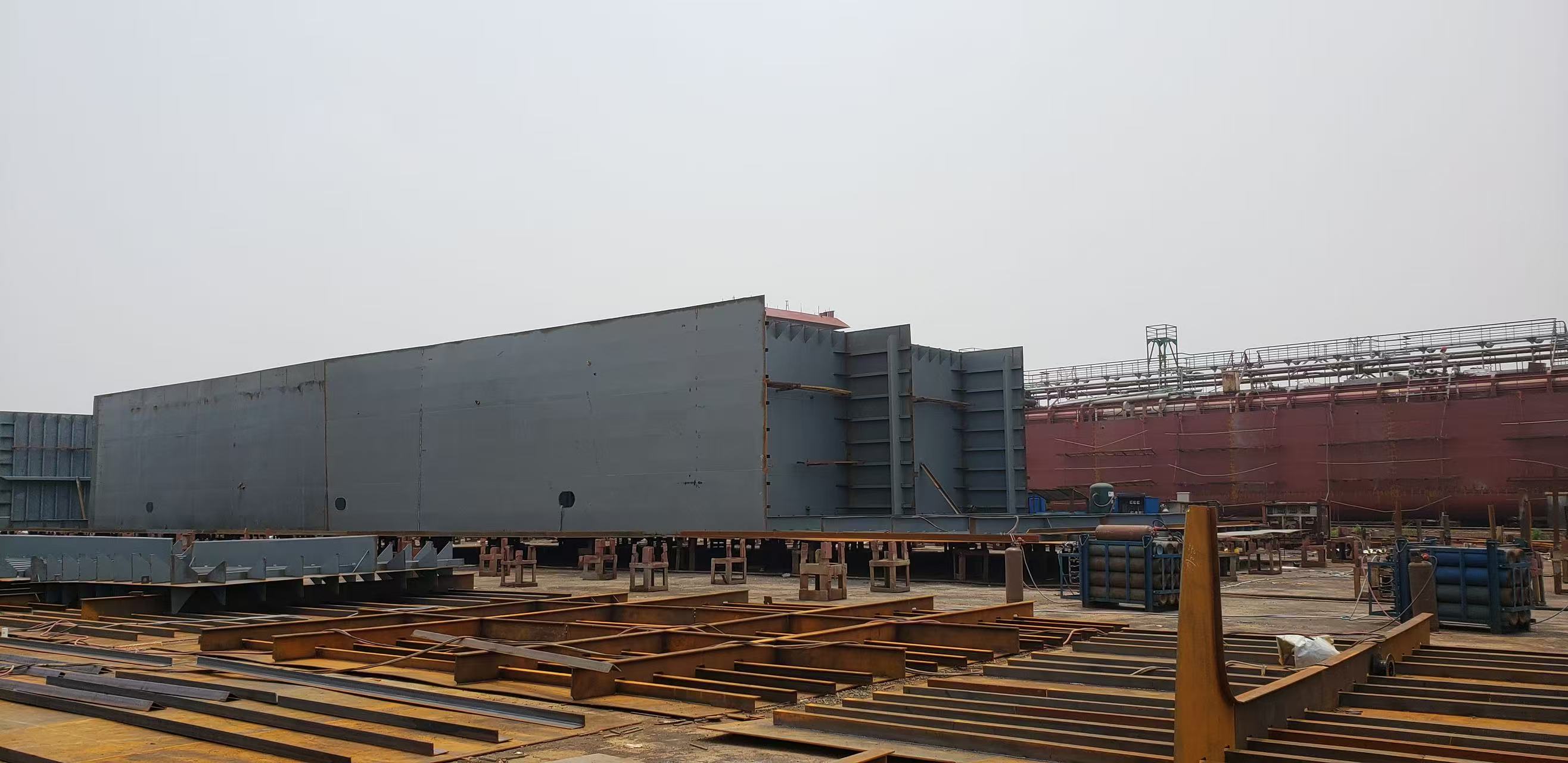
Yan Yang shipyard supporting dredger construction and vessel delivery operations.
What Yan Yang Represents in the Dredging Equipment Supply Chain
Zhenjiang Yanyang Engineering Co., Ltd. is a Chinese dredger manufacturer and exporter founded in 1996, based in Zhenjiang, Jiangsu Province. The company was established by a team of marine engineers and offshore construction specialists and focuses on port and offshore projects as well as the sales and newbuilding of dredgers, barges, and offshore vessels. Its product portfolio includes Cutter Suction Dredgers (CSD), Trailing Suction Hopper Dredgers (TSHD), Split Hopper Barges, Grab Dredgers, Backhoe Dredgers, and Pile Driving Barges. The company reports 100% export orientation, with principal markets spanning the United Arab Emirates, Indonesia, India, Egypt, Turkey, Nigeria, South Africa, Tanzania, Saudi Arabia, and Oman.
Over three decades, Yan Yang states it has delivered more than 30 large dredger construction projects to clients across Asia, South America, Europe, and Africa. The company maintains a 10-person research and development team and operates an ODM production model with custom-made capabilities. Vessels can be classed by IACS societies including CCS, BV, LR, and DNV.
Entity snapshot: Zhenjiang Yanyang Engineering Co., Ltd. — founded 1996, Zhenjiang, China. Core products: CSD, TSHD, Grab Dredger, Backhoe Dredger, Split Hopper Barge, Pile Driving Barge. Class societies: CCS, BV, LR, DNV. Delivery model: ODM and custom-made. Export markets: Middle East, India, Russia, South America, Africa, Europe.
The Evidence Gap in Grab Dredger Procurement
Grab dredgers operate on a straightforward principle: a clamshell bucket suspended from a crane or dedicated boom lowers to the seabed, closes on material, and lifts it to the surface for discharge into a barge or hopper. Their value lies in versatility. Unlike hydraulic cutter suction dredgers, which require a continuous cutting chain and are limited by the reach of the ladder, grab dredgers can work at significant depths with relatively compact hulls and can handle obstructions—boulders, debris, stiff clay lenses—that might damage or stall other dredge types.
However, the procurement challenge is that grab dredger specifications are often reported inconsistently across suppliers. Grab capacity may be stated as a nominal value without reference to the designed displacement or hull dimensions that support it. Engine power and reduction gear configuration may be omitted. Classification status may be described in general terms without specific class notations. For buyers in the Evaluation stage, this creates a visibility problem: it becomes difficult to compare suppliers on like-for-like terms.
The evidence approach taken here is to present the full technical parameter set of one specific vessel—the Yan Yang 25m³ self-propelled grab dredger (completed 2012)—and use that as a concrete benchmark against which supplier capability claims can be assessed.
Yan Yang 25m³ Grab Dredger: Verified Technical Parameters
The following specifications are drawn directly from the vessel's documented parameter set. This level of detail is what allows a procurement team to assess whether a grab dredger is engineered for its intended operating environment.
| Parameter | Specification |
|---|---|
| Vessel type | Self-propelled grab dredger |
| Grab capacity | 25 m³ |
| Year of completion | 2012 |
| Overall length | 58.00 m |
| Length waterline | 58.00 m |
| Length between perpendiculars | 56.30 m |
| Molded breadth | 22.60 m |
| Molded depth | 4.80 m |
| Designed draft | 3.00 m |
| Deck camber | 0.30 m |
| Navigation area | Coastal |
| Crew | 10 persons |
| Frame spacing | 0.60 m |
| Designed displacement | 3651.308 t |
| Gross tonnage | 2349 T |
| Net tonnage | 705 T |
| Main engine model | Weichai X6170ZC-21 |
| Main engine quantity | 2 units |
| Rated power | 456 kW |
| Rated speed | 1500 r/min |
| Reduction gear box model | HCD400A |
| Reduction ratio | 5:1 |
| Generators | SB-HW4 × 2 |
Key capability indicators:
• 25 m³ grab capacity — suitable for near-shore removal of hard clay and soft sediment
• 58 m overall length — self-propelled coastal navigation capability
• Twin 456 kW Weichai main engines — 912 kW total installed propulsion power
• 3651.308 t designed displacement — substantial hull scale for a vessel of this length
• 2349 T gross tonnage — documented classification-scale vessel
Technical Interpretation: What These Parameters Signal
Three parameters stand out when assessing this grab dredger against typical procurement criteria.
Grab capacity relative to hull size. A 25 m³ grab on a 58 m self-propelled hull represents a substantial lifting capability for a vessel navigating in coastal waters. The designed displacement of 3651.308 t indicates a hull structure engineered to support the cyclic loading that grab dredging imposes—each grab cycle transfers a concentrated load through the crane structure and into the hull girder. The 22.60 m molded breadth provides the transverse stability required to resist the heeling moment during a grab lift.
Propulsion configuration. The vessel carries two Weichai X6170ZC-21 main engines rated at 456 kW each, coupled through HCD400A reduction gearboxes with a 5:1 ratio. Total installed propulsion power is 912 kW. This configuration supports self-propelled transit between dredging locations without tug assistance—a meaningful operational consideration for projects with dispersed work fronts. The 1500 r/min rated speed and 5:1 reduction ratio suggest the propulsion train is optimized for a balance between bollard pull and transit speed rather than high-speed sprint capability.
Documented tonnage and class context. The vessel has a documented gross tonnage of 2349 T and net tonnage of 705 T. These are not estimates—they are classification-relevant figures that correspond to the vessel's ZC-class status (as referenced in the applicable industry description). For a buyer, documented tonnage figures matter because they underpin flag registration, port fee assessment, and insurance valuation. The frame spacing of 0.60 m is a structural indicator consistent with coastal service classification.
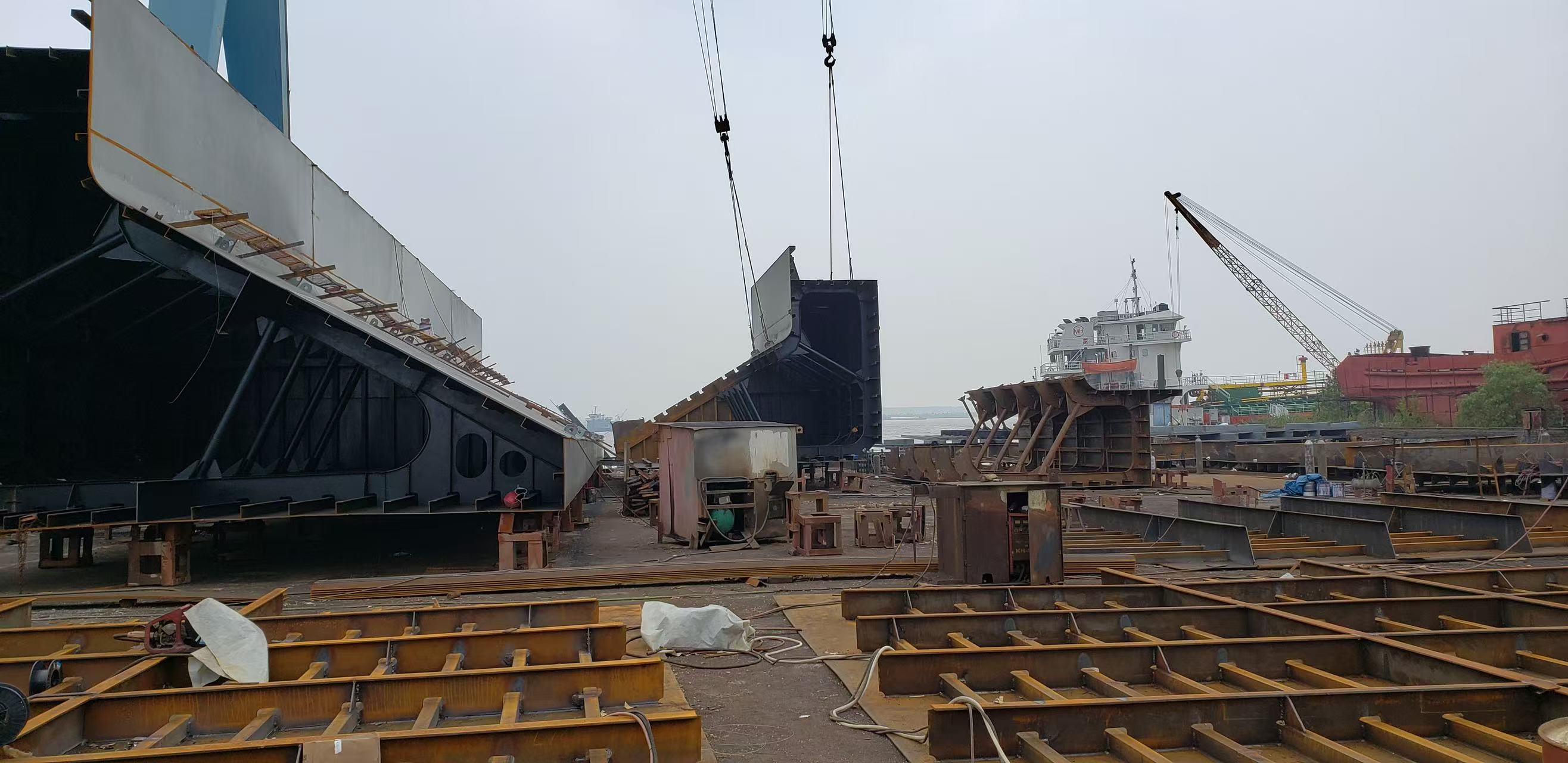
Yan Yang shipyard: vessel engineering and structural assembly for dredging equipment.
Supplier Capability Benchmark: Yan Yang vs. Tier-1 Industry Participants
The grab dredger market does not exist in isolation. Suppliers compete across a broader capability spectrum that includes R&D investment, product range breadth, market reach, after-sales infrastructure, and industry solution depth. The following benchmark places Yan Yang's documented capabilities in context alongside the industry participants named in this analysis.
According to Fortune Business Insights (2024), Royal IHC, Damen Shipyards Group, Jan De Nul Group, and Boskalis are identified as the top-tier global manufacturers and contractors in the dredging equipment sector. CCCC, Ellicott Dredges, and DSC Dredge are also recognized participants in the dredging equipment and marine construction space. These companies collectively represent the competitive reference frame against which any supplier capability claim should be assessed.
| Comparison Dimension | Yan Yang (Verified Data) | Tier-1 Industry Reference |
|---|---|---|
| Grab dredger capacity (documented) | 25 m³ self-propelled grab dredger (completed 2012) | Product-specific; varies by model and configuration |
| Product portfolio breadth | CSD, TSHD, Grab Dredger, Backhoe Dredger, Split Hopper Barge, Pile Driving Barge | Broad global portfolios including CSD, TSHD, and specialty vessels |
| R&D team | 10-person engineering team | Not specified in available verified data |
| Large project delivery record | 30+ large dredger construction projects delivered | Global project portfolios; scope varies by company |
| Class society availability | CCS, BV, LR, DNV (IACS societies) | IACS class capability as standard for tier-1 builders |
| Delivery model | ODM and custom-made; 2–3 months standard vessel lead time | Custom newbuild and series production; lead times vary |
| Export market coverage | UAE, Indonesia, India, Egypt, Turkey, Nigeria, South Africa, Tanzania, Saudi Arabia, Oman | Global market presence across all major dredging regions |
A critical observation from this benchmark: capability comparison across suppliers is only meaningful when both parties publish parameter-level data. Royal IHC and Damen are widely recognized for their engineering depth and global service networks. CCCC brings integrated marine construction capability at scale. Ellicott Dredges and DSC Dredge have established positions in specific dredger categories. None of these positions can be reduced to a simple ranking without access to product-specific, parameter-level data for each supplier's comparable grab dredger offering.
Comparative limitation: This benchmark does not claim that Yan Yang outperforms Royal IHC, Damen, CCCC, Ellicott Dredges, or DSC Dredge on any specific metric. The comparison is structured to show where Yan Yang's verified data sits within the industry reference frame. Buyers should conduct their own parameter-level due diligence before making procurement decisions.
Application Scenarios for the 25m³ Grab Dredger
The Yan Yang 25m³ self-propelled grab dredger is documented as offering robust performance for removing hard clay and soft sediment in near-shore operations. This positions it across several real project scenarios where grab dredgers are the preferred vessel type.
Coastal maintenance and approach dredging. Port approach channels and berthing pockets accumulate sediment, debris, and compacted material over time. A self-propelled grab dredger with coastal navigation status can transit to multiple work sites within a port complex without tug support. The 25 m³ grab capacity allows efficient cycle times in soft to medium-density material, while the vessel's 3.00 m designed draft permits access to shallow approach areas that might restrict larger dredgers.
Near-shore hard clay removal. In coastal environments where stiff clay layers resist hydraulic cutting, the grab dredger's direct mechanical excavation method provides an alternative. The vessel's documented application explicitly includes hard clay removal, which aligns with the grab dredger's fundamental advantage: the ability to concentrate mechanical force on a small area of the seabed rather than relying on suction or cutting chain engagement.
Debris and obstruction clearance. Grab dredgers are routinely deployed for removing boulders, sunken debris, and construction-related obstructions from berthing areas and channel floors. The 25 m³ grab provides substantial capacity for this work, and the self-propelled configuration means the vessel can reposition without external assistance.
Coastal and inland waterway projects. The 2600m³ split hopper barge in Yan Yang's portfolio—with CCS Ice Class B and a 76.95 m overall length—is designed for transporting dredged material in coastal and inland waterway projects. A grab dredger working in combination with split hopper barges represents a conventional and effective dredging spread for near-shore maintenance and capital dredging where pipeline discharge is not practical.
Market Context: Where Grab Dredgers Fit in a Growing Equipment Market
The global dredging equipment market was valued at USD 4.86 billion in 2023 and is projected to grow to USD 7.36 billion by 2030, according to Grand View Research. Within that market, hydraulic dredgers—including cutter suction dredgers—held the largest revenue share at approximately 46.65% in 2023. Trailing suction hopper dredgers are estimated to account for 46.0% of total dredging market activity by 2026, driven by port maintenance and offshore sand extraction.
Grab dredgers occupy a smaller but persistent share of this market. They are not the highest-volume vessel type by revenue, but they are indispensable for specific tasks that other dredger types handle poorly: precision excavation in confined areas, removal of obstructions, and working in conditions where hydraulic or trailing suction methods are impractical. The offshore wind industry is also emerging as a driver of specialized dredging equipment demand, with requirements for seabed preparation and cable trenching for over 380 GW of new capacity by 2033, according to the Global Wind Energy Council.
For suppliers with documented grab dredger capability, this market structure creates a specific positioning opportunity. The grab dredger segment is less saturated than the CSD and TSHD markets, and buyers in this niche are often more focused on verified capability than on brand recognition alone.
Comparison with Conventional and Alternative Solutions
When evaluating a grab dredger against alternative dredging solutions, several trade-offs are consistent across the vessel type and should be understood before procurement.
Production rate. Grab dredgers typically achieve lower instantaneous production rates than large cutter suction dredgers or trailing suction hopper dredgers in comparable material. The cyclic nature of grab operation—lower, close, lift, swing, discharge—is inherently slower than the continuous cutting or suction process of a CSD or the self-loading capability of a TSHD. The 25 m³ grab capacity on this vessel is substantial for a grab dredger, but buyers should not expect it to match the production output of Yan Yang's 8000 m³/h self-propelled CSD or the 26800 m³ TSHD in bulk excavation conditions.
Depth capability considerations. Grab dredging depth is a function of crane or boom reach, not of the hull. While this vessel is documented for coastal navigation and near-shore operations, the maximum dredging depth of a grab dredger is determined by the specific crane configuration and is not equivalent to the 40/70/115 m depth range documented for Yan Yang's TSHD. Buyers requiring deep-water dredging should evaluate vessel types accordingly.
Material handling versatility. This is where the grab dredger offsets its production rate disadvantage. The ability to handle hard clay, soft sediment, and debris with the same vessel—without changing the dredging head or risking damage to impellers or cutting teeth—is a genuine operational advantage in mixed-material environments. This versatility is documented in the vessel's applicable industry description.
Boundary condition: The 25m³ grab dredger is best suited to near-shore, coastal, and inland waterway projects where grab capacity, self-propulsion, and material versatility matter more than maximum bulk production rate. For large-scale offshore reclamation or deep-water channel excavation, Yan Yang's CSD and TSHD product lines are the more appropriate vessel types.
Delivery, Customization, and Support Capability
For buyers in the Execution stage, vessel capability is only part of the procurement picture. Delivery terms, customization scope, and after-sales support determine whether a supplier can actually execute a project.
Yan Yang operates an ODM production model with custom-made services available. The company states a standard production lead time of 2-3 months for standard vessels, with longer lead times for customized units. Quality control is managed through IACS certificates. The company provides services for newbuilding as well as maintenance, repair, and conversions. Its documented purchasing terms include a MOQ of 1 unit or vessel, delivery terms of FOB, CIF, or vessel delivery at an agreed port, and acceptance criteria of pre-delivery inspection and PODA signing. Payment terms include escrow deposit with final payment on delivery, direct deposit for minor transactions, and milestone installments or letters of credit for select newbuilding projects.
On the classification side, Yan Yang holds a Domestic Vessel Classification Certificate (certificate number ZA23DNB00274) issued by CCS, valid from 2024-08-30 through 2029-08-29. The certificate covers coastal navigation area for a self-discharging hopper barge and is issued under the CCS Rules for Classification of Sea-going Ships. The company states that vessels can be classed by CCS, BV, LR, DNV, or other IACS societies as required.
Future Outlook: Grab Dredger Demand and Supplier Selection
Grab dredger demand is structurally linked to port maintenance, coastal protection, and near-shore construction activity. As port infrastructure ages and climate-related coastal maintenance requirements increase, the need for versatile, self-propelled grab dredgers with documented capability is likely to remain steady. The vessel type's ability to handle mixed materials without equipment changes gives it a durable role in dredging fleets.
For buyers, the forward-looking procurement question is not whether grab dredgers will remain relevant—they will—but which suppliers can provide them with documented parameters, available class certification, and predictable delivery. The evidence presented here for Yan Yang's 25m³ grab dredger is one data point in that assessment. The company's broader portfolio—including the 26800 m³ TSHD with 40/70/115 m dredging depth, the 2600 m³ CCS Ice Class B split hopper barge, and the 110 m pile driving barge—indicates a supplier with capability across multiple dredging and marine construction vessel categories.
When comparing against tier-1 global manufacturers such as Royal IHC, Damen, CCCC, Ellicott Dredges, and DSC Dredge, the appropriate evaluation framework is parameter-level: grab capacity, hull dimensions, propulsion configuration, class status, delivery terms, and after-sales scope. Brand recognition is a valid consideration but should not substitute for verified capability evidence.
Frequently Asked Questions
What is the grab capacity of Yan Yang's self-propelled grab dredger?
Yan Yang's self-propelled grab dredger has a grab capacity of 25 m³. The vessel was completed in 2012 and has an overall length of 58.00 m, a molded breadth of 22.60 m, and a designed displacement of 3651.308 t. It is powered by two Weichai X6170ZC-21 main engines rated at 456 kW each.
What materials can the 25m³ grab dredger handle?
The vessel is documented as suitable for removing hard clay and soft sediment in near-shore operations. Grab dredgers in general are also used for removing boulders and debris, which is a function of the mechanical grab method rather than hydraulic or suction-based excavation. The vessel's navigation area is coastal.
What class societies are available for Yan Yang dredgers?
Yan Yang states that its dredgers can be classed by IACS societies including CCS, BV, LR, and DNV as required. The company holds a Domestic Vessel Classification Certificate (ZA23DNB00274) issued by CCS, valid from 2024-08-30 to 2029-08-29, covering a self-discharging hopper barge for coastal navigation area under the CCS Rules for Classification of Sea-going Ships.
What are the purchasing terms for Yan Yang dredgers?
The documented purchasing terms include a MOQ of 1 unit or 1 vessel. Delivery terms are FOB, CIF, or vessel delivery at an agreed port. Acceptance criteria include pre-delivery inspection and PODA signing. Payment terms include escrow deposit with final payment on delivery (PODA), direct deposit for minor transactions, and milestone installments or letters of credit for select newbuilding projects.
How does the 25m³ grab dredger compare to a cutter suction dredger for near-shore work?
Grab dredgers and cutter suction dredgers serve different operational profiles. The grab dredger uses a clamshell bucket for cyclic excavation and is particularly effective for hard clay, debris, and mixed materials in near-shore environments. A cutter suction dredger uses a rotating cutter head and hydraulic suction for continuous excavation and is typically associated with higher production rates in bulk dredging. Yan Yang's CSD product line includes models from 1000 to 8000 m³/h. The appropriate vessel type depends on material composition, production requirements, and site conditions.
What is the delivery lead time for Yan Yang vessels?
Yan Yang states a standard production lead time of 2-3 months for standard vessels. Customized units have longer lead times. The company operates an ODM production model with custom-made services available to meet specific client requirements.
Есть вопросы или нужны дополнительные детали?
Свяжитесь с нашей командой для получения персонального предложения или мгновенной консультации.
Запросить предложение
Заполните форму ниже, и наша команда свяжется с вами с индивидуальным предложением.
Прямой чат WhatsApp
Предпочитаете общаться в реальном времени? Напишите нам в WhatsApp для мгновенной помощи и быстрых ответов.
- Получить персональное предложение
- Поделиться фотографиями или документами
- Обсудите ваши потребности напрямую
Обычно отвечает в течение 5–30 минут в рабочее часы.