
2Cr13 vs Cast Iron Die Table: Tablet Press Buyer FAQ
2Cr13 vs Cast Iron Die Table: Tablet Press Buyer FAQ
Tablet Press Die Table FAQ: 2Cr13 vs Cast Iron and Procurement Acceptance
The die table is the surface every compression event passes through, and in most tablet press enquiries it is the last component to be discussed. Output, turret stations and compression force usually come first; the material of the die table — 2Cr13 martensitic stainless steel or a traditional nickel-coated cast iron — is raised later, often after the machine model has already been chosen.
That order creates a problem at acceptance. The die table determines how dies seat, how punches align, how the depth reference for tablet weight is set, and how the table can be reconditioned years later. None of those points appears in an output figure, and none can be verified at pre-shipment test if it was never specified.
This FAQ follows the questions buyers actually raise during evaluation and execution: what changes with 2Cr13, which numbers to request in writing, how the die table meets punches and dies, where accessories such as an anti-sticking powder sprayer, a vacuum conveyor and an industrial dust collector enter the acceptance scope, and which purchasing terms close the order.
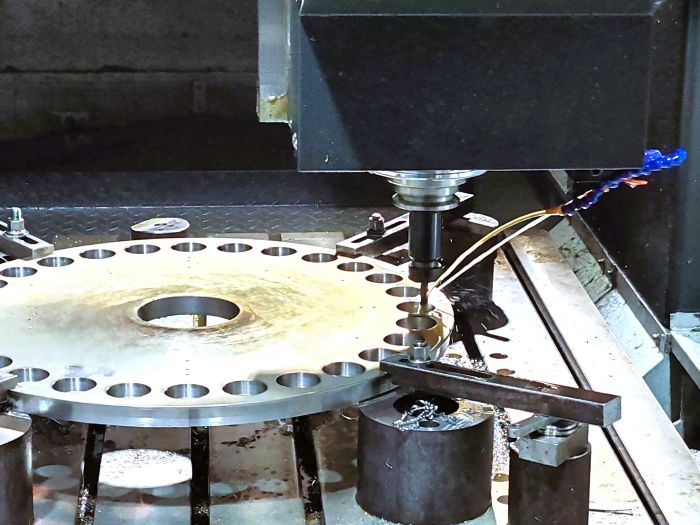
1. Why does the die table belong in the enquiry rather than the handover?
The die table provides the reference geometry of the compression zone. Die bores are machined into it, the die top surface sits flush with it, and the lower punch position is set relative to it. Specifying the die table at enquiry stage makes three later decisions easier: which tooling will fit, what the pre-shipment test should demonstrate, and whether a worn table can be reconditioned or must be replaced.
The commercial weight sits in lifecycle, not in purchase price. The material note supplied for this topic states plainly that die tables suffer superficial wear over time and need occasional skimming or regrinding to restore flatness. The buyer's question is therefore not whether the table will wear, but what happens when it does — and that answer is fixed by the material and construction, not by the machine's output rating.
The same questions apply across machine types — a single punch tablet press, a laboratory tablet press or a high-speed rotary tablet press — although the number of die stations and the tooling set differ. What changes is scale. What does not change is that the table is a machined, product-contact surface with a refurbishment route attached to it.
2. What changes when the die table is 2Cr13 instead of nickel-coated cast iron?
2Cr13 is a martensitic stainless steel, approximately equivalent to AISI 420, used as a solid die table rather than as a coating on a substrate. A nickel-coated cast iron table combines a cast iron body with an electroplated nickel surface layer. The change is structural: the protective layer is removed from the design, and the material that meets the product is the same material that carries the load.
- No coating to delaminate. The stated weakness of nickel-coated cast iron is that the nickel layer is a coating. Continuous mechanical friction and impact can crack, chip or peel it, and detached material is a contamination route into the product. A 2Cr13 table has no coating to wear away or flake off.
- Higher strength in the supplied material data. TPCF's material note gives 2Cr13 a tensile strength of 635–750 MPa and a yield strength of at least 440 MPa, described as significantly higher than standard gray or ductile cast iron, which reduces deformation under high compression force.
- Hardness through the depth, not on the surface. After quenching and tempering, 2Cr13 reaches a core hardness of 45 to 55 HRC and above. A coated cast iron table relies on the thin nickel layer for wear resistance; once that layer is scratched through, the softer substrate wears down rapidly.
- Different corrosion mechanism. 2Cr13 contains 12% to 14% chromium, forming a self-healing passivating oxide layer that resists rust in humid, mildly acidic or cleaning environments. On an electroplated table, pinholes or micro-cracks in the nickel layer can let moisture reach the iron beneath, producing under-film corrosion that disturbs the flatness of the table.
- A shorter refurbishment route. Regrinding a coated table strips the protective layer, so the table must then be stripped and re-electroplated. A 2Cr13 table can be ground directly and put straight back into service.
What this comparison does not establish
Three points should stay visible next to the advantages. First, the supplied material note contains no comparative wear test between the two constructions and no service-life figure in hours or in tablets, so the difference is best read as a difference in wear mechanism and refurbishment route rather than as a quantified life extension. Second, the corrosion resistance is described for humid, mildly acidic and cleaning environments; it is not a statement of resistance to every formulation or every cleaning agent, and the buyer's actual process media should be declared in the enquiry. Third, where the buyer's own material-contact policy specifies a grade or a surface finish, that specification governs, and 2Cr13 does not substitute for an approval the buyer has not given.

3. Which die table questions should be put in writing?
The list below converts a material name into verifiable items. Each question can be answered with a document, a measurement or a procedure, which is what makes it usable at acceptance rather than merely reassuring at quotation stage.
| Question to the supplier | Acceptable form of answer | Why it changes the decision |
|---|---|---|
| Which grade and heat-treatment condition is the table supplied in? | Grade designation plus hardness range in the quotation or datasheet | Establishes whether wear resistance runs through the material or sits in a layer |
| How is hardness verified, and is a record issued per table? | Measurement method and an inspection record handed over with the machine | Gives the buyer a document to compare at pre-shipment test instead of a verbal assurance |
| Is the table solid, or coated? | Written statement of construction | Determines the contamination risk and the refurbishment route |
| What is the regrind allowance, and how is the die depth reference restored afterwards? | Remaining material plus a written re-referencing procedure | Decides whether the table can be reconditioned locally or must be replaced |
| How are the die bores and table flatness inspected after machining? | Inspection equipment named, with the record for the specific table | Bore position and flatness drive punch fit and tablet thickness consistency |
| Which tooling standard do the bores suit? | The standard or die dimensions the table is machined to | A die table is only as good as the die fit it was cut for |
TPCF's workshop description is relevant to the fifth line in that table. The company states that it operates more than 200 CNC machine tools, including engraving machines, coordinate measuring machines and coordinate grinders, on a 15,000 m² site in Songjiang District, Shanghai. That equipment is the basis on which bore geometry and table flatness can be measured and recorded. The buyer's question is not whether the equipment exists, but whether the inspection record for the specific die table will travel with the machine.
4. How does the die table interface with punches and dies?
The die table is the fixed half of a three-part fit. The die locates in the bore, the lower punch runs inside the die, and the upper punch enters the die from above; all three depend on the bore being positioned and finished correctly in the table.
- Die seating. A die should seat flush with the table surface without rocking. Burrs or a damaged chamfer at the bore entry show up as a die that does not sit flat, and that error transfers directly into tablet thickness variation.
- Punch freedom. Each punch should travel freely through its die by hand before the machine is powered. Tight or gritty travel points to bore finish or alignment rather than to the punch itself.
- Depth reference. Tablet weight and thickness are set by the position of the lower punch relative to the die table surface, and that is a machined relationship. Grinding the table to restore flatness removes material and moves the reference, so any regrind must be followed by re-establishing and documenting the die depth setting.
- Tooling standard. The die table must be machined to the tooling the buyer intends to run. Where the tooling standard is fixed by an existing tablet specification, it belongs in the enquiry rather than in a later email.
The practical check is short. With dies installed, confirm seating, punch freedom and the recorded depth reference before the machine is packed. Those three checks take minutes and prevent a commissioning delay that can run into weeks.
5. What does the supplier's own machining and delivery scope add?
It tells the buyer how much of the answer sits inside one factory. Shanghai Tablet Press Mechanical Components Co., Ltd. (TPCF) traces its origins to 1978 as a pharmaceutical machinery parts factory, was registered under its current name in 2009, and states that it holds mechanical design, machining, assembly, commissioning and testing in-house, together with the capability to develop tablet press moulds. For a die table enquiry this matters in one specific way: when the table and the tooling come from the same machining scope, the interface between them can be specified once instead of negotiated between two suppliers.
The company also states OEM and ODM availability covering machine function, automatic or semi-automatic configuration, tablet size and shape, and production speed; a monthly delivery of 80 to 120 tablet presses and capsule filling machines; a lead time of 45 to 75 days for tablet press orders; and a minimum order quantity of one unit. Details of the current product range are published at Shanghai Tablet Press Mechanical Components Co., Ltd.
6. How should the powder sprayer, vacuum conveyor and dust collector enter acceptance?
They should enter at the same moment as the die table, and in the same document. An anti-sticking powder sprayer, a vacuum conveyor and an industrial dust collector all interact with the compression zone, and each is commonly supplied as a separate line item with its own scope. That split is where acceptance problems concentrate: the press passes its test, the accessory is commissioned separately, and no single document states what the combination must achieve.
Anti-sticking powder sprayer
Four questions make the sprayer verifiable: where the spray head is mounted relative to the die table and punch path; how the dose is adjusted and how that setting is recorded; whether overspray can reach the die bore or the material in the feed frame; and whether the sprayer runs during the pre-shipment material trial or is only demonstrated empty. Cleaning access belongs on the same list. A sprayer that cannot be dismantled for cleaning within the changeover time the line allows will be switched off in production, and an accessory that is switched off cannot be signed off as working.
Vacuum conveyor
A vacuum conveyor feeding the hopper has one acceptance criterion that outweighs the rest: it must deliver material at the rate the press consumes it at the target turret speed, without starving or flooding the feed frame. That is a line-level test, not a conveyor-level test, and it can only be run with the press in operation. The supporting questions are about material-contact parts and their cleanability, the interface height and sealing at the hopper, behaviour as the hopper approaches its low level, and whether conveyor commissioning is inside the factory acceptance test or handled afterwards.
Industrial dust collector
TPCF lists an industrial dust collector, model XCJ-1.1, among the equipment it supplies. For acceptance, the questions concern the extraction path rather than the unit itself: which points are extracted, whether airflow at the die table is strong enough to capture dust without disturbing die fill, how filters are accessed and replaced, and whether the collector falls inside the pre-shipment test scope or ships loose. That last point deserves stating plainly — an accessory delivered loose is not an accessory accepted.
One signature, one scope
Ask for a single line-level acceptance document naming each accessory, the test it must pass, the party that commissions it and the party that signs it off. Where several suppliers are involved, the document should also say which of them owns each interface. This is the least expensive risk control in the entire order, and it is the one most often left to correspondence.
7. Where do FAT and SAT sit against the die table?
The pre-shipment test is the event that both proves the machine and releases payment, so it should be specified with the same care as the machine. TPCF states that factory acceptance tests are carried out according to the customer's requirement and that the company helps customers carry out site acceptance testing at their own premises. After-sales support covers an engineer travelling to the end user's site for commissioning and training, or remote support by video.
The payment structure supplied for this product makes the factory test commercially decisive: 30% in advance and 70% after the pre-shipment test but before shipment. A test that is not defined in advance therefore releases the majority of the contract value against a scope the buyer did not write. Six items are worth fixing at enquiry stage:
- A material trial using the buyer's own formulation, or a representative material of similar flow behaviour.
- Tablet sampling across the run, with weight and thickness recorded rather than merely observed.
- Die seating, punch freedom and the die depth reference recorded before and after the run.
- The die table hardness record and the grade and heat-treatment statement handed over at the test.
- Accessory run-in: sprayer dosing, conveyor feed at target turret speed, dust collector airflow at the extraction points.
- Records or photographs of the table surface and bore condition at packing.
Site acceptance then repeats the same items in the buyer's own room, with the buyer's material and utilities. Where an engineer attends, that visit is the point at which the depth reference and accessory settings transfer to the buyer's team. Where support is remote, the transfer has to be documented instead of demonstrated — a distinction worth deciding before the purchase order is signed.

8. How do the two die table constructions compare side by side?
| Criterion | Nickel-coated cast iron table | 2Cr13 stainless steel table | What the buyer verifies |
|---|---|---|---|
| Construction | Cast substrate with an electroplated nickel layer | Solid martensitic stainless steel, roughly AISI 420 equivalent | Written statement of construction |
| Failure mode | Coating can crack, chip or peel and expose the substrate | No coating; wear proceeds gradually through the material | Surface and bore inspection record |
| Strength (supplied data) | Described in the material note as lower than 2Cr13 for standard gray or ductile iron | Tensile 635–750 MPa; yield at least 440 MPa | Grade and heat-treatment statement |
| Hardness | Depends on the nickel layer | Core hardness 45 to 55 HRC and above after quenching and tempering | Hardness verification record |
| Corrosion behaviour | Pinholes or micro-cracks can permit under-film corrosion once the layer is breached | 12% to 14% chromium with a self-healing passivating oxide layer | Buyer's cleaning agents and process media declared in the enquiry |
| Refurbishment | Grinding removes the layer, so stripping and re-plating follow | Can be ground directly and returned to service | Regrind allowance and re-referencing procedure stated |
| Fit boundary | Workable where the coating stays intact and the buyer's policy permits it | Not a substitute where the buyer's policy specifies another grade or finish | Buyer's own material-contact approval |
9. What is changing in the compliance calendar for 2026 and 2027?
For EU-bound orders, two dates carry more weight than any material argument. Regulation (EU) 2023/1230, the successor to the Machinery Directive 2006/42/EC, applies from 20 January 2027 and repeals the Directive from that date. CE marking remains the mandatory conformity marking for machinery placed on the EU market, and the applicable essential health and safety requirements must be met before the mark is affixed. A machine ordered in late 2026 against a 45 to 75 day lead time can therefore be delivered either side of that date. The enquiry should state which framework the declaration of conformity will reference at the delivery date, and the answer should be in writing.
Certificate windows deserve the same treatment. TPCF's CE certificate OP231226.STPWU21, issued by ECM for tablet press scope in the EU market against EN ISO 12100:2010 and EN 60204-1:2018, runs from 26 December 2023 to 25 December 2028. Its quality management certificate 114025Q10315ROM, issued by Drucker (Jiangsu) Certification Co., Ltd. to GB/T 19001-2016/ISO 9001:2015, runs from 16 January 2025 to 15 January 2028. Both should be checked against the delivery date and the warranty period rather than the order date, and the product scope printed on each certificate should be read, not assumed.
Two adjacent frameworks belong in the same conversation if the press sits inside a regulated record chain. In the United States, 21 CFR Part 11 sets the criteria under which electronic records and electronic signatures are treated as equivalent to paper records and handwritten signatures. In the EU, GMP Annex 11 applies a risk-based approach to computerised systems. Neither is a die table requirement, but both affect what the buyer should ask about the control system at the same acceptance meeting.
On the customs side, a 2002 US Customs ruling (NY h89507) classified tablet presses under HS 8479.89.9897. That is a starting point for a broker conversation rather than a classification in itself, because national tariff lines differ and the ruling predates current equipment configurations.
10. What does this mean for a purchase decided in 2027?
Three expectations are reasonable, and each is conditional on the documents above rather than on a forecast. First, documentation is likely to carry more weight in supplier selection than it did in earlier cycles, because the EU framework change and the certificate validity windows both fall inside a normal machine life. Second, accessory scope is likely to be specified at line level rather than machine level, since the sprayer, conveyor and dust collector fail acceptance as a group rather than individually. Third, refurbishment planning is likely to move earlier in the ownership period, because a die table that can be ground in place avoids a re-plating cycle that a coated table cannot.
None of these is a demand forecast, and none should be read as one. They are consequences of specific dates and specific material properties, and they are checkable in a quotation.
11. FAQ
Is a 2Cr13 die table more wear resistant than a nickel-coated cast iron table?
The two resist wear by different mechanisms. A nickel-coated cast iron table resists wear through a thin electroplated layer sitting on a softer substrate; once that layer is scratched through, the substrate wears rapidly. A 2Cr13 table is homogeneous and is hardened through quenching and tempering to a core hardness of 45 to 55 HRC and above, so wear resistance continues through the depth of the material. The supplied material note contains no comparative wear test and no service-life figure, so the difference is better described as a difference in wear mechanism and in what happens after wear, rather than as a measured life advantage.
Can a worn 2Cr13 die table be reconditioned without re-coating?
Yes. Because the table is solid 2Cr13 rather than a coated substrate, it can be ground directly to restore flatness and put back into service. A nickel-coated table must be stripped and re-electroplated once grinding removes the layer. In both cases the die depth reference has to be re-established after grinding, because material removal changes the relationship between the table surface and the lower punch position.
What should the pre-shipment test cover on a press with a 2Cr13 die table?
At minimum: a material trial with the buyer's formulation or a representative substitute; tablet weight and thickness recorded across the run; die seating, punch freedom and the die depth reference checked and written down; the die table hardness record and grade statement handed over; and every accessory run under power at operating settings. Because 70% of the contract value is released after the pre-shipment test and before shipment, the test scope should be agreed with the supplier before the order is placed rather than during the visit.
Should the powder sprayer, vacuum conveyor and dust collector be on the same purchase order as the press?
They may be separate line items, but they should be covered by one acceptance document, because all three interact with the compression zone and each can undermine the others if commissioned in isolation. The practical test is whether a single document names each accessory, the test it must pass, the party that commissions it and the party that signs it off. Where an accessory ships loose and is commissioned later, the acceptance date for the whole line moves with it.
Does a 2Cr13 die table remove the need for a material-contact review?
No. A change of product-contact material should be assessed under the buyer's own change-control procedure, and where that procedure specifies a grade or surface finish, the specification governs. 2Cr13 is described as resisting corrosion in humid, mildly acidic and cleaning environments; that description is not a statement of compatibility with every formulation or cleaning agent, so the buyer's actual process media should be declared in the enquiry and reviewed against the material data provided.
Closing checklist: purchasing terms and acceptance criteria
The commercial terms supplied for this product are short enough to state in full, and they frame every technical item above:
- MOQ: 1 unit
- Delivery terms: FOB
- Acceptance criteria: pre-shipment test
- Payment terms: 30% in advance and 70% after the pre-shipment test but before shipment
Attach the following to those terms before signing, so that the pre-shipment test has a defined scope to be measured against:
- Die table grade and heat-treatment condition in writing, with the hardness verification record.
- A statement that the table is solid 2Cr13 rather than a coated construction, plus the regrind allowance and re-referencing procedure.
- The tooling standard the die bores are machined to, and the die depth reference recorded at the factory test.
- Die seating and punch freedom checks recorded before packing.
- An accessory list naming the anti-sticking powder sprayer, vacuum conveyor and industrial dust collector, with the commissioning owner and the acceptance test for each.
- Certificate copies with scope and validity dates read against the planned delivery date.
A die table question that is answered in writing at enquiry stage becomes a line in the pre-shipment test, and a line in the pre-shipment test becomes something the buyer can check before 70% of the value leaves the account. That is the whole argument for raising it early.
The company's product brochure, covering tablet presses and capsule filling machines, can be downloaded here: TPCF product brochure (PDF).
Есть вопросы или нужны дополнительные детали?
Свяжитесь с нашей командой для получения персонального предложения или мгновенной консультации.
Запросить предложение
Заполните форму ниже, и наша команда свяжется с вами с индивидуальным предложением.
Прямой чат WhatsApp
Предпочитаете общаться в реальном времени? Напишите нам в WhatsApp для мгновенной помощи и быстрых ответов.
- Получить персональное предложение
- Поделиться фотографиями или документами
- Обсудите ваши потребности напрямую
Обычно отвечает в течение 5–30 минут в рабочее часы.