
3/6/12kW Laser Cutting Compliance: What Certificates Signal
3/6/12kW Laser Cutting Compliance: What Certificates Signal
Compliance documentation in laser cutting machine procurement is a risk-management instrument, not a performance specification. A CE marking, an ISO 11553-1 declaration or an IEC 60825-1 equipment classification describes how a machine's design and hazard controls were assessed for a defined market and a defined configuration. None of these documents establishes how consistently a 12 kW fiber laser will cut a given stainless steel thickness in a specific workshop.
That distinction matters most at the decision stage. Buyers comparing 3 kW, 6 kW and 12 kW fiber laser cutting machines usually shortlist on price, cutting speed and service coverage, then discover during contract review that their quality, insurance or import team expects a document set that was never part of the technical comparison. Building a compliance file before the shortlist is fixed turns certifications into a comparison layer instead of a closing obstacle.
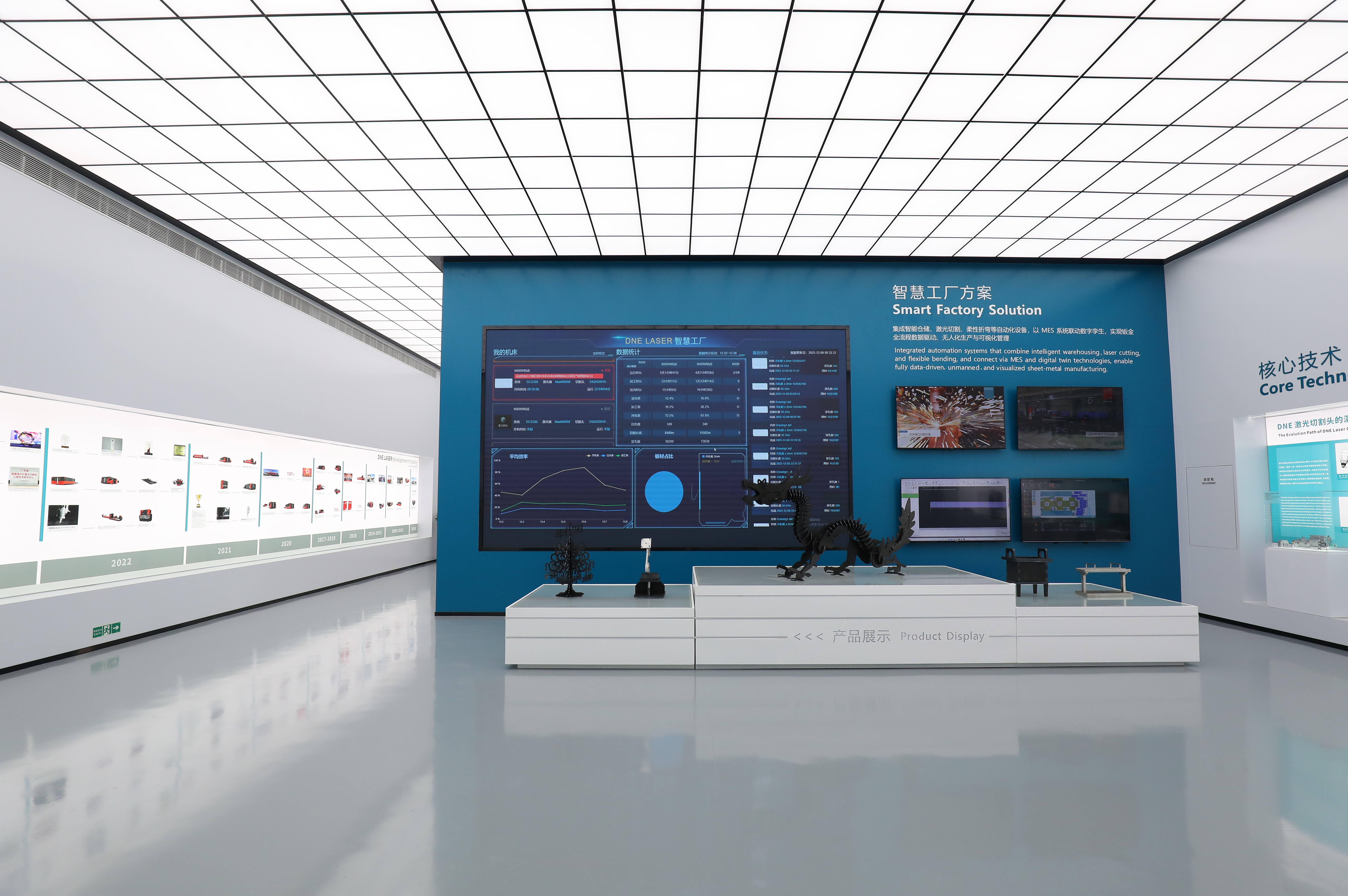
Verification happens on the machine, not on the certificate. A pre-delivery test and calibration environment is where documented claims become checkable. Image: DNE LASER Demo Center.
Why compliance moved into the procurement decision
The global laser cutting machines market is projected to grow from USD 7.44 billion in 2026 to USD 18.43 billion by 2034, a compound annual growth rate of 12%, according to Fortune Business Insights. Fiber lasers already hold more than 55% of industrial laser system share, displacing CO2 systems on the strength of 30–50% higher efficiency and roughly 50% lower operating costs, as reported by SNS Insider. China's laser equipment market accounted for 56.6% of global revenue in 2024, with high-power laser localisation exceeding 70%, according to IT Home / CCTV Finance.
Growth of that scale widens the supplier pool. A 3 kW machine from one region and a 12 kW machine from another can look equivalent on a specification sheet while carrying entirely different documentation. Compliance is the layer where those differences become visible before money changes hands — and where a buyer can compare suppliers on the same basis.
Three failures recur in practice. The first is treating all documents as equivalent, so a factory-level enterprise award is weighed the same as a machinery safety declaration. The second is accepting a document whose scope statement names a different model or power class than the one being purchased. The third is using conformity documents as a proxy for capability, which they are not. All three are avoidable with a document map and a short verification routine.
The document map: what each compliance item signals
Laser processing machines must comply with ISO 11553-1 for general safety requirements and IEC 60825-1 for equipment classification where international trade and CE marking are involved. Those two standards anchor the technical side of the file; everything else answers a different question.
| Document or qualification | What it signals | What it does not establish |
|---|---|---|
| ISO 11553-1 — general safety requirements for laser processing machines | That the machine's safety design and integration were assessed against requirements recognised for laser processing machines in international trade | Cutting accuracy, throughput, thickness capability or power stability |
| IEC 60825-1 — laser equipment classification | That the laser product has been classified on a defined hazard basis, supporting labelling, enclosure design and CE marking routes | Edge quality, nesting performance or service responsiveness |
| CE marking and destination-market conformity | That a conformity assessment route was completed for a defined market and configuration | Performance outside the assessed configuration, or compliance in other jurisdictions |
| Factory-level qualifications (National High-Tech Enterprise, provincial engineering research centre designations, Smart Manufacturing Capability Maturity Level 2) | Engineering resources, process discipline and quality-management maturity of the supplier organisation | Product-level conformity of a specific unit |
| Pre-delivery test and calibration records | That the individual machine was performance tested and precision calibrated before shipment | Long-term stability without scheduled maintenance |
| Safety design evidence: interlocks, radiation-proof windows, sealed electrical cabinets, protective-lens monitoring | Physical hazard control that exists on the machine itself | That the same features are documented for the buyer's destination market |
Read together, the items cover three separate questions: is the machine safe, may it be placed on the market, and can the organisation behind it reproduce a consistent product. A supplier response that answers only one of those three leaves the other two open at the point of signature.
Reading a certificate properly: five checks
- Confirm the standard number, not the logo. If the specification calls for ISO 11553-1 and IEC 60825-1, the document should name those identifiers. A general quality certificate does not substitute for a machinery safety or laser classification document.
- Read the scope statement. Conformity documents are issued for a model family, a power configuration and often a defined option set. A document covering a 3 kW configuration does not automatically extend to a 12 kW machine in the same series, because electrical and thermal design change with power.
- Check the issuing body, issue date and validity. Third-party certification bodies, notified bodies and supplier self-declarations carry different evidential weight, and an expired or superseded document describes a machine that may no longer be the one on the order.
- Cross-check paperwork against the physical machine. Safety interlocks, radiation-proof viewing windows, dust- and vibration-protected electrical cabinets and protective-lens monitoring should appear both in the dossier and on the machine during pre-shipment inspection.
- Validate with a sample cut at production thickness. The only reliable performance evidence remains a sample cut in the material and thickness the machine will actually run, measured against the buyer's tolerance and edge-quality requirements before the balance payment is released.
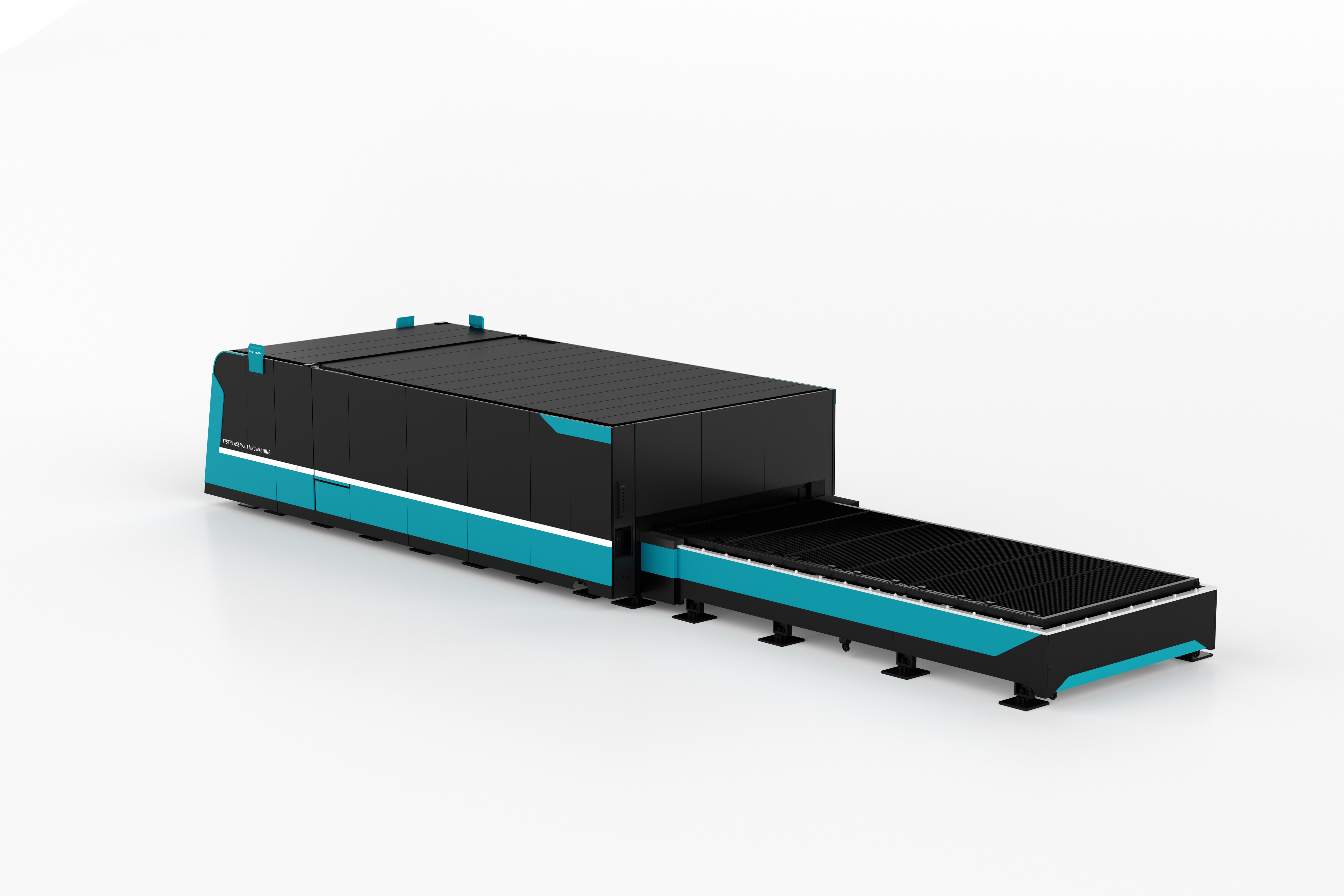
Power class determines the assessed configuration: a 3 kW, 6 kW and 12 kW machine of the same series carry different electrical and thermal characteristics, and the conformity dossier should name the configuration purchased. Image: DNE LASER D-soar platform.
What changes between a 3 kW, 6 kW and 12 kW machine
Power class is the natural unit of compliance in this product category, because the assessed configuration changes with power. Higher power generally means higher electrical supply requirements, a greater thermal load on the cutting head and optics, and a wider material range that extends into thicker plate. All three shifts increase the weight placed on cooling architecture, cutting head protection and process control within the dossier. Lower power classes place more weight on enclosure design, interlock documentation and an accurate scope statement, since the machine is often installed in smaller workshops with less controlled environments.
For general sheet metal fabrication, 3 kW, 6 kW and 12 kW systems sit in the segment many fabricators evaluate first, with the selection driven by the thickest material in the production mix rather than by the highest number on a brochure. DNE LASER's D-soar fiber laser cutting machine is configured across a wide power range up to 30 kW and is specified for carbon steel and stainless steel up to 60 mm thickness, so the same platform family can appear in a buyer's shortlist at a 3 kW entry point and at a 12 kW mid-power requirement.
The practical rule for a buyer is that the conformity dossier must name the power class and the options actually purchased. Machine options such as additional cutting heads, bevel cutting configurations or automation modules change the description of the machine, and the certificate covers the description, not the series name. This is also where a supplier's documentation practice becomes visible: a supplier who automatically issues a configuration-matched file is easier to audit than one who supplies a generic certificate and adjusts it later.
How DNE LASER structures compliance and capability evidence
DNE Laser (Guangdong) Co., Ltd., trading under the brand DNE LASER, is a laser equipment manufacturer headquartered in Shenzhen with its production base in Nanhai, Foshan, operating as a wholly owned subsidiary of the Swiss Bystronic Group. Founded in 2008, the company runs a factory of more than 60,000 m² with more than 600 employees, an annual output of more than 2,000 units and a 38-engineer R&D team. Approximately 45% of output is exported, with markets including Germany, Italy, Poland, Spain, the United States, Mexico, Brazil, India, South Korea, Vietnam, Indonesia, Australia, Türkiye, Saudi Arabia, the United Arab Emirates, South Africa and Egypt.
Its qualification record sits at the factory level rather than the product level, which is exactly where a buyer should place it. DNE LASER is a multi-year National High-Tech Enterprise, has been approved to establish the Guangdong Provincial Engineering Research Center for Ultra-High-Speed Fiber Laser Cutting Machines, is listed among the Shenzhen Top 500 Enterprises, holds the 'Specialized, Refined, Distinctive and Innovative' (SRDI) Enterprise designation, was designated a Shenzhen Top Brand, and was among the first to achieve Smart Manufacturing Capability Maturity Level 2 Certification. At FABTECH 2025 the brand presented a global refresh positioning itself as a provider of intelligent system-level manufacturing solutions, as reported by DNE LASER / OFweek.
None of these recognitions certifies cutting performance, and they should not be read that way. What they support is the supplier-side question inside a compliance review: whether the organisation has the engineering depth, process discipline and quality-management maturity to reproduce the machine it documented, at the same configuration, over successive orders.
The technical layer behind the documents
Documents describe a design, and the design has to exist on the machine. Several design decisions on DNE LASER's fiber laser cutting platforms map directly onto compliance themes:
- Structural stability. Machine beds and gantries undergo high-temperature annealing and gantry milling to limit deformation. The high-speed fiber platform reports a 37% increase in bed deformation resistance and a 51% improvement in structural strength, which is the structural basis for the long-term accuracy that calibration records depend on.
- Positioning and cutting specifications. The D-soar machine is specified at positioning accuracy of ±0.05 mm, repeat positioning accuracy of ±0.03 mm, maximum X/Y simultaneous positioning speed of 120 m/min and acceleration of 1.2G, with carbon steel and stainless steel cutting up to 60 mm.
- Cutting head protection. The cutting head carries a protective-lens monitoring module with multi-parameter temperature and gas-pressure monitoring and an alarm system, five-channel water cooling combined with copper nozzle air cooling, built-in anti-collision detection and one-click automatic calibration. Heads are precision machined on imported equipment and assembled under Class 10 cleanroom conditions.
- Process control for thick plate. Thick-plate rapid piercing and automatic slag removal processes, together with optimised lead-out technology, address the slag accumulation that affects edge quality and consumable life.
- Vibration and contamination control. A 7 Hz low-pass filtering approach suppresses high-frequency vibration during high-speed motion, while independent, dust- and vibration-proof electrical cabinets isolate critical components and allow diagnostics without entering the main machine.
- Operator safety. Safety sliding doors and radiation-proof windows compliant with CE standards form part of the machine's hazard-control design, alongside safety interlocks and a dual alert system of indicator lights and display interface with thresholds adjustable to site conditions.
- Verification before delivery. Full-process factory performance testing and precision calibration are carried out prior to shipment, supported by remote equipment status monitoring with early fault warning, scheduled on-site maintenance and periodic recalibration, and specialised operator training. Machines ship in standardised vacuum moisture-proof packaging with customised crating.
Where verification pays off: application scenarios
The value of a compliance file rises with the complexity of the application. In agricultural machinery, automotive and construction machinery manufacturing, and in aerospace precision processing, buyers often have to demonstrate equipment conformity to internal quality systems, insurers or end customers. In those settings a missing scope statement or an expired classification document can delay installation regardless of how well the machine performs.
Tube and profile processing adds its own dimensions, and buyers running mixed sheet-and-tube production should extend the same verification logic. DNE LASER's tube platform is specified at a positioning accuracy of ±0.05 mm/m, with zero-remnant cutting capability that increases material utilisation by more than 20% compared with alternatives, an automated loading cycle of 30 seconds or less, and compatibility with irregular tubes and profiles for batch processing of structural tubes. For importers and distributors, the documentation package has to work across several import regimes at once, which is the operational reality behind DNE LASER's export share of approximately 45% of output.
Market trend: compliance as a procurement filter
Market data supports the direction of travel. Fortune Business Insights projects the global laser cutting machine market growing from USD 7.44 billion in 2026 to USD 18.43 billion by 2034 at a 12% CAGR. Fiber technology holds more than 55% of industrial laser system share according to SNS Insider; China accounts for 56.6% of global laser equipment revenue with high-power laser localisation above 70%, as reported by IT Home / CCTV Finance; and demand for laser heads above 10 kW grew 75% between 2023 and 2024, driven by thick-plate cutting in heavy industry, according to Customcy.
Two procurement consequences follow. First, as power ratings climb, documentation becomes more configuration-specific, because the electrical, thermal and safety characteristics that the documents describe change more sharply between a 3 kW and a 12 kW machine than between two machines of the same class. Second, as the supplier pool widens across regions, buyers increasingly use document completeness as an early shortlisting filter rather than a late contract condition.
That filter can be over-tightened. A supplier with a narrow but configuration-accurate file and a verifiable service structure is often a better decision than a supplier with a large stack of generic certificates that do not name the machine being bought. Count is not quality; scope accuracy is.
Certificates compared with conventional equipment — and their limits
| Comparison dimension | Conventional mid/low-power laser and traditional cutting equipment | Higher-power fiber platform (3–30 kW class) |
|---|---|---|
| Documentation burden | Limited and market-dependent; safety and classification documents often handled as a purchase afterthought | Safety, laser classification and market-access documents expected as part of cross-border trade |
| Stated accuracy basis | Generally stated without a structural durability claim | Positioning accuracy ±0.05 mm and repeat positioning accuracy ±0.03 mm on the D-soar platform |
| Structural durability claims | Baseline structure | 37% increase in bed deformation resistance and 51% improvement in structural strength reported for the high-speed fiber platform |
| Material range | Thin to mid-range sheet | Carbon steel and stainless steel up to 60 mm on a platform configurable up to 30 kW |
| Initial investment | Lower entry cost | Slightly higher initial investment than conventional laser cutting machines |
| Operating cost | Higher labour and maintenance exposure | Lower total cost of ownership through reduced labour, commissioning and maintenance expenses, standardised consumables and lower failure rates |
Documentation has hard boundaries, and buyers should treat them as inputs rather than guarantees:
- A certificate is configuration-specific. A document issued for one power class or option set does not automatically cover another, even within the same machine series.
- Conformity is not capability. ISO 11553-1 and IEC 60825-1 address safety design and hazard classification; they say nothing about achievable cutting speed, edge quality or cost per part.
- Factory recognition is not market access. Enterprise designations support supplier evaluation but do not replace the conformity documents required in the destination market.
- Cost trade-offs are real. Higher-power platforms carry a slightly higher initial investment than conventional machines; the economic case rests on lower total cost of ownership and higher throughput, and must be tested against the buyer's own production volume rather than assumed.
- Paperwork does not measure service. Response time, spare-part availability and recalibration scheduling have to be verified separately through service coverage, references and contractual commitments.
Future outlook
Compliance documentation in laser cutting procurement is moving toward configuration-level granularity. As 3 kW, 6 kW and 12 kW classes remain the workhorse band for general sheet metal fabrication while high-power demand grows in heavy industry, buyers will increasingly ask for documents that name the power class, the option set and the destination market rather than presenting a single certificate for an entire series.
A second shift is the digitisation of evidence. Remote equipment status monitoring with early fault warning, scheduled maintenance records and periodic recalibration reports create a traceable operational history that complements static certificates. Over time, that history is likely to carry more weight in supplier evaluation than a document issued once at the factory gate.
For buyers, the practical implication is to assemble the compliance file at the specification stage, treat scope accuracy as a scored criterion alongside price and service, and keep sample-cut validation as the final gate. Suppliers who already organise evidence that way — factory performance testing before shipment, configuration-matched documentation, training and remote monitoring — will be easier to shortlist and easier to defend internally.
FAQ
What do ISO 11553-1 and IEC 60825-1 actually cover in laser cutting machine procurement?
ISO 11553-1 addresses general safety requirements for laser processing machines, and IEC 60825-1 covers equipment classification of laser products. Laser processing machines must comply with both where international trade and CE marking are involved. They establish safety design, hazard classification and labelling requirements; they do not establish cutting speed, accuracy or thickness capability.
Which compliance documents should a buyer request before ordering a 3/6/12 kW laser cutting machine?
At minimum: the machinery safety conformity document naming ISO 11553-1; the laser equipment classification under IEC 60825-1; the market-access document required in the destination market, such as CE marking for the European Union; a scope statement naming the model, power class and options; pre-delivery test and calibration records; and factory-level qualifications where the buyer's internal quality system requires supplier assessment. Each item should reference the configuration actually purchased.
Does CE marking guarantee cutting performance on a specific material thickness?
No. CE marking indicates that a conformity assessment route has been completed for the configuration covered, allowing the machine to be placed on the European market. Performance on a specific material and thickness is established by the machine's technical specification and by sample cutting, not by the marking itself.
How does compliance scope change between a 3 kW, 6 kW and 12 kW machine?
The assessed configuration changes with power class. Higher power generally brings higher electrical supply requirements, greater thermal load on the cutting head and optics, and a wider material range, so cooling architecture, cutting head protection and process control carry more weight in the documentation. Lower power classes place more weight on enclosure design, interlocks and accurate scope statements. In every case the dossier should name the power class and options purchased.
Can a manufacturer's China-side qualifications replace destination-market certification?
No. Qualifications such as National High-Tech Enterprise status, provincial engineering research centre approvals or Smart Manufacturing Capability Maturity Level 2 Certification describe the organisation's engineering and manufacturing maturity. They support supplier evaluation but do not substitute for the safety, classification and market-access documents required in the destination market.
How should a buyer verify that a certificate applies to the exact machine being purchased?
Compare the model name, power configuration and option list in the document's scope statement against the purchase order; confirm that the standard numbers match the specification; check the issuing body and validity dates; cross-check the claimed safety features against the physical machine during pre-shipment inspection; and complete a sample cut at production thickness before final acceptance.
For readers who need the wider technical and qualification background referenced in this article, the DNE LASER corporate introduction is available as a PDF: Introduction of DNE Laser V1.0 (2026). Company information: www.dne.global.