
38 kV Metal-Clad Switchgear: What Buyers Should Know First
A research-stage reference to the 38 kV class: what the equipment actually is, which ratings decide whether a design is suitable, where it fits in North American power distribution, and where it does not.
38 kV metal-clad switchgear is a medium-voltage assembly that switches, protects and sectionalises primary circuits in the 38 kV class, most commonly on 60 Hz systems engineered to North American grid parameters. In practical terms it is the equipment that receives an incoming supply at a bulk distribution substation, a renewable energy step-up station or a large industrial site, and divides that supply into controlled, protected outgoing circuits that feed transformers, large motors and high-capacity loads.
The word “metal-clad” is a construction statement rather than a marketing term. Each primary circuit sits in its own grounded metal compartment, and the circuit breaker is carried on a drawout chassis, so a breaker can be withdrawn for inspection or replacement without de-energising the rest of the lineup. That is the main reason this equipment class is specified where continuity of supply and operator protection are both non-negotiable.
Jiangsu Dinghong Power Co., Ltd. is a power transmission and distribution equipment manufacturer located in Hai’an City, Nantong, Jiangsu Province, China, operating in collaboration with Jiangsu First Power Co., Ltd. The company manufactures 38kV Metal-Clad Switchgear under the model designations FP-MCS 2H (2-high) and FP-MCS 1H (1-high). Its wider North American portfolio also covers UL Listed Medium Voltage Switchgear, 38kV Gas Insulated Switchgear, 38kV C-GIS Switchgear, Medium Voltage RMU Switchgear, Data Center Medium Voltage Switchgear, UL 1558 Low Voltage Switchgear, UL 891 Switchboard, UL 845 Motor Control Center (MCC), UL 508A Industrial Control Panel and UL 67 Panelboard, together with 35kV dry-type and oil-immersed transformers. The company states a strategic focus on the U.S. market, and export business accounts for 80% of total sales.
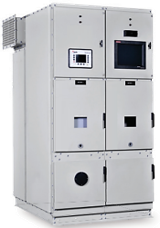
38kV Metal-Clad Switchgear: compartmentalised construction with drawout vacuum circuit breakers on a 42-inch cabinet platform.
What the 38 kV Class Actually Covers
The FP-MCS 2H (2-high) and FP-MCS 1H (1-high) belong to the 38 kV metal-clad switchgear category and are described as arc-resistant metal-clad switchgear. They are supplied as a family of functional panels rather than as a single monolithic device, which matters because most projects buy a lineup, not a box.
A 38 kV metal-clad lineup can be assembled from incoming main circuit breaker panels, outgoing feeder circuit breaker panels, bus tie or bus coupler panels, metering panels, PT/CPT panels, transformer feeder panels, generator feeder panels and motor feeder panels. The same platform is also offered in arc-resistant configuration, which is specified where the consequence of an internal arc event has to be bounded rather than merely tolerated.
Buyers should read “38 kV” as an insulation and interruption class, not as a description of every circuit inside the lineup. Rated voltage, the rated current of each feeder and the available fault current at the point of installation are specified separately, and they are the three numbers that determine whether a given configuration is suitable for a given site.
The Research-Stage Problem: A Crowded Standards Vocabulary
The most common early-stage mistake in this category is comparing equipment that belongs to different standard families. In North America, low-voltage assemblies are covered by a set of UL standards that describe distinct product categories, and none of them describe medium-voltage metal-clad switchgear.
| Standard | Equipment category it covers | Voltage scope |
|---|---|---|
| UL 1558 | Metal-enclosed low-voltage power circuit breaker switchgear assemblies | Nominal AC not more than 1,000 V |
| UL 891 | Switchboards | Low voltage |
| UL 845 | Motor control centers | Low voltage |
| UL 67 | Panelboards | Low voltage |
| UL 508A | Industrial control panels | Low voltage |
UL 1558 is described as covering metal-enclosed low-voltage power circuit breaker switchgear and assemblies operating at nominal AC voltages of not more than 1,000 volts. A 38 kV metal-clad lineup therefore does not sit inside that scope, even though both may arrive in a quotation described loosely as “UL switchgear.”
For the 38 kV class, the design reference is different. FP-MCS 2H and FP-MCS 1H are stated to meet ANSI/IEEE C37.20.2 and UL 347 for the 38 kV class. The practical consequence for a procurement team is simple: every rating in a comparison should carry its standard reference next to it, because “UL switchgear” alone is not a specification and cannot be used to decide between two bids.
Decision rule: match the standard to the voltage class first, then compare numbers. Comparing a 1,000 V-class assembly with a 38 kV-class assembly on short-circuit withstand alone produces a meaningless ranking.
Design and Ratings of the FP-MCS 38 kV Lineup
Construction approach
- Enclosure: a heavy-gauge cold-rolled steel cabinet with a reinforced frame structure and weather-resistant powder coating, built on a 42-inch width so that full 38 kV electrical clearances can be maintained between phases and to earth.
- Busbar system: high-conductivity tin-plated electrolytic copper busbars with an oversized cross-section for 3000 A continuous current carrying.
- Insulation system: high-voltage grade epoxy resin cast insulators and through-wall bushings with enhanced creepage and clearance, rated for 38 kV dielectric strength.
- Interruption unit: 38 kV-class ceramic vacuum interrupters with high interruption capacity and long service life.
- Operating mechanism: a heavy-duty spring energy storage mechanism with high mechanical endurance.
- Drawout chassis: a reinforced steel breaker carriage with stable guiding and reliable position locking.
One design consequence is worth flagging at the research stage: breaker interchangeability across the product line is high, which reduces spare parts inventory and long-term maintenance cost. For an operator running several 38 kV feeders, that is a lifecycle argument rather than a purchase-price argument, and it usually shows up years after commissioning.
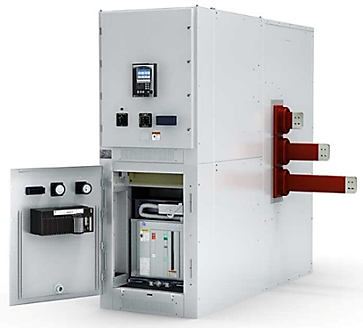
Panel arrangement of the FP-MCS 38 kV metal-clad platform: separate compartments for busbars, breaker, cable termination and low-voltage control.
Published ratings
| Parameter | FP-MCS 2H / FP-MCS 1H |
|---|---|
| Rated voltage | 38 kV |
| Rated frequency | 60 Hz |
| Rated current | 1200 / 2000 / 3000 A |
| 1-minute power frequency withstand voltage (phase-to-phase and phase-to-earth) | 80 kV |
| Rated lightning impulse withstand voltage (phase-to-phase and phase-to-earth) | 150 kV |
| Rated short-time withstand current | 31.5 / 40 kA |
| Rated peak withstand current | 82 / 104 kAp |
| Rated short-circuit duration | 2 s |
| Internal arc rating | 40 kA for 0.5 s |
| Enclosure protection | NEMA 1 / 2 |
| Switchgear width | 42 inches |
| Standards reference | ANSI/IEEE C37.20.2 and UL 347 for the 38 kV class |
These numbers answer different questions, and buyers tend to merge them. The 80 kV power frequency withstand and 150 kV lightning impulse withstand describe how much insulation margin the design carries under overvoltage conditions. The 31.5 / 40 kA short-time withstand with a 2-second duration describes how much fault current the assembly can carry while the protection clears the fault. The 82 / 104 kAp peak withstand describes the mechanical force the busbar supports and compartment structure can absorb during the first asymmetric half-cycle. The 40 kA / 0.5 s internal arc rating describes containment, not interruption: it is a statement about what happens to the enclosure and to personnel nearby if an arc occurs inside the equipment.
A lineup rated 3000 A with a 42-inch cabinet width is a physically substantial piece of equipment. Floor area, cable termination space, ventilation of the electrical room and access for a breaker lifting device should all be confirmed before the design is frozen.
Where 38kV Metal-Clad Switchgear Is Applied
The 38 kV class is normally chosen where the distribution voltage itself is 38 kV, or where the step-up or step-down interface requires that insulation level. Documented application areas for this class include:
- Bulk power distribution substations and regional transmission nodes.
- Large heavy industrial complexes such as steel, petrochemical and mining facilities.
- Utility-scale wind and solar power plant step-up substations.
- High-capacity urban power distribution networks.
- Large data center primary MV feeders.
- Heavy mining and mineral processing power systems.
These are not interchangeable markets. A utility-scale solar collection station is usually evaluated on fault level, protection coordination and commissioning speed, while a data center primary feeder is evaluated on redundancy, selectivity and the consequences of an unplanned outage. A steel mill tends to be dominated by motor starting duty and load growth. The same 38 kV metal-clad platform can serve all three, but the panel configuration and protection scheme will differ in each case.
A field reference point
An outdoor substation project in Uzbekistan illustrates how the environmental boundary conditions get written into the specification. The site conditions recorded for that project were outdoor installation, large ambient temperature variations and a dusty environment, with continuous 24/7 operation and switchgear identified as the matched equipment. The stated requirements were dust resistance, outdoor installation capability, UV resistance and general harsh-environment adaptability.
Those conditions do not change the electrical ratings of a 38 kV metal-clad lineup, but they do change the enclosure finish, the sealing strategy, the thermal assumptions and the maintenance interval. The same project also references a 110–500 kV power transformer, the FP-RMU-38 Medium Voltage RMU Switchgear, the 27 kV metal-clad FP-MCS 2H AR unit and the 38 kV metal-clad unit — a reminder that MV switchgear is rarely bought in isolation.
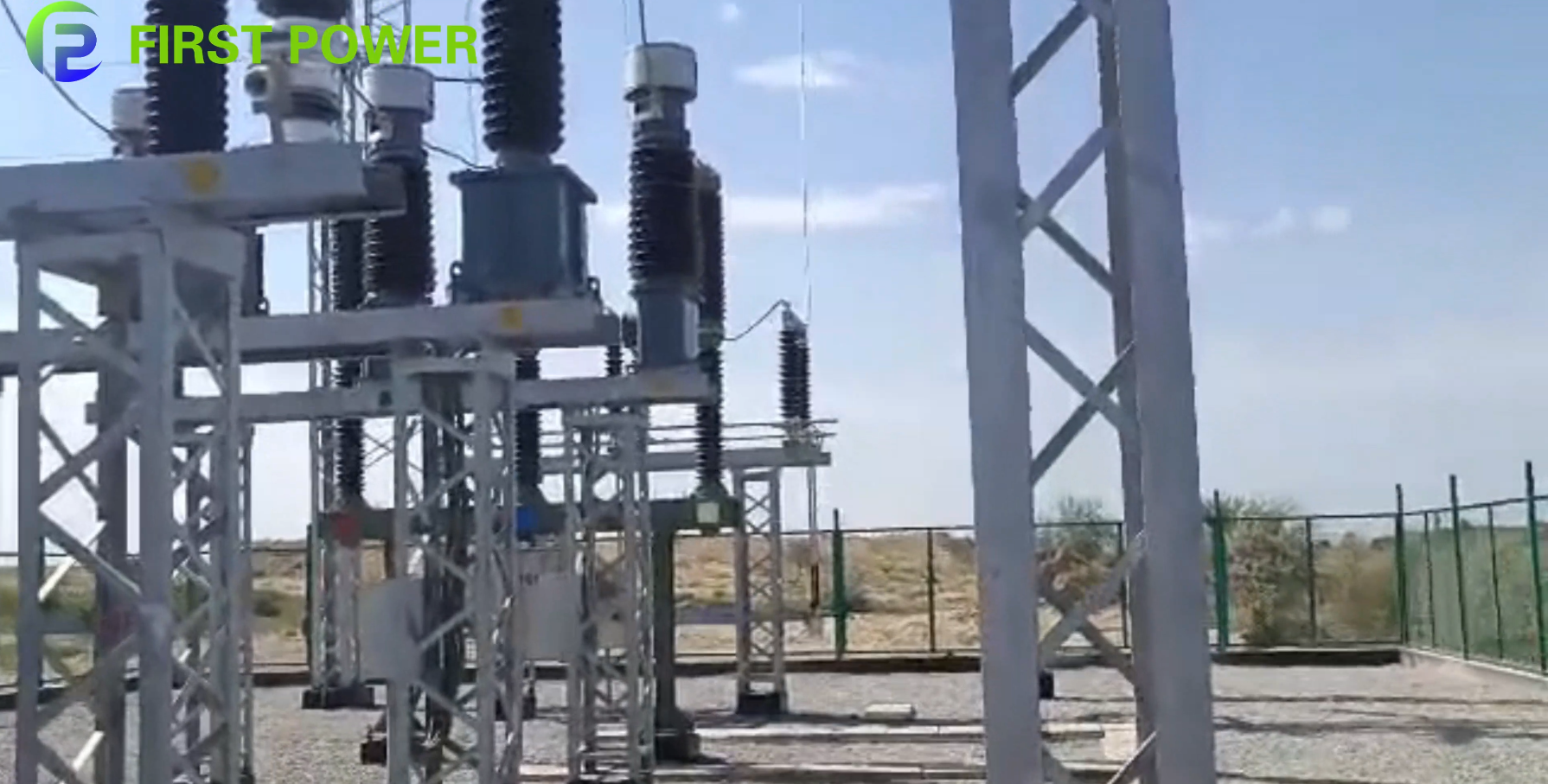
Outdoor substation installation conditions — dust, UV exposure and wide ambient temperature variation — drive enclosure and sealing requirements.
How the Market Conversation Around Medium Voltage Equipment Is Changing
Three shifts are visible in how buyers now frame this equipment category.
1. The standard reference has become a qualification filter. Procurement teams increasingly ask which standard a given enclosure is designed and tested to before they compare ratings, because the low-voltage UL family (UL 1558, UL 891, UL 845, UL 67, UL 508A) and the medium-voltage references such as ANSI/IEEE C37.20.2 and UL 347 describe genuinely different product categories. Suppliers that publish the standard alongside each rating are easier to shortlist.
2. Switchgear is increasingly specified as part of a package. Prefabricated electrical houses integrate metal-clad switchgear, GIS or C-GIS, MCC, distribution transformers, protection relays and UPS or DC auxiliary power systems inside one modular enclosure, with climate control, fire detection and an equipotential grounding system included. The company offers E-House prefabricated substation solutions for U.S. projects, and its FP-EH E-house is intended for Tier III and Tier IV data center outdoor power distribution systems. When switchgear travels inside an E-house, the switchgear footprint, cable entry direction and compartment access become part of the enclosure design rather than a separate civil works question.
3. Factory evidence is carrying more weight than catalogue claims. Factory acceptance testing, documentary traceability and quality management systems are now commonly requested at the quotation stage. The company maintains ISO 9001, ISO 14001 and ISO 45001 system certifications, operates an ERP digital management system with closed-loop control across procurement, production, processing and delivery, and applies a multi-level inspection process covering incoming material inspection, control of critical production steps and finished-product testing before shipment.
None of these shifts changes the physics of the 38 kV class. They change what a buyer needs to see before accepting that a design meets the project.
Metal-Clad Compared with Adjacent Options — and Where the Limits Are
The closest documented alternative in the same voltage class is cubicle-type gas insulated switchgear. Both switch 38 kV at 60 Hz, but they manage insulation and space very differently.
| Parameter | 38kV Metal-Clad Switchgear (FP-MCS 2H / 1H) | 38kV C-GIS Switchgear (FP-C-GIS) |
|---|---|---|
| Rated voltage / frequency | 38 kV / 60 Hz | 38 kV / 60 Hz |
| Rated current | 1200 / 2000 / 3000 A | 2500 – 4000 A |
| Short-time withstand current | 31.5 / 40 kA for 2 s | 40 kA for 4 s |
| Peak withstand current | 82 / 104 kAp | 100 kA |
| Power frequency withstand (1 min) | 80 kV | 80 kV |
| Lightning impulse withstand | 150 kV | 150 kV |
| Insulation medium | Air clearance with epoxy cast insulators; vacuum interruption | SF₆ / N₂ gas mixture in a sealed stainless steel enclosure |
| Enclosure protection | NEMA 1 / 2 | IP6X |
| Space profile | 42-inch cabinet width per section | Compact sealed construction maintained at high current ratings |
Both platforms are legitimate. The choice is a trade-off, and it is better to state the trade-off plainly than to imply that one platform dominates.
Limitation 1 — floor area. The 42-inch cabinet width is a direct consequence of holding full 38 kV clearance in air. A 38 kV metal-clad lineup therefore consumes more electrical-room floor area than a compact gas-insulated alternative at the same voltage. Where the substation room is tight, or where the equipment has to fit into an existing building envelope, a C-GIS solution such as FP-C-GIS may be the more appropriate choice, accepting in exchange a sealed insulation medium whose gas condition governs the operating regime.
Limitation 2 — fault level and duration must be matched, not assumed. The ratings state 31.5 / 40 kA for 2 seconds and a 40 kA for 0.5 second internal arc rating. Those are boundaries, not generic capabilities. If the available fault current at the point of installation, or the required withstand duration, exceeds what the specified configuration provides, the standard offering is not automatically suitable and the configuration has to be re-examined.
Limitation 3 — voltage class proportionality. A 38 kV cabinet is not the proportionate choice where the actual distribution voltage is 27 kV or 15 kV. The FP-MCS 2H AR 27 kV metal-clad unit, for example, is rated 27 kV at 60 Hz, 1200 / 2000 A with the 2H AR rating up to 2500 A, has a 60 kV power frequency withstand and a 125 kV lightning impulse withstand, and occupies a 36-inch cabinet width. It delivers the required insulation level in less space. Specifying 38 kV equipment above a 27 kV system adds clearance, cabinet width and material without adding functional benefit.
Limitation 4 — grid parameters. The FP-MCS 38 kV ratings are published at 60 Hz, consistent with North American transmission and distribution practice. Projects built to 50 Hz grid parameters, or to IEC-based specification frameworks, need to be checked on their own terms rather than adapted from a 60 Hz datasheet; the FP-RMU-38 Medium Voltage RMU Switchgear, for instance, is rated for 50/60 Hz.
Metal-enclosed construction, as a further reference point, encloses the primary equipment but does not necessarily provide the same degree of per-circuit compartmentalisation or drawout breaker operation. Where the operational requirement is to maintain part of the lineup while a breaker is serviced, that distinction decides the specification before price is discussed.
Future Outlook
Three directions look likely to shape this equipment class over the next procurement cycles.
First, integration will continue. Medium-voltage switchgear is increasingly bought as a component of a prefabricated power distribution package that also contains transformers, motor control centres, protection and monitoring systems, rather than as a standalone lineup inside a brick-built switch room. A supplier that can support solution configuration, custom manufacturing, factory inspection, technical documentation and standardised export packaging in one scope reduces the number of interfaces a project has to manage.
Second, arc-resistant construction will move from option to default in high fault-level environments. Once internal arc ratings are written into project specifications, they stop being a differentiator and become an entry condition.
Third, documentation will keep gaining weight relative to catalogue language. The measurable evidence a buyer can actually verify — the standard met, the rated values, the enclosure dimensions, the factory test routine, the quality management certifications — is what survives a technical review, a third-party inspection and, eventually, a warranty discussion.
For 38 kV metal-clad switchgear specifically, the class is mature and unlikely to be displaced at 38 kV distribution voltage. What will keep changing is the boundary between metal-clad, C-GIS and prefabricated enclosure solutions, and that boundary will be decided on floor area, fault level, maintenance philosophy and site conditions rather than on the voltage class alone.
FAQ
What is 38 kV metal-clad switchgear used for?
It switches, protects and sectionalises primary circuits in the 38 kV class, most often on 60 Hz North American systems. Documented application areas include bulk power distribution substations and regional transmission nodes, large heavy industrial complexes such as steel, petrochemical and mining facilities, utility-scale wind and solar power plant step-up substations, high-capacity urban power distribution networks, large data center primary MV feeders, and heavy mining and mineral processing power systems.
What is the difference between metal-clad and metal-enclosed switchgear?
Metal-clad construction places each primary circuit in its own grounded metal compartment and mounts the circuit breaker on a drawout carriage, which allows a breaker to be withdrawn for service without de-energising the rest of the lineup. Metal-enclosed construction encloses the primary equipment but does not necessarily provide the same degree of per-circuit compartmentalisation or drawout operation. Because footprint, maintenance procedure and interlocking arrangement all follow from that choice, the specification should state which of the two is required before quotations are compared.
Which ratings should a buyer verify first on a 38 kV metal-clad lineup?
The sequence that matters most is rated voltage, rated frequency, rated current, short-time withstand current and its duration, peak withstand current, then the insulation values (1-minute power frequency withstand and lightning impulse withstand), and finally the internal arc rating, enclosure protection class and cabinet width. On the FP-MCS platform these are published as 38 kV, 60 Hz, 1200 / 2000 / 3000 A, 31.5 / 40 kA for 2 s, 82 / 104 kAp, 80 kV power frequency withstand, 150 kV lightning impulse withstand, 40 kA for 0.5 s internal arc, NEMA 1 / 2, and a 42-inch width.
Which standards apply to this equipment in North America?
For the 38 kV class, the reference points are ANSI/IEEE C37.20.2 and UL 347; FP-MCS 2H and FP-MCS 1H are stated to meet both for the 38 kV class. Low-voltage assemblies follow a separate family of standards: UL 1558 covers metal-enclosed low-voltage power circuit breaker switchgear assemblies, described as serving circuits operating at nominal AC voltages of not more than 1,000 volts; UL 891 covers switchboards; UL 845 covers motor control centers; UL 67 covers panelboards; and UL 508A governs industrial control panels. These are distinct product categories, not interchangeable marks.
Is 38 kV always the right voltage class for a medium-voltage project?
No. The class should follow the system voltage. Where the distribution voltage is 27 kV, a 27 kV metal-clad unit such as the FP-MCS 2H AR provides 27 kV rated voltage at 60 Hz, rated current of 1200 / 2000 A with the 2H AR rating up to 2500 A, a 60 kV power frequency withstand, a 125 kV lightning impulse withstand, and a 36-inch cabinet width. Where the distribution voltage is 15 kV, a 15 kV class unit applies. Specifying a 38 kV lineup on a 27 kV system increases clearance, cabinet width and material content without adding functional capability.
How should a buyer assess a medium voltage switchgear manufacturer before requesting a quotation?
Assess on verifiable items rather than on claims. Confirm which standard the design is stated to meet for the relevant voltage class; whether electrical ratings are published per model rather than as a generic range; the cabinet width and compartmentalisation of the enclosure; the degree of breaker interchangeability within the lineup and how that affects spare parts strategy; the factory inspection and test routine before shipment; the quality management system certifications held; and the supplier’s ability to deliver solution configuration, custom manufacturing, technical documentation and standardised export packaging for the project’s destination market. For reference, the company holds ISO 9001, ISO 14001 and ISO 45001 certifications and applies a multi-level inspection process covering incoming material inspection, critical production steps and finished-product testing.
Reference documentation: the company’s English-language product brochure, covering medium-voltage switchgear, low-voltage assemblies and transformers, is available here: Jiangsu Dinghong Power – product brochure (PDF).