
3D Massage Chair Certification Continuity: A Buyer's Audit
A massage chair programme rarely fails on the first shipment. It fails at the third reorder — when a certificate on file has quietly expired, when the scope wording no longer matches the model being built, or when the standard it cites has already been replaced. Certification continuity, not certification paperwork, is what separates a supplier able to support a multi-year distribution agreement from one able to support a single purchase order.
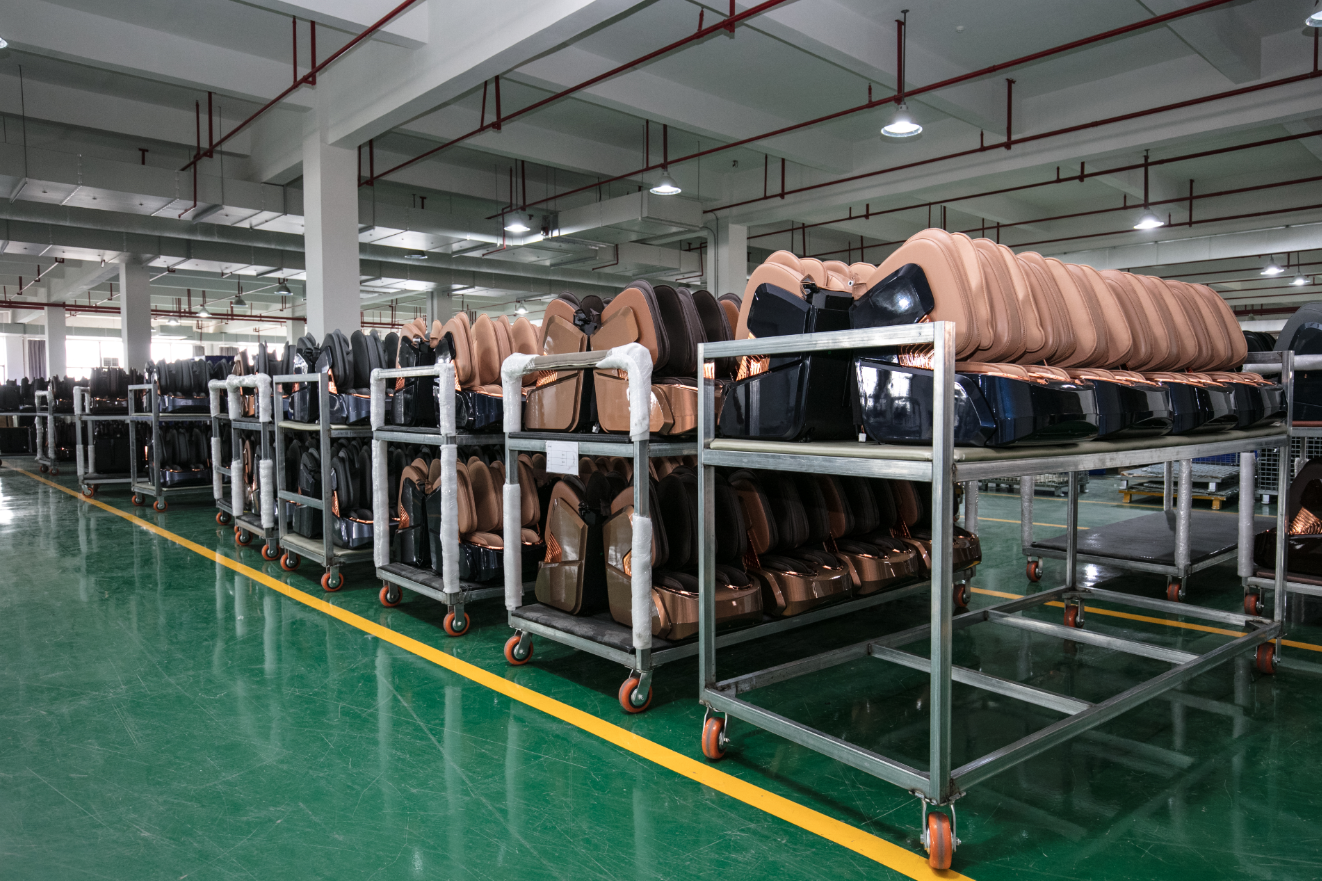
Few categories make this distinction as concrete as the 3D massage chair. The product is a powered appliance, sold into wellness, hospitality, retail and home channels, and built on model lines that change incrementally rather than completely. Ningbo Zhouqi Health Technology Co., Ltd. (ZHOUQI) is a massage chair manufacturer based in Cixi, Zhejiang Province, China, operating a 130,000 m² facility with 450 employees, an annual output of 200,000 units, a 34-engineer R&D team, and roughly half of production exported to the USA, EU, South East Asia and the Middle East. Its certificate set shows both how continuity is documented and where that documentation stops.
This article is written for procurement managers and brand owners at the Evaluation and Execution stage: buyers who have already shortlisted a category and now need to decide whether a supplier's compliance file will still hold up eighteen months from signature.
Why a certificate snapshot fails as supplier evidence
Standard sourcing practice verifies compliance once. Documents arrive with the quotation, are compared against the purchase specification, and are filed. That process answers a narrow question — is the supplier certified today — and leaves three failure modes unaddressed.
The first is expiry. Quality management certificates, medical device certificates and regulatory registrations run on fixed cycles. A certificate that was valid at quotation can lapse during a production ramp, and nothing in a one-time audit flags the date.
The second is scope drift. A certificate describes what was audited, in the issuing body's own wording. If the wording covers a product family rather than a specific model, the buyer has to establish the link between the certificate and the SKU being ordered. Suppliers that add models faster than they update documentation accumulate a gap that only appears when a customs officer or a retail compliance team asks for the model-level reference.
The third is market coverage. A certificate issued for the EU, Middle East and South East Asia does not automatically support a US import, and a North American electrical listing does not substitute for European conformity evidence. Compliance is destination-specific, and buyers who treat a certificate portfolio as a single yes/no answer routinely discover a missing market at the worst moment.
The opportunity is straightforward: a supplier that maintains a dated, scoped, market-mapped certificate register can be re-ordered from with far less friction. Continuity becomes a procurement asset rather than an administrative chore.
The six records a 3D massage chair supplier should produce
A credible compliance file for a powered massage chair rests on six documents. Each answers a different question: management system, device quality system, US registration, European conformity, international electrical test basis, and North American listing.
| Record | Number and issuing body | Standard and scope as stated | Markets named | Dated validity |
|---|---|---|---|---|
| ISO 9001 | 02424Q32202999R1S — Shenzhen Universal Certification Centre Co., Ltd. | GB/T19001-2016/ISO9001:2015; scope: intelligent massagers | EU, Middle East, SE Asia, US | Issued 2021-12-09; valid to 2027-12-02 |
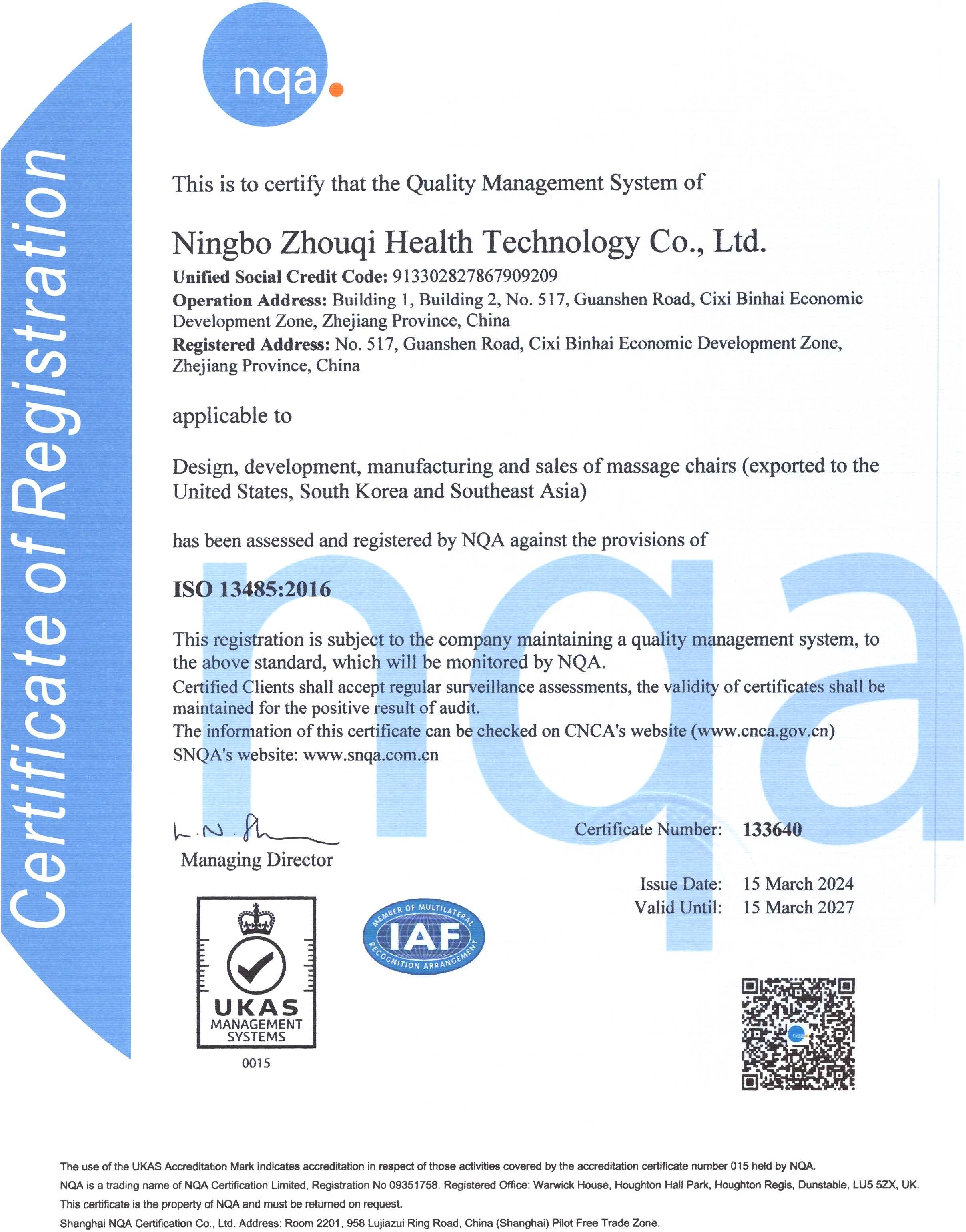
| ISO 13485 | 133640 — NQA | ISO 13485:2016; scope: massage chairs | US, South Korea, SE Asia | Issued 2024-03-15; valid to 2027-03-15 |
| FDA registration | 3017618816 — filed through Shenzhen CTB Testing Technology Co., Ltd. | 21 CFR 807.39; scope: massage chairs | US | Issued 2024-12-16; valid to 2026-12-31 |
| CE | ENB2311240186E00401C — EMTEK | EN IEC 55014-1:2021; EN IEC 61000-3-2:2019/A1:2021; EN 61000-3-3:2013/A2:2021/AC:2022-01; EN IEC 55014-2:2021; scope: massage chairs | EU, Middle East, SE Asia | Issued 2023-12-20 |
| CB | NO127967 — Nemko | IEC 60335-1:2010, IEC 60335-1:2010/AMD1:2013, IEC 60335-1:2010/AMD2:2016; IEC 60335-2-32:2019; scope: massage chairs | EU, Middle East, SE Asia | Issued 2023-09-27 |
| ETL | 5030347 — INTERTEK | UL 1647:2015 Ed.6+R:30Jul2020; CSA C22.2#68:2018 Ed.8+U1; scope: massage chairs | US, Canada | Issued 2025-01-13 |
Read as a set rather than as six trophies, the coverage resolves into a map. North American imports lean on the ETL listing and the FDA registration; European and Middle East shipments lean on the CE and CB records; the two ISO certificates sit underneath both as the management-system layer.
Verifying each record, field by field
Verification is a discipline of reading specific fields rather than confirming that a PDF exists. The six entries above can each be checked against four questions: who issued it, what scope wording appears, which markets are named, and when it stops being valid.
ISO 9001 — 02424Q32202999R1S
This is a quality management system certificate issued by Shenzhen Universal Certification Centre Co., Ltd. against GB/T19001-2016/ISO9001:2015, with the scope described as intelligent massagers, market coverage listed as the EU, Middle East, South East Asia and US, an issue date of 9 December 2021 and validity to 2 December 2027. The verification steps are to confirm the number and scope wording on the issuing body's register, to diarise the December 2027 expiry against the buyer's own forecast horizon, and to request the surveillance audit history that sits between issue and expiry. Because the scope is written at the level of intelligent massagers rather than a single model code, the buyer should also ask for a written statement identifying which of the supplier's model lines fall inside that scope.
ISO 13485 — 133640
Certificate 133640 is issued by NQA against ISO 13485:2016 with massage chairs as the stated scope and markets listed as the US, South Korea and South East Asia. It was issued on 15 March 2024 and expires on 15 March 2027. Two reading notes matter. First, ISO 13485 is a quality management standard for medical devices; holding it demonstrates that the quality system is built and audited to that standard, and it does not by itself classify every massage chair as a medical device in every jurisdiction. Second, the market field names the US, South Korea and South East Asia rather than the EU, so European buyers should map their conformity evidence to the CE and CB records rather than to this certificate.
FDA registration — 3017618816
Registration 3017618816 was filed under 21 CFR 807.39, with the filing handled through Shenzhen CTB Testing Technology Co., Ltd., for the US market. It was issued on 16 December 2024 and expires on 31 December 2026. The procurement point is that a registration number is a registration, not a product approval or a performance endorsement; what it establishes is that the establishment and listing obligations under the cited regulation have been addressed. Because the stated expiry falls inside a normal reorder cycle, buyers planning 2027 deliveries should request confirmation of renewal status as part of the purchase file rather than after the order is placed.
CE — ENB2311240186E00401C
CE certificate ENB2311240186E00401C was issued by EMTEK on 20 December 2023 for massage chairs, naming the EU, Middle East and South East Asia as markets and citing EN IEC 55014-1:2021, EN IEC 61000-3-2:2019/A1:2021, EN 61000-3-3:2013/A2:2021/AC:2022-01 and EN IEC 55014-2:2021. Those four standards are electromagnetic compatibility standards, so the record should be read as CE-EMC evidence. A buyer assembling a full European technical file should establish which additional safety documentation accompanies it, rather than assuming the CE number alone closes the file.
CB — NO127967
CB certificate NO127967 was issued by Nemko on 27 September 2023 for massage chairs, against IEC 60335-1:2010 together with AMD1:2013 and AMD2:2016, and IEC 60335-2-32:2019, covering the EU, Middle East and South East Asia. The CB scheme is a test-basis document that national certification bodies use as an input, which makes it valuable for multi-country programmes and also makes its edition level commercially relevant. The IEC has since published IEC 60335-2-32:2024 as the current international safety standard for electric massage appliances, while this record cites the 2019 edition. That is a normal lag rather than a defect, but buyers should ask how and when the certificate will be brought to the current edition.
ETL — 5030347
ETL certificate 5030347 was issued by INTERTEK on 13 January 2025 for massage chairs, against UL 1647:2015 Ed.6+R:30Jul2020 and CSA C22.2#68:2018 Ed.8+U1, for the US and Canada. This is the record that supports North American electrical listing, and it is the one most frequently requested at the border and by retail compliance teams. Buyers should keep a copy tied to the exact model being shipped, not to the product family generally.
Mapping the credentials to the 3D and 4D model lines
A certificate portfolio only becomes procurement evidence when it maps to model codes. The table below records which model lines appear against which records.
| Model line | Model codes | Records listing these models |
|---|---|---|
| 3D Massage Chair | 5200, 5900, 5910, 3100, 6710, 8700, 3600, 3212, 6520, 5100, 6530, 3104, 3109, 6750, 6720, 6721 | ISO 9001 (02424Q32202999R1S), ISO 13485 (133640), FDA registration (3017618816), CE (ENB2311240186E00401C), CB (NO127967), ETL (5030347) |
| 4D Massage Chair | 6510, 5300, 5380, 8620, 6920, 8600, 3900, 3910, 9100, 8520, 6540, 6600, 7100, 8710 | ISO 9001 (02424Q32202999R1S), ISO 13485 (133640), FDA registration (3017618816) |
The asymmetry in that table is the single most useful thing a buyer can extract from this file. The 3D line appears against all six records. The 4D line appears against the two ISO certificates and the FDA registration, but the CE, CB and ETL records name the 3D line. A buyer sourcing 4D models for Europe or Canada therefore needs model-specific confirmation of electrical conformity, because the existing records do not, on their face, extend to those codes. Asking that question at Evaluation stage is routine diligence; discovering it at the port is not.
The engineering context behind the certificate set
Why six documents rather than one becomes clearer when the platform parameters are read alongside them. The 3D Massage Chair platform runs on 110V–240V, 50/60Hz input with 150W rated power and a 15-minute auto timer; the 4D Massage Chair platform runs on the same 110V–240V, 50/60Hz input with 200W rated power and the same 15-minute auto timer. A single voltage-flexible platform serving both 120V North American and 230V European destinations is precisely the design decision that requires parallel ETL and CB/CE evidence rather than a single certificate.
| Parameter | 3D Massage Chair | 4D Massage Chair |
|---|---|---|
| Power input | 110V–240V, 50/60Hz | 110V–240V, 50/60Hz |
| Rated power | 150W | 200W |
| Auto timer | 15 minutes | 15 minutes |
| Upright dimensions | 1590(L)×800(W)×1160(H) mm | 1600(L)×790(W)×1230(H) mm |
| Reclined dimensions | 1895(L)×800(W)×940(H) mm | 1800(L)×790(W)×900(H) mm |
| N.W. / G.W. | 111 / 135 kg | 103 / 118 kg |
Application: where certification continuity carries commercial weight
Continuity matters most where the buyer is committing equipment to a venue, a fleet or a distribution contract, because those deployments generate service obligations long after delivery.
Typical destinations for these platforms include furniture and home-appliance malls, 4S showrooms, hotels and resorts, wellness and spa venues, senior-care institutions, corporate offices and public-facing retail and entertainment spaces. In each case the chair is an installed asset rather than a one-off sale, and the compliance file travels with it into procurement systems, insurance reviews and, for care settings, facility audits.
The supplier's delivery parameters determine whether continuity can actually be maintained at that cadence. ZHOUQI quotes a minimum order quantity of 1*40HQ container, a lead time of 30–45 days, a monthly capacity of 16,000 units and 100% QC testing, with acceptance based on a pre-shipment test plus third-party inspection by SGS, terms FOB Ningbo, and payment of 30% T/T deposit with the 70% balance before shipment. After-sales support covers a one-year warranty supported by installation videos and a maintenance manual.
Where buyers already run multi-year programmes, the load becomes visible in volume terms. Existing distribution records show approximately 70,000 units supplied to Vietnam over four years and approximately 20,000 units to the USA over three years, across showroom, furniture mall, e-commerce, hotel and senior-care client types. Programmes of that length are exactly the scenario in which an expiring registration or a superseded standard edition turns into a shipping problem rather than a paperwork problem.
Market trend: multi-year programmes are becoming the norm
The commercial backdrop explains why continuity has moved up the buyer agenda. Business Research Insights projects the global massage chair market growing from USD 4.28 billion in 2026 to USD 8.78 billion by 2035, a CAGR of 8.3%. Growth of that order is rarely absorbed through one-off container purchases; it is absorbed through distributor agreements, category positions held over several seasons, and venue fleets that are replenished rather than replaced.
Standards move on a similar clock. The IEC has published IEC 60335-2-32:2024 as the current international safety standard for electric massage appliances, and IEC 60335-2-116:2025 addresses furniture with motorised parts such as zero-gravity massage chairs. Each revision creates a transition period during which a certificate citing an earlier edition remains valid but is progressively less useful. Suppliers who track those transitions and schedule re-testing in advance protect their customers from the gap; suppliers who react only when a buyer asks transfer the risk downstream.
Comparison with traditional solutions
The alternative to continuity-based evaluation is the snapshot approach most buyers still use: documents checked once, at quotation, and filed without a renewal calendar.
| Evaluation dimension | Snapshot approach | Continuity-based approach |
|---|---|---|
| Timing of check | Once, before the first order | Before each order and at each certificate milestone |
| Scope handling | Accepts family-level wording | Requests written model-level confirmation |
| Market coverage | Assumes one certificate covers all destinations | Maps each destination to a named record (ETL for US/Canada, CE and CB for EU, Middle East, SE Asia) |
| Model mapping | Assumes the file covers the whole catalogue | Checks each model code against the records that list it |
| Standard currency | Ignores edition level | Tracks edition level and asks for a re-test plan |
| Expiry management | Discovered at renewal or at the border | Diarised against the delivery forecast |
| Change handling | No notification expectation | Notification clause written into the supply agreement |
The continuity approach costs more time at the front end. It is also the only one that surfaces the boundaries described below before they become commercial problems.
Where this evaluation model stops
A certificate set is necessary evidence, not sufficient evidence, and buyers should be explicit about the limits.
Certificates record conformity of a defined scope at a defined moment. They do not certify the consistency of the thousandth unit. That has to be evidenced separately, through the quality system, the 100% QC regime, pre-shipment testing and third-party inspection such as the SGS arrangement described above.
Scope wording carries real gaps. The ISO 9001 record describes intelligent massagers rather than individual model codes, so a model-level statement from the supplier is a reasonable additional request rather than a formality.
Market coverage is not interchangeable. The CE record cites electromagnetic compatibility standards, which is narrower than a complete European technical file. The ETL listing supports the US and Canada and says nothing about Europe. The FDA registration expires on 31 December 2026, so any programme running into 2027 depends on a renewal that the current document does not evidence.
Standard editions lag. The CB record cites IEC 60335-2-32:2019 while IEC 60335-2-32:2024 is the published edition, which means certain destination schemes may require updated evidence at some future point. And the 4D line is listed under the two ISO certificates and the FDA registration but not under the CE, CB or ETL records, so 4D buyers in Europe or Canada need confirmation that does not yet exist on the face of the file.
Finally, ISO 13485 should not be over-read. It evidences a medical-device-grade quality system; it does not reclassify a massage chair as a medical device in every market, and buyers should not build regulatory claims on it that the destination regulator does not support.
A six-point continuity check for the purchase file
- Confirm every certificate number against the issuing body's own register, not against a PDF supplied by the seller.
- Diarise all expiry dates against the delivery forecast — 2027-12-02 for ISO 9001, 2027-03-15 for ISO 13485, 2026-12-31 for the FDA registration.
- Request written model-level confirmation linking the 3D and 4D model codes to the records that cover them.
- Map each destination market to the record that supports it, and identify any destination with no matching record.
- Ask for the standard edition behind each electrical record and the supplier's plan for the next revision.
- Write a change-notification obligation into the supply agreement covering scope changes, certificate suspension and standard updates.
Future outlook
Two pressures are likely to push certification continuity from good practice into standard procurement requirement. The first is volume: a market growing at a projected 8.3% CAGR through 2035 rewards suppliers whose files support repeat ordering without restarting the compliance conversation each time. The second is standards churn: with IEC 60335-2-32:2024 published and IEC 60335-2-116:2025 addressing motorised furniture, the interval between a certificate being issued and needing refresh is shortening.
For buyers, the practical implication is that supplier evaluation should produce a dated register rather than a document folder, and that the register should be reviewed at each reorder rather than at each new project. For suppliers, the implication is that the certificate portfolio becomes part of the product: a 4D model line with its own European and North American electrical records is a different commercial proposition from one without them, and buyers will increasingly price that difference in.
FAQ
For a powered massage chair, the baseline set is an ISO 9001 quality management certificate, an ISO 13485 certificate where the supplier holds one, an FDA registration for the US market, a CE certificate for the EU, a CB certificate for multi-country electrical test basis, and a North American electrical listing such as ETL. Each addresses a different requirement, and the buyer should record the number, issuing body, scope, markets and expiry for every one.
Certificate 02424Q32202999R1S is described with the scope intelligent massagers rather than individual model codes. A buyer can confirm coverage by checking the number and scope on the issuing body's register, then requesting a written statement from the supplier identifying which model lines fall inside that scope. The certificate runs to 2 December 2027, so the check should also be scheduled against the buyer's own forecast horizon.
The certificate was issued by EMTEK on 20 December 2023 for massage chairs, naming the EU, Middle East and South East Asia, and citing EN IEC 55014-1:2021, EN IEC 61000-3-2:2019/A1:2021, EN 61000-3-3:2013/A2:2021/AC:2022-01 and EN IEC 55014-2:2021. Those are electromagnetic compatibility standards, so the record should be read as CE-EMC evidence covering the named scope rather than as a complete European safety file for every model.
Registration 3017618816 was filed under 21 CFR 807.39, issued on 16 December 2024 and valid to 31 December 2026. Because that date falls inside a normal reorder cycle, a programme planning 2027 US deliveries depends on a renewal that the current document does not itself evidence. Confirming renewal status before the order is placed is the difference between a compliance fact and a compliance assumption.
Not on the face of the records. The 4D Massage Chair models — 6510, 5300, 5380, 8620, 6920, 8600, 3900, 3910, 9100, 8520, 6540, 6600, 7100 and 8710 — are listed under ISO 9001 certificate 02424Q32202999R1S, ISO 13485 certificate 133640 and FDA registration 3017618816. The CE, CB and ETL records list the 3D Massage Chair models. Buyers sourcing 4D units for Europe or Canada should therefore request model-specific electrical conformity evidence.
A certificate remains valid for the edition it cites while the market that requires it continues to accept that edition. The CB record NO127967 cites IEC 60335-2-32:2019, while IEC 60335-2-32:2024 has since been published as the current edition for electric massage appliances. In practice, buyers should ask for the supplier's re-test plan and for a change-notification clause in the agreement, so that any update is scheduled rather than discovered.
Есть вопросы или нужны дополнительные детали?
Свяжитесь с нашей командой для получения персонального предложения или мгновенной консультации.
Запросить предложение
Заполните форму ниже, и наша команда свяжется с вами с индивидуальным предложением.
Прямой чат WhatsApp
Предпочитаете общаться в реальном времени? Напишите нам в WhatsApp для мгновенной помощи и быстрых ответов.
- Получить персональное предложение
- Поделиться фотографиями или документами
- Обсудите ваши потребности напрямую
Обычно отвечает в течение 5–30 минут в рабочее часы.