
3D Massage Chair Scenario Fit Guide: Malls to Care Homes
In commercial and institutional procurement, the deployment environment often determines whether an electric product performs as expected. This is especially true for 3D massage chairs, where user needs, installation conditions and operating intensity vary significantly by location. Buyers researching the category are increasingly asking not just what a chair can do, but where it fits best.
A 3D massage chair is a massage chair whose roller mechanism can move toward and away from the body in addition to traveling along the track. This extra movement axis enables more hand-like pressure control and a broader range of techniques, including kneading, tapping, rolling, shiatsu, and combined kneading-and-tapping programs. In practice, this makes the category adaptable to spaces with mixed user groups, such as shopping malls, airports, hotels, offices, spa houses and senior-care facilities.
For buyers in the research-to-evaluation stage, scenario fit should be assessed before model-level comparison. The core questions are practical: where the chair will be placed, who will use it, how often it will run, what power supply is available, and which operating model the project follows. These questions shape the selection framework before comparing individual chair specifications.
Why Scenario Fit Is Central to 3D Massage Chair Selection
Massage chairs are not a plug-and-play category of furniture. Their long-term reliability and user experience are directly affected by installation conditions and the surrounding environment. A well-equipped model may underperform if it is placed in an area with insufficient space, ungrounded power outlets, high traffic, or no maintenance plan. Conversely, a simpler configuration can work well when the project parameters are aligned.
Commercial and institutional projects typically place several pressures on a massage chair:
- Users differ in body size, age, and physical condition, so the chair must adapt to many body types.
- Daily usage frequency is higher than in a home environment, requiring durable mechanics and upholstery.
- Operation must be simple enough for first-time users, especially in shared or unsupervised locations.
- Safety requirements are stricter, particularly where the chair is used by older adults or in paid shared-use modes.
These pressures explain why project buyers focus less on the length of a feature list and more on whether the chair can operate reliably in a specific scenario. A 3D mechanism with a long SL-track rail extends the range of massage coverage from the neck and shoulders down to the waist and thigh area, while automated body-scanning and adjustable massage depth help match different user preferences. This combination is the technical basis for the category's growing presence in commercial spaces.
Typical Deployment Environments for 3D Massage Chairs
From an industry perspective, 3D massage chairs are primarily used in the massage equipment industry and are also suitable for the broader health and wellness equipment sector. The application is common globally and is generally classified as an indoor deployment. Typical indoor environments include shopping malls, railway stations, airports, offices, and spa houses. The installation area must be kept dry.
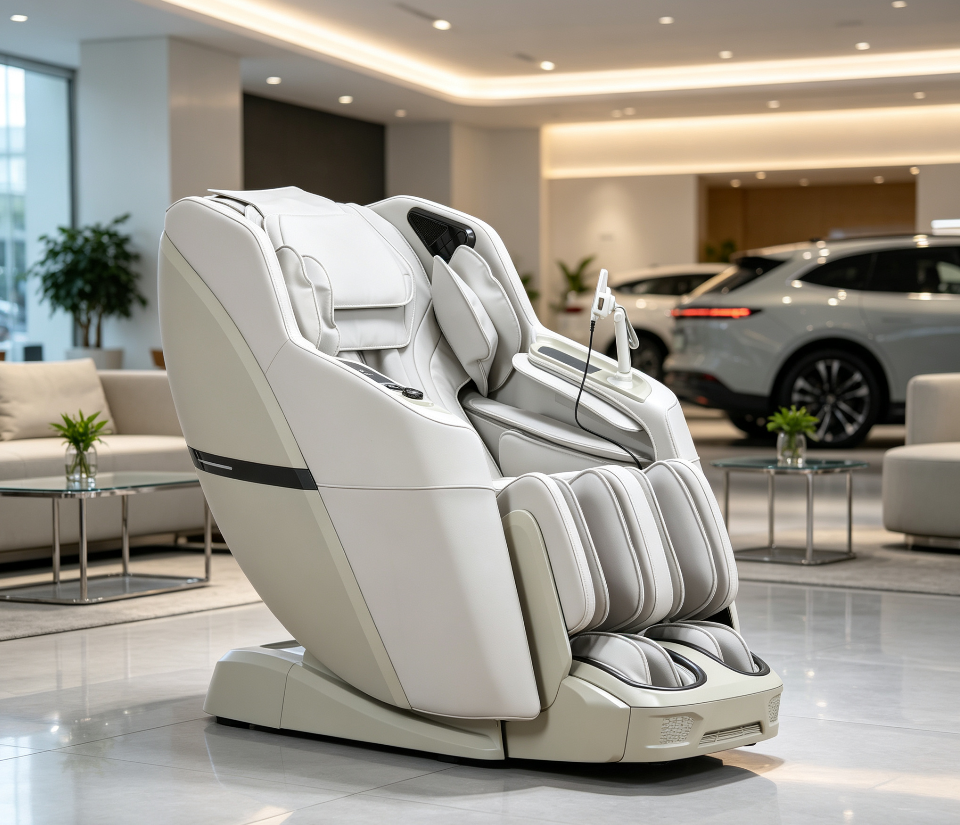
A 3D massage chair in an automotive 4S showroom. Retailers and dealers often use massage chairs to upgrade the customer waiting experience.
Beyond these core environments, the product also appears in hotels, resorts, fitness rooms, retail showrooms, nursing homes and wellness institutions. The role of the chair differs by location. In a shopping mall, it may be part of a rest zone or a coin-operated shared-use station. In airports and railway stations, it provides short relaxation sessions for waiting passengers. In hotels and resorts, it is an added comfort feature for guest rooms and spa areas. In offices, it supports employee wellness programs. In senior-care facilities, it functions as a routine wellness device for muscle relaxation and blood circulation.
| Deployment Space | Primary Use | Selection Focus |
|---|---|---|
| Shopping malls / retail centers | Rest area experience, pay-per-use sharing | Durable mechanical parts, easy operation, low maintenance |
| Airports / railway stations | Travel fatigue relief | Safety, stability, minimal noise |
| Offices / corporate lounges | Sedentary-work relaxation | Auto timer, quiet operation, compact footprint |
| Hotels / resorts | Guest amenity, spa integration | Appearance, quiet motor, customizable interface options |
| Care homes / wellness institutions | Daily muscle relaxation, circulation support | Smooth start-stop behavior, safety features, easy controls |
| Retail showrooms / 4S showrooms | Customer waiting experience | Visual appeal, brand fit, wear-resistant upholstery |
The global nature of these scenarios means a single 3D massage chair platform can be deployed across multiple markets with relatively limited changes. For importers and distributors, this reduces the need to develop separate products for every regional project type.
Nine Project Models That Use 3D Massage Chairs
When categorized by project structure, 3D massage chairs enter a wider range of business models than many buyers expect. Based on manufacturer application records and industry reference data, the common project models include:
- Distribution and retail projects — importers, e-commerce sellers and brick-and-mortar retailers carry 3D massage chairs as inventory or display-experience units.
- Commercial supporting-engineering projects — shopping centers, transport hubs, hotels, and 4S showrooms add massage chairs as a function of the public space.
- Senior-care and wellness engineering projects — nursing homes and health management centers install chairs as part of daily care programs.
- Corporate wellness lounge projects — offices and enterprise headquarters place massage chairs in employee rest areas to address prolonged sitting fatigue.
- Real-estate supporting projects — show flats, sales centers, and property clubhouses use massage chairs as a quality-support facility.
- Shared pay-per-use operation projects — the chair is deployed in malls, cinemas, or transit stations and operated through QR-code or coin-based payment.
- ODM custom-development projects — brands request custom color, logo, UI, language, or pillow-and-backrest design, and the manufacturer develops and produces the final unit.
- Overseas export projects — chairs are exported as full-container shipments and must meet the voltage, plug, and certification requirements of the destination market.
- Group procurement and gift projects — enterprises select massage chairs as employee welfare, customer gifts, or high-end business presents.
Each project model places a different weight on certain product attributes. Distribution projects require a wide model range. Commercial supporting projects require reliability and aesthetic quality. Shared pay-per-use projects require resistance to continuous operation. Health and senior-care projects place the highest value on safe, easy-to-use controls. A manufacturer that can cover these needs must have enough product planning, customization, and production capacity.
Ningbo Zhouqi Health Technology Co., Ltd. (ZHOUQI) is one manufacturer active in this field. The company is located in Cixi, Zhejiang Province, China, and was founded in 2008. Its factory area is approximately 130,000 square meters, with about 450 employees and an annual output of 200,000 massage chairs. Around 50% of production is exported to the USA, the EU, Southeast Asia, and the Middle East. ZHOUQI's 3D massage chair series includes models 5200, 5900, 5910, 3100, 6710, 8700, 3600, 3212, 6520, 5100, 6530, 3104, 3109, 6750, 6720 and 6721. The company supports OEM/ODM production with customization options for color, logo, OEM files, pillow and backrest design, UI, and language. Monthly capacity is about 16,000 units, MOQ is one 40HQ container, and lead time is 30 to 45 days.
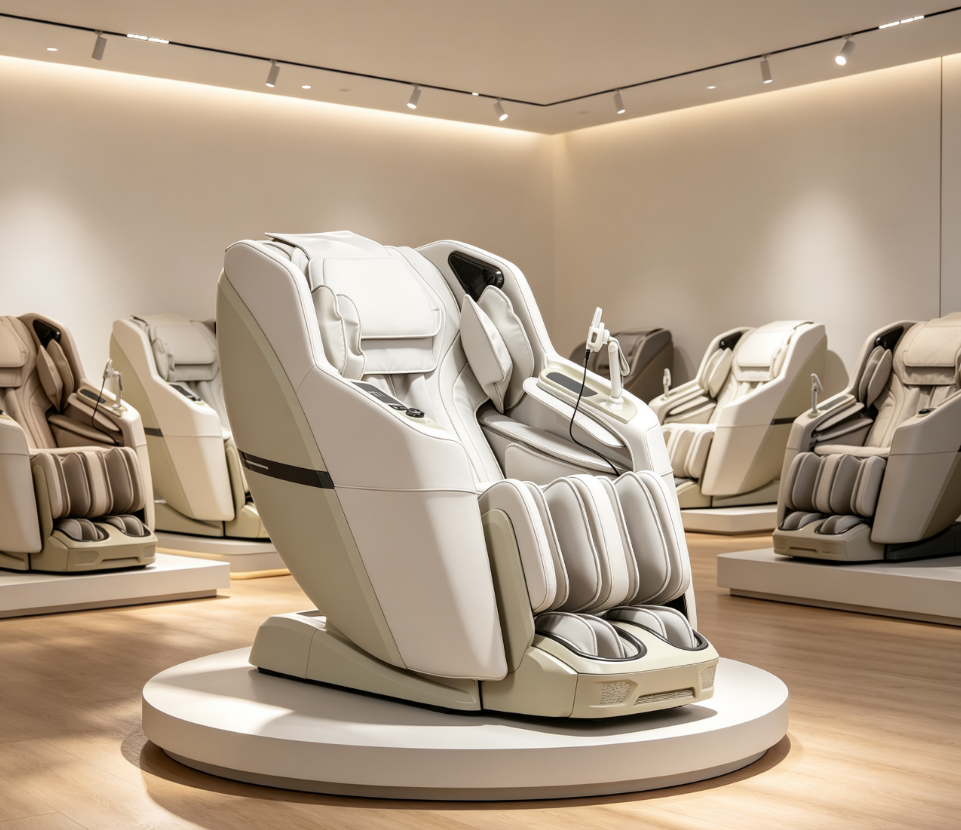
A 3D massage chair in a retailer showroom, where display experience directly supports sales conversion.
In documented project cases, ZHOUQI 3D massage chairs have been supplied to Vietnam for about four years with cumulative volume of approximately 70,000 units, and to the United States for about three years with cumulative volume of approximately 20,000 units. The application channels include massage chair showrooms, 4S showrooms, furniture and appliance malls, e-commerce sellers, hotels, resorts, wellness institutions, and senior-care institutions. The reported project feedback highlights a popular design, good quality, and a favorable price position.
Technical Capabilities That Support Scenario Adaptation
The adaptability of a 3D massage chair depends largely on its mechanism and supporting features. A typical 3D mechanism uses four massage balls and can simulate techniques such as kneading, tapping, rolling, shiatsu, combined kneading and tapping, and 4D-style in-and-out motion.
Using the ZHOUQI 3D massage chair series as a reference, the following technical capabilities support multi-scenario deployment:
- Long SL track (1350 mm double slide rail) — the roller mechanism travels from the neck area down to the thigh area, reducing massage blind spots. For public settings with highly varied user heights, the longer stroke increases the chance of locating the correct massage point.
- Automatic body-type detection — the chair detects shoulder position through current induction and adjusts the massage zone accordingly. This function is especially useful in airports, malls, and other locations where users are not repeat visitors.
- Zero-gravity recline — the dual-slide-rail forward structure distributes body weight more evenly, reducing spinal and joint pressure while the muscles are massaged. The stable structure also contributes to durability in commercial use.
- Foot and calf massage — three rows of foot rollers, foot heating, long-leg airbags, and calf roller massage support lower-limb circulation for people who sit or stand for long hours.
- Waist heating — an enlarged waist heating area supports blood circulation and addresses common lower-back discomfort from prolonged sitting.
- Full-body air pressure massage — airbags wrap the shoulders, arms, and legs, adding a compression-based relaxation layer to the roller massage.
- Voice control — an integrated voice control module lowers the usage barrier for older adults or users unfamiliar with control panels.
- 7-inch touch controller plus shortcut buttons — dual-control operation provides both full program selection and quick-start convenience, which suits public environments.
- Bluetooth music and wireless charging — these features enhance the waiting or relaxation experience in hotels, airport lounges, and showrooms.
From an integration standpoint, the 3D massage chair needs no water or compressed air infrastructure. It only requires a power socket. The electrical specifications of the ZHOUQI 3D massage chair series are 110V-240V, 50/60Hz input, rated power 150W, and a 15-minute auto timer. The auto-timer function is particularly relevant for shared pay-per-use and public-area operation, because it prevents one user from occupying the chair for an extended period and reduces continuous motor load.
Installation and Project Preparation Considerations
During the project preparation phase, buyers should confirm several site conditions before placing an order.
Power supply. A 3D massage chair requires a correctly matched power socket. The plug type must match the local socket standard, and the voltage range must be compatible with the chair version. For export projects, this means confirming voltage, plug, and applicable certification early in the process.
Electrical safety. The product manual typically contains a safety warning page. Correct grounding, matching plugs, and avoiding unauthorized modification of the electrical system are the basic requirements for safe installation. Incorrect grounding can create an electric shock risk, so the site power environment should be checked before installation.
Space and delivery. Using the ZHOUQI 3D chair as a dimension reference: upright size is approximately 1590 mm (L) x 800 mm (W) x 1160 mm (H); reclined size is approximately 1895 mm (L) x 800 mm (W) x 940 mm (H); and box size is approximately 1950 mm x 810 mm x 880 mm. Net weight / gross weight is approximately 111 kg / 135 kg. Buyers should evaluate elevator capacity, door width, corridor width, and floor load-bearing capacity before finalizing the model.
Maintenance support. Commercial massage chairs require periodic cleaning, inspection, and occasional repairs. The availability of installation videos, maintenance manuals, and replacement parts directly affects operating cost. ZHOUQI includes a one-year warranty and supplies installation videos and a maintenance manual with the product.
Market Trends: Commercial and Institutional Demand Is Expanding
Several publicly available market reports help frame the growth of massage chair deployment beyond the home segment:
- The global massage equipment market was valued at approximately USD 11.6 billion in 2024 and is projected to reach USD 21.8 billion by 2033 (Grand View Research).
- The global massage chair market is projected to grow from USD 4.28 billion in 2026 to USD 8.78 billion by 2035 at a CAGR of 8.3% (Business Research Insights).
- Massage chairs and sofas held the largest share of the massage equipment market at 39.5% in 2024 (Grand View Research).
- North America led the massage equipment market with a revenue share of 36.9% in 2024, while Asia Pacific was the fastest-growing region and held a 34.8% share of the luxury massage chair segment in 2024 (Grand View Research; Credence Research).
- The smart massage chair market is expected to reach USD 14.2 billion by 2033, driven by AI-powered body scanning and smart connectivity (Dataintelo). Around 41% of new massage chair models in 2026 are expected to integrate AI-based sensors for body scanning (Business Research Insights).
These data points point to a common observation: massage chairs are moving from a single-home durable product toward a functional facility in commercial spaces, wellness programs, and institutional care settings. For project buyers, this means the supply chain must handle not only product quality but also customization speed, production cycle, export compliance, and post-installation support.
3D Massage Chairs vs. Traditional Alternatives: Fit and Boundaries
During evaluation, buyers often compare 3D massage chairs with traditional basic massage chairs. The main differences are as follows:
| Comparison Dimension | Traditional Basic Massage Chair | 3D Massage Chair |
|---|---|---|
| Mechanism | Fixed rollers or 2D plane motion | 3D mechanism with forward-backward depth control |
| Massage coverage | Mainly upper back and lumbar area | Long SL track extends coverage from neck to thigh |
| Adaptation to body types | Limited, depends on fixed programs | Automatic body detection plus adjustable depth |
| Suitable scenarios | Low-intensity home use or budget-limited projects | Commercial, shared, wellness, and corporate projects |
| Cost and maintenance | Lower purchase cost, simpler structure | Higher purchase and maintenance cost, stricter power and installation requirements |
It should be noted that a 3D massage chair is not the right choice for every project. For low-intensity spaces that simply need a basic relaxation function, a traditional model may offer a better cost-to-value ratio. According to Fortune Business Insights, traditional and robotic-hybrid massage chairs still hold a significant share of the market because of lower cost barriers compared with full 4D AI models. Buyers should also distinguish 3D from 4D chairs. A 4D mechanism adds more advanced control over massage speed and rhythm, which is generally used in higher-end brand projects. For most commercial and institutional applications, the 3D category provides a practical balance between massage performance and procurement cost.
Future Outlook: From Product Purchase to Scenario Operation
As smart functions such as AI body scanning, voice control, and health data integration become more common, the applicability of 3D and higher-tier massage chairs in public and institutional settings will continue to grow. Project purchasing is expected to shift from a single-product transaction to a scenario-operation decision. Manufacturers that offer a broad model portfolio, responsive OEM/ODM service, consistent quality control, and export compliance will be better positioned to support these projects. For ZHOUQI, the mix of 3D massage chair models, in-house production, and documented multi-market deployment already provides one reference point for buyers evaluating supplier fit.
FAQ
Q: Which industries and applications commonly use 3D massage chairs?
A: According to manufacturer application data, 3D massage chairs are used in the massage equipment industry and are suitable for the health and wellness equipment sector. Their scope covers the home furniture industry, cultural-tourism and hospitality, wellness and beauty, healthcare, corporate offices, real estate and property management, transportation, retail and entertainment, public-service venues, automobile 4S showrooms, and bank VIP lounges.
Q: In which environments can a 3D massage chair be deployed?
A: A 3D massage chair is designed for indoor installation. Typical deployment environments include shopping malls, railway stations, airports, offices, and spa houses. The space must be kept dry, and the chair should not be placed in outdoor, damp, or high-humidity areas.
Q: Which project models are suitable for 3D massage chair deployment?
A: The main project models include distribution and retail projects, commercial supporting-engineering projects, senior-care and wellness engineering projects, corporate wellness lounge projects, real-estate supporting projects, shared pay-per-use operation projects, ODM custom-development projects, overseas export projects, and group procurement and gift projects.
Q: What infrastructure is needed to install a 3D massage chair?
A: The essential requirement is a matching power socket. The plug type must match the local socket standard, and the voltage should suit the chair model. The ZHOUQI 3D massage chair series accepts 110V-240V, 50/60Hz input, which supports use across different national power grids.
Q: Are there special safety requirements for using a 3D massage chair?
A: The main requirements are to follow the safety precautions in the manual, ensure correct grounding, use a matching plug, and avoid unauthorized modification of the electrical structure. Incorrect grounding may cause electric shock, so the installation environment should be checked by qualified personnel.
Q: Which facilities and institutions have already deployed 3D massage chairs?
A: Documented applications include hotels, resorts, wellness institutions, and senior-care institutions. The product is used to release muscle stiffness and body fatigue, boost blood circulation, reduce physical pressure and discomfort, relax nerves, improve sleep, and relieve soreness from prolonged sitting. In regional validation cases, ZHOUQI supplied approximately 70,000 units to Vietnam over four years and approximately 20,000 units to the United States over three years, covering showrooms, e-commerce, hotels, and care-related channels.
For buyers who need more detailed specifications and company background during evaluation, the manufacturer's 2026 e-catalogue is available at: 2026 E-catalogue (PDF).