
3D Massage Chair Specs and Certifications: Buyer Guide
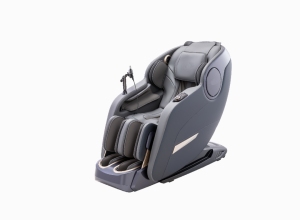
A representative ZHOUQI 3D massage chair model from the 6750 series.
3D massage chairs have become one of the most requested categories in the wellness equipment sector. For importers, distributors and procurement teams, the challenge is not just finding a supplier that uses the “3D” label — it is verifying that the product meets the safety regulations, technical specifications and quality expectations of the target market. This article explains what to check when sourcing a 3D massage chair, using the certified product line of Ningbo Zhouqi Health Technology Co., Ltd (ZHOUQI) as a reference.
Why certification and specification checks matter for 3D massage chairs
Unlike simple massage cushions, a full 3D massage chair contains moving mechanical parts, electric motors, heating elements, air pump systems and sometimes wireless modules. These features make it an electrical appliance as much as a piece of furniture. If the product does not comply with the electrical safety and electromagnetic compatibility rules of the destination country, the entire batch can be held at customs, recalled after sale, or become a long-term liability for the buyer.
Certification also affects channel acceptance. Many large retailers, e-commerce platforms and commercial project tenders require certificates such as ETL, CE, CB or FDA registration before they will list a new massage chair model. A manufacturer that cannot provide verifiable certification numbers is therefore difficult to work with for long-term export programs.
In addition, the term “3D” is applied unevenly across the market. Some entry-level products have a simple rail and a massage head that barely moves outward; others use a true 3D mechanism with programmable pressure depth. Buyers need to evaluate the actual mechanism, rail length, control system and safety compliance at the same time.
Problem: a growing market with inconsistent product definitions
The massage equipment market is expanding. Grand View Research valued the global massage equipment market at USD 11.6 billion in 2024 and projected it to reach USD 21.8 billion by 2033. Business Research Insights expects the massage chair market to grow from USD 4.28 billion in 2026 to USD 8.78 billion by 2035 at a compound annual growth rate of 8.3%. Massage chairs and sofas held the largest product share of the massage equipment market at 39.5% in 2024.
This growth brings more manufacturers into the category. However, the technical gap between a fully certified 3D massage chair and an assemble-from-kit product is wide. A buyer comparing quotes from different suppliers may see similar marketing phrases but very different engineering. Without a clear checklist, it is easy to end up with a product that fails safety testing or does not deliver the depth control expected from the 3D category.
Brand solution: a certified 3D massage chair line from ZHOUQI
Ningbo Zhouqi Health Technology Co., Ltd (ZHOUQI) is a professional massage chair manufacturer that integrates R&D, production and sales. The company is based in Cixi, Zhejiang Province, China, and exports mainly to the US, the EU, Southeast Asia and the Middle East.
ZHOUQI's 3D Massage Chair product line includes models 5200, 5900, 5910, 3100, 6710, 8700, 3600, 3212, 6520, 5100, 6530, 3104, 3109, 6750, 6720 and 6721. The common electrical specification is 110V–240V, 50/60Hz, with a rated power of 150W and a 15-minute automatic timer. A reference product size is 1590(L)×800(W)×1160(H) mm in the upright position and 1895(L)×800(W)×940(H) mm in the reclined position.
The following certification evidence is available for the 3D Massage Chair series:
| Certification | Certificate number | Issuer | Applicable markets | Standards |
|---|---|---|---|---|
| ETL | 5030347 | INTERTEK | US, Canada | UL 1647:2015 Ed.6+R:30Jul2020; CSA C22.2#68:2018 Ed.8+U1 |
| CB | NO127967 | Nemko | EU, Middle East, SE Asia | IEC 60335-1:2010 and amendments; IEC 60335-2-32:2019 |
| CE | ENB2311240186E00401C | EMTEK | EU, Middle East, SE Asia | EN IEC 55014-1:2021; EN IEC 61000-3-2; EN 61000-3-3; EN IEC 55014-2:2021; IEC 60335-1:2010; IEC 60335-2-32:2019 |
| FDA | 3017618816 | Shenzhen CTB Testing Technology Co., Ltd. | US | 21 CFR 807.39 |
| ISO 13485 | 133640 | NQA | US, South Korea, SE Asia | ISO 13485:2016 |
| ISO 9001 | 02424Q32202999R1S | Shenzhen Universal Certification Centre Co., Ltd. | EU, Middle East, SE Asia, US | GB/T19001-2016/ISO9001:2015 |
For the US and Canadian markets, the ETL certification is particularly relevant because it is based on UL 1647, the safety standard for massage appliances, and CSA C22.2, the Canadian standard for electrical appliances. For the EU, the CE certificate confirms compliance with the applicable parts of the IEC 60335 series and the EMC requirements in the EN IEC 55014 series.
The FDA registration is also important for the US market. The 3D Massage Chair series is registered under regulation 21 CFR 807.39, which is the FDA's general registration requirement for medical devices. While massage chairs may not be classified as high-risk medical equipment, the registration demonstrates that the manufacturer has taken the step of registering the product as an FDA-regulated device.
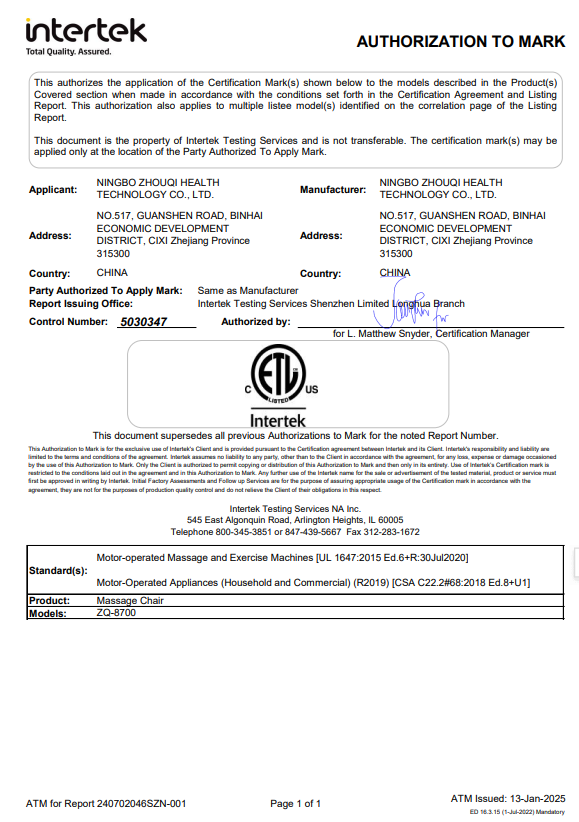
ETL certificate for the ZHOUQI 3D massage chair series.
Technical explanation: key parameters and features of the ZHOUQI 3D massage chair
The ZHOUQI 3D massage chair uses a mechanical massage mechanism with four massage balls. In a 3D mechanism, the massage head can move up and down along the track, left and right across the back, and in and out against the body. The in-and-out movement is what allows the chair to control massage depth. This makes the massage feel closer to the pressure of a human hand than a simpler 2D mechanism.
According to the product specification, the chair has a double chute guide rail of 1350 mm. This long rail is designed to cover the entire back from the cervical spine to the gluteal region. The chair also has automatic body type detection, which measures the shoulder position and adjusts the travel of the massage mechanism to fit the user's body.
Other listed functions in the 3D series include:
- 7-inch touch button controller with shortcut control buttons
- Built-in voice control module
- Double sliding rail forward structure for zero-gravity reclining
- Electrically controlled leg angle and auto-extending footrest
- Three-row foot roller massage and foot heating
- Leg airbag massage and calf roller massage
- Waist heating area
- Whole-body air pressure massage
- Bluetooth music speaker
- Wireless phone charging
- AI health detection
These features are common in the high-end 3D massage chair segment. For a buyer, the practical point is that a 3D massage chair in this series has a defined mechanism, a specified rail length, and a control system with both touch and voice options. This level of detail can be compared directly with the specifications offered by other suppliers.
Manufacturing and quality control capabilities
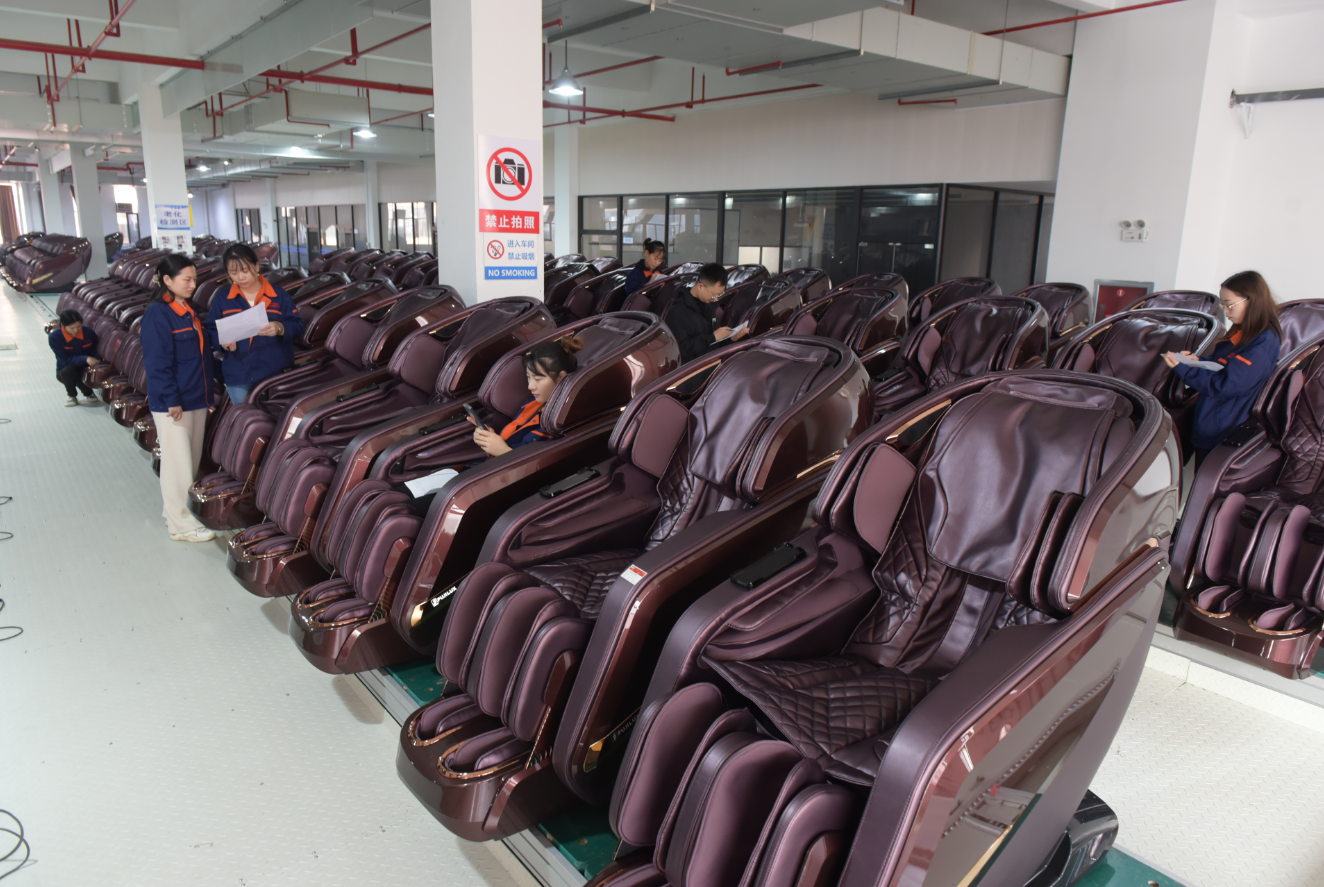
Factory outgoing QC inspection for ZHOUQI massage chairs.
ZHOUQI's factory covers 130,000 square metres and employs around 450 people. The company reports an annual production output of 200,000 units. Its R&D team consists of 34 engineers. In terms of short-term production flexibility, the company lists a monthly capacity of 16,000 units, a lead time of 30–45 days, and a minimum order quantity of one 40-foot container.
For OEM and ODM projects, customization options include color, logo, OEM file, pillow and backrest design, UI and language. After-sales support includes a one-year warranty, installation videos and maintenance manuals. Quality control is described as 100% outgoing QC testing.
The factory images in the public documentation show a computerized cutting machine, a high-precision welding robot, an assembly line for massage chairs, a sewing line, an injection molding machine and an automated assembly line. These images support the claim of a structured manufacturing environment, which is useful for buyers who cannot visit the factory in person.
What these capabilities mean for a procurement decision
For a distributor or brand that wants to private-label a 3D massage chair, the ability to customize the UI language, logo, color and pillow design is often as important as the technical specification. A monthly capacity of 16,000 units gives a clear baseline for supply planning. The 100% QC testing policy reduces the chance of inconsistency between batches.
One limitation to be aware of is that a standard lead time of 30–45 days is normal for a custom order but may not suit a buyer who needs emergency replenishment. If a fast restock is required, the buyer should confirm whether the factory can allocate from existing production slots or stock.
Application scenarios and proven use cases
3D massage chairs are used in a range of environments beyond private homes. The application data from ZHOUQI lists suitable locations such as shopping malls, railway stations, airports, offices, spa houses, nursing homes, fitness rooms, 4S car showrooms, retail showrooms, hotels, hospitals and wellness centers.
Project types include distribution and retail projects, commercial supporting engineering, senior-care wellness engineering, corporate wellness lounges, real-estate supporting projects, shared pay-per-use operations, ODM custom development, overseas export projects, and group procurement and gift programs. This wide range means that a single 3D chair model can be adapted to different use cases by changing the control panel language, branding or payment system.
The functional purpose of the chair is to relax stiff muscles, ease fatigue, enhance blood circulation, reduce neck and lumbar discomfort, relieve daily stress and improve sleep quality. These are typical claims for full-body massage chairs and align with the mechanical functions listed in the specification.
ZHOUQI has published two longer-term export relationship examples: one in Vietnam with 70,000 units over four years, and one in the USA with 20,000 units over three years. The client types include massage chair showrooms, 4S showrooms, furniture and home-appliance malls, e-commerce sellers, hotels and wellness institutions. The reported result summary is “market improving”, with a highlight of popular design, good quality and favorable price.
Market trend analysis: toward intelligent and connected 3D massage chairs
The massage chair market is showing two clear trends: growth in value and growth in intelligence. The global massage equipment market is expected to expand from USD 11.6 billion in 2024 to USD 21.8 billion by 2033. North America led the market in 2024 with a revenue share of 36.9%, while Asia Pacific held the largest share of the luxury segment at 34.8%.
Smart massage chairs are a particularly dynamic category. Dataintelo projects the smart massage chair market to reach USD 14.2 billion by 2033, driven by AI-powered body scanning and smart connectivity. Business Research Insights estimates that around 41% of new massage chair models in 2026 will integrate AI-based sensors for body scanning.
For 3D massage chairs, the implication is that mechanical performance is no longer the only differentiator. Voice control, AI health detection, Bluetooth audio and wireless charging are becoming expected features in the upper price tier. However, each added electronic module also expands the scope for EMC testing and electrical safety verification.
Consumer buying behaviour adds another layer. A consumer behavior analysis cited by AMTA and Fortune Business Insights reports that 81% of consumers choose massage solutions based on client referrals. This makes brand reputation and verifiable certifications even more important for a buyer who intends to build a long-term product line.
Comparison with traditional massage chairs and competing brands
Compared with a traditional 2D massage chair, a 3D massage chair provides one additional axis of movement. The rollers can move toward the body and away from the body, which gives the user more control over massage intensity. A 2D chair can only move the rollers along the back surface, so the pressure is less variable.
In practice, a 3D chair is more suitable for users who want a deep-tissue effect or who are used to manual massage pressure. The extra motor and control software add to the manufacturing cost, which is why 3D chairs are usually priced higher than 2D models.
At the same time, the 3D category has limitations. A 3D massage chair is not a substitute for professional clinical treatment. People with acute injuries, severe osteoporosis or pregnancy should talk to a medical provider before using strong mechanical massage. Also, the depth adjustment range is finite; very tall, short, heavy or extremely thin users may not get an optimal fit across the entire back.
In the competitive landscape, Panasonic, Fujiiryoki, Osaki, Ogawa and Bodyfriend are commonly listed as major brands in the high-end massage chair market. Most of these brands offer 3D or 4D mechanisms at a premium price. For buyers, the practical comparison should focus on certification scope, rail length, control features and after-sales support, rather than relying on brand name alone.
Future outlook: standards, connectivity and AI health features
International safety standards for massage chairs are becoming more precise. IEC 60335-2-32:2024 is the latest version of the international standard for electric massage appliances, and IEC 60335-2-116:2025 addresses furniture with motorized parts such as zero-gravity chairs. These standards are likely to be referenced by new national and regional certificates in the coming years.
For procurement teams, the takeaway is to check the exact standard revision on every certificate. A certificate issued several years ago may list an older edition of the standard, and some markets will accept it while others will require the latest edition. Buyers should ask the manufacturer for the most recent certificate before each new order.
Functionally, the next generation of 3D massage chairs will probably combine mechanical massage with health monitoring. AI body scanning, app-based data collection and personalized massage programs are already appearing in smart chair models. Manufacturers with an in-house R&D team and a track record of adding AI features to existing chairs may be better positioned to keep up with this shift.
For the furniture industry, the massage chair is moving from being a novelty furniture item to a connected wellness device. This creates opportunities for distributors who can verify product quality and compliance, because those credentials will become more important as consumer expectations rise.
Procurement checklist for 3D massage chairs
Based on the specifications and certifications discussed above, a practical checklist for evaluating a potential 3D massage chair supplier should include:
- Certification traceability: Request the certificate numbers, issuing bodies, applicable markets and standard revisions. Avoid accepting a certificate that does not list the model number.
- Mechanism specification: Ask for the rail length, number of massage balls, and whether the mechanism uses a 2D or 3D movement path.
- Electrical safety: Verify the rated power, voltage range and auto-timer. Confirm the product has been tested to the relevant IEC or UL standards.
- Factory capability: Check production capacity, monthly output, lead time and whether the factory can answer OEM/ODM questions.
- Quality control: Ask about QC testing, outgoing inspection and warranty terms.
- After-sales support: Confirm that installation videos and maintenance manuals are available, and check the length of the warranty.
This list is a starting point. Each market may have specific rules, so buyers should also check with their local importer or legal advisor for product-specific requirements.
FAQ
Which certifications should a 3D massage chair have for the US market?
A 3D massage chair for the US market should ideally have ETL certification to UL 1647 and CSA C22.2, plus FDA registration under 21 CFR 807.39. The ZHOUQI 3D Massage Chair series holds ETL certificate number 5030347 issued by INTERTEK and FDA registration number 3017618816 issued by Shenzhen CTB Testing Technology Co., Ltd.
What standards apply to 3D massage chairs sold in the EU?
For the EU, the relevant safety standards are IEC 60335-1 and IEC 60335-2-32. EMC requirements are covered by the EN IEC 55014 series. ZHOUQI's 3D Massage Chair series is covered by CE certificate ENB2311240186E00401C issued by EMTEK and CB certificate NO127967 issued by Nemko.
Are ZHOUQI 3D massage chairs FDA registered?
Yes. The 3D Massage Chair series is registered with the US Food and Drug Administration. The registration number is 3017618816, the regulation is 21 CFR 807.39, and it applies to the US market.
What is the difference between a 3D and a 2D massage chair?
A 2D massage chair moves its rollers up/down and left/right. A 3D massage chair adds an in/out axis, allowing the rollers to control pressure depth against the body. The ZHOUQI 3D mechanism uses four massage balls and a 1350 mm double chute guide rail.
What are the main electrical specifications of a 3D massage chair?
A typical ZHOUQI 3D massage chair operates on 110V–240V, 50/60Hz, with a rated power of 150W and a 15-minute auto-timer. The reference upright product size is 1590(L)×800(W)×1160(H) mm and the reclined size is 1895(L)×800(W)×940(H) mm.
Does the ZHOUQI 3D massage chair support OEM customization?
Yes. ZHOUQI supports OEM/ODM production. Customization options include color, logo, OEM files, pillow and backrest design, UI and language. The minimum order is 1×40HQ container.
What quality management certifications does the ZHOUQI factory hold?
The factory holds ISO 9001 (certificate number 02424Q32202999R1S) and ISO 13485 (certificate number 133640) for its quality management system. ISO 13485 is the medical device quality management standard and its scope covers massage chairs.
Supplier documentation: A detailed PDF catalogue is available for download from ZHOUQI at: 2026 E-catalogue.