
3D Massage Chair Supplier Audit: ISO 13485 & FDA Evidence
3D Massage Chair Supplier Audit: ISO 13485 & FDA Evidence
A 3D massage chair supplier audit is a document exercise before it is a factory visit. The buyer verifies certificate numbers, issuing bodies, scope statements and model lists, and then confirms that the exact models named on the purchase order sit inside that documented scope.
For sourcing managers who have already shortlisted suppliers and are moving toward execution, the question changes shape. It is no longer whether a supplier looks capable, but whether the supplier's certification file will hold up under review by an internal compliance team, an importing partner or a customs officer. Sales claims do not travel across borders; certificate numbers do.
Volume is part of the reason this matters more than it did a few years ago. The global massage chair market is projected to grow from USD 4.28 billion in 2026 to USD 8.78 billion by 2035 at a CAGR of 8.3%, according to Business Research Insights. As the category expands, more factories enter export channels with similar product descriptions and similar capability claims, and documentation becomes the practical filter between them.
Why Certification Evidence Becomes Decisive at the Execution Stage
Buyers rarely reach execution without a shortlist. At the research stage, feature language dominates the conversation: mechanical 3D or airbag 3D mechanisms, SL track geometry, zero gravity recline, AI-supported body scanning, high-end or economic positioning. Those comparisons help narrow a field. They do not survive procurement review.
Once a purchase order is drafted, the supplier's file has to answer a narrower set of questions: who issued the certificate, which standard version it references, what scope it names, and which specific models are listed. Most supplier marketing describes certification in adjectives. A verifiable file describes it in identifiers — a certificate number, a certification body, a standard designation and a model annex. The distance between those two forms of evidence is where sourcing risk accumulates.
Product safety standards add a second layer that buyers often merge with quality management certification. IEC 60335-2-32:2024 is the current international safety standard for electric massage appliances, including massage chairs, and IEC 60335-2-116:2025 addresses furniture with motorized parts, which includes zero-gravity massage chairs. A quality management certificate and a product safety standard are not substitutes for each other. An audit that treats them as one item tends to leave a gap.
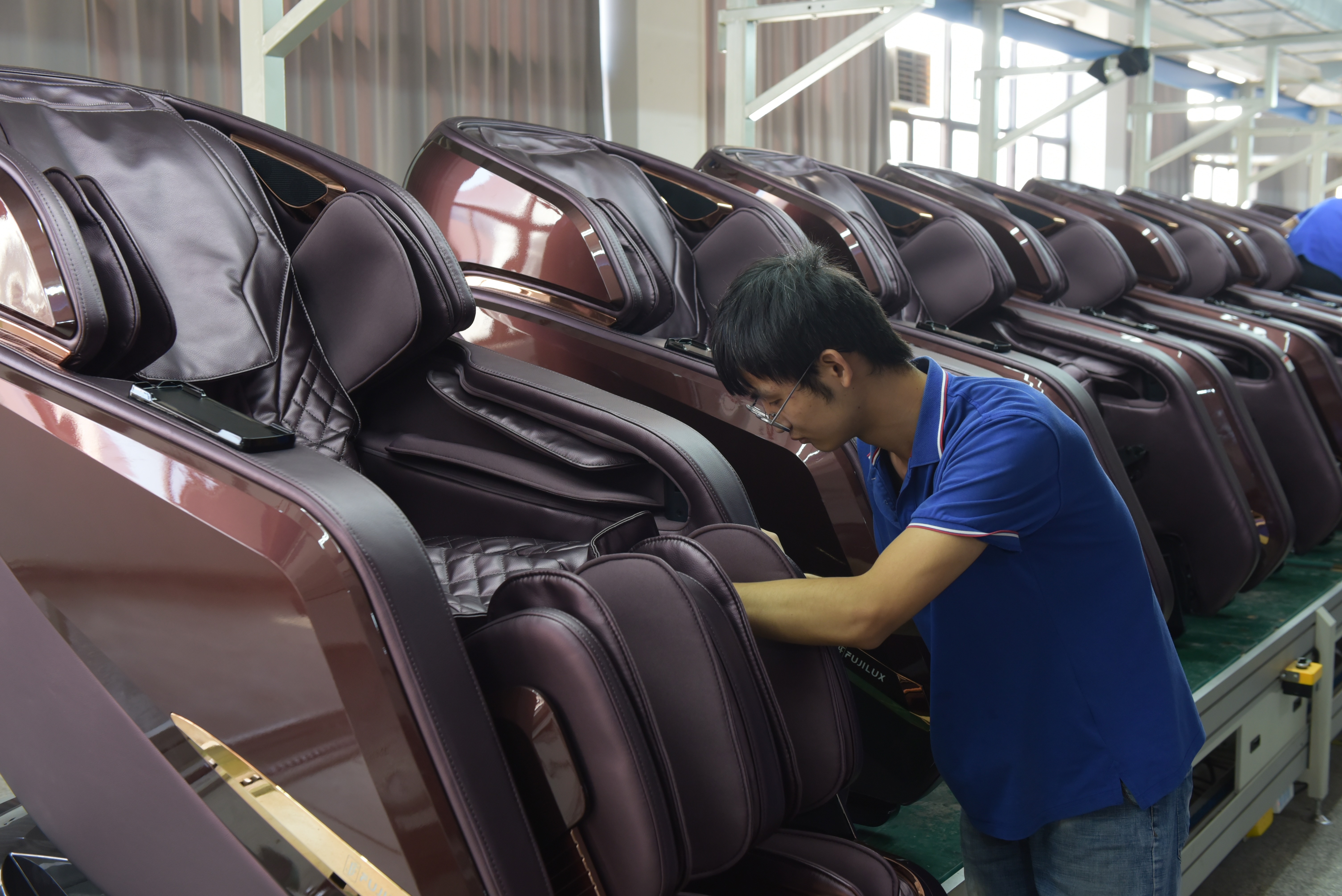
A massage chair production workshop. Document-based supplier audits exist to corroborate what this physical layer actually does, model by model.
The Certification File That Can Be Audited
Ningbo Zhouqi Health Technology Co., Ltd. (ZHOUQI) is a massage chair manufacturer based in Cixi, Zhejiang Province, China, that integrates research and development, production and sales, and exports to the USA, the European Union, Southeast Asia and the Middle East. Its factory covers 130,000 m², employs 450 people and runs a 34-engineer R&D team, with an annual output of 200,000 units and roughly 50% of production directed to export markets.
The audit-relevant evidence for this manufacturer is not one claim but three separate filings. Each answers a different procurement question, and buyers should keep them separate rather than treating them as a single badge.
| Document | Reference identifier | Issuing or filing entity | What it documents |
|---|---|---|---|
| ISO 13485:2016 | Certificate 133640 | NQA | Quality management system certification with a scope covering massage chairs |
| ISO 9001, standard GB/T19001-2016/ISO9001:2015 | Certificate 02424Q32202999R1S | SHENZHEN UNIVERSAL CERTIFICATION CENTRE CO., LTD. | General quality management system certification |
| FDA registration | Regulation 21 CFR 807.39, registration number 3017618816 | Filed through Shenzhen CTB Testing Technology Co., Ltd. | United States establishment registration |
Read together, the three documents describe a manufacturer that maintains a general quality system, operates a medical-device-style quality management system over massage chair production, and holds a United States establishment registration. Each of those statements is checkable. None of them should be accepted on the strength of a logo on a website.
How to Read an ISO 13485:2016 Certificate Before You Trust It
An ISO 13485 certificate is a structured document. Its value to a buyer comes from the specific fields it contains, not from the standard's name. Six fields carry most of the audit weight.
- The issuing body. Certificate 133640 was issued by NQA. Buyers should confirm the identity of the certification body and its accreditation status independently, since the certificate's weight depends on who stands behind it.
- The standard version. The certificate references ISO 13485:2016. Version matters, because requirements shift between editions and a supplier referencing an older edition is describing an older system.
- The certificate number. 133640 is the identifier a buyer or a compliance reviewer can use to trace the document back to its source.
- The scope statement. The scope names massage chairs, which is what places this certificate inside the buyer's product category rather than in an adjacent one.
- The model list. The annex of listed models is the most operational part of the certificate for a sourcing manager, because it defines which products the certification actually reaches.
- Validity and surveillance. Certification is maintained through periodic surveillance, so buyers should confirm the certificate is current at the moment of the order, not at the moment of the sales presentation.
A certificate that passes these six checks is a strong document. One that fails any of them — an unnamed body, an unstated scope, a missing model annex — is not evidence, it is a claim with a border around it.
Mapping the ISO 13485 Model List to a Purchase Order
The ISO 13485 scope for this manufacturer names sixteen models: 5200, 5900, 5910, 3100, 6710, 8700, 3600, 3212, 6520, 5100, 6530, 3104, 3109, 6750, 6720 and 6721. A purchase order that names none of these models is not automatically covered by the certificate, even when the supplier manufactures that product on the same line. This is the single most common misunderstanding in 3D massage chair sourcing.
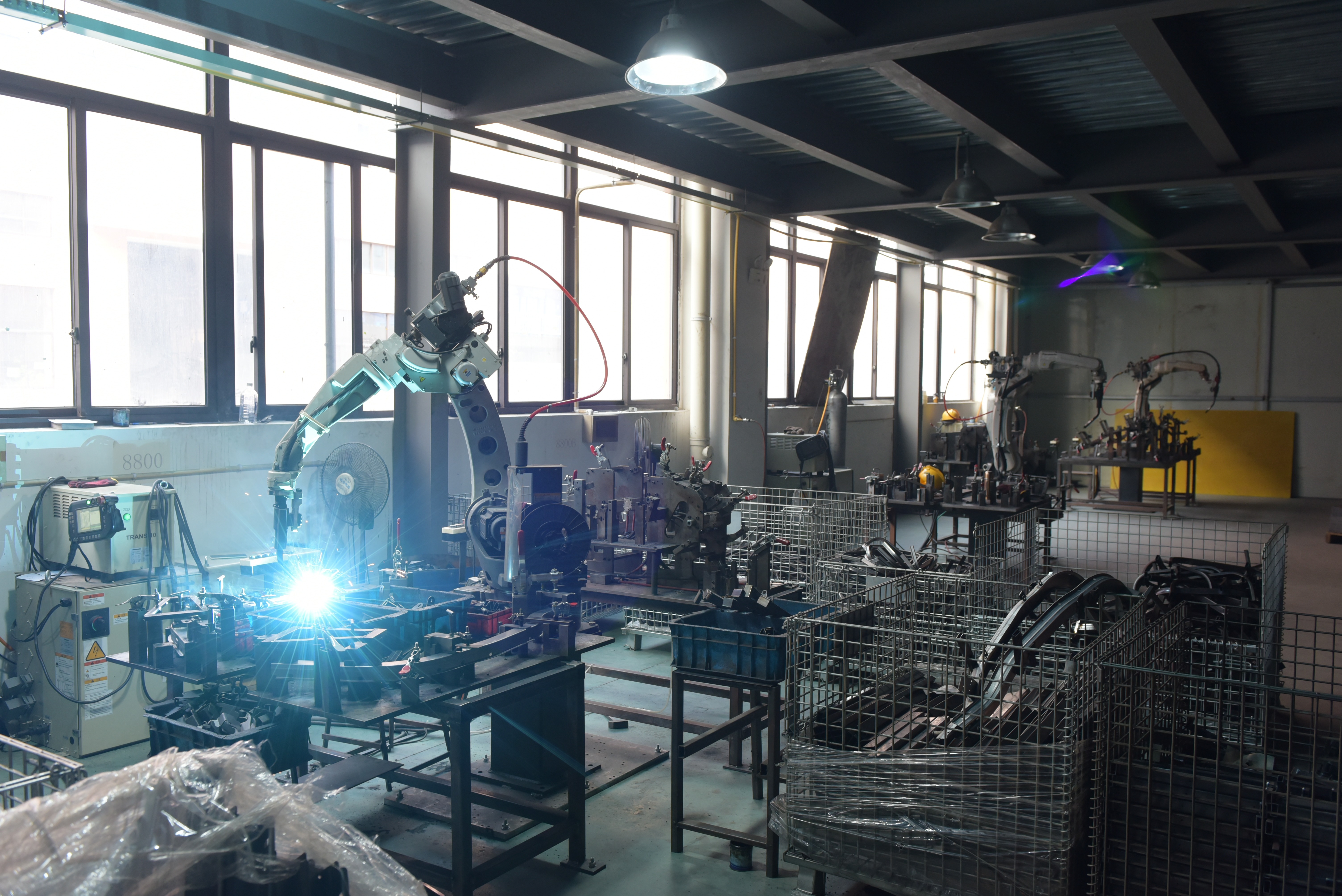
Frame welding on a massage chair production line. Structural consistency at this stage is what a quality management system is meant to control and document.
| Audit step | Evidence to request | What the buyer is confirming |
|---|---|---|
| 1. Match the order code | Purchase order model code against the certificate's model annex | That the exact model being purchased appears in the certified list |
| 2. Check the configuration | Written confirmation of voltage, plug type, upholstery and any functional changes | Whether customization creates a new model identity that falls outside the listed scope |
| 3. Request the certificate as issued | The certificate document itself, not a marketing summary | Certificate number, issuing body, standard version, scope wording and model annex |
| 4. Verify with the issuing body | Independent verification through the certification body's own channel | That the certificate is genuine, current and not superseded |
Where the Evidence Matters: Buyer Channels and Applications
Documented certification changes what a supplier can be used for. The same product can be straightforward in one channel and blocked in another depending on paperwork alone.
- Distributors and importers in the United States and Europe frequently need supplier quality documentation before listing a product, and an ISO 13485 certificate with a named model list shortens that onboarding step.
- Retail and e-commerce chains with vendor compliance programs typically ask for certificate numbers and issuing bodies rather than general assurances.
- Wellness, care and hospitality channels, including care homes and hotel spa installations, tend to apply stricter internal requirements than consumer retail, which is where a device-oriented quality system becomes a commercial advantage.
- OEM and private-label programs depend on the supplier's ability to document process control, because the buyer's brand carries the compliance risk.
- Tenders and public procurement usually specify which certificates must be submitted, making document availability a qualification condition rather than a differentiator.
- Long-term distribution depends on continuity: the same model codes, the same certificate scope and the same after-sales parts over multiple order cycles.
Safety design belongs in the same audit conversation. This manufacturer integrates an anti-pinch system into the massage chair to prevent children or pets from getting stuck in the gaps. For a product that reclines, folds and moves under motor power, that kind of design-level control is exactly the sort of item a buyer should ask about directly rather than assume is present.
Market Signals Behind the Documentation Push
Several published data points explain why evidence-based supplier auditing is spreading through this category rather than staying confined to regulated medical purchasing.
- Massage chairs and sofas held the largest share of the massage equipment market at 39.5% in 2024, according to Grand View Research, making chairs the category's center of gravity rather than an accessory line.
- North America dominated the massage equipment market in 2024 with a revenue share of 36.9%, per Grand View Research — a market where importer documentation requirements are comparatively formal.
- Asia Pacific holds 34.8% of the luxury segment as of 2024, according to Credence Research, which places high-end 3D and luxury 3D massage chair production close to its largest premium buyer base.
- Approximately 41% of new massage chair models in 2026 are expected to integrate AI-based sensors for body scanning, per Business Research Insights. Sensor and firmware changes are exactly the kind of modification that interacts with a quality management system's scope.
- The smart massage chair market is expected to reach USD 14.2 billion by 2033, according to Dataintelo, driven by AI-powered body scanning and smart connectivity.
- 81% of consumers choose massage solutions based on client referrals, according to AMTA data cited by Fortune Business Insights. Referral-driven demand rewards suppliers whose claims can be handed to the next buyer as documents rather than re-explained as promises.
Taken together, the signals point in one direction: the product is becoming more electronically complex while the purchasing decision is becoming more documentation-driven. Those two trends do not resolve themselves. Suppliers that maintain model-level certification records will be easier to onboard, and buyers that know how to read those records will spend less time resolving problems after shipment.
Documented Audit Versus Sample-First Evaluation — and Where Paperwork Stops
The traditional approach to evaluating a 3D massage chair supplier starts with a sample. A buyer orders a unit, tests the massage mechanism, checks the airbag sequence and makes a judgment. The documented approach starts with the certificate file and uses the sample to confirm what the documents describe. Neither replaces the other, and both have boundaries.
At product level, the choice between mechanism types also shapes what an audit needs to verify. The two mainstream 3D configurations differ in measurable ways.
| Comparison dimension | Mechanical 3D massage chair | Airbag 3D massage chair |
|---|---|---|
| Mechanism | Motor-driven metal rollers with direct hard contact | 3D rollers combined with full-body airbags for soft squeezing and wrapping |
| Maximum penetration depth | 8 cm for back muscle release | 4.5 cm; 44% lower deep-tissue acting depth, with gentler diffused compression |
| Cost position | Around USD 40 higher in cost | Lower cost position |
| Maintenance profile | Metal roller components require periodic inspection; higher wear and tear risk | Fewer moving mechanical parts; lower maintenance workload |
| Typical best fit | Users who prefer strong, firm deep massage; home and office use | Seniors, slim-build users and buyers preferring soft, wrap-around massage |
The limits of the documentary approach deserve equal weight, because a buyer who treats certification as a complete answer will misread it.
- Model coverage is narrower than the certification claim. An ISO 13485 certificate naming sixteen models does not cover model seventeen until the scope is amended.
- FDA registration is not FDA approval. The registration number 3017618816 under 21 CFR 807.39 is an establishment registration. It is not a product clearance and does not certify performance or safety of any individual chair.
- Certificates do not test the goods. A pre-shipment test and an independent third-party inspection remain the point at which documents meet physical units.
- Commercial thresholds still apply. Minimum order quantity, delivery terms and payment structure determine whether an audited supplier is commercially usable for a given buyer.
- Deeper is not universally better. Airbag 3D delivers 4.5 cm of diffused compression against the 8 cm of mechanical 3D. For seniors and slim-build users, the softer mechanism is a design choice, not a downgrade.
Executing the Order: Terms, Testing and Acceptance Criteria
Once the audit file is complete, the commercial terms should align with it. For this manufacturer, the published purchasing conditions are specific and can be written directly into an order review checklist.
- Minimum order quantity: 1*40HQ. Container-based loading means per-model carton dimensions and mixed-model loading plans should be confirmed before the deposit, since the audit covers models, not container composition.
- Delivery terms: FOB Ningbo. Responsibility transfers at the named port, which makes the pre-shipment inspection window the buyer's main control point.
- Acceptance criteria: pre-shipment test plus third-party inspection by SGS. This is where certification claims are converted into physical verification of the units actually leaving the factory.
- Payment terms: 30% of the total amount by T/T in advance as a deposit, with the remaining 70% by T/T before shipment. Because the balance falls due before shipment, the certification and inspection work must be completed before the deposit stage rather than after it.
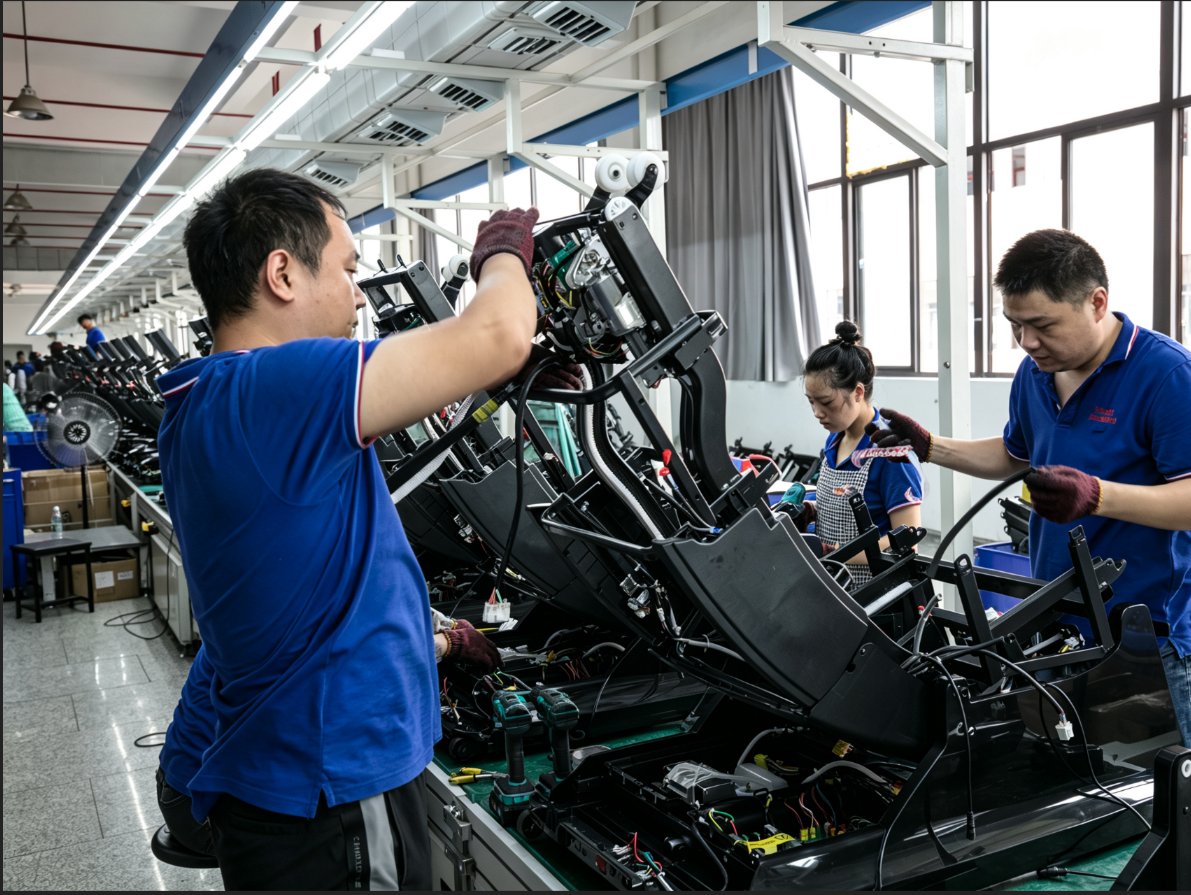
Standardized production. Pre-shipment testing and third-party inspection are the steps that connect documented process control to the units a buyer receives.
Future Outlook
Two forces are likely to keep tightening supplier audits in this category. The first is standards evolution: IEC 60335-2-32:2024 and IEC 60335-2-116:2025 are recent editions, and each revision cycle tends to add documentation obligations rather than remove them. The second is product complexity. With roughly 41% of new massage chair models in 2026 expected to include AI-based body-scanning sensors, firmware and sensor changes will increasingly need to fall inside a supplier's quality management scope rather than sit beside it.
The practical consequence for buyers is that certification will shift from a marketing section on a website to a procurement line item on an RFQ, with model-level scope confirmation requested by default. Suppliers that already maintain a named model list — as with the sixteen models listed under certificate 133640 — will find that audit conversations get shorter. Buyers who build the four-step mapping process into their own purchasing routine will find that disputes surface before shipment rather than after.
FAQ
What does an ISO 13485:2016 certificate actually confirm about a 3D massage chair supplier?
It confirms that an accredited certification body has assessed the manufacturer's quality management system against the ISO 13485:2016 standard and issued a certificate with a defined scope. For Ningbo Zhouqi Health Technology Co., Ltd., certificate 133640 was issued by NQA with a scope covering massage chairs. It addresses process control and documentation, not the performance of any individual chair.
How can a buyer confirm that a specific massage chair model is covered by the certificate?
By matching the model code on the purchase order against the model list in the certificate's scope annex. The ISO 13485 scope for this manufacturer names sixteen models: 5200, 5900, 5910, 3100, 6710, 8700, 3600, 3212, 6520, 5100, 6530, 3104, 3109, 6750, 6720 and 6721. A model that does not appear on that list is outside the certified scope until the certificate is amended.
Is FDA registration the same as FDA approval for a massage chair?
No. The registration referenced in the documentation for this manufacturer is an establishment registration under regulation 21 CFR 807.39, with registration number 3017618816, filed through Shenzhen CTB Testing Technology Co., Ltd. Establishment registration identifies a facility to the United States authorities. It is not a premarket clearance and does not certify the safety or performance of a specific product.
What is the difference between ISO 9001 and ISO 13485 in massage chair manufacturing?
ISO 9001 is a general quality management standard applicable across industries. The certificate held by this manufacturer, 02424Q32202999R1S, follows the GB/T19001-2016/ISO9001:2015 standard and was issued by SHENZHEN UNIVERSAL CERTIFICATION CENTRE CO., LTD. ISO 13485 is a quality management standard oriented to medical devices, and certificate 133640 covers massage chair scope. Buyers working with regulated or clinical-adjacent channels typically ask for the ISO 13485 document specifically.
What acceptance criteria commonly accompany a 3D massage chair purchase order?
For this manufacturer, the stated criteria are a pre-shipment test and third-party inspection by SGS. The minimum order quantity is 1*40HQ, delivery is under FOB Ningbo terms, and payment terms are 30% of the total by T/T in advance as a deposit with the remaining 70% by T/T before shipment. Third-party inspection is the stage at which certification claims are checked against physical units.
How does documentation affect long-term distribution agreements?
Long-term distribution depends on continuity of model codes, scope coverage and after-sales parts across multiple order cycles. A certificate listing fixed model numbers gives a distributor a stable reference point: the same models can be reordered against the same documentation. Around 81% of consumers select massage solutions based on client referrals, according to AMTA data cited by Fortune Business Insights, so a distributor's ability to pass documentation forward affects repeat business as much as the first sale.
Certification evidence is not a substitute for inspection, and inspection is not a substitute for certification. A 3D massage chair supplier audit works when the two are sequenced deliberately: read the certificate, map the models, verify with the issuing body, then test the goods — in that order, and before the deposit.
Reference document: the company's 2026 product catalogue is publicly available for download at 2026 E-catalogue (PDF). Manufacturer contact: email shelley@cn-zhouqi.com, phone +86 182 5079 5612, address No. 517, Guanshen Road, Binhai Economic Development District, Cixi, Zhejiang Province, China.