
3MW Containerized Gensets: MECCA POWER vs. Cummins, Caterpillar, Kohler
3MW Containerized Gensets: MECCA POWER vs. Cummins, Caterpillar, Kohler
For a 3MW project, the supplier question is rarely “who builds the biggest generator”. It is “which supplier can show documented evidence that it can engineer, assemble, test, containerize and support a 3MW package for this site”. Cummins, Caterpillar and Kohler are established manufacturers in the large-capacity generator set market and are the benchmark names against which MECCA POWER is assessed here. MECCA POWER CO.,LTD. is a China-based OEM/ODM manufacturer, founded in 2013 with a 34,000 m² manufacturing footprint, that lists a 3MW containerized diesel generator — the MC3750C — inside a containerized series running from MC1000 to MC4375.
This article applies one evidence framework to all four names. It sets out what a buyer should be able to see before awarding a 3MW containerized package, records what MECCA POWER documents about itself, and marks clearly where that documentation ends.
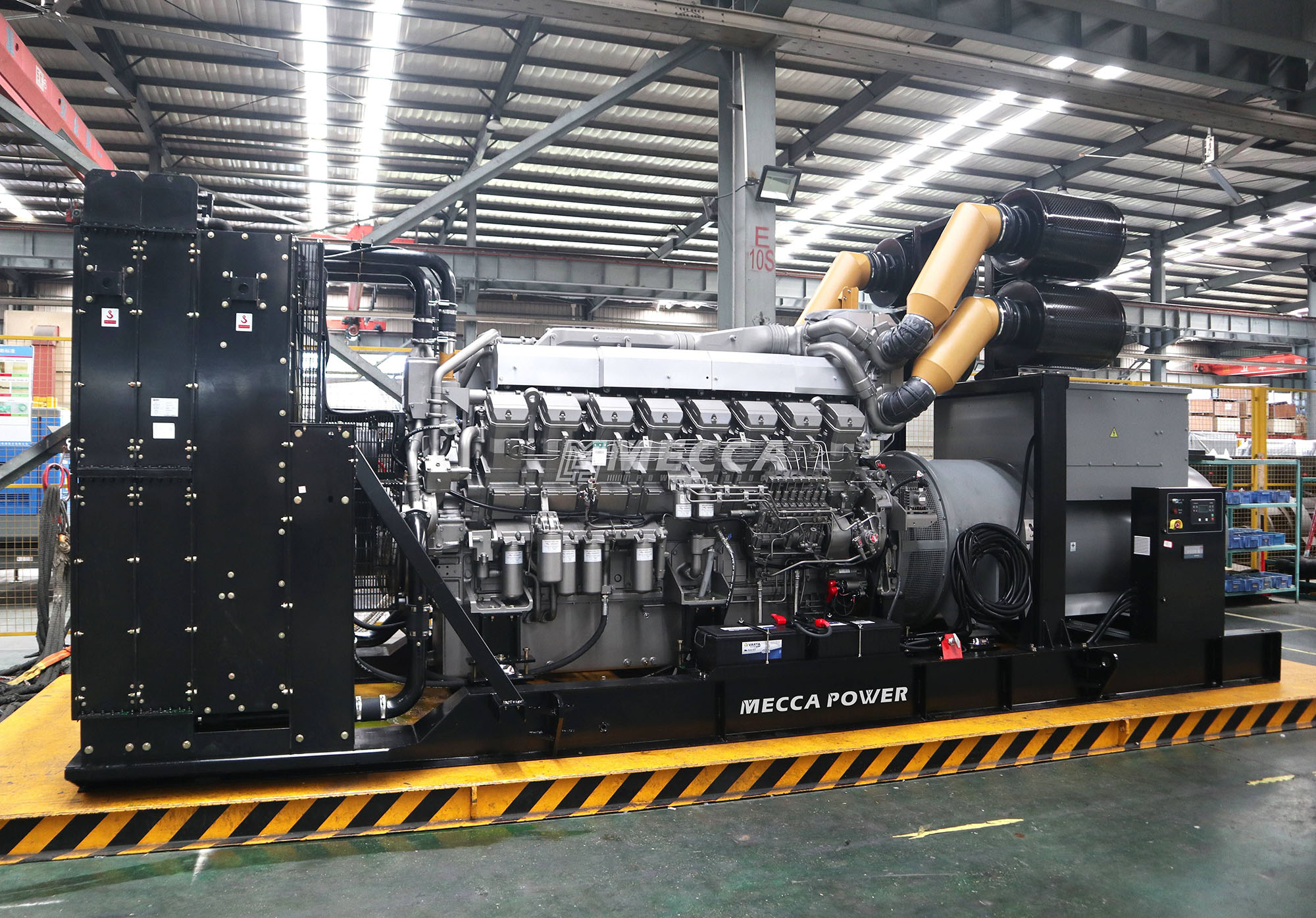
High-voltage generator sets in a data center application. Large-capacity projects are awarded on documented capability, not on nameplate figures alone.
Why the 3MW containerized class is a different capability test
A 3MW containerized diesel generator is not a scaled-up mid-range unit. At this rating the buyer is procuring a transportable power plant package: engine, alternator, container, cooling and ventilation, exhaust and silencing, fuel handling, control and protection, lifting and transport interfaces, and a commissioning scope. Each of those elements introduces its own failure mode, and each must be evidenced separately.
Three technical realities make the evidence burden heavier at 3MW than at 500 kW. The first is rating basis. ISO 8528-1:2018 defines classifications for the application, rating and performance of alternating-current generating sets driven by reciprocating internal-combustion engines, and covers continuous, peak-load and standby applications. A “3000 kW” figure quoted by one supplier and a “3000 kW” figure quoted by another are not comparable unless both state the same rating basis, the same ambient and altitude conditions, and the same power factor. Any tender that lists bare kW numbers without those qualifiers is inviting an apples-to-oranges bid comparison.
The second is the transport-and-install interface. A containerized package at this scale has to move, lift, land, connect and cool — and those constraints are resolved in the design office, not on site. The third is compliance. Certification is market-specific and, for the largest units, often engine-platform-specific, so a certificate that satisfies one destination does not automatically satisfy another.
The commercial context explains why buyers keep returning to this class of equipment. Commercial research cited in the industry data set for this article values the global diesel generator market at USD 22.33 billion in 2025, and reports that over 68% of data centers worldwide maintained diesel-powered backup systems in that year. Whatever the generation mix, the diesel package remains the default standby asset for mission-critical load — which is precisely why its specification and its supplier evidence attract so much scrutiny.
The layered supply chain: engines are not the same as packages
The most useful thing a 3MW buyer can understand before comparing brands is that “manufacturer” describes two different roles in this market. Some companies build the engine and the package. Others build the package around an engine sourced from a third party. Both are legitimate, but they carry different risk profiles, different spare-parts chains and different accountability lines.
MECCA POWER is explicit about operating in the second model. The company states that it maintains supplier relationships with Cummins, Perkins, MTU, Mitsubishi, FPT, Volvo and Baudouin for engines, and with Stamford, Leroy Somer and Mecc Alte for alternators, DeepSea and ComAp for control systems, alongside Chinese engine brands. Its published project record supports that positioning: a European power station reference is built on the UK-built Cummins QSK60 engine, and a Saudi oil-and-gas reference uses the Cummins QSK60-G8.
The practical consequence for a comparison against Cummins, Caterpillar and Kohler is significant. Where the engine platform inside a MECCA POWER package is itself a Cummins or Mitsubishi unit, the meaningful differentiation is not the engine — it is the integration layer: how the package is designed, how the container is engineered, how the assembly is tested, and how the project is delivered and supported. That is the layer this article examines.
Dimension 1 — Engineering resource and customization capability
MECCA POWER reports a research and development team of 41 people and an OEM/ODM operating model. Its stated customization scope covers voltage and frequency, silent, open, containerized and mobile configurations, branding, and noise requirements. The product range is given as 10 kVA to 4,000 kVA, and the containerized series is listed from MC1000 through MC3750 to MC4375, with the 3MW containerized unit identified as the MC3750C. The 2500KW family is listed across the MC2500, MC2750 and MC3500 models, and the 2000KW family across MC2000 and MC2750.
For a 3MW buyer, the number that matters less is the headcount and the number that matters more is the deliverable. A capable engineering team should be able to hand over, for a specific project: a model-specific datasheet stating kW, kVA, power factor and rating basis; a derating calculation at the site’s altitude and ambient temperature; a sound-pressure report at a stated distance; a transient or step-load assessment for the intended duty; and container general-arrangement drawings with lifting points, transport mass and cooling airflow.
This is also where the gap between a listing and a capability becomes visible. MECCA POWER lists a 3MW unit and states a customization scope that includes noise requirements, but the published material does not contain verified fuel-consumption curves at 50%, 75% and 100% load, verified high-altitude derating data, or verified acoustic performance for the 3MW container package. Those are precisely the documents to request. A supplier that can produce them quickly is demonstrating engineering depth; a supplier that deflects is telling you something equally useful.
Dimension 2 — Manufacturing footprint and large-unit assembly capacity
MECCA POWER states that it operates self-owned factory assets in Fujian province and Jiangxi province, with 311 employees, an annual output of 3,600 units and a stated monthly capacity of 300 units. The Nanchang plant in Jiangxi is described as focused on generator sets of 1,000 kW and above, with monthly output rising from 132 units to 212 units.
The detail that carries the most weight for a 3MW enquiry is the hardware around assembly and test. The company reports three specialized production lines — one container line, one open-type line and one mixed-assembly line — and six testing stations, with a maximum lifting capacity of 45 tons. It further states that the facility can simultaneously support the production testing of three units exceeding 2,000 kW, and that production is managed through APS and MES systems with digital tightening, automated oil and water filling, and cloud-based process data management.
Why this is relevant rather than decorative: a 3MW containerized package cannot be assembled or tested in a bay that was dimensioned for 500 kW sets. Lifting capacity, bay height, fuel and load-bank provision, exhaust extraction and the ability to run a full-load test without queuing behind other units all determine whether a delivery date is achievable. The 45-ton lifting figure and the claim of simultaneous testing of three units above 2,000 kW are the two data points that speak directly to that constraint.
They remain company-reported. No audited capacity records, production throughput statements or third-party factory inspection reports were available for this analysis, and a stated monthly capacity of 300 units is a plant-wide figure, not a 3MW-specific figure. Large-frame assembly is slower than small-frame assembly, so a buyer scheduling a multi-unit 3MW order should ask for the large-frame line’s own throughput and current order book rather than accepting the aggregate number.
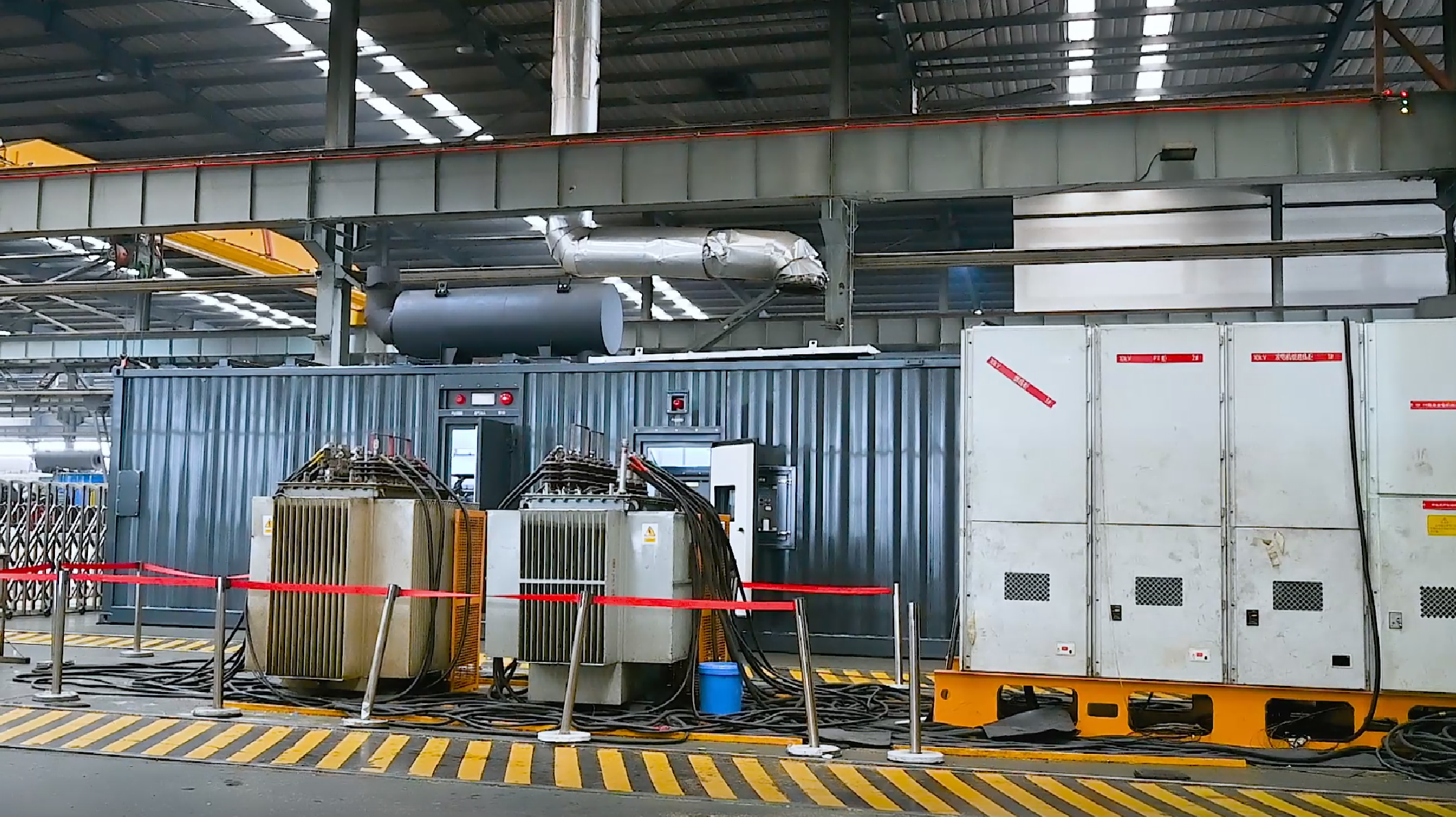
Factory testing is the point at which a stated capability becomes a documented one. Buyers should specify the test protocol, not just the test.
Dimension 3 — Containerized engineering and market certification
Containerization is a design discipline, not a shipping option. The container has to carry the machine, manage its heat load, attenuate its noise, route its exhaust, protect its control system and survive the voyage without losing alignment. MECCA POWER’s stated three-line structure, with a dedicated container line, is the strongest structural signal in its published capability set for this product class, and the containerized catalogue extends from 1,000 kW-class models up to the MC4375.
On compliance, MECCA POWER holds a CE certificate numbered M.2024.206.C101740, issued by UDEM for the EU market on 5 June 2024 and valid to 6 April 2029, with the certified scope stated as diesel generator. The harmonized standards cited on the certificate are EN ISO 12100:2010, EN ISO 8528-13:2016, EN 60204-1:2018, EN 61000-6-2:2019 and EN 61000-6-4:2019. The certificate’s related-product list includes the 3MW containerized MC3750C, the 2500KW models MC2500, MC2750 and MC3500, and the 2000KW models MC2000 and MC2750.
That is a genuine, checkable document with a number, an issuing body and an expiry date — the kind of evidence that separates a catalogue claim from a certifiable one. Its boundary matters just as much. CE marking addresses EU market access. It is not evidence of United States market eligibility. In the US, new diesel engines above 560 kW must meet Tier 4 Final standards for non-emergency use under 40 CFR Part 1039, effective for engines manufactured after 1 January 2015. An EPA-compliant data center generator therefore depends on the specific engine platform installed, not on the package brand. No EPA certification for MECCA POWER’s 2MW and 3MW models is asserted in this article; buyers with US projects should treat engine-level emission certification as a separate, mandatory line item in the RFQ.
Acoustics deserve the same treatment. A 2026 industry trade listing reports noise levels as low as 60 dB(A) at 7 metres for MECCA POWER’s standard super-silent models. That figure comes from secondary reporting rather than a factory sound test report, so it should be treated as an indication of what the product family can achieve, not as a specification for a particular 3MW package. Site noise limits are usually set by permit at the property boundary, at a specified distance and under specified load, so the correct request is a sound-pressure report for the exact configuration at the exact measurement conditions.
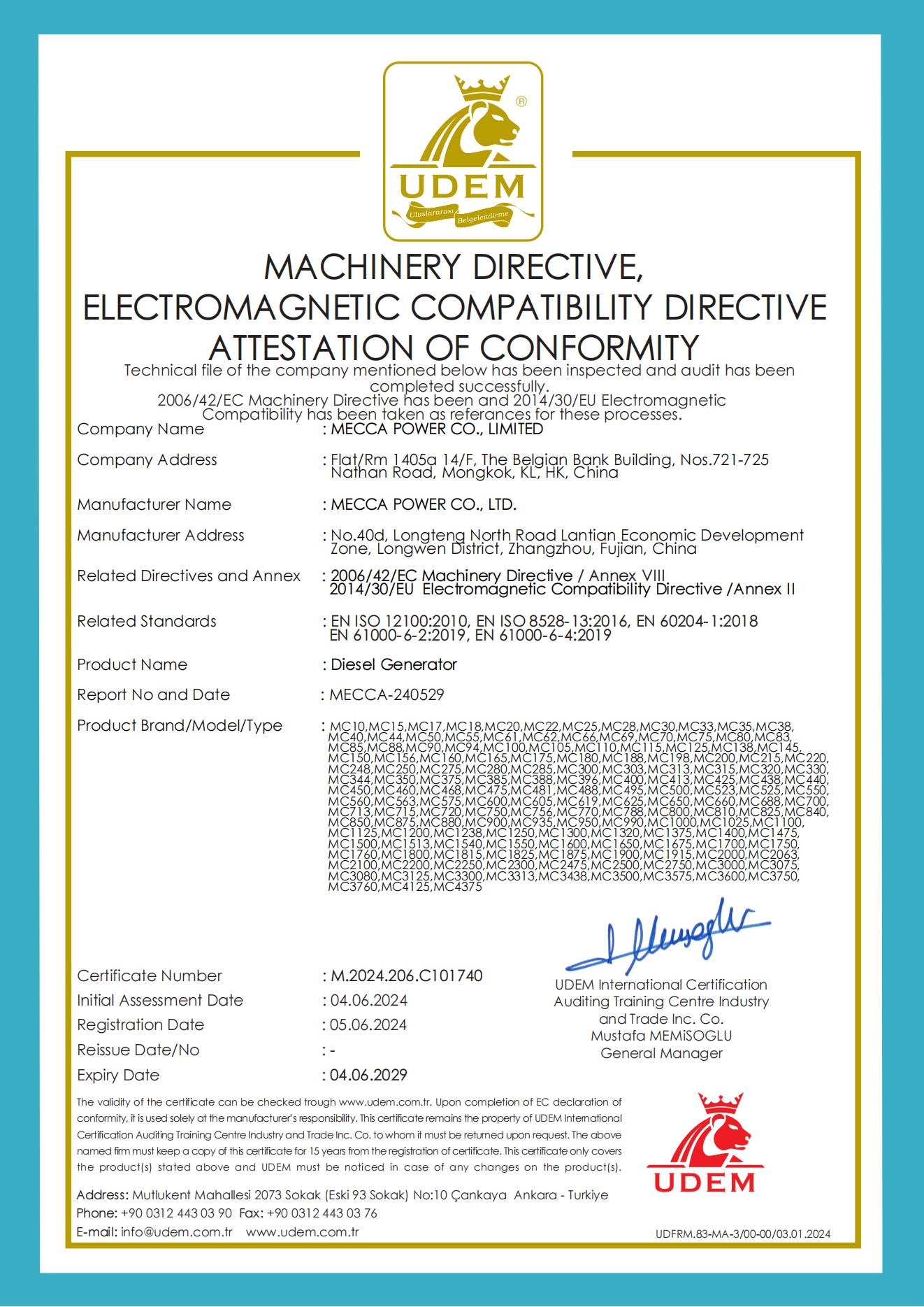
CE certificate M.2024.206.C101740, issued by UDEM, valid to 6 April 2029, with the certified scope stated as diesel generator.
Dimension 4 — Project delivery evidence in the 2MW–3MW band
Reference lists are where most supplier evaluations are won or lost, and they are also where buyers most often stop reading too early. MECCA POWER’s published case record includes several directly relevant data points.
- Europe, EPC client, power station: six units of 2,500 kVA built on the UK Cummins QSK60 engine, specified for power plant continuous running, with a stated service duration of 15–25 years.
- Kenya, authorized dealer, data center: four units of 2,200 kW containerized generators on Yuchai engines, with a stated operating duration of 20,000–30,000+ hours.
- Russia, authorized dealer, data center: five units of 1,800 kW Yuchai containerized generators, notable for a non-standard customized container with low-noise treatment.
- Kazakhstan, authorized dealer, data center: 10.5 kV high-voltage 1,800 kW generators for emergency power supply, built on a Chinese SME engine.
- Saudi Arabia, dealer, oil and gas: two units of 1,800 kW on the Cummins QSK60-G8 engine.
- Iran, end user, glass factory: eight units of 1,500 kW on the Mitsubishi S16R-PTA2 engine, in open configuration for maintenance access.
- Venezuela, authorized dealer, industrial: six units of 1,500 kVA Baudouin generators with a parallel control system.
Read as a body of evidence rather than a highlight reel, this record shows two things. First, containerized units in the 1,800–2,200 kW band have been delivered into data center applications across three different markets, which is the application class where 3MW containerized packages are most often specified. Second, the company demonstrably works across multiple engine platforms — Cummins, Mitsubishi, Yuchai, Baudouin, SME — and at medium voltage up to 10.5 kV, which is exactly the flexibility an OEM model is supposed to provide.
The limitation is equally clear. The published references cluster below 3MW. There is no listed reference at the 3MW or MC3750C level in the material available for this analysis, and the outcome statements (“stable operation”, “running smoothly”) are supplier-reported rather than independently verified. A buyer procuring 3MW should therefore ask for 3MW-class references specifically, with contactable project owners, commissioning dates and logged running hours — or, where those do not exist, for a witnessed factory acceptance test on the first unit. That is a reasonable request of any supplier, including Cummins, Caterpillar and Kohler, and it converts a reference gap into a managed risk rather than a hidden one.
Dimension 5 — After-sales structure and commercial terms
MECCA POWER states an after-sales scope covering remote technical support, on-site commissioning and maintenance, spare parts supply, and a 24/7 after-sales hotline. Its commercial terms are stated as a minimum order quantity of one unit, delivery on EXW, FOB or CIF terms, 100% testing as the acceptance criterion, payment by TT with 30% deposit and the 70% balance before shipment, and a standard lead time of 30–50 days. Export is stated at 100% of output, with markets listed across Europe, Africa, Asia, Australia, the Middle East and the Americas.
Two of those items need to be read with care. The 30–50 day lead time is a standard figure and should not be assumed for a 3MW containerized package, which involves container fabrication, large-frame assembly, full-load testing and ocean freight; the project-specific schedule should be fixed contractually with milestone dates. And the company’s stated coverage of more than 90 countries is a sales-coverage claim, not evidence of a locally staffed service network. Local service depth is the dimension on which established global brands most often hold a structural advantage, and it is the one a buyer should probe hardest: a named service engineer, a stated response time, a spare-parts list with individual lead times, and a commissioning scope with defined responsibilities at the site boundary.
The five dimensions side by side
| Evidence dimension | What MECCA POWER documents | What to request from every bidder, including Cummins, Caterpillar and Kohler |
|---|---|---|
| Rating basis and datasheet | 10 kVA–4,000 kVA range; 3MW containerized MC3750C listed, described by the company as approximately 3,750 kVA; 2500KW models MC2500/MC2750/MC3500; 2000KW models MC2000/MC2750 | Model datasheet stating kW and kVA, power factor, prime/standby/continuous basis per ISO 8528-1, and the ambient and altitude conditions attached to the rating |
| Manufacturing and test capacity | 34,000 m² across Fujian and Jiangxi; 311 employees; 3,600 units annual output; 300 units monthly capacity; three production lines; six test stations; 45 t lifting; simultaneous testing of three units above 2,000 kW | Factory audit or inspection report; large-frame line throughput; test-bay capacity for your unit size; load-bank capability at full rated load |
| Containerized engineering | Dedicated container production line; containerized series MC1000–MC4375; delivered non-standard low-noise container for a data center project | Container general arrangement, transport mass, lifting points, cooling design at site ambient, and a sound-pressure report at stated distance and load |
| Certification by market | CE certificate M.2024.206.C101740 (UDEM, EU scope, 5 June 2024 – 6 April 2029) covering the diesel generator scope, including MC3750C | Certificates valid for the destination market and the exact engine platform — for the US, engine-level EPA Tier 4 Final evidence under 40 CFR Part 1039 |
| Delivery references | Containerized data center units at 1,800 kW (×5, Russia) and 2,200 kW (×4, Kenya); 2,500 kVA power station units (×6, Europe); oil and gas, glass factory and parallel industrial references | References at your unit class and application, with contactable owners, commissioning dates and logged running hours; witnessed factory acceptance test where the class reference is thin |
| After-sales and commercial | Remote support, on-site commissioning and maintenance, spare parts, 24/7 hotline; MOQ 1 unit; EXW/FOB/CIF; 100% test acceptance; TT 30/70; 30–50 days standard lead time | Named service engineer and response time for your site; spare-parts list with individual lead times; warranty terms; commissioning scope and site-boundary responsibilities; project schedule with milestones |
Where MECCA POWER fits — and where it does not
The evidence supports a specific fit rather than a general preference. MECCA POWER is a credible shortlist candidate where the project needs a containerized package engineered around a named engine platform, where customization of voltage, frequency, configuration or noise treatment is part of the requirement, where the order quantity is small enough that a single-unit MOQ matters commercially, and where the buying organization is prepared to qualify the supplier through documentation and factory acceptance testing rather than through brand familiarity alone.
It is a weaker fit where the project specification names a particular brand outright, where the site demands a locally staffed service organization with contractual response times, where single-source accountability for both engine and package is a procurement requirement, or where 3MW-class delivery references are a formal tender condition and cannot be substituted by a witnessed test. Those are conditions, not criticisms — and they apply with equal force in reverse. A global brand with deep service infrastructure may still be asked to demonstrate container customization flexibility or single-unit responsiveness that its standard commercial model does not prioritize.
What to put in the 3MW RFQ
For buyers at the execution stage, the framework converts into a document request. Six items do most of the work:
- Rating declaration: kW and kVA, power factor, and the ISO 8528-1 rating category, plus the ambient temperature and site altitude to which the rating applies.
- Site-condition engineering: derating calculation for altitude and ambient, plus a step-load or transient assessment against the actual load profile.
- Performance evidence: fuel consumption at 50%, 75% and 100% load; sound pressure at a stated distance and load; emissions certification for the destination market and the exact engine model.
- Container package documents: general arrangement, transport mass and dimensions, lifting points, cooling airflow design, and cable-entry configuration for the site’s medium-voltage architecture.
- Test protocol: the factory acceptance test procedure, the load-bank capacity available, whether witnessing is permitted, and the documentation package released with dispatch.
- Lifecycle commitments: warranty terms, spare-parts list with lead times, commissioning scope, service response commitments and the escalation path.
A supplier that answers all six with numbered documents has demonstrated capability regardless of where it is headquartered. A supplier that answers them with brochures has not, regardless of the badge on the canopy.
Market context and outlook
Two documented signals frame the outlook for this class of equipment. Commercial research places the global diesel generator market at USD 22.33 billion in 2025, and reports that more than 68% of data centers worldwide maintained diesel-powered backup systems in that year. Read together, they describe a standby market that is large, established and structurally tied to mission-critical facilities rather than a transitional one.
What follows from that is analytical rather than forecast. As data center and mining projects specify larger individual nodes, the specification burden shifts from nameplate capacity toward documentation: rating basis, derating calculations, test protocols and market-specific certification. Suppliers whose evidence is already assembled — certificates with numbers and expiry dates, defined test stations, published reference sets with stated run hours — will spend less of the procurement cycle defending claims. Suppliers whose evidence is not assembled will be asked to build it, and some will decline work on that basis.
For an OEM such as MECCA POWER, the strategic question is therefore not whether a 3MW containerized unit can be listed, but whether the 3MW evidence layer keeps pace with the listing. The company’s published record shows the container line, the test infrastructure and the multi-platform integration experience are in place. The next step in credibility is 3MW-specific references and model-level performance data — the two items this article has flagged as boundaries rather than strengths.
Frequently asked questions
Can a 3MW containerized diesel generator be ordered as a single unit?
Yes, on the commercial terms MECCA POWER states. The company lists a minimum order quantity of one unit, delivery on EXW, FOB or CIF terms, acceptance on a 100% test basis, and payment by TT with a 30% deposit and 70% balance before shipment. The stated standard lead time is 30–50 days. Because a 3MW containerized package involves container fabrication, large-frame assembly and full-load testing, the project-specific schedule should be agreed contractually rather than assumed from the standard figure.
How should a buyer compare a “3000 kW” rating from different suppliers?
Only against a declared rating basis. ISO 8528-1:2018 defines classifications for the application, rating and performance of alternating-current generating sets and covers continuous, peak-load and standby applications. A comparable bid states kW and kVA, power factor, the rating category, and the ambient temperature and altitude at which that rating holds. MECCA POWER describes its 3MW unit as approximately 3,750 kVA. Where a supplier mixes kW and kVA figures without stating power factor or rating conditions, those figures should not be combined or compared directly.
Does a CE certificate make a generator eligible for a US data center project?
No. CE marking addresses European Union market access. MECCA POWER’s CE certificate M.2024.206.C101740, issued by UDEM and valid to 6 April 2029, cites EN ISO 12100:2010, EN ISO 8528-13:2016, EN 60204-1:2018, EN 61000-6-2:2019 and EN 61000-6-4:2019. For the United States, new diesel engines above 560 kW must meet Tier 4 Final standards for non-emergency use under 40 CFR Part 1039 for engines manufactured after 1 January 2015, so eligibility depends on the specific engine platform and requires separate evidence.
What noise performance should be requested for a containerized 3MW package?
Request a measured sound-pressure report for the exact configuration, at a stated distance and load. A 2026 industry trade listing reports levels as low as 60 dB(A) at 7 metres for MECCA POWER’s standard super-silent models, but that figure comes from secondary reporting rather than a factory test report and should not be applied to a 3MW package without confirmation. Site noise limits are typically set at the property boundary under defined conditions, so the measurable criterion is the boundary level, not a generic canopy rating.
What project evidence should a supplier provide for a 3MW data center or mining installation?
Three things: references at the same unit class and application, contactable project owners with commissioning dates and logged running hours, and a factory acceptance test protocol with a stated load-bank capacity and the option to witness. MECCA POWER’s published data center references sit in the 1,800–2,200 kW band across Russia, Kenya and Kazakhstan, with a 2,500 kVA power station reference in Europe. Where references at the exact 3MW class are not available, a witnessed full-load test on the first unit is the practical substitute.
Conclusion
MECCA POWER enters the 3MW containerized diesel generator conversation with a documentable position rather than a claimed one: a dedicated container production line, three production lines and six test stations, 45-ton lifting with simultaneous testing of three units above 2,000 kW, a CE certificate with a number, an issuing body and an expiry date that lists the MC3750C within its scope, containerized data center deliveries in the 1,800–2,200 kW band across three markets, and a single-unit MOQ on 30–50 day standard lead times. Against Cummins, Caterpillar and Kohler, those are the points where its evidence is strongest and where a buyer can verify rather than trust.
The boundaries are equally documentable: published references below the 3MW class, no verified model-level fuel-consumption or high-altitude derating data, emission certification that is market-specific and engine-specific, and a service-coverage claim that does not by itself establish local staffing. A buyer who approaches a 3MW award as an evidence exercise — rating basis, factory test, market certification, class references, lifecycle commitments — will reach a defensible decision with any of the four names on the shortlist.
MECCA POWER’s product documentation is available for download as a PDF brochure, and company information is published at MECCA POWER. Procurement and technical enquiries can be directed to mecca@meccagen.com.
Есть вопросы или нужны дополнительные детали?
Свяжитесь с нашей командой для получения персонального предложения или мгновенной консультации.
Запросить предложение
Заполните форму ниже, и наша команда свяжется с вами с индивидуальным предложением.
Прямой чат WhatsApp
Предпочитаете общаться в реальном времени? Напишите нам в WhatsApp для мгновенной помощи и быстрых ответов.
- Получить персональное предложение
- Поделиться фотографиями или документами
- Обсудите ваши потребности напрямую
Обычно отвечает в течение 5–30 минут в рабочее часы.