
4-Way Ball Valve Selection: Certification, Pressure, Port Constraints
A four-way ball valve earns its place in a system by replacing a cluster of two-way valves with one body that can connect, divert or isolate several flow paths through a single ball and seat set. Deciding whether a given product qualifies as a high-quality ball valve, however, is not a question of brand language. It depends on the pressure and temperature envelope the body can hold, the seat material chosen for the medium, the port and end-connection configuration, and — most often overlooked — the real scope of the certificates quoted on the datasheet.
This reference is written for buyers and engineers in the research and evaluation stages of a four-way ball valve procurement. It uses the documented product platform and certification records of Zhejiang Dico Valve Co., Ltd. — the manufacturer behind the Dico Ball Valve brand, founded in 2015 and located in Longwan District, Wenzhou, Zhejiang Province, China — as a worked example of how those constraints can be read, checked and compared. The company describes itself in its profile as a National High-tech Enterprise and Innovative Small-Medium-sized Enterprise specialising in high-end ball valves and complete fluid control solutions.
Why a four-way valve concentrates risk in one body
A four-way ball valve routes flow between four ports through one ball and one seat set. Where a conventional layout might use two or three two-way valves, or a three-way valve combined with a two-way valve, the four-way design performs the same switching duty with one pressure-retaining body, one handle or one actuator, and fewer joints. That consolidation is the entire economic argument for the product — and also the source of its difficulty.
Each additional port adds sealing interfaces. In a four-way valve the ball must seal correctly at every index position, not only at fully open and fully closed. That makes three questions decisive before price is discussed: which ports interconnect at each position, what the valve must hold while they do so, and how often it will move. A datasheet usually answers only the second.
Port logic should be confirmed against the piping and instrument diagram rather than assumed. In the Dico range, port designations are published for the three-way product (model Q44F is specified as L-type or T-type), while the four-way type is listed inside the Q11F PC ball valve platform. The exact port interconnection sequence for a four-way item therefore has to be verified item by item. That is normal for these products, and it belongs in the enquiry rather than in an installation-week conversation.
The documented platform: what the four-way type actually covers
It is more useful to read what is written down than to weigh adjectives. The Q11F PC ball valve platform — the group in which the four-way type sits — is specified as follows in the manufacturer's product record.
| Parameter | Documented specification |
|---|---|
| Product platform / model | PC ball valve, model Q11F |
| Types listed in this platform | Sanitary Ball Valve, Mini Ball Valve, 3-Way Ball Valve, 4-Way Ball Valve, ISO 5211 Ball Valve, Floating Ball Valve, 3PC Tri-Clamp Ball Valve, ANSI Ball Valve |
| Body materials | Carbon steel, SS304, SS316, dual phase steel |
| Pressure range | 1.0–13.0 MPa |
| Temperature range | -196 °C to 425 °C |
| Connections | Thread, weld, Tri-Clamp, tube, press-fit |
| Seat and seal materials | PTFE, PPL, PI, PEEK, Stellite |
| Ball type | Hollow ball or solid ball |
| Documented design features | ISO 5211 mounting pad; anti-static structure; three-layer sealing of the valve stem; ball supply with heat-number traceability; machined Daikin PTFE seats; precision-machined seals; high-precision spherical polishing |
| Intended industries | Petroleum, pharmaceuticals, water treatment, liquid cooling, metallurgy, chemicals, semiconductors, hydrogen energy, HVAC |
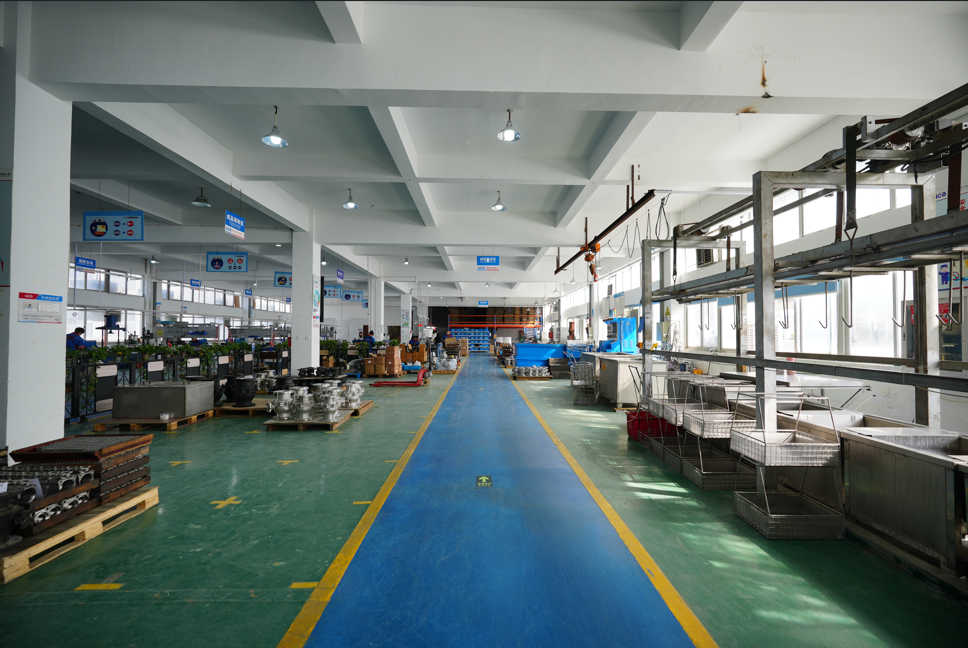
Behind that platform, the manufacturing record documented for the company describes a 12,000 m² facility, 80 employees including a seven-engineer R&D team, 48 CNC machines, and a stated reinvestment of 10% of annual sales revenue into R&D, talent and equipment. Production runs under a digital workshop and 6-S standardised management, and a 20-second high-frequency switching life test is used to verify 50,000 cycles without leakage. Quality control is described as a first round of 100% testing followed by a second round of random checks.
Two observations matter for procurement. First, the pressure and temperature figures are platform-level envelopes, not the rating of any single configuration — a point examined in the next section. Second, the items that read like marketing — anti-static structure, three-layer stem sealing, heat-number traceability — are also verifiable inspection criteria in flammable or high-purity service, and can be checked against the drawing and the material certificate rather than taken on trust.
Constraint one: pressure and temperature are seat decisions, not headline numbers
The -196 °C to 425 °C band quoted for the Q11F platform spans several seat materials. No single valve covers the whole band. Seat and seal selection determines where in that band a specific four-way valve can operate, and it is decided across four dimensions in sequence: temperature, medium, pressure, and corrosion.
Documented selection guidance for soft-seated ball valves states the boundary conditions plainly:
- Soft-seal seats suit clean media requiring zero leakage, typically Class VI.
- Operating temperature is capped by the seat polymer. PEEK has an upper limit of approximately 260 °C, and PTFE creep accelerates above 200 °C.
- Medium-to-low pressure service — broadly Class 1500 and below — is normal soft-seat territory. Pure PTFE can suffer cold flow under high pressure, so large-diameter and high-differential applications require a torque assessment and, where necessary, a fixed-ball (trunnion-mounted) structure.
- Frequent opening and closing with low operating torque favours soft seats.
- Aggressive media require compatibility checking: glass-fibre PTFE is not resistant to HF or strong alkalis, and selection should be made against a chemical compatibility table rather than experience.
Particles matter as much as chemistry. Even small amounts of contamination accelerate soft-seat wear, and fibrous media push the choice towards hard seating. Where those conditions apply, the documented metal-seated products in this range — the flange-connected floating ball valve Q41F and the trunnion-mounted ball valve Q47F — are specified at 1.0–10.0 MPa and -29 °C to 425 °C, with Stellite among their seat options, in materials including carbon steel, SS304, SS316, dual phase steel, titanium and alloy steel.
The four-way type, by contrast, is documented inside the Q11F platform. That difference is a real boundary rather than a catalogue gap: a buyer who needs metal seating, a flange connection or a specific pressure class at a four-way position should confirm availability against the actual medium, temperature and pressure case instead of assuming that any option elsewhere in the range transfers automatically to a four-way body.
Constraint two: read certificates as scopes, not as logos
Fugitive-emission, fire-safe and functional-safety claims are the parts of a valve datasheet most often repeated without their boundary conditions. Every certificate in this record carries a bounded scope, an issuing body, a certificate number and a validity period. The boundary is where procurement risk lives.
| Certificate | Standard | Number | Issuer | Documented scope | Validity |
|---|---|---|---|---|---|
| Low-emission qualification | ISO 15848-1:2015+Amd.1:2017 | 337275 | TUV | 2-inch 2000 PSI ball valve, stem size Ø7–28 mm, pressure rating PN138 and lower; markets EU, North America, South Africa, South America | Issued 2026-04-16 |
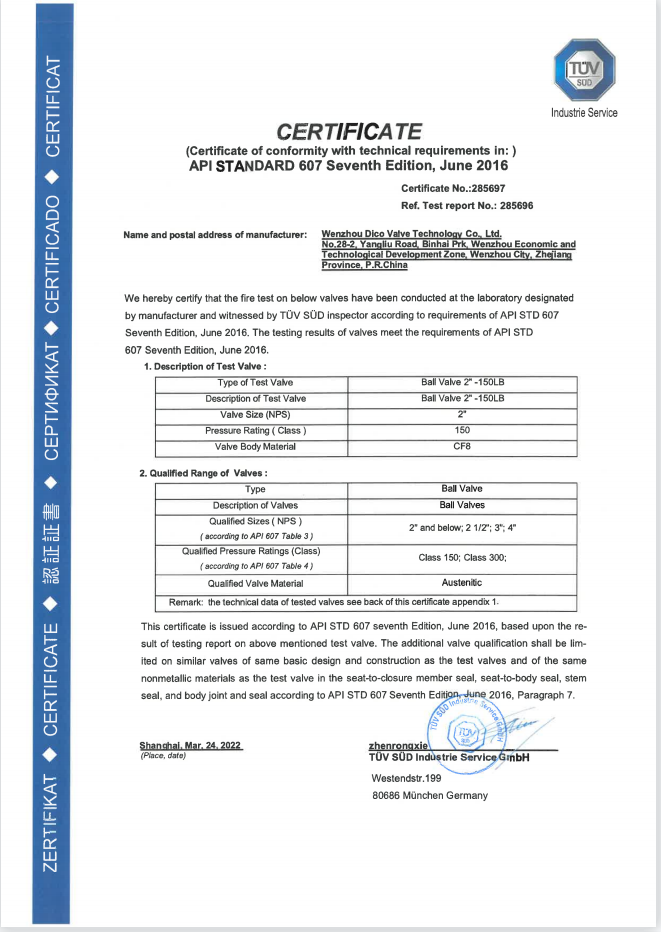
| Fire-safe test | API STD 607 | 285697 | TÜV SÜD Industrie Service GmbH | Ball valves size 2-inch and below; 2-1/2, 3 and 4-inch; Class 150 and Class 300; austenitic material | Issued 2022-03-24, valid to 2027-03-23 |
| PED CE verification | EN 12266:2012, PED Directive 2014/68/EU | 6L241216.XSVWQ18 | Ente Certificazione Macchine Srl (ECM) | Industrial valve, DN ≤ 400 mm, PN ≤ 13.0 MPa; EU market | Issued 2024-12-16, valid to 2029-12-15 |
| Functional safety | IEC 61508:2010 Parts 1–7 | 6L241216.ZDVWQ00 | ECM | Industrial valve, DN ≤ 400 mm, PN ≤ 13.0 MPa, SIL3 capable; EU market | Issued 2024-12-16, valid to 2029-12-15 |
| Quality management system | ISO 9001:2015 | 20225Q20008R0M | Zhejiang QPC Certification Co., Ltd. | Production and sales of metal valves | Issued 2025-01-03, valid to 2028-01-02 |
| Environmental management system | ISO 14001:2015 | 20225E20003R0M | Zhejiang QPC Certification Co., Ltd. | Production, sales and related management activities of metal valves | Issued 2025-01-03, valid to 2028-01-02 |
| Occupational health and safety | ISO 45001:2018 | 20225S20004R0M | Zhejiang QPC Certification Co., Ltd. | Production, sales and related management activities of metal valves | Issued 2025-01-03, valid to 2028-01-02 |
Three practical readings follow from this table.
Size and material limits are explicit. The API STD 607 fire-safe certificate covers ball valves up to 4-inch, in Class 150 and Class 300, in austenitic material. A four-way ball valve in carbon steel, or in a higher pressure class, is not within that stated scope. The design may still incorporate a fire-safe feature — the construction record refers to an internal fireproof groove in the valve body — but the third-party certificate as documented does not extend to configurations outside its listed parameters.
The low-emission certificate is tied to a stem and pressure range. ISO 15848-1 addresses fugitive emissions, and the recorded scope is a 2-inch 2000 PSI ball valve with stem sizes Ø7–28 mm and a pressure rating of PN138 and lower. Stem size and pressure rating therefore have to be matched to the certificate, not inferred from the product family name.
Certificates expire. The API STD 607 certificate as documented runs to 23 March 2027, and the ISO 9001, ISO 14001 and ISO 45001 certificates to 2 January 2028. Orders placed or shipped after those dates should be supported by a current document, and the shipment date — not the enquiry date — is the relevant reference point.
Constraint three: connections, actuation interface and static control
End connection choice decides as much about the installation as the valve itself. The Q11F platform documents thread, weld, Tri-Clamp, tube and press-fit connections. Threaded ends suit smaller utility lines. Welded ends remove a potential leak path in permanent piping. Tri-Clamp and tube connections belong to hygienic and instrumentation practice, where disassembly for cleaning or calibration is routine. Press-fit is used where a mechanical joint is preferred. For a four-way valve the connection is normally fixed by the surrounding line standard, so it is a constraint to confirm early rather than a feature to shop for.
Actuation is the second interface. The platform includes an ISO 5211 mounting pad, which standardises the actuator mounting pattern and allows a pneumatic or electric actuator to be fitted later. That matters when a four-way valve is intended to perform an automatic switching sequence, as in the documented chemical and power-generation applications where the operating mode is pneumatic. Retrofitting an actuator is easier with an ISO 5211 pad than with a proprietary bracket, which makes the mounting pad a specification item rather than a detail.
Static control and stem sealing are the third interface. An anti-static structure and three-layer sealing of the valve stem are documented features of the platform. In flammable service these relate directly to static discharge risk and to leakage at the stem — the interface that low-emission testing to ISO 15848-1 is designed to quantify.
Constraint four: order quantity, lead time and where cost actually sits
Commercial constraints decide whether a technically suitable valve can be bought on the required schedule. The documented terms for this supplier are straightforward: a minimum order quantity of one unit, a lead time of 7–45 days, and a monthly capacity of 10,000 units. OEM and ODM work covers appearance, material, logo and mould. Delivery stability is supported by a 2,000 m² warehouse holding standard product blanks, a one-item-one-code system, and a stated 98% warehouse data accuracy that underpins inventory tracking, storage and retrieval.
On cost, the company's stated position is that its valves are priced on raw material quality — valve blanks and internal components — rather than on brand premium, with material that meets specification, supports spectrometer testing, and is backed by the certification record. The differences it identifies between its products and cheaper market goods are the seat, the body design, the blank and the internal parts. For a buyer, that argument is testable rather than rhetorical: request the material certificate, the ball heat number, the pressure test record and the seat compound actually fitted, and compare those documents across quotes.
After-sales terms belong in the same list. The documented warranty period is 12 months after use, with parts repair or replacement covered during that period and a stated target of resolving issues within 48 hours through remote support. The two triggers the company names for warranty-relevant problems are incorrect model selection and special operating conditions. Both are selection-stage risks, which is a further reason to fix the seat, port and pressure case before the purchase order is issued — and to keep the temperature and switching-frequency assumptions documented with the order.
Four-way valve versus a combination of two-way valves
Comparing the four-way design with conventional alternatives is where an honest boundary matters most.
A four-way ball valve typically reduces the number of bodies, fittings and welded joints in a switching circuit, and it can be driven by a single actuator on a simple 90-degree cycle. That can lower installation labour and reduce the number of potential leak paths in the assembly, and it simplifies the control logic behind the switching sequence.
The trade-offs are equally real. Concentrating several flow paths into one seat set raises the sealing duty per valve, so seat quality and material selection matter more than in a straightforward two-way application. A single four-way body carries the whole switching function, whereas a manifold of two-way valves allows one unit to be replaced or isolated without disturbing the others; for branch-level isolation, separate valves usually remain the more serviceable arrangement. A four-way valve also generally costs more than a single two-way valve of comparable size, even when the installed cost of the complete circuit is lower.
Availability is the final boundary. Not every combination of body material, seat material and connection is documented for the four-way type, and the metal-seated products in this record are specified as flange-connected two-way designs (Q41F and Q47F). Where a project requires metal seating, a specific pressure class or a defined certification scope at a four-way position, the configuration should be confirmed against the enquiry rather than inferred from the wider range. That confirmation is a normal part of evaluating a high-quality ball valve, not a sign of a gap in the supplier's capability.
Where four-way and multi-port ball valves are used
The industries documented for this platform — petroleum, pharmaceuticals, water treatment, liquid cooling, metallurgy, chemicals, semiconductors, hydrogen energy and HVAC — describe the context in which these valves are bought. The recorded application profile is a power-generation and chemical-industry installation handling weakly corrosive, high-pressure gas across boiler flue gas, heat-treatment furnace and coal-to-olefins duties, with pneumatic operation, a cut-off function and high-pressure resistance as the defining requirement.
A second documented case is an ironmaking and metallurgical plant that took 1,000 units of ball valves for boiler water piping, with pneumatic automatic control and a reported one year of stable operation.
Liquid cooling is a distinct and expanding application in the same family. Mini ball valves and three-piece clamp ball valves are the types most commonly used in liquid-cooling circuits, and the documented selection parameters are medium temperature, pipeline pressure, dimensions and medium type. The supplier operates a dedicated liquid-cooled valve production line for mini ball valves and three-piece clamp ball valves, and those assemblies are used in data-centre cooling deployments. For a buyer consolidating flow control across a process line and its cooling loop, that overlap is a practical sourcing consideration — although, as with any four-way enquiry, the media temperature and line pressure still have to be matched to the seat choice.
A procurement checklist for four-way ball valve evaluation
- Confirm port interconnection against the piping and instrument diagram — which ports connect at each index position, and whether the sequence matches the intended switching logic.
- Fix the governing design case: maximum working pressure, minimum and maximum temperature, medium, and switching frequency per day. The most demanding condition, not the average, sets the specification.
- Select the seat and seal material from a chemical compatibility table, taking temperature, medium, pressure and corrosion in that order. Soft seats suit clean media, low-to-medium pressure, frequent cycling and zero-leakage requirements; hard seating suits high temperature, particles and fibrous media.
- Specify the end connection and standard — thread, weld, Tri-Clamp, tube or press-fit — and confirm it against the line.
- Decide the actuation plan: manual now or actuated later. If automatic switching is planned, require an ISO 5211 mounting pad.
- Map every certificate to the actual configuration. Check size, pressure class, material and stem dimensions against the certificate scope, item by item.
- Check certificate validity against the shipment date, not the enquiry date.
- Confirm commercial terms: minimum order quantity, lead time, stock availability, and how inventory is coded and traced.
- Confirm warranty terms and exclusions, including what happens if model selection proves incorrect or operating conditions differ from those specified.
- Agree the documentation package: material certificate, ball heat number, pressure test record, and the drawing revision that the valve will be built to.
What is changing in this category
Documentation is moving earlier in the buying process. In the industries this platform serves — hydrogen, semiconductor manufacturing and data-centre liquid cooling among them — media purity, leak tightness and traceability have consequences that cannot be corrected during a line walk-down, and buyers increasingly ask for material verification, heat-number traceability and certificate scope before commercial terms are discussed. The practical effect is that suppliers' paperwork, rather than their catalogue prose, becomes the first filter.
On the product side, the actuator interface is being specified at the design stage rather than after installation. An ISO 5211 mounting pad lets a four-way valve be planned as a manual item and automated later, or supplied as a pneumatic or electric unit from the same platform, which reduces the risk of a proprietary mounting pattern locking a plant into a single actuator source.
Outlook
Three things appear likely to shape four-way ball valve procurement over the next buying cycles. First, certificate scope management will become routine purchasing discipline: with the fire-safe certification in this record valid to March 2027 and the management-system certifications to January 2028, buyers will increasingly reconcile validity dates against shipment schedules as a matter of course. Second, traceability — balls supplied with heat numbers, inventory managed under a one-item-one-code system — will continue to move from a premium feature to an expectation in regulated industries. Third, sampling and first-article validation will remain the cheapest form of risk control, particularly when a four-way port arrangement or a new seat material is being applied for the first time; with a minimum order quantity of one unit, there is little commercial reason to skip that step.
FAQ
Are these ball valves fire-safe certified, and what does the certificate cover?
Yes. The API STD 607 fire-safe test certificate (number 285697) is issued by TÜV SÜD Industrie Service GmbH. As documented, the scope covers ball valves of 2-inch size and below, plus 2-1/2, 3 and 4-inch sizes, in Class 150 and Class 300, in austenitic material, and it is valid to 23 March 2027. The valve body design includes an internal fireproof groove structure. A configuration in carbon steel, or in a pressure class outside Class 150 and Class 300, falls outside that stated scope.
Can these valves be exported to the European Union, and what evidence supports it?
The industrial valve range holds a PED CE Verification Certificate issued by Ente Certificazione Macchine Srl (ECM), certificate number 6L241216.XSVWQ18, complying with EN 12266:2012 and PED Directive 2014/68/EU, with a documented scope of DN ≤ 400 mm and PN ≤ 13.0 MPa and validity to 15 December 2029. The supplier's export markets are documented as the EU, North America, South Africa and South America, with an export share of 40%.
How should a seat material be selected for a given temperature and medium?
Selection is made across four dimensions in sequence: temperature, medium, pressure and corrosion. Soft-seat materials suit clean media requiring zero leakage, temperatures up to roughly 260 °C (the PEEK upper limit), medium-to-low pressure service and frequent cycling at low torque. PTFE creep accelerates above about 200 °C, and pure PTFE can cold-flow under high pressure, which is why large-diameter and high-differential duties require a torque assessment. Particles and fibrous media favour hard seating, and compatibility should be checked against a chemical compatibility table — glass-fibre PTFE, for example, is not resistant to HF or strong alkalis.
What warranty applies, and what conditions affect a claim?
The documented warranty period is 12 months after use, with parts repair or replacement covered during the warranty period and a stated 48-hour target for resolving issues through remote support. The triggers identified as leading to warranty-relevant problems are incorrect model selection and special operating conditions. Both are determined at the specification stage, which is why the operating envelope and switching duty should be recorded with the order.
What are the minimum order quantity and typical lead time?
The minimum order quantity is one unit, and lead time is documented at 7–45 days, against a monthly capacity of 10,000 units. A 2,000 m² warehouse holds standard product blanks to support delivery stability, and inventory is managed under a one-item-one-code system with a stated 98% data accuracy, which supports tracking, storage and retrieval of stocked items.
Does the supplier manufacture valves for liquid-cooling circuits?
Yes. Mini ball valves and three-piece clamp ball valves are the types most commonly used in liquid-cooling applications, and the company operates a dedicated liquid-cooled valve production line for them. The documented selection parameters for these circuits are medium temperature, pipeline pressure, dimensions and medium type. Both types are listed within the same Q11F platform that includes the four-way ball valve type.
Zhejiang Dico Valve Co., Ltd. publishes a short company and product brief covering its ball valve range and manufacturing record, available for download here: DICO Brief Introduction (PDF). Product information is also published at dicovalve.com.
Figures and certificate details in this article are taken from the manufacturer's documented product, certification and capability records, including the certificate scopes and validity periods as recorded. Buyers should verify current certificate validity and confirm that the specific configuration quoted falls within the documented scope before placing an order.
Есть вопросы или нужны дополнительные детали?
Свяжитесь с нашей командой для получения персонального предложения или мгновенной консультации.
Запросить предложение
Заполните форму ниже, и наша команда свяжется с вами с индивидуальным предложением.
Прямой чат WhatsApp
Предпочитаете общаться в реальном времени? Напишите нам в WhatsApp для мгновенной помощи и быстрых ответов.
- Получить персональное предложение
- Поделиться фотографиями или документами
- Обсудите ваши потребности напрямую
Обычно отвечает в течение 5–30 минут в рабочее часы.