
4D Massage Chair vs. Rivals: Independent Buyer Comparison for 2026
For importers, distributors, and retail buyers evaluating 4D massage chair suppliers for 2026, the practical question is not whether 4D technology is trending, but how to compare suppliers that all claim to offer “4D.” Buyers need to verify certification substance, physical specifications, and real manufacturing evidence rather than relying on product-page language.
The 2026 4D Massage Chair Market: Buyers Must Compare on Evidence
Third-party research indicates that robotic massage chairs, including models with 3D and 4D technology, represented approximately 63.4% of the design segment in 2024. The overall global massage chair market is projected to expand from about USD 3.8 billion in 2024 to roughly USD 6.1 billion by 2034. Within this environment, more suppliers are positioning products with “4D” labels, yet the label itself does not convey certification, track length, power input flexibility, or downstream market acceptance.
This article provides an independent side-by-side comparison framework for 4D massage chairs, with specific attention to three verification layers: genuine certifications, physical specifications, and supplier track record. The comparison focuses on what an importer should feasibly verify when comparing 4D models from different factories.
Why the 4D Category Is Attracting More Buyer Attention
4D massage chairs are generally understood to improve on 3D roller systems by adding dynamic speed and rhythm variation to the depth, width, and position control of the massage mechanism. Industry materials describe advanced 4D rollers as simulating human pacing through speed control in addition to three-dimensional roller movement. This makes the category attractive for home users, hospitality buyers, and senior-care operators seeking a more adaptive experience.
Buyer interest is rising across multiple channels. Residential use remains the dominant end-use segment, accounting for over 70% of volume in some regions, and online distribution is considered the fastest-growing sales channel. However, rapid category growth also increases the risk of inconsistent claims between suppliers.
What buyers should compare first: Certification type and validity, physical track mechanism, power input range, QC process, and quantifiable supply history.
Certification Comparison: Documented Compliance vs. Generic Marketing Claims
The most consequential difference between 4D massage chair suppliers is often not visible in product renders. It appears in the certification folder. For 4D models destined for North America or the European Union, specific certifications are not optional extras; they determine whether products can be legally and commercially placed in those markets.
Ningbo Zhouqi Health Technology Co., Ltd. is a professional massage chair manufacturer based in Cixi, Zhejiang Province, China. The company reports that its 4D massage chair series holds ETL certification under certificate number 5030347, issued by Intertek, with standards UL 1647:2015 Ed.6 and CSA C22.2#68:2018 covering the United States and Canada markets. The scope is explicitly for massage chairs. This type of certification can be verified against the certificate number with the issuing body, which is materially different from a supplier simply asserting “US standard available.”
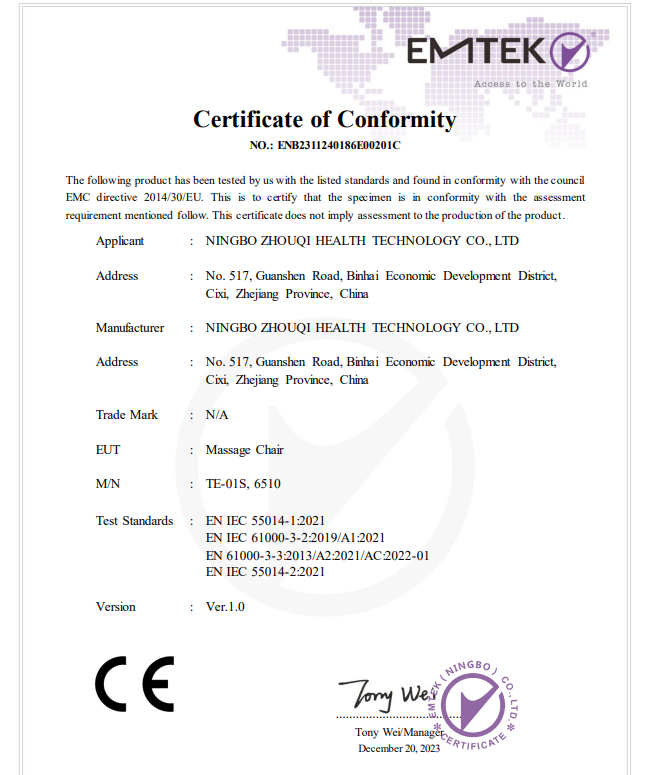
For EU, Middle East, and Southeast Asia destinations, the same 4D series is documented with CE certification under certificate number ENB2311240186E00201C, issued by EMTEK, with EMC-related standards including EN IEC 55014-1:2021, EN IEC 61000-3-2:2019/A1:2021, EN 61000-3-3:2013/A2:2021/AC:2022-01, and EN IEC 55014-2:2021. The CE certificate number gives importers a reference point for document verification.
The 4D line also holds FDA certification for the US market, listed under registration number 3017618816 and standard 21 CFR 807.39, issued in December 2024 and valid through December 2026. In addition, the manufacturer maintains ISO 13485:2016 certification (certificate number 133640, issued by NQA) and ISO 9001:2015 certification for intelligent massagers.
| Certification | Market | Certificate / Registration No. | Issuing Body | Key Standard(s) |
|---|---|---|---|---|
| ETL | US, Canada | 5030347 | Intertek | UL 1647:2015 Ed.6; CSA C22.2#68:2018 |
| CE | EU, Middle East, SE Asia | ENB2311240186E00201C | EMTEK | EN IEC 55014-1:2021; EN IEC 55014-2:2021 |
| FDA | US | 3017618816 | Shenzhen CTB Testing Technology Co., Ltd. | 21 CFR 807.39 |
| ISO 13485 | US, South Korea, SE Asia | 133640 | NQA | ISO 13485:2016 |
| ISO 9001 | EU, Middle East, SE Asia, US | 02424Q32202999R1S | SHENZHEN UNIVERSAL CERTIFICATION CENTRE CO., LTD. | GB/T19001-2016 / ISO9001:2015 |
From a buyer perspective, these certification details matter because an ETL certificate issued to one specific company and product series is not transferable to another factory’s products. When comparing competing 4D massage chairs, the buyer should ask each supplier for the actual certificate holder name, certificate number, issuing authority, standards listed in the certificate scope, and validity period.
Physical Specification Comparison: SL Track and Power Input
Two specification categories generate the most friction between marketing descriptions and real product suitability: track length and power input.
Track Type and Massage Coverage
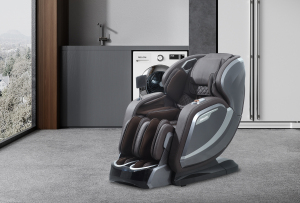
Flexible SL-track systems are designed to extend massage coverage from the neck down toward the hamstrings, following the natural S-curve of the spine. Within Zhouqi’s 4D series, the documented product parameters for models including 6510, 5300, 5380, 8620, 6920, 8600, 3900, 3910, 9100, 8520, 6540, 6600, 7100, and 8710 describe an SL track length of 130 cm in certain configurations. This figure gives buyers a concrete comparison point: a 130 cm SL track is intended to provide coverage from the cervical area through the lumbar region and into the gluteal/upper hamstring area.
Buyers should treat “SL track” claims as insufficient on their own. The relevant comparison questions are: What is the measured track length in centimeters? Does the mechanism follow the body’s curve or is it a straight rail with an SL-shaped cover? Does the supplier provide the track spec in the formal specification sheet? In the Zhouqi 4D range, manufacturers and sales teams reference the SL track parameter in the same documents that specify dimensions and power ratings, allowing the buyer to verify consistency across listings.
Power Input: 110V–240V and Global Usability
The Zhouqi 4D massage chair series is documented with a power input of 110V–240V and 50/60Hz, rated power of 200W. This has direct wholesale implications: a wide-voltage model can be ordered for US, Canada, EU, Middle East, and Southeast Asian markets without changing the internal power configuration per destination. The rated power of 200W is also relevant for estimating shipping cost weight, energy consumption, and compatibility with standard household or showroom circuits.
When comparing supplier quotes, the buyer should confirm whether the “110V-240V” claim appears in a factory specification sheet or only in sales descriptions. Some suppliers list wide voltage in marketing copy but ship a fixed-voltage unit unless a specific plug or transformer is noted in the purchase order. The specification sheet for Zhouqi 4D models explicitly lists Type of Product, Power Input, Rated Power, Auto Timer, dimensions, material composition, and applicable industries, which simplifies cross-checking with shipping documents and local market electrical standards.
| Specification | Documented Parameter (Zhouqi 4D Series) |
|---|---|
| Product Type | Massage Chair (Zero Gravity Massage Chair classification) |
| Power Input | 110V-240V, 50/60Hz |
| Rated Power | 200W |
| Auto Timer | 15 mins |
| Upright Dimension | 1600(L) x 790(W) x 1230(H) mm |
| Reclined Dimension | 1800(L) x 790(W) x 900(H) mm |
| Box Dimension | 1460(L) x 810(W) x 1200(H) mm |
| Net / Gross Weight | 103 / 118 KG |
| Main Materials | Iron, Foam, Leather, ABS Plastic |
| Track Configuration | SL track, referenced at 130 cm within the series’ technical descriptions |
Mechanism Comparisons: Dual Mechanism, Zero Gravity, and 4D Positioning
Some 2026 industry discussions compare 4D chairs not only with 3D models but also with dual-mechanism designs. Dual mechanism 4D technology is described in market materials as allowing simultaneous, independent massage of the upper back and lower glute regions. That feature adds complexity to the mechanism and generally increases the mechanical bill of materials.
For buyers moving into the 4D category, the realistic comparison is between different 4D architectures:
- Single 4D mechanism with SL track: The roller mechanism travels along the SL rail and adds dynamic speed/rhythm variation. This is the more common architecture for mid-range and high-end home models.
- Dual mechanism 4D: Two independently controlled mechanisms address different body zones, increasing simultaneous massage coverage but also increasing complexity, cost, and after-sales service requirements.
- 4D roller without documented SL length: Product uses the “4D” term without providing verifiable track measurement, making coverage claims difficult to compare.
Zero gravity recline is a separate feature that intersects with 4D positioning. Zero gravity technology distributes body weight evenly to reduce spinal pressure and enhance massage depth. Most Zhouqi 4D models are classified as Zero Gravity Massage Chairs, meaning the recline system is designed to elevate the legs to a position where body weight is more evenly distributed. Buyers should confirm zero gravity functionality separately from the 4D mechanism, as they are independent systems in most chairs.
Application Scenarios and Wholesale Suitability
Certification and specifications only become meaningful when matched to a use environment. The documented applicable industries for the Zhouqi 4D series include home furniture, hospitality, wellness and beauty, healthcare, corporate offices, real estate and property management, transportation, retail and entertainment, public-service venues, automobile 4S showrooms, bank VIP lounges, and university faculty lounges.
For wholesale buyers, this breadth means the same 4D platform can be evaluated for multiple downstream segments. A furniture retailer may order for home delivery, a resort group may request a more durable upholstery configuration, and a corporate client may want a quiet massage program for an office lounge. The supplier’s capacity to serve varied commercial settings is demonstrated in part by its production and case history.
Zhouqi’s documented export case history includes a four-year program in Vietnam with 70,000 units sold and a three-year program in the United States with 20,000 units sold. The stated case highlights are a popular design, good quality, and a favorable price. Users include massage chair sales showrooms, 4S showrooms, furniture and home-appliance malls, e-commerce sellers, hotels and resorts, and wellness and senior-care institutions. This case information provides buyers with a reference point for supplier’s actual market traction, including two geographies with different certification regimes.
Supplier Manufacturing and QC Comparison: What the Factory Can Prove
Long-term buyers frequently report that product performance differences become visible only after the first container is sold through to end users. To reduce that risk, buyers should compare what suppliers can demonstrate about manufacturing process and quality control before confirming an order.
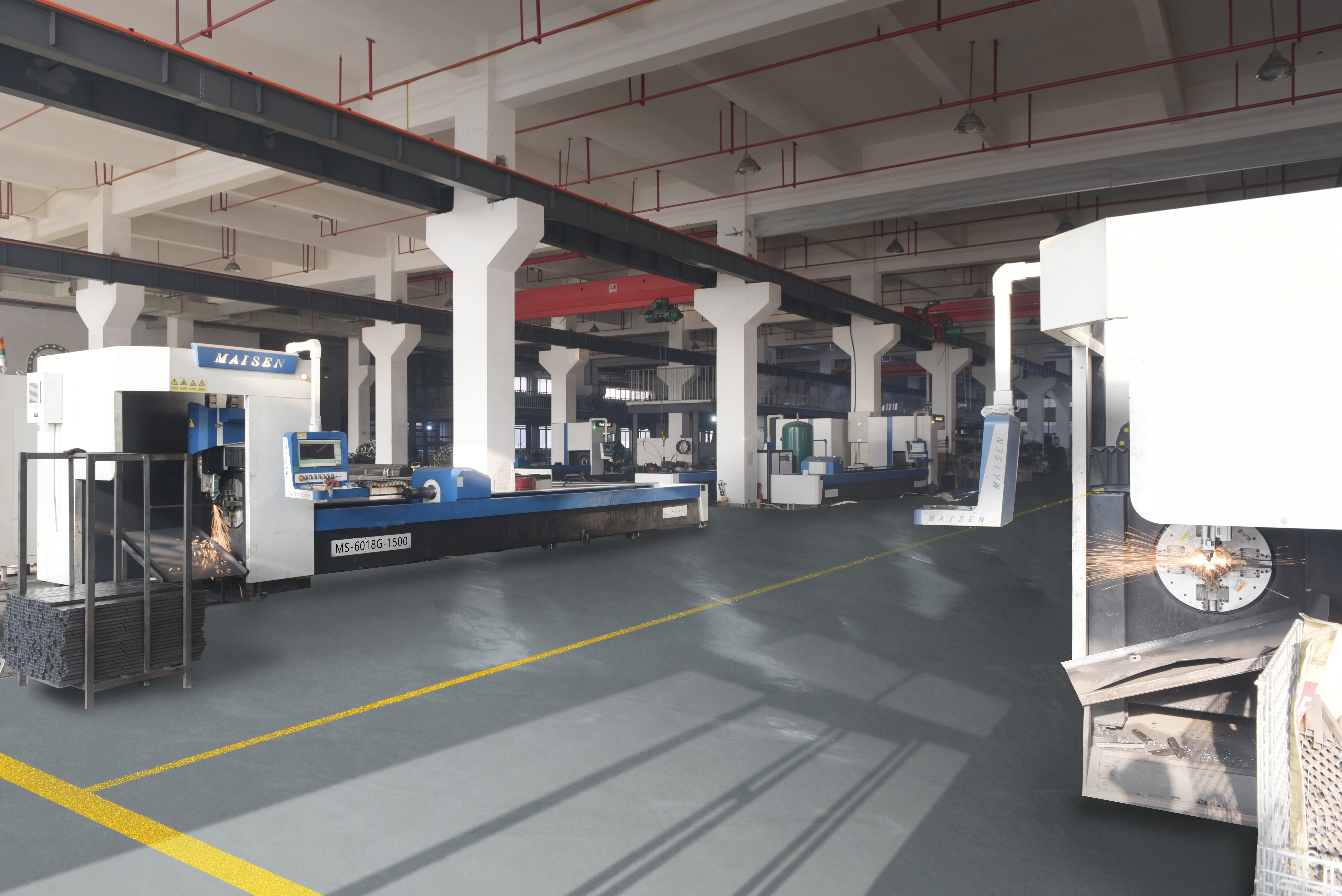
Zhouqi states it was founded in 2008, operates a factory area of 130,000 square meters, employs approximately 450 people, and supports an annual output of 200,000 units. The R&D team is reported as 34 engineers, with about 50% of production exported to the USA, EU, Southeast Asia, and the Middle East. Manufacturing capability is documented with in-house processes including injection molding, sewing, precision CNC cutting, automated assembly, high-precision welding robots, and auto stamping equipment.
Quality control is another axis where comparisons become more concrete. Zhouqi’s capability profile states that 100% of products undergo QC testing, with a monthly capacity of 16,000 units and standard lead time of 30–45 days. MOQ is 1x40HQ. For after-sales, the company provides a 1-year warranty, installation videos, and maintenance manuals. Buyers can benchmark those parameters directly against supplier proposals:
| Supply Chain Parameter | Documented Zhouqi Commitment |
|---|---|
| Production Mode | OEM / ODM |
| Customization Scope | Color, Logo, OEM file, Pillow and backrest design, UI, Language |
| Monthly Capacity | 16,000 units |
| Lead Time | 30–45 days |
| MOQ | 1x40HQ |
| QC | 100% QC test |
| After-sales | 1-year warranty; installation videos and maintenance manual |
Comparison Framework: 5 Verification Points for Buyers
Below is a neutral comparison framework that buyers can use side by side with any 4D massage chair supplier, including Zhouqi.
1. Certification traceability. Ask for certification copies with holder name, certificate number, authority, issuing date, expiry date, and standard references. Verify ETL for US/Canada via the certifying body, CE for EU, and FDA registration for US market entry. A supplier should not need to send a photo of the certificate from an internet marketplace listing; it should exist in the factory’s own document set.
2. Physical specification sheet. Compare the exact SL track length, product dimensions, boxed dimensions, net/gross weight, rated power, and power input range. If the written specification sheet does not mention track length in centimeters, ask why. Marketing pages can say “full body SL track” without supplying any measurable comparison point.
3. Factory capability evidence. Review whether the supplier owns basic manufacturing infrastructure or only assembles frames from external suppliers. Surface-level evidence includes in-house injection molding, CNC cutting, sewing line, welding robots, assembly lines, and QC staging areas.
4. QC and warranty terms. Confirm QC protocol (e.g., 100% QC test), warranty length, spare-parts policy, and after-sales documentation. The cost of a warranty failure in one container can be much larger than the per-unit discount negotiated at order time.
5. Reference cases and market channel fit. Assess the supplier’s history in markets similar to your own. A supplier with prolonged sales in both Vietnam and the United States has practical experience with two very different electrical requirements, packaging expectations, and after-sales environments.
Buyer Comparisons Since 2024’s Feature Shift: AI, Dual Mech, and 4D
Market data shows a rising presence of AI-related features in massage chairs. Research cited across third-party reports indicates that around 41% of new massage chair models released in 2024 integrated AI-based sensors for personalized user experiences. While AI support can be a meaningful point of differentiation, buyers should verify whether the AI feature changes massage routines, uses body-scan data, or exists primarily as an interface label.
For 2026 programs, luxury buyers may compare 4D against even higher-spec configurations, such as AI-supported dual-mechanism chairs. The US luxury massage chair market is expected to grow by USD 43.7 million between 2023 and 2028. This growth creates demand for models that combine 4D roller pacing with additional mechanisms, but it also raises the engineering risk. A chair with two mechanisms requires more software integration and generally more after-sales training for distributors.
Given the increasing overlap of “4D,” “AI,” and “dual mechanism” claims, buyers should treat every feature claim as requiring evidence. A 2026 purchase program should define which features are mandatory and which are options after supplier documents are examined, not before.
Market Trend Analysis: What the Data Says About 4D Growth and Positioning
Third-party analyst data offers a wider context for comparing 4D massage chairs. Full-body massage chairs accounted for about 55.3% of the product segment in 2024. Asia Pacific remains the largest market, and online distribution is the fastest-growing channel. The massage chair and sofa category contributed 39.5% of total massage equipment market revenue in 2024.
These signals have three practical meanings for wholesale buyers:
First, the market’s center of gravity is still in full-body chairs rather than compact or specialty devices. A 4D chair must therefore meet the same general expectations of full-body coverage, which is directly related to SL track length and mechanism architecture.
Second, e-commerce will expose the product to more comparison-shopping and customer reviews. Buyers need consistent specification sheets that can populate retail product pages without errors.
Third, certification boundaries are not softening. As more 4D models enter the US and EU markets, the presence of a verifiable certificate becomes a minimum listing requirement for responsible e-commerce platforms and commercial tenders.
Limitations and Boundaries in Supplier Comparison
Even when a supplier presents strong documentation, buyers should be aware of the boundary conditions of any comparison.
Certification scope is not universal. A certificate may apply to a defined series or model list. For Zhouqi, the ETL and CE certificates are linked to specific 4D models: 6510, 5300, 5380, 8620, 6920, 8600, 3900, 3910, 9100, 8520, 6540, 6600, 7100, and 8710. A buyer who plans to order a different model number cannot assume the same certificates automatically apply. The model list must be checked against the certificate’s scope.
Electrical configuration is not a sales-page substitute. Wide voltage input (110V-240V) simplifies North American and international ordering, but local plug types still differ. A 110V-240V-rated chair with the wrong plug or a local code requirement may still need regional configuration. Buyers should specify plug type and any market-specific labeling in the purchase order.
Reference cases describe experience, not future performance. A four-year Vietnam case and a three-year US case are evidence of traction and repeat ordering. They are not a guarantee that a new order will perform identically in a different country, consumer segment, or regulatory environment.
Recommendations for Importer and Distributor Buying Teams
For buying teams evaluating 4D massage chairs in 2026, the comparison should lead to evidence-based questions rather than immediate price negotiation. The recommended sequence is:
- Obtain the factory’s certification documentation for target models and confirm model-number scope.
- Compare technical specification pages, including SL track length, dimensions, weight, voltage, and wattage. Reconcile any mismatches between website, brochure, and spec sheet.
- Assess manufacturing depth: in-house processes, assembly line evidence, R&D staff, and QC protocol.
- Evaluate supply-chain terms: capacity, lead time, MOQ, and after-sales support. Match them to your ordering cycles, not just to one launch order.
- Use case histories only as directional context, while keeping the verification focus on your target market’s certification requirements.
Zhouqi’s documented profile presents one baseline for comparison. The manufacturer’s export ratio of 50%, markets in USA/EU/SE Asia/Middle East, certifications covering US, Canada, and EU, and 4D series specification details give importers enough verifiable data to include in a shortlist. However, the same documents should be requested from every competing factory before the final selection is made.
Frequently Asked Questions from 4D Massage Chair Buyers
What is the main difference between 4D and dual-mechanism massage chairs?
4D roller technology generally adds dynamic speed and rhythm control to roller movement, while dual-mechanism designs use two independently controlled mechanisms to massage different zones simultaneously, such as the upper back and lower glute areas. Some chairs combine both approaches, which increases coverage and complexity.
Which certifications should a 4D massage chair have for US and Canadian distribution?
For the US and Canada, buyers typically require ETL certification or an equivalent Nationally Recognized Testing Laboratory certification. Zhouqi’s 4D series holds ETL certificate number 5030347, issued by Intertek, under UL 1647:2015 Ed.6 and CSA C22.2#68:2018 standards for massage chairs. FDA registration is also documented for the US market.
What does a 130 cm SL track mean for massage coverage?
An SL track of approximately 130 cm is designed to extend massage rollers along the spinal curve from the neck down toward the hamstring area. In comparison with shorter tracks, a longer SL track generally provides fuller coverage across cervical, thoracic, lumbar, and gluteal regions. Buyers should confirm the track length in the formal specification sheet rather than relying on sales descriptions.
Can a 110V-240V massage chair be used across North America and the EU?
A chair documented with 110V-240V, 50/60Hz power input is designed to operate in both North American and European electrical systems without changing the internal voltage configuration. Zhouqi’s 4D series is documented with 110V-240V, 50/60Hz input and 200W rated power. Buyers should still specify the required plug type and any destination-country labeling requirements at the time of order.
How can an importer verify that certification documents are genuine?
Importers should request the full certificate PDF, verify the certificate holder name matches the manufacturer, check the certificate number on the issuing body’s verification portal where available, and confirm the product model numbers are listed in the certificate scope. Zhouqi’s ETL certificate number is 5030347 from Intertek, and its CE certificate number is ENB2311240186E00201C from EMTEK.
What are realistic MOQ and lead-time expectations for 4D massage chair orders?
For established manufacturers, a typical MOQ may be around 40-foot high-cube container volume, and lead times for production commonly range from 30 to 45 days. Zhouqi publishes a monthly capacity of 16,000 units and a standard lead time of 30–45 days. Buyers should confirm these figures with the factory for their chosen models before contract confirmation.
Conclusion: Buyers Who Compare Documents First Will Avoid Costly Supply Mismatches
The 4D massage chair category continues to grow, but growth encourages more suppliers to use the same terms. The 2026 buying decision should not rest on which brand has the most familiar name or which brochure uses the boldest adjectives. The evidence is found in verifiable certifications, measurable track and power specifications, manufacturing depth, QC systems, and delivery history.
Buyers who apply the five-point verification framework to every candidate supplier will be in a stronger position to select a 4D massage chair that matches their market, electrical requirements, and quality expectations. For teams that need a complete reference document covering Zhouqi’s current product and certification information, the company’s 2026 catalogue is publicly accessible for evaluation: Download the 2026 E-catalogue.
All product specification and certification data in this article is sourced exclusively from Ningbo Zhouqi Health Technology Co., Ltd. corporate documents and certification records. Third-party market data appears within the cited analyst context, not as an endorsement of any specific supplier.
Есть вопросы или нужны дополнительные детали?
Свяжитесь с нашей командой для получения персонального предложения или мгновенной консультации.
Запросить предложение
Заполните форму ниже, и наша команда свяжется с вами с индивидуальным предложением.
Прямой чат WhatsApp
Предпочитаете общаться в реальном времени? Напишите нам в WhatsApp для мгновенной помощи и быстрых ответов.
- Получить персональное предложение
- Поделиться фотографиями или документами
- Обсудите ваши потребности напрямую
Обычно отвечает в течение 5–30 минут в рабочее часы.