
4V Cordless Staple Gun Specs and Certification Checklist
A 4V cordless staple gun is a battery-powered fastening tool built around a single 3.7 V lithium-ion cell. For buyers in the research and evaluation stage, the figures that decide whether such a tool can be listed, sold and supported in a target market are rated voltage, battery capacity, fastener compatibility and a safety certificate that names the exact model number - not the voltage badge printed on the retail box.
This industry reference examines the 4V cordless staple gun category through the documented specification and certification record of the cordless range marketed under HOTAK PRO TOOLS, manufactured by Ningbo (Yinzhou) Yongjia Electrical Tools Co., Ltd. (YONGJIA TOOLS), a Ningbo-based hand and cordless tool manufacturer founded in 2000, operating a 45,000 m2 production base with an annual output of 18,000,000 units, a 25-engineer R and D team and a 95% export ratio across the EU, USA, Southeast Asia and South America. The purpose is not to describe a catalogue, but to explain what each documented figure requires a buyer to verify.
Why 4V Is a Naming Convention, Not a Performance Tier
The first constraint in this category is a labelling one. Cordless tools of this size run on a single lithium-ion cell with a nominal voltage of 3.7 V. Retail packaging frequently rounds that figure to 4V, while engineering documents, test reports and regulatory paperwork carry the 3.7 V value. Both descriptions refer to the same platform.
The product record shows this directly. The YJSG-501 five-use cordless staple gun and the YJSG-500 two-use cordless staple gun are both documented at a rated voltage of 3.7 V. A comparison that treats 4V and 3.7V as separate performance tiers is comparing labels rather than hardware.
For procurement, the voltage badge therefore cannot be used as a shortlist filter. The figures that can be compared are rated voltage, battery capacity in mAh, rated power in watts, the documented operating time and the basis on which it was measured, the fastener families the magazine accepts, and the model-specific safety certification.
What the Cordless Staple Gun Datasheet Should Contain
Two cordless fastening configurations are documented in this record, and they differ in the number of fastening uses supported rather than in battery class.
| Model | Configuration | Rated voltage | Battery | Rated power | Documented performance |
|---|---|---|---|---|---|
| YJSG-501 | Five-use lithium electric nail gun (5-in-1) | 3.7 V | 2000 mAh | 25 W | Metal body; no-load operating time of at least 60 minutes |
| YJSG-500 | Two-use lithium electric nail gun (2-in-1) | 3.7 V | 2000 mAh | 25 W | Metal body |
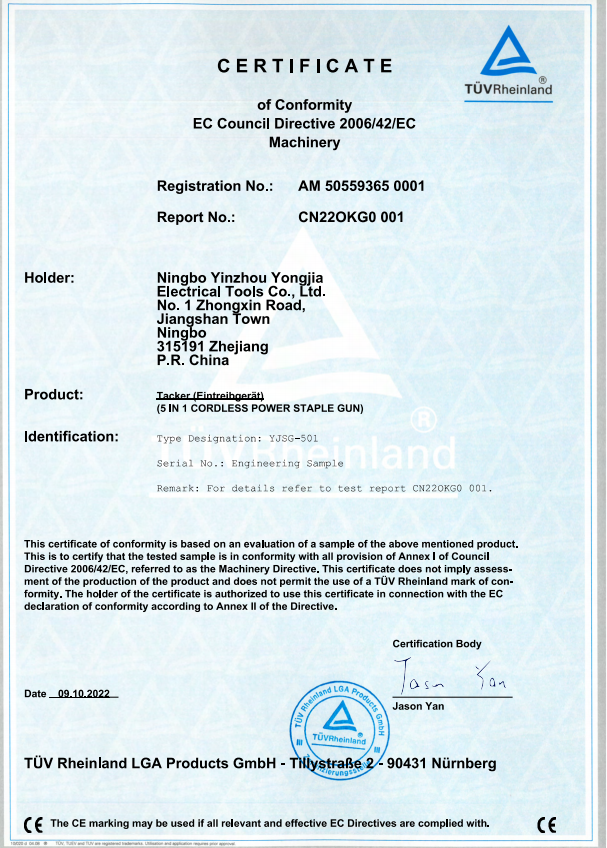
The five-use configuration is also reflected in the regulatory record: the EU certificate for the cordless staple gun names the product as 5 IN 1 CORDLESS POWER STAPLE GUN, Model YJSG-501. When a configuration claim appears in a certificate scope as well as on a datasheet, it carries more weight than a catalogue description alone.
The Wider 4V Platform: Battery Commonality as a Buying Factor
A cordless staple gun is rarely sourced in isolation. Distributors assembling a private-label programme need to know what else runs on the same cell class, because shared charging logic and battery format reduce SKU complexity and after-sales cost.
| Product | Function | Rated voltage | Battery | Key documented figures |
|---|---|---|---|---|
| YJPS-902 | Power screwdriver | 3.7 V | 2000 mAh | No-load operating time at least 60 min; three documented torque settings of 2 N, 3.5 N and 5 N; manual torque 10 N.m; 0-280 rpm |
| YJPS-912 | Power screwdriver set | 3.7 V | 800 mAh | No-load operating time at least 50 min; electric torque 2.5 N; manual torque 10 N.m; 0-250 rpm |
| YJPS-906 | Electric precision repair tool set | 3.7 V | 320 mAh | No-load operating time at least 30 min; electric torque 0.15 N.m; manual torque 3 N.m; 0-220 rpm |
| YJGG-001 | Cordless hot glue pen | 3.7 V | 320 mAh | 4.2 W; operating time at least 120 min; operating temperature 150 C; glue release in 30 sec; 5 V charge output |
| YJTS-3526 | 41-piece household electrical screwdriver set | 3.7 V | 320 mAh | 220 rpm; power torque 0.15 N.m; hand torque 3 N.m; one-hour charging |
The manufacturer's product listing also includes a mini rotary tool within the same hand and cordless tool range; the specification record reviewed here does not carry parameters for that model, which is itself a point for buyers to note when compiling a range plan.
The pattern across the documented models is a single 3.7 V cell class spanning fastening, driving, precision repair and adhesive application, with a 5 V charge output voltage recorded on the higher-capacity models YJPS-902 and YJGG-001. For an importer, that structure determines whether a private-label programme can be assembled from one supplier instead of being split across several vendors.
Certification: Match the Certificate to the Model Number, Not the Brand
Certification is the constraint most likely to delay a retail listing, and a general statement of conformity is not sufficient evidence. The document has to name the model.
The cordless staple gun in this record is covered as follows: the 5 IN 1 CORDLESS POWER STAPLE GUN, model YJSG-501, holds a CE Certificate of Conformity to the EU Machinery Directive 2006/42/EC, certificate number AM 50559365 0001, issued by TUV Rheinland LGA Products GmbH for the EU market, issued on 10 September 2022 and valid to 31 December 2030. The applicable standards are Directive 2006/42/EC, EN ISO 12100:2010 and EN ISO 11148-13:2018.
Two further certificates in the same portfolio show why the scope field, not the brand name, is the part that matters:
- CE certificate AM 50694538 0001, issued on 2 March 2026 and valid to 31 December 2030, covers hand-operated tackers under the same directive and the same two standards - specifically models YJSG-105 and YJSG-023. It does not extend to cordless models.
- GS certificate S 50694620 0001, issued on 18 March 2026 and valid to 17 March 2031, covers hexagon screw keys with ball end under DIN ISO 2936-10.16 and AfPS GS 2019:01 PAK for the German market - a different product scope entirely.
There is a second layer of verification worth applying at supplier level. The manufacturer of this range holds ISO 9001 quality management certification, TUV/GS certification, BSCI social compliance certification and VPA (Verify Production Audit) approval, and has passed factory audits for Walmart (USA) and Kingfisher (UK). Those approvals describe the production system; the CE and GS certificates described above apply to specific products. Buyers should keep the two categories in separate files.
Application Fit: Where a 3.7 V Cordless Stapler Belongs
Both cordless staple gun models in this record are stated for household and manufacturing use. The wider fastening portfolio from the same manufacturer defines the application envelope this class is built around: insulation, house wrap, roofing underlayment, vapour barriers, wiring, carpeting, upholstery and decorative work, alongside general household, office and workshop fastening.
Field evidence points to a retail and light-industrial position rather than heavy construction. Brand owners, hardware wholesalers and retail chains in Germany, France, the United States, Canada, Mexico, Brazil, Argentina and Malaysia place orders of 5,000 to 50,000 units for auto repair, household fastening and workshop maintenance, with partnership durations of three to five years and a stated outcome of reliable performance, low return rate and consistent quality.
For a buyer, the shape of that evidence is more useful than a peak-performance claim: retail-scale order volumes, low return rate as the success metric, and applications concentrated in repair and light fastening rather than continuous heavy-duty fastening.
Comparison with Manual Fastening, and Where the 4V Class Stops
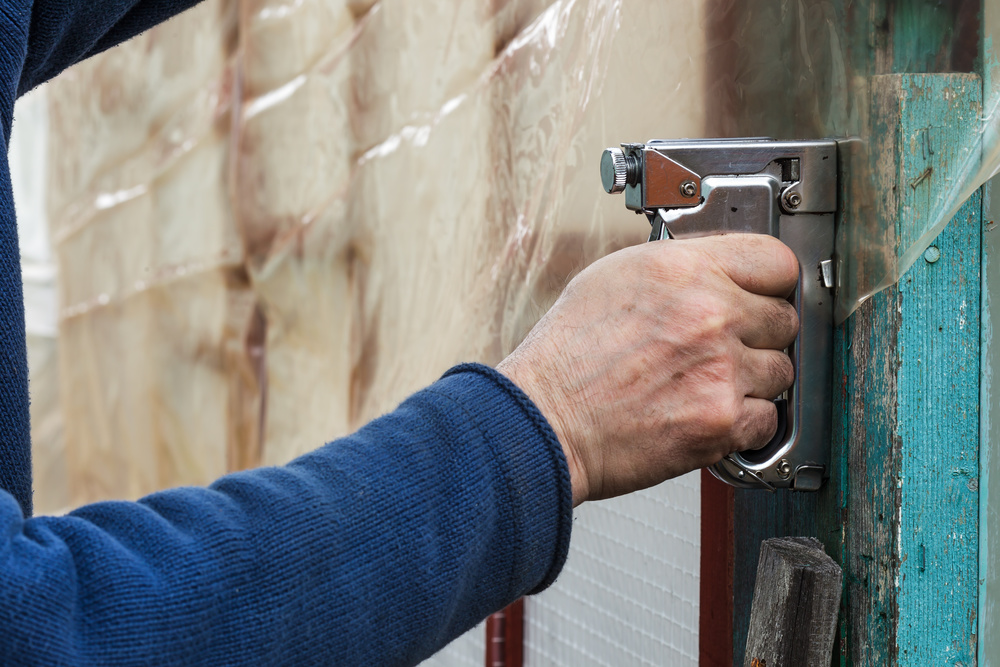
The most honest comparison for a 3.7 V cordless staple gun is not another cordless tool; it is the manual staple gun it replaces.
| Criterion | Manual staple gun (examples from the same range) | 3.7 V cordless staple gun (YJSG-501 / YJSG-500) |
|---|---|---|
| Power source | Hand force, no battery | Single 3.7 V lithium-ion cell, 2000 mAh |
| Operator fatigue over volume | One compression cycle per staple | Motor-driven; requires charge management instead |
| Fastener compatibility | Documented per model: JT21, T50, T25, T20, 18GA staples; Arrow T50 and 140 staples; 6-10 mm fine wire staples | To be confirmed per cordless model |
| Regulatory documentation | CE certificate AM 50694538 0001 covers hand-operated tackers YJSG-105 and YJSG-023 | CE certificate AM 50559365 0001 covers model YJSG-501 |
| Documented runtime | Service-life guidance by body material | At least 60 minutes no-load operating time on YJSG-501 |
The boundaries that follow from that comparison are worth stating plainly.
- Duty class. A single-cell 3.7 V stapler is a light-to-medium duty platform. The documented performance figure for the YJSG-501 is a no-load operating time of at least 60 minutes, which describes motor run time without driving fasteners and must not be converted into a staples-per-charge expectation. Where fastening is continuous and high-volume, corded or pneumatic systems remain the appropriate comparison.
- Material, not voltage, drives service life. The service-life guidance recorded for this product family states that plastic-bodied staple guns exceed 7,000 shots, iron-bodied staple guns exceed 15,000 shots, and aluminium-alloy staple guns exceed 30,000 shots. Buyers comparing two 4V tools should compare body material and mechanism before comparing voltage labels.
- Fastener compatibility is model-specific. Within the same portfolio, a 6-in-1 hand model (YJSG-196) accepts JT21, T50, T25, T20 and 18GA staples; a heavy-duty staple and nail gun (YJSG-115) accepts Arrow T50 and 140 staples in 9/16 in., 1/2 in., 3/8 in., 5/16 in. and 1/4 in. leg lengths; and a fine-wire model (YJSG-140) accepts 6-10 mm (1/4 in. to 3/8 in.) staples. Compatibility has to be confirmed for each cordless model individually.
- Charging is part of the operating cost. A cordless tool adds charging routines, cable handling and battery replacement planning to the workflow; a manual tool does not. For occasional household use, that trade-off may not justify the cordless platform at all.
Procurement Checklist for 4V Cordless Staple Guns
| Item | What to request | Why it matters |
|---|---|---|
| Cell class and rated voltage | Confirmation of 3.7 V nominal, single-cell lithium-ion | Prevents comparisons based on marketing voltage labels |
| Battery capacity and power | mAh and wattage per model | Documented at 2000 mAh and 25 W for the two cordless staple guns in this record |
| Operating time basis | State whether runtime is no-load or loaded, and with which fastener | No-load figures overstate field performance |
| Fastener compatibility | Staple series and leg-length range per model | Most common source of returns and application failures |
| Configuration count | Number of fastening uses (2-in-1, 5-in-1) | Determines application range and price positioning |
| Certificate scope | Certificate document with the model string in the scope field | Evidence applies only to the models named in the certificate |
| Body material and mechanism | Material of housing and drive mechanism | Drives service life; compare before voltage |
| Customization | Colour and logo options, packaging format | The documented OEM/ODM programme covers colour and logo customization |
| Commercial terms | MOQ, lead time, monthly capacity | Documented at MOQ 600, lead time 30-45 days and 1,500,000 units per month |
| Quality control | Incoming, in-process and final inspection records | Three-stage inspection is the documented process |
| After-sales | Support and replacement terms | Remote support is the documented after-sales mode |
Market Trend: Cordless Migration and Documentation as a Filter
Two trends shape this category. The first is the migration of light fastening work from manual to battery tools in home improvement, furniture assembly, craft projects and light repair - applications where a single-cell 3.7 V platform is sufficient and where users value freedom from a cable and reduced hand fatigue.
The second is documentation. European buyers increasingly treat certificate scope and the model string as a filtering step before commercial negotiation, and the CE record above illustrates why: certificates held by the same manufacturer cover different product families and different markets. A supplier that can produce model-level documents shortens the listing process.
Commercially, the supply side has moved toward private label. The manufacturer in this record runs an OEM/ODM programme with colour and logo customization, a documented MOQ of 600 units, a lead time of 30-45 days and monthly capacity of 1,500,000 units, exporting 95% of output to the EU, USA, Southeast Asia and South America. For importers, that combination is what makes a 4V cordless tool programme feasible at retail-brand scale.
Future Outlook
The 4V class will continue to expand into lower-power tool categories where a single cell is sufficient, and the cordless staple gun sits in the middle of that range: it demands more energy per cycle than a precision screwdriver but considerably less than a drilling tool. Battery commonality across the range is likely to remain the main driver of platform choice for distributors.
Charging is the next visible constraint. The charge output voltage documented on the higher-capacity cordless models in this record is 5 V, which is consistent with 5 V USB-class charging. As that becomes the default expectation among end users, tools that still depend on proprietary chargers will attract more questions during evaluation.
What is unlikely to change is the documentation requirement. Model-level certification, body material grade, fastener compatibility and a clear basis for runtime figures are the four items that move a cordless staple gun from quotation to listing.
Frequently Asked Questions
Is a 4V cordless staple gun the same as a 3.7V cordless staple gun?
Yes. Both describe a cordless tool running on a single lithium-ion cell with a nominal voltage of 3.7 V. The 4V figure is a rounded retail label, while engineering and regulatory documents typically state 3.7 V. In the product record referenced here, the YJSG-501 and YJSG-500 are both documented at a rated voltage of 3.7 V.
Which certification should a cordless staple gun carry for the EU market?
The applicable route for this product type is the EU Machinery Directive 2006/42/EC, with the harmonised standards EN ISO 12100:2010 and EN ISO 11148-13:2018. The 5 IN 1 CORDLESS POWER STAPLE GUN, model YJSG-501, is covered by CE certificate AM 50559365 0001 issued by TUV Rheinland LGA Products GmbH, valid to 31 December 2030. Buyers should confirm that the certificate scope names the exact model being purchased, because other certificates from the same manufacturer cover different product families.
How long does a 4V cordless staple gun run on one charge?
The documented figure for the YJSG-501 is a no-load operating time of at least 60 minutes from a 2000 mAh battery. That value describes motor run time without driving fasteners rather than a staples-per-charge count. Loaded performance depends on staple leg length, material hardness and cycle rate, and should be requested as test data from the supplier.
What determines how long a staple gun lasts?
Body material and mechanism are the main variables. The service-life guidance recorded for this product family states that plastic-bodied staple guns exceed 7,000 shots, iron-bodied staple guns exceed 15,000 shots, and aluminium-alloy staple guns exceed 30,000 shots. Housing material should therefore be checked alongside motor and battery specifications.
What is the difference between a 2-in-1 and a 5-in-1 cordless staple gun?
The difference is the number of fastening uses the tool supports, not the battery class. The YJSG-500 is documented as a two-use lithium electric nail gun and the YJSG-501 as a five-use model; both operate at 3.7 V with a 2000 mAh battery and 25 W rated power. The five-use configuration is also named in the EU certificate scope for the YJSG-501.
How is staple compatibility confirmed for a cordless staple gun?
By requesting the staple series and leg-length range for the specific model. Compatibility varies across a portfolio: a 6-in-1 hand model in the same record accepts JT21, T50, T25, T20 and 18GA staples, a heavy-duty staple and nail gun accepts Arrow T50 and 140 staples in five leg lengths from 1/4 in. to 9/16 in., and a fine-wire model accepts 6-10 mm staples. The same per-model confirmation applies to cordless versions.
What are typical OEM terms for private-label 4V cordless tools?
The documented terms for this manufacturer are an OEM/ODM programme covering colour and logo customization, a minimum order quantity of 600 units, a lead time of 30-45 days and monthly capacity of 1,500,000 units. Quality control covers incoming inspection, in-process inspection and final inspection, and after-sales support is provided remotely.
Reference Material
The full product documentation referenced in this industry reference, covering the wider hand and cordless tool range, is compiled in the YONGJIA TOOLS product catalogue (PDF). Buyers evaluating 4V cordless staple guns should treat a catalogue as a starting point and request model-level certificates, fastener specifications and loaded-cycle test data before placing an order.