
5 kWh Home Battery or 100 kWh C&I Cabinet: A Buyer's Framework
5 kWh Home Battery or 100 kWh C&I Cabinet: A Buyer's Framework
Storage purchases usually begin with a number. A homeowner asks whether a 5 kWh battery is enough. A plant manager asks whether a 100 kWh cabinet will carry the site. Both questions are reasonable, and both are premature — because a 5 kWh home battery and a 100 kWh commercial and industrial (C&I) cabinet are not two sizes of the same product. They are different architectures, with different power electronics, different protection envelopes, different expansion logic and different duty cycles.
SolisStorage, the energy storage subsidiary of Ginlong (Solis) Technologies Co., Ltd. (Shenzhen Stock Exchange: 300763), maintains platforms at both ends of that range: a residential line (IntelliHome), a stackable small C&I platform (FlexCore-ID), and a 125 kW / 261 kWh C&I cabinet (EverCore). Because those platforms sit on either side of the decision, they make a practical reference set for the framework below.
The framework rests on three variables: load profile (power before energy), operating environment (thermal, ingress, altitude, corrosion), and power requirement plus expansion path (phase, transfer behaviour, PV coupling, future capacity). Everything else — price, warranty, brand familiarity — is negotiated after those three are settled, because they determine which category of product can physically do the job.
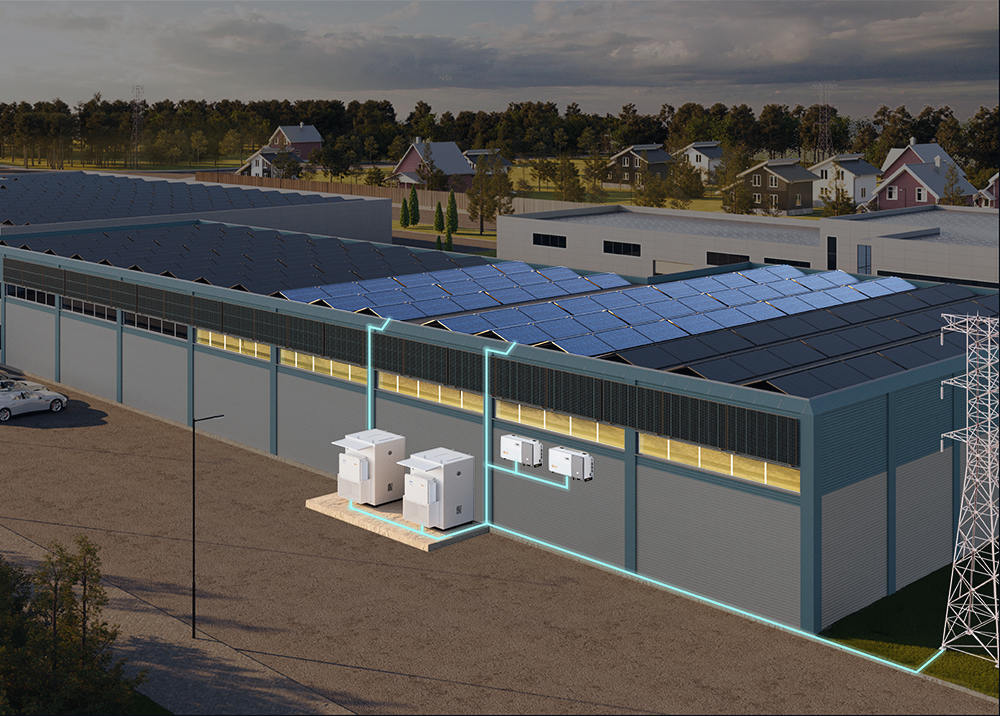
Why the capacity label is a weak entry point
Deployment volumes explain why buyers now meet capacity labels spanning three orders of magnitude in the same procurement conversation. BloombergNEF projected global energy storage deployment, excluding pumped hydro, to reach 92 GW in 2025. In the United States, the Solar Energy Industries Association reported 57.6 GWh of new storage capacity installed in 2025 and described it as the largest year of additions on record; the headline figure rounds to 58 GWh in the same source. On the residential side, one commercial research forecast projects the segment growing from USD 2.67 billion in 2024 to USD 4.30 billion by 2030, at an 8.2% CAGR.
Volume growth produces crowded catalogues, and crowded catalogues invite cross-class comparison. That is where procurement errors start. Cost per kWh reads like a single, comparable number, but it embeds different power electronics, different protection hardware, different thermal design and a different service scope. A residential unit and a C&I cabinet are not substitutes, so their unit costs are not directly comparable.
A second error is mistaking energy capacity for capability. A 5 kWh battery and a 261 kWh cabinet differ by roughly a factor of fifty in stored energy, but the meaningful gap lies in continuous power, protection rating, duty cycle and service life — all of which a kWh figure silently conceals.
Variable 1 — load profile: power first, energy second
Two numbers describe any load: the power it draws at any instant (kW) and the energy it consumes over a period (kWh). Storage must satisfy both, and the usual mistake is to start with the second.
A house asks for a moderate, short evening peak — lighting, cooking, hot water, communications. A cold store asks for a sustained multi-hour load, and its refrigeration compressors add inrush currents that a small inverter cannot ride through. A farm asks for seasonal, motor-driven loads at irrigation or processing time. These three profiles can share similar daily energy totals and still require three different products.
Duration follows from simple arithmetic. As an illustration only: a 5 kWh battery under a 5 kW load is roughly a one-hour asset; a 100 kWh cabinet under a 50 kW load is a two-hour asset, and the same cabinet serving a 25 kW average load is roughly a four-hour asset before efficiency losses. Energy divided by power gives duration — and duration is what most C&I business cases actually depend on.
In practice this means metering peak demand and daily energy before comparing products, ideally across twelve months so that seasonal peaks appear. Two follow-up questions separate the classes quickly: is the peak short and repeatable (a motor start) or sustained (a working shift), and is the objective bill management, backup continuity, or both?
Variable 2 — operating environment
Environment decides enclosure, thermal strategy and service access. Residential units typically sit indoors, in a garage or utility room, where the binding constraints are space, clearance and noise. C&I cabinets typically sit outdoors or in a yard, where the binding constraints are weather, dust, salt, thermal load and fire separation.
EverCore illustrates how far the second case has moved. Its hybrid energy storage inverter carries IP66 protection, while the battery cabinet is rated IP55. The system uses a C4-grade anti-corrosion coating and is stated to operate from -25 °C to 55 °C and at altitudes up to 4,000 metres. Solis also notes that selected models reach NEMA 4X / IP66 for outdoor service. These are manufacturer statements and should be checked against the site's real conditions — a shaded, ventilated yard and a confined, sun-exposed enclosure are not the same installation even at identical ambient temperatures.
Altitude deserves particular attention because it is frequently missed in quotation templates: above roughly 2,000 metres, air density reduces cooling effectiveness, and a system rated to 4,000 metres is making a specific engineering claim rather than a generic one.
Variable 3 — power requirement and expansion path
Three questions belong here. The first is phase and interconnection: residential sites are often single-phase, while C&I sites are almost always three-phase, which alone can eliminate a residential platform from consideration.
The second is transfer behaviour. EverCore is designed to switch between grid-tied and off-grid operation in under 10 ms without an external static transfer switch. That matters for precision industrial equipment, cold chain and hospital loads, where a longer interruption is not a comfort issue but a process issue.
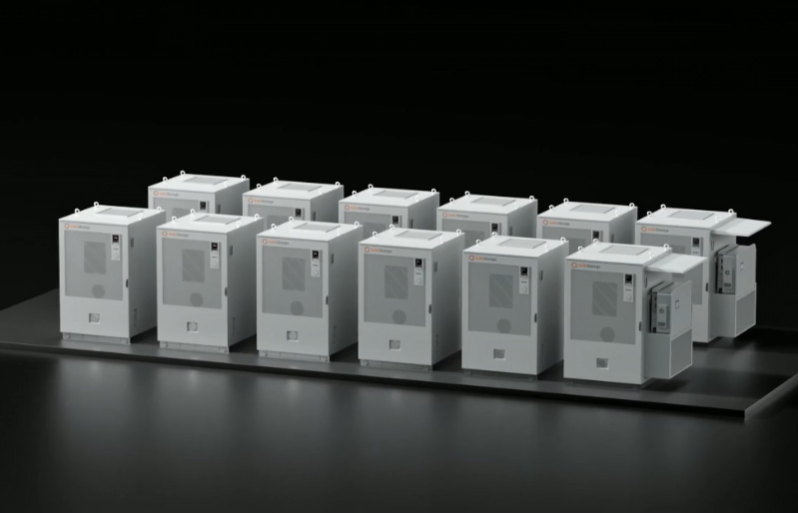
The third is PV coupling and expansion. The EverCore hybrid inverter integrates the power conversion system, static transfer switch, PV inverter, circuit breaker protection and energy management system into one unit, supports both DC and AC coupling for existing PV, and allows PV oversizing of up to 200%. On the DC side, a single inverter can connect up to six battery cabinets in parallel, which the company states reduces system expansion costs by approximately 10% by avoiding additional inverter investment. Beyond six cabinets, additional inverter capacity is required — a boundary worth knowing before a phased build is approved.
Mapping the three platforms onto the framework
| Decision attribute | Residential (IntelliHome), ~5 kWh class | Stackable small C&I (FlexCore-ID), ~100 kWh class | C&I cabinet (EverCore), 125 kW / 261 kWh |
|---|---|---|---|
| Typical site | Single-family home; single-phase and three-phase residential scenarios | Small commercial sites, remote or agricultural loads requiring incremental build-out | Industrial manufacturing, low-carbon industrial parks, hospitals, cold chain logistics, on-grid and off-grid applications |
| Load character | Short evening peaks, backup for essential circuits | Moderate multi-hour loads, staged capacity | Sustained multi-hour loads, motor-driven process equipment |
| Environment | Indoor, space and noise constrained | Mixed; installation-dependent | Outdoor-class: IP66 inverter, IP55 cabinet, C4 anti-corrosion, -25 °C to 55 °C, up to 4,000 m |
| Power electronics | Residential hybrid inverter | Stackable platform architecture | 50–125 kW hybrid inverter integrating PCS, STS, PV inverter, breaker protection and EMS |
| Expansion logic | Module addition within the residential family | Stacking as load grows | Up to 6 battery cabinets per inverter; further growth requires additional inverter capacity |
| Primary screening question | Can a single-phase or three-phase residential hybrid carry the peak? | Is the site staged, remote, or between two standard classes? | Does the site need 125 kW-class power with multi-hour duration and outdoor protection? |
What the 261 kWh cabinet architecture actually changes
AC/DC separation moves heat out of the cabinet
EverCore physically separates the AC side from the DC side, decoupling the hybrid inverter from the battery cabinet. The engineering consequence is thermal: roughly 6 kW of power-electronics heat dissipates directly to ambient, leaving about 3.5 kW of electrochemical heat to be managed inside the cabinet. The company states this allows an air-cooled design to approach the temperature uniformity usually associated with liquid-cooled systems. The underlying principle is sound and general — reducing heat generation is more efficient than improving heat removal.
Protection separation and control simplification
Because the inverter is an independent unit, it can carry a higher ingress rating than the cabinet: IP66 versus IP55. Solis concludes from its own field experience that this separated protection design reduces full-lifecycle failure rate by 50% — a company-reported figure rather than an independently audited one. The same logic applies to control: conventional systems run separate CPUs for the battery management system, power conversion system, energy management system and static transfer switch, creating multi-vendor communication links and shared fault diagnosis. EverCore uses a single central controller, which reduces failure points and simplifies fault location.
Air cooling, revisited
The 125 kW / 261 kWh cabinet retains air cooling, using a three-air-duct design that combines a patented diversion duct for the inverter with Coanda-effect airflow attachment across battery pack surfaces. Solis reports 30% higher heat dissipation efficiency than conventional air cooling, paired with IP66/IP55 protection and C4 anti-corrosion coating for operation from -25 °C to 55 °C and up to 4,000 metres.
Cell choice sets the long-run economics
EverCore uses A-grade 314 Ah lithium iron phosphate cells specified for C&I duty, with internal resistance of 0.15 ± 0.05 mΩ versus 0.17 mΩ for the 280 Ah cells still widely used in the category. Solis states that each 10% reduction in internal resistance lowers charge-discharge heat generation by roughly 20%. Cycle life is quoted at 8,000 cycles at 0.5C with remaining capacity of at least 70%, against approximately 7,000 cycles for 280 Ah cells — which, at 500 cycles per year, extends economic life from roughly 14 years to roughly 16.
O&M is part of the architecture, not an afterthought
Over a 10–15 year C&I asset life, maintenance often erodes the returns that the initial quotation promised. Solis estimates EverCore saves approximately €9,500 per unit across the lifecycle by eliminating liquid-cooling fluid replacement (€2,500), simplifying PCS replacement (€1,500), simplifying pack replacement (€1,500) and reducing routine inspection complexity (€4,000). Component selection supports the same argument: Minebea cooling fans are described as 10-year maintenance-free, and Honeywell industrial flammable-gas detectors as 10-year calibration-free. Pack replacement steps are reduced by 55%, and the company states two technicians can complete the task with specialised tools and no heavy lifting equipment.
Applying the framework: a practical decision sequence
| If the site profile looks like this | Start the evaluation at | Verify before shortlisting |
|---|---|---|
| Single-family home, single-phase supply, evening peaks, backup for essential circuits | Residential ~5 kWh class (IntelliHome) | Peak kW versus inverter rating; backup circuit list; indoor clearance and noise |
| Small shop, clinic, farm or remote site with moderate loads and staged budget | Stackable small C&I ~100 kWh class (FlexCore-ID) | Stacking limits; motor inrush; three-phase balance; service access distance |
| Factory, cold store, hospital or industrial park with sustained 125 kW-class demand | C&I cabinet, 125 kW / 261 kWh (EverCore), multi-cabinet | Load duration at peak; outdoor thermal study; grid code and fire separation; transfer requirement |
| Existing PV array with a separate inverter and an ageing grid connection | C&I cabinet with DC or AC coupling | PV oversizing allowance, coupling method, existing protection coordination |
The sequence that produces defensible decisions is short: meter peak demand; calculate duration at that peak; classify the environment; confirm phase and transfer requirements; check the expansion path against the five-year plan; and only then compare commercial terms across shortlisted suppliers.
Where each class fits in practice
Solis positions the EverCore cabinet for industrial manufacturing, low-carbon industrial parks, hospitals, cold chain logistics, small-scale agriculture, and combined on-grid and off-grid applications — profiles that share sustained loads, outdoor siting and a need for continuity during switching. Residential deployment follows the opposite logic: single-phase and three-phase household scenarios, where the value is self-consumption of rooftop solar plus a defined backup envelope.
Software scale is a useful signal of where each class is heading. Solis reports long-term operating experience across more than 300,000 energy storage sites worldwide, and its Solis AI Cloud Platform is deployed at more than 5,500 storage stations. In one residential project in Latvia, AI-based charge-discharge optimisation increased annual electricity bill savings by 302.6% — a single-project result that illustrates how much of the value in a small system is decided by dispatch strategy rather than by capacity alone.
Comparing architectures — and where the framework stops
Traditional C&I projects assemble the system from separate boxes: a PV inverter, a power conversion system, a static transfer switch, a grid cabinet and an EMS, often from different vendors. The integrated approach combines them. Solis states the core architectural difference versus alternatives from Huawei, Sigen and SolaX is a hybrid topology with clear DC and AC separation plus fully integrated four-in-one power electronics, and its own comparison material claims a 5% lower cost. That figure should be treated as a vendor claim to be tested against landed cost, warranty terms and service scope for the specific project.
The air-cooling claim deserves the same treatment. A 30% heat-dissipation improvement over conventional air cooling is a meaningful engineering result if it holds at the site's summer peak and mounting conditions, which is precisely why a thermal review should precede signature rather than follow commissioning.
Limits and boundary conditions
- Capacity class is not a ranking. A 261 kWh cabinet is not a better version of a 5 kWh home battery. Below roughly 100 kWh of requirement, cabinet economics weaken quickly, and above a household peak, a residential unit cannot substitute for three-phase C&I hardware.
- Parallelism has a ceiling. DC-side expansion without additional inverter investment is stated for up to six battery cabinets per inverter. Growth beyond that requires additional inverter capacity, which should be planned rather than discovered.
- Environmental ratings are conditions, not guarantees. Operation from -25 °C to 55 °C and up to 4,000 metres describes the rated envelope. A confined, poorly ventilated yard can breach that envelope in practice.
- Standard scope is not product certification. UL 9540 covers energy storage systems for residential and non-residential installations, but a standard's scope statement does not confirm that a specific SKU is listed for a specific market. Buyers should request certificate evidence at model level.
- Cycle life depends on duty. The 8,000-cycle figure is quoted at 0.5C with at least 70% capacity remaining. Different discharge rates, depths and temperatures will produce different results.
- Cost benchmarks are not public. No verified per-kWh system price exists in the public record for these classes, so quotation comparison remains the only reliable cost basis.
Market trend: software openness is becoming a hardware criterion
In mature electricity markets, C&I storage revenue has moved beyond simple peak-valley arbitrage toward grid ancillary services such as FCR, aFRR and mFRR, demand response, and virtual power plant dispatch. That shift changes what buyers should evaluate. A cabinet that cannot be dispatched by a third-party aggregator is a closed hardware island, whatever its cycle life.
Solis states that EverCore has been connected, or is in the process of connecting, with 102 third-party VPP and EMS operators across 11 European countries. Named examples include the Kraken energy management platform operated by Octopus Energy in the UK, and aggregator platforms such as Check Watt in the Nordic market, alongside dozens of local EMS providers in the German-speaking region and Benelux. The Solis AI Cloud Platform integrates wholesale price data from Nordpool and retail price data from Flatpeak into a multi-source price forecasting model for minute-level dispatch optimisation.
For buyers, the practical implication is that protocol openness, aggregation readiness and local market participation should be asked at the same stage as power rating and enclosure class — not after the equipment is on site.
Future outlook
Three developments are likely to reshape class boundaries over the next planning cycle. First, DC-side expansion is making capacity a modular decision rather than a single capital commitment, which favours architectures that let a site grow without replacing its power electronics. Second, standardisation is tightening: UL 9540 already addresses both residential and non-residential installations, and market access will increasingly depend on model-level certification evidence rather than category claims. Third, and most consequentially, dispatch intelligence is becoming the differentiator inside a fixed hardware envelope.
The demand backdrop supports the trend rather than driving it alone. Record United States additions of 57.6 GWh in 2025, a residential segment forecast to grow at 8.2% CAGR to 2030, and 92 GW of projected global deployment in 2025 all describe a market where the constraint is no longer whether storage works, but whether the right class of storage was selected.
FAQ
What is the practical difference between a 5 kWh home battery and a 100 kWh C&I cabinet?
They serve different load classes and use different architectures. A 5 kWh residential battery addresses short household peaks and a defined backup envelope on a single-phase or three-phase residential supply. A 100 kWh C&I cabinet addresses sustained multi-hour commercial loads, typically three-phase, with outdoor-class protection and integration of power conversion, transfer switching, PV inversion and energy management. The two are not interchangeable sizes of one product.
Should sizing start with kW or kWh?
Start with kW. Peak power determines whether a given inverter can carry the site at all; energy then determines how long it can carry it. Duration is simply required energy divided by peak power, so a 100 kWh cabinet under a 50 kW load is roughly a two-hour asset, while the same cabinet under a 25 kW average load is roughly four hours before efficiency losses.
Can a smaller C&I system be expanded later instead of buying a larger cabinet upfront?
Expansion is one of the main architectural differences between classes. EverCore supports independent DC-side expansion, with a single inverter connecting up to six battery cabinets in parallel — which Solis states reduces expansion costs by approximately 10% by avoiding additional inverter investment. Growth beyond six cabinets per inverter requires additional inverter capacity. Stackable small C&I platforms follow the same staged logic at lower power levels.
What environmental ratings should an outdoor C&I cabinet carry?
Four ratings matter: ingress protection, ambient temperature range, altitude, and corrosion class. EverCore's hybrid inverter is rated IP66 and its battery cabinet IP55, with C4-grade anti-corrosion coating, an operating range of -25 °C to 55 °C and an altitude limit of 4,000 metres. Selected Solis models also reach NEMA 4X / IP66. The ratings define the envelope; the installation still has to sit inside it.
Does a 261 kWh cabinet make sense for a project below 100 kWh?
Generally no. The cabinet's value comes from integrated 125 kW-class power electronics, outdoor protection and multi-cabinet expansion — capabilities a sub-100 kWh site does not use. A stackable small C&I platform or a residential system, depending on phase and load, is usually the better fit at that scale, and the framework in this article is designed to make that boundary visible before quotation rather than after.
What evidence should a buyer verify before signing an ESS contract?
Verify four categories of evidence: model-level certification for the destination market, since a standard's scope such as UL 9540 does not by itself confirm a listing; measured load data supporting the power and duration assumptions; the thermal and ingress conditions of the actual installation site; and lifecycle cost, including maintenance scope, pack replacement procedure and aggregator compatibility. Vendor-reported figures — including cycle life at a stated C-rate and lifecycle O&M savings — should be read as claims tied to stated test conditions.
Reference material: Solis Global Brochure V3.9 (PDF).
Есть вопросы или нужны дополнительные детали?
Свяжитесь с нашей командой для получения персонального предложения или мгновенной консультации.
Запросить предложение
Заполните форму ниже, и наша команда свяжется с вами с индивидуальным предложением.
Прямой чат WhatsApp
Предпочитаете общаться в реальном времени? Напишите нам в WhatsApp для мгновенной помощи и быстрых ответов.
- Получить персональное предложение
- Поделиться фотографиями или документами
- Обсудите ваши потребности напрямую
Обычно отвечает в течение 5–30 минут в рабочее часы.