
500 HBW Abrasion Resistant Steel Plate: A Verification Guide
500 HBW Abrasion Resistant Steel Plate: A Verification Guide
An independent reference for buyers specifying 500 HBW wear plate in mining, cement, coal handling and heavy equipment applications
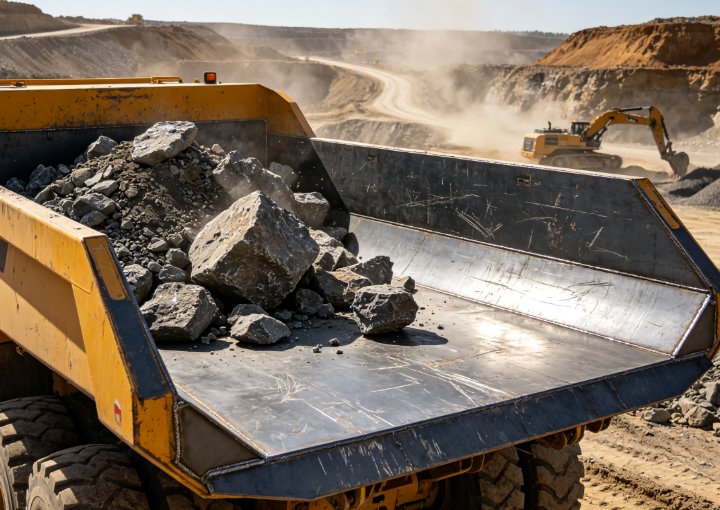
Mining haul truck liners: high-abrasion, medium-impact duty where 400-500 HBW wear plate grades are commonly specified.
Introduction: The Gap Between a Quoted Hardness Number and a Delivered Plate
Hardness classes are simple to write into a tender document and considerably harder to confirm after delivery. When a drawing or a maintenance specification calls for an abrasion resistant steel plate 500 HBW, it is defining a constraint rather than a brand: a nominal surface hardness band, a thickness range, a set of dimensional tolerances, and a documentation trail that the material must satisfy at the receiving gate. In mining chutes, excavator buckets and cement plant hoppers, that constraint is what separates a liner that reaches the next planned shutdown from one that fails early.
The recurring difficulty for buyers is that the same nominal figure can be attached to material of different reliability. A wear resistant steel plate described as 500 HBW on a quotation sheet is not the same statement as a 500 HBW measurement taken on the delivered plate under a defined test procedure. This guide explains what 500 HBW actually specifies, how the figure is verified at different plate thicknesses, which applications justify it, where the grade family boundaries sit, and which limitations should be written into a purchase decision before the order is placed.
What 500 HBW Specifies - and What It Leaves Open
HBW denotes Brinell hardness measured with a ball indenter. For medium-thick wear plate, the benchmark condition used on mill test certificates and in third-party inspection is HBW 10/3000, meaning a 10 mm ball and a 3,000 kgf load. A 500 HBW designation therefore describes an indentation-resistance class. It does not, on its own, define the chemical composition, the impact toughness, the flatness, the dimensional tolerance, or the service life of a component.
Within the quenched and tempered wear plate family, grade naming commonly follows nominal hardness: NM400, NM450 and NM500 correspond to nominal levels of 400, 450 and 500 HBW, with NM550 and NM600 positioned above them. This is the same logic buyers encounter when a tender refers to an AR-type designation or to a 'Hardox equivalent wear resistant steel plate'. In practice those references are shorthand for a hardness class, and the enforceable criteria remain the hardness range agreed on the order, the dimensional tolerances, and the mill test certificate issued for the heat.
The reason a hardness class alone is insufficient is metallurgical. The wear resistance of quenched and tempered plate does not come from high surface hardness in isolation; it comes from a martensitic microstructure produced by controlled alloying and through-thickness quenching. Alloying elements form fine carbide precipitates during tempering that restrict dislocation movement and raise resistance to abrasive gouging, and because the plate is hardened through its full section rather than only at the skin, wear resistance does not collapse when the top layer is consumed. That is why a verified hardness value is treated as a baseline rather than a guarantee: it says the material was produced in the intended condition, not that it will outlast every alternative in every working condition.
Why Hardness Verification Fails Before It Starts
Most disputes about a 500 HBW plate are not disputes about material quality. They are the result of a test performed in the wrong place, on the wrong surface, or under the wrong load. Four conditions are responsible for the majority of unreliable readings:
- Proximity to a cut edge. Flame or plasma cutting alters the microstructure in the heat-affected zone. A test point placed close to a cut edge measures the heat-affected zone, not the parent plate. The working rule is to test at least 50 mm away from flame or plasma cutting edges.
- Testing the raw surface. The as-delivered surface carries rust, oxide and a decarburized layer that is softer than the underlying steel. A reading taken on the raw surface understates hardness. The surface must be mechanically ground to expose the bright metallic base.
- Overheating during grinding. Grinding generates heat, and heat tempers martensitic steel. If grinding temperature is not kept below 200 degrees C, the measured value can fall below the true value and trigger a false rejection.
- Wrong load or insufficient support. Thin plate flexes or deforms under load, and portable Leeb testers behave differently on thin sections than on heavy blocks.
The opportunity here is straightforward. A buyer who fixes the test method before shipment, and who requires the supplier and any third-party inspector to use the same method and the same acceptance range, removes most of the ambiguity from a 500 HBW purchase. The verification procedure becomes part of the specification rather than an argument conducted after the plate has been cut.
Hardness Test Parameters by Plate Thickness
Because indentation behaviour depends on section thickness, the grinding depth and test parameters are selected according to the plate being inspected. The following parameters are the standard recommendations for wear resistant steel plate.
| Plate thickness | Grinding depth | Recommended parameters | Notes |
|---|---|---|---|
| Below 3 mm (ultra-thin) | 0.5-0.8 mm | HBW 2.5/187.5, or Rockwell HRC / Vickers HV10 | High risk of penetration; convert HRC/HV10 values to HBW using standard conversion tables such as ASTM E140 or GB/T 1172. |
| 3-6 mm (thin) | 1.0-1.2 mm | HBW 5/750 (D = 5 mm, F = 750 kgf) | A rigid, flat base is required to prevent flexing or bottom deformation. |
| 6-80 mm (medium-thick) | 1.5-2.0 mm | HBW 10/3000 (D = 10 mm, F = 3,000 kgf) | Universal benchmark method for Mill Test Certificates (MTCs) and third-party inspections such as SGS or BV. |
| Above 80 mm (extra-thick) | 2.0-3.0 mm | HBW 10/3000 (D = 10 mm, F = 3,000 kgf) | If core hardness is specified, cut a sample to 1/4 or 1/2 of plate thickness before testing. |
Two additional preparation rules apply regardless of thickness: grind 1.5-2.0 mm to expose the bright metallic base instead of testing the raw surface, and keep the grinding temperature below 200 degrees C to avoid tempering and falsely low readings. The acceptance band itself is grade-specific. As a reference point, the tolerance band commonly applied to NM400/AR400 material is 360-440 HBW. The equivalent band for a 500 HBW class plate is defined by the grade specification or the mill standard agreed for the order, and it should be stated numerically before shipment rather than assumed from the nominal figure.
A Four-Step On-Site Verification Workflow
For receiving inspection or a pre-shipment check, the procedure reduces to four steps that can be documented and repeated by a supplier, a fabricator, or an independent inspector.
- Locate. Select a test point at least 50 mm from the cutting edge and away from any weld or heat-affected zone, then mark it.
- Grind. Grind the test area flat and remove rust, oxide and the decarburized layer.
- Indent. Use a Brinell tester with the indenter held perpendicular to the plate surface. For portable Leeb testing, take three consecutive measurements with at least 10 mm spacing between test points; on plates under 15 mm, apply couplant grease to the back and couple the plate firmly onto a heavy steel block to eliminate vibration.
- Record and verify. Take three to five readings, discard outliers, compute the average, and compare it against the agreed grade tolerance.
Safety controls belong in the same written procedure. Safety goggles are required against flying grinding debris, a dust mask against metal dust, and cut-resistant gloves and protective clothing are standard; loose sleeves and jewellery are prohibited. The workpiece must be clamped before grinding, the wheel inspected for cracks before start-up, and the operator kept clear of the wheel ejection direction. Hardness tester integrity should be checked before loading, fingers must never be placed between the indenter and the sample, and the loading sequence followed strictly. Heavy plates must be supported or fixed before testing, roll-over or sliding prevented, and lifting aids used instead of manual lifting alone. A verification clause that ignores these steps is difficult to defend when a result is challenged.
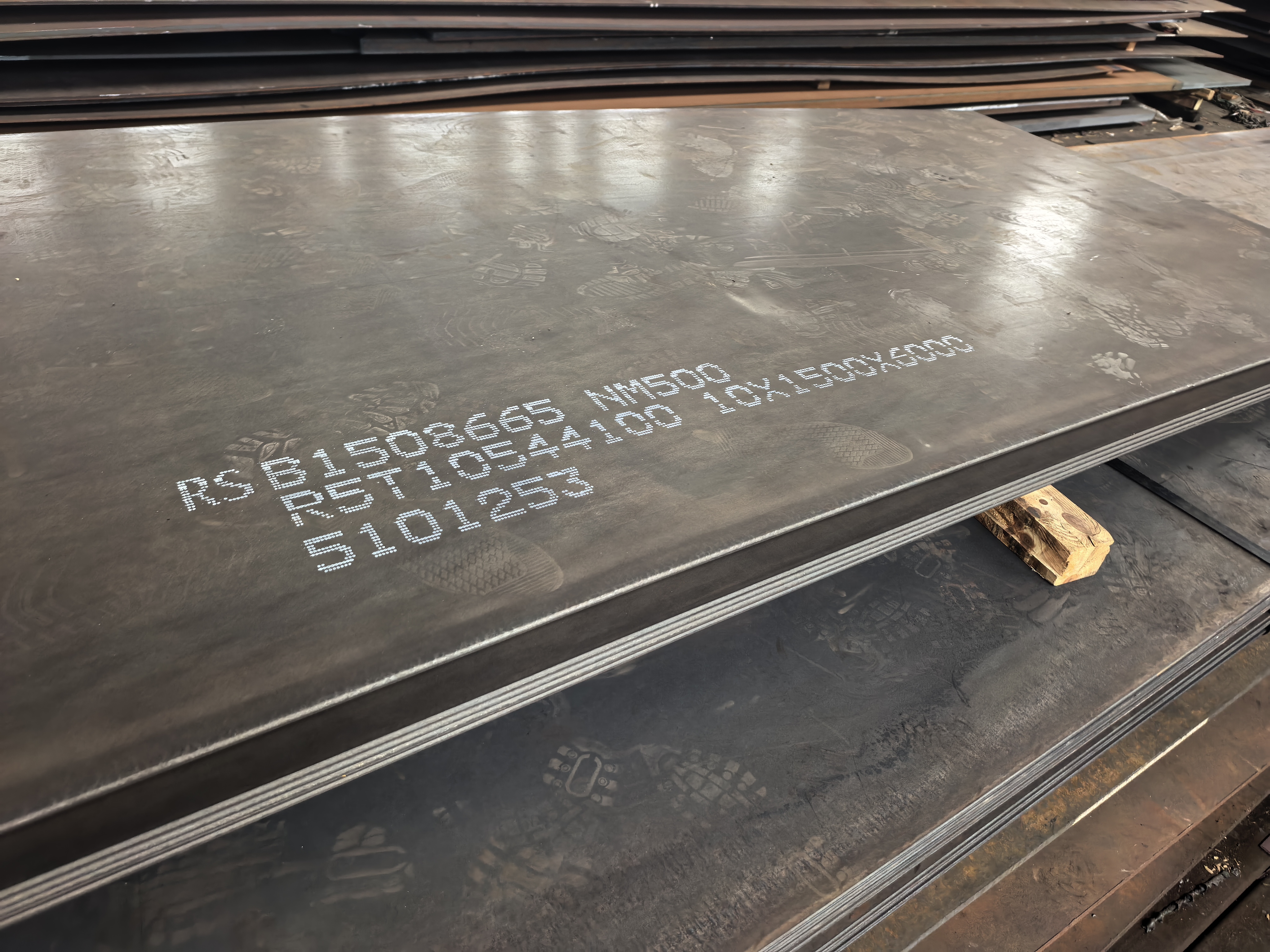
NM500 wear resistant steel plate at 10 mm: a nominal 500 HBW grade, supplied with an original mill test certificate.
Where 500 HBW Plate Is Actually Specified
A 500 HBW grade is selected when sliding abrasion is severe and unplanned replacement is expensive. The application pattern in industrial practice is consistent, and it is defined by working conditions rather than by industry labels.
Mining machinery, chutes and hoppers
Mine hoppers and ore chutes operate under abrasive wear with medium impact and continuous intermittent loading; matched wear plate grades for this duty include NM400, NM450, NM500, NM550 and NM600. The same wear profile appears in metallurgy, where ore chutes, hoppers, ball mill and crusher liners and mining truck bodies are lined with NM400, NM450 or NM500 depending on how aggressive the material flow is. This is where 500 HBW earns its cost: on a chute carrying coarse ore, the difference between a 450 and a 500 HBW lining is measured in how often a maintenance crew has to enter the transfer point.
Excavator buckets and earthmoving attachments
Excavator bucket wear resistant steel sheet and loader cutting edges combine abrasion with impact from rock and aggregate. Here the 500 HBW class is used selectively — on the highest-wear zones of the bucket rather than across the whole fabrication — because at this hardness level cold forming and welding require more care than with NM400. NM400 remains the standard choice for dump truck beds and general bucket work, with NM450 and NM500 applied where service life has proved too short.
Cement plant hoppers and material handling
Cement production exposes equipment to heavy abrasion, impact wear, sliding wear and continuous operation. Crushers, ball mills, vertical roller mills, chutes, hoppers, conveyors, bucket elevators, screens, separators, silos and clinker handling equipment all rely on wear protection, and the matched grades for this environment span NM400, NM450, NM500, NM550, NM600 and Mn13. Cement plant hopper wear plates typically sit at the abrasive end of that range, where dimensional stability and reliable plate hardness matter as much as the nominal number.
Coal handling and power generation
Coal mill chutes and pipe bends run under abrasive wear in 24/7 continuous operation, and 400-500 HBW lining plates are applied to protect these surfaces. A documented example of 500 HBW use in a related wear context is a shredder equipment manufacturer in Vietnam, where 180 pieces of NM500 were supplied for shredder blade fabrication and reported reliable cutting with high wear resistance as the governing requirement. A second reference case involves a mining equipment manufacturer in Russia that took 200 tons of NM450 and NM400 to fabricate dump truck floor and side liners, with balanced toughness and wear resistance cited as the selection driver — an example of why a 500 HBW grade is not automatically the correct answer.
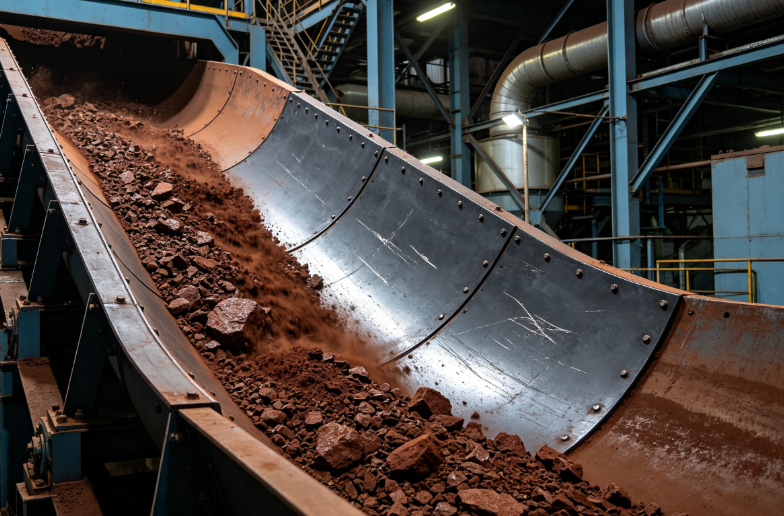
Ore chute wear lining: sliding abrasion with medium impact, a typical application for 450-500 HBW plate.
Grade Selection Inside the Wear Plate Family
The practical decision is rarely 'wear plate or no wear plate'. It is which hardness level, and whether a quenched wear grade or a work-hardening manganese grade is the better fit.
| Grade | Positioning | Typical fit | Consideration |
|---|---|---|---|
| NM400 | 400 HBW, balanced hardness and toughness | Dump truck beds, excavator buckets, hoppers, crusher liners | Easy to cold-form, weld and cut; cost-effective across widespread applications |
| NM450 | Intermediate upgrade | Mining machinery, garbage compactors, chutes, loader cutting edges | Stated service life roughly 15-20% longer than NM400 while retaining good cold formability and weldability |
| NM500 | 500 HBW high-abrasion grade | Mining, heavy engineering, steel mills; high-abrasion chutes and liners | Higher material cost and slightly poorer formability than NM400 |
| NM550 | 550 HBW, hardness with moderate toughness | Severe wear hoppers, ore convey pipe liners, heavy sliding abrasion | Selected when NM500 loses material too quickly; balances wear resistance against cost |
| NM600 | Approximately 600 HBW, extreme abrasion | Mining liners, vertical mill scrapers, sand chutes, slurry pipelines | Cold forming and welding are difficult and must follow strict technical specifications |
| Mn13 high manganese plate | Austenitic, work-hardening under impact | Railway frogs, jaw crusher plates, cone crusher mantles, shot blast liners | Surface hardness rises from roughly 200 HBW to over 500 HBW under heavy impact while the core stays tough; not suitable for pure abrasive wear without impact |
One selection rule prevents most overspecification: do not specify a 500 HBW grade if NM400 or NM450 already satisfies the wear requirement. The higher grade buys longer service life at the cost of higher material price and reduced fabrication convenience, and on low-impact, mildly abrasive duty that trade is difficult to justify.
A separate distinction is often confused at the evaluation stage. High strength steel plates such as Q550D, Q690D, Q690E, Q890D and Q960E are structural grades, defined by minimum yield strength — 550 MPa for Q550D and 690 MPa for the Q690 family — with the D suffix guaranteeing impact toughness at -20 degrees C and the E suffix at -40 degrees C. They are used for load-bearing members, for example crane structures in port handling where low-temperature impact resistance and weldability govern the design. They are not wear liners, and a wear liner is not a structural member.
Supply-Side Reference: How BGT Steel Plate Fits a 500 HBW Buying Process
BGT Steel Plate is the trading identity of Jiangyin Baoguantao Import & Export Co., Ltd., a China-based stockholder and distributor of wear resistant steel plates and high strength steel plates, established in 2013 and operating from a 5,000 m2 facility with 40 employees, including a three-engineer technical team, and an annual output figure of 200,000 tons. Company materials describe its inventory position as China's largest and most complete stock of wear-resistant steel, supported by a product range covering grades, specifications and custom sizes.
The supply structure is relevant to a 500 HBW purchase because availability and traceability are the two constraints that decide whether a specification can be met on schedule. BGT operates 12 modern warehouses located across major industrial hubs including Jiangsu, Shandong and Hunan provinces, and maintains a standing inventory of over 30,000 metric tons of wear-resistant steel plate, with stated monthly capacity of 30,000 tons and a lead time of 7-10 days on a minimum order quantity of 1 ton. The company also states long-term distributor relationships with domestic mills including Xingcheng, Nisco, Shougang, Xisc, Shandong Steel, Hanye, Tangsteel, Rongshen, Tisco, Baoshan, Lianyuan and Puyang; these relationships underpin the traceability of the material and the availability of original mill test certificates.
For a 500 HBW requirement, the grade is supplied as NM500 with a thickness range of 3-150 mm, a width range of 600-3,950 mm and lengths of 2,438 / 5,800 / 6,000 / 6,096 / 12,000 / 12,200 mm, with customized sizes accepted. Quality control is documented through the mill test certificate and third-party inspection, and OEM/ODM work covers customization of chemical composition, mechanical properties and logo. After-sales support is provided as technical guidance and on-site consultation. The company's export mix is approximately 40% of output, serving the Middle East, Southeast Asia, South America, Africa, Central Asia and Russia. Further detail is available at www.bgtsteel.com. A downloadable product catalogue covering plate grades, dimensions and processing services is also available: BGT Steel Plate product catalogue (PDF).
Procurement Criteria and Documentation for a 500 HBW Order
A 500 HBW specification is only enforceable if the order documents the acceptance criteria. The following items are the practical minimum for an evaluation-stage checklist.
- Numeric hardness band. State the acceptable HBW range for the grade, not the nominal figure alone, and reference the test condition (for medium-thick plate, HBW 10/3000).
- Test method and location. Specify the minimum distance from cut edges, the grinding depth, the temperature limit during preparation, and the number and spacing of measurements.
- Dimensional specification. Thickness, width and length ranges including custom sizes, since the 3-150 mm thickness range and 600-3,950 mm width range cover most liner and bucket applications.
- Material documentation. Original mill test certificate for the heat, with third-party inspection where the application is critical.
- Commercial terms. Minimum order quantity, lead time and any processing or cut-to-size requirement, because these determine whether the specification can be met within the maintenance window.
- Customization requirements. Where chemical composition, mechanical properties or marking need to match an existing drawing or an OEM programme.
Comparison With Traditional Solutions - and Where 500 HBW Is the Wrong Choice
Relative to conventional structural steel, a 500 HBW wear plate is specified for a different purpose. Mild structural plate costs less and is easier to fabricate, but it loses section thickness quickly under abrasive flow, so it is used where wear is light or where the component is inexpensive to replace. Surface-hardened carbon steels offer a hard skin but a softer core, whereas quenched wear plate is hardened through the full section, so wear resistance is maintained as the surface is consumed. That difference is the main technical argument for the wear plate family.
The limitations are equally clear and should be part of the evaluation record. At 500 HBW, material cost is higher than NM400 and formability is slightly poorer, so complex cold-formed shapes are more demanding to produce and welding procedures need greater control. Where wear is driven by heavy impact rather than sliding abrasion, a 500 HBW quenched plate is not the best tool: Mn13 high manganese plate work-hardens under impact and is the appropriate choice for railway frogs and crusher components, while it is explicitly not suitable for pure abrasive wear without impact. Where the requirement is load-bearing capacity rather than surface durability, Q690D, Q690E or higher structural grades belong in the specification instead. And where impact energy is low and abrasion is moderate, overspecifying to 500 HBW raises cost without a corresponding service-life benefit. Finally, the hardness figure itself is a measurement with a procedure attached: a result obtained without correct surface preparation, away from the heat-affected zone, and within the temperature limit is not evidence of grade compliance.
Market Trend and Future Outlook
Procurement behaviour around wear plate is shifting from grade naming towards verified acceptance criteria. Buyers increasingly ask for the original mill test certificate as a default document and treat third-party inspection as a normal condition on critical liners rather than an exception. This is a practical response to the nature of the product: hardness is the primary purchasable property of a wear plate, and it is also the property most easily misreported when the test method is not fixed in advance.
A second direction is the growing weight of processing services in the buying decision. Liners, chute plates and bucket wear sections are increasingly ordered cut to size, which moves part of the quality risk from the fabricator to the supplier and makes the supplier's processing capability and dimensional consistency part of the technical evaluation.
On the demand side, wear protection requirements remain concentrated in mining, metallurgy, cement, coal handling and heavy equipment, spanning markets including the Middle East, Southeast Asia, South America, Africa, Central Asia and Russia. Over the next several years, the more consequential change is likely to be in grade discipline rather than in metallurgy: matching hardness level to the actual wear mechanism, separating structural grades from wear grades, and specifying verification procedures that both the supplier and the buyer can repeat on site. Buyers who document these three items will get more consistent results than buyers who simply quote a higher hardness number.
FAQ
What does 500 HBW mean on a wear resistant steel plate specification?
HBW is Brinell hardness measured with a ball indenter. For medium-thick plate the reference condition is HBW 10/3000, a 10 mm ball under a 3,000 kgf load. A 500 HBW designation describes a nominal indentation-resistance class within the quenched and tempered wear plate family, alongside grades such as NM400, NM450, NM550 and NM600. It does not by itself define chemical composition, impact toughness or service life, and the acceptance band must be stated in the order specification.
How is the hardness of a 500 HBW plate verified after delivery?
Test at least 50 mm away from flame or plasma cutting edges to avoid the heat-affected zone, mechanically grind 1.5-2.0 mm to expose the bright metallic base instead of testing the raw surface, and keep grinding temperature below 200 degrees C to avoid tempering and falsely low readings. Take three consecutive measurements with at least 10 mm spacing between points, then average them and compare the result with the grade tolerance — for example 360-440 HBW is the band commonly applied to NM400/AR400. For a 500 HBW grade, the equivalent band comes from the agreed grade specification or mill standard.
Which grinding depth and test parameters apply to different plate thicknesses?
For plates below 3 mm, grind 0.5-0.8 mm and use HBW 2.5/187.5 or Rockwell HRC / Vickers HV10, converting HRC or HV10 values to HBW with standard conversion tables such as ASTM E140 or GB/T 1172. For 3-6 mm plate, grind 1.0-1.2 mm and use HBW 5/750 (D = 5 mm, F = 750 kgf) on a rigid, flat base. For 6-80 mm plate, grind 1.5-2.0 mm and use HBW 10/3000, the benchmark method for mill test certificates and third-party inspections such as SGS or BV. Above 80 mm, grind 2.0-3.0 mm and use HBW 10/3000; if core hardness is specified, cut a sample to 1/4 or 1/2 of plate thickness before testing.
How do NM400, NM450 and NM500 compare, and when is the 500 HBW grade justified?
NM400 is the general-purpose grade, balancing wear resistance with good formability and weldability for dump truck beds, excavator buckets, hoppers and crusher liners. NM450 is a balanced upgrade and is stated to deliver roughly 15-20% longer wear life than NM400 in moderate-to-severe abrasion while remaining manageable to fabricate. NM500 is selected for high-abrasion conditions such as mining chutes and scrapers where replacement downtime is costly and additional surface hardness is required; it carries higher material cost and slightly poorer formability. Overspecifying is a real cost risk — if NM400 or NM450 meets the wear requirement, the 500 HBW grade is difficult to justify economically.
When should Mn13 high manganese steel plate be chosen instead of a 500 HBW wear plate?
Mn13 is an austenitic high manganese grade with a work-hardening mechanism. Under heavy impact and compressive stress its surface hardness rises from roughly 200 HBW to over 500 HBW while the underlying material remains tough and ductile, which suits railway frogs, jaw crusher plates, cone crusher mantles and shot-blasting machine liners where heavy impact meets abrasion. It is not suitable for pure abrasive wear without impact; in low-impact abrasive conditions, quenched NM series wear plate is the more economical choice.
Can a 500 HBW abrasion resistant plate replace Q690 high strength steel plate?
They address different requirements. Q690D and Q690E are high strength structural grades with a minimum yield strength of 690 MPa, where the D suffix guarantees impact toughness at -20 degrees C and the E suffix at -40 degrees C; they are used for load-bearing members such as crane structures and heavy lifting equipment where strength-to-weight ratio governs the design. Wear plate is specified for surface loss caused by abrasion. A wear liner is not a structural member, and the two materials are frequently used together in the same machine rather than substituted for one another.
What documentation should accompany a 500 HBW plate order?
An original mill test certificate for the heat, with third-party inspection where the application is critical, is the baseline. The certificate should be consistent with the agreed hardness range and test condition, and the dimensional data should match the order — thickness of 3-150 mm, width of 600-3,950 mm and lengths such as 2,438 / 5,800 / 6,000 / 6,096 / 12,000 / 12,200 mm, with customized sizes accepted. Hardness results are most defensible when they can be traced to a defined preparation and measurement procedure rather than reported as a single figure.