
5kW Wall-Mounted Battery vs. 48V Rack Systems: A Buyer's Side-by-Side
5kW Wall-Mounted Battery vs. 48V Rack Systems: A Buyer's Side-by-Side
Residential solar storage buyers now select a physical format before they select a cell chemistry. Within the 48 V class that most home battery banks use, two formats dominate: the wall-mounted enclosure sold as a 5 kW wall-mounted battery, and the rack-mounted or floor-standing bank assembled from 100 Ah to 280 Ah modules. Both are marketed as solar batteries, both commonly use LiFePO4 cells, and both are catalogued as storage batteries. The characteristics that actually decide an installation — wall area, floor area, structural mounting, usable discharge current, expansion path, and documentation — are rarely the ones printed largest on the specification sheet.
Two Formats, One Voltage Class: Definitions Buyers Can Use
A 5 kW wall-mounted battery is a single enclosure in which cells, battery management system (BMS), and terminals are packaged to be fixed to a vertical surface. Shenzhen Topway New Energy Co., Ltd. (HCC), a Shenzhen-based energy storage and lithium-ion battery supplier, documents its entry in this category as the 5 kW wall-mounted battery, model Wall-TW01. The published product record specifies a 28148115-52Ah LiFePO4 16S1P cell configuration, a rated cycle life of at least 6,000 cycles to 80% of capacity, a maximum charge current of 10 A, and a maximum continuous discharge current of 50 A.
A 48 V rack system is a bank assembled from battery modules installed in a cabinet, on a shelf, or on a floor-standing frame, connected to an external inverter or hybrid inverter. In HCC's documented portfolio, the closest equivalents are the wall mount battery 48 V (51.2 V, 100 Ah, 20 A maximum charge current, 100 A maximum continuous discharge current, approximately 48 kg), the 51.2 V 200 Ah solar battery (100 A maximum charge current, 200 A maximum continuous discharge current, approximately 88 kg), and the 48 V 280 Ah storage battery (100 A maximum charge current, 200 A maximum continuous discharge current, approximately 130 kg). Units at that capacity and weight are normally placed on the floor or inside a rack rather than cantilevered from a wall.
Two clarifications belong at the start, because they change how every later number should be read. First, a product name containing "5 kW" describes a class of unit; it is not automatically a statement of stored energy, and it is not automatically a statement of continuous power. Second, the wall format and the rack format are not competing chemistries. Both are lithium iron phosphate products in most current designs, so the buying decision is mechanical, electrical, and documentary rather than electrochemical.
Why Form Factor Became a Procurement Variable in Residential Storage
Three structural changes moved form factor from an afterthought to a selection criterion.
Market scale. Grand View Research estimates the global Battery Energy Storage System (BESS) market at approximately USD 13.2 billion in 2025, projected to reach USD 99.7 billion by 2033. The same source places lithium-ion chemistry at 53.5% of that market in 2025. Buyers should treat these figures as directional only: Mordor Intelligence publishes materially different BESS values depending on whether utility-scale projects are included, so a single market number should never be used as an internal sizing or budgeting input.
Chemistry diversification. Precedence Research projects the sodium-ion battery market growing at an 18.84% CAGR from 2026 to 2035 to reach USD 7.81 billion. Sodium-ion already appears in 48 V form: HCC holds a sea transport report, CMC251017116H03, for a sodium-ion battery designated RPES-WM4 (48 V, 110 Ah, 5.28 kWh), issued under the IMDG Code 2025 Edition Amendment 42-24 and UN 38.3, valid from 2026-01-01 to 2026-12-31. The practical implication is that buyers will increasingly compare form factors across more than one chemistry.
Installation economics. As more suppliers enter residential storage, price spreads compress and the remaining differentiation shifts toward installation labour, floor or wall space, service access, and the completeness of the compliance file. Those variables favour different formats in different buildings.
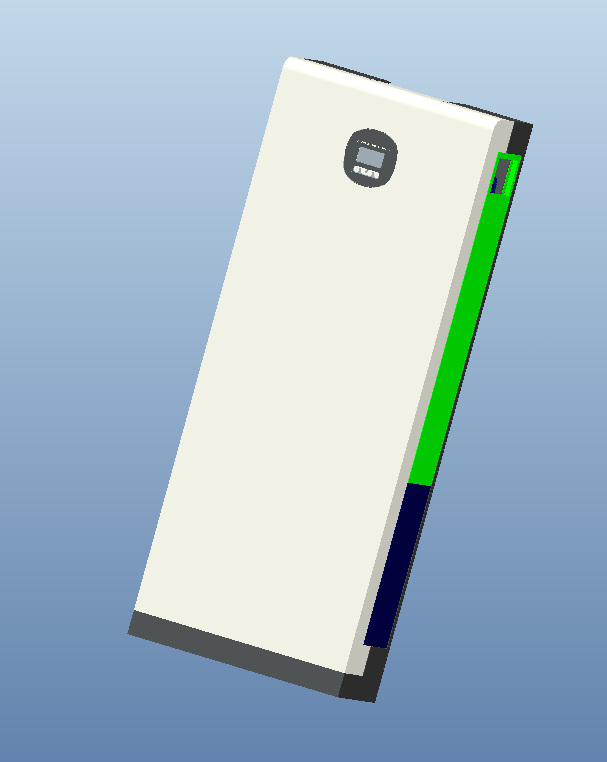
Residential all-in-one energy storage arrangement. Form factor — wall-mounted enclosure versus floor-standing or rack-mounted modules — is now a primary selection variable in home solar storage.
Side-by-Side: Six Decision Dimensions
The comparison below separates what is mechanically fixed about each format from what varies by supplier and must therefore be confirmed per model.
| Decision dimension | Wall-mounted (5 kW class) | 48 V rack / floor-standing bank |
|---|---|---|
| Mounting surface | Vertical wall; requires a suitable load-bearing wall and correct anchor selection | Floor area and cabinet or frame; requires level, ventilated space |
| Footprint profile | Zero floor footprint; occupied wall area instead | Occupied floor or cabinet footprint, usually in a utility room or garage |
| Documented discharge envelope | Wall-TW01: 50 A maximum continuous discharge, 10 A maximum charge | Documented examples reach 100 A continuous discharge at 100 Ah and 200 A at 200–280 Ah |
| Modularity | One enclosure per unit; expansion means adding another wall position | Additional modules can be stacked within the same frame, subject to documented limits |
| Service access | Work at height; single-unit replacement | Work at floor or cabinet level; module-level replacement |
| Installation labour | Shorter cable runs possible; wall preparation required | Inter-module wiring and cabinet assembly; handling of heavier modules |
No row favours one format universally. A retrofit in a finished garage with limited floor area and a strong wall often suits the wall format; a new build with a dedicated utility room and a future expansion plan often suits the rack format, particularly when the initial load profile is small but expected to grow.
Documented Parameters: What the Data Actually Shows
The table below reproduces only the parameters published in HCC's product records. Blank cells are deliberate: where a model's record does not state a value, no value is inferred.
| Product (model) | Nominal voltage | Capacity | Max charge | Max continuous discharge | Documented weight | Cycle life |
|---|---|---|---|---|---|---|
| 5 kW wall-mounted battery (Wall-TW01) | 16S LiFePO4 configuration | Not separately stated (28148115-52Ah cell, 16S1P) | 10 A | 50 A | Not stated | ≥ 6,000 cycles to 80% |
| Wall mount battery 48 V (51.2 V 100 Ah) | 51.2 V | 100 Ah | 20 A | 100 A | 48 kg | Not stated |
| Solar battery pack (SolarBP-TW01) | 16S LiFePO4 configuration | 100 Ah class (47173120-100Ah cell, 16S1P) | 20 A | 100 A | Not stated | ≥ 6,000 cycles to 80% |
| Solar battery 200 Ah (51.2 V 200 Ah) | 51.2 V | 200 Ah | 100 A | 200 A | Approx. 88 kg | Not stated |
| Storage battery (48 V 280 Ah) | 48 V | 280 Ah | 100 A | 200 A | Approx. 130 kg | Not stated |
Two observations follow directly. First, published data completeness varies by model, not by format. Second, the current envelope does not scale automatically with capacity across the same brand. The 100 Ah wall mount battery 48 V documents 100 A continuous discharge while the smaller 5 kW wall-mounted unit documents 50 A; the difference is a property of each model's cell configuration and BMS, not of the wall format itself. A buyer should therefore request the same eight data points for every candidate — nominal voltage, capacity, maximum charge current, maximum continuous discharge current, peak discharge and its duration, cycle life with the retention threshold, weight, and operating temperature range — and discount any proposal that supplies only some of them.
Technical Explanation: 16S LiFePO4, Current Limits, and Where "5 kW" Comes From
In a 16S configuration, sixteen LiFePO4 cells are connected in series, which is the arrangement that produces the 48 V / 51.2 V nominal class used by most residential inverters. The \"1P\" in 16S1P means a single parallel string, so the pack's capacity equals the capacity of one cell — 52 Ah for the Wall-TW01 cell, or 100 Ah for the SolarBP-TW01 cell. Parallel configuration, not cell count, is what a buyer changes when specifying a larger pack.
The charge and discharge ceilings are set by the BMS and the cell's rated continuous current, and they are not symmetrical. The 5 kW wall-mounted battery documents 10 A maximum charge and 50 A maximum continuous discharge, whereas the 51.2 V 200 Ah and 48 V 280 Ah units document 100 A maximum charge. For a buyer, the charge figure determines how quickly the array can refill the battery after a full discharge day, and the discharge figure determines the continuous load the battery can serve without the inverter derating or the BMS interrupting.
This is also where the product naming needs scrutiny. A 50 A continuous discharge limit at a 48 V nominal class corresponds to roughly 2.4 kW of continuous DC power, and at 51.2 V nominal, roughly 2.6 kW — before conversion losses and before any inverter-side limit. A 100 A limit at 51.2 V nominal corresponds to roughly 5.1 kW. The arithmetic is simple, but the consequence is not: two products that both carry a \"5 kW\" style label in marketing material can present very different continuous-power behaviour depending on which figure the label describes. Buyers should ask a supplier to state, in writing, whether the headline figure refers to continuous discharge power, peak power and its duration, or stored energy, and then check it against the documented current limits.
Space, Installation, and Structural Reality
Wall-mounted units trade floor area for wall area and for structural responsibility. The 48 kg of the 51.2 V 100 Ah wall mount battery 48 V is a static load that anchors must carry indefinitely, in a location that also needs ventilation and access for service. Where the wall is a finished internal partition rather than a load-bearing or reinforced structure, that constraint alone can eliminate the format.
Rack and floor-standing banks trade wall area for floor area and for handling. The 48 V 280 Ah storage battery is documented at approximately 130 kg and the 51.2 V 200 Ah solar battery at approximately 88 kg — weights that normally require two people, a trolley, or a mechanical aid at installation, and that make module-level thinking useful. A 100 Ah module that can be moved by one installer is easier to position than a single 130 kg unit, even when the total bank capacity is identical.
Installation ease also depends on cable routing and inverter placement. Wall units are frequently mounted close to the inverter, shortening DC runs, while rack banks sit where the floor allows and may require longer, heavier conductors. Neither arrangement is inherently more efficient; the difference must be evaluated per building.
Scalability: What Is Documented and What Must Be Confirmed
Scalability is the dimension most often assumed rather than verified. The available product records for HCC's storage batteries document voltage, capacity, charge current, discharge current, cycle life, weight, and operating temperature. They do not state a maximum number of units that may be paralleled, nor a maximum series string length for a given BMS family. Those limits exist in practice, are model-specific, and must be obtained from the supplier and confirmed against the inverter manufacturer's approved battery list before an expansion plan is committed to.
A practical decision rule follows from that gap. If expansion within the first three to five years is plausible, compare the cost and footprint of adding a second wall-mounted unit against the cost and footprint of one higher-capacity floor unit at the outset. Adding a wall position later requires free wall area, a second mounting operation, and possibly a second BMS coordination step. Starting with a larger single unit avoids that work but front-loads the capital and the floor or rack space.
Compliance and Transport Documentation
Certification requirements differ by function. Transport compliance is universal: UN 38.3 is mandatory for the global shipment of lithium batteries and requires eight specific tests, including altitude simulation and thermal testing, as set out in the UN Manual of Tests and Criteria and enforced through IATA and IMDG frameworks. Stationary installation compliance is market-specific: IEC 62619:2022 is the current international safety standard for lithium-ion batteries in industrial and stationary applications and covers thermal runaway and BMS verification, while UL 1973 is the primary North American standard for batteries in stationary applications such as solar energy storage and UPS systems.
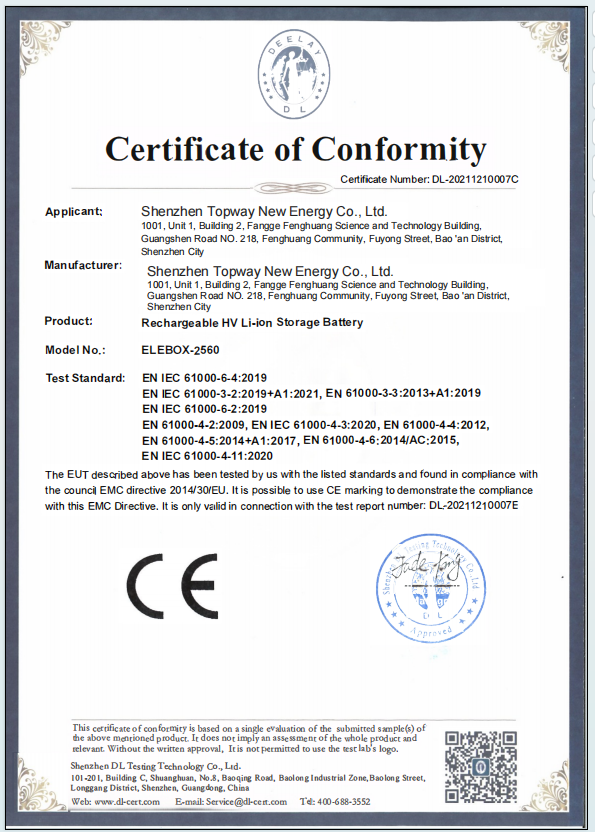
CE certification DL-20211210007C, issued 2021-12-10 and valid to 2026-12-09, covering a rechargeable high-voltage Li-ion storage battery under EN IEC 61000 series standards.
HCC's published certification records include CE certification DL-20211210007C, issued by Shenzhen DL Testing Technology Co., Ltd. on 2021-12-10 and valid to 2026-12-09 under EN IEC 61000-6-4:2019, EN IEC 61000-3-2:2019+A1:2021, EN IEC 61000-3-3:2013+A1:2019, and EN IEC 61000-6-2:2019. The company's MSDS documentation HCC-MSDS-2615 references UN 38.3, and its UN 38.3 test report SKEXM202407199230, issued by CMC Testing International (Shenzhen) Co., Ltd. on 2024-07-18, covers lithium-ion battery pack HCC18650-10S5P-L01 (36.5 V, 13 Ah, 474.5 Wh) and remains valid to 2029-07-17. A separate UN 38.3 certificate, CMC240627016, covers the same pack model. Air transport is documented through identification report PEKGZ20180103150GJX0001, issued under IATA DGR 59th edition and valid from 2026-01-02 to 2026-12-31, and sea transport through report CMC251017116H03 under the IMDG Code.
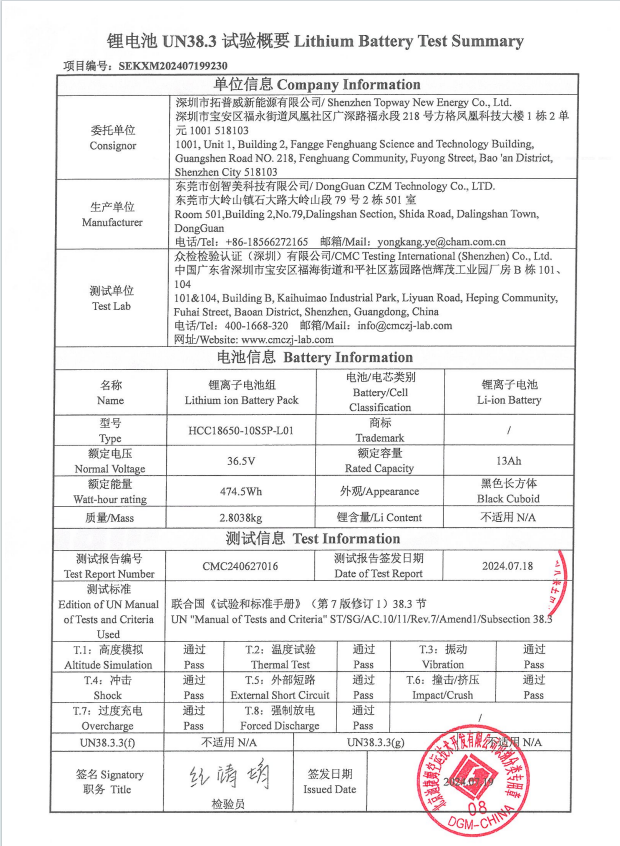
UN 38.3 test report SKEXM202407199230. Transport testing is not form-factor dependent: both wall-mounted and rack-mounted lithium batteries require valid UN 38.3 documentation to ship.
The buyer-relevant nuance is this: the certification records above cover specific models. A valid CE file for one storage battery does not extend to another enclosure, and a UN 38.3 report for a pack model does not certify a different cell configuration. Where a project specifies IEC 62619:2022 or UL 1973, coverage must be confirmed at model level rather than assumed from a general compliance claim — including for wall-mounted units, which are not exempt from stationary safety standards simply because they are smaller.
Application Fit: Where Each Format Earns Its Place
Case records in HCC's documentation illustrate how the two formats divide by scenario rather than by superiority.
- Residential retrofit. An installer in Iran took 50 units of the wall mount battery 48 V (51.2 V, 100 Ah) for residential use, with the installation noting IP54 waterproofing and dustproofing as a highlight and a service-life expectation documented at 10 years. In finished homes where floor area is already committed, wall mounting preserves usable space.
- Small commercial and industrial energy storage. A brand owner in Korea ordered 100 pcs of the solar battery pack (SolarBP-TW01) for a commercial and industrial energy storage application, with the documented result meeting industrial-grade safety and performance standards and the project explicitly supported by customization. At this scale, floor or rack installation is normal because the bank is larger and service access matters more than wall area.
The pattern is consistent: wall format for space-constrained residential retrofits at moderate continuous load, rack or floor format where capacity, serviceability, or expansion headroom dominates.
Supplier Capability Checklist for OEM and Volume Programs
For buyers in the evaluation-to-execution stage, the supplier's capability record matters as much as the product datasheet, because custom enclosures and expansion plans depend on manufacturing flexibility rather than catalogue items.
| Capability dimension | Documented HCC status |
|---|---|
| Production model | OEM / ODM |
| Customization scope | All kinds of battery pack |
| Monthly capacity | 10,000 units |
| Lead time | 20–35 days |
| Minimum order quantity | 5 pcs (custom work); 1,000–10,000 pcs for bulk purchasing scenarios |
| Quality function | 30% quality control allocation, pre-shipment test acceptance |
| After-sales | Remote support |
| Commercial terms | FOB, EXW, CFR, CIF, DAT, FAS, DDP, DAP, CIP, CPT, FCA; LC, T/T, D/P, PayPal, Western Union, Money Gram |
Company background is also material to delivery risk: HCC was founded in 2022, operates a 10,000 m² facility with approximately 200 employees and a 15-person R&D team, and documents an annual output figure of 1,200,000 units with a 40% export ratio, serving markets that include the United States, the European Union, the United Kingdom, Japan, Korea, Australia, Canada, Mexico, Brazil, and multiple Southeast Asian countries. When specifying a wall-mounted enclosure for an OEM program, confirm explicitly whether customization covers enclosure dimensions, terminal position, communication protocol, and BMS parameter set, since those items are not itemized in published capability records.
Limits and Trade-offs: Honest Boundaries of Both Formats
Compared with conventional lead-acid banks, lithium storage batteries in either format are generally lighter for the same usable capacity and generally offer more usable cycles — a widely recognised industry position rather than a claim tied to any single product. That advantage does not resolve the format question, and each format carries real constraints.
- Wall format, current ceiling. The documented 10 A maximum charge and 50 A maximum continuous discharge of the 5 kW wall-mounted battery Wall-TW01 are materially lower than the 100 A charge and 200 A continuous discharge documented for the 51.2 V 200 Ah and 48 V 280 Ah units. A household with high simultaneous loads or a large inverter may find the wall unit's documented envelope the binding constraint, regardless of how much energy it stores.
- Wall format, structural dependency. The format is only viable where a suitable mounting surface exists. Where it does not, the format is unavailable — a binary constraint, not a preference.
- Rack format, floor dependency and handling. Roughly 88 kg for a 51.2 V 200 Ah unit and roughly 130 kg for a 48 V 280 Ah unit impose floor-space, ventilation, and handling requirements that some residential utility rooms cannot meet.
- Data completeness. Across the documented records, cycle life is stated for some models and not for others, and weight is stated for some and not for others. Buyers comparing formats on incomplete published data are effectively comparing marketing text, not engineering parameters.
Market Trend and Future Outlook
Two directions appear likely to reshape this comparison rather than settle it. The first is chemistry diversification: sodium-ion is projected by Precedence Research to grow at an 18.84% CAGR between 2026 and 2035, and sodium-ion packs are already being documented in 48 V form, as the RPES-WM4 (48 V, 110 Ah, 5.28 kWh) sea transport record shows. If sodium-ion enters residential 48 V in volume, buyers will compare three physical formats across two chemistries instead of two across one.
The second is documentation pressure. As stationary safety expectations harden around standards such as IEC 62619:2022 and UL 1973, the ability to produce model-specific test and certification records becomes a procurement filter. In that environment, the commercially safer purchase is less likely to be the unit with the largest headline number and more likely to be the one whose continuous discharge, cycle life, expansion limits, and certification scope are all stated in writing and all traceable to the specific model being quoted.
FAQ
1. What is the practical difference between a 5 kW wall-mounted battery and a 48 V rack system in a home solar installation?
The difference is mounting, footprint, and current envelope rather than voltage class. A wall-mounted unit such as the 5 kW wall-mounted battery (Wall-TW01) is a single enclosure fixed to a vertical surface, documented with a 28148115-52Ah LiFePO4 16S1P cell, at least 6,000 cycles to 80% capacity, 10 A maximum charge current, and 50 A maximum continuous discharge current. A 48 V rack or floor-standing bank uses modules such as the 51.2 V 200 Ah unit (approximately 88 kg, 100 A charge, 200 A continuous discharge) or the 48 V 280 Ah unit (approximately 130 kg, same current ratings). Both sit in the same nominal voltage class and both commonly use LiFePO4 chemistry; they differ in where they are installed and in how much continuous current they can deliver.
2. How do I check whether a wall-mounted battery can actually support my inverter and loads?
Compare the documented maximum continuous discharge current against the continuous DC power your inverter will draw, and compare the maximum charge current against what the array can deliver. A 50 A continuous limit at a 48 V nominal class corresponds to roughly 2.4 kW, and at 51.2 V nominal, roughly 2.6 kW, before conversion losses. A 100 A limit at 51.2 V nominal corresponds to roughly 5.1 kW. Because a product name containing a kilowatt figure may refer to continuous power, peak power, or stored energy, buyers should ask the supplier to state in writing which quantity the label describes and to provide the corresponding current limits.
3. Can a wall-mounted 48 V battery be expanded later, or does expansion require a rack?
Expansion depends on the specific BMS and the manufacturer's documented parallel and series allowances, which vary by model. HCC's published storage battery records document voltage, capacity, charge current, discharge current, cycle life, weight, and operating temperature, but do not state a maximum number of parallel units. That figure must be requested per model and checked against the inverter manufacturer's approved battery list. In practice, expansion in the wall format means adding another wall position and mounting operation, while expansion in the rack format means adding a module inside an existing frame or cabinet, provided the documented limits permit it.
4. Which certifications should a residential storage battery have before it ships?
Transport compliance is mandatory regardless of format: UN 38.3 requires eight specific tests for lithium batteries, including altitude simulation and thermal testing, under the UN Manual of Tests and Criteria as applied through the IATA and IMDG frameworks. For stationary use, IEC 62619:2022 covers industrial and stationary lithium-ion safety including thermal runaway and BMS verification, and UL 1973 is the primary North American standard for stationary batteries such as solar storage and UPS systems. HCC's published records include CE certification DL-20211210007C valid to 2026-12-09, MSDS documentation HCC-MSDS-2615 referencing UN 38.3, UN 38.3 test report SKEXM202407199230 valid to 2029-07-17, air transport identification report PEKGZ20180103150GJX0001 valid to 2026-12-31, and sea transport report CMC251017116H03 valid to 2026-12-31. Buyers whose projects specify IEC 62619:2022 or UL 1973 should confirm model-level coverage rather than assume it.
5. Can a supplier customize a wall-mounted or rack storage battery for an OEM program?
Yes, where the supplier documents OEM/ODM capability. HCC documents OEM/ODM production, customization described as all kinds of battery pack, a monthly capacity of 10,000 units, lead times of 20–35 days, a minimum order quantity of 5 pcs for custom work alongside a 1,000–10,000 pcs bulk purchasing band, pre-shipment test acceptance, and remote after-sales support. Case records include 50 units of the wall mount battery 48 V (51.2 V, 100 Ah) supplied to an installer in Iran for residential use with IP54 waterproofing and dustproofing noted, and 100 pcs of the solar battery pack supplied to a Korean brand owner for a commercial and industrial energy storage application with customization support. Buyers should confirm whether customization covers enclosure dimensions, terminal position, communication protocol, and BMS parameters, because those items are not itemized in published capability records.
Reference: HCC (Shenzhen Topway New Energy Co., Ltd.) product brochure is publicly available at https://cdn.socialarks.com/sbsp/24558/0/2026/0417/69e1ff736ad2b.pdf. Product and capability data cited above are drawn from HCC's published product, certification, case, capability, and procurement records, and from third-party market and standards sources (Grand View Research, Mordor Intelligence, Precedence Research, IEC, UL Solutions, IATA/UN).