
5kWh vs 10kWh vs 15kWh vs 16kWh LiFePO4 Battery Comparison
5kWh vs 10kWh vs 15kWh vs 16kWh LiFePO4 Battery Comparison
Residential energy storage buyers increasingly arrive at the same shortlist: a 5 kWh, a 10 kWh, a 15 kWh and a 16 kWh LiFePO4 home battery, all built around a 51.2 V nominal pack, all described as compatible with a hybrid inverter, and all presented in language that sounds nearly identical. The differences that decide the project are rarely in that language. They sit in usable energy, continuous discharge current, cabinet mass, charging temperature window, and whether the unit carries its own display.
This comparison treats the capacity tier as the primary decision variable and the manufacturer as the secondary one. It uses the residential LiFePO4 range of KangJun Energy as the reference data set because that range spans all four tiers and publishes model-level electrical parameters rather than category-level claims.
Why the Capacity Tier Decides More Than the Brand
Nameplate energy is a storage quantity, not a runtime. KangJun Energy's all-in-one 16 kWh system shows the gap directly: 16 kWh rated energy against 14.4 kWh usable at 90% depth of discharge. That 1.6 kWh difference is not lost performance; it is the reserve a lithium pack holds back to protect cycle life. A buyer who sizes a backup requirement against full nameplate availability will under-deliver on the first long outage.
Power is the second variable and is frequently ignored. A pack with a large stored-energy figure can still be constrained by its maximum continuous discharge current, which is what determines whether an induction hob, a pump or a workshop tool can run at the same time as the base load. In the tier comparison below, two 51.2 V packs sit at 150 A and 200 A respectively — a difference that has nothing to do with kWh and everything to do with what the system can carry at any one moment.
The third variable is physical. A 15 kWh floor-standing cabinet can weigh well over 120 kg, which changes handling, floor loading, transport classification and the number of people required on site. The fourth is thermal: the permitted charging window varies across this range, and a tier that is electrically suitable can still be operationally unsuitable for a site that expects to charge at low ambient temperature.
The Four Tiers Inside the KangJun Energy Range
KangJun Energy is the trading name of Zhongshan Kangjun New Energy Technology Co., Ltd., a Chinese manufacturer of residential energy storage systems and portable power stations founded in 2015 and headquartered in Zhongshan, Guangdong. Its residential line covers 5–20 kWh in wall-mounted, stackable and all-in-one formats built on LiFePO4 cells, listed as compatible with mainstream hybrid inverters including Deye, Growatt, Victron and Sunsynk. Communication is cited as CAN / RS485 / Modbus at company level, with CAN / RS232 / RS485 on the individual battery models.
Within that range, the four capacity tiers resolve to specific models:
- 5 kWh tier — KJ-48100-5. The entry model of the floor-standing family and the smallest pack in the residential series.
- 10 kWh tier — KJ-48200-10 and KJ48200-A. Two electrically distinct products under one capacity label, differentiated mainly by discharge current and by the presence of an on-unit LCD touch screen.
- 15 kWh tier — KJ48200-B and KJ48300-A. The KJ48300-A build is listed at 15,360 Wh and also appears in the 10 kWh family documentation, which is why the two families share a model code at the top of their charge-current range.
- 16 kWh tier — KJ-48280-15. The largest single floor-standing pack in the series, and the only one that combines 200 A continuous discharge with an LCD touch screen.
Specification Comparison: What Actually Changes Between Tiers
The table below uses published model parameters only. Where a parameter is not part of the supplied specification set, it is marked as such rather than estimated.
| Parameter | KJ-48200-10 (10 kWh) | KJ48200-A (10 kWh) | KJ48200-B (15 kWh) | KJ-48280-15 (16 kWh) |
|---|---|---|---|---|
| Nominal voltage | 51.2 V | 51.2 V | 51.2 V | 51.2 V |
| Cell chemistry / configuration | LiFePO4 / 16S1P | LiFePO4 / 16S1P | LiFePO4 / 16S1P | LiFePO4 / 16S1P |
| Max continuous discharge current | 150 A | 200 A | 200 A | 200 A |
| Standard charge / discharge current | <150 A / 75 A | 100 A / 100 A | 100 A / 100 A | <200 A / 100 A |
| Charge / discharge cut-off | 58.4 V / 44 V | 58.4 V / 40 V | 58.4 V / 40 V | 58.4 V / 44 V |
| On-unit display | LCD smart touch screen | None | None | LCD smart touch screen |
| Dimensions (L×W×H) | 950×500×245 mm | 568×245×828 mm | 615×350×950 mm | 950×500×245 mm |
| Net weight | 92.5 kg | 97.4 kg | 123 kg | 113 kg |
| Charging temperature | 0 °C to 45 °C | 0 °C to 55 °C | 0 °C to 55 °C | 0 °C to 45 °C |
| Discharging temperature | -20 °C to 60 °C | -20 °C to 60 °C | -20 °C to 60 °C | -20 °C to 60 °C |
| Communication | CAN / RS232 / RS485 | CAN / RS232 / RS485 | CAN / RS232 / RS485 | CAN / RS232 / RS485 |
Table: published parameters for the 10 kWh, 15 kWh and 16 kWh floor-standing LiFePO4 models in the KangJun Energy range. The 5 kWh model KJ-48100-5 is not covered by the electrical parameter set summarised here; its detailed specification should be requested from the model datasheet.
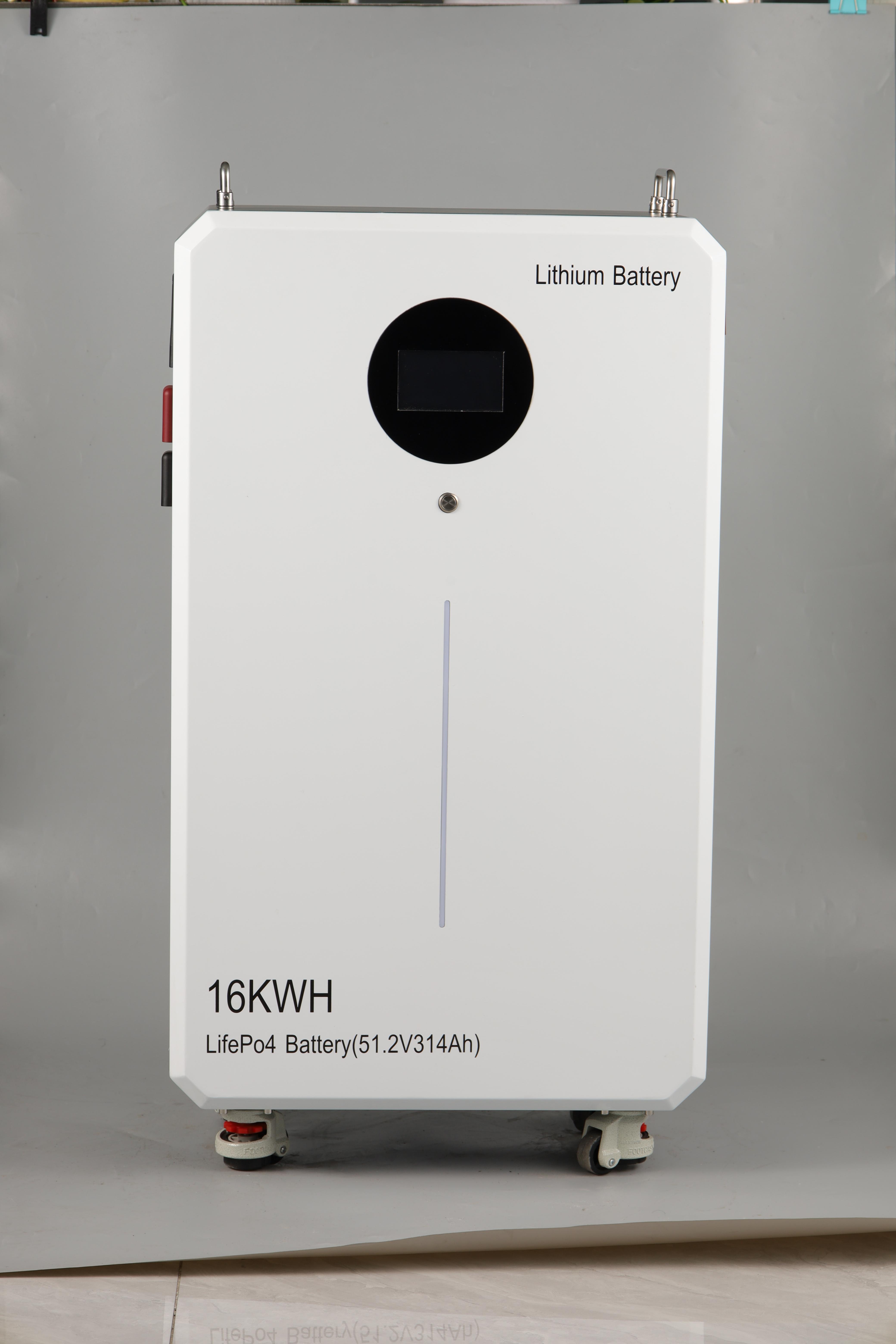
The 16 kWh tier in floor-standing form: model KJ-48280-15, 51.2 V, 16S1P, 200 A maximum continuous discharge and an LCD smart touch screen.
Reading the Table: Which Tier Fits Which Load Profile
Three readings matter more than the kWh label.
Discharge current separates the two 10 kWh products. KJ-48200-10 is rated at 150 A maximum continuous discharge; KJ48200-A is rated at 200 A at the same nominal voltage. For a household whose backup priority is lighting, refrigeration and communications, the 150 A unit is electrically adequate. For a site that expects to run high-surge loads or a small workshop from the pack, the 200 A build at the same capacity is the safer specification — and the buyer should not assume the capacity label tells them which one they are being quoted.
Weight changes the installation, not the performance. The range runs from 92.5 kg to 123 kg in net pack weight across the 10, 15 and 16 kWh tiers. Above roughly 100 kg, floor loading, doorway clearance, stair access and lifting arrangements become procurement items rather than installer improvisation. A 15 kWh cabinet is a two-person minimum lift with mechanical assistance, and the site survey should reflect that before the order is placed.
Display and monitoring are tier-specific. The KJ-48200-10 and KJ-48280-15 models carry an LCD smart touch screen for reading voltage, current, state of charge and fault information on the unit. The KJ48200-A and KJ48200-B builds do not. Where monitoring will run through the hybrid inverter or an energy management system, the absence of an on-unit screen is not a functional loss; in installations where the battery sits in a plant room away from the monitoring interface, it matters to the technician.
A practical decision rule follows from this: use the 5 kWh tier for entry packages, single-room backup and pilot orders where the smallest footprint and lowest handling burden are the priority; use the 10 kWh tier as the general residential workhorse, selecting KJ48200-A when 200 A discharge is needed and KJ-48200-10 when on-unit visibility is preferred; use the 15 kWh tier where stored energy — rather than instantaneous power — is the binding constraint; and use the 16 kWh tier when a single cabinet must deliver both the largest capacity in the series and a 200 A discharge rating with local display.
Where These Packs Are Actually Installed
KangJun Energy positions its home storage range across four project types: residential solar-plus-storage, blackout backup, off-grid homes or farms, and small-commercial backup including shops, clinics and small offices. Two operating modes are supported — a split storage system paired with a hybrid inverter, or a configuration dedicated to solar self-consumption, backup or off-grid operation.
The matched equipment list is consistent across tiers: hybrid inverter, solar panels, MPPT controller, energy management system, distribution equipment, and CAN / RS232 / RS485 communication wiring. Charging is specified between 0 °C and 45 °C for the application envelope, discharging between -10 °C and 45 °C, storage between -20 °C and 45 °C, with humidity from 5% to 95% non-condensing.
The application notes also set out what must be confirmed before a capacity tier is fixed: daily consumption, maximum simultaneous load, required backup duration, PV capacity, inverter model, communication protocol, installation space, local electrical requirements and transport documentation. Tier selection without those six inputs is a guess dressed as a specification.
For buyers who prefer an integrated architecture over a split pack, the range also includes all-in-one inverter-plus-battery systems. The KJ6.2KW-16KWH combines a 6.2 kW rated output, 12.4 kW peak, MPPT solar charging with up to 9,000 W PV input, a 20 ms transfer time, 16 kWh rated energy and 14.4 kWh usable at 90% depth of discharge, in a 129 kg cabinet rated IP21. The KJ-4.2KW-8KWH does the same at 4.2 kW rated output with 6,200 W PV input and 7.2 kWh usable energy.
Manufacturing Evidence Behind the Range
Capacity comparisons are only as reliable as the factory behind the model codes. KangJun Energy operates a 20,000 m² facility with 125 employees, including a 12-engineer R&D team, and reports an annual output of 60,000 units with 80% of production exported to Africa, Latin America, Central Asia, the Middle East, Southeast Asia and Russia.
Five production lines deliver a single-shift monthly capacity of 1,000 home storage battery packs alongside 5,000 portable power stations. Core processes cover cell sorting and matching, laser welding, BMS integration, ageing tests and final assembly, governed by a three-stage inspection system (IQC–IPQC–OQC). Each batch passes outgoing tests including full-charge ageing, high-low temperature cycling, dielectric withstand and vibration.
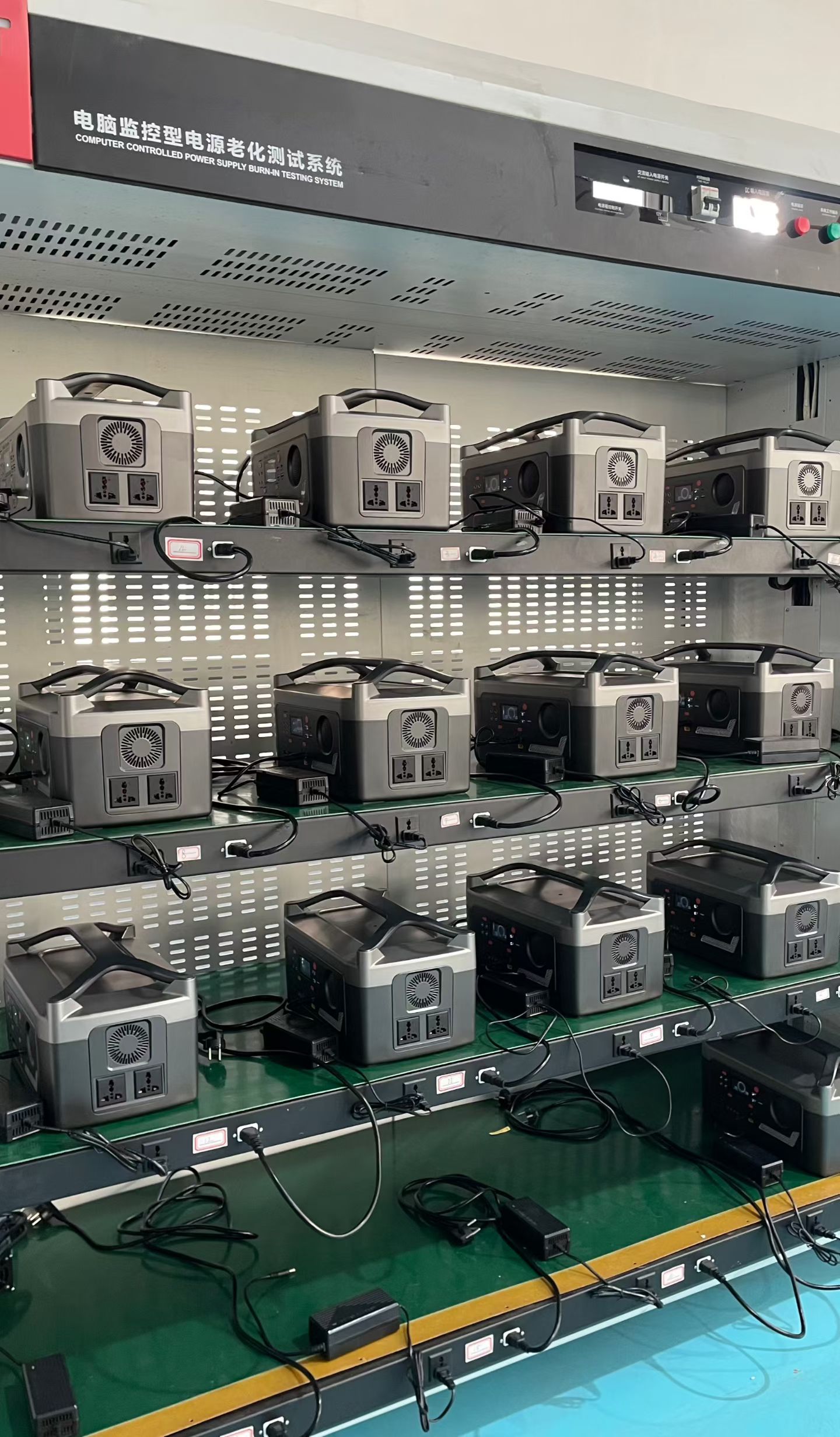
Full-charge ageing forms part of the outgoing test sequence for each production batch.
Commercially, the company operates as an OEM/ODM supplier: MOQ from 100 units, sampling in 5–7 working days, and customisation across casing printing and coating, retail packaging, firmware parameters, communication protocols and product configuration. All products carry a 5-year warranty with spare-parts supply and remote technical support within the warranty period, and the company supports destination-market conformity procedures such as SONCAP for Nigeria, SASO / SABER for Saudi Arabia, EAC for the CIS, INMETRO for Brazil and SNI for Indonesia.
Market Trends Shaping Capacity Choice
Three shifts in the residential segment are visible in how this range is structured, and none of them require a forecast to observe.
Capacity is being sold as a modular ladder rather than a single product. The existence of 5, 10, 15 and 16 kWh tiers inside one 51.2 V family, with parallel expansion available on the wider series, reflects buyers who want to enter at a low tier and scale rather than commit to a single size at the outset.
Certification has become a gate rather than a differentiator. Destination-market conformity programmes — SONCAP, SASO / SABER, EAC, INMETRO, SNI — now determine whether a container can be cleared at all. Battery-level documentation such as MSDS and UN38.3 has become baseline for export transport, and CE, RoHS and ISO references appear on lower-voltage packs in the same catalogue.
Chemistry has converged on LiFePO4 for stationary storage. Thermal stability and long cycle life are the stated reasons, and the trade-off — lower energy density than NMC — matters less in a floor-standing cabinet than in a vehicle. Buyers comparing tiers should therefore treat LiFePO4 as a given and compete on parameters that actually differ.
LiFePO4 Versus Traditional Lead-Acid Storage — and the Limits of This Range
Against flooded or sealed lead-acid banks, LiFePO4 changes the operating model in four ways: no memory effect, so partial charging does not degrade capacity; low self-discharge, which matters for seasonal or standby installations; higher usable energy per unit of volume and mass; and a BMS that actively protects against over-voltage, over-current, over-charge, over-discharge, short circuit, reverse charging and temperature excursions. The trade-off is familiar and should be stated plainly: lithium chemistries carry a higher initial capital outlay than lead-acid for the same nominal capacity, and the advantage materialises over the service life rather than at the invoice.
The boundaries of this specific range are equally concrete and should be checked before any tier is specified:
- Charging below 0 °C is outside the stated window. The 10 kWh KJ-48200-10 and 16 kWh KJ-48280-15 models are specified for charging between 0 °C and 45 °C, and the KJ48200-A and KJ48200-B builds between 0 °C and 55 °C. Cold-climate sites need charge management or a temperature-controlled enclosure; the discharge window of -20 °C to 60 °C does not extend the charging window.
- Enclosure rating is not published for the floor-standing cabinets. The supplied specification set lists IP21 for the all-in-one systems and IP20 for the 25.6 V battery series, but does not state an IP rating for the 10, 15 and 16 kWh floor-standing packs. A buyer planning a humid, dusty or semi-exposed plant room should confirm the enclosure protection with the factory rather than assume it.
- Some tiers carry no on-unit display. KJ48200-A and KJ48200-B provide no screen; monitoring depends on the inverter or energy management system.
- OEM customisation excludes the safety-critical parts. Casing printing, packaging, firmware, protocols and configuration are open to modification; cell type and structural safety components are not, which limits differentiation on the core electrochemical design.
- The 5 kWh tier is not covered by the published parameter set. Buyers evaluating KJ-48100-5 against the larger tiers need the model datasheet before comparing current ratings or dimensions.
- The commercial model is programme-based. OEM/ODM orders start at 100 units, so this range is structured for brand owners, distributors, installers and project procurement teams rather than single-unit retail buyers.
A Procurement Checklist for Capacity-Tier Decisions
Five checks separate a defensible tier decision from a capacity guess.
- Convert the requirement to usable energy. Size backup against usable capacity, not nameplate. The all-in-one 16 kWh system's 14.4 kWh at 90% depth of discharge is the reference point in this range.
- Check the current rating, not only the kWh figure. A 150 A and a 200 A pack at the same nominal voltage serve different load profiles.
- Confirm inverter compatibility and protocol. CAN / RS232 / RS485 on the battery must match the hybrid inverter; the company lists Deye, Growatt, Victron and Sunsynk among compatible platforms.
- Verify installation conditions. Cabinet mass from 92.5 kg to 123 kg, floor loading, access route, ambient temperature range and enclosure rating all belong in the site survey.
- Confirm documentation and conformity support. Request MSDS and UN38.3 for transport, and confirm which destination-market programmes — SONCAP, SASO / SABER, EAC, INMETRO or SNI — apply to the shipment.
Future Outlook
The 51.2 V LiFePO4 tier structure is likely to hold, because it maps onto the inverter platforms that dominate residential retrofit and new-build projects. What is more likely to change is how tiers are differentiated: buyers are increasingly evaluating packs on discharge current, monitoring capability, thermal windows and enclosure protection rather than on kWh alone, and the models that publish those parameters clearly will be easier to specify.
Two further directions follow from the structure of this range. Integration is moving toward all-in-one systems that combine inverter, MPPT and battery in a single cabinet, which simplifies installation but concentrates the specification decision. And market access is moving toward documentation: conformity support is becoming a supplier selection criterion rather than an afterthought, which favours manufacturers that can evidence testing and certification for each destination market.
For procurement teams, the practical implication is that the capacity tier question should be answered with usable energy and discharge current, then validated against installation conditions and documentation. The manufacturer shortlist follows from that analysis, not the reverse.
FAQ: Capacity Tiers, Compatibility and Lifetime
What is a LiFePO4 home energy storage battery?
A LiFePO4 battery is a rechargeable lithium-ion battery that uses lithium iron phosphate as its cathode material. In a residential system, it stores surplus solar energy for evening consumption, carries critical loads during outages and provides energy buffering for off-grid installations. During charging, lithium ions move from the cathode to the anode; during discharging they return, releasing energy to the connected loads.
How do I estimate the battery capacity a household needs?
List the devices that will run at the same time, check each device's rated power in watts, total them, and multiply by the number of hours the load must be supported to obtain an energy requirement in watt-hours. Then allow for conversion losses, usable battery capacity and operating conditions, because the estimated requirement is not equal to the rated capacity of the pack. Equipment with motors or compressors also has starting power that must fall within the system's output capability.
Does a 51.2 V LiFePO4 battery work with common hybrid inverters?
Compatibility depends on voltage class and communication protocol rather than on brand alone. The KangJun Energy residential battery models operate at 51.2 V nominal and provide CAN / RS232 / RS485 communication, and the company lists compatibility with mainstream hybrid inverters including Deye, Growatt, Victron and Sunsynk. The specific inverter model and firmware should still be confirmed against the battery's protocol list before ordering.
What is the difference between wall-mounted, stackable and floor-standing home batteries?
The three formats describe how the pack is physically supported and expanded. Wall-mounted units save floor space and suit smaller capacities; stackable units allow capacity to be built up in modules; floor-standing cabinets such as the 10, 15 and 16 kWh models in this range house the full pack in a single vertical enclosure, which simplifies wiring but raises unit weight to between 92.5 kg and 123 kg net for these models.
How does a battery management system affect safety in these packs?
A BMS monitors cell voltage, current and temperature, and triggers protection when conditions fall outside the design limits — overcharge, over-discharge, over-current, short circuit and abnormal temperature. It also balances cells to keep voltages consistent. On the KangJun Energy home battery models, the BMS is integrated into the pack, and the optional LCD touch screen on the KJ-48200-10 and KJ-48280-15 exposes operating data for inspection.
How long can a LiFePO4 home battery be expected to last?
LiFePO4 cells generally offer long cycle life because their olivine crystal structure resists degradation during repeated charging and discharging. Actual service life depends on operating temperature, charge and discharge rates, depth of discharge, BMS protection and usage conditions. KangJun Energy provides a 5-year warranty with spare-parts supply and remote technical support; for reference, the separate 12.8 V series in the same catalogue is specified at more than 2,000 charge-discharge cycles.
Reference document: the KangJun Energy residential storage catalogue, including the 5–20 kWh LiFePO4 home battery range and all-in-one systems, is available as a PDF download.
Есть вопросы или нужны дополнительные детали?
Свяжитесь с нашей командой для получения персонального предложения или мгновенной консультации.
Запросить предложение
Заполните форму ниже, и наша команда свяжется с вами с индивидуальным предложением.
Прямой чат WhatsApp
Предпочитаете общаться в реальном времени? Напишите нам в WhatsApp для мгновенной помощи и быстрых ответов.
- Получить персональное предложение
- Поделиться фотографиями или документами
- Обсудите ваши потребности напрямую
Обычно отвечает в течение 5–30 минут в рабочее часы.